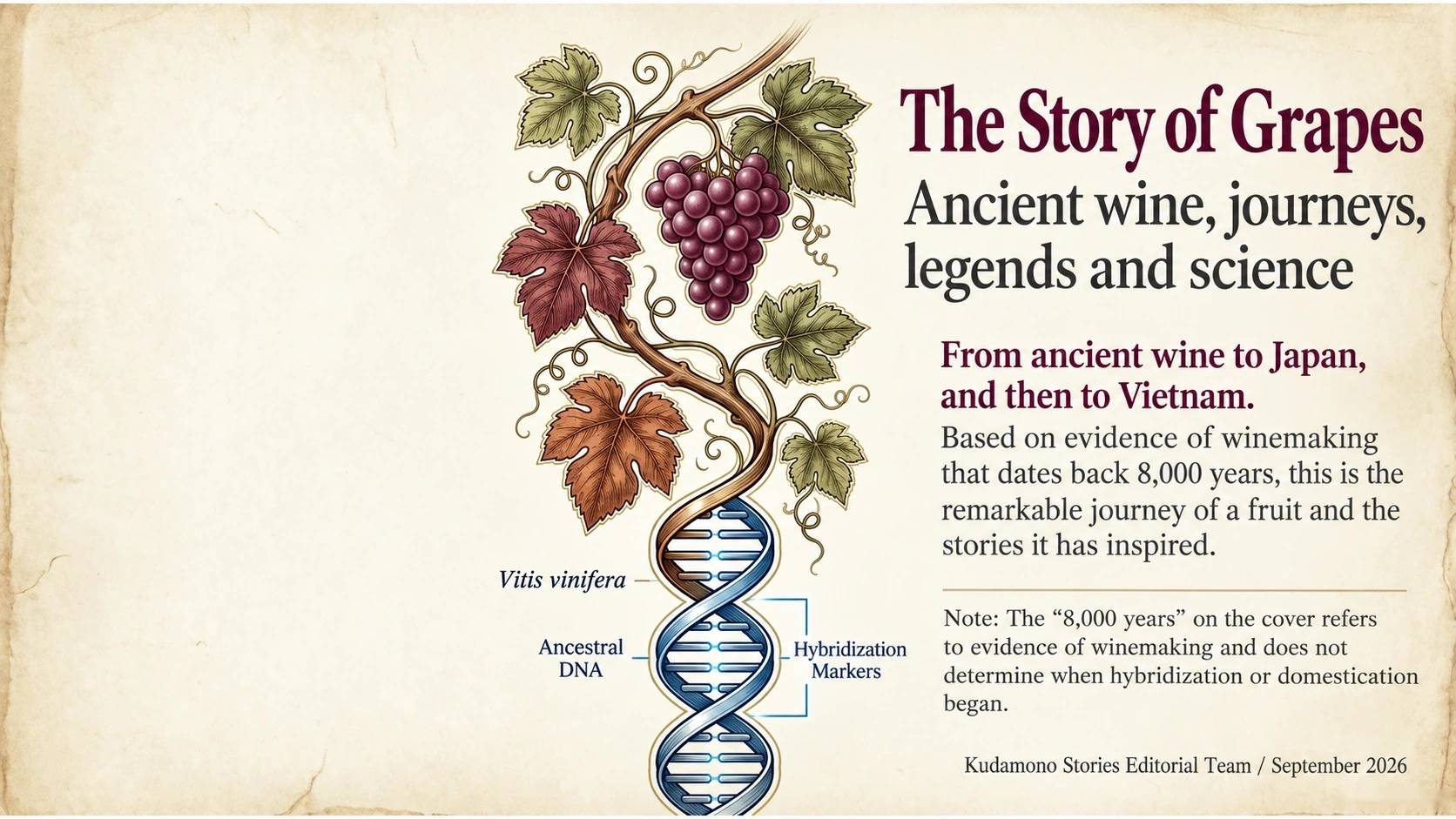
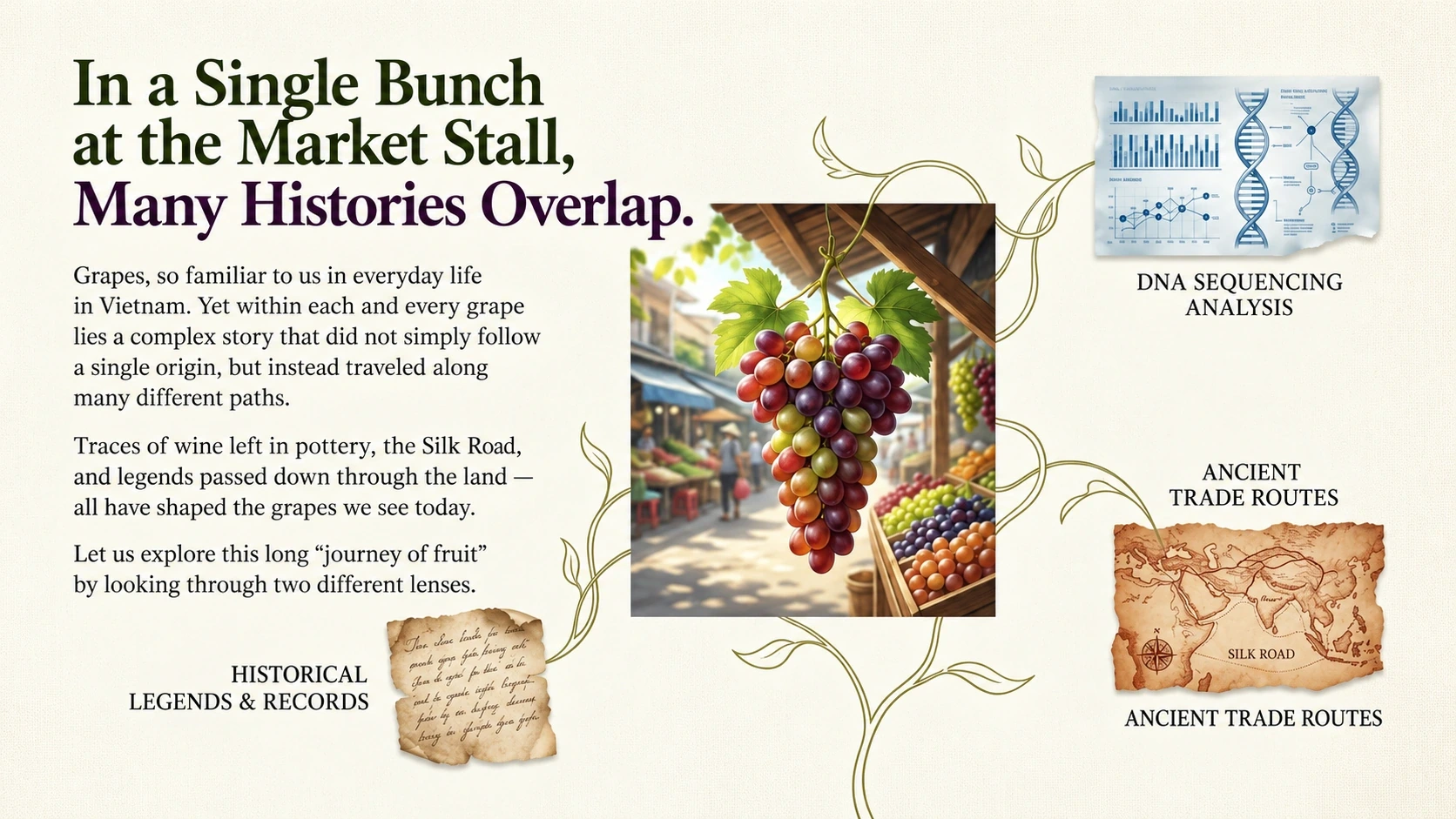
The long history of grapes includes traces of wine preserved in pottery, growing techniques carried by travelers, and legends rooted in particular places. Even a bunch on a Vietnamese market stall can invite us to imagine that journey.
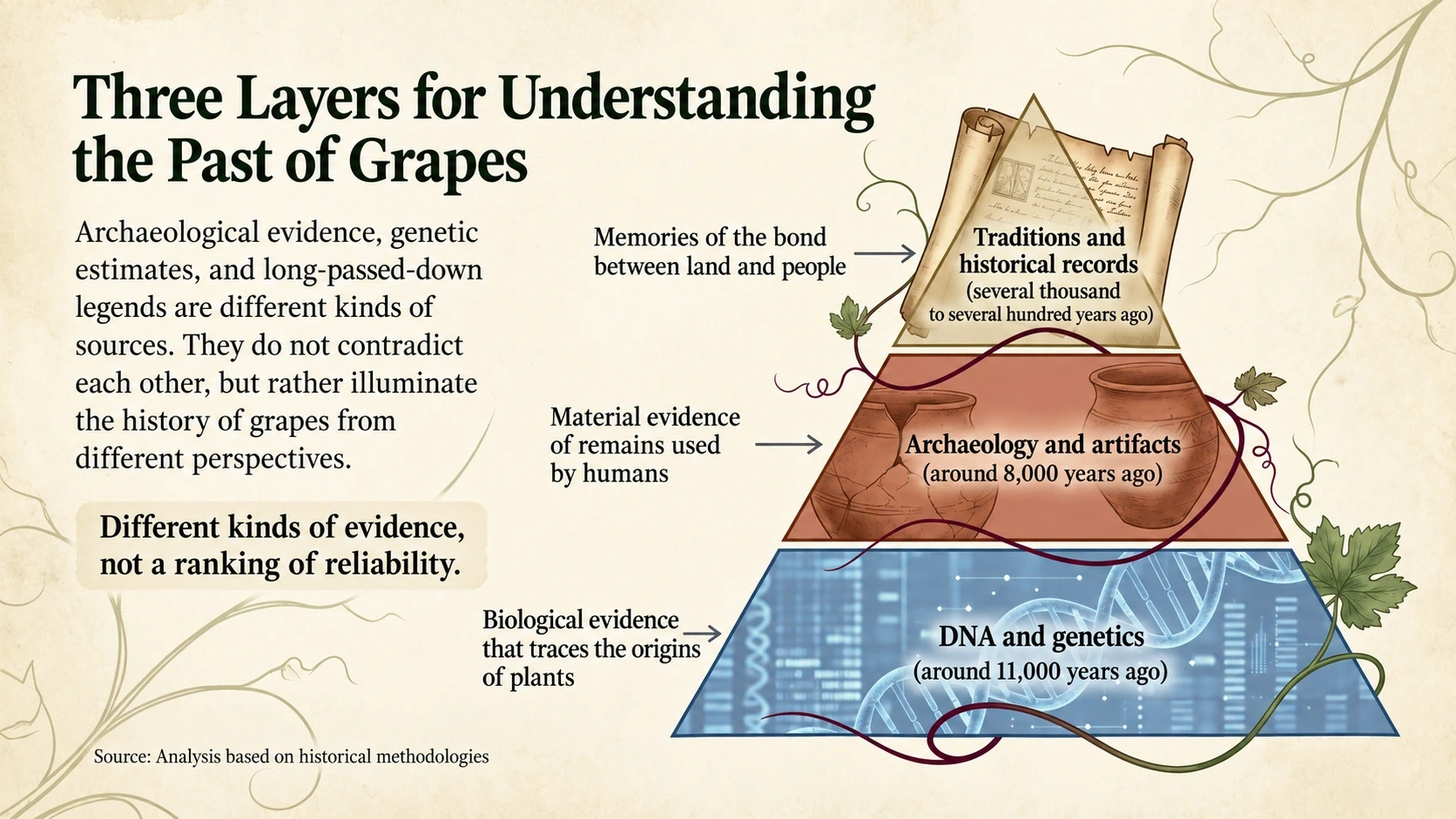
Yet evidence that people made wine about 8,000 years ago is not the same as evidence that grape cultivation began then. To follow grapes from the ancient Caucasus to Japan and Vietnam, we need to distinguish archaeological findings, genetic estimates, and stories passed down through generations.
Wine 8,000 years ago: what Georgian pottery tells us
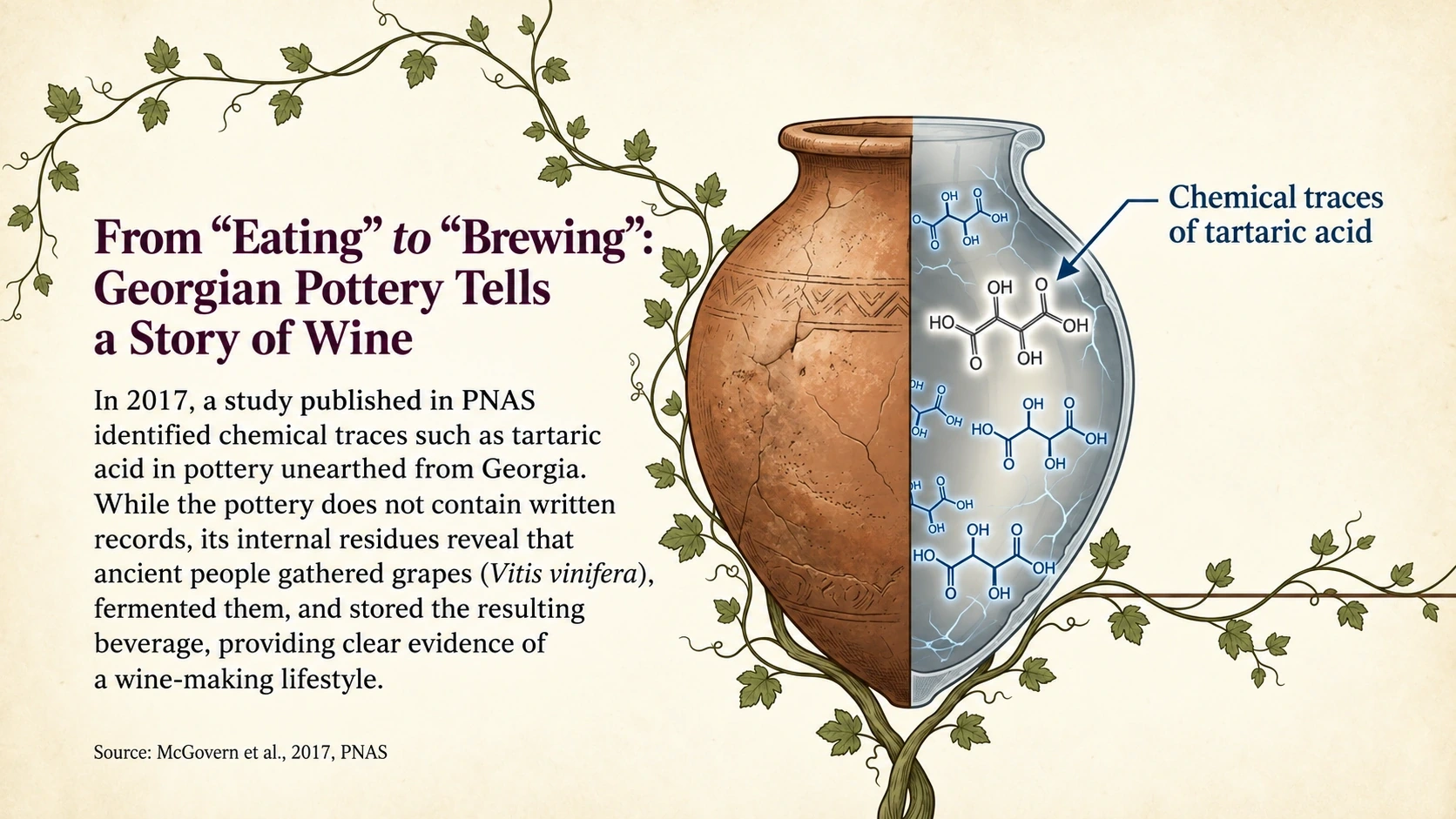
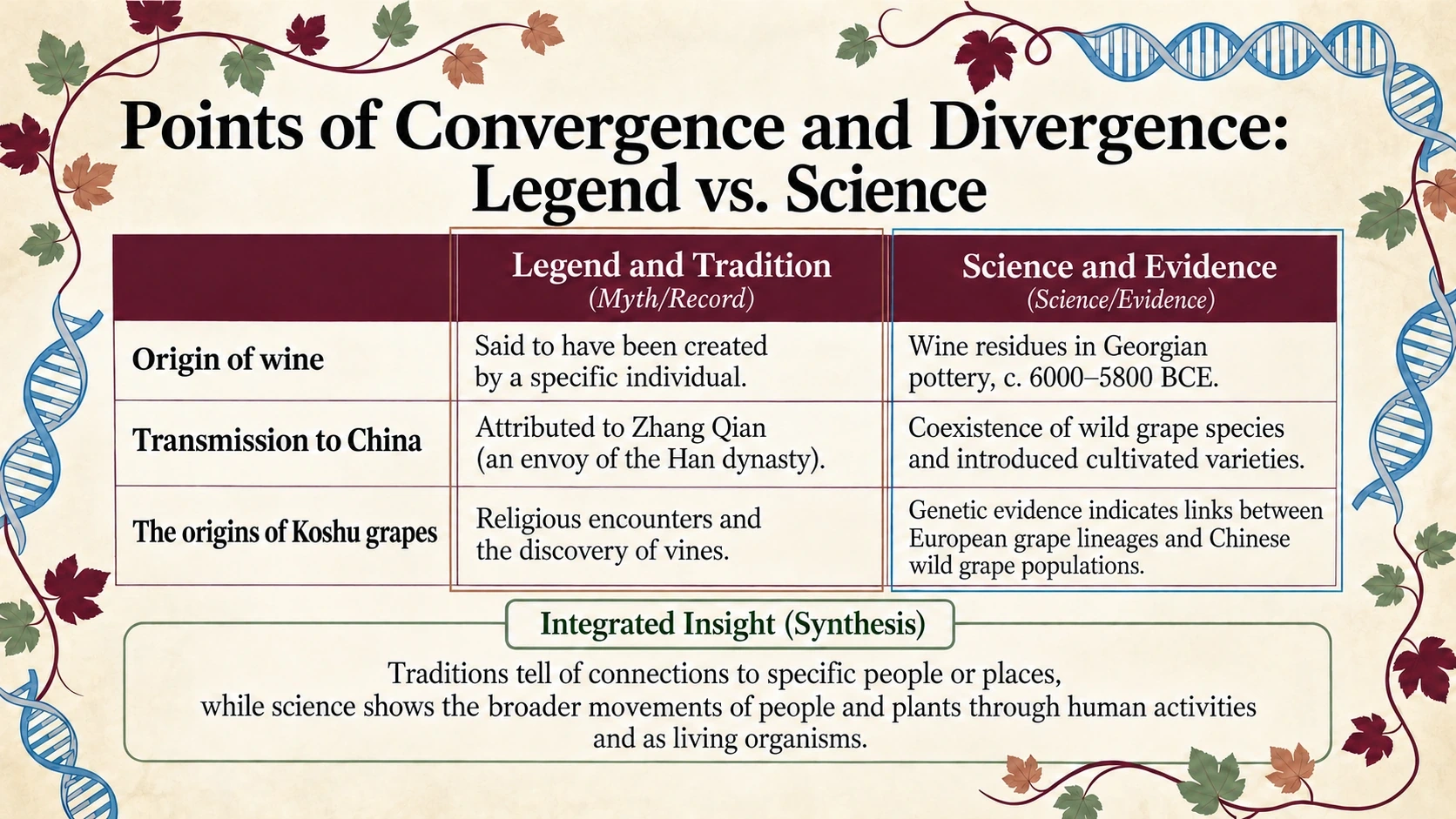
In 2017, researchers published an analysis of pottery from Neolithic sites in Georgia. They identified chemical traces associated with grape wine, including tartaric acid. The vessels dated to around 6000–5800 BCE, approximately 8,000 years ago.
The study offers important evidence that ancient people fermented grapes and used them as a drink. However, some of the earliest surviving evidence does not necessarily mark the very first occasion on which wine was made. McGovern et al., PNAS, 2017
The pots preserve no spoken accounts from their makers. Even so, residues on their inner surfaces offer a glimpse of people gathering, fermenting, and storing grapes. This fruit’s story is closely tied to making drinks as well as eating fresh fruit.
When were grapes domesticated? A different genetic timeline
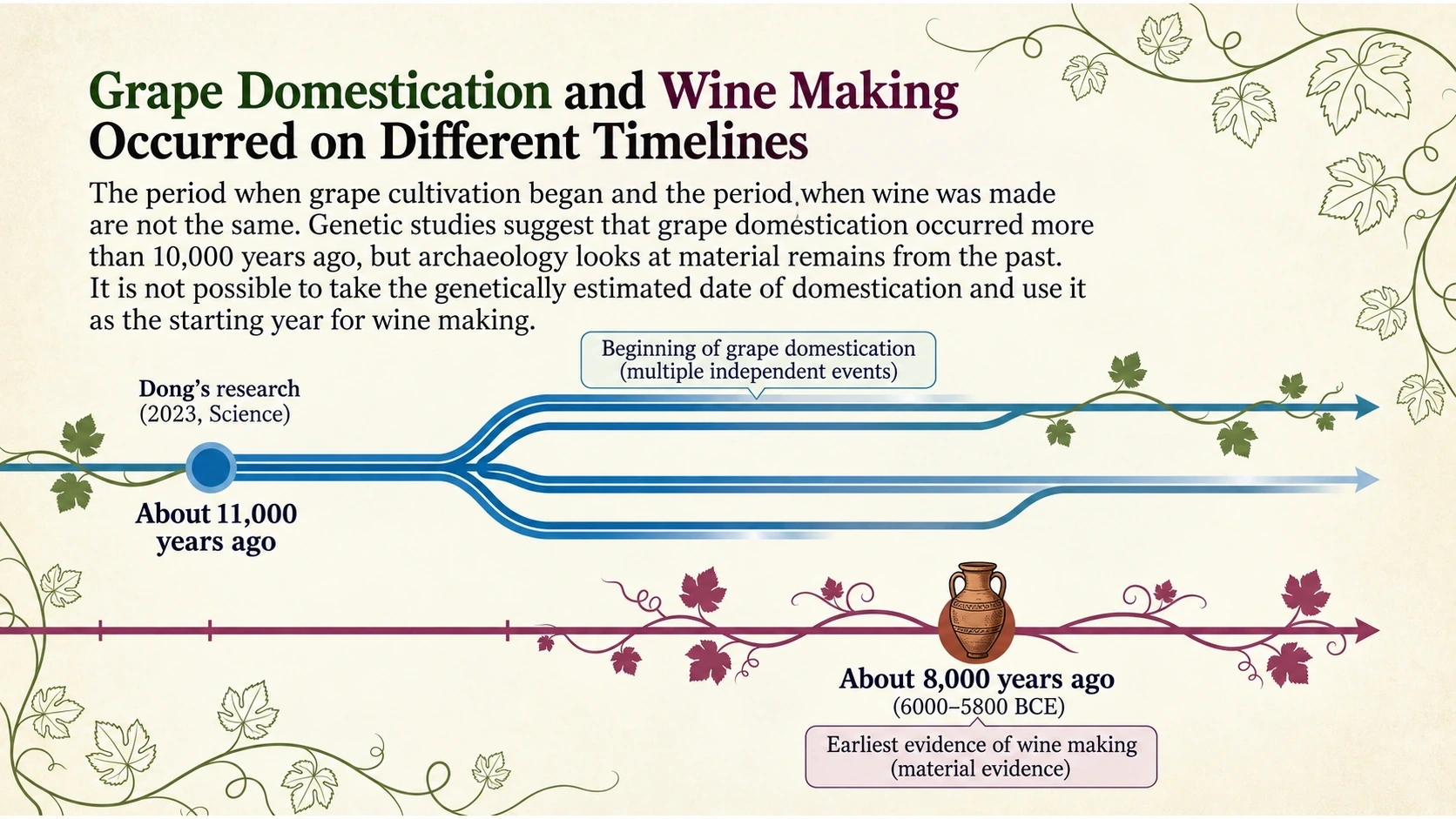
A large genomic study published in Science in 2023 estimated that domestication proceeded in parallel in Western Asia and the Caucasus around 11,000 years ago. Its findings suggest a more complex history than a single beginning in one part of the Caucasus. Dong et al., 2023
Archaeology investigates the past through surviving objects such as pottery and seeds. Genetics infers ancestry from differences in DNA passed down to the present. These approaches illuminate history in different ways: an estimated date for domestication cannot simply be treated as the date winemaking began.
Eastward along the Silk Road to China
Accounts of the eastward spread of grapes often mention Zhang Qian, an envoy of the Western Han dynasty. Sent to the Western Regions in the second century BCE, he returned from his long travels with information about lands to the west.
His journeys and the exchanges that followed are associated with the introduction of cultivated grapes of European grape ancestry into China’s Central Plains. Accounts also describe western grapes being brought in during Emperor Wu’s reign and grown around the imperial palace. China News Service’s account of grape introductions (in Chinese)
This does not mean that China had no plants of the grape genus before then. The use of wild grapes and the introduction of cultivated varieties from the west are different matters. Rather than imagining that one traveler started everything, it is more useful to see varieties and growing knowledge moving along networks of people and goods.
Two origin legends of Japan’s Koshu grape
Two different origin legends surround Koshu, a traditional Japanese grape variety.
Gyoki and the Medicine Buddha holding grapes
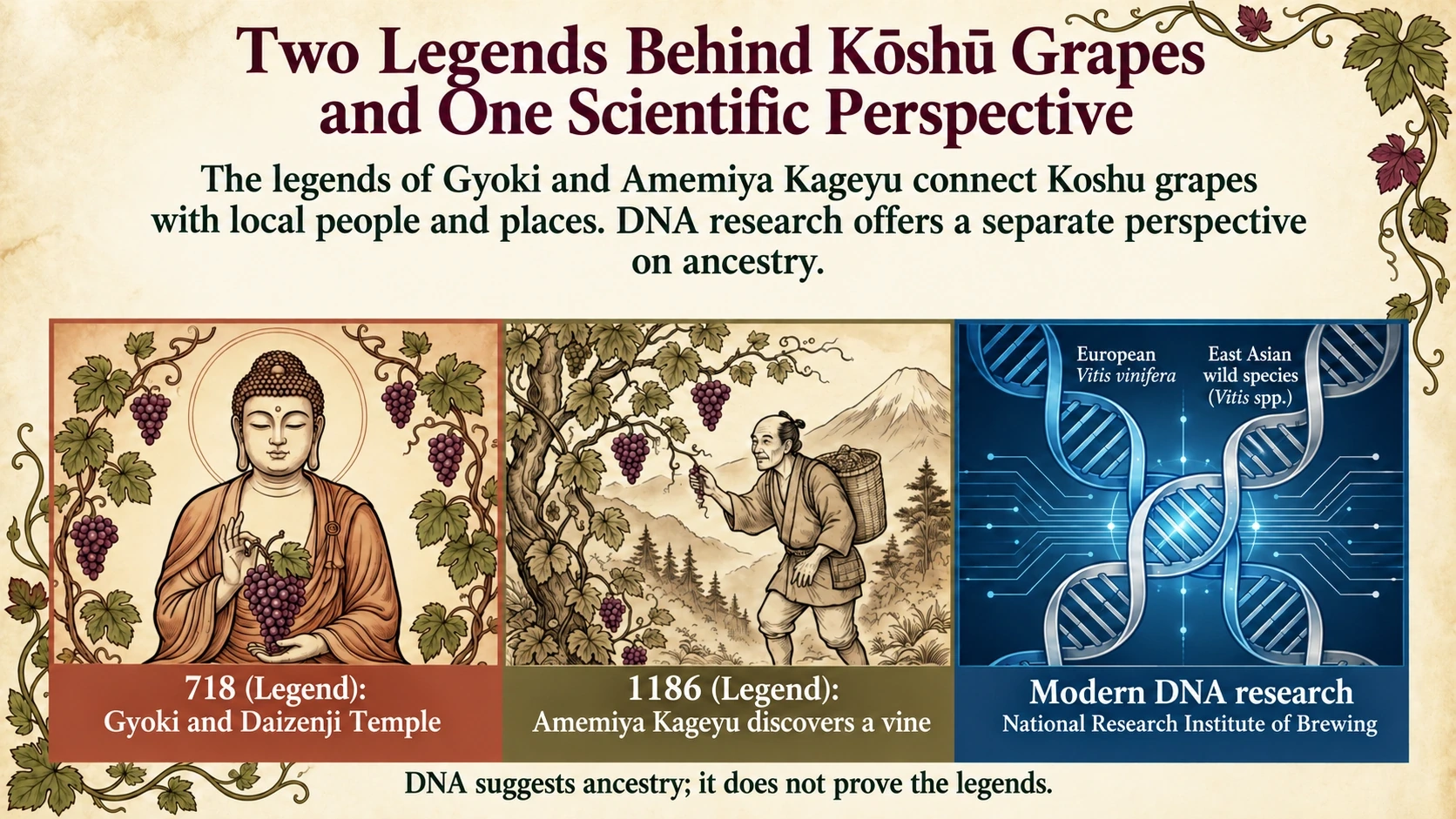
One legend is set in 718, during Japan’s Nara period. It tells of the monk Gyoki encountering Yakushi Nyorai, the Medicine Buddha, holding grapes while he was engaged in religious practice. This encounter is said to have inspired him to introduce grape cultivation. The story is associated with Daizenji Temple in Katsunuma.
The vine discovered by Amemiya Kageyu
The other legend tells of Amemiya Kageyu finding an unfamiliar vine in 1186, taking it home, and growing it. Unlike Gyoki’s religious encounter, this account begins with the discovery of a plant in the local landscape.
These traditions express the bond between Koshu grapes and their home region. They should not be treated as records establishing the exact year grapes arrived in Japan or cultivation began. Koshu City: history of Koshu grapes (in Japanese)
What DNA reveals about Koshu’s ancestry
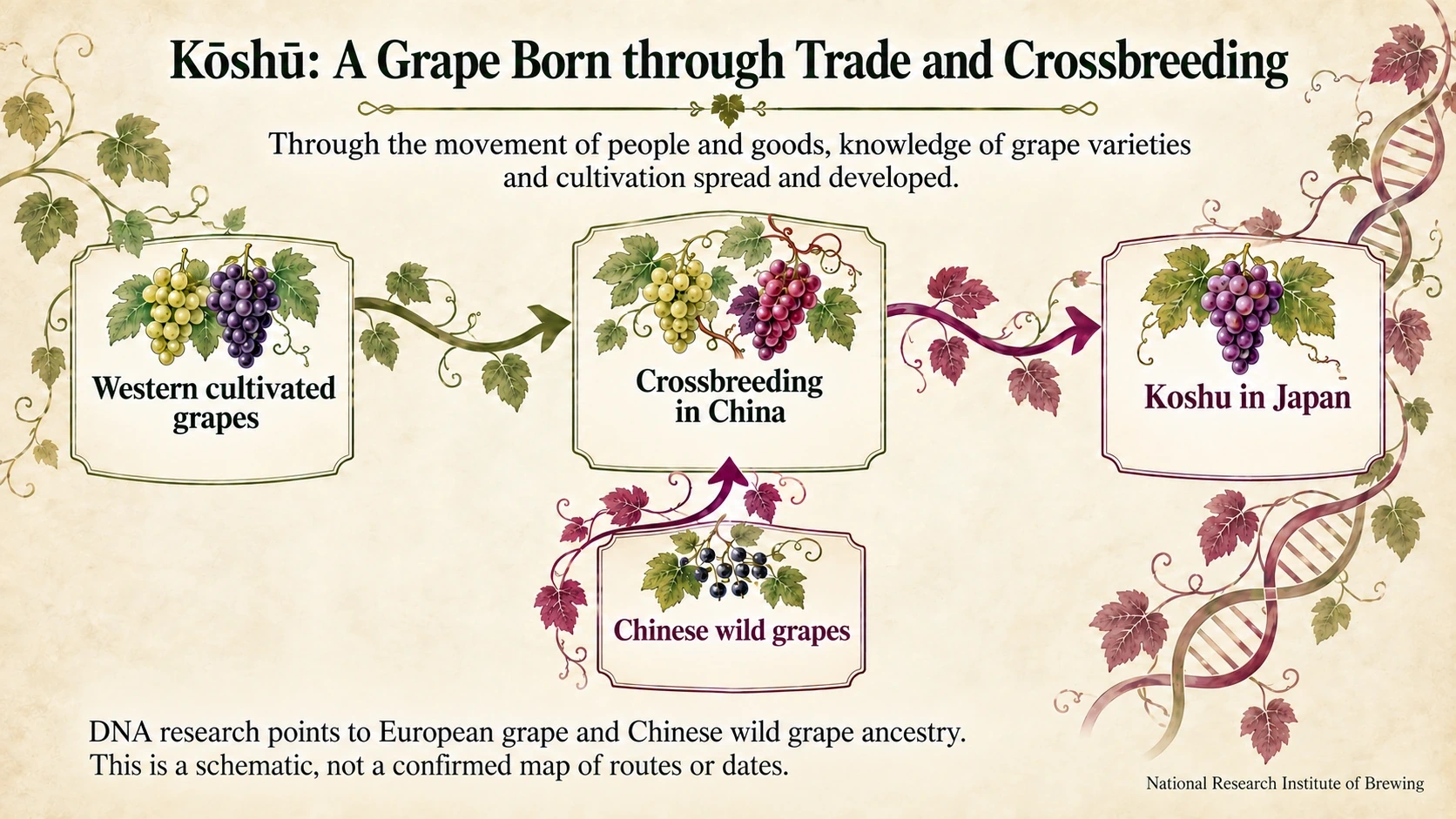
Science has added another perspective to Koshu’s origins. DNA analysis by Japan’s National Research Institute of Brewing found that Koshu has a large component of European grape ancestry, along with ancestry from a wild Chinese grape.
The institute explains that Koshu’s European grape ancestors are thought to have crossed with a wild species in China, undergone further crossing, and eventually reached Japan. National Research Institute of Brewing research overview (in Japanese)
These findings help us understand a history of movement and hybridization. They do not scientifically prove the stories of Gyoki or Amemiya Kageyu. While legends preserve community memories, DNA offers a different view of a plant’s ancestry.
Phylloxera: the pest that devastated European vineyards
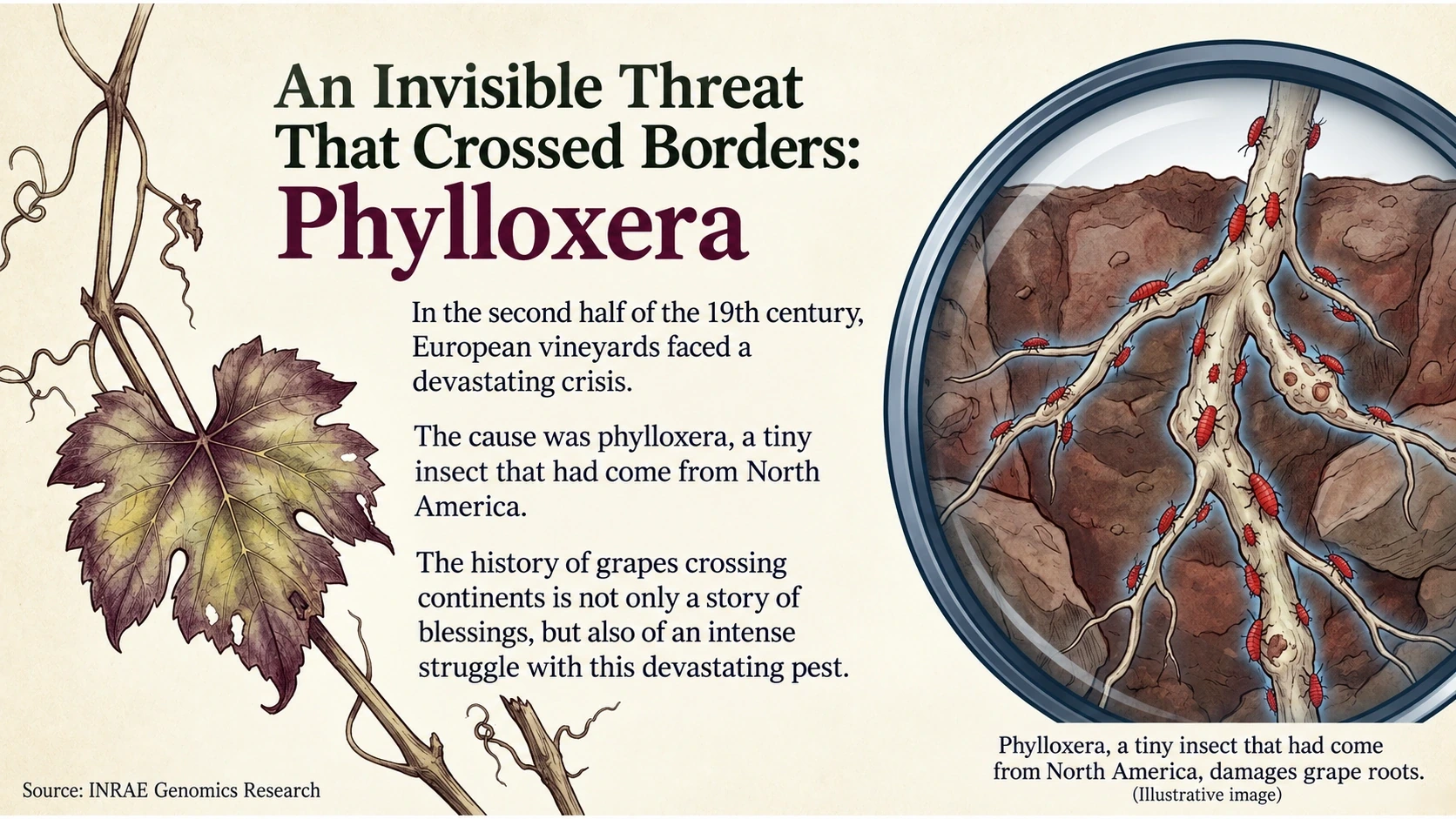
In the second half of the nineteenth century, European grape growing faced a major crisis. One of its causes was phylloxera, a tiny insect originating in North America.
As this root-damaging pest spread, many vineyards suffered severe losses. Researchers at France’s INRAE have used genomic analysis to investigate the ancestry of the phylloxera that invaded Europe. INRAE’s research overview
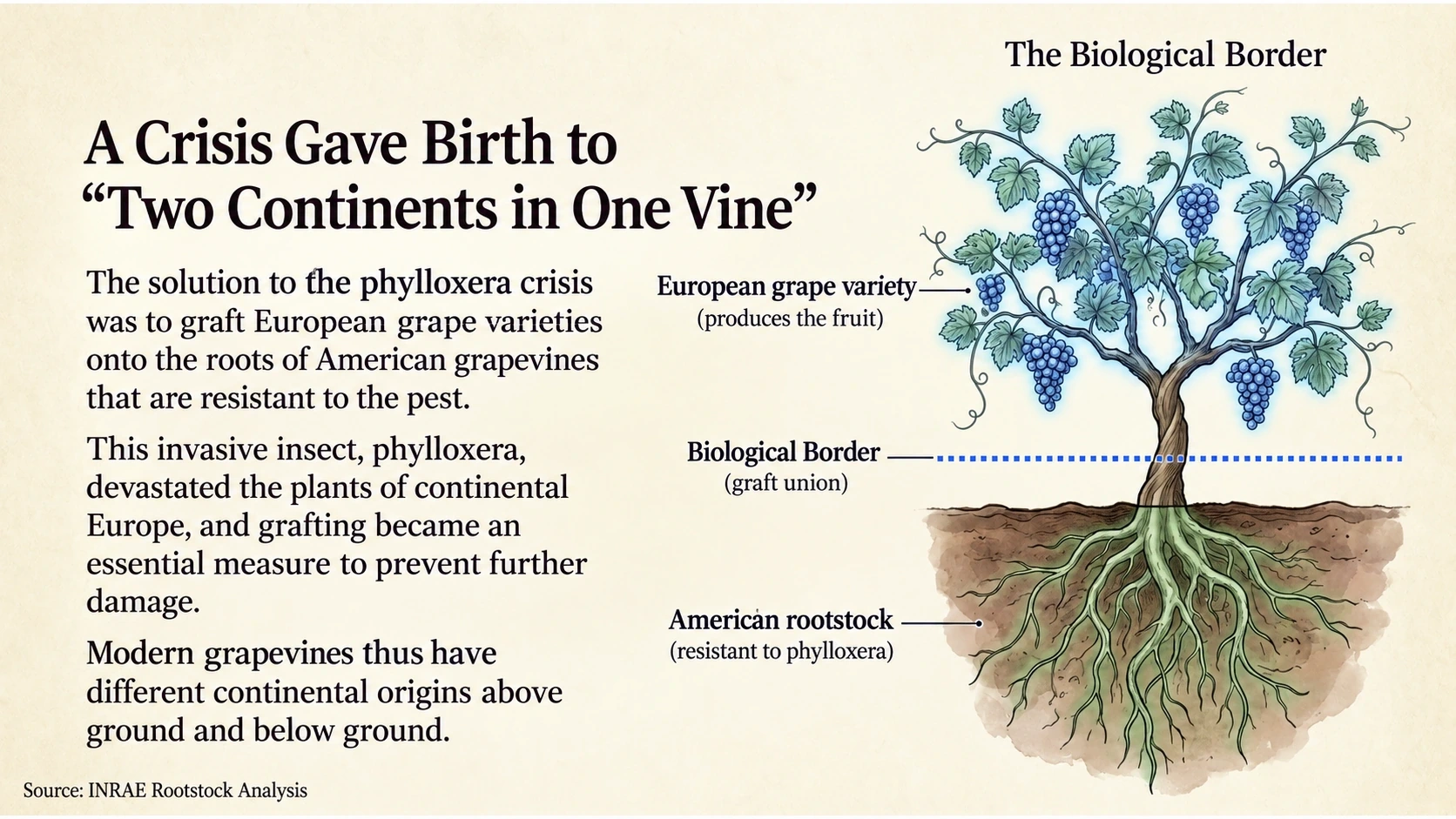
A widely adopted response was to graft European grape varieties onto resistant American grape rootstocks. The fruit-bearing part of the vine and the roots supporting it could thus have different origins. INRAE’s explanation of grapevine rootstocks
Grapes from the continent where the pest originated also helped growers limit its damage. The movement of grapes across borders has brought benefits, but it has also been a history of confronting pests and diseases.
Vietnam: a new chapter in Ninh Thuan
In Vietnam, the Ninh Thuan region is known for grape growing. The former province was merged into Khanh Hoa in the 2025 administrative reorganization, but Ninh Thuan remains a familiar name for the growing area. Vietnamese government’s information on the reorganization (in Vietnamese)
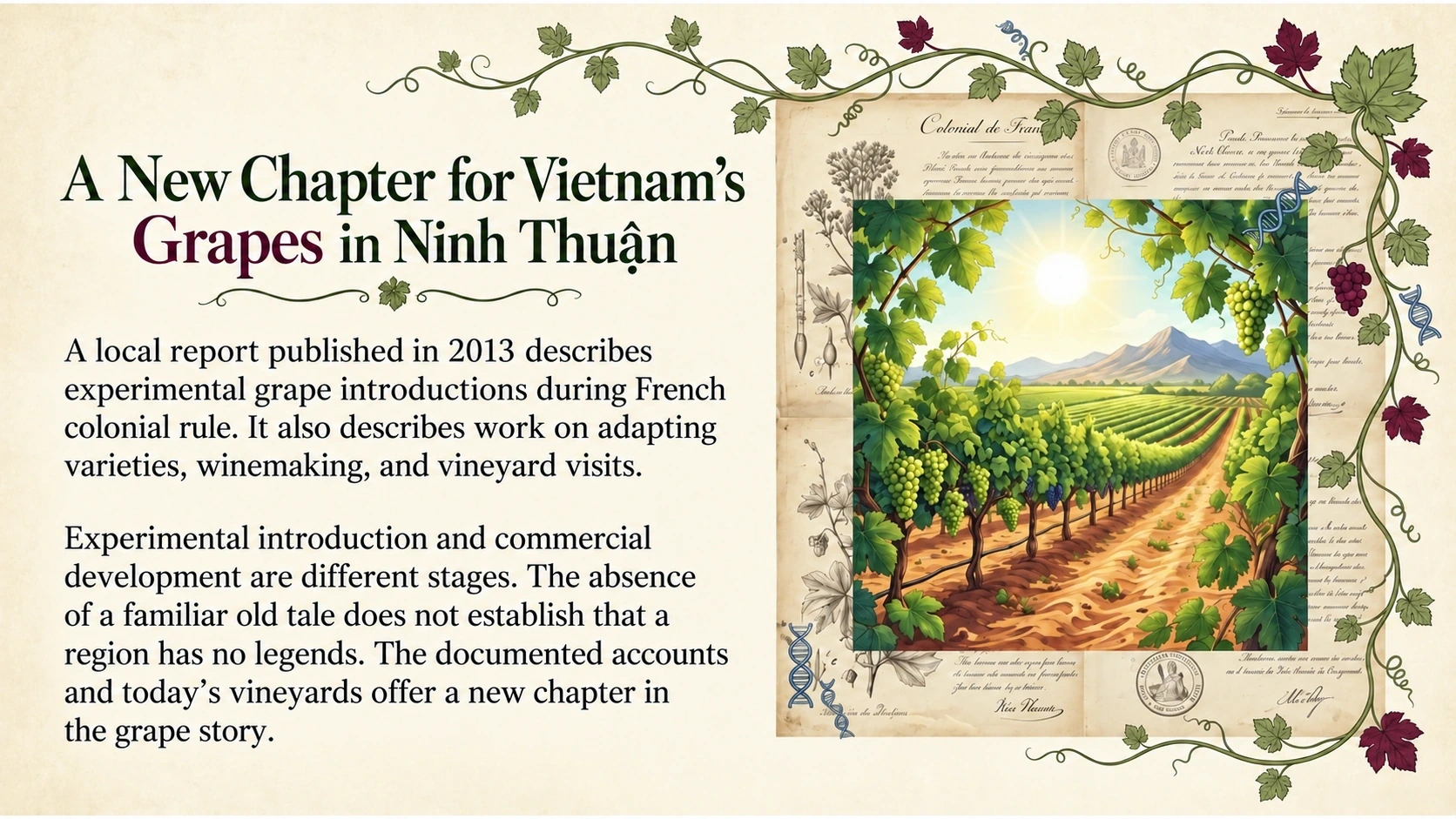
A local report published in 2013 describes experimental grape introductions during French colonial rule. It also describes growers testing varieties for local suitability and developing winemaking and vineyard visits. A report from Ninh Thuan vineyards (in Vietnamese)
This does not justify fixing the beginning at “100 years ago” regardless of when the article is read. Nor does the absence of a familiar old tale justify claiming that a place has no legends because its grape-growing history is short. The documented accounts of introduction and the development of today’s vineyards already make an interesting story.
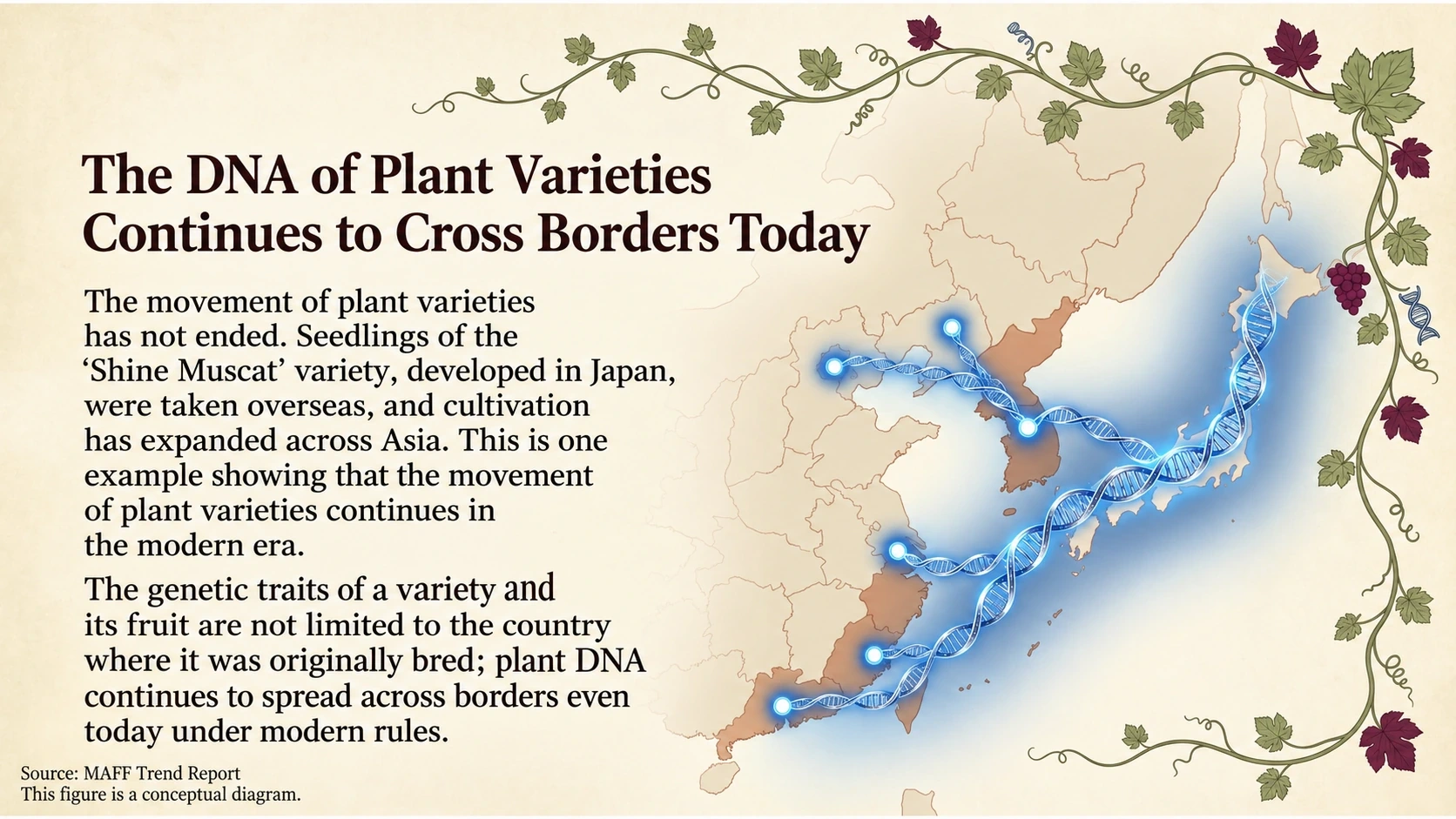
Varieties still cross borders today. Japan’s Ministry of Agriculture, Forestry and Fisheries has reported the overseas spread of Shine Muscat planting material and the expansion of cultivation and distribution in China and South Korea. However, a variety developed in Japan is not the same thing as fruit grown in Japan, and fruit should not be called counterfeit merely because it was grown abroad. MAFF’s report (in Japanese)
Many histories behind a single bunch
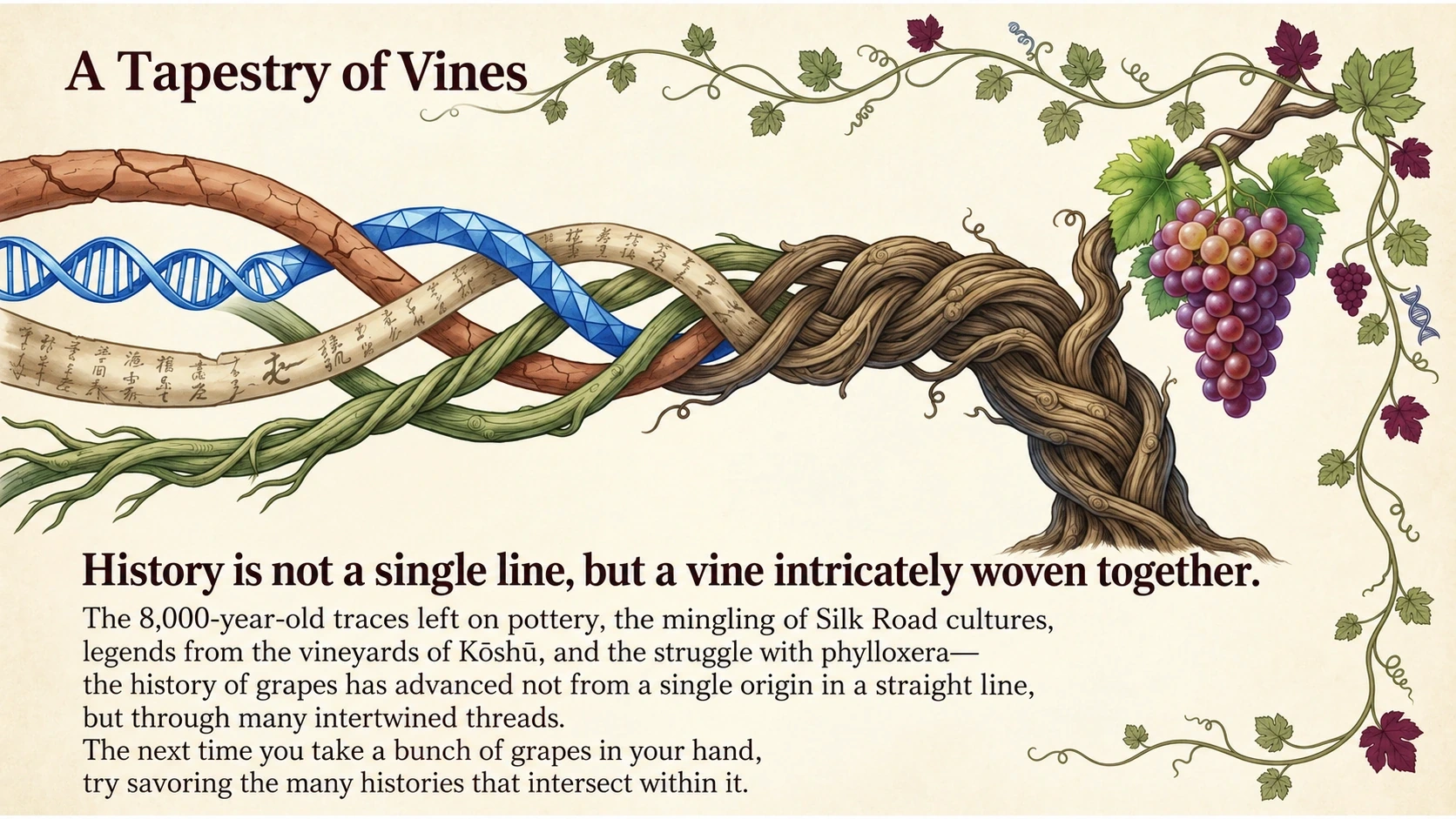
Wine residues in pottery, exchanges along the Silk Road, Koshu’s legends, and grafting techniques used to protect vineyards: grapes carry several overlapping histories. Their story cannot be reduced to a straight line from one single beginning.
The grapes growing in Ninh Thuan are another chapter in that long story. The next time you pick up a bunch in Vietnam, its variety and place of origin may be as interesting as its taste.