The History and Stories of Milk Fruit
Updated
Milk fruit carries stories that reach beyond its flavor and appearance into people’s daily lives and memories. Its Vietnamese name, Vú sữa, and a folktale about a mother and her son reveal some of the feelings people have attached to this fruit.
This article follows its origins, the meanings of its names in different places and its spread into Asia. It also introduces a Vietnamese folktale and the recorded story of a seedling sent from southern to northern Vietnam in 1954.
Here are the five things you will learn:
- The origins of milk fruit and its scientific name
- Why names in different regions evoke milk or motherhood
- Its spread from the Caribbean region into Asia
- A Vietnamese folktale about a mother and her son
- The history of a seedling carried from southern to northern Vietnam
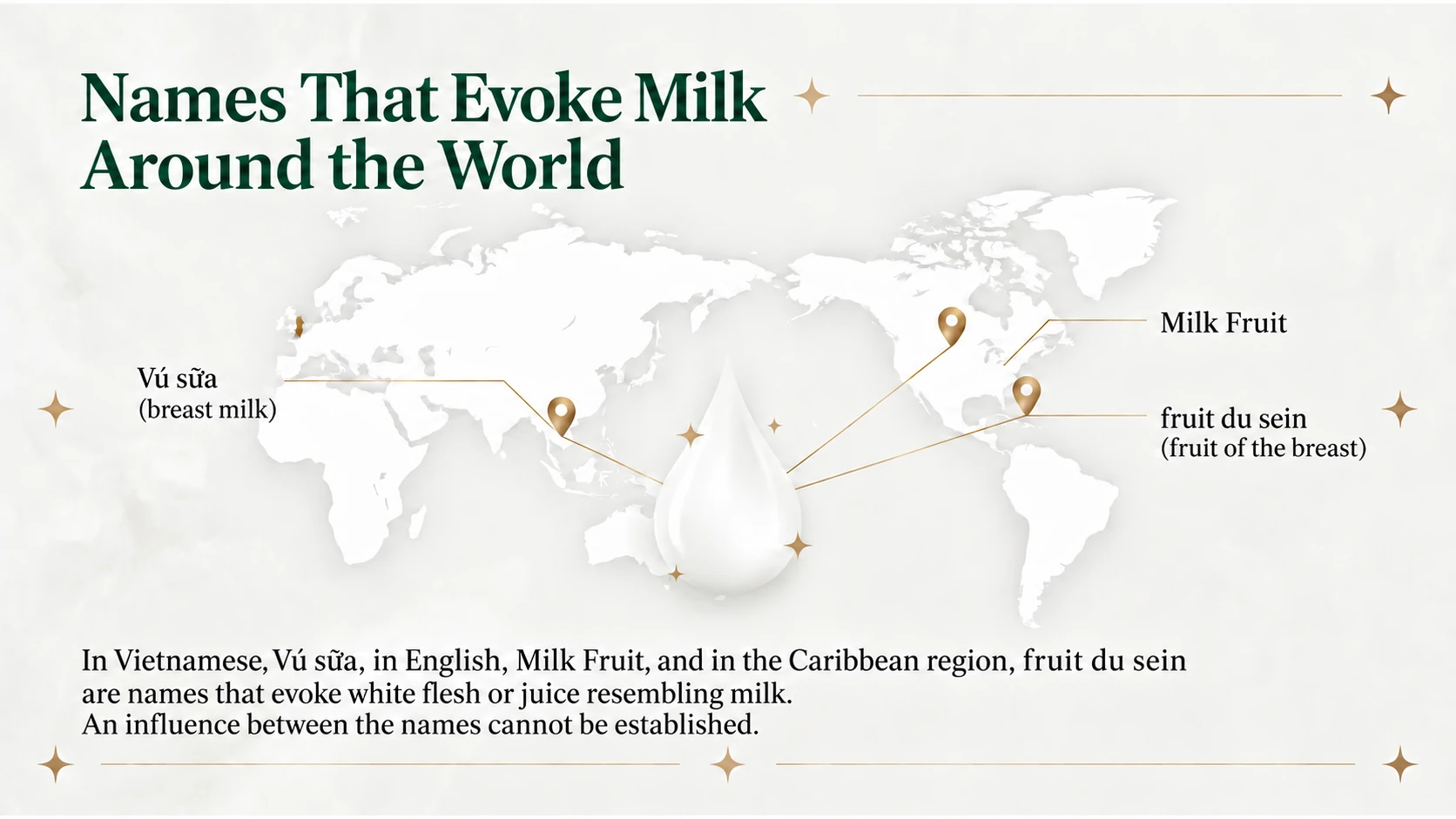
The same fruit can acquire different names in different places. For milk fruit, names in several languages liken its white flesh or juice to milk.
Exactly how every name developed and spread cannot be fully established. The meanings of names, research into origins, folktales and recorded events offer different ways to follow its story.
The Vietnamese Vú sữa and the English milk fruit both evoke milk. The sight of the white flesh may help explain how the fruit’s names and stories came to overlap.
Milk fruit’s origins and genetic research pointing to Panama
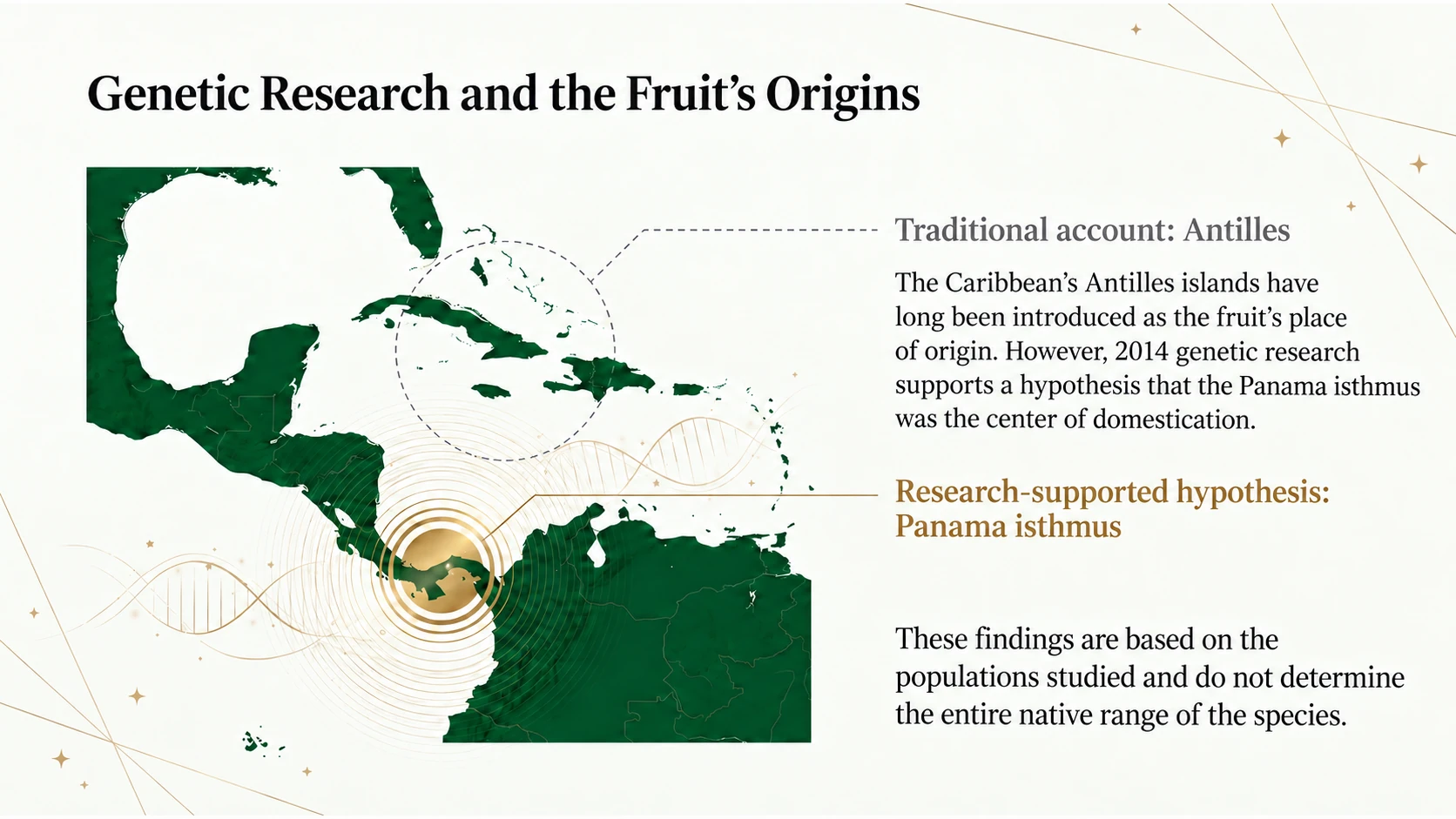
Milk fruit was long thought to have originated in the Caribbean’s Antilles. A genetic study published in 2014, however, supports the hypothesis that the Isthmus of Panama was a center of its domestication.
The findings concern the populations studied; they do not settle every aspect of the fruit’s native range.
For the tree’s characteristics and varieties, see the Milk Fruit Guide.
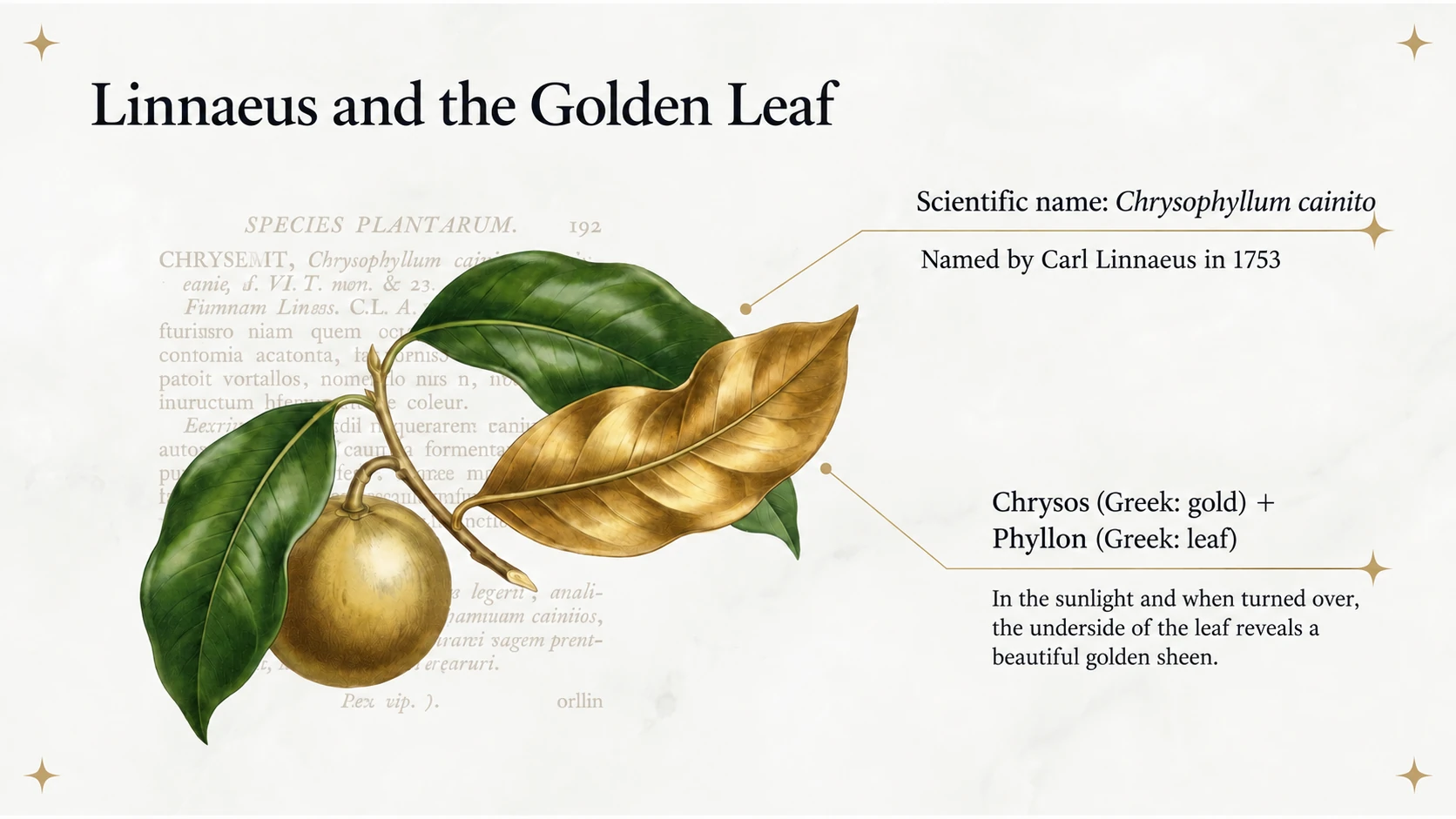
The scientific name and Linnaeus’s golden leaf
In 1753, the Swedish naturalist Carl Linnaeus recorded the fruit’s scientific name, Chrysophyllum cainito, on page 192 of Species Plantarum (“The Species of Plants”).
The genus name Chrysophyllum combines the Greek words chrysos (“gold”) and phyllon (“leaf”). It is explained as a reference to the golden sheen on the underside of the leaves of some members of the genus. The genus name reflects observation of a plant’s appearance.
The species name cainito is explained in connection with an Indigenous name from the Caribbean.
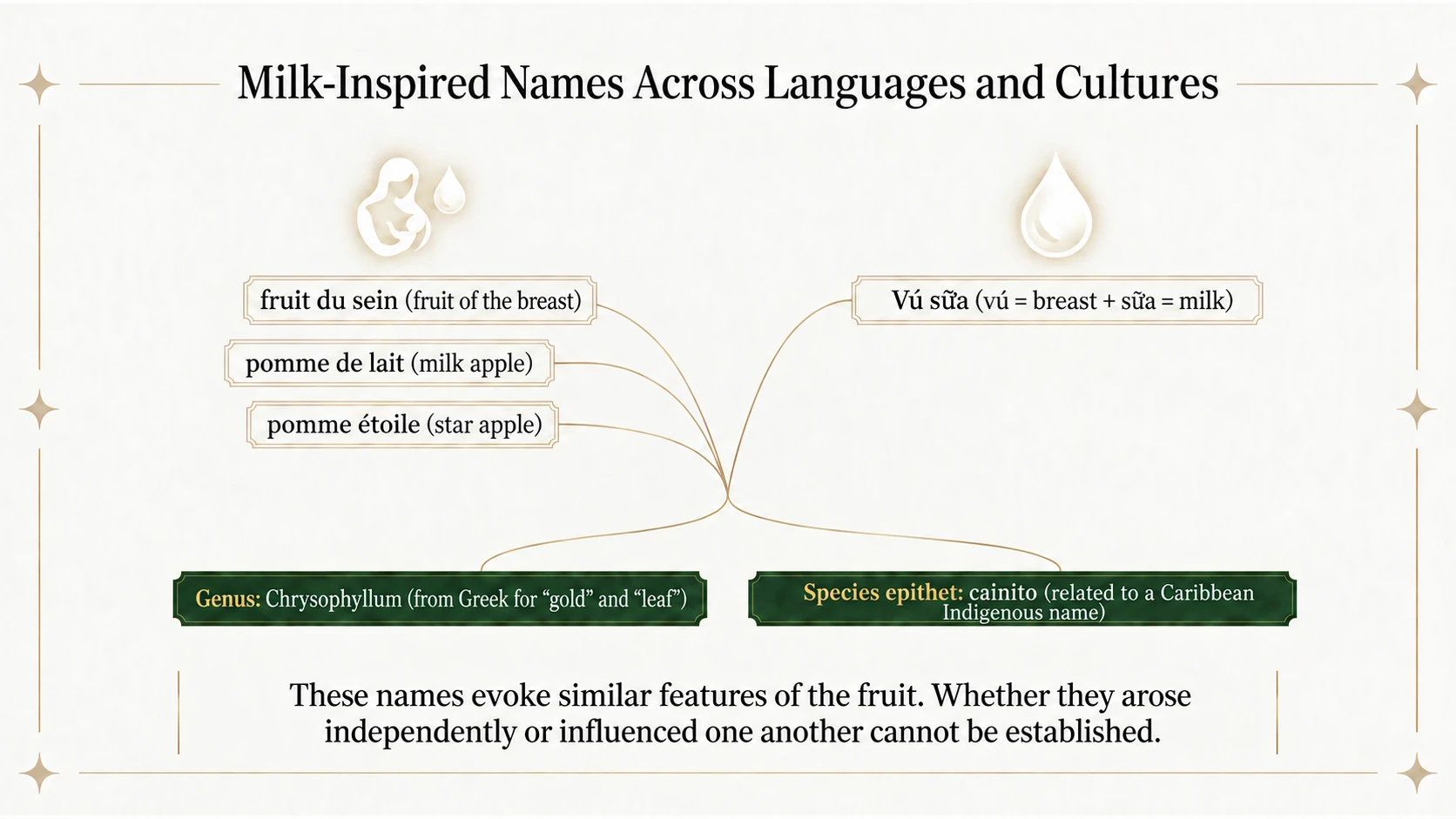
Names that evoke milk
Names evoking the white flesh or juice are used in several parts of the world.
The Vietnamese Vú sữa combines vú (“breast”) and sữa (“milk”). It is commonly explained by the sweet, white juice that seeps out when the ripe fruit is cut. The English name milk fruit evokes the same feature.
In the French-speaking Caribbean, including Guadeloupe and Martinique, names for the fruit have included fruit du sein (“breast fruit”) and pomme de lait (“milk apple”). The latter also evokes the milky-white flesh. Pomme étoile (“star apple”), referring to the pattern in the cut fruit, is another name used in the region.
It is striking to find names with similar meanings in distant places. That does not establish that each arose independently, without influence from other languages or cultures. They can be read more simply as expressions inspired by the fruit’s milky flesh.
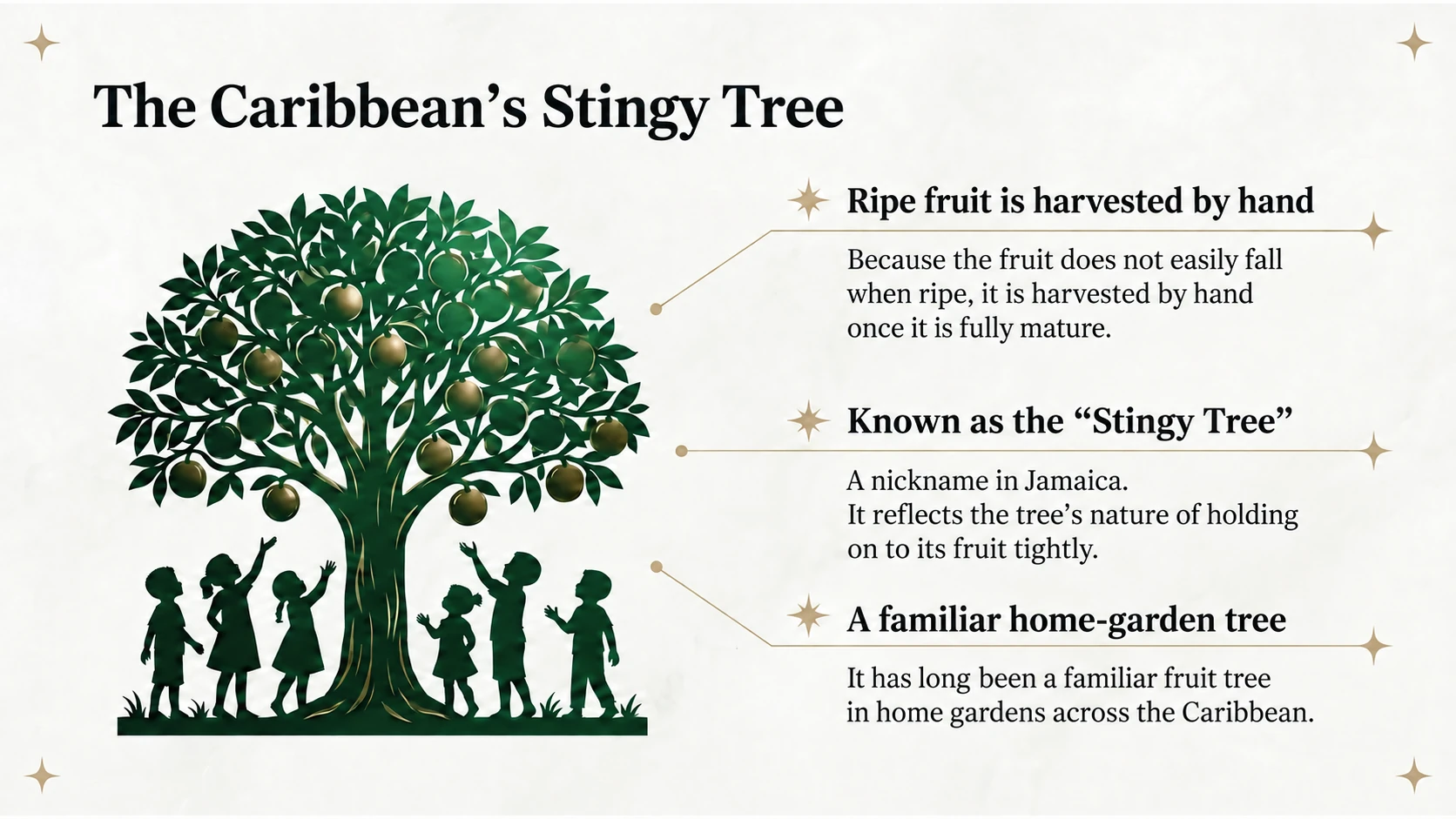
Caribbean gardens and the stingy tree
In the Caribbean, milk fruit has been appreciated as a tree in home gardens. The University of Florida’s growing guide notes that ripe fruit does not readily drop from the tree and needs to be harvested by hand.
In Jamaica, the nickname “stingy tree” is sometimes explained by this habit. The tree seems to hold on to its fruit: a playful expression drawn from everyday experience.
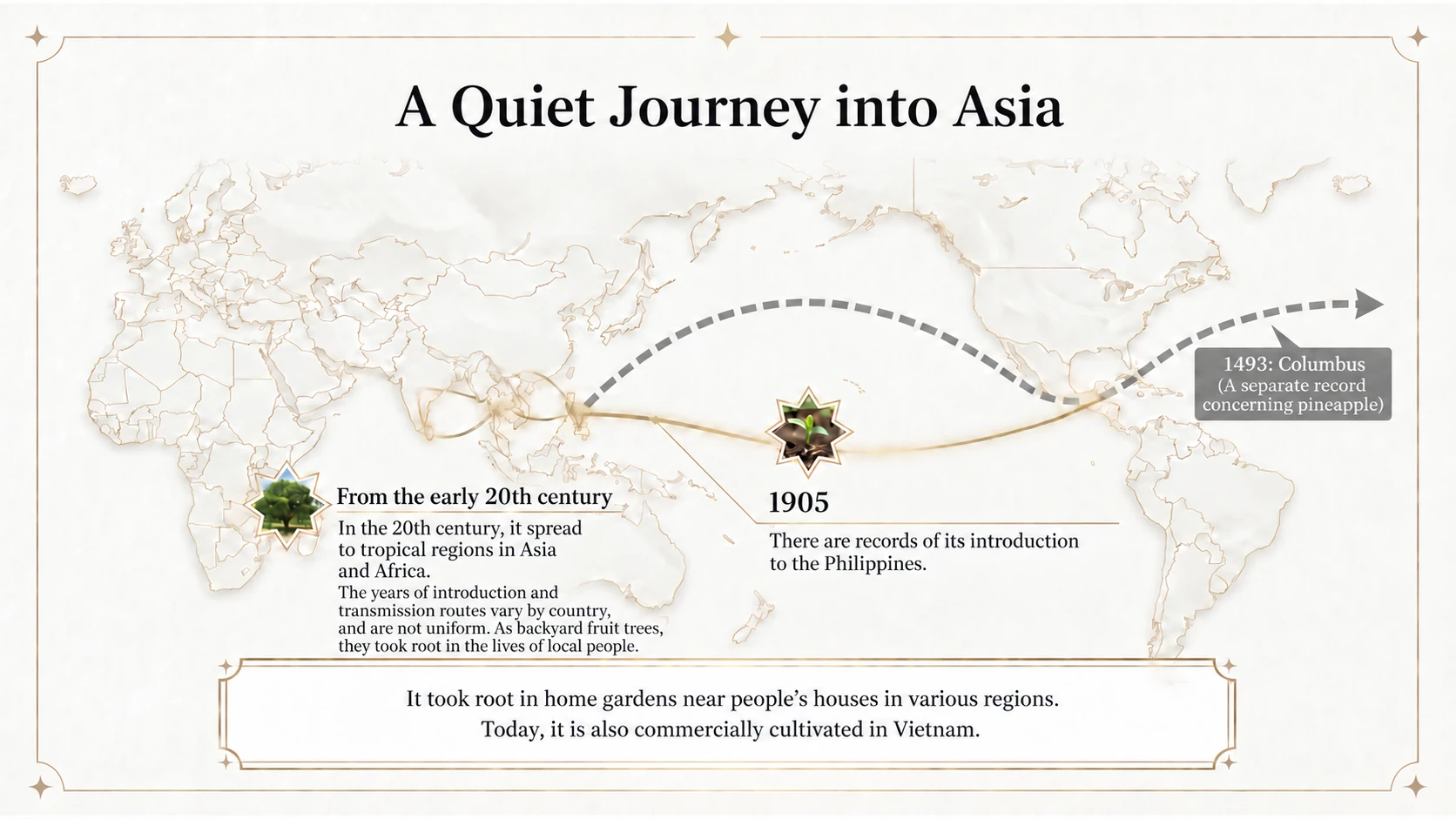
A quiet journey into Asia
Milk fruit’s spread can be followed through introduction records for individual countries and regions.
A single introduction date or route cannot be assigned to every country.
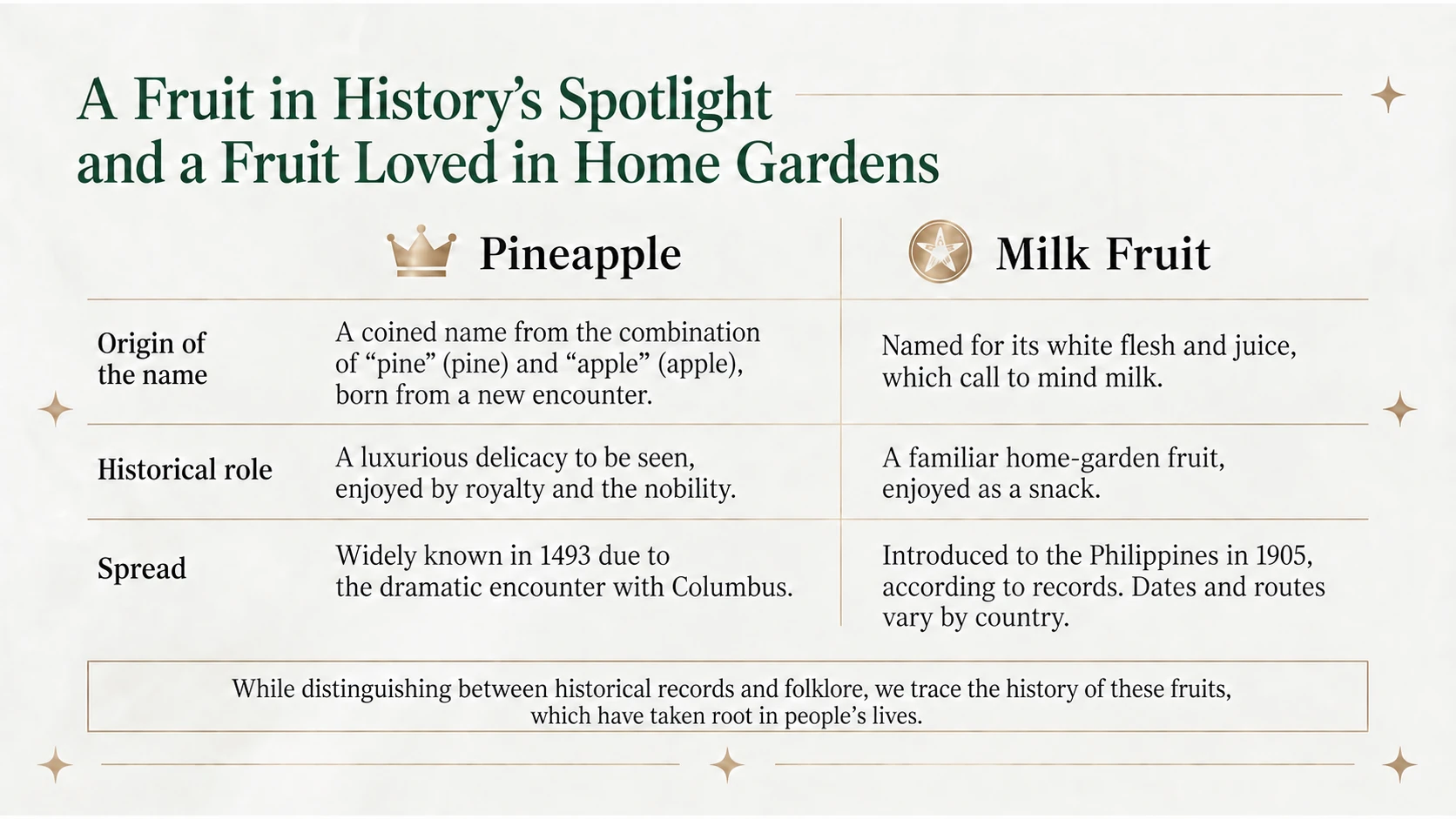
During the 20th century, milk fruit spread into parts of Asia and Africa. Accounts give 1905 for its introduction to the Philippines, but this does not establish that it reached every Asian country through the Philippines.
Milk fruit became familiar in home gardens and along roadsides across tropical Asia. Commercial production now also takes place in countries such as Vietnam.
A Vietnamese folktale about fruit as white as a mother’s milk
In Vietnam, milk fruit is the subject of Sự tích cây vú sữa, the legend of the star apple tree. The tale is also shared on school websites. The following is a retelling; versions of the story vary.
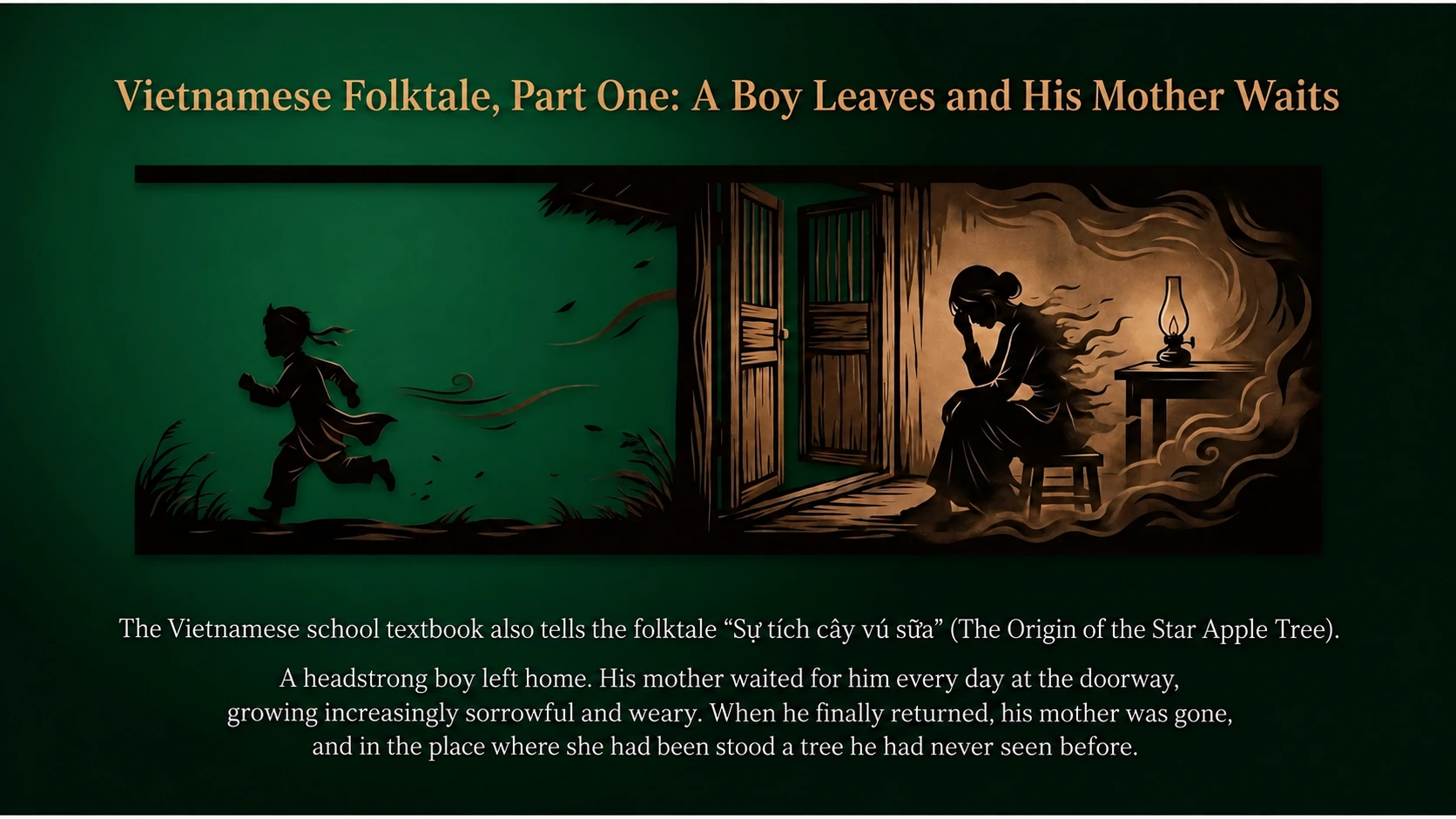
Once there was a boy whose mother had indulged him. He was stubborn and often refused to listen. One day, after she scolded him, he ran away from home. While her son wandered without a destination, his mother sat at the doorway every day, waiting. He did not return. Worn down by sorrow and exhaustion, she finally died.
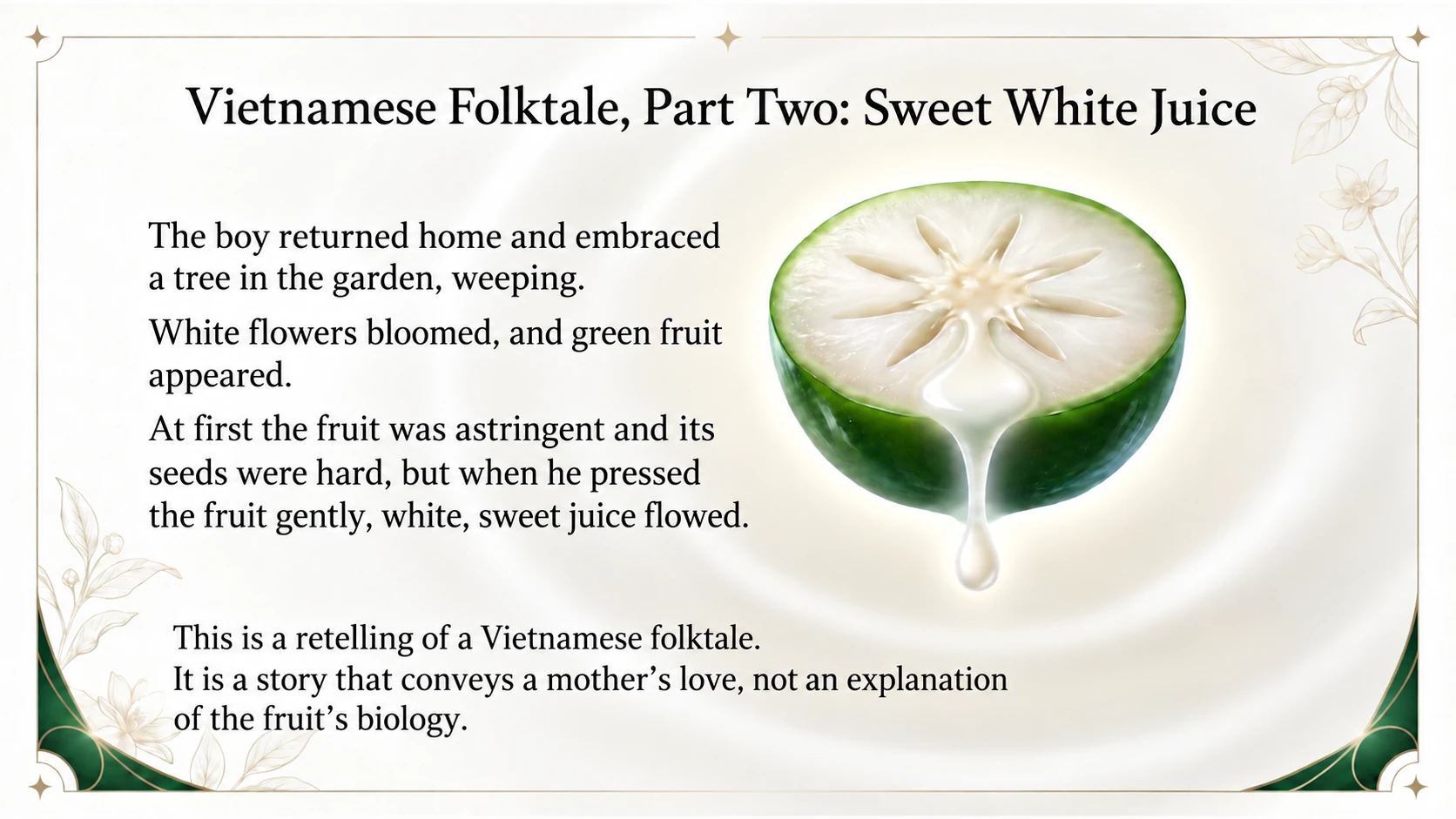
Eventually, hungry, cold and bullied by older children, the boy remembered his mother. He hurried home. Everything looked as he remembered it, but wherever he searched, he could not find her.
He broke down in tears and embraced a tree in the garden. Then something extraordinary happened. The tree trembled, and small flowers as white as clouds appeared along its branches. As the flowers fell, fruit formed and quickly grew, with smooth, glossy green skins. A branch bent down and gently dropped a large fruit into his hands.
The first fruit tasted astringent when he bit into it; the next startled him with its hard seeds. Eventually, he pressed a fruit gently, and sweet, white juice appeared, reminding him of his mother’s milk. In the leaves and trunk, too, he sensed his mother’s presence. He came to understand both his regret and her love.
This is a synopsis of Sự tích cây vú sữa. Versions vary. It is folklore, rather than an account of fruit cultivation or plant physiology.
The tale is more than an explanation of a fruit’s name. It expresses the idea that a mother’s love continues to protect and nourish her child, even after she changes form. The fruit’s milk-related name fits that theme with particular force.
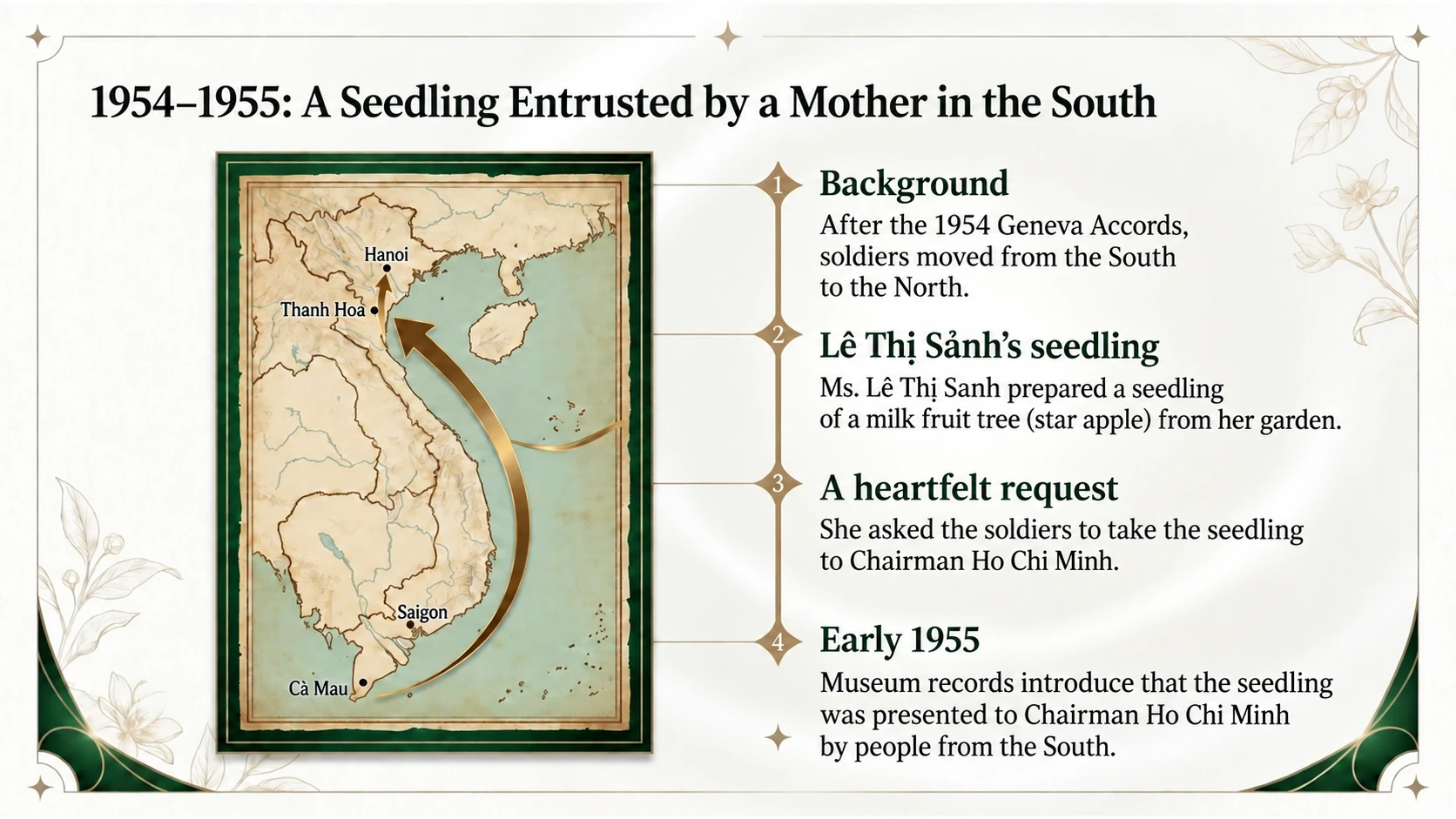
The seedling sent from the south to Ho Chi Minh in 1954–1955
The next story concerns a recorded event in the 20th century. In 1954, after the Geneva Accords, Lê Thị Sảnh of Cà Mau entrusted a milk fruit seedling to soldiers moving from southern to northern Vietnam.
A Cà Mau newspaper recounts the family’s memory of her daughter digging the seedling from their garden. The Vietnam National Museum of History also describes a tree given to President Ho Chi Minh by people from the south in early 1955.
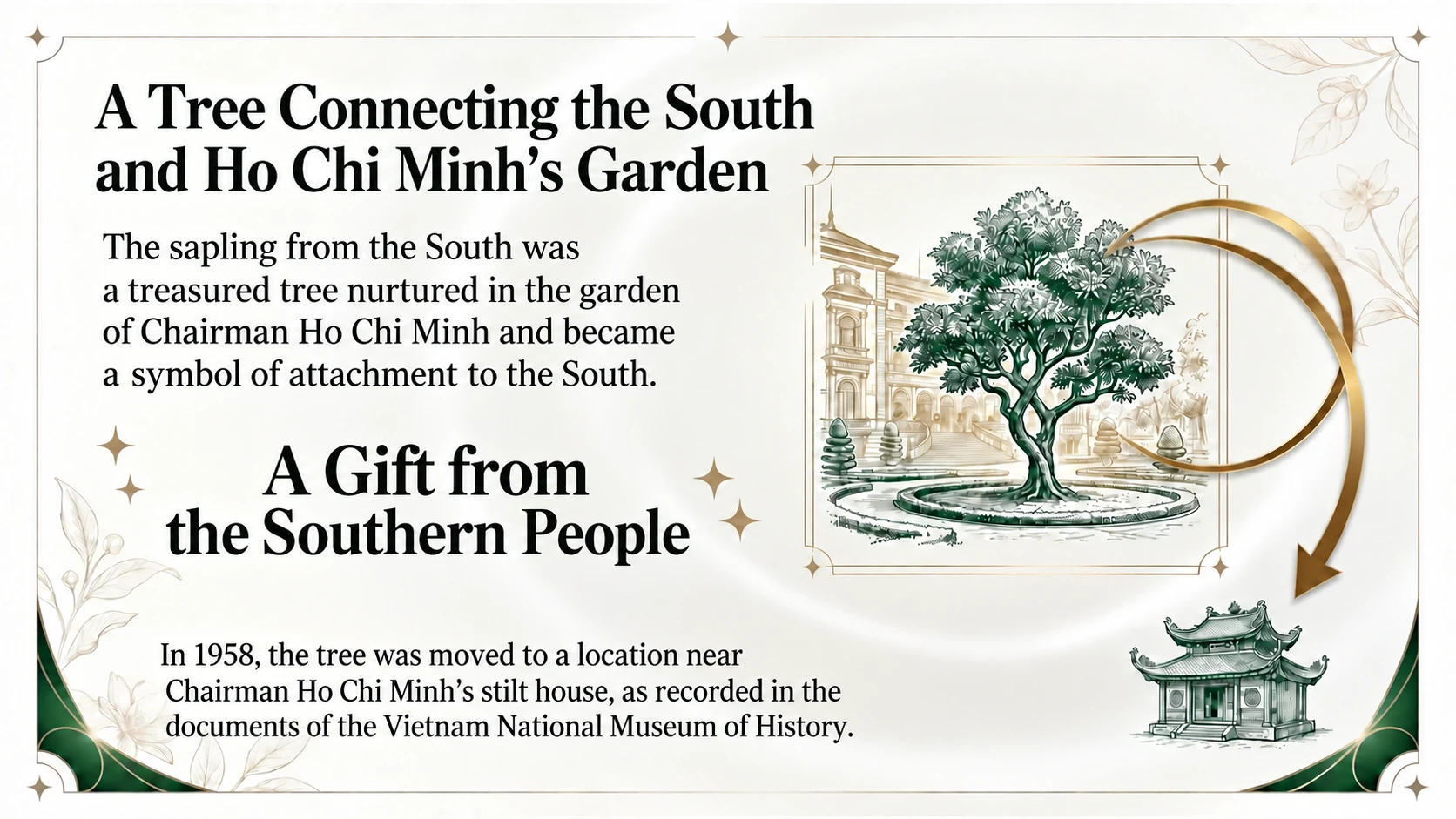
The tree was carefully tended in the Presidential Palace grounds and became a symbol of attachment to the south. Museum records say it was moved near the president’s stilt house in 1958. Through one tree, people separated by distance kept a connection alive.
Milk fruit today and exports to the United States in 2017
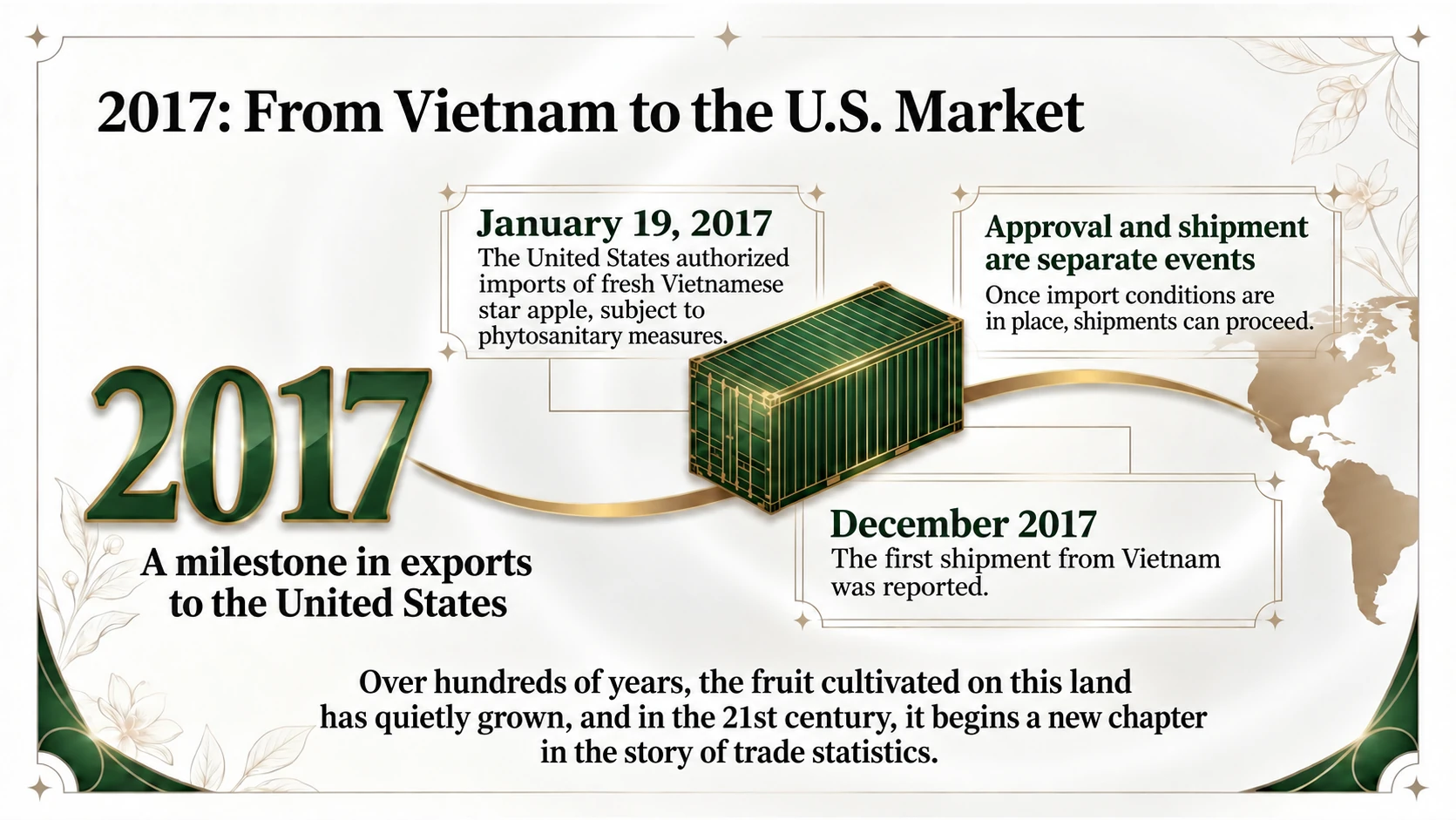
On January 19, 2017, the United States announced in the Federal Register that fresh star apple from Vietnam could be imported into the continental United States subject to phytosanitary measures. The first shipment was reported in December of the same year.
A fruit familiar in home gardens had also become a product for overseas markets.
Milk fruit across names and borders
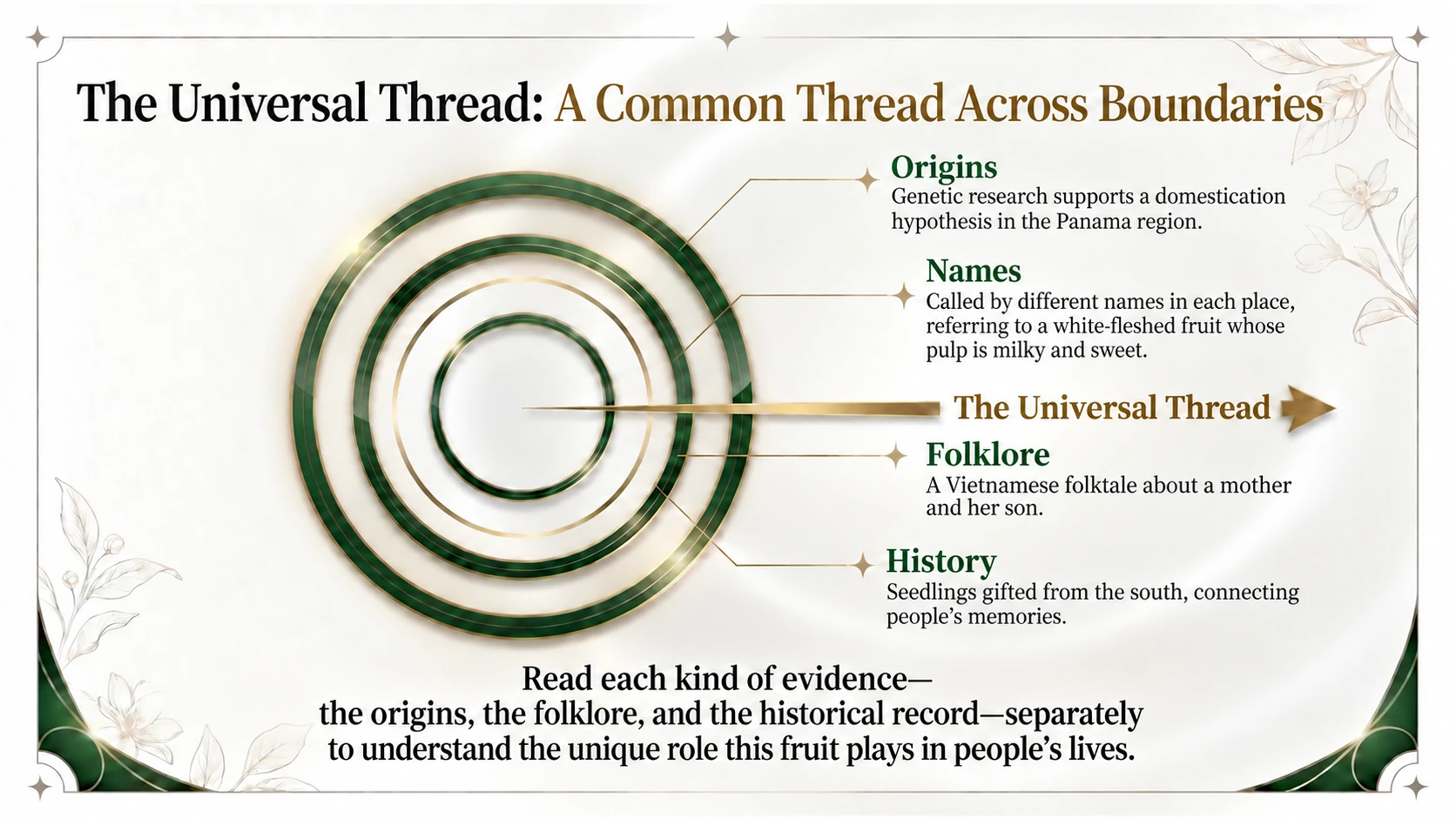
Milk fruit spread as a garden tree, carrying names that evoke its white flesh. In Vietnam, it became the subject of a folktale about a mother’s love. In the 20th century, a seedling sent from the south to the north became a symbol connecting people’s feelings.
Names, folktales and historical records are different kinds of evidence. Reading each on its own terms helps us understand the roles one fruit has played in people’s lives.
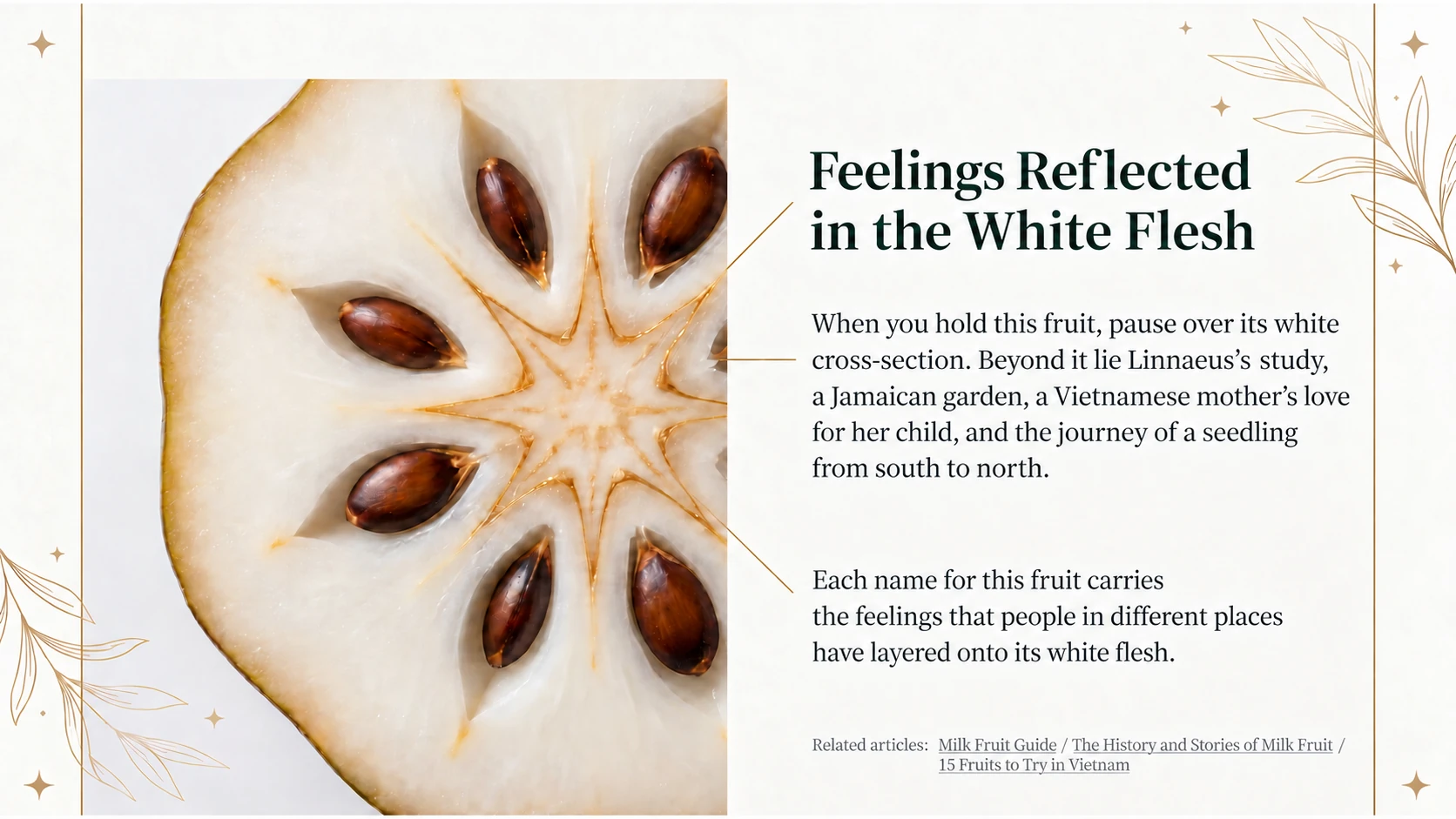
The next time you hold a milk fruit, pause over its white cross section. Beyond it are Linnaeus’s study, a Jamaican garden, a Vietnamese child longing for his mother and the journey of a seedling from south to north.
One fruit’s name can carry feelings that people in different places have recognized in it.
Frequently asked questions about milk fruit’s history and stories
What does Vú sữa mean?
In Vietnamese, vú means “breast” and sữa means “milk.” The name evokes the white flesh or juice and is also associated with the folktale of a mother and her son.
Is the story of the mother and her son a historical event?
Sự tích cây vú sữa is a folktale. The gift of a seedling to Ho Chi Minh is a separate historical story recorded by museums and newspapers.
Related articles
- The tree, names, varieties and markets: Milk Fruit Guide
- Choosing, cutting and storing milk fruit in Vietnam: How to Eat Milk Fruit
- A South American fruit that went from a luxury to a familiar food: The Story of Pineapple
- Other fruits to enjoy in Vietnam: 15 Fruits to Try in Vietnam (Japanese)
References
- Kew Science Plants of the World Online: “Chrysophyllum cainito L.”
- NCBI/PMC: “Domestication of the neotropical tree Chrysophyllum cainito from a geographically limited yet genetically diverse gene pool in Panama”
- alexetalex.com: “Caïmite (fruit): un drôle de fruit antillais à découvrir” (French)
- martiniqueannu.com: “Caimite” (French)
- jamaicans.com: “Exploring Jamaican Food: Star Apple”
- Purdue University Horticulture & Landscape Architecture: “Star Apple”
- eva.vn: “Truyện cổ tích: Sự tích cây vú sữa” (Vietnamese)
- loigiaihay.com: “Sự tích cây vú sữa – Truyện cổ tích Việt Nam” (Vietnamese)
- Tân Trụ Primary School: “Sự tích cây vú sữa” (Vietnamese)
- Cà Mau Newspaper: “Bến tập kết, bến lòng dân – Bài 2: Chuyện cây vú sữa miền Nam của má Sảnh” (Vietnamese)
- Cà Mau Newspaper: “Cây vú sữa miền Nam – Một biểu tượng tấm lòng” (Vietnamese)
- Inquirer Business: “Vietnam exports first batch of star apples to US”
- VietnamPlus: “Vietnam – Sole country exporting star apples”
The source edition was fact-checked and updated on October 8, 2026. Recheck prices and plant-quarantine conditions when buying fruit or traveling.
- Vietnam National Museum of History: the milk fruit tree given in 1955 (Vietnamese)
- U.S. Federal Register: authorization for Vietnamese star apple imports, January 19, 2017
- UF/IFAS: harvesting ripe fruit and its worldwide distribution
About the Author

Chuta
Based in Hanoi, Vietnam, Chuta buys fruit at local markets and supermarkets and writes about its taste, seasons, selection and preparation. Drawing on life in Vietnam, he introduces tropical fruits that are less familiar to readers in Japan.
About Fruit Guide