Coconut History and Stories
Published October 9, 2026
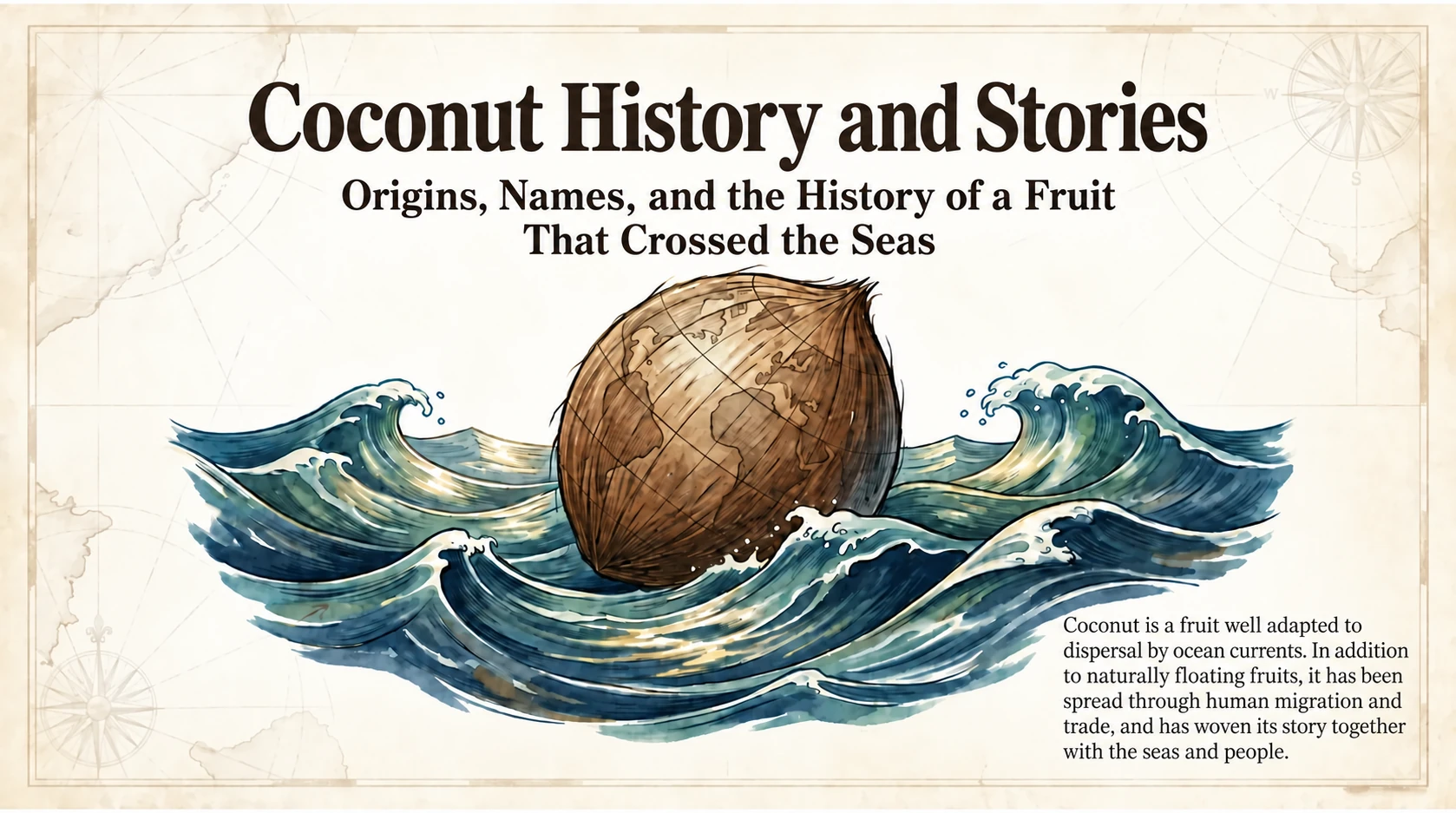
A coconut floats across the sea and reaches a distant sandy shore. Its journey involves ocean currents, but also the migrations and trade of people who cultivated the fruit and loaded it onto their boats.
Following the journeys explored in Pineapple History and Stories and Papaya History and Stories, this article traces the coconut’s footsteps. Its fibers bound together Pacific canoes, its hard shell became a European craft object, and in Vietnam it appears in Lunar New Year wishes and the history of Đạo Dừa, the Coconut Religion.
From research into its homeland and the origins of its name to regional myths and Vietnamese culture, we follow the history and stories that nature and people have woven around the coconut.
Where Did Coconuts Originate? Two Centers of Domestication
Pineapple’s homeland in South America and papaya’s in Central America are relatively clear. The coconut’s “homeland,” however, remains a subject of research and debate.
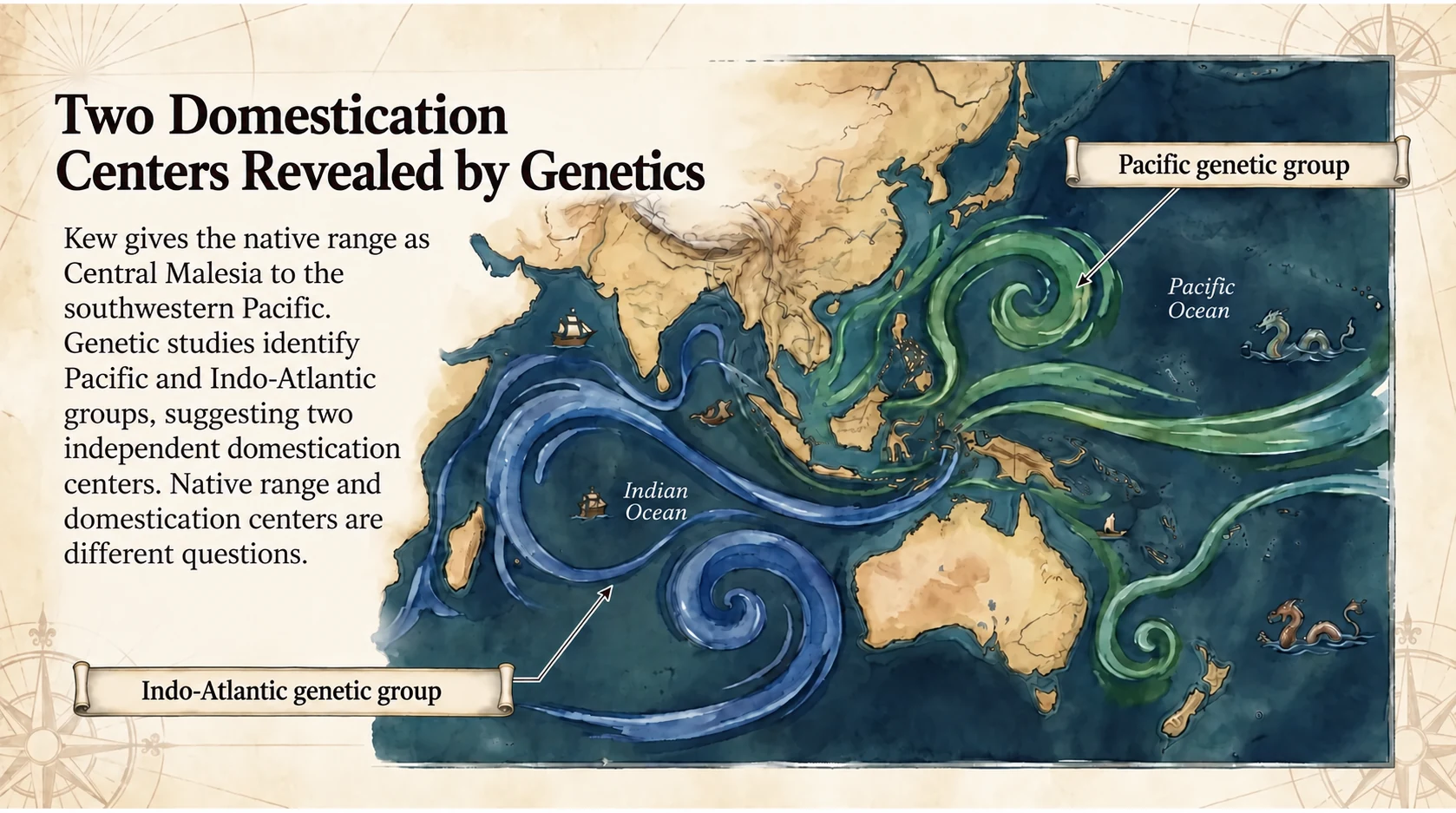
Kew gives the coconut palm’s native range as Central Malesia to the southwestern Pacific. A 2011 genetic study of 1,322 accessions identified two strongly differentiated groups, Pacific and Indo-Atlantic, suggesting independent domestication in island Southeast Asia and the southern margins of the Indian subcontinent.
A wild plant’s native range and its centers of domestication are different questions. Although coconut fruit is adapted for ocean dispersal, the study also notes that its spread throughout the tropics involved human assistance and that many present-day populations reflect cultivation and transport by people.
The Origin of the Name: Medieval Europe’s “Indian Nut”
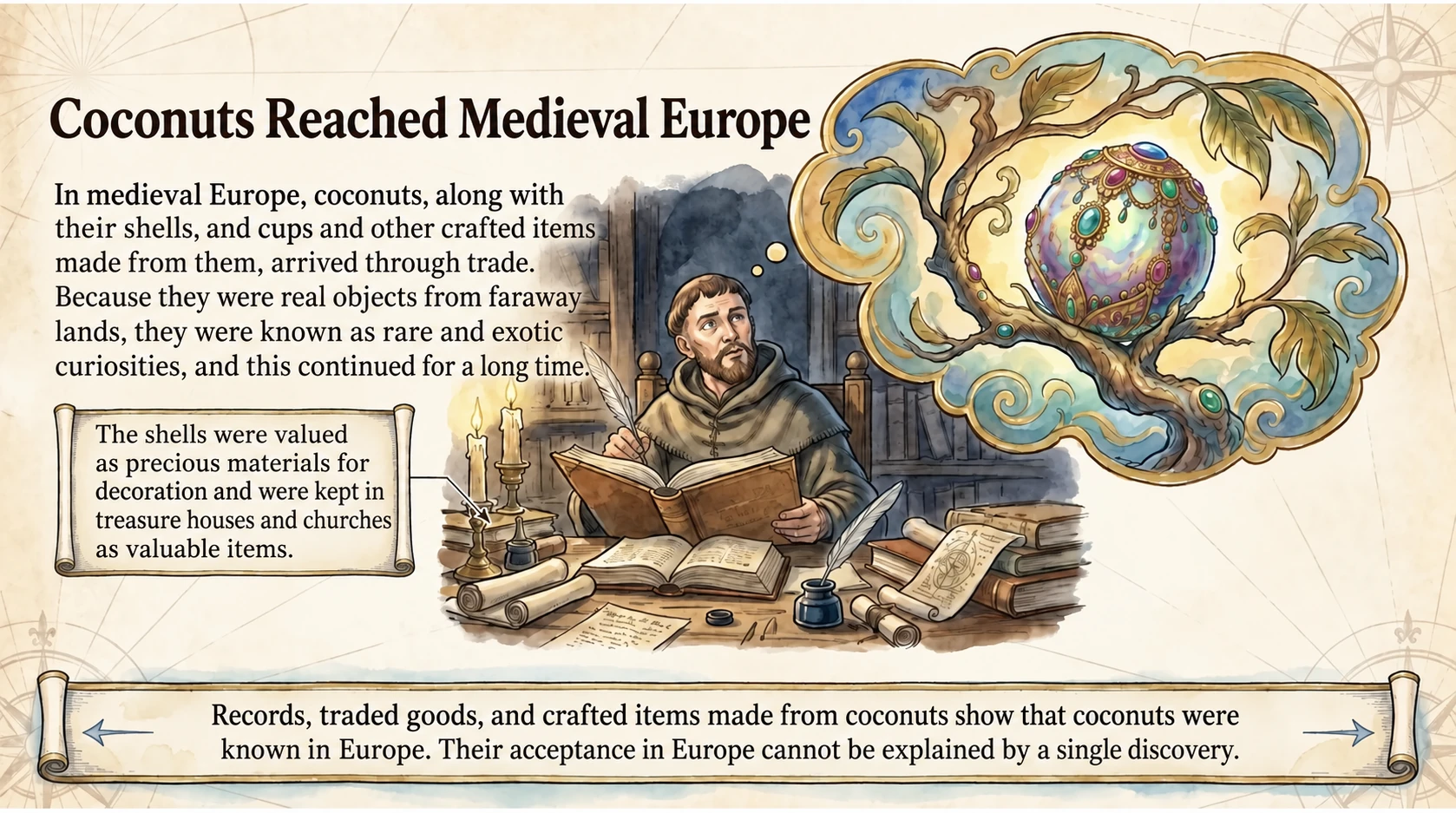
In medieval Europe, coconut shells were prized under names such as “nux indica,” or “Indian nut,” and made into vessels with metal fittings. Rather than simply a name arriving before the fruit, this was a history of shells and crafted objects transported through long-distance trade and received as rarities far from their origins.
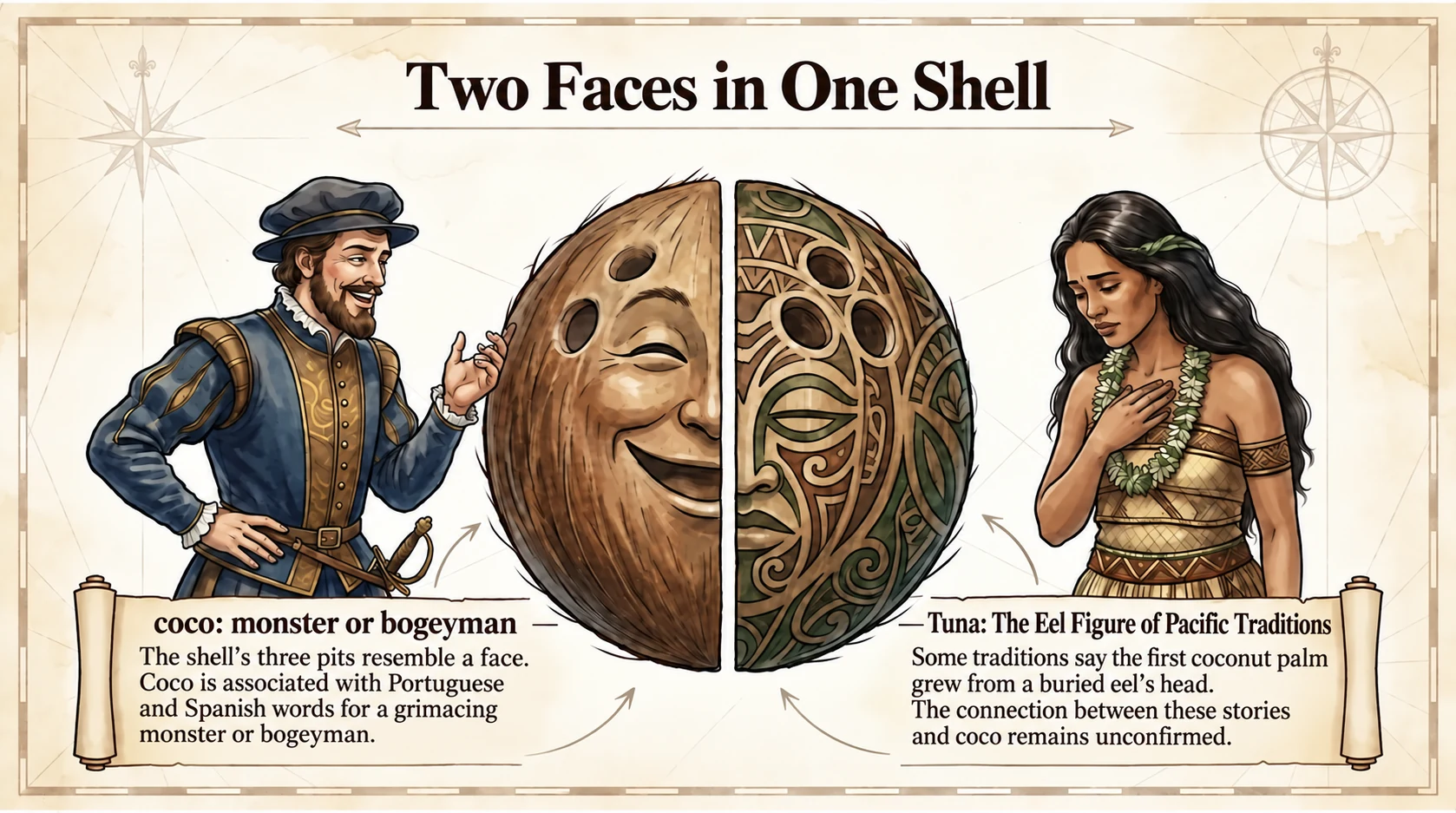
The word “coco,” which later became part of “coconut,” is associated with Portuguese and Spanish terms for a grimacing monster or bogeyman around the sixteenth century. The name likened the shell’s three pits to a face; “a smiling face” is not an accurate translation.
The Fruit That Helped Bind Pacific Voyaging Canoes
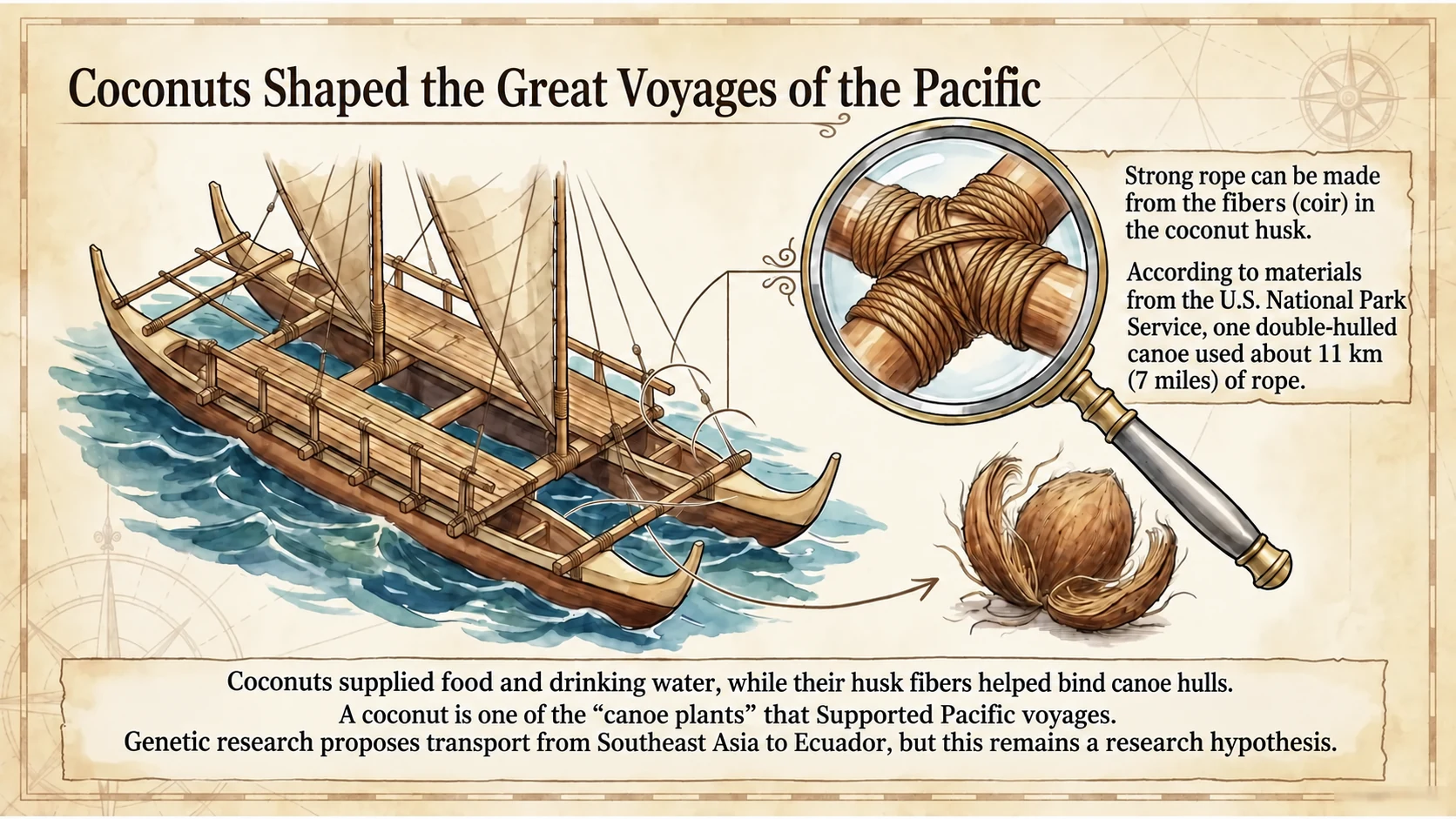
From around 3000 BCE to around 1200 CE, Austronesian-speaking peoples set out from Southeast Asia into the vast Pacific. Their eventual settlements reached the enormous triangle linking Hawaii in the north, Easter Island in the east, and New Zealand in the southwest.
These voyages were supported by “canoe plants,” including taro, breadfruit, and bananas. Coconut was a prominent example. In Hawaii it supplied food, drinking water, basket material, and roofing. Especially important was rope made from the fibrous fruit husk, or coir. A US National Park Service guide describes an example in which one double-hulled canoe uses about seven miles, or 11 km, of cordage.
The coconut was more than cargo: its fibers helped lash together the very boat that carried it. If pineapple and papaya were passengers, coconut was also part of the vessel that made long Pacific voyages possible. A genetic study by Baudouin and Lebrun, published online in 2008, proposed that coconuts may have been carried from the Philippines to Ecuador about 2,250 years ago. This is a research hypothesis, not a confirmed historical route and date.
Europe’s Treasure Was the Shell
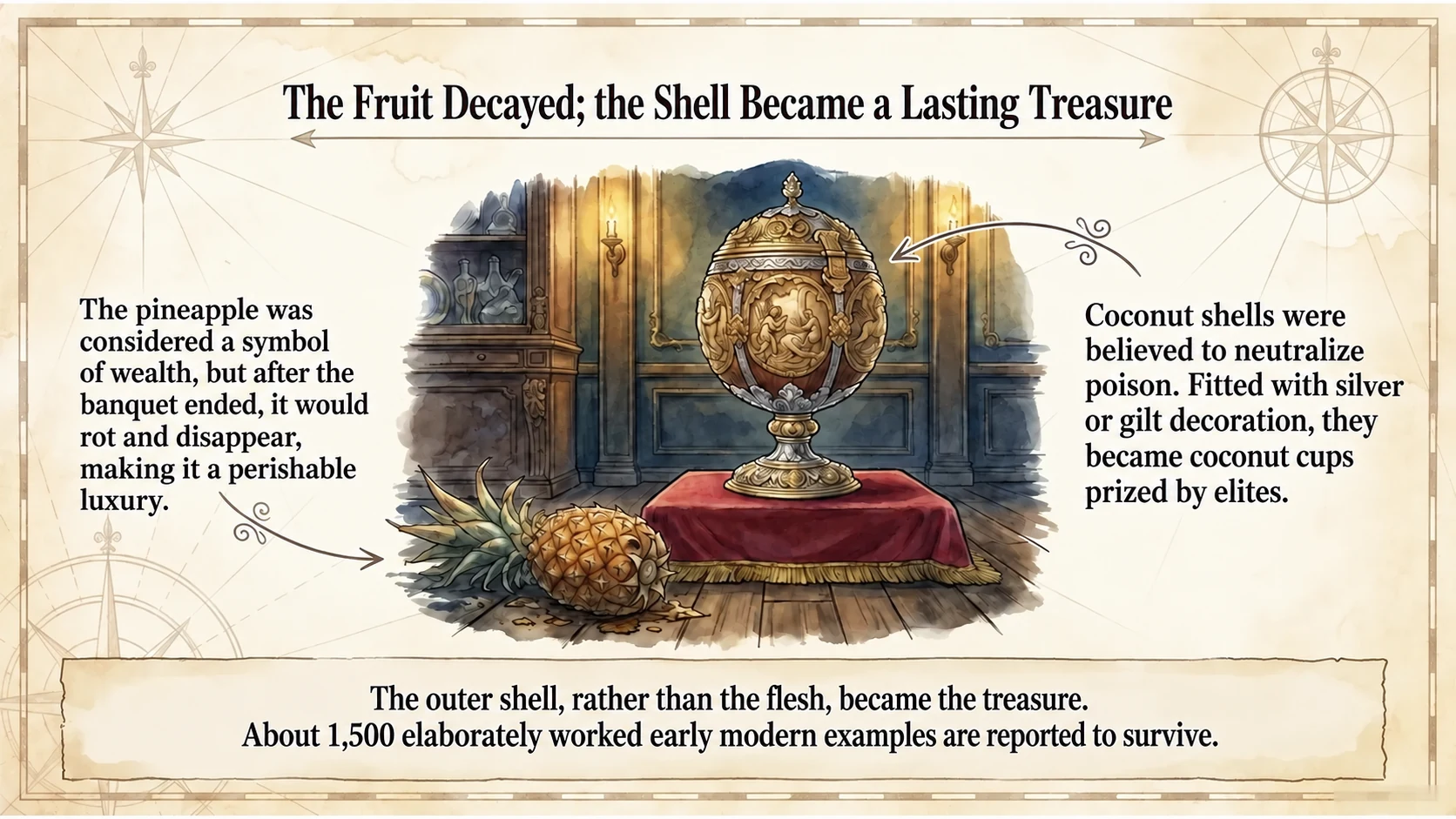
As discussed in Pineapple History and Stories, in seventeenth- and eighteenth-century Europe the pineapple itself symbolized wealth. It could stand at the center of a banquet and even be rented for one night, then returned without anyone eating it.
Coconut took a different form as a prized possession. From the late medieval period into the Renaissance, shells were fitted with silver or silver-gilt decoration to make “coconut cups,” treasures for wealthy collectors’ cabinets of curiosities, or Wunderkammern. Around 1,500 early modern examples are reported to survive. Particularly elaborate German-speaking examples from the late sixteenth century onward feature biblical or military scenes. People also believed the shell could neutralize poison.
Both fruits became European treasures, but a pineapple was a perishable luxury. For coconut, the outer shell rather than the edible flesh became the lasting treasure. Shells embellished with carving and metalwork remain in museums centuries later. The fruits beloved by elites followed strikingly different paths.
The Face on the Shell: Polynesian Myth
The Coconut Field Guide explains the name associated with European sailors seeing a monster or bogeyman’s face in the shell’s three pits. Pacific stories link those same markings to another face.
Stories about Hina, or Sina in Samoa, and the eel figure Tuna are told across a broad Pacific region, including Samoa, Tonga, Fiji, Tahiti, Hawaii, and Māori traditions in New Zealand. Details vary. In one representative version, Tuna falls in love with Hina. Sensing his death, he asks her to cut off his head and bury it. The shoot that grows from it becomes the first coconut palm.
The story explains the shell’s two eye-like marks and one mouth-like mark as the face of the buried Tuna. It is intriguing that different cultures explained the same apparent “face” through different stories.
A Vietnamese Origin Tale and the Final Piece of a New Year Wish
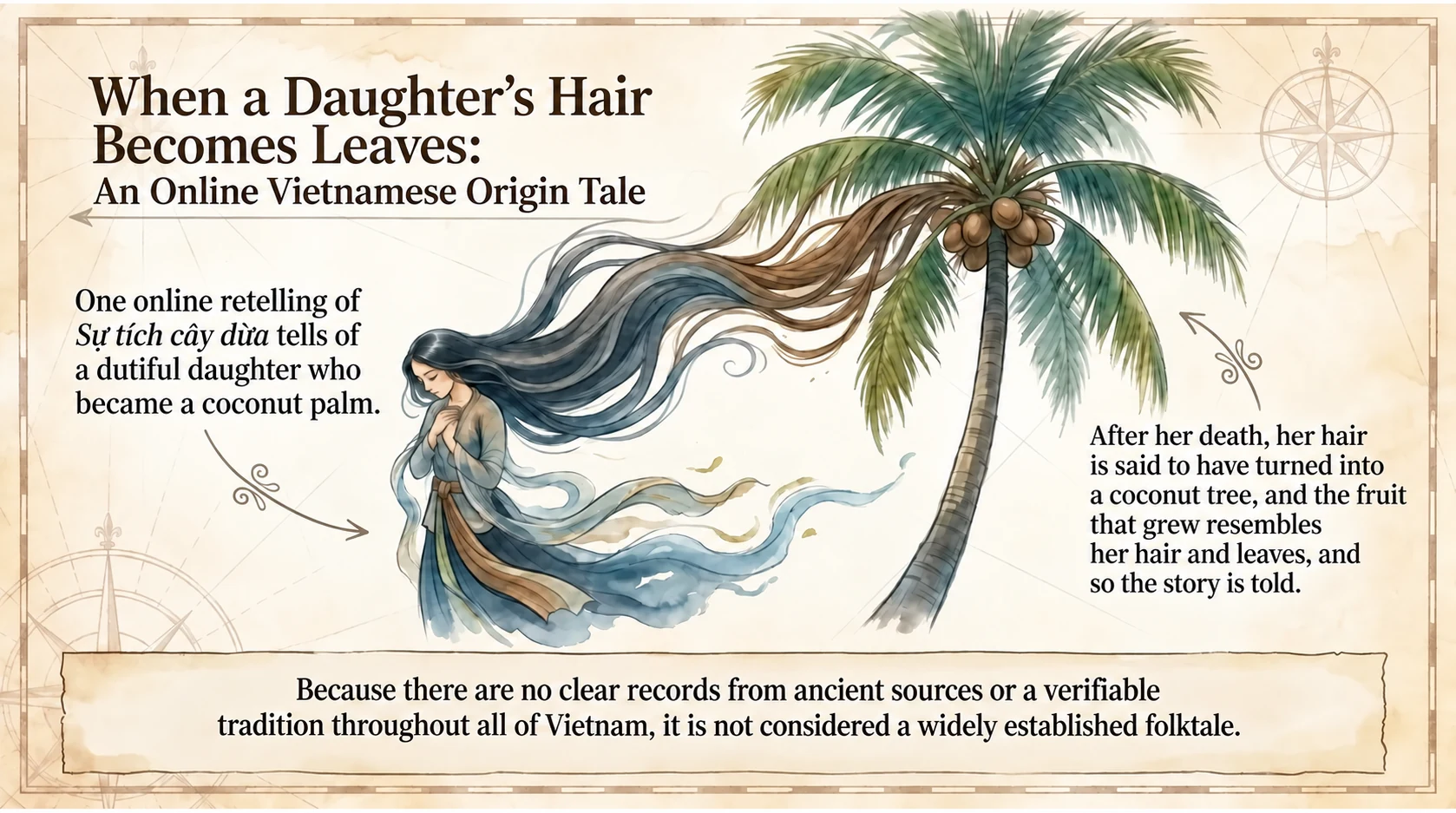
Vietnamese websites retell a story about a dutiful daughter and her sick mother under the title “Sự tích cây dừa,” the origin tale of the coconut palm. The versions checked here did not clearly identify their sources, and we could not corroborate them with scholarly folklore collections or early records. We therefore present it as one retelling circulating online, rather than a firmly established tale throughout Vietnam.
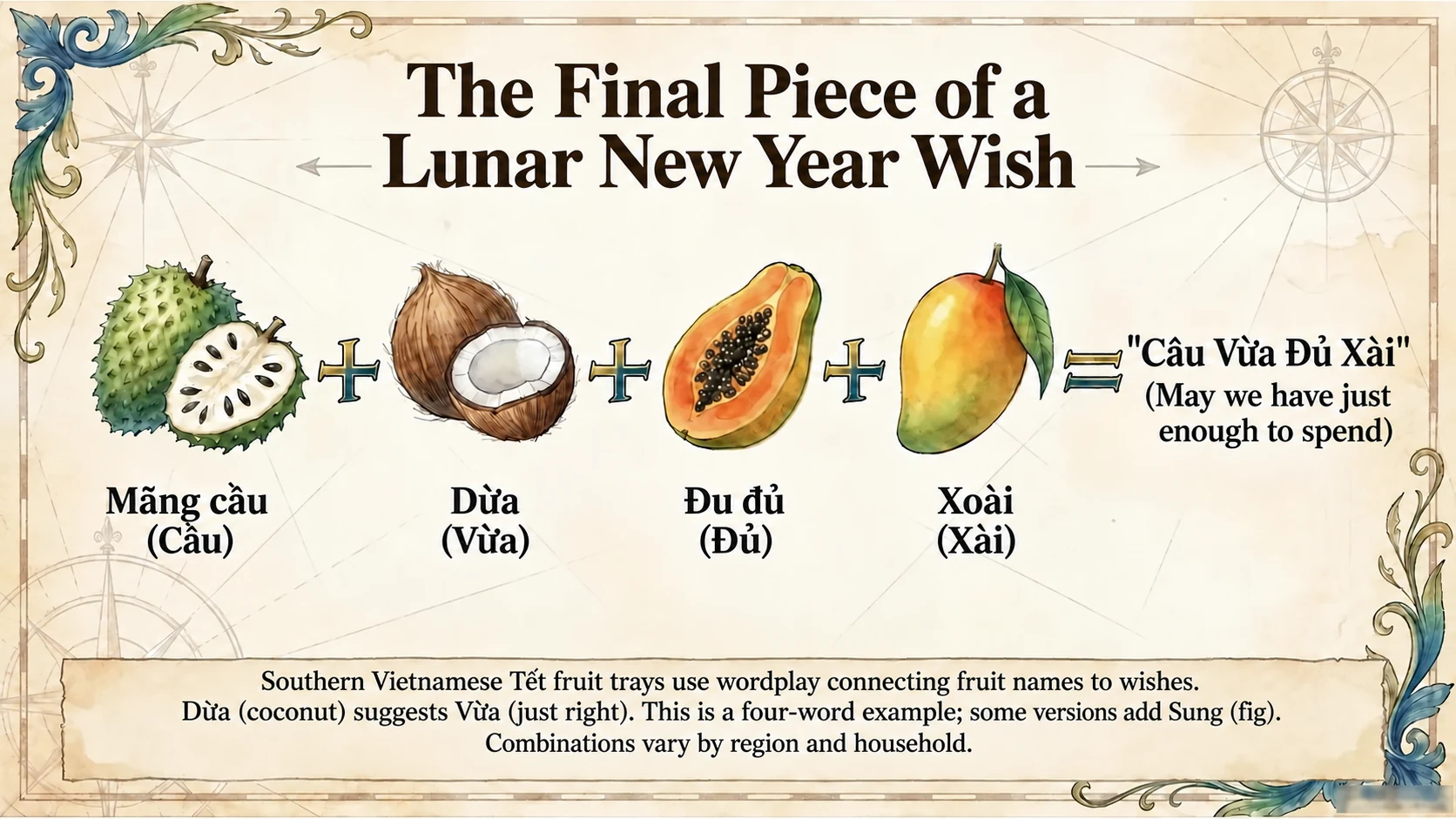
Coconut has another clear role in Vietnam. Southern Vietnamese Lunar New Year, or Tết, fruit trays use wordplay that links fruit names to wishes. In the four-word example “Cầu Vừa Đủ Xài”—roughly “May we have just enough to spend”—Mango History and Stories discusses Xoài (mango), suggesting Xài (spend), and Papaya History and Stories discusses Đu đủ (papaya), suggesting Đủ (enough). Dừa, coconut, suggests Vừa (just right). Coconut is a familiar piece in assembling the wish.
Some regions and households add figs, Sung, to form the five-word “Cầu Sung Vừa Đủ Xài.” See Papaya History and Stories for more.
Another Story in Ben Tre: Đạo Dừa
Alongside folktales, Vietnamese coconut has a story rooted in twentieth-century events.
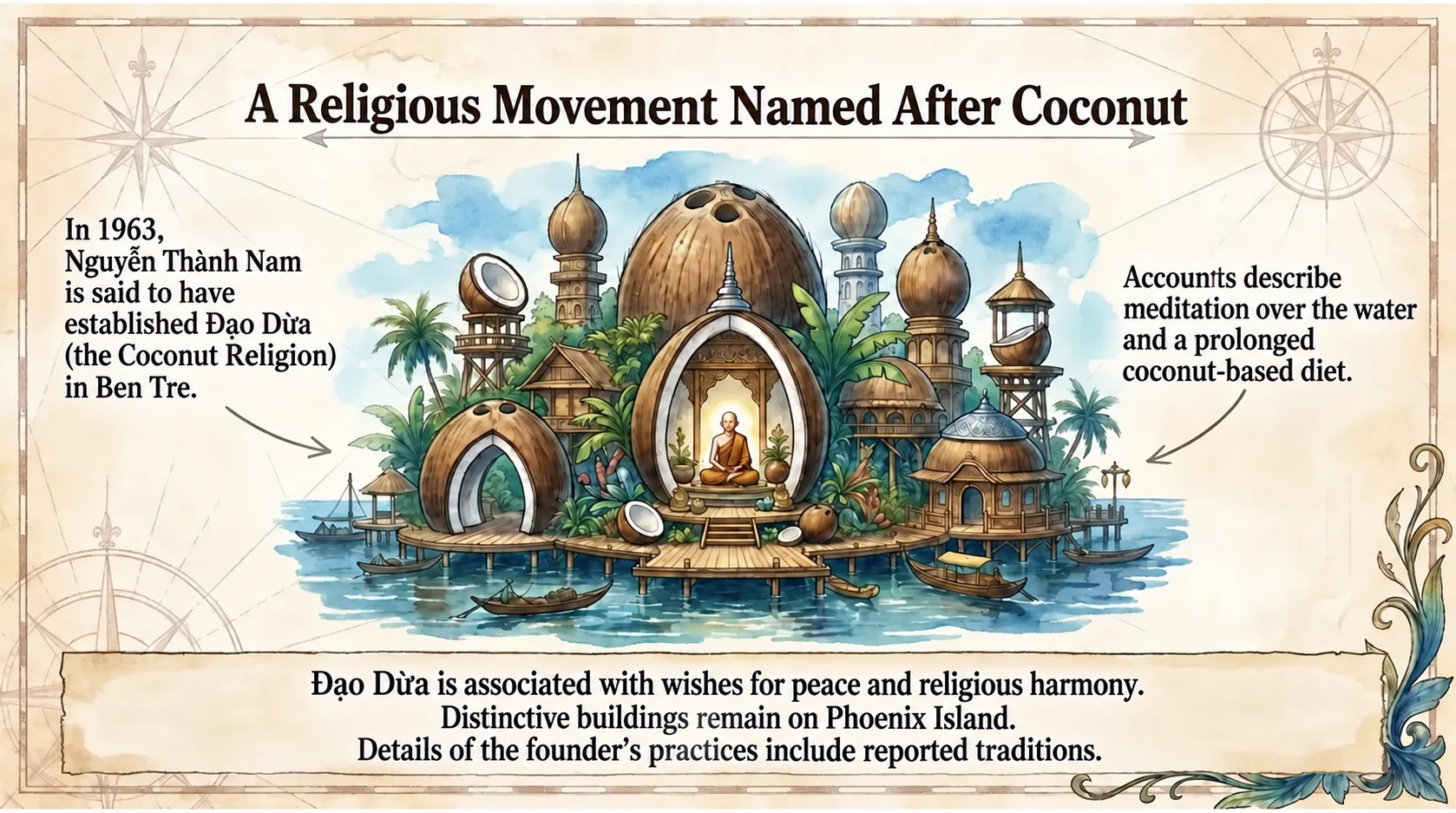
Accounts of Đạo Dừa describe Nguyễn Thành Nam, who had studied chemical engineering in France, establishing a religious site on a small Mekong island in Ben Tre Province in 1963, now known as Phoenix Island. His movement, Đạo Dừa or the Coconut Religion, combined elements of Buddhism, Christianity, and other traditions. Nam is said to have lived on coconuts alone for three years and to have organized meditation and prayer on a platform over the river, hoping for an end to the Vietnam War.
The Ben Tre area, formerly Ben Tre Province and now part of Vinh Long Province, is sometimes called the land of coconuts. It also became the setting for a religious movement shaped by one person’s beliefs and practices. The movement attracted followers, but accounts say its activities were prohibited after 1975. Distinctive coconut-inspired buildings are now preserved as the Đạo Dừa historical site and tourist attraction. Where pineapple’s story includes European courts and Hawaiian canning factories, Vietnam’s coconut history includes an entire chapter shaped by one individual’s life.
Frequently Asked Questions
Where are coconuts native?
Kew gives their native range as Central Malesia to the southwestern Pacific. Genetic studies identify Pacific and Indo-Atlantic groups, suggesting that domestication took place in more than one region.
Where does the name coconut come from?
It is associated with coco, a Portuguese and Spanish word for a grimacing monster or bogeyman around the sixteenth century. The shell’s three pits were likened to a face.
Did coconuts spread around the world only by ocean currents?
The fruit is adapted to ocean dispersal, but human cultivation, migration, and trade also played major roles in its present worldwide distribution.
What was Vietnam’s Coconut Religion?
Đạo Dừa was a distinctive religious movement established by Nguyễn Thành Nam in Ben Tre in the twentieth century, combining elements of Buddhism, Christianity, and other traditions. Its buildings are now preserved as a historical site.
Recap: Carried by Currents and by Human Voyages
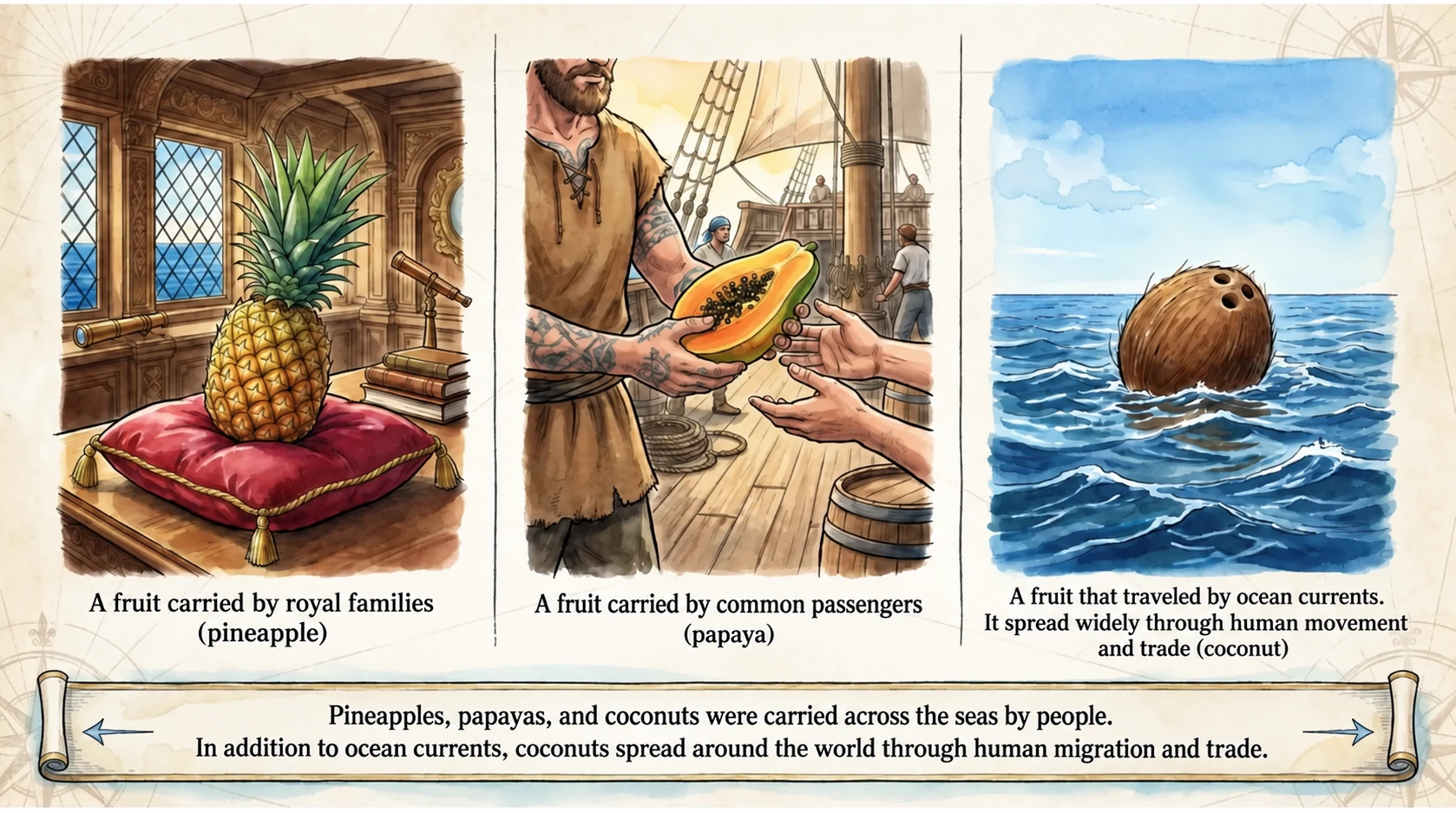
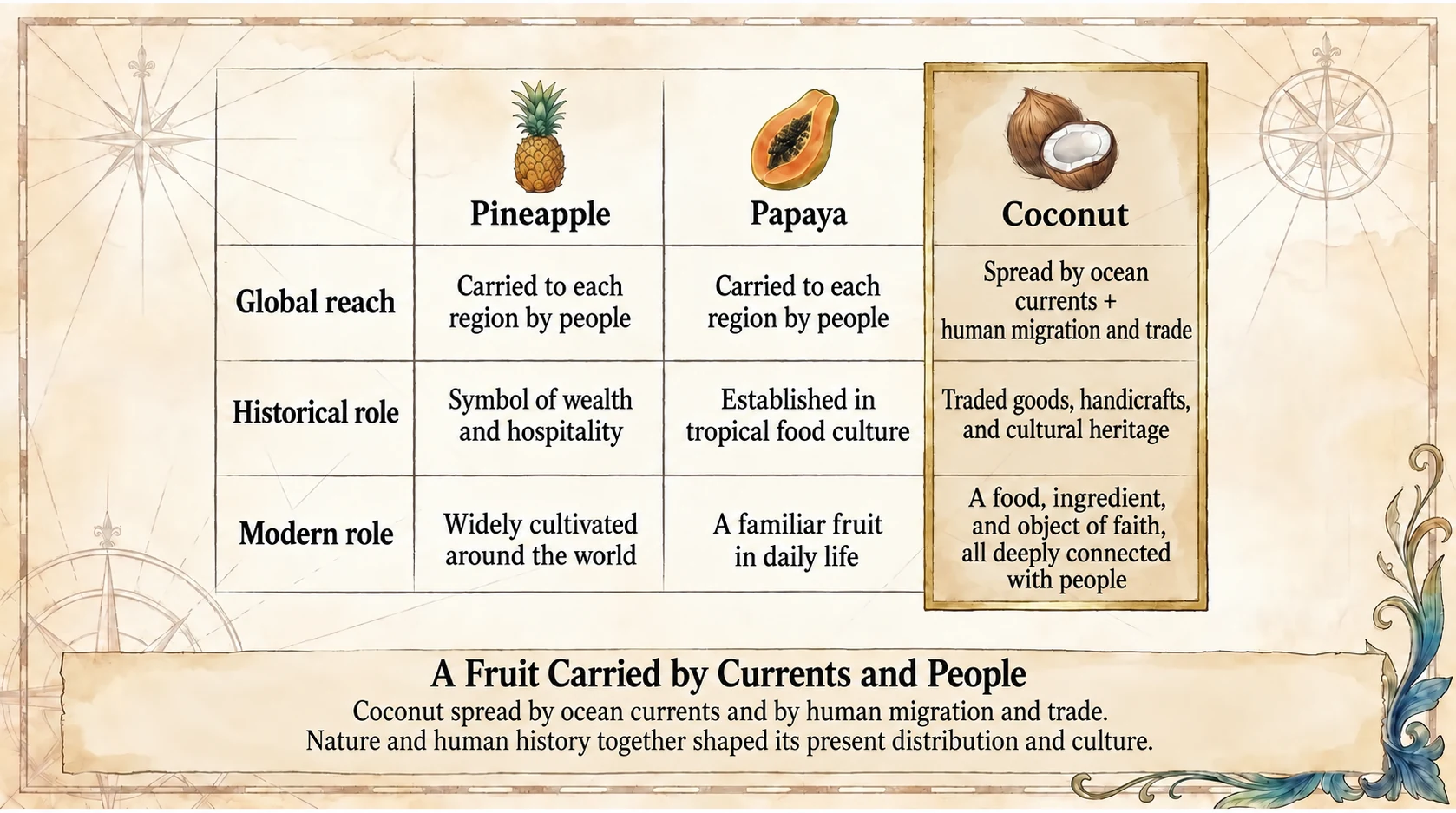
Pineapple traveled from South America to the Caribbean and Europe, eventually becoming known as a king of fruits. Papaya did not receive that crown, but traveled on human ships and spread remarkably quickly through much of the tropical world.
Coconut’s journey differed from both. Its fruit is adapted for ocean dispersal, while people carried and cultivated it as a source of food, drink, fiber, and building material. It helped bind Pacific voyaging boats, its shell became European craftwork, it appeared in Pacific myths, and in Vietnam it even gave its name to a religion shaped by one person’s faith.
A fruit with both the ability to travel through nature and the usefulness that made people want to carry it: that is the coconut’s story.
Related Articles
- Ecology, names, varieties, and Japanese plant quarantine: Coconut Field Guide
- Prices, choosing fruit, drinking, and storage in Vietnam: How to Eat Coconut in Vietnam
- More fruits to enjoy in Vietnam: 15 Fruits to Try in Vietnam
- Connected through Lunar New Year fruit trays: Mango History and Stories and Papaya History and Stories
Sources
- Vietnam Government: Provincial Administrative Reorganization in 2025 (Vietnamese)
- Kew Plants of the World Online: Cocos nucifera
- Origin and dispersal of the coconut – Wikipedia
- Independent Origins of Cultivated Coconut (Cocos nucifera L.) in the Old World Tropics – PLOS One
- Deep history of coconuts decoded – The Source, WashU
- Coconut cup – Wikipedia
- A silver-gilt-sheathed coconut goblet links the Age of Discovery with the Bible – Harvard Magazine
- Court Coconut Cups – Kunstkammer Georg Laue
- Ancient Seafaring: The Polynesian Colonization of the Pacific Islands
- Plant ID 508 — National Park Service, Puʻuhonua o Hōnaunau National Historical Park
- Coconut (Cocos nucifera L.) DNA studies support Austronesian migration – Springer
- Tuna (Polynesian mythology) – Wikipedia
- Sina and the Eel – Wikipedia
- Sự tích cây dừa – vanvn.net
- Sự tích cây dừa – loigiaihay.com
- Sự tích cây dừa – arttimes.vn
- pasgo.vn – Mâm ngũ quả miền Nam ngày Tết
- Ông Đạo Dừa – Wikipedia
- Coconut Religion – Wikipedia
- The Coconut Monk – Oi Vietnam
About the Author

Chuta
Based in Hanoi, Vietnam, Chuta buys fruit at local markets and supermarkets and writes about its taste, seasons, selection and preparation. Drawing on life in Vietnam, he introduces tropical fruits that are less familiar to readers in Japan.
About Fruit Guide