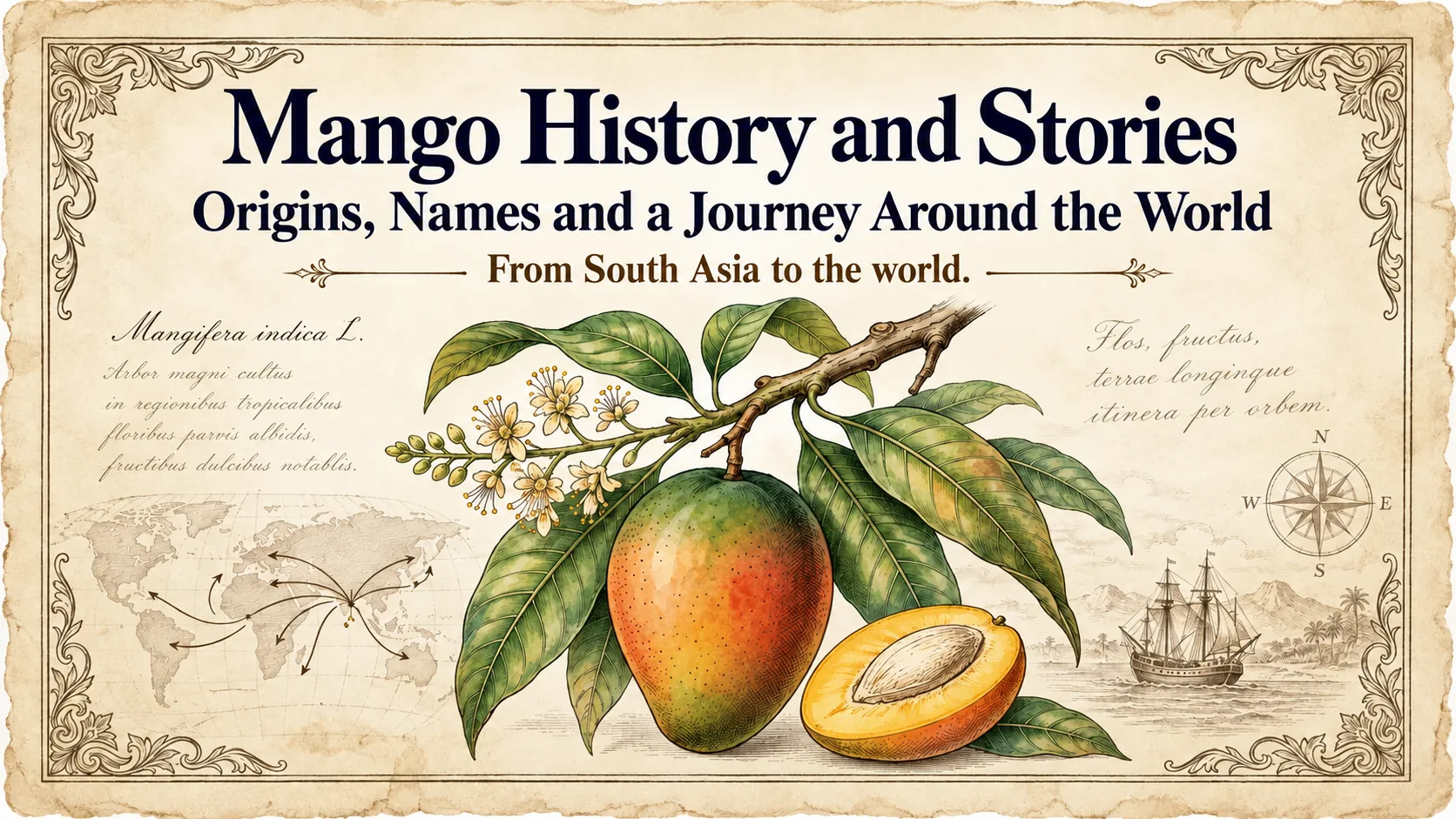
Cultivated mangoes come from South Asia, centred on India. Their name travelled from southern Indian languages through Portuguese, while trade carried the fruit into Southeast Asia, Africa and the Americas.
The ripe flesh glows orange like a sunset. Peel the fruit, and a sweet fragrance fills the air.
Mangoes have a long history of cultivation. From South Asia, they travelled with merchants and became part of royal orchards, religious traditions, textiles and New Year offerings.
This is the story of one fruit’s journey. For taste, nutrients and varieties, read Mango Guide; for prices, choosing and cutting, see How to Eat Mangoes in Vietnam.
Mango origins: South Asia and India
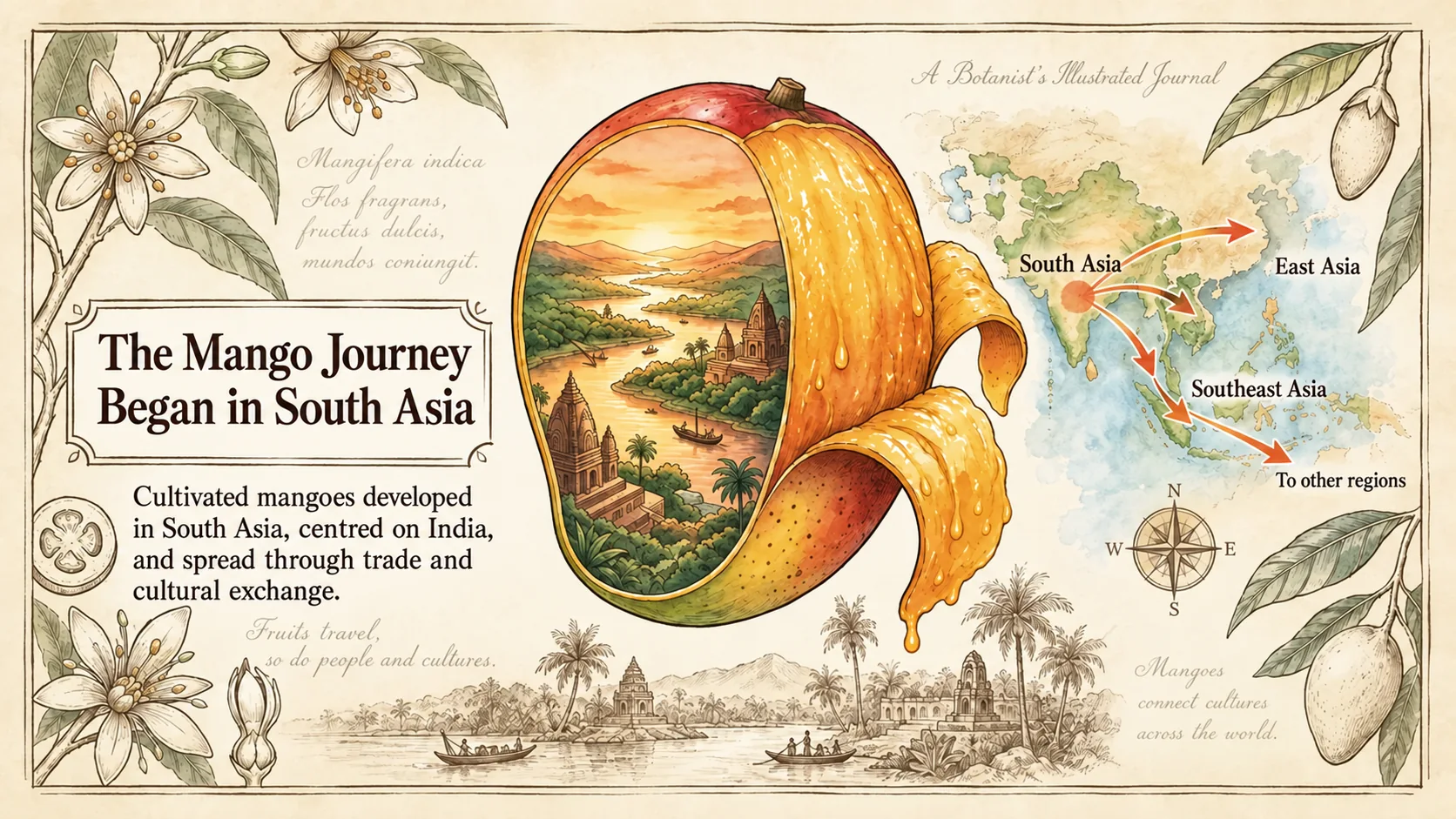
Cultivated mangoes originated in South Asia, centred on India. When wild relatives are included, the broader region of diversity extends into Southeast Asia.
People are thought to have grown and eaten mangoes here for thousands of years. Ancient Indian writings and traditions mention them. Over generations, growers selected trees with desirable fruit and passed on their qualities.
Grafting became a widely used way to preserve a good tree’s characteristics. Earlier bearing and more consistent fruit quality helped growers establish many cultivars.
Where the word “mango” comes from
The fruit’s name carries a trace of its homeland.
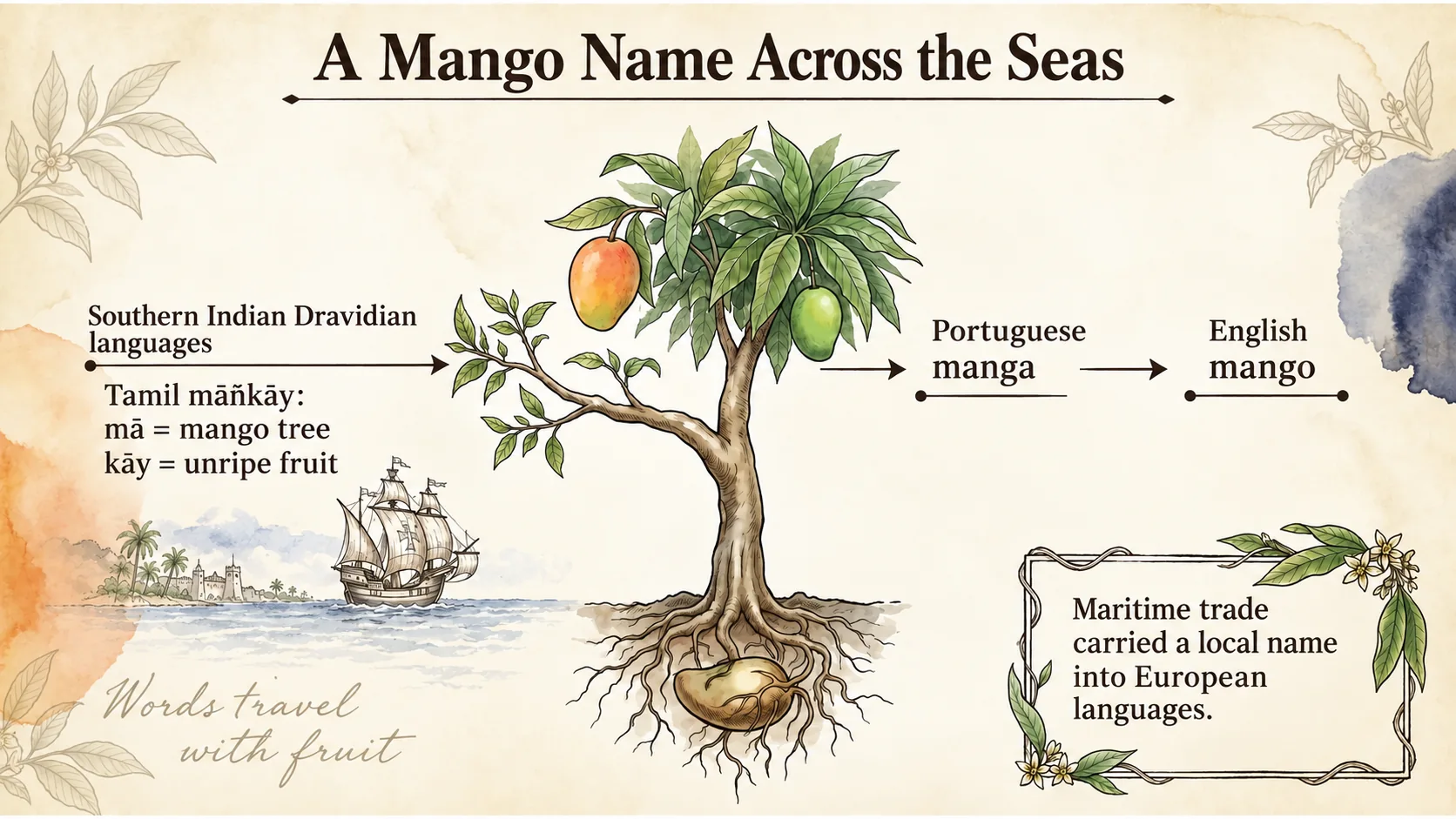
English mango is generally traced through Portuguese manga to words in southern Indian Dravidian languages, including Tamil māṅkāy: mā for the mango tree and kāy for unripe fruit. Maritime trade carried the local name into European languages.
As described in the Pineapple Story, pineapple’s English name reflects its resemblance to a pine cone. Mango’s name instead travelled across languages while retaining much of its earlier form.
The mango journey: Asia, Africa and the Americas
Mangoes travelled both east and west.
Merchants carried the fruit westward. Arab and Persian trade helped bring Asian mangoes to East Africa during the medieval period. In the fourteenth century, the traveller Ibn Battuta recorded mangoes in Mogadishu.
Portuguese trading and colonial networks later extended this journey from Goa to Africa. Introductions to the Western Hemisphere came later: accounts place mangoes in Brazil around 1700, the West Indies around 1740 and Florida in 1833.
Land and sea routes also carried mangoes east. Southeast Asia has many related Mangifera species, and cultivated mangoes became part of local food cultures. Accounts of their arrival in China differ, so it is difficult to assign one definite dynasty or date.
Unlike pineapple, which travelled from South America to Europe during the age of oceanic exploration, mangoes had already begun spreading east and west from Asia much earlier.
Mangoes and the Mughal Empire: Akbar’s great orchard
The sixteenth-century Mughal Empire offers a striking example of mangoes and royal prestige.
Emperor Akbar is traditionally credited with establishing an orchard of 100,000 mango trees at Darbhanga in today’s Bihar during the 1580s. It became known as Lakh Bagh, the “garden of a hundred thousand”.
The Mughal court encouraged orchards and grafting, preserving valued flavours and fragrances. This does not establish that every later named cultivar originated in that particular orchard.
Mangoes were also diplomatic gifts. Sent through courtly networks from Kabul to Bengal, they could express both imperial reach and generosity.
Mangoes in Japan: Irwin and greenhouse cultivation
Irwin makes up the great majority of mangoes grown in Japan.
The cultivar takes its name from F. D. Irwin of Florida. A Lippens seedling he raised first fruited in 1945. Haden is considered the likely pollen parent, though the tree was open-pollinated. Irwin subsequently spread to Japan and other growing regions.
JIRCAS places the first Japanese mango introductions in the middle of the Meiji era. They arrived as seeds, so cultivar names were not recorded. In 1958, four cultivars, including Haden, were introduced to Okinawa from the University of Hawaii.
Early cultivation did not become established. Rain during flowering complicated pollination and disease control. Greenhouse techniques introduced during the 1980s helped protect flowering trees from rain and supported commercial production.
A fruit with an ancient history became familiar on Japanese tables only in recent decades.
Mango flowers and pollination
Knowing the fruit’s long journey changes how a single mango looks on a shop shelf.
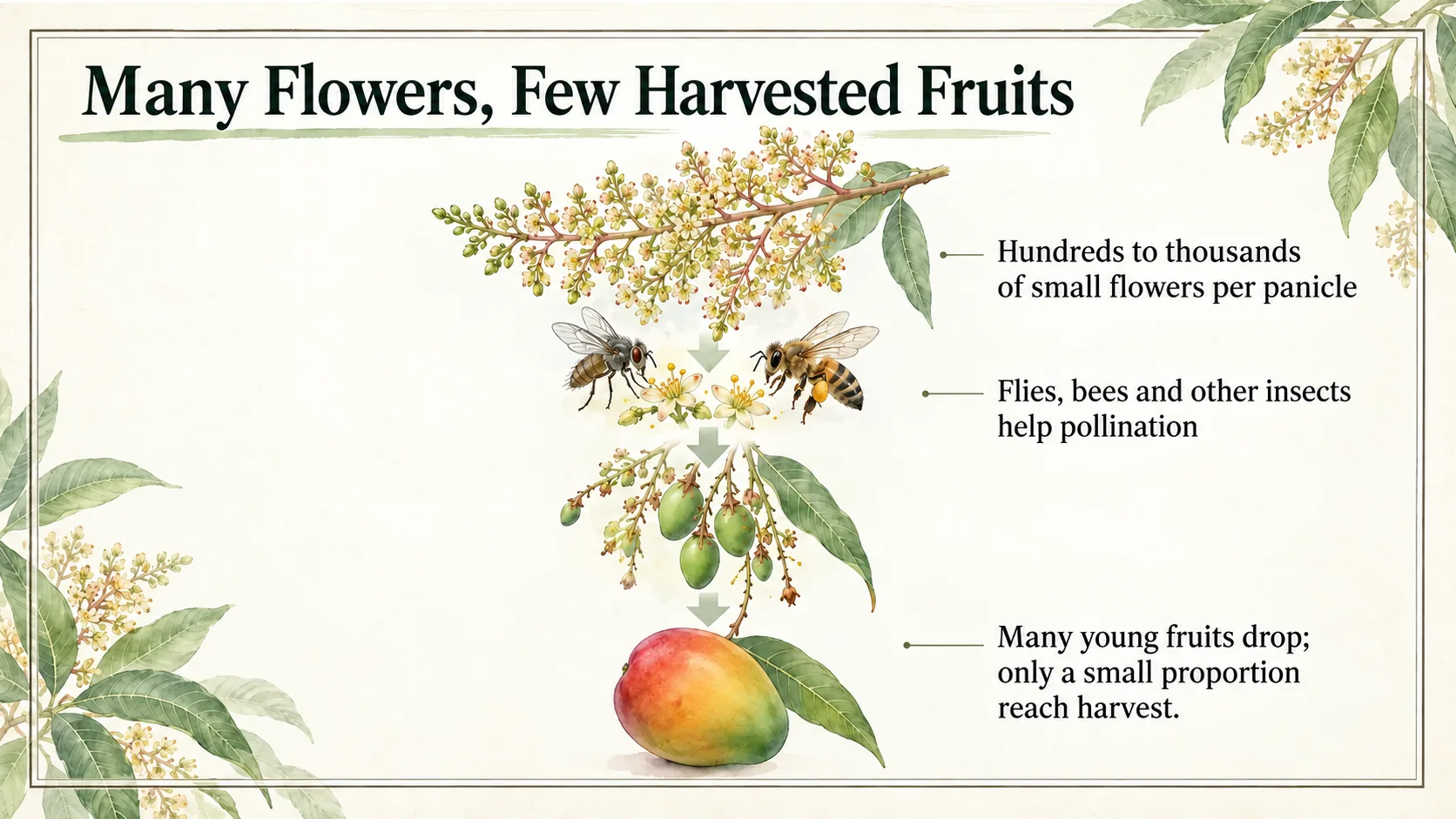
A mango panicle carries hundreds to thousands of small flowers, but only a small proportion yield harvested fruit. Flies, bees and other insects visit the flowers and help pollination.
Long ago, someone in South Asia selected a good fruit and grew its tree. A mango in our hands carries the accumulated choices of many generations.
Mangoes in culture: faith, patterns and national symbols
The following stories include religious traditions and symbols shaped over time, alongside historical events. People have found meaning in the mango’s fragrance, colour and form.
India: auspicious leaves
In parts of India, mango-leaf garlands called toran decorate entrances during festivals and celebrations. Their forms and meanings vary by region and occasion, but the leaves are widely used as auspicious decorations.
The mango tree became part of everyday life and religious practice, beyond its role as a source of fruit.
Buddhist tradition: the miraculous mango seed
Buddhist traditions preserve stories connecting the Buddha and a mango tree.
One account tells how the Buddha announced that he would perform a miracle beneath a mango tree at Śrāvastī. Rival teachers removed nearby trees. On the appointed day, a gardener offered a mango; when its seed was planted, a tree immediately grew and flowered.
This is a religious narrative, not a verified historical event. Its use of a mango nevertheless shows how familiar the fruit was in the cultural world that preserved the story.
A pattern woven around the world
The curved teardrop form known as paisley is sometimes compared with a mango in South Asia.
The motif is associated with Persian boteh, a term linked to a shrub or floral cluster. Its form has been interpreted as a cypress, shoot, bouquet or mango. It cannot be assigned exclusively to mango as its origin. Kashmir shawls bearing the motif became fashionable in nineteenth-century Europe.
The Scottish town of Paisley became a major manufacturing centre, using Jacquard looms to reproduce the pattern. Its name eventually became attached to the motif. The Pineapple Story explores fruit in architecture; mango-like forms still appear across textile traditions.
A fruit representing a nation
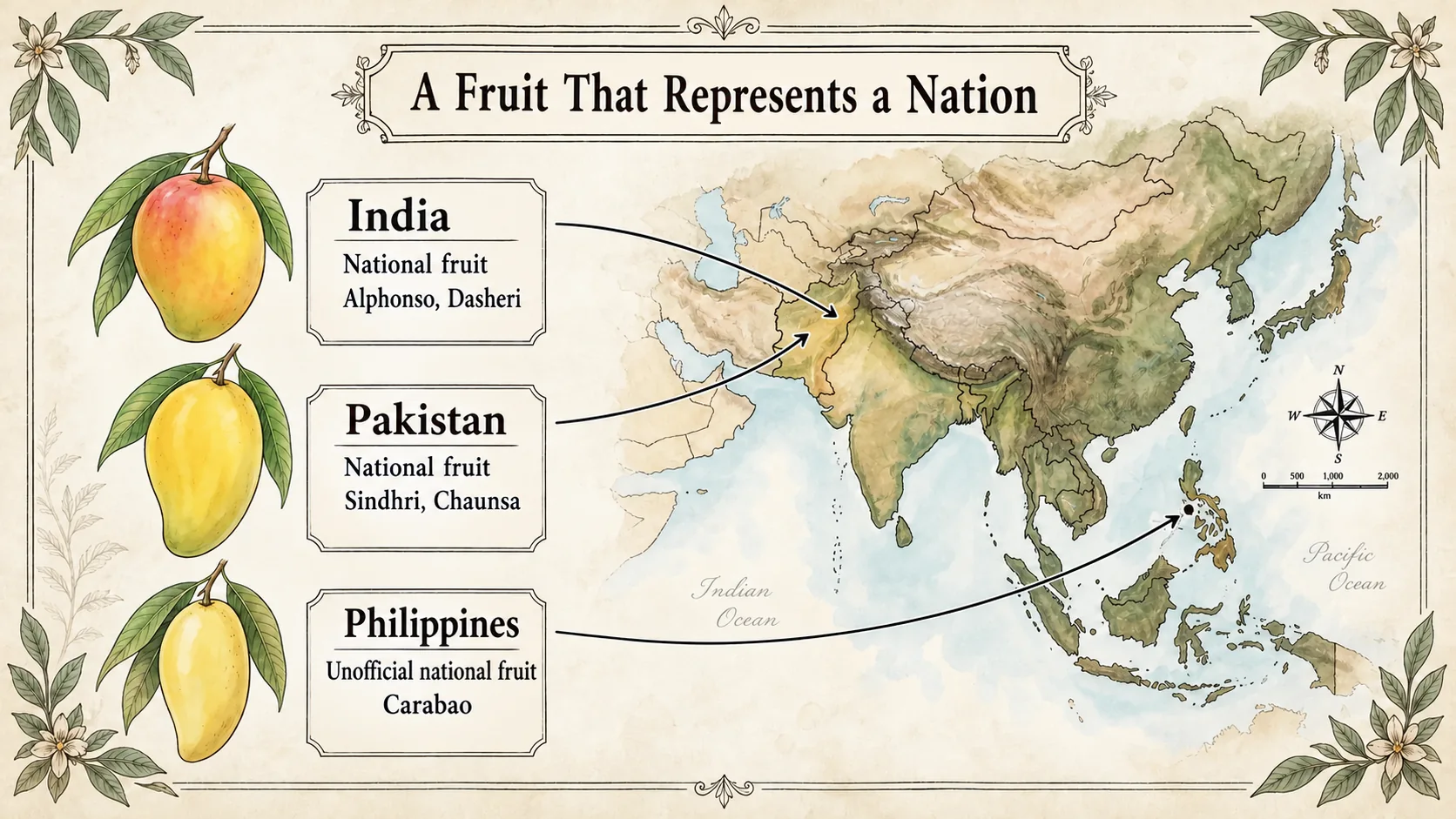
Mango is described as the national fruit of India and Pakistan. In the Philippines, it is widely regarded as a national symbol, while congressional material describes it as an unofficial national fruit and discusses proposals to formalise that status.
Each country has celebrated cultivars: India’s Alphonso and Dasheri, Pakistan’s Sindhri and Chaunsa, and the Philippines’ Carabao or Manila mango. The diversity explored in Mango Guide also reflects regional pride.
Vietnam: wishes on the Tết fruit tray
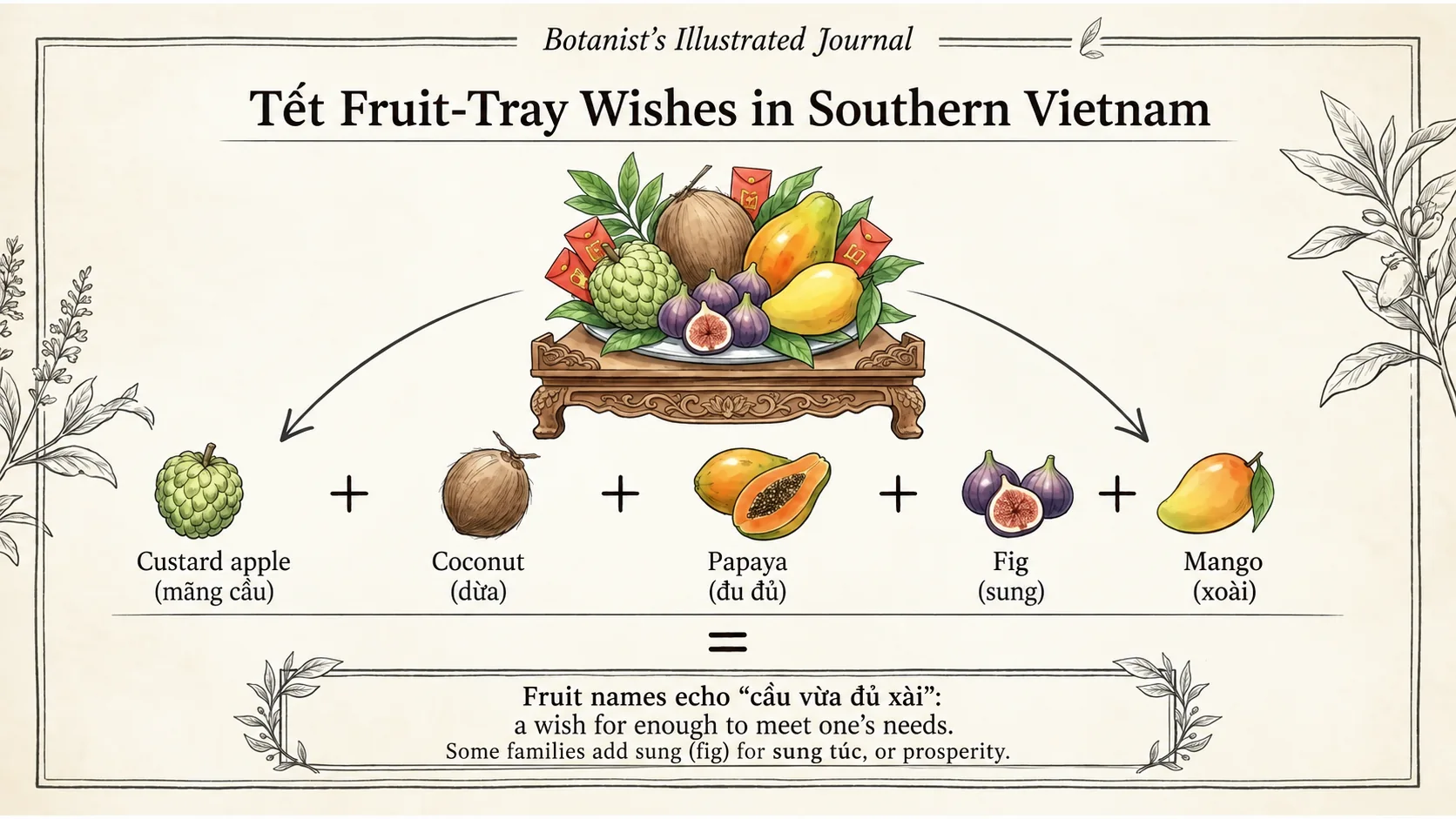
In southern Vietnam, a mâm ngũ quả, or five-fruit tray, forms part of Lunar New Year celebrations.
A familiar southern combination uses custard apple (mãng cầu), coconut (dừa), papaya (đu đủ) and mango (xoài). Their names echo cầu vừa đủ xài, a wish for enough to meet one’s needs. Some households add figs (sung), associated with sung túc, or prosperity.
The mango becomes part of a quiet wish that a family will have enough throughout the coming year.
Related stories about papaya, coconut and custard apple use the simpler four-word version. Fruit combinations vary by region and household.
The history within one fruit
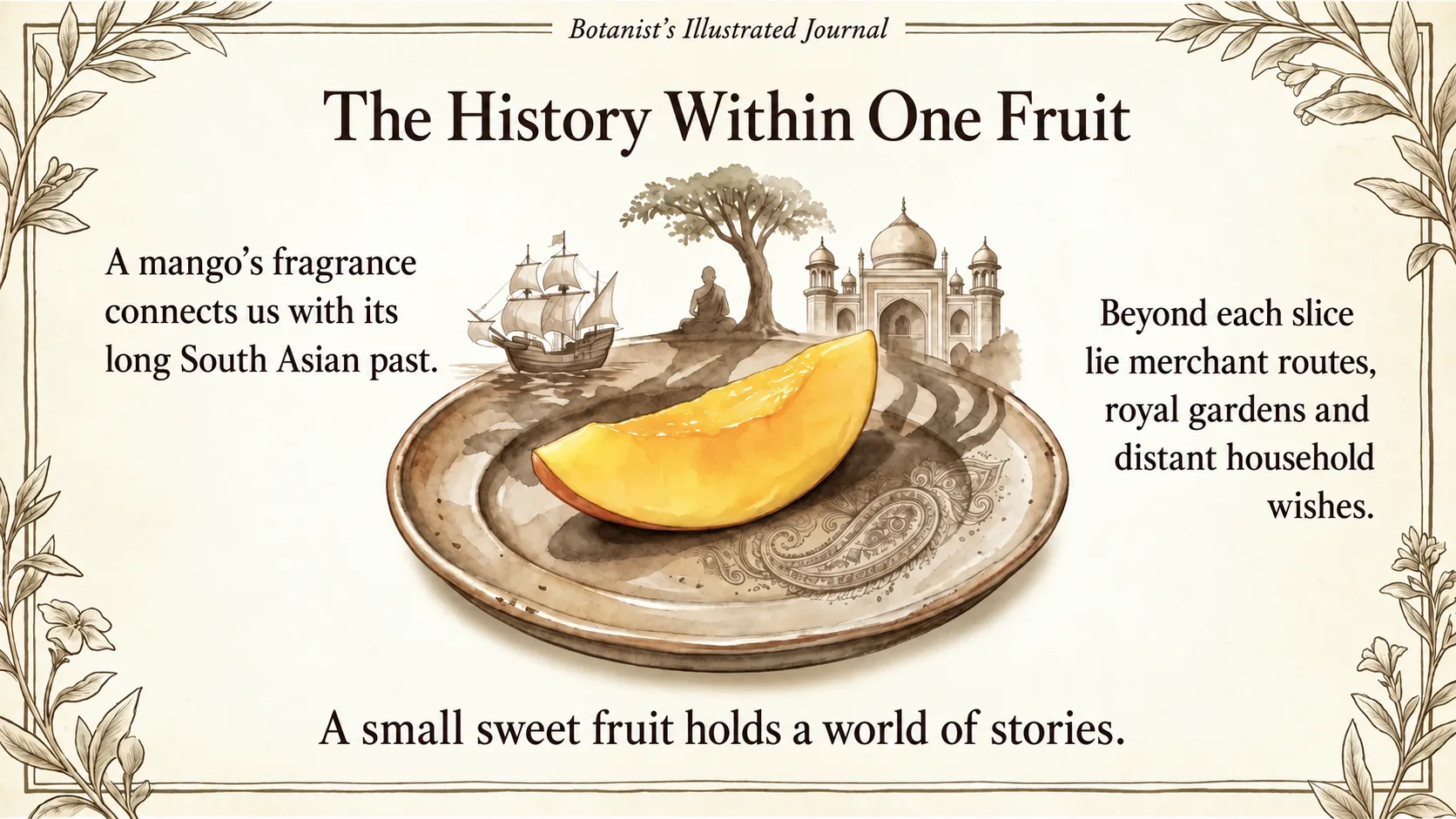
From South Asian soils to Buddhist traditions, Mughal gardens and textile motifs, mangoes took root in many places and acquired new meanings.
Yet the fragrance released when we peel one may feel familiar to people across those distant times.
The next time you taste a slice, imagine the merchant routes, royal gardens and household wishes that lie beyond it.
A single fruit holds a world of stories.
Related articles
- Taste, nutrition, varieties and botanical family: Mango Guide.
- Prices, choosing, cutting and storage: How to Eat Mangoes in Vietnam.
- More fruit to enjoy in Vietnam: 15 Fruits Vietnamese People Eat After Meals.
References
Main sources
- JIRCAS: Mango origins and domestication
- JIRCAS: Introduction of mango to Japan
- JIRCAS: Mango pollination
- Oxford Learner’s Dictionaries: mango
- Government of India Press Information Bureau: National Fruit
- Philippine House of Representatives: Mango as national fruit; described as unofficial
- Pakistan Trade Development Authority: Mango Brochure
- Encyclopaedia Britannica: Mango
- California Rare Fruit Growers: Mango
- CBSE: Agriculture; account of Akbar’s orchard
- Maharashtra State Gazetteers: Festivals; mango-leaf toran
- Religions: Significance of the Śrāvastī Miracles According to Buddhist Texts and Dvāravatī Artefacts
- RISD Museum: The Paisley Pattern in Kashmir Shawls
- Thanh Niên: Southern Vietnamese New Year fruit-tray wordplay
