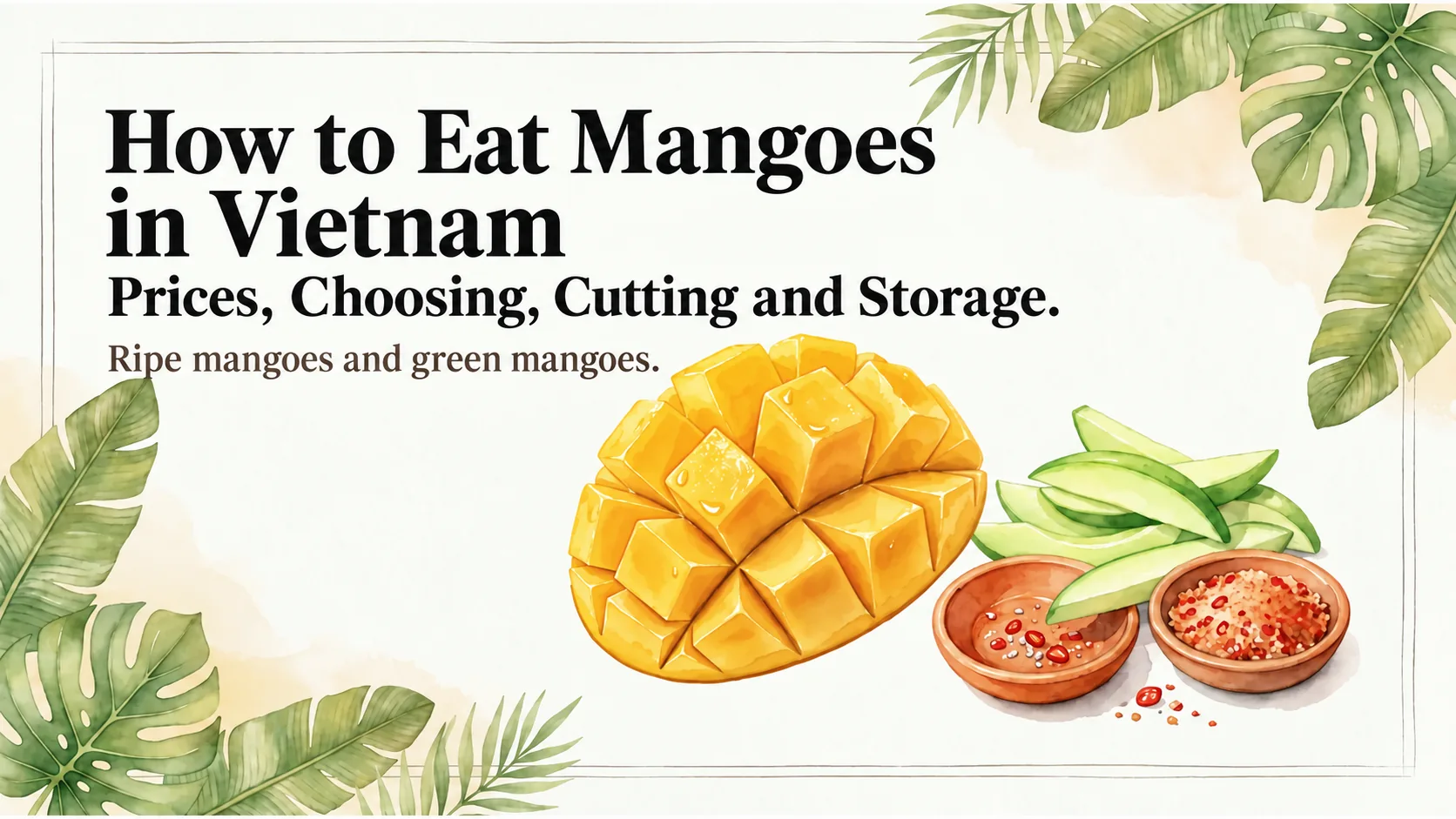
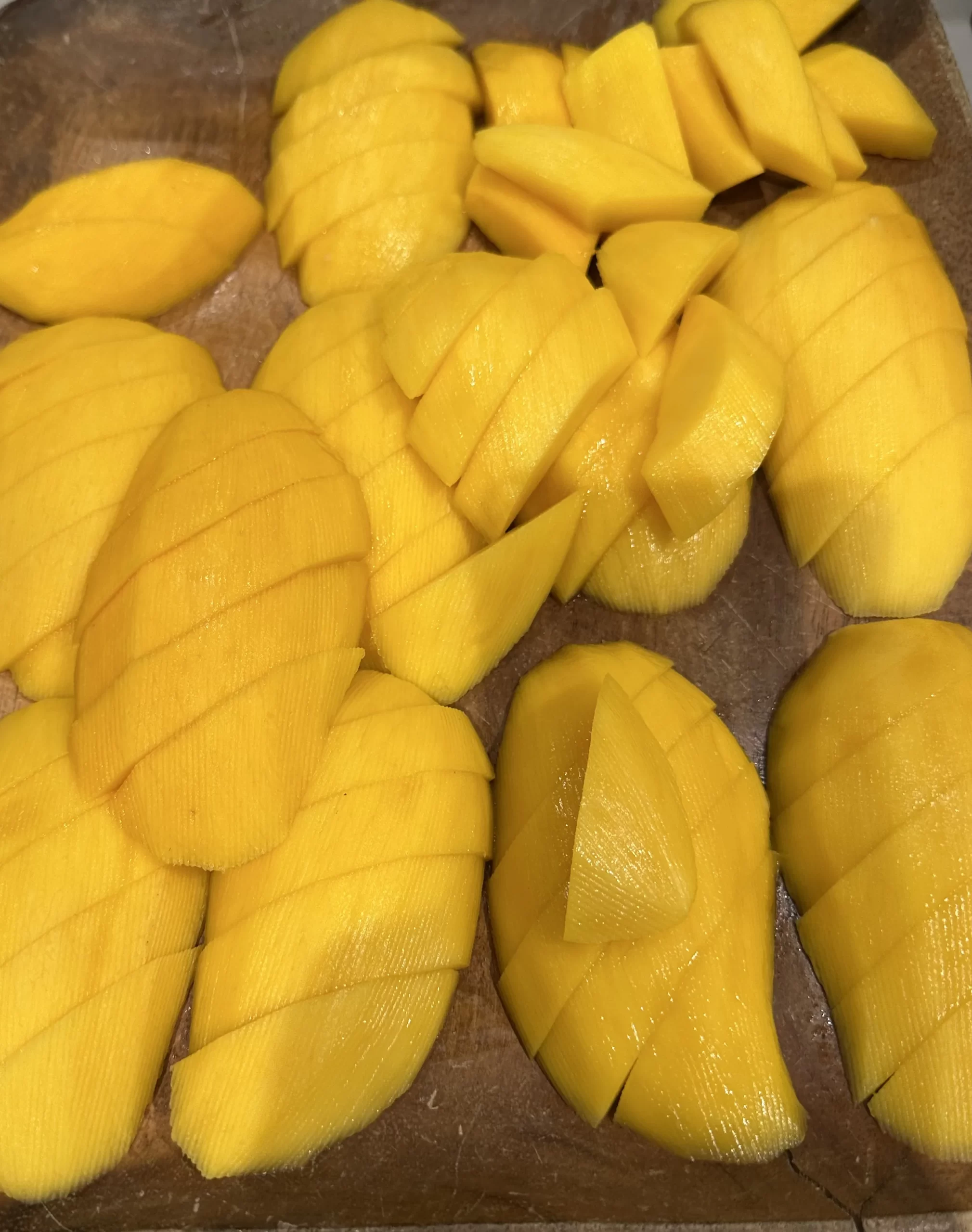
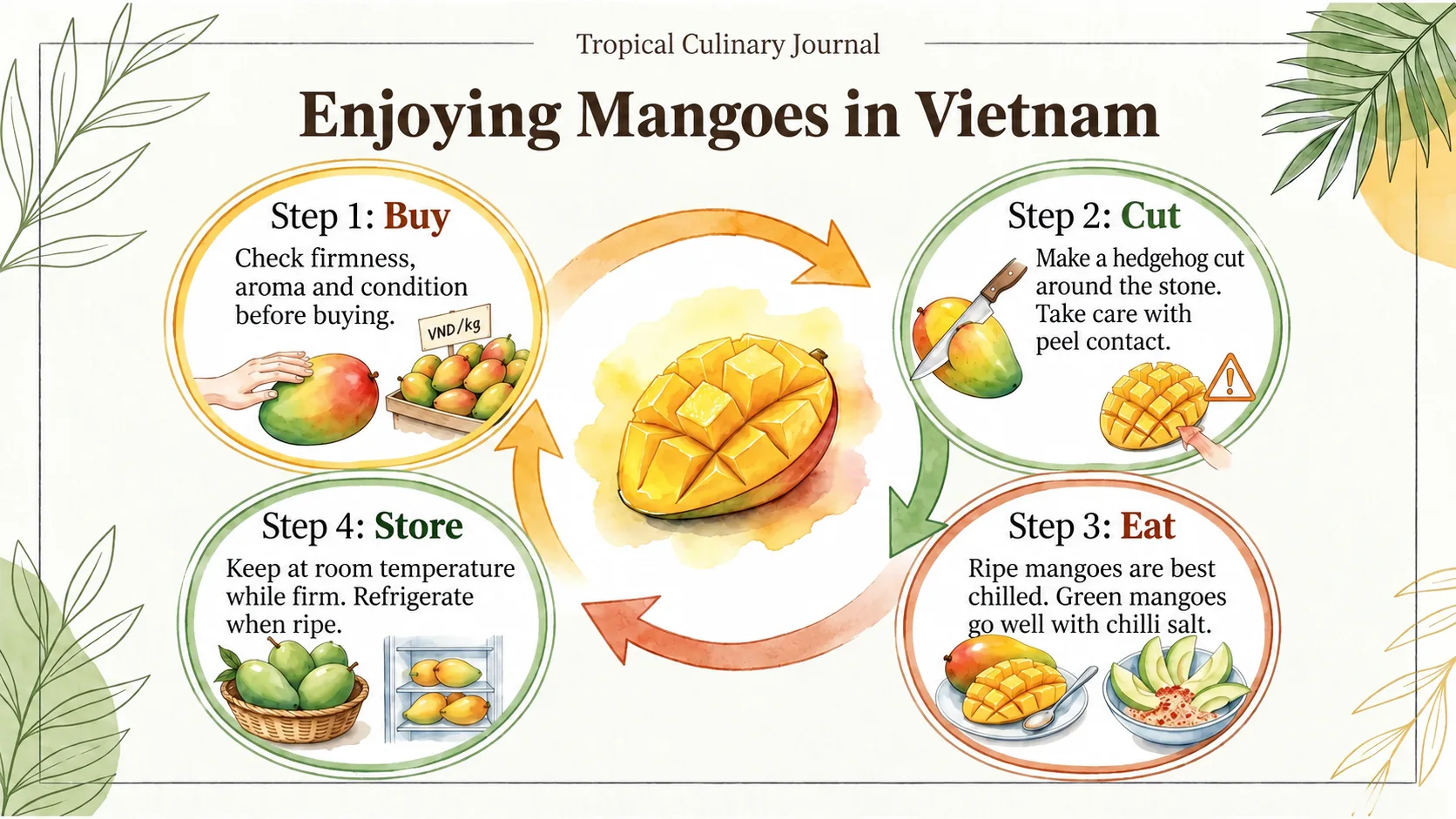
For ripe mangoes, cut along both sides of the flat stone, then score the flesh into a grid for a hedgehog cut. Thin green-mango slices with chilli salt offer a distinctly Vietnamese way to enjoy the fruit.
Market stalls and supermarkets display mangoes in many colours, from deep green to reddish orange. Which ones will be sweet, and how do you cut around the stone?
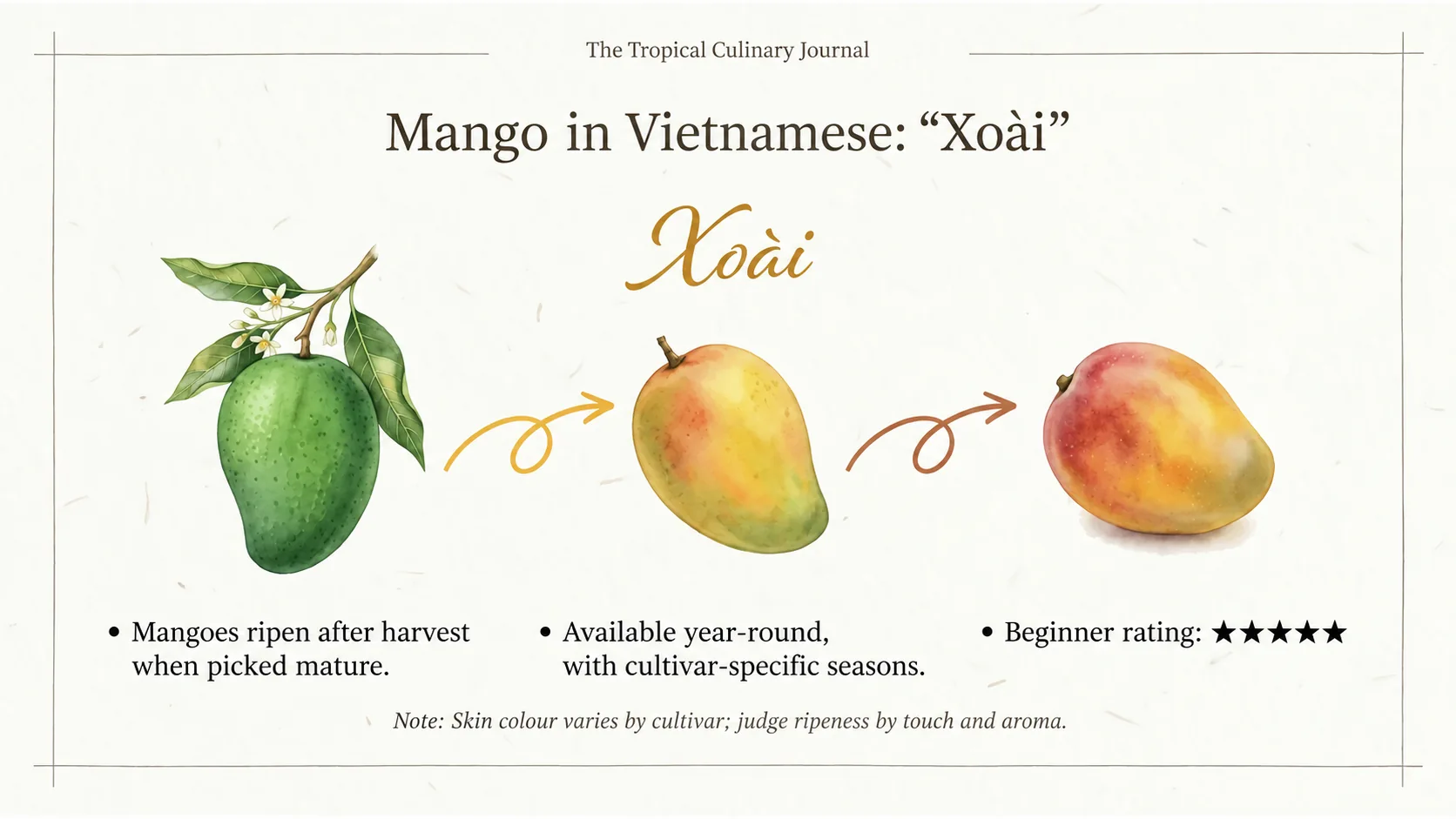
As explained in Mango Guide, mangoes continue ripening after harvest, unlike pineapples. Fruit harvested at adequate maturity can approach eating ripeness at room temperature even if still firm when purchased. Understanding this helps you choose and store it.
This guide follows the practical sequence: find mangoes, check the price, choose, cut, eat and store.
Vietnamese mangoes at a glance
| Item | Details |
|---|---|
| Vietnamese name | Xoài |
| Approximate pronunciation | “Swai”; pronunciation varies by dialect |
| Taste | Typically sweet and fragrant when ripe, with considerable cultivar differences |
| Texture | Soft and juicy when ripe; firm and refreshing when unripe |
| Availability | Sold year-round; harvest seasons differ by cultivar. See the Mango Guide for more detail. |
| Observed price examples | Cát Chu: 49,000 VND/kg; Cát Hòa Lộc: 85,000 VND/kg at a Hanoi supermarket on 18 July 2026. Prices vary by cultivar, shop and season. |
| Where to buy | Markets, street fruit sellers, supermarkets and specialist fruit shops |
| Basic cutting method | Hedgehog cut: remove the cheeks around the stone and score a grid |
| Local ways to eat | Green mango with chilli salt; shaken mango, Xoài lắc |
| Beginner rating | ★★★★★ |
The Vietnamese word is “Xoài”
Mango is generally called Xoài in Vietnamese. Its everyday name varies less by region than the names for pineapple described in the Pineapple Guide.
The following phrase is useful when asking a market price. Mangoes are often sold by weight rather than by the piece.
Một ký bao nhiêu tiền?
“How much is one kilogram?”
To ask a seller to cut the fruit, try this phrase.
Cắt giúp tôi nhé.
“Please cut it for me.”
If pronunciation is difficult, showing the sentence on your phone can help.
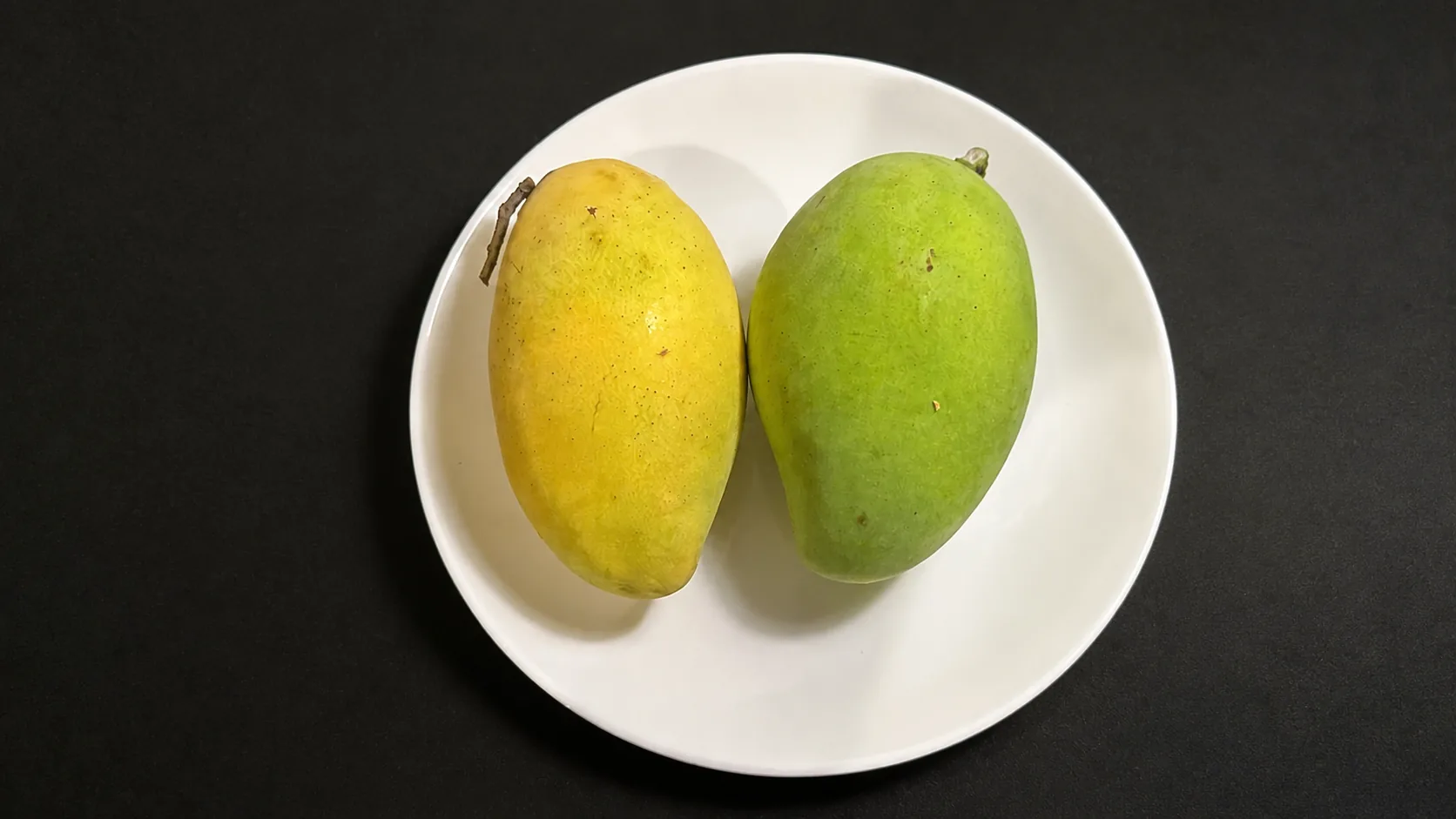
Ripe mangoes and green mangoes: taste and texture
Vietnamese mango cultivars differ substantially. Cát Chu is relatively low in fibre and sweet when ripe. Cát Hòa Lộc is a prized southern cultivar with rich sweetness and fragrance. See Mango Guide for more about the varieties.
Ripe mangoes have soft, juicy flesh. Depending on cultivar, the skin may turn yellow or develop red colour, or remain partly green. Unripe green mangoes are firm and tart, and Vietnamese food culture makes good use of that texture.
How much do mangoes cost in Vietnam, and where can you buy them?
Prices vary with cultivar, origin, season and shopping location.
At a Hanoi supermarket on 18 July 2026, the author recorded Cát Chu at 49,000 VND/kg and Cát Hòa Lộc at 85,000 VND/kg, discounted from 95,000. Green mango bought on another occasion cost 130,000 VND/kg. These are observed examples, not current guaranteed prices. Check the unit and total at purchase; the tasting notes below provide the original context.
Open-air markets and street sellers
These often offer a choice of cultivars and sales by weight, so you can buy the amount you need. If no price is displayed, agree on it before ordering.
Supermarkets
Labels make weight and prices easier to compare, and pre-cut fruit may be available. They are convenient if you prefer less negotiation or want to compare handling conditions.
Specialist fruit shops and delivery apps
It can be easier to request a particular cultivar, though prices may exceed those at markets. Check whether the displayed price is per fruit or per kilogram.
How to choose a sweet mango
Unlike pineapple, mango is a climacteric fruit that continues ripening after harvest. As explained in Mango Guide, fruit harvested at adequate maturity can be bought firm and ripened at home for a few days.
Choose a different stage depending on whether you want to eat the mango now or later.
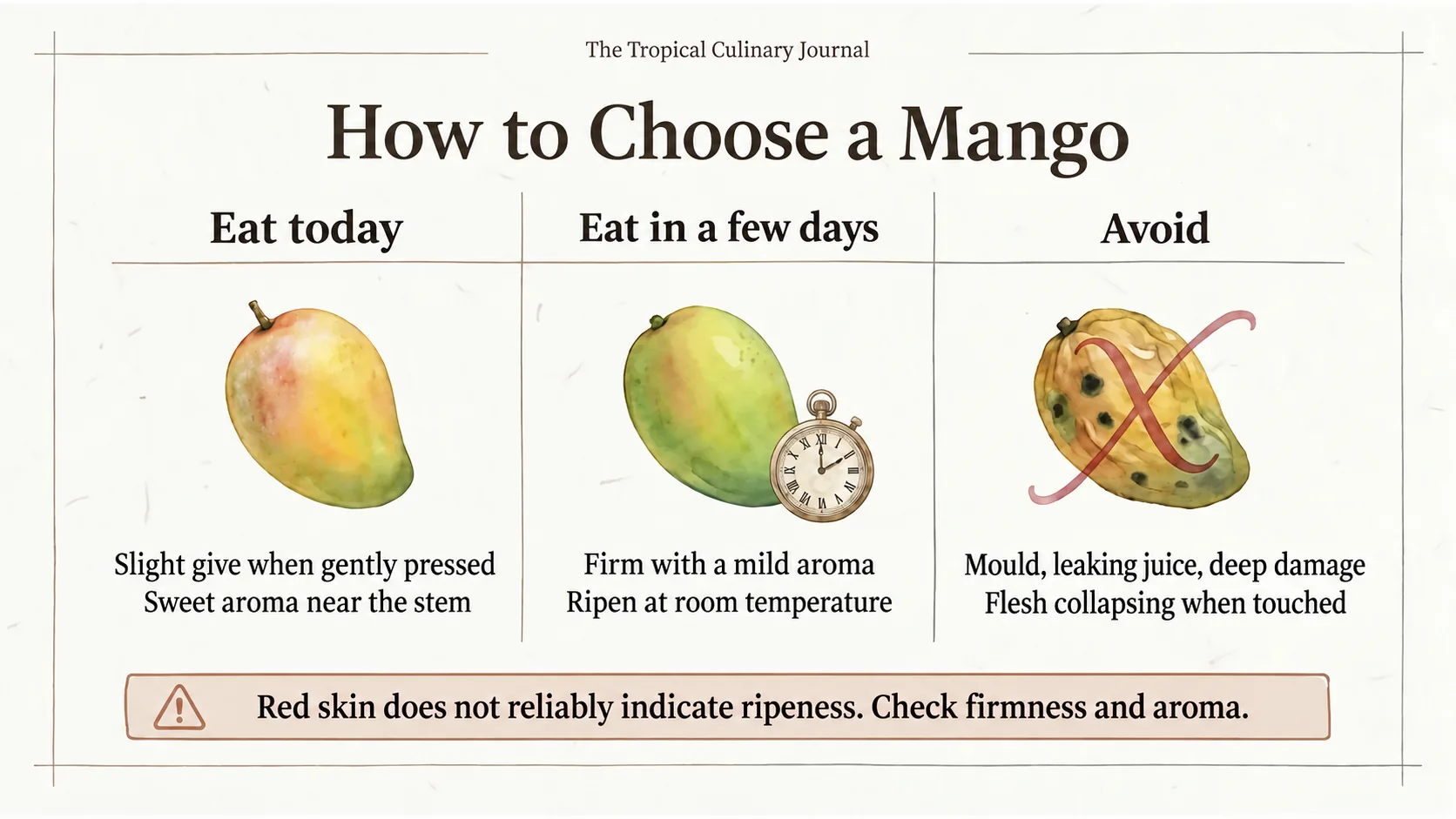
- Eat today: Choose fruit that gives slightly under gentle pressure and smells sweet around the stem.
- Eat in a few days: Choose firmer fruit with a milder aroma, then let it ripen at room temperature.
- Avoid: Mould, leaking juice, deep damage or fruit so soft that it collapses when touched.
Do not rely on skin colour alone. Red colour may be unrelated to ripeness, and some cultivars remain green when ripe. Check firmness first, then aroma and condition.
How to cut a mango around the flat stone
The large flat central stone makes uniform crosswise rings impractical. The widely used hedgehog cut removes the cheeks around the stone and scores their flesh into a grid.
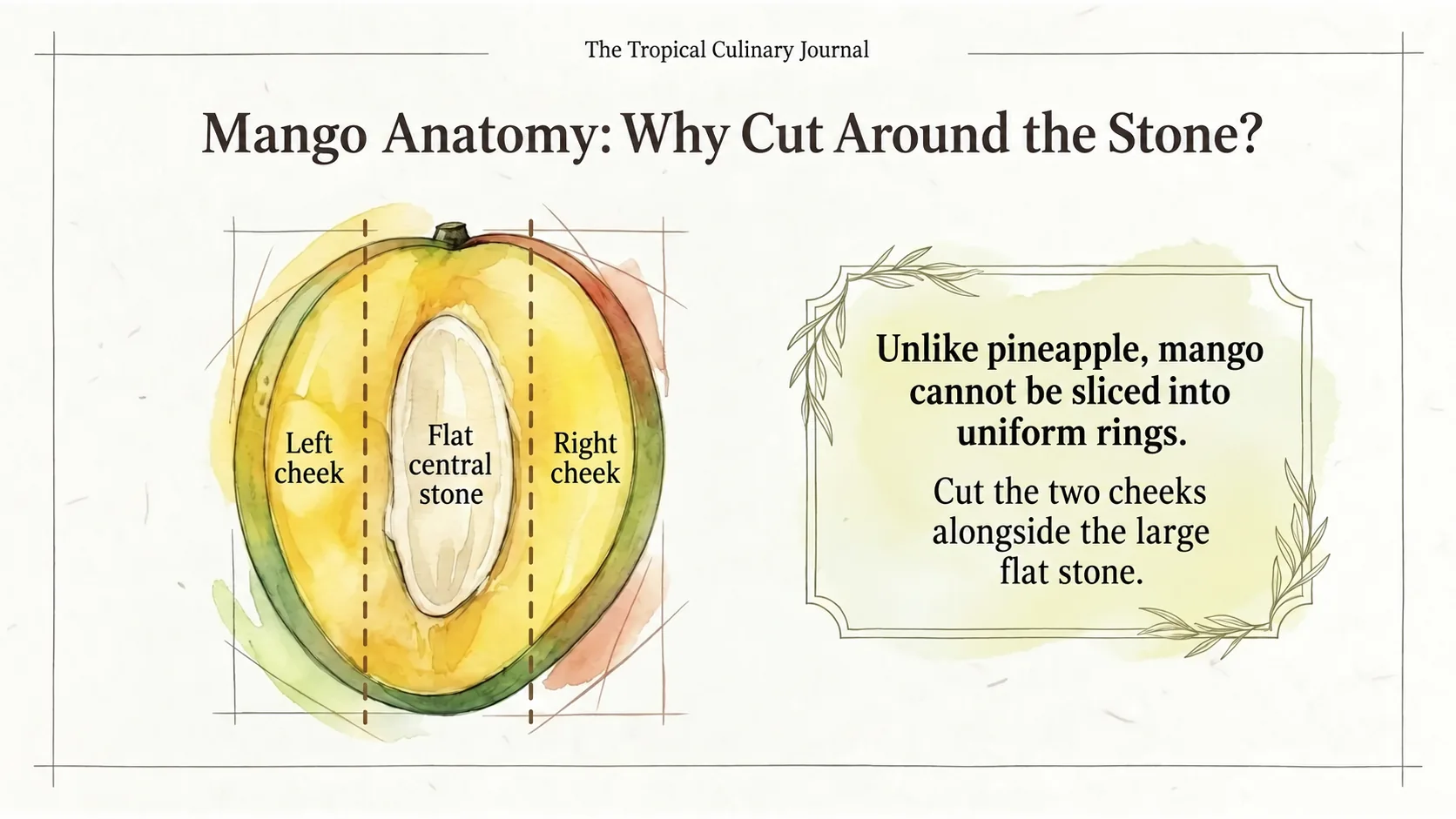
Wash the skin under running water immediately before cutting. Use a clean, stable board and a sharp knife. Mango peel and sap may contain contact allergens, as discussed in Mango Guide. If you have a relevant reaction history, avoid handling the peel yourself or use food-preparation gloves.
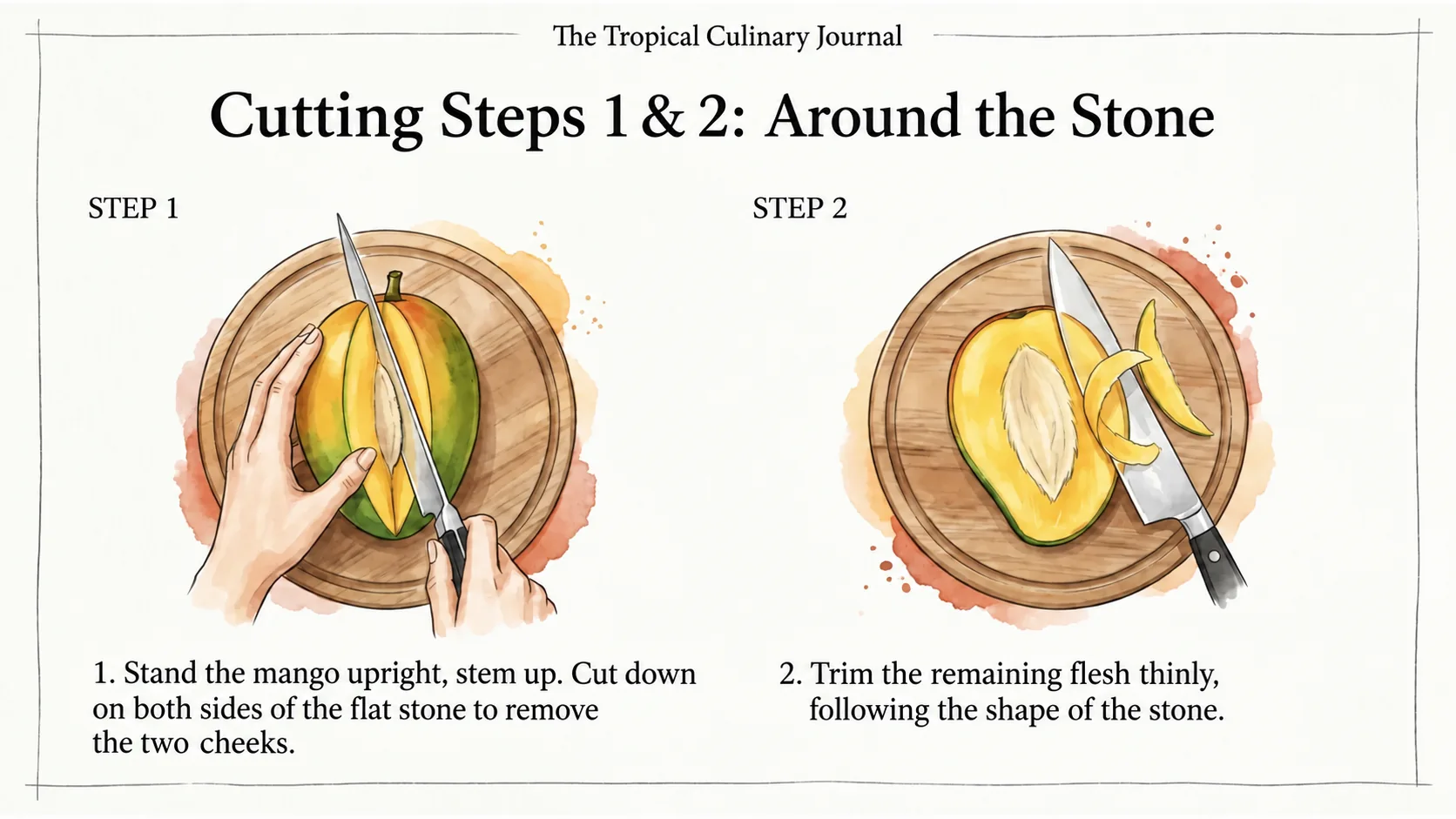
- Stand the mango upright and cut down slightly to one side of the centre, following the flat stone. Repeat on the other side to remove the two large cheeks.
- Trim the remaining flesh from around the stone. Follow its shape rather than forcing the knife through it.
- Score each cheek into a grid at roughly 1–1.5 cm intervals, taking care not to cut through the skin.
- Push the skin outward from underneath so the flesh stands up like a hedgehog.
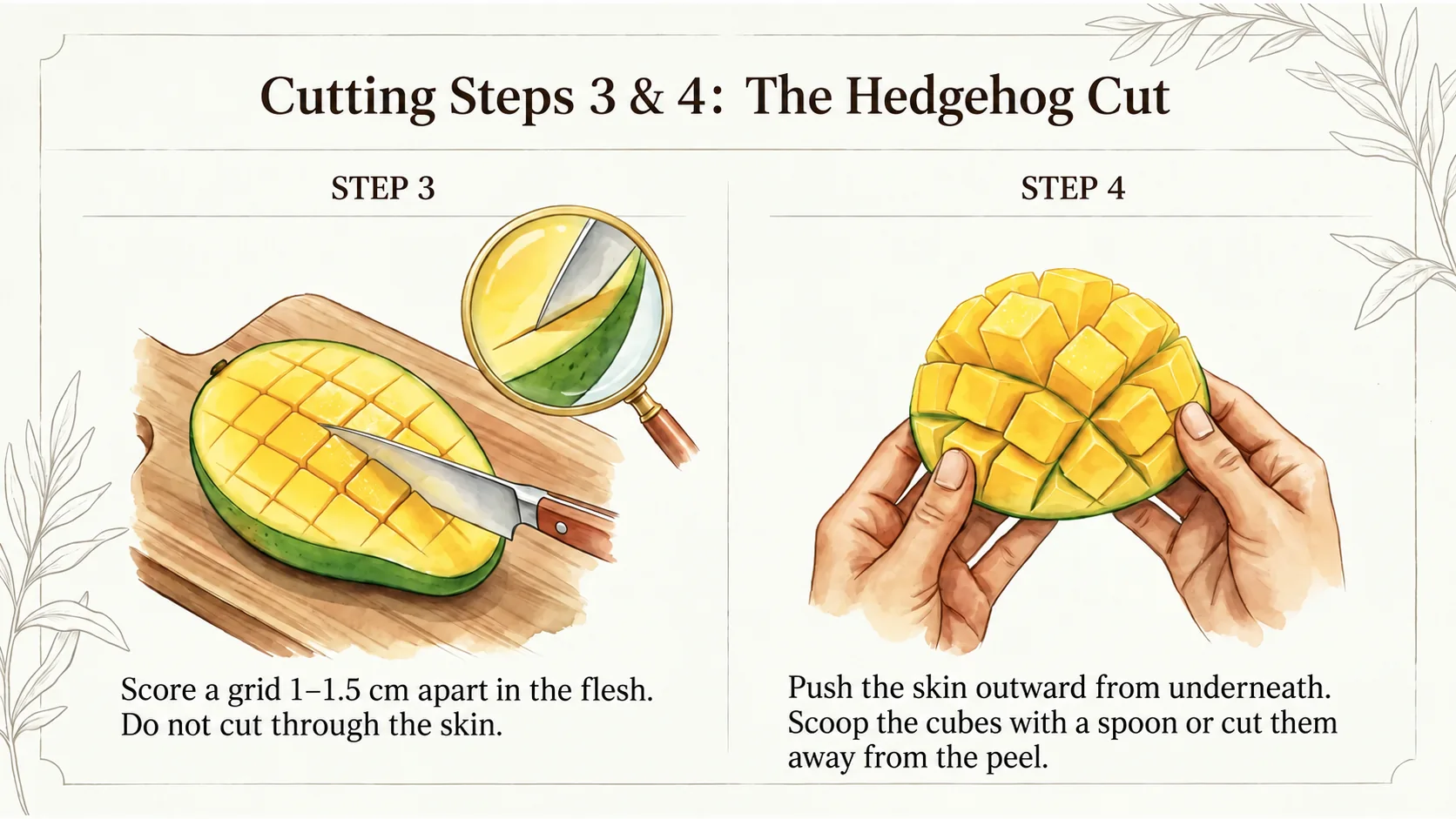
- Scoop the raised flesh with a spoon or cut carefully along the skin to separate it.
Vietnamese cooking guides also show this grid-and-invert method. It is the same practical technique used in many other countries.
Four ways to enjoy mangoes locally
1. Eat ripe mango fresh
A well-ripened mango needs little preparation beyond peeling and cutting. Chilling it makes a refreshing fruit plate on a hot day.
2. Try green mango with chilli salt
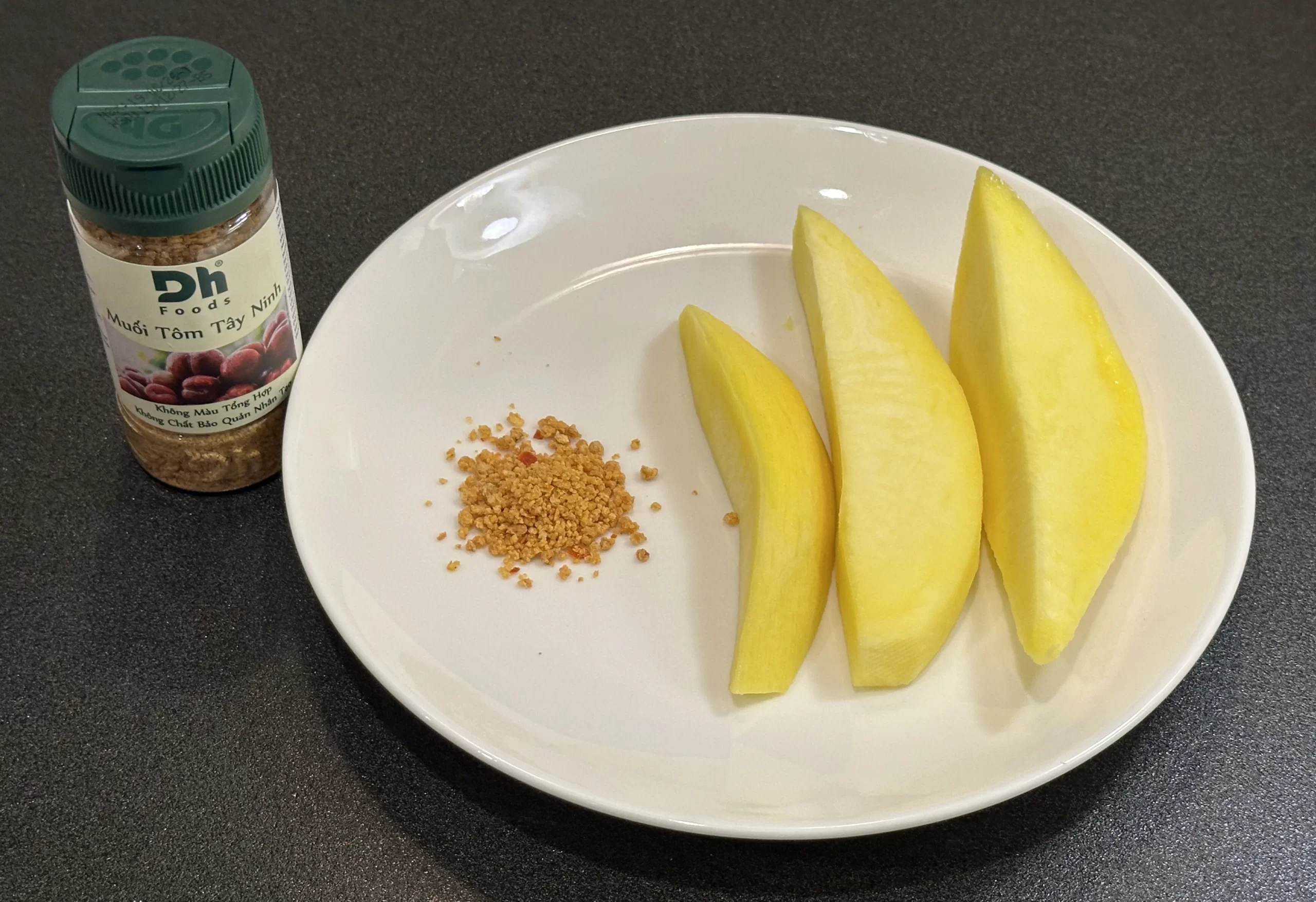
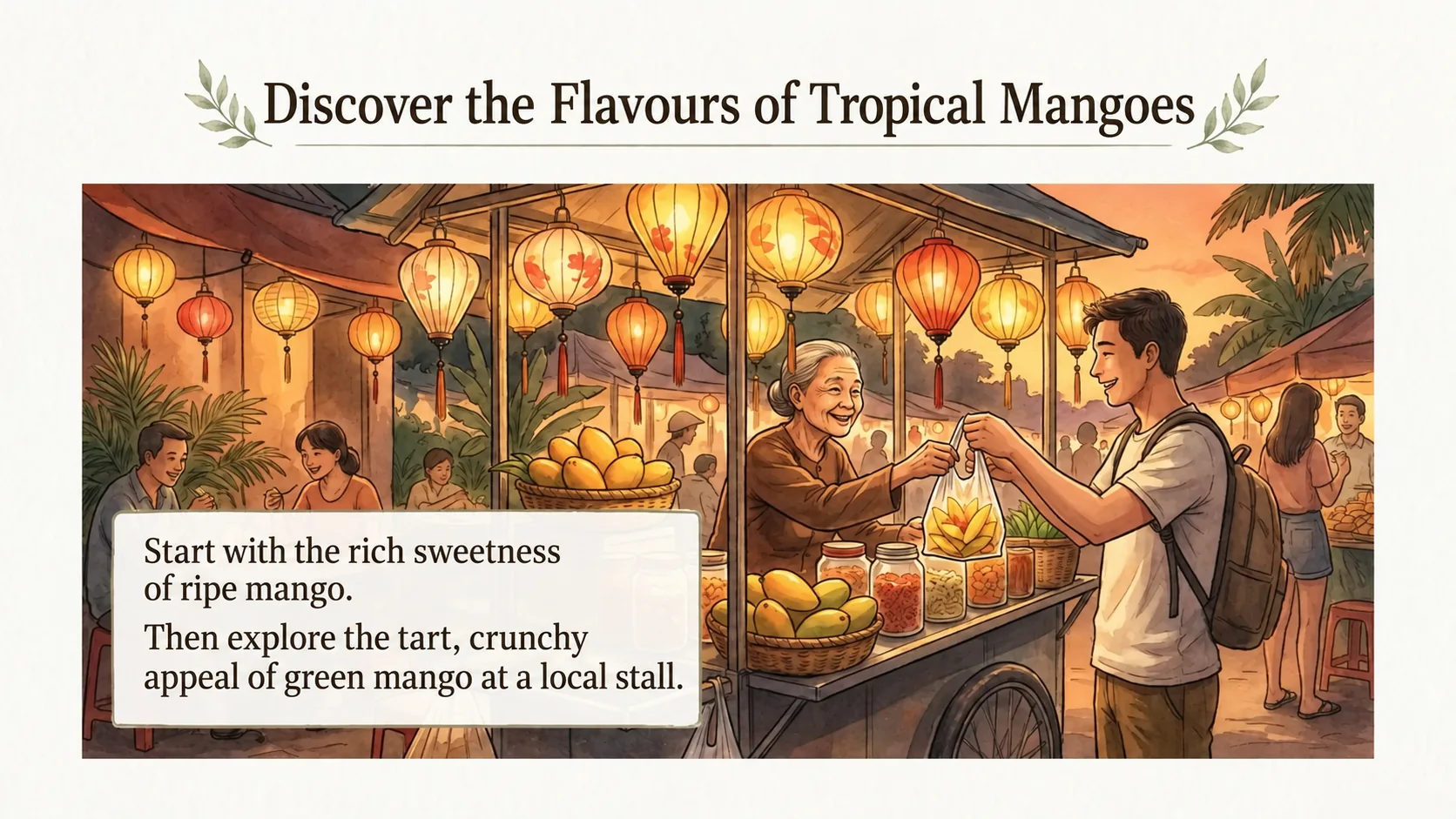
Thin green-mango slices dipped in Muối ớt, or chilli salt, are a familiar street snack. The Pineapple Eating Guide also introduces this seasoning. Salt and chilli balance the fruit’s tart crunch.
Gỏi xoài is a salad of shredded green mango with ingredients such as shrimp, onion and herbs, dressed with lime, fish sauce, sugar, chilli and garlic.
Xoài lắc, or shaken mango, combines cut green fruit with seasonings such as shrimp salt, sugar and chilli in a container, then shakes them together.
3. Enjoy juice or a smoothie
Ripe mango is used in juice and sinh tố smoothies. Condensed milk or sugar often adds richness. Many shops blend the drink to order, making it a familiar choice for visitors.
4. Choose dried mango as a souvenir
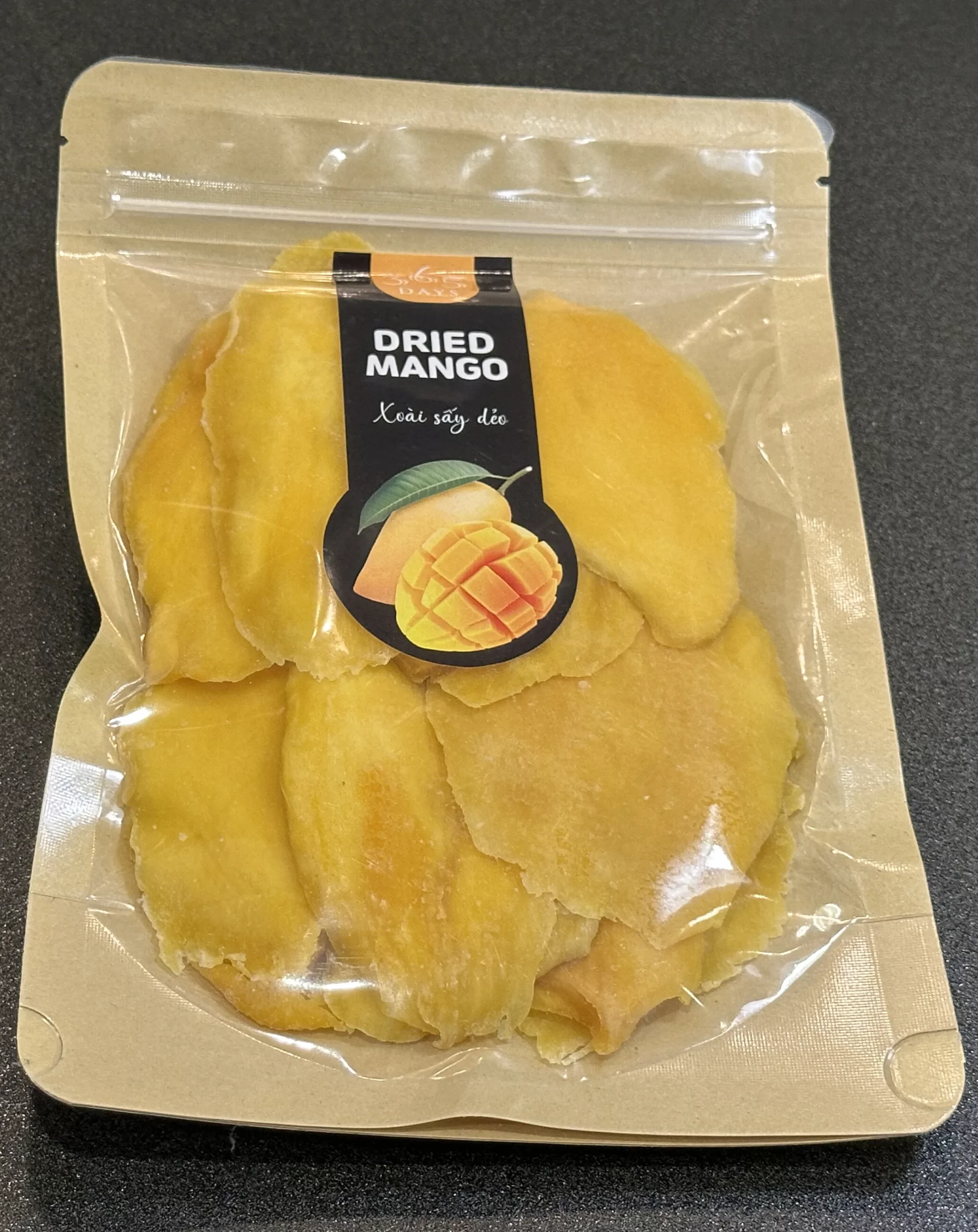
Soft dried mango, Xoài sấy dẻo, is a popular souvenir. Sấy means dried and dẻo suggests a soft, pliable texture. It is generally easier to transport than fresh fruit, though you should still check destination requirements.
Prices recorded by the author
Prices change with shop, date and pack size. These are examples observed or purchased by the author.
| Product | Recorded price | Context |
|---|---|---|
| Cát Chu mango | 49,000 VND/kg | Hanoi supermarket, 18 July 2026 |
| Cát Hòa Lộc mango | 85,000 VND/kg | Same date; discounted from 95,000 VND/kg |
| Green mango | 130,000 VND/kg | 0.438 kg purchased for 56,940 VND |
| Dried mango | 72,000 VND per 250 g | Author’s purchase example |
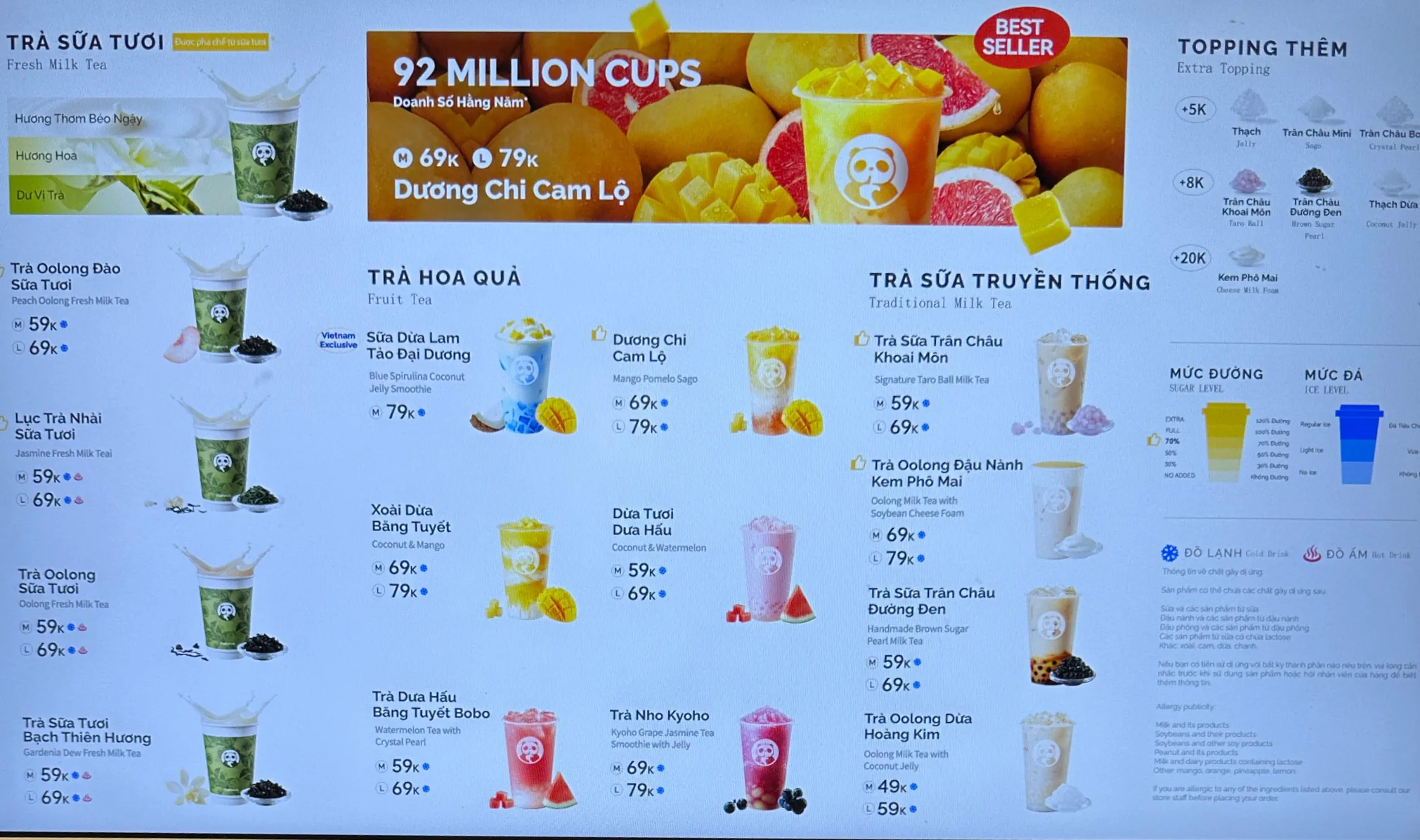
| Mango and coconut-milk drink | Medium: 69,000 VND; large: 79,000 VND | Observed at a local drink chain |
Storing mangoes: ripening, refrigeration and freezing
Pineapples do not become sweeter after harvest and are best eaten promptly. Mangoes continue ripening, so their condition determines where to store them.
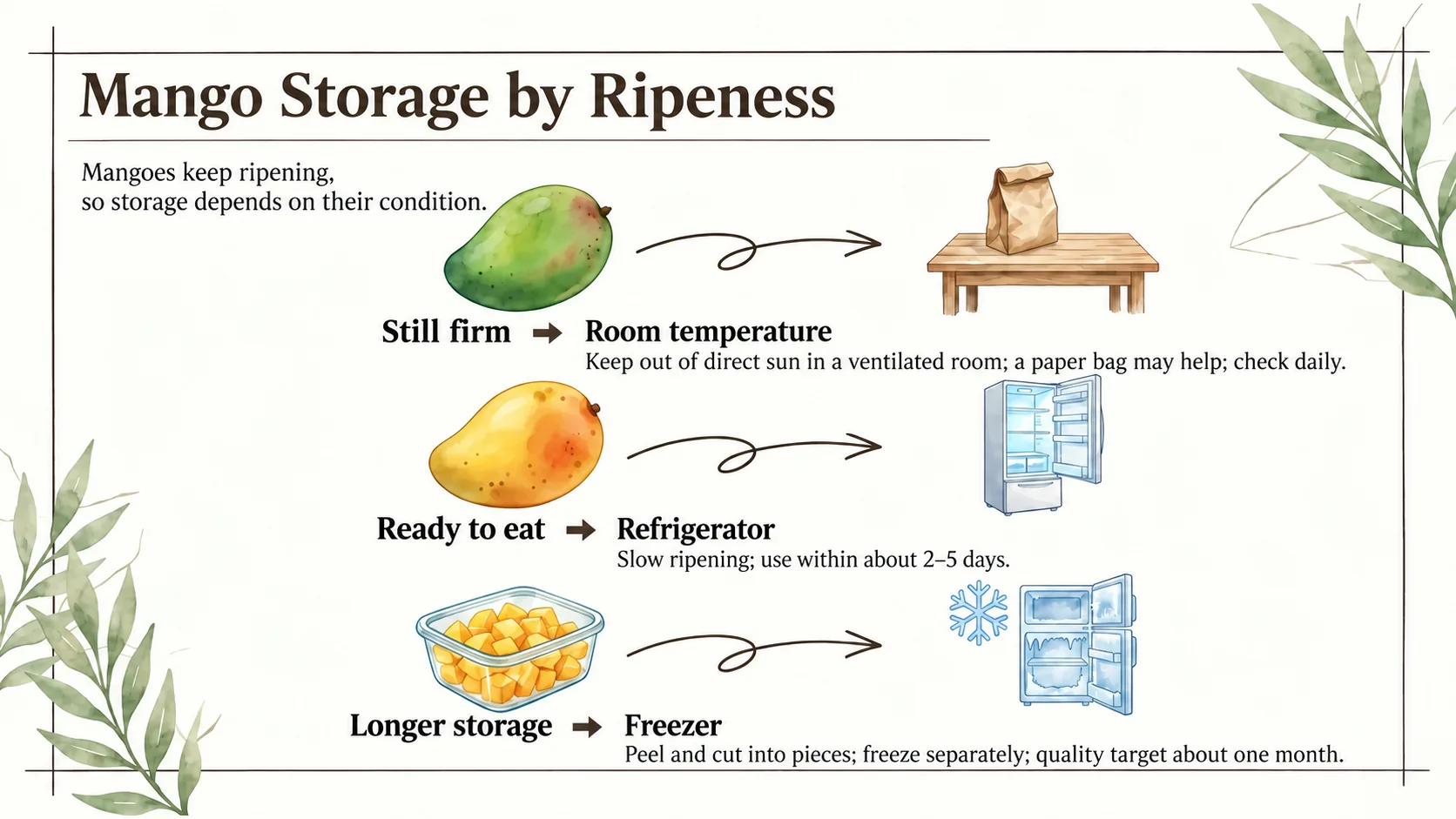
- Still firm: Ripen in a ventilated room away from direct sunlight. A paper bag can help speed the process. In hot weather, check daily for deterioration.
- Ready to eat: Refrigerate to slow further ripening and aim to use within roughly 2–5 days. Put cut flesh in a clean sealed container and eat it promptly.
- Longer storage: Peel and cut into bite-size pieces, then freeze without crowding. About one month is the quality target used in this article. Thawed flesh softens and suits smoothies or cooked dishes.
Skin reactions and food allergy
As explained in Mango Guide, mango belongs to Anacardiaceae. Its peel and sap contain potential contact allergens, including alkyl or alkenyl resorcinols that can cross-react with urushiol.
People who have reacted to lacquer trees, poison ivy or mango may develop contact dermatitis after handling peel or letting it touch the mouth. Reactions are often delayed, with onset ranging from hours to days. Avoid peeling it yourself if you have a relevant history, or use suitable gloves; taking off a little extra flesh beneath the skin may reduce exposure but does not guarantee safety.
Food-allergy symptoms such as mouth itching, hives or breathing difficulty can occur soon after eating. Contact dermatitis and food allergy have different mechanisms, so their timing should not be treated as one pattern.
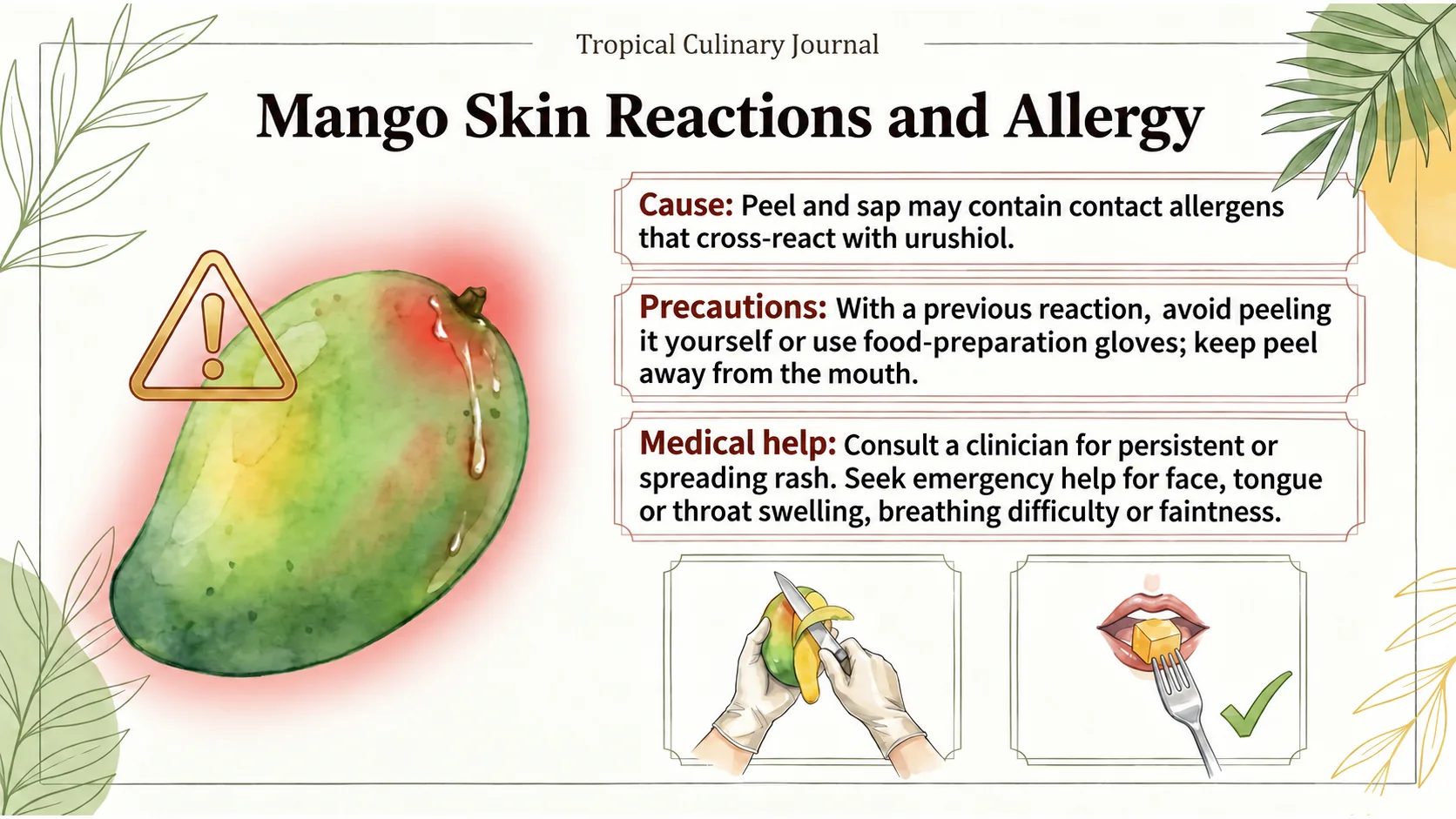
If a rash or itching develops, stop eating or handling the fruit and gently wash exposed skin with soap and running water. Consult a clinician if symptoms persist, recur or spread.
Hives with facial, lip, tongue or throat swelling, breathing difficulty, wheezing, repeated vomiting, dizziness or faintness may indicate a severe allergic reaction. Seek emergency help immediately rather than waiting. Vietnam’s ambulance number is 115; Japan’s Ministry of Foreign Affairs notes possible language and destination limitations. Keep your accommodation, insurer and suitable medical-service contacts available.
Can you bring fresh Vietnamese mangoes into Japan?
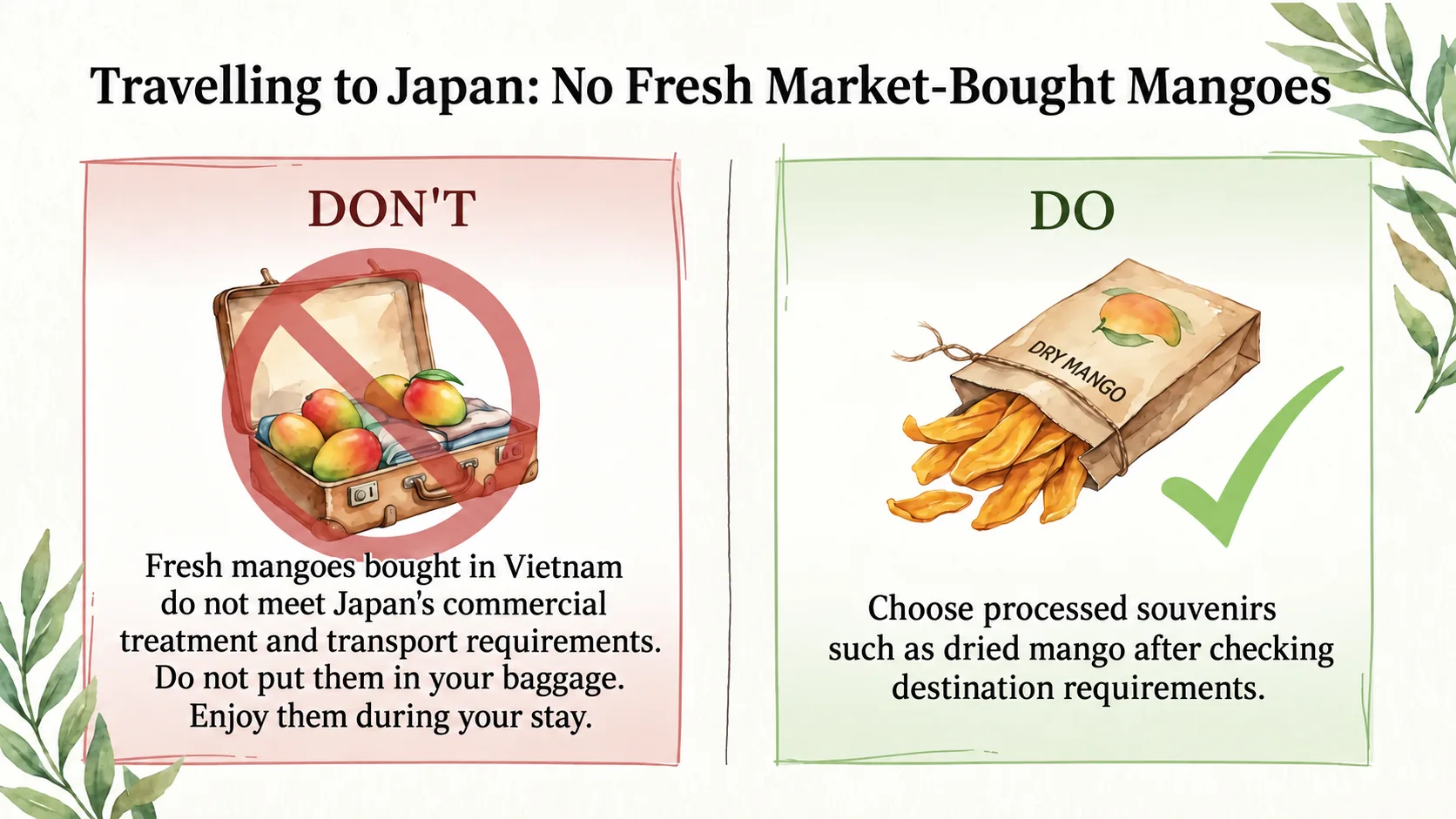
Travellers cannot bring fresh mangoes bought in Vietnamese markets or supermarkets into Japan as souvenirs.
Japan’s Plant Protection Station lists mangoes among prohibited fresh fruits from Vietnam for travellers. Conditional commercial imports of Vietnamese Cát Chu were approved on 17 September 2015, with requirements including designated vapor-heat treatment, certification and transport. Ordinary shop-bought fruit does not meet that export process. Eat it during your stay and check the requirements for processed souvenirs such as dried mango.
The author rechecked the official Plant Protection Station guidance in October 2026. Quarantine rules can change; consult the current official information before travel.
The author’s tasting notes
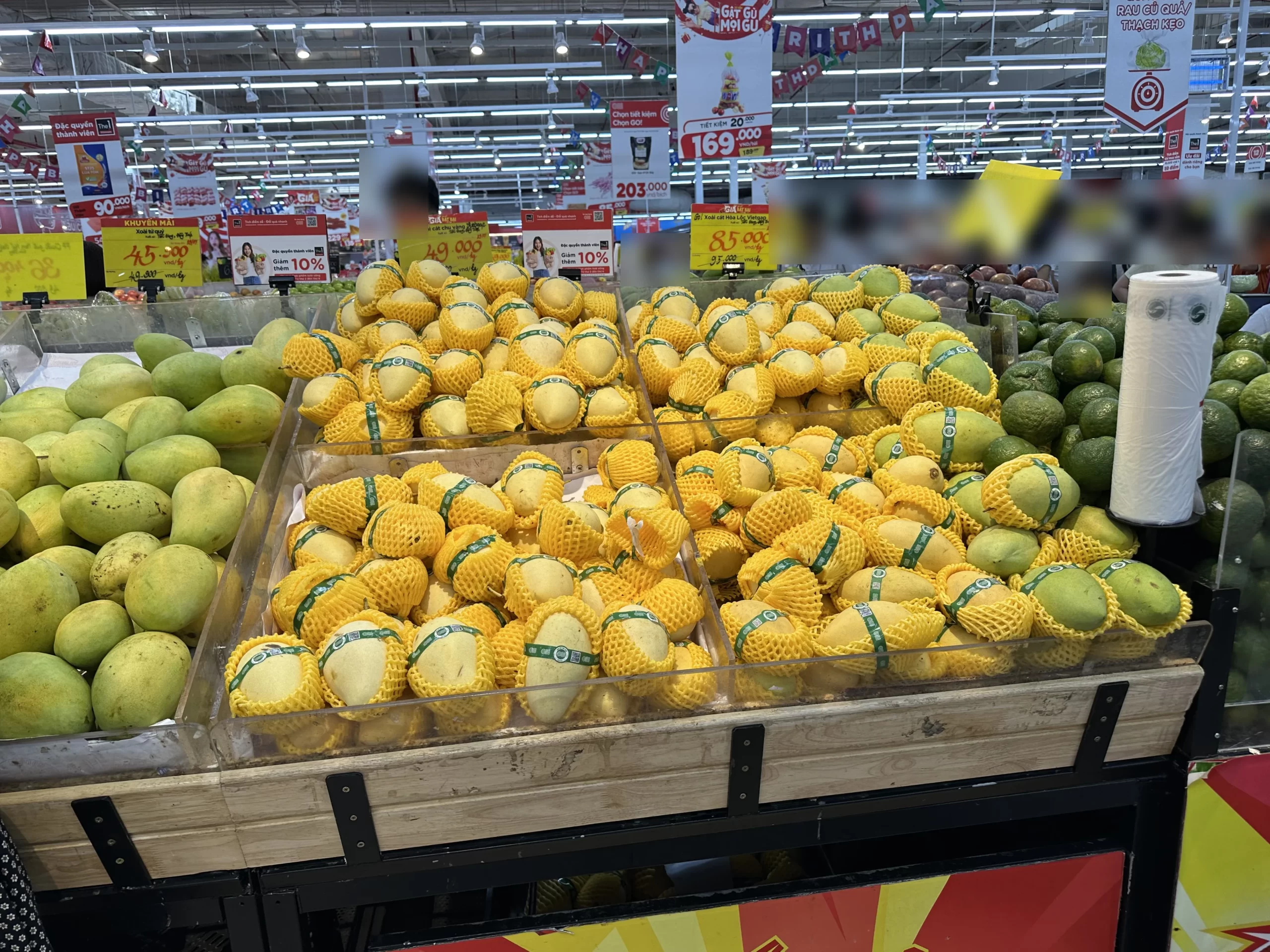
Purchase record
Location: supermarket in Hanoi
Date: 18 July 2026
Prices: Cát Chu 49,000 VND/kg; Cát Hòa Lộc 85,000 VND/kg, reduced from 95,000Tasting notes
Strong sweetness and a smooth texture. Some fruit retained acidity depending on ripeness.
Beginner rating: ★★★★★
Local drink chains also offer mango combined with coconut milk.
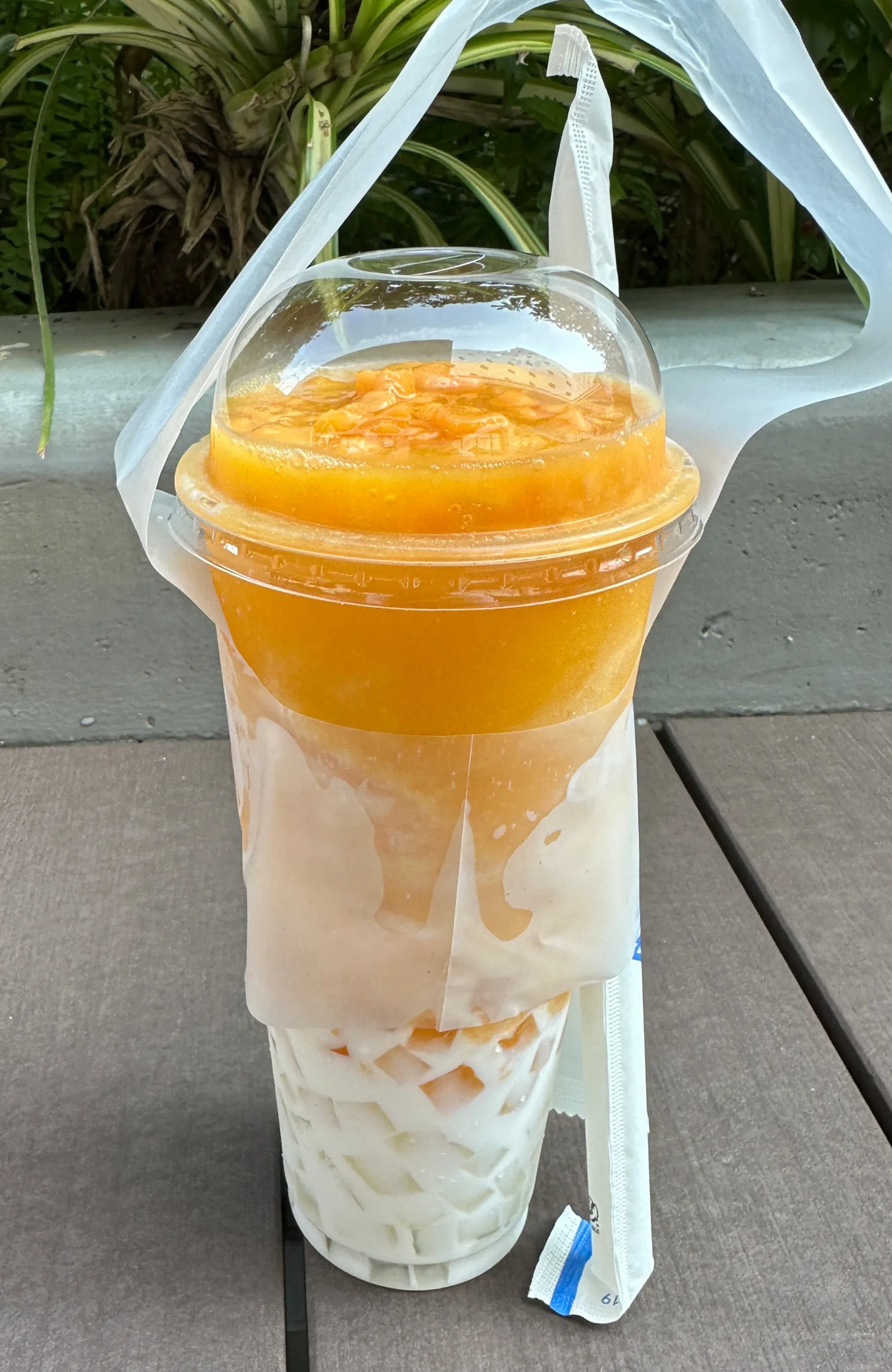
Purchase record
Item: large mango-and-coconut-milk drink
Price: 79,000 VNDImpression
The large serving was difficult to finish alone. Medium, at 69,000 VND, would probably have been enough for one person.
The author would also like to try shaken mango on a future occasion.
Frequently asked questions
Was buying a hard mango a mistake?
Not necessarily, if it was harvested at adequate maturity. Away from direct sun at room temperature, it may approach eating ripeness over a few days. Fruit harvested too immature may never develop full sweetness.
Can I eat it immediately?
If it is already soft enough and fragrant, yes. Allow firm fruit to ripen first.
Can the seller peel or cut it for me?
Market and street sellers may do this. Say Cắt giúp tôi nhé or point to prepared fruit and ask.
I do not know whether I react to mango peel. What should I do?
Take particular care if you have reacted to poison ivy, lacquer trees or mango. Avoid prolonged bare-hand contact; gloves and separating flesh from the peel can limit exposure. Do not let the peel rub around your mouth.
Can I take it home to Japan?
Fresh mangoes from Vietnamese markets or supermarkets cannot be brought into Japan in travellers’ baggage. Enjoy them during your stay and check destination rules for processed products.
Putting it all together
Knowing how mangoes ripen makes choosing and storage easier.
- Choose: for today, check gentle give and fragrance; for later, choose firmer mature fruit and allow it to ripen.
- Cut: remove the cheeks around the stone and score a grid; take care with peel contact.
- Eat: ripe fruit fresh, green fruit with chilli salt, salad, shaken mango, juice or dried mango.
- Store: room temperature while firm, refrigeration when ripe, and freezing for longer storage.
- Take care: peel and sap can cause skin reactions in susceptible people.
- Travel: fresh market-bought mangoes cannot be taken from Vietnam into Japan; check the rules for processed souvenirs.
Start with one fragrant ripe mango from a market or supermarket. Once you are familiar with it, explore local green-mango dishes too.
Learn more about mangoes
- Taste, nutrition, varieties and the botanical family: Mango Guide.
- Origins, names and the fruit’s journey: Mango History and Stories.
References
- MAFF Plant Protection Station: Bringing plants into Japan; traveller restrictions
- MAFF Plant Protection Station: Conditional approval for commercial Vietnamese Cát Chu mango imports, 17 September 2015
- Japan Ministry of Foreign Affairs: Medical information for Vietnam
- Contact Allergy Induced by Mango (Mangifera indica): A Relevant Topic?
- National Mango Board: How to Choose a Mango
- National Mango Board: Ripening and Storing Mangos
MAFF: Vietnam traveller restrictions — Reviewed 10 October 2026.
