Pomelo, Citrus maxima, is a large citrus native from Assam to Indochina. In Vietnam it is called Bưởi, an everyday fruit also used in Mid-Autumn Festival and Tết offerings.
Its history brings together ancient Chinese references to you, grapefruit’s emergence in the Caribbean and Japan’s buntan culture. Because later traditions mingle with early fruit history, this account distinguishes documentary records from local stories.
The old English name shaddock and the Japanese names buntan and bontan come with several traditions. These stories deserve attention, while their uncertainties remain visible.
Was the Ancient Chinese You a Pomelo?
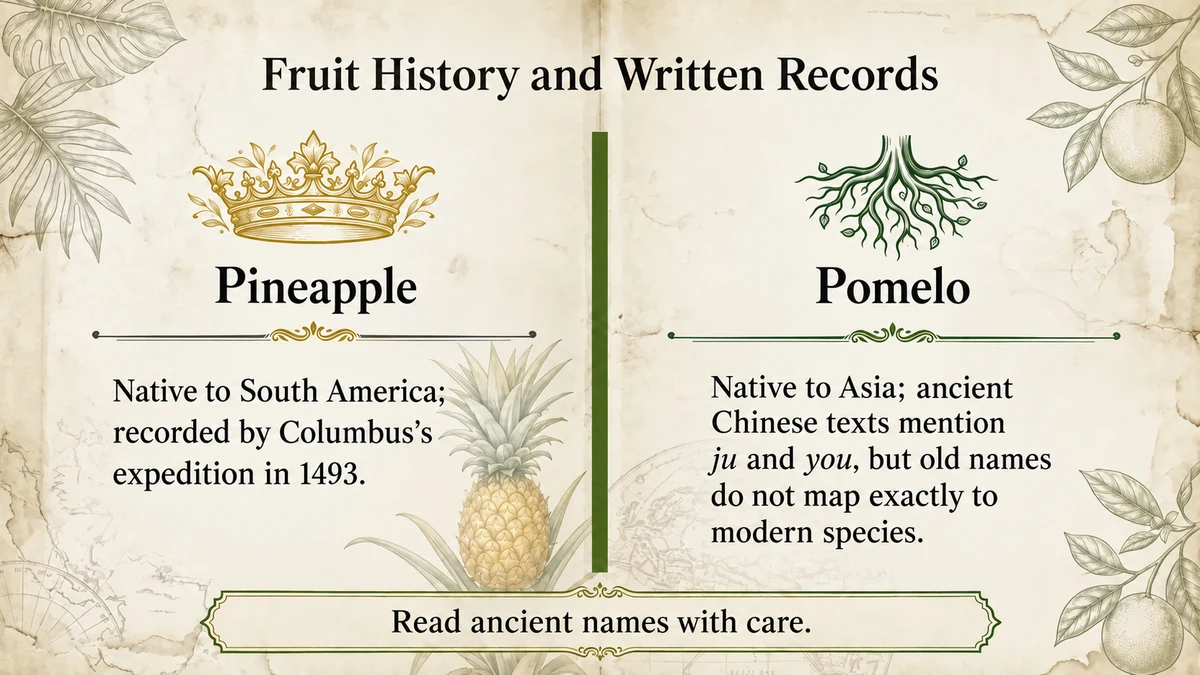
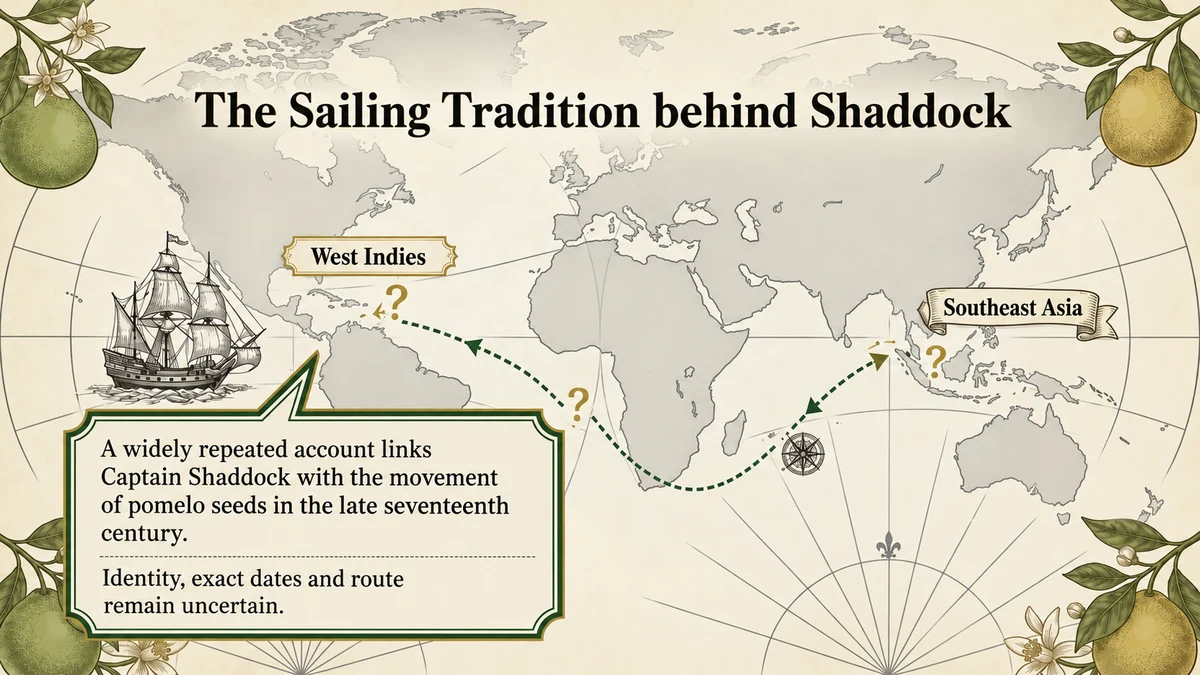
The Tribute of Yu chapter of the Chinese classic Shang Shu mentions ju and you among tributes from Yangzhou. The chapter describes ancient geography and tribute, although scholars debate its date of composition.
The you in this text cannot confidently be identified as exactly the modern pomelo species. Historical plant names do not always match current taxonomy one to one. The record does show that fruits called you, potentially including large pomelo-like citrus, appeared in Chinese texts more than 2,000 years ago.
That distinction matters: a documentary mention of an old fruit name is different from proof of a modern botanical species.
The Sailing Tradition behind “Shaddock”
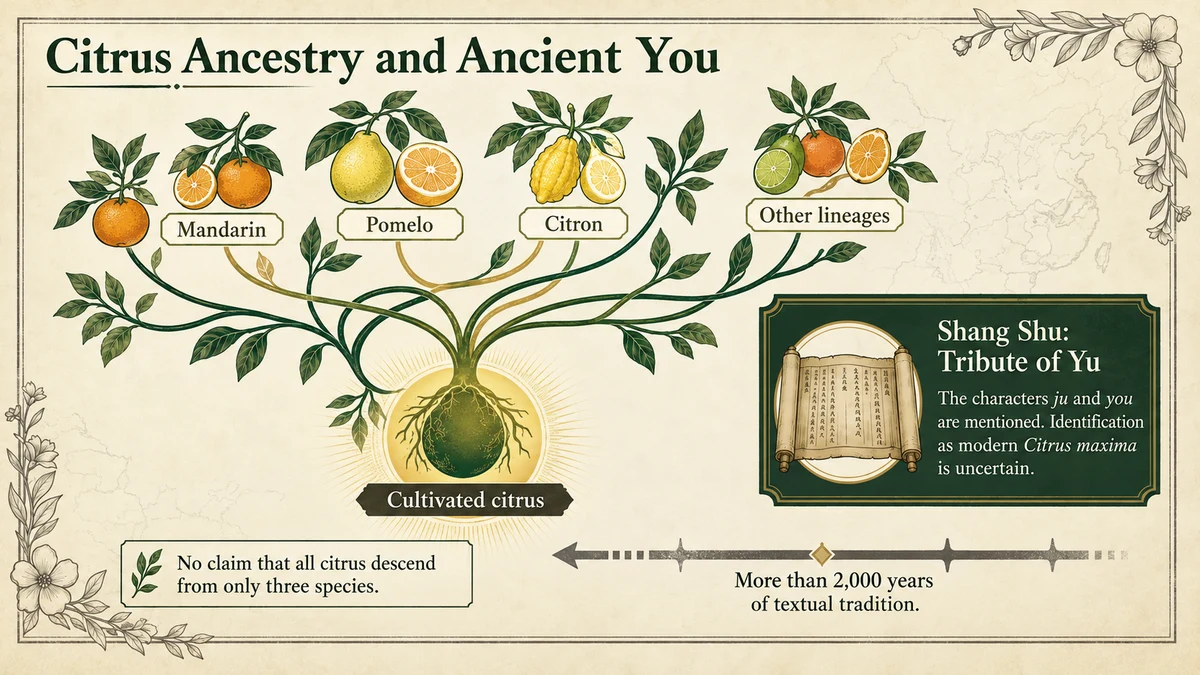
Shaddock is an old English name for pomelo. A familiar account attributes it to a sailor known as Captain Shaddock, who reportedly carried pomelo seeds from Southeast Asia to the West Indies in the late seventeenth century.
Contemporary evidence does not firmly establish the captain’s full identity, exact year or departure point. Specific versions naming 1696, the Malay Peninsula and Barbados should therefore be treated as a tradition rather than a verified itinerary.
Pomelo’s movement from Asia to the Caribbean and its association with the name shaddock are important to grapefruit history. That does not mean a particular captain’s voyage log has been established.
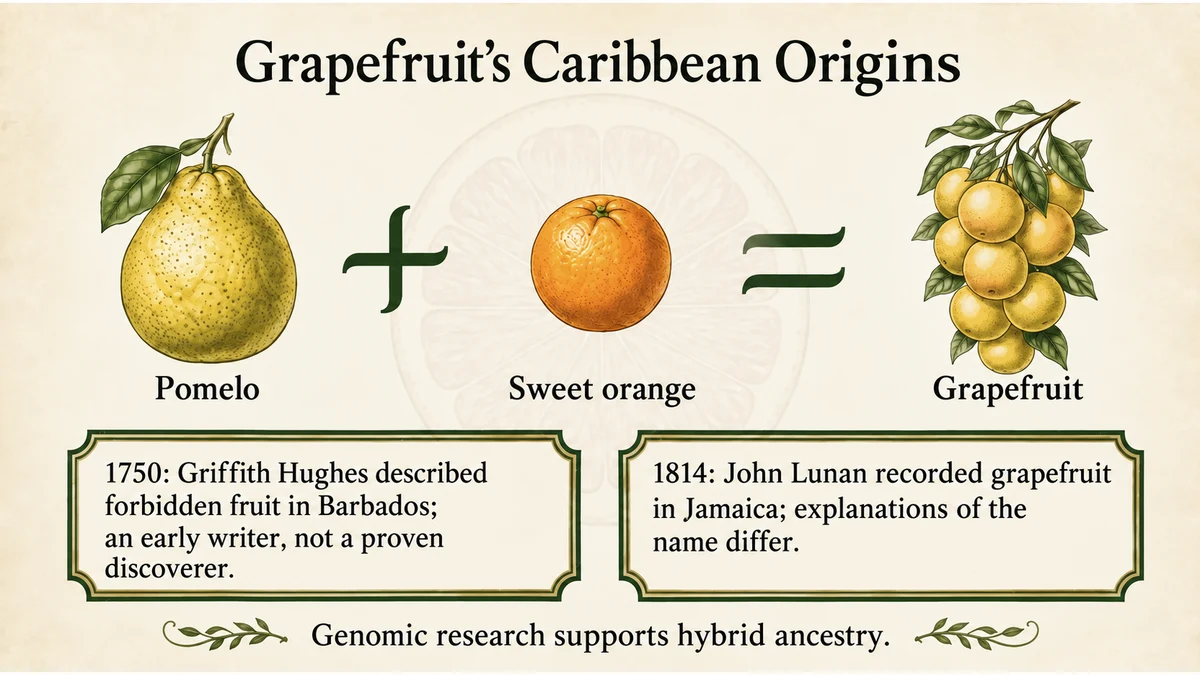
Grapefruit’s Caribbean Origins
Genomic research confirms that grapefruit derives from pomelo and sweet orange ancestry. It is thought to have emerged in the West Indies. In 1750, Griffith Hughes described a Barbadian fruit as forbidden fruit.
Hughes was an early writer about the fruit, rather than a proven discoverer. John Lunan recorded the name grapefruit in Jamaica in 1814. Historical literature offers both grape-like clusters and a grape-like taste as explanations of the name.
The precise place of the original cross and the first individual tree have not been established. A natural hybrid origin is better supported than a detailed scene of its sudden appearance in a particular garden.
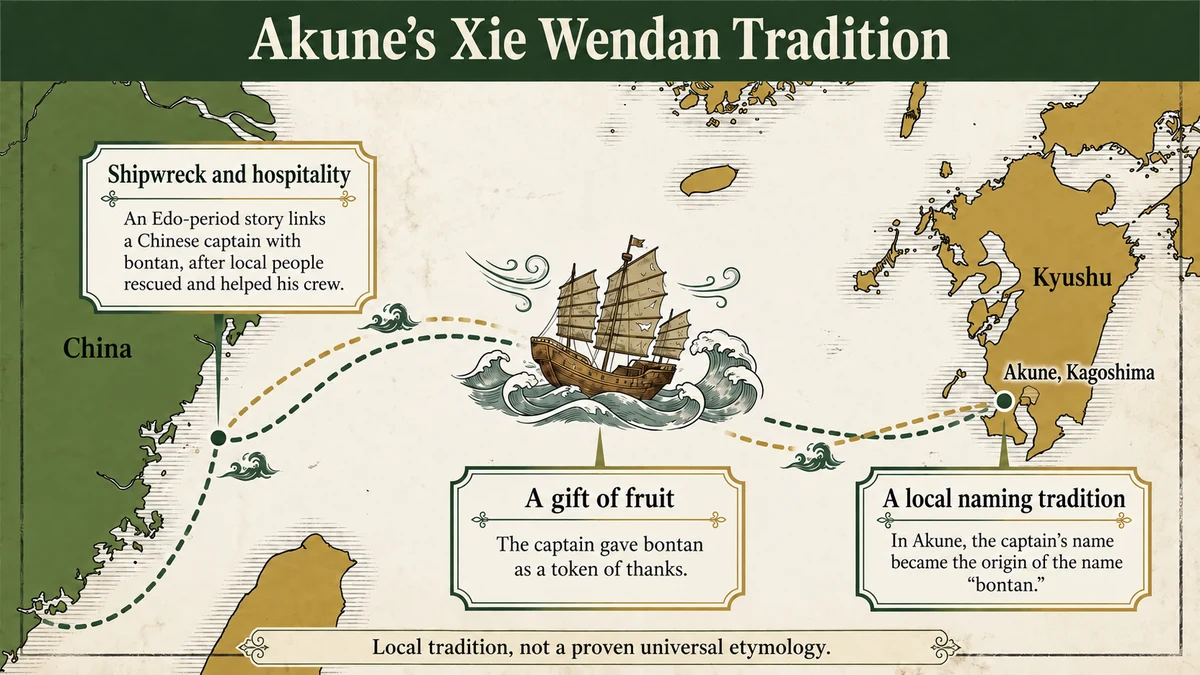
Akune’s Tradition of Xie Wendan
Akune City in Kagoshima preserves an Edo-period story about a Chinese trading vessel wrecked and washed ashore at Kuratsu Port. Its captain, Xie Wendan, reportedly gave fruit in thanks to local people.
The city links the captain’s name with bontan. This regional account should not be used as a proven explanation of every Japanese pomelo name.
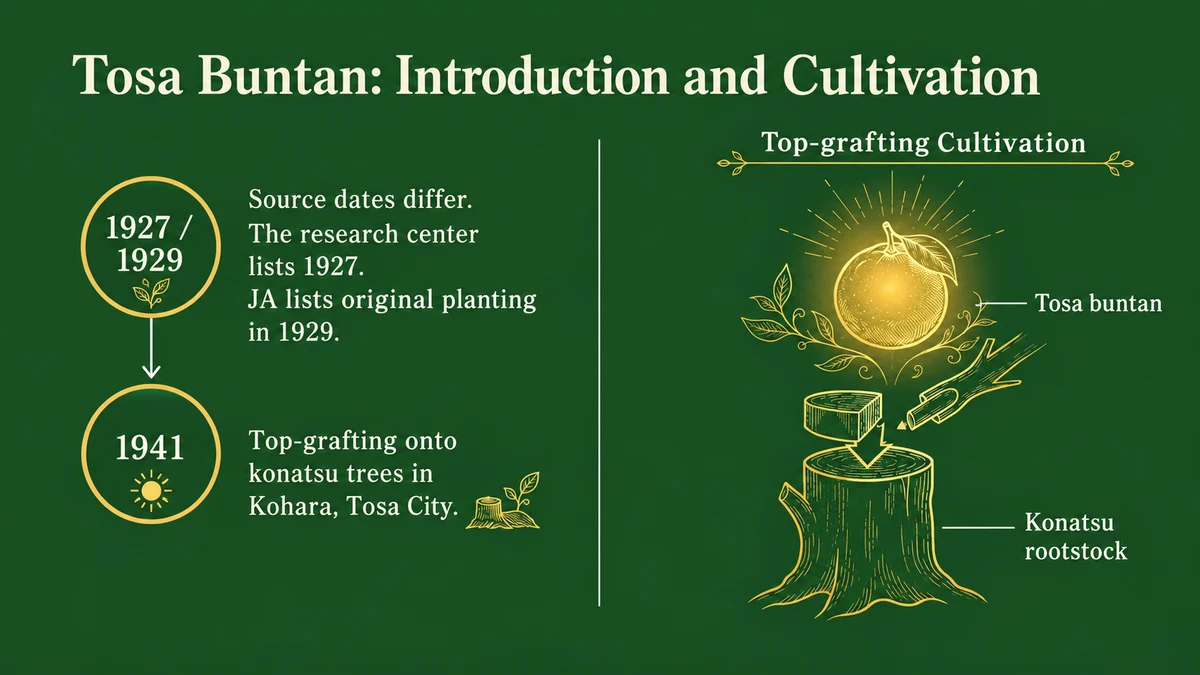
The Development of Tosa Buntan
Kochi’s official materials trace Tosa buntan to a Kagoshima cultivar known as Hogen buntan, introduced by Tsuneo Watanabe of the prefectural agricultural experiment station.
Sources give different dates: Kochi’s agricultural research center lists 1927, while JA Kochi describes the original tree as planted in 1929. Both dates should be presented with their respective sources.
In 1941, grafting onto konatsu trees took place in the Kohara district of Tosa City, helping establish cultivation. Pomelo became a local specialty through regional growing techniques.
What Is a Vietnamese “Pomelo Dog” Made From?
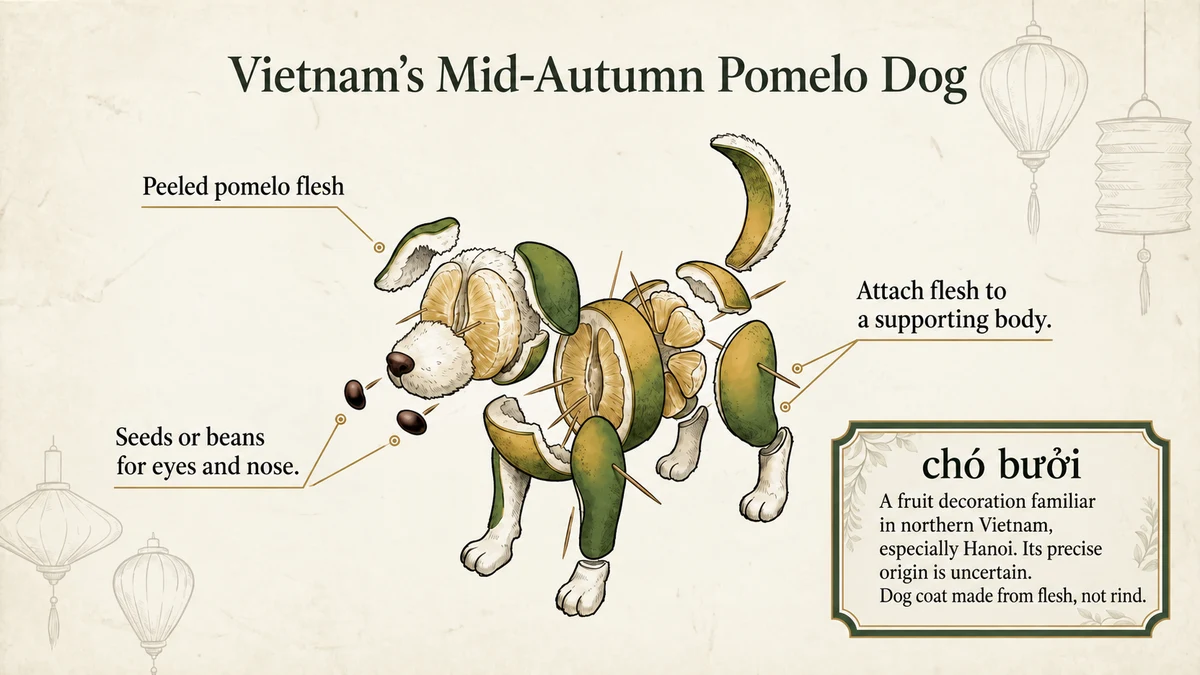
A familiar Mid-Autumn Festival decoration in northern Vietnam, especially Hanoi, is chó bưởi: the pomelo dog. Peeled flesh, with its segment membranes removed, is attached to a supporting body with toothpicks or similar fasteners to create a fluffy-looking dog.
Its characteristic coat is made from the flesh, rather than mainly from the outer rind or white pith.
The custom is documented as a fruit decoration. A proposed connection to the loyal dog in the Cuội legend has not been established by the reliable sources consulted here, so it is not presented as the decoration’s proven origin.
The Five-Fruit Offering at Tết
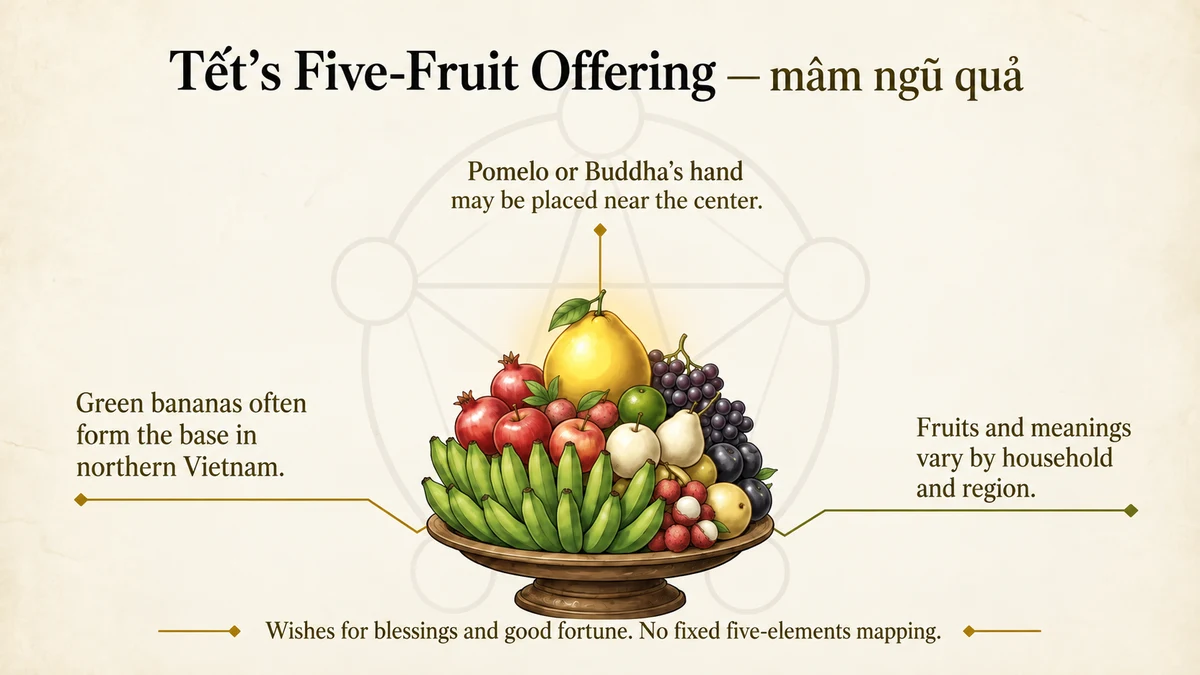
In northern Vietnam, the ancestral offering called mâm ngũ quả may include green bananas, pomelo, mandarins and persimmons. A banana cluster often forms the base, with pomelo or Buddha’s hand near the center.
Hanoi’s official site associates pomelo and Buddha’s hand with wishes for blessings and good fortune. Fruit combinations and meanings vary by region and household, so a single fixed chart of fruits and the five elements would be misleading.
Mid-Autumn Wordplay in Southern China
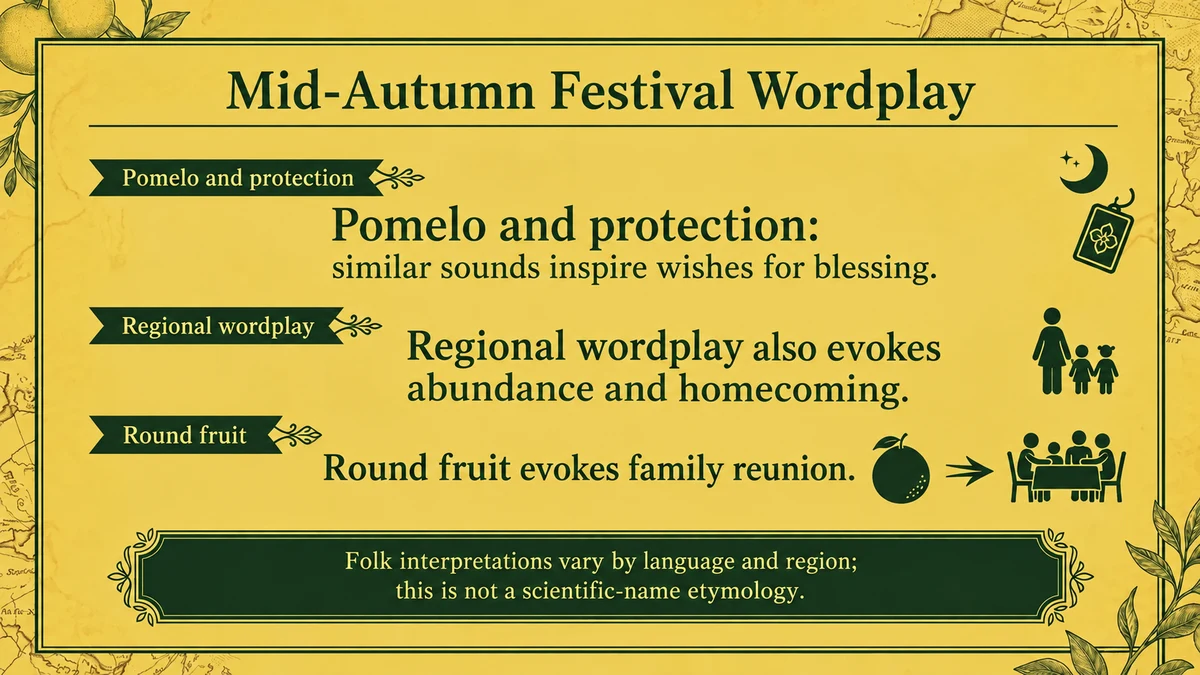
In southern China, pomelo is eaten or offered around the Mid-Autumn Festival. Its round shape evokes reunion. Similar sounds for the characters meaning pomelo and protection or blessing inspire wordplay; other regional associations involve abundance or family members returning home.
These are folk interpretations developed within festival culture, rather than the etymology of the scientific name. Their meaning varies by language and region.
Looking Back
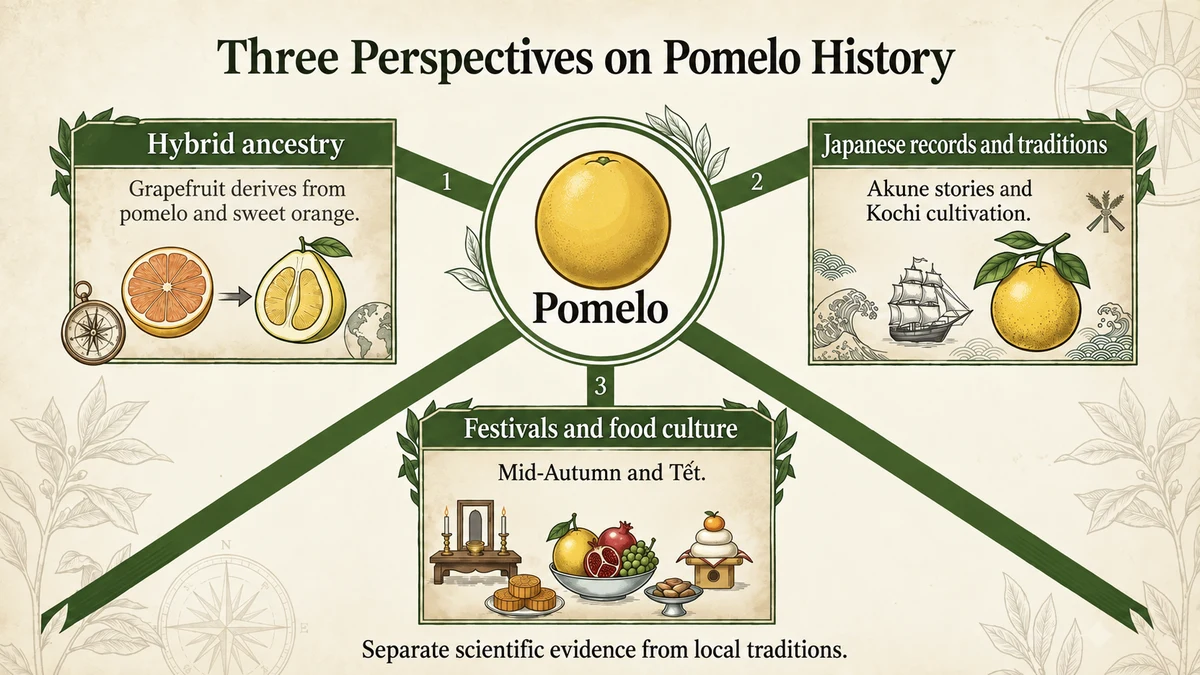
Pomelo history follows several connected paths.
- Ancient Chinese texts mention ju and you, but the old name cannot confidently be equated with exactly the modern pomelo species.
- The name shaddock is linked to a sailor’s story whose identity, dates and route remain uncertain.
- Grapefruit derives from pomelo and sweet orange ancestry.
- In Japan, pomelo connects Akune’s Xie Wendan tradition with Kochi’s cultivation history.
- In Vietnam, it appears in Mid-Autumn fruit decorations and Tết offerings.
- In southern China, it evokes reunion and festival wordplay.
Distinguishing scientific evidence from inherited traditions makes each part of pomelo’s history easier to appreciate.
Frequently Asked Questions
Where do the Japanese names come from?
Akune preserves a story linking bontan with the Chinese captain Xie Wendan. This does not conclusively explain all uses of zabon or buntan.
What does shaddock mean?
Shaddock is an old English name for pomelo. It is associated with a sailor said to have carried seeds to the West Indies, although his identity, dates and route remain uncertain.
Did grapefruit come from pomelo?
Genomic research identifies grapefruit as a pomelo–sweet orange hybrid. Its emergence is associated with the Caribbean, but the location of the first tree has not been established.
Related Articles
- Botany, names, nutrition and Vietnamese varieties: Pomelo Guide: Names, Varieties, Season and Nutrition
- Choosing, peeling and eating: How to Eat Pomelo in Vietnam: Choosing, Peeling, Dishes and Storage
References
- Royal Botanic Gardens, Kew — Citrus maxima (Burm.) Merr.
- Chinese Text Project — Shang Shu: Tribute of Yu
- Wu et al. — Genomics of the origin and evolution of Citrus
- University of Florida IFAS Extension — Fact sheet: Grapefruit
- University of Florida — From “Forbidden-Fruit” to “Ruby Red”
- Akune City — Citrus grown in Akune
- Kochi Agricultural Technology Center — Specialty citrus of Kochi
- JA Kochi — Tosa buntan and Suisho buntan
- Vietnam Government News — Mid-Autumn cakes and autumn flavors
- Hanoi City — The meaning of the five-fruit offering at Tết
- Guangzhou Culture, Radio, Television and Tourism Bureau — Shatian pomelo
