The right eating stage depends on the peach cultivar. Types that soften can generally be ripened in a cool room, provided they were harvested sufficiently mature, then refrigerated. Chilling injury depends on temperature, storage duration and cultivar; brief refrigeration does not automatically damage a peach. Some northern Vietnamese peaches are described as having a crisp bite even when ready to eat.
I bought Chinese peaches at MaxValu in Hanoi on October 12, 2026, and ate them the next day. The photo diary, price and tasting notes are included below. For varieties, seasons and growing areas, see the Peach Guide.
Contents
- Quick guide to choosing, ripening and storing peaches
- Buying peaches in Vietnam: useful words and labels
- When is a peach ready to eat: soft or crisp?
- Ripening a hard peach
- Washing, cutting and peeling peaches
- Vietnamese peach syrup and peach tea
- Storage before ripening, after ripening and after cutting
- Peach allergy and serving fruit to children
- Can you bring peaches from Vietnam into Japan?
- Chinese peaches bought in Hanoi: MaxValu price and tasting diary
- A practical routine
- Frequently asked questions
- More in the peach trilogy
- Sources and editorial note
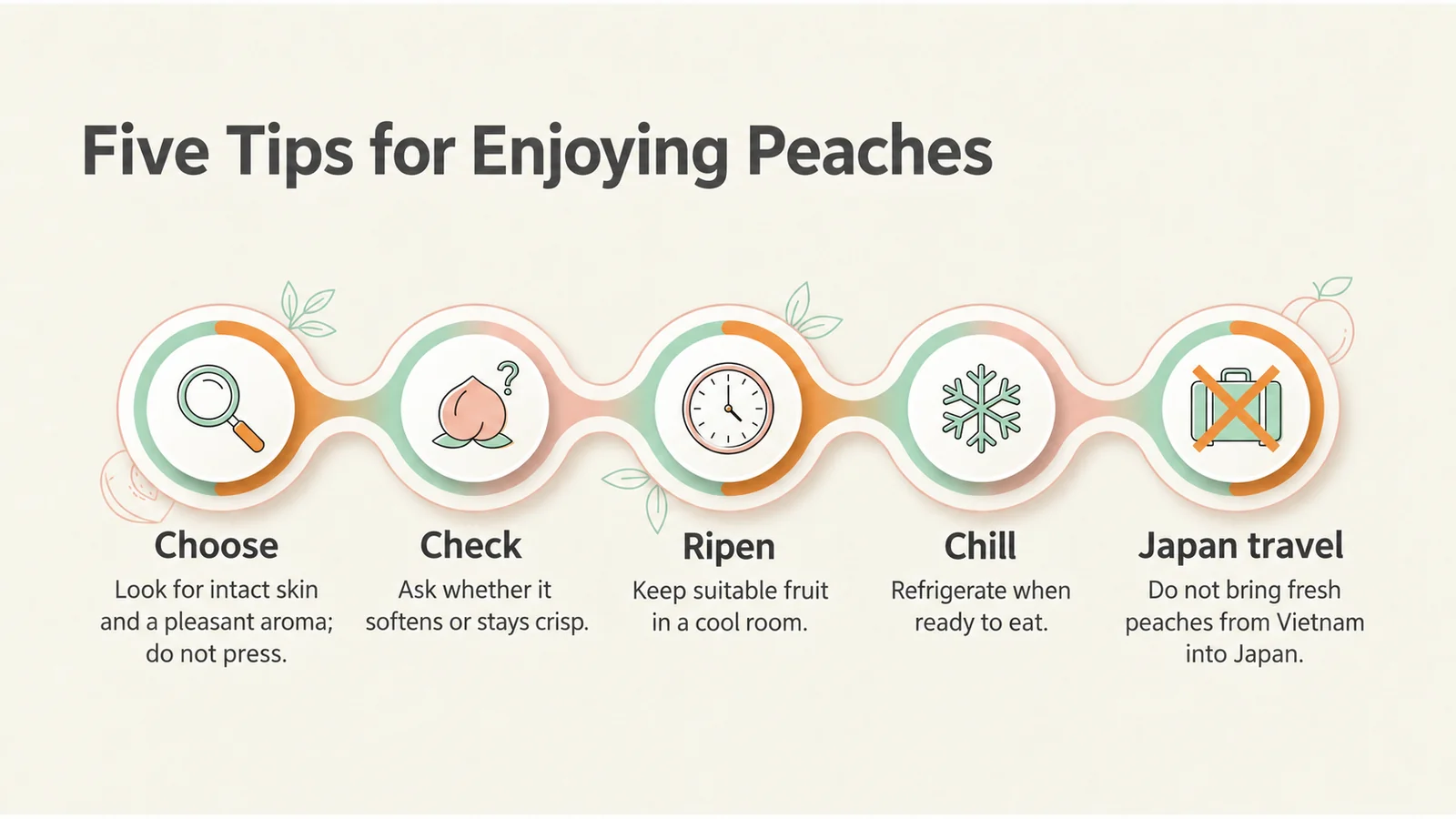
Quick guide to choosing, ripening and storing peaches
| Question | Practical guide |
|---|---|
| What is a peach called? | Quả đào |
| How do I choose one? | Look for intact skin and a pleasant sweet aroma; avoid damage and discoloration |
| Does it need ripening? | Only suitable softening types harvested sufficiently mature; keep them in a cool room |
| How do I judge ripeness? | Aroma and gentle softness for softening types; ask the seller about crisp cultivars |
| When should I chill it? | Refrigerate when ready to eat; if eating soon, chilling for 1–2 hours is one serving guideline |
| Is refrigeration before ripening always harmful? | No; chilling injury depends on conditions, not simply a brief spell in the fridge |
| Which part is often sweeter? | The blossom end, opposite the stem |
| What about cut fruit? | Put it in a closed container and refrigerate promptly |
Selection and serving guidance draws on Kudamono Navi’s white-peach guide; maturity and chilling injury are discussed in University of Georgia guidance. Both were checked for the Japanese edition on September 29, 2026.
Buying peaches in Vietnam: useful words and labels
Vietnamese words for the fruit stall
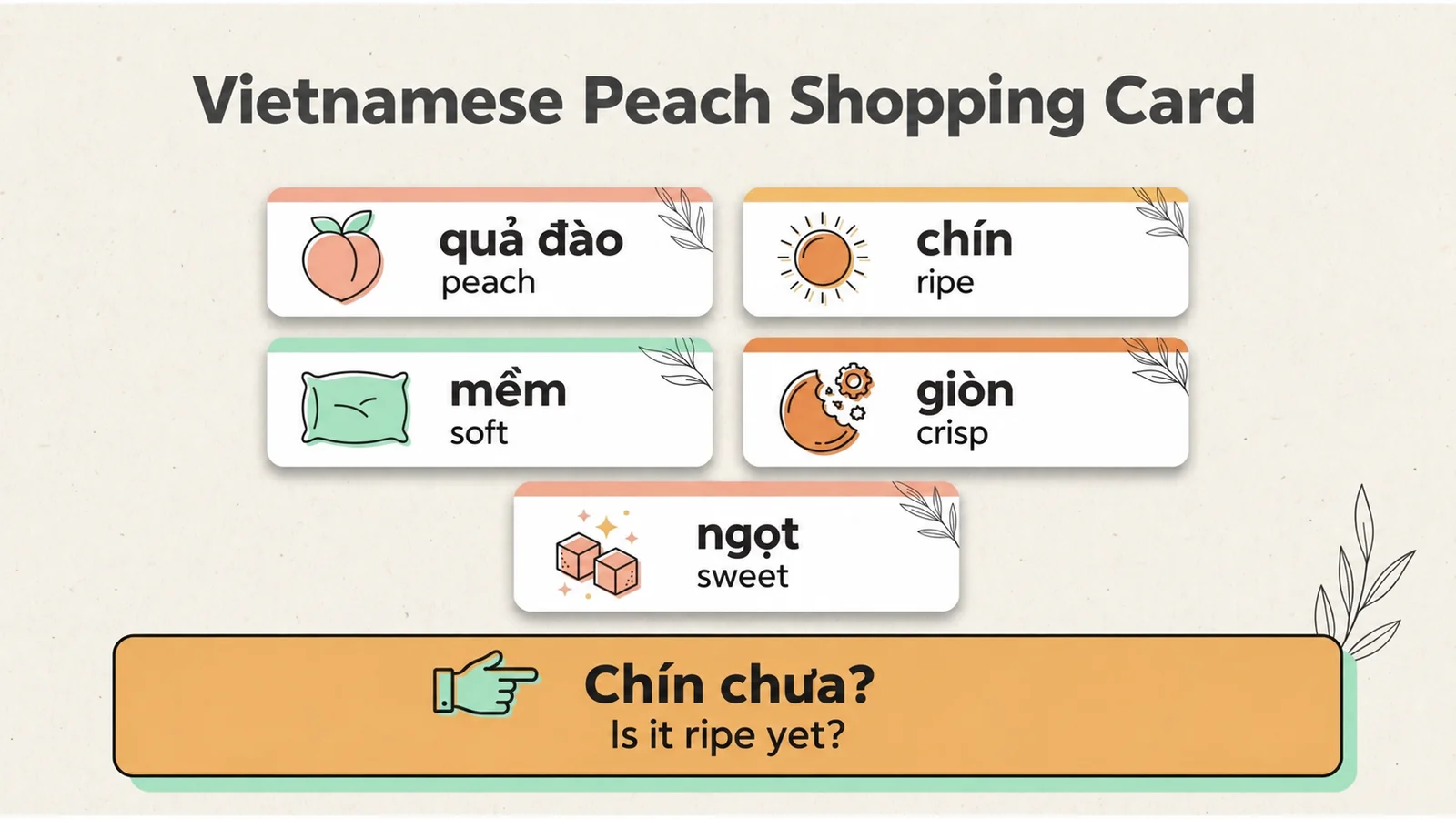
Vietnamese supermarkets and fruit shops sell domestic peaches as well as imported peaches and nectarines. Check the price label or packaging for origin.
| Vietnamese | Meaning |
|---|---|
| quả đào | Peach |
| chín | Ripe |
| mềm | Soft |
| giòn | Crisp or crunchy |
| ngọt | Sweet |
Chín chưa? means “Is it ripe yet?” You can also ask whether the fruit will become mềm or is meant to be enjoyed giòn. Wording on signs differs among shops, so these terms are a guide rather than a standardized labeling system.
Choosing a good peach
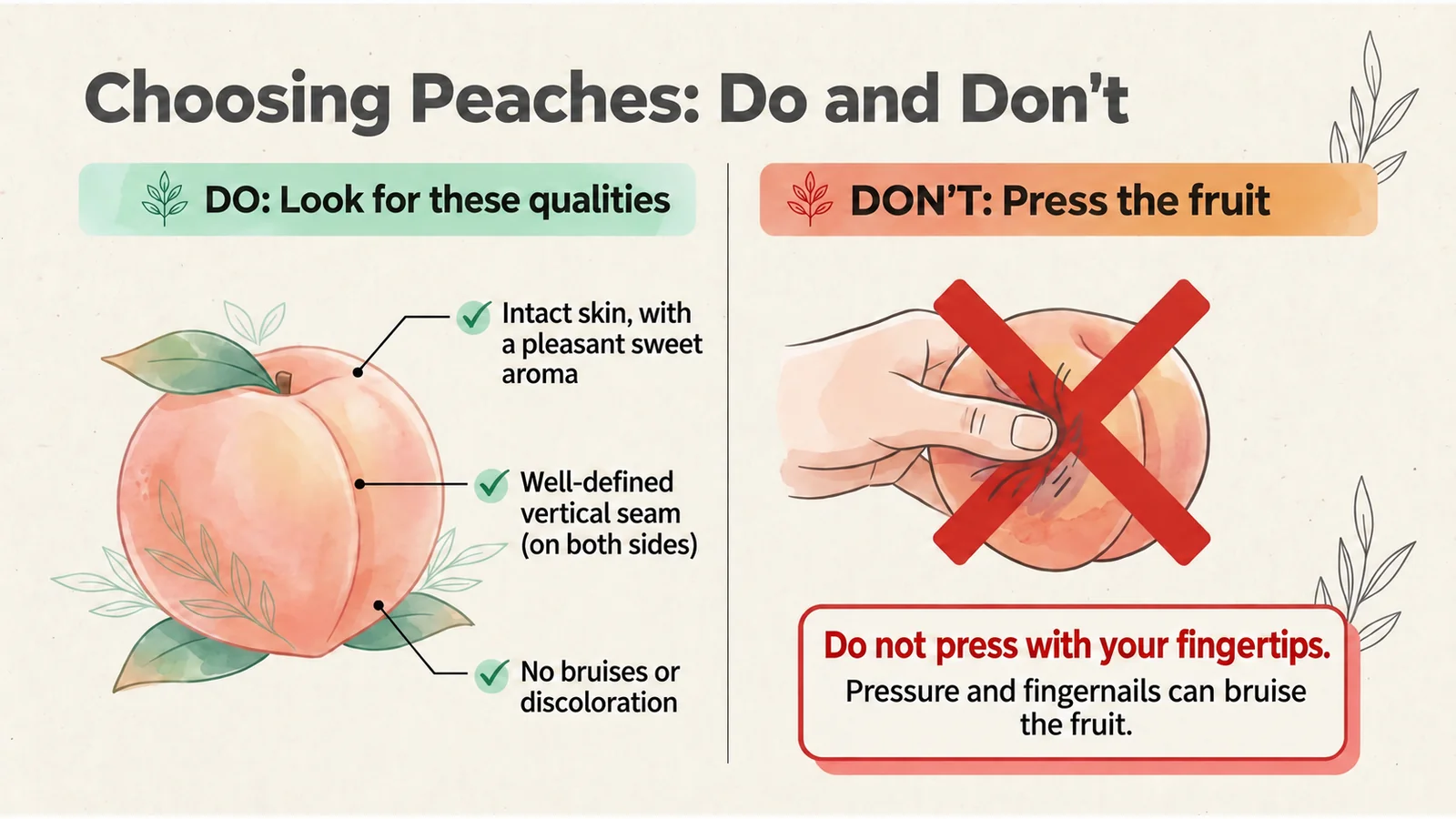
Look for fruit with intact, taut skin, a pleasant sweet aroma and no obvious bruises or discoloration. A reasonably even shape around the seam is another feature described in the white-peach guide. Do not squeeze or press with your fingertips; pressure and fingernails can damage the flesh beneath the skin. Source: Kudamono Navi.
Color and firmness alone cannot identify the cultivar or country of origin. Read the label or ask the seller.
When is a peach ready to eat: soft or crisp?
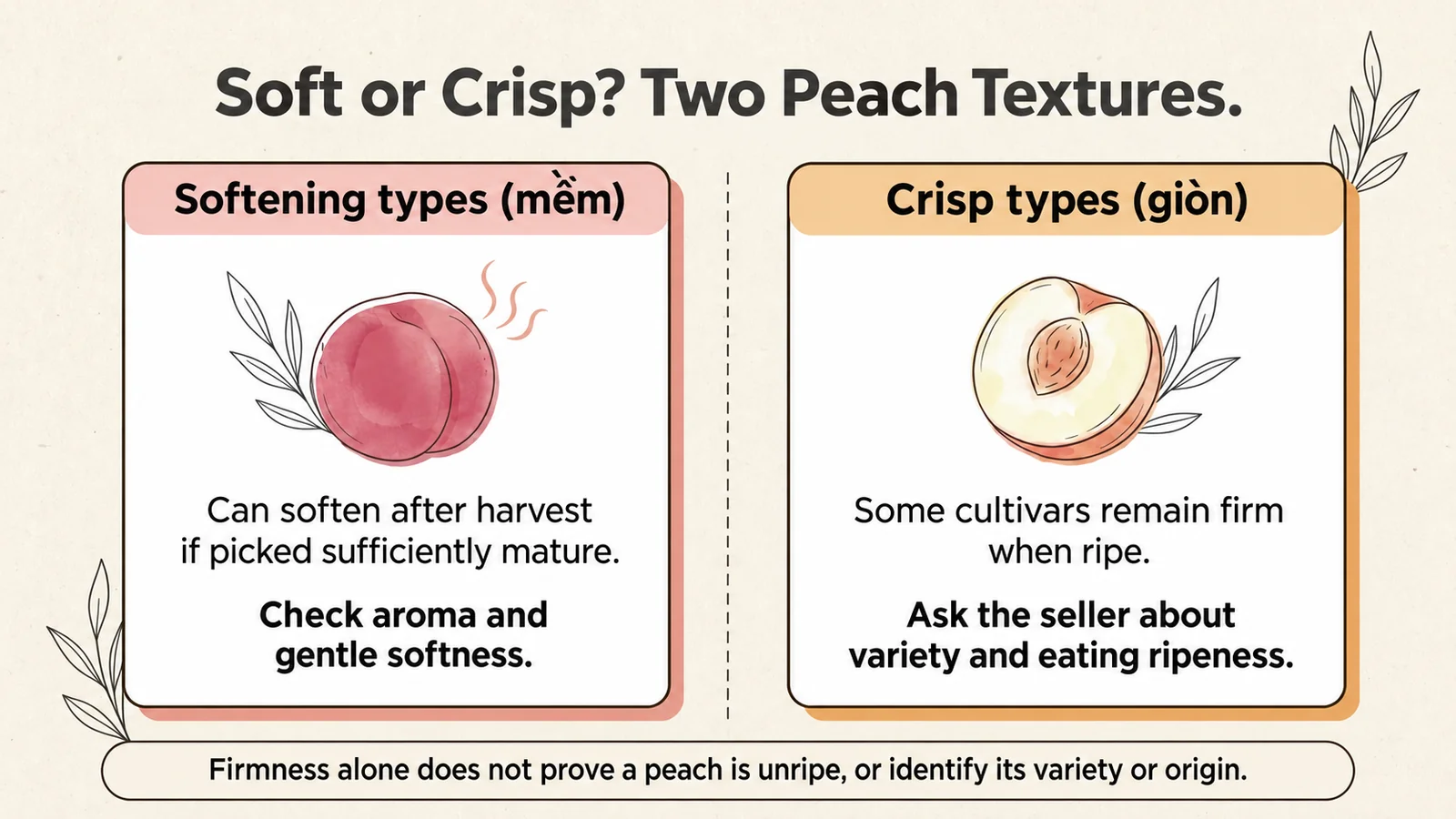
Some peach flesh becomes meltingly soft as it ripens, while other cultivars retain more bite. A hard peach is not necessarily unripe.
The University of Georgia explains that suitable peaches can continue ripening after harvest, but they must have been harvested sufficiently mature. It also distinguishes flesh types, including non-melting and stony-hard traits. A crisp bite alone cannot tell you how a peach will ripen. Source: UGA CAES, Peaches: Appropriate Harvest and Postharvest Handling (checked September 29, 2026).
| Texture type | How to judge eating readiness |
|---|---|
| Softening types, including many Japanese white peaches | A fuller aroma and some softness when gently held in the palm |
| Crisp types | Ask the seller about the variety and eating stage; softness alone is not a useful test for a cultivar that stays firm |
Some peaches from northern Vietnam are described as crisp. That does not establish the precise flesh classification of an individual fruit. Asking about expected texture is more useful than assuming every peach should become soft.
Ripening a hard peach
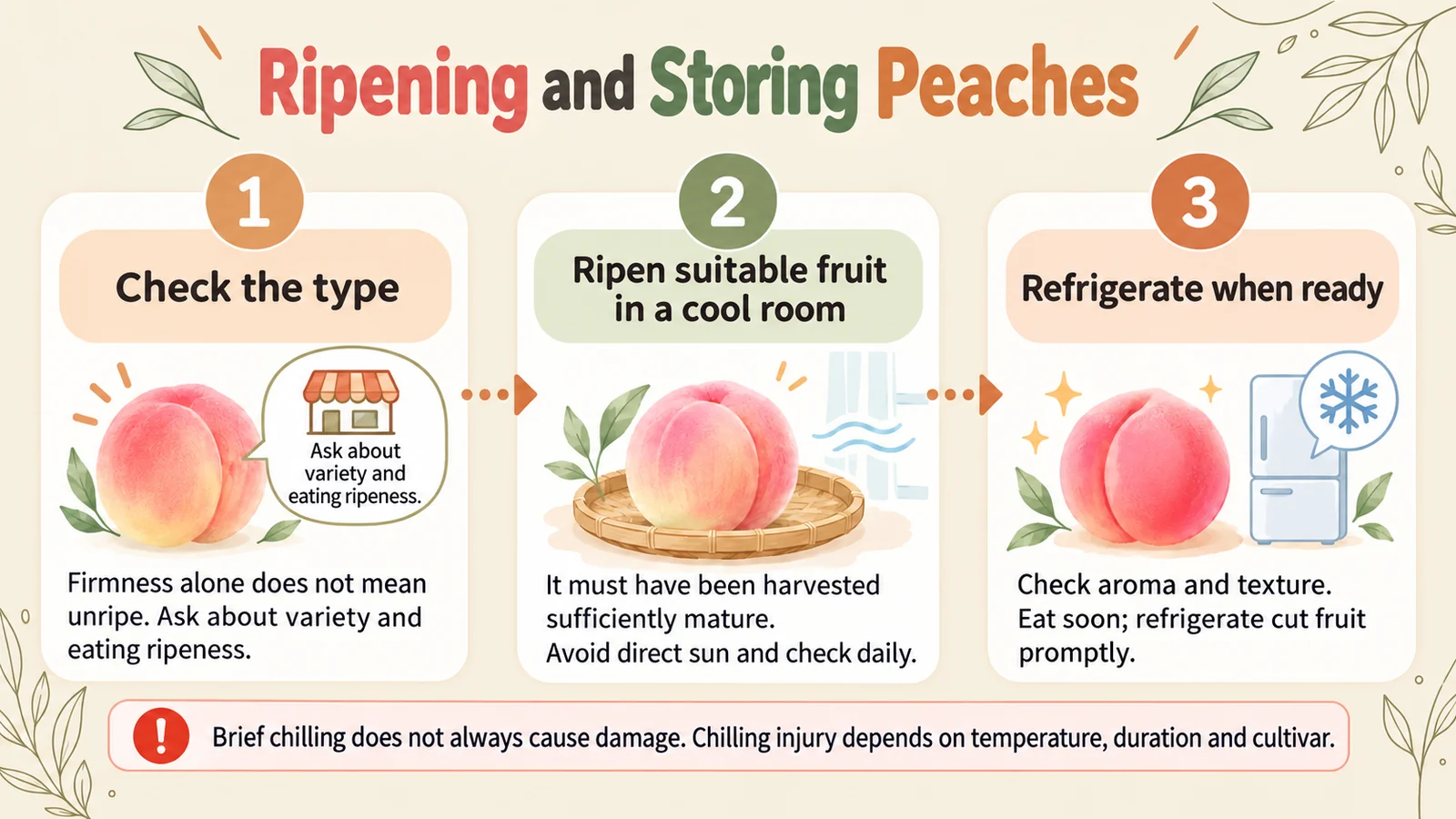
If a peach is a type that should soften and is not yet ready, place it in a cool room out of direct sunlight. Fruit harvested too early will not necessarily become sweet and flavorful simply by waiting.
Kudamono Navi suggests wrapping white peaches in newspaper, keeping them in a cool shaded place, then putting them in a plastic bag in the refrigerator’s crisper once they soften and develop aroma. Eat them promptly. Source: Kudamono Navi (checked September 29, 2026).
Chilling injury is affected by temperature, time and cultivar. Commercial cold-storage findings should not be read as a blanket instruction never to refrigerate peaches at home. The University of Maryland recommends ripening peaches and nectarines at room temperature and then refrigerating them in bags. Refrigerate fruit once it is ready to eat. Source: University of Maryland Extension (checked October 16, 2026).
In hot Vietnamese weather, ripening and deterioration can both progress quickly. Use a cool, shaded room, preferably air-conditioned when needed, and check aroma and texture daily. Judge the fruit’s condition rather than relying on a fixed number of days.
Washing, cutting and peeling peaches
Wash gently just before eating
Clean your hands, knife and cutting board. Rinse the peach gently under running water before cutting. Lightly rubbing it with your palm helps remove loose fuzz. Even if you intend to peel it, wash first to reduce transfer of surface contamination to the flesh. Do not use soap or dishwashing detergent. Source: FDA, 7 Tips for Cleaning Fruits and Vegetables.
Cutting into wedges
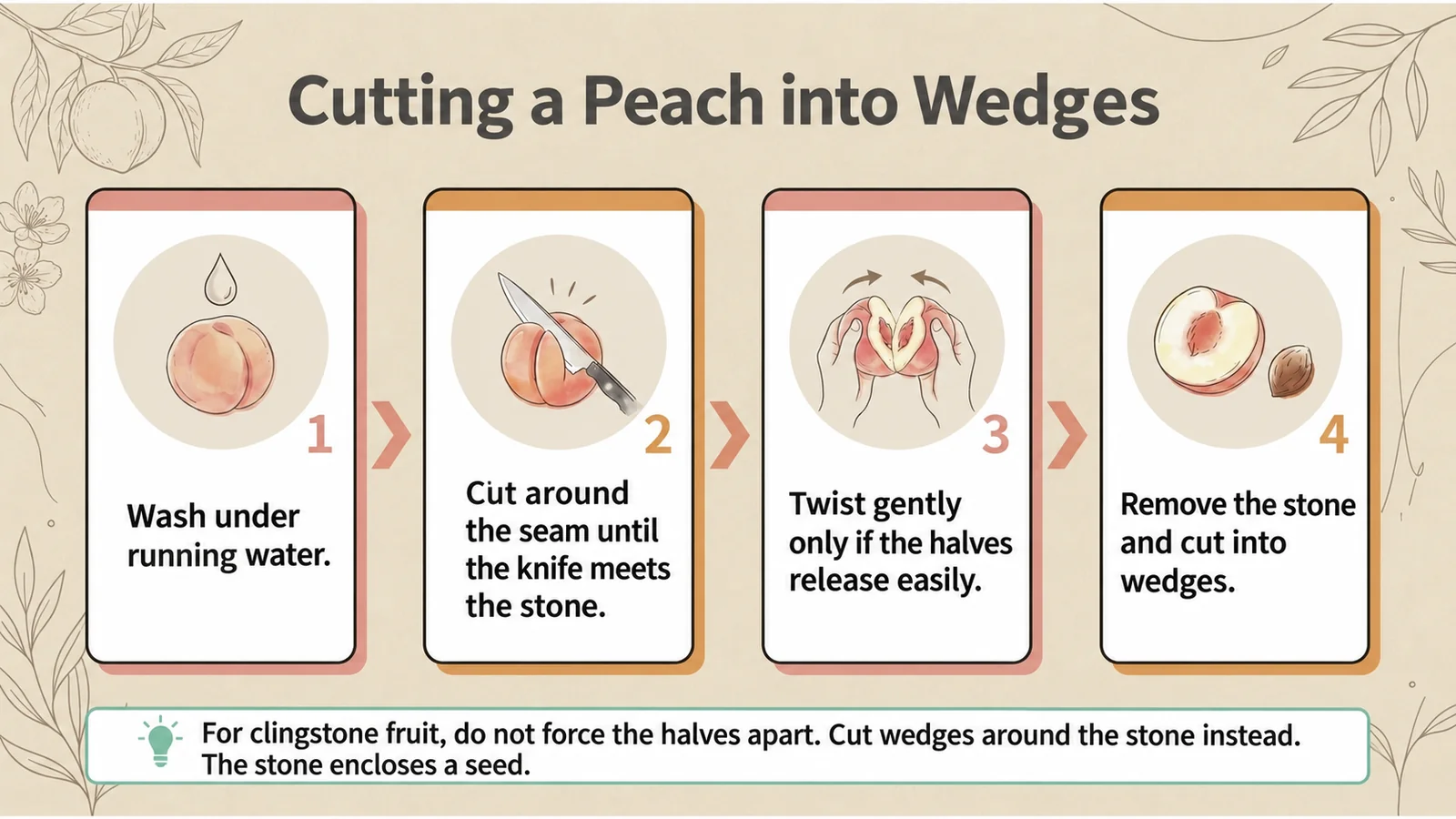
- Dry the washed peach. Cut around its seam until the knife reaches the hard stone.
- Hold the halves and twist gently in opposite directions. If there is strong resistance, stop and use step 4.
- If the halves separate easily, remove the stone and cut the flesh into wedges.
- If the flesh clings to the stone, cut individual wedges around it rather than forcing it apart.
Freestone peaches release their stones more readily; clingstone peaches do not. In everyday cooking the stone is often called the “seed,” but botanically the seed is enclosed inside that hard shell. Kudamono Navi recommends lengthwise wedges and describes the blossom end as the sweeter part. Source: Kudamono Navi.
Blanching to loosen the skin
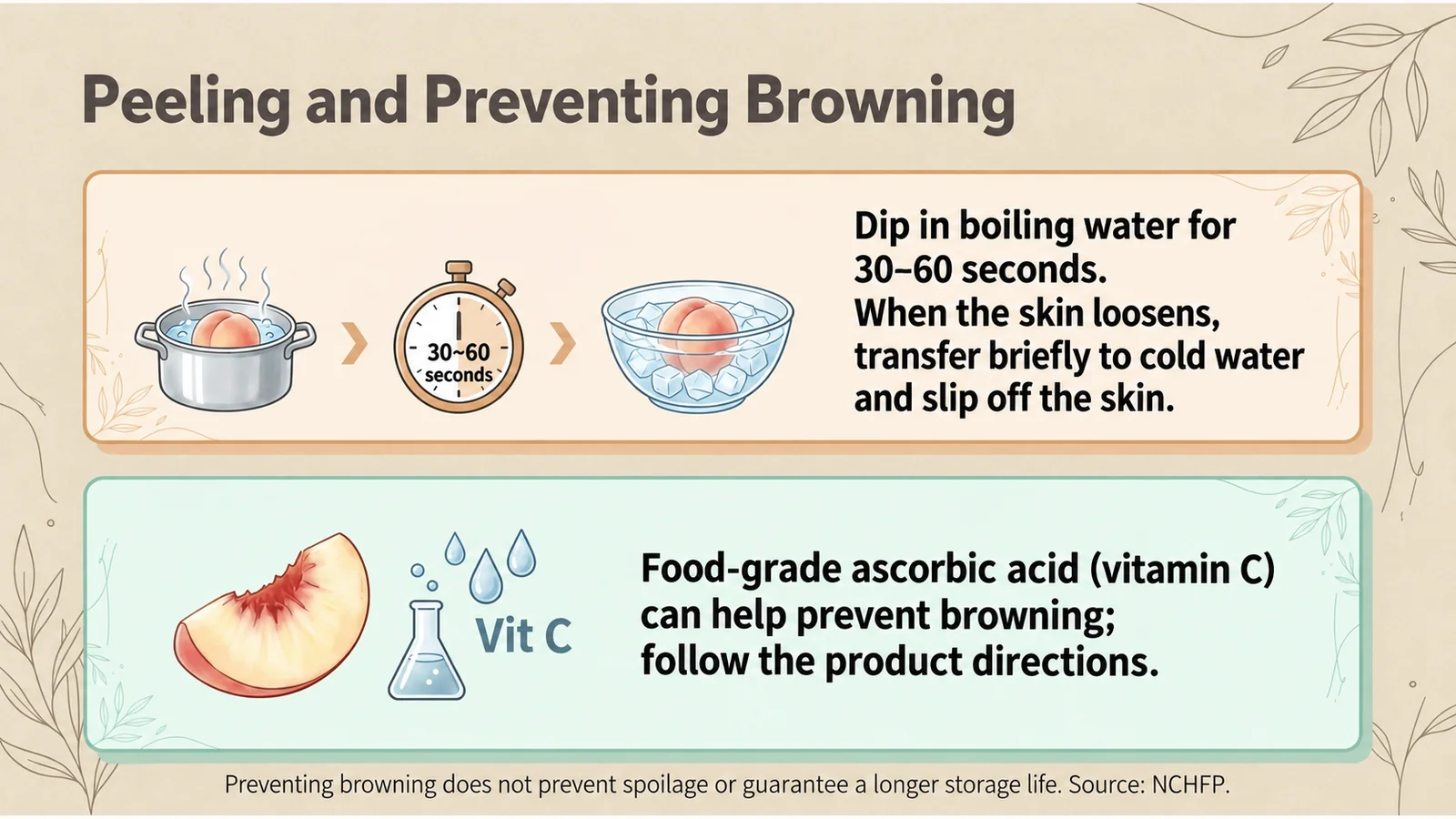
The skin of a very ripe, soft peach may peel away by hand. If it does not, blanching can help. The US National Center for Home Food Preservation (NCHFP) describes dipping peaches in boiling water for 30–60 seconds, transferring them briefly to cold water when the skin loosens, then slipping the skin off. Source: NCHFP, Peaches—Halved or Sliced (checked September 29, 2026).
For a chilled serving, the Japanese white-peach guide suggests 1–2 hours in the refrigerator before eating. A brief dip in ice water is another serving option. Cold fruit may taste less sweet, but ripe fruit being stored should still be refrigerated.
Vietnamese peach syrup and peach tea
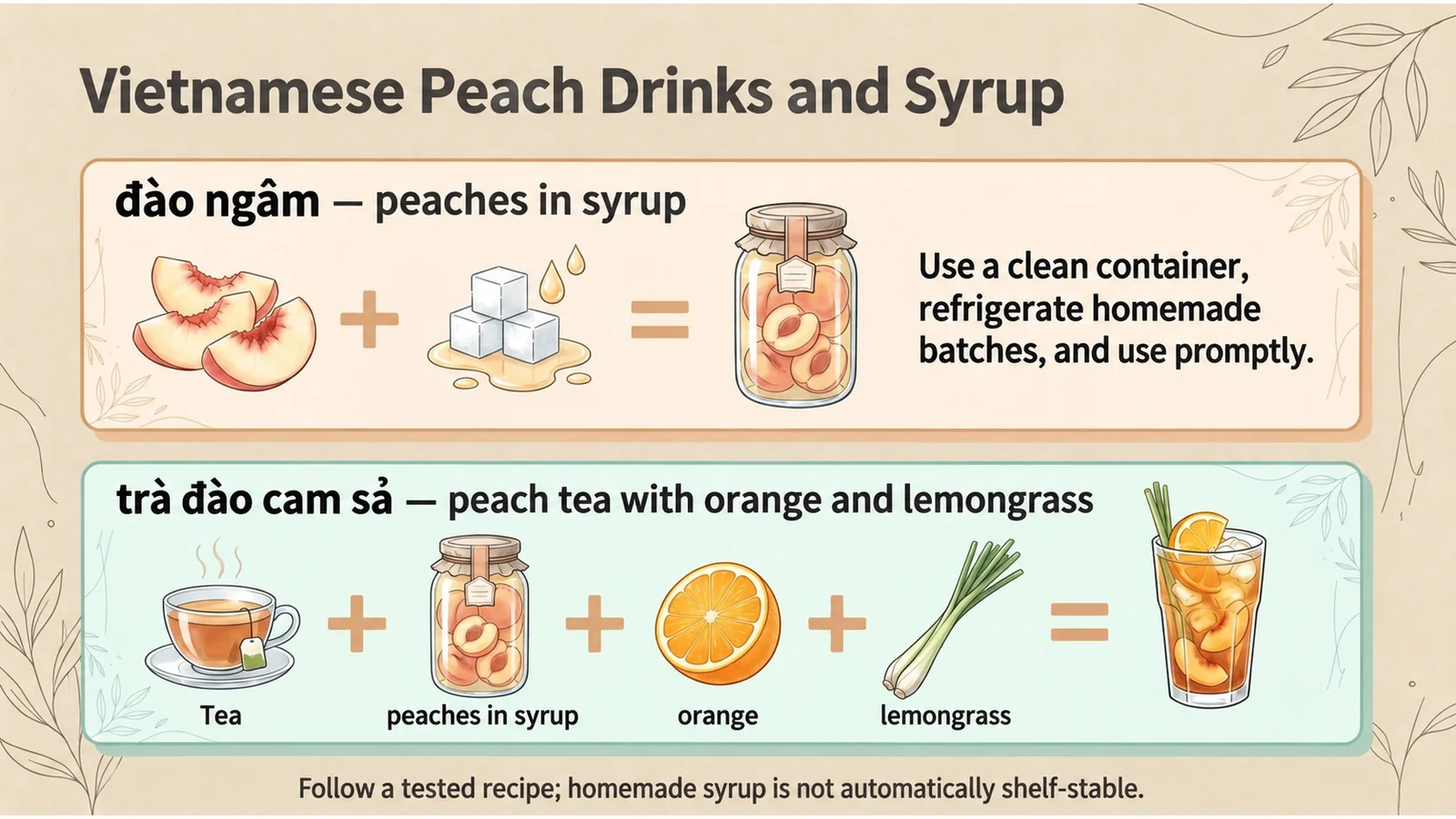
Two familiar Vietnamese uses are:
- Đào ngâm: peaches preserved in syrup.
- Trà đào cam sả: tea made with peaches in syrup, orange and lemongrass, a familiar café drink.
If making these at home, use a recipe that gives quantities and a clear method. VnExpress’s recipe covers peach syrup and the tea. A homemade batch is not automatically equivalent to a commercially canned, shelf-stable product. Use a clean container, refrigerate and use promptly.
Storage before ripening, after ripening and after cutting
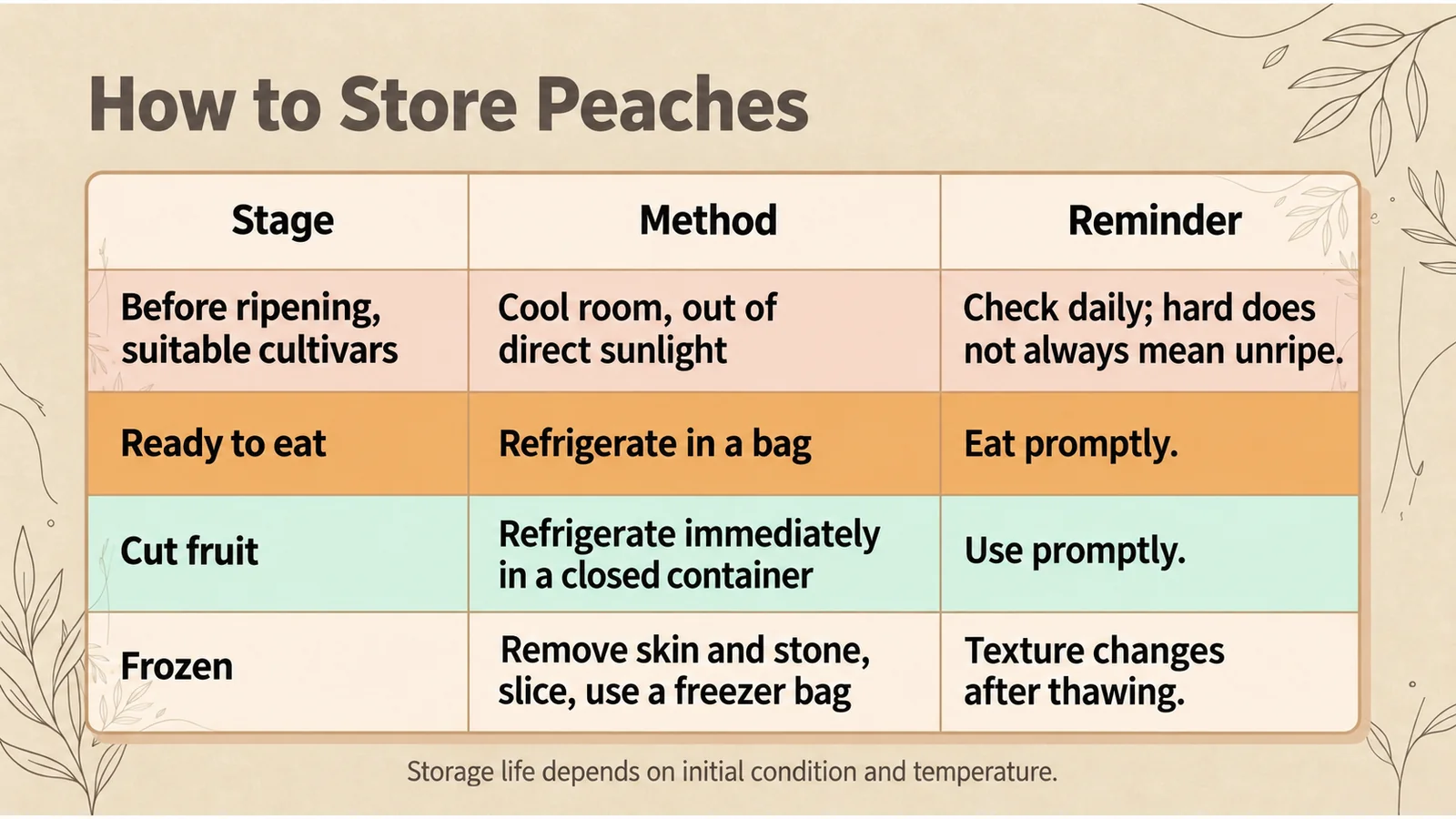
| Stage | Storage method | What to remember |
|---|---|---|
| Before ripening, for suitable softening types | Cool room away from direct sunlight; loosely wrap as appropriate | Check daily rather than leaving the fruit indefinitely |
| Ready to eat | Refrigerate in a bag in the crisper | Eat promptly |
| Cut fruit | Closed container in the refrigerator immediately | Use promptly, preferably the same day |
| Frozen | Remove skin and stone, slice and place in a freezer bag | Texture changes after thawing; it can be enjoyed in a sorbet-like form |
The before-and-after ripening guidance is based on Kudamono Navi. Actual storage life depends on the fruit’s initial condition and the temperature.
Preventing browning after cutting
Cut peach flesh can turn brown on contact with air. NCHFP describes using an ascorbic-acid solution to reduce browning. If using a food-grade anti-browning product, follow its directions. This treatment does not prevent spoilage or make storage time unlimited. Source: NCHFP.
Do not leave cut peaches at room temperature. CDC guidance says to refrigerate cut fruit within two hours, or within one hour when exposed to temperatures above about 32°C (90°F). Keep the refrigerator at approximately 4°C (40°F) or below. Source: CDC, Preventing Food Poisoning (checked October 16, 2026).
Signs of spoilage
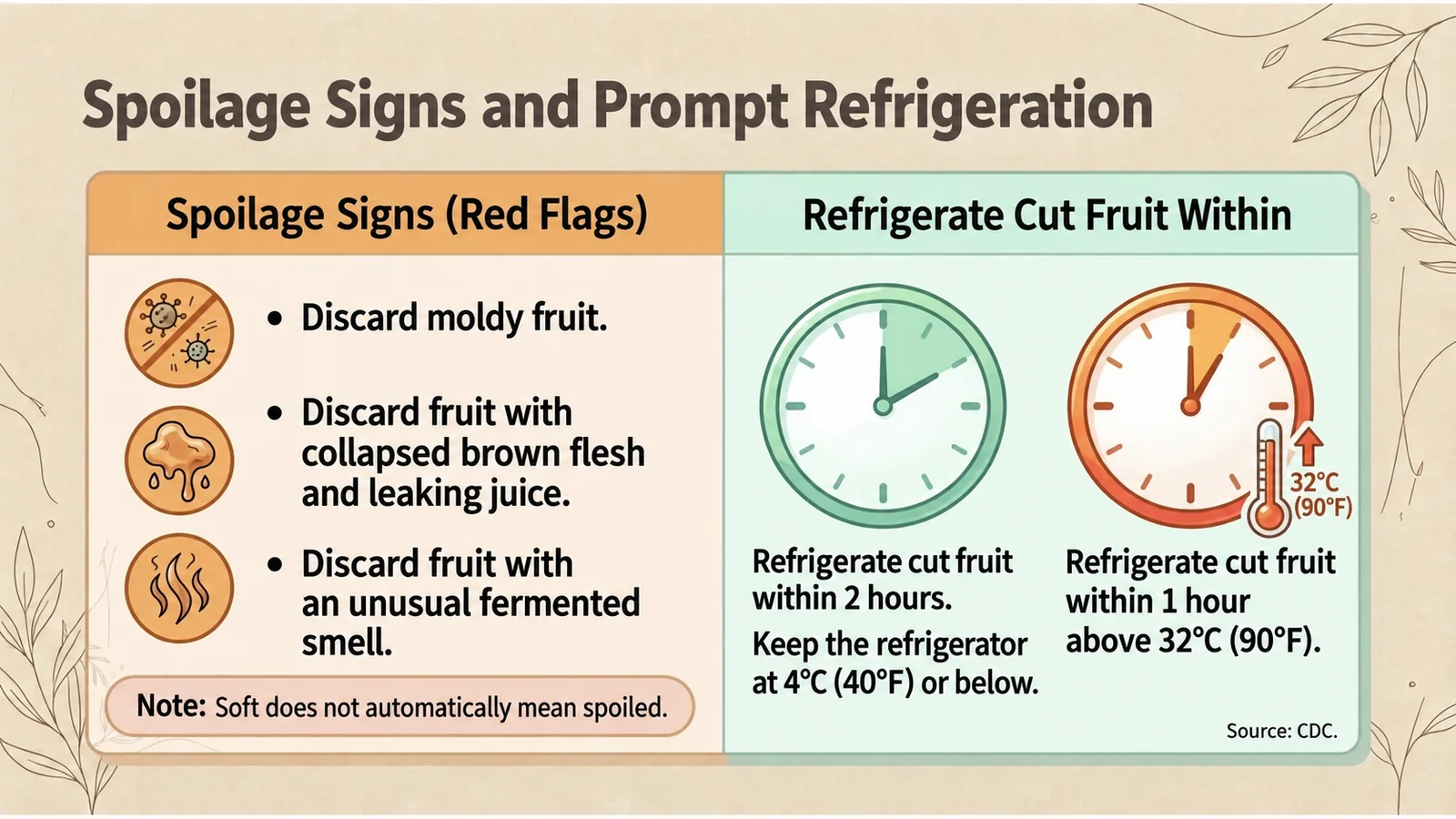
Do not eat a peach if it has mold on the skin or flesh, collapsing brown flesh with leaking juice, or an unusual fermented or unpleasant smell.
A ripe peach can be soft without being spoiled, and a dark spot may be a bruise. However, FDA guidance advises discarding produce that looks rotten and food with mold. Do not simply cut the mold off a soft peach and eat the remainder. If the condition is doubtful, discard it. Source: FDA, Selecting and Serving Produce Safely.
Peach allergy and serving fruit to children
Heating and peeling do not always prevent an allergic reaction
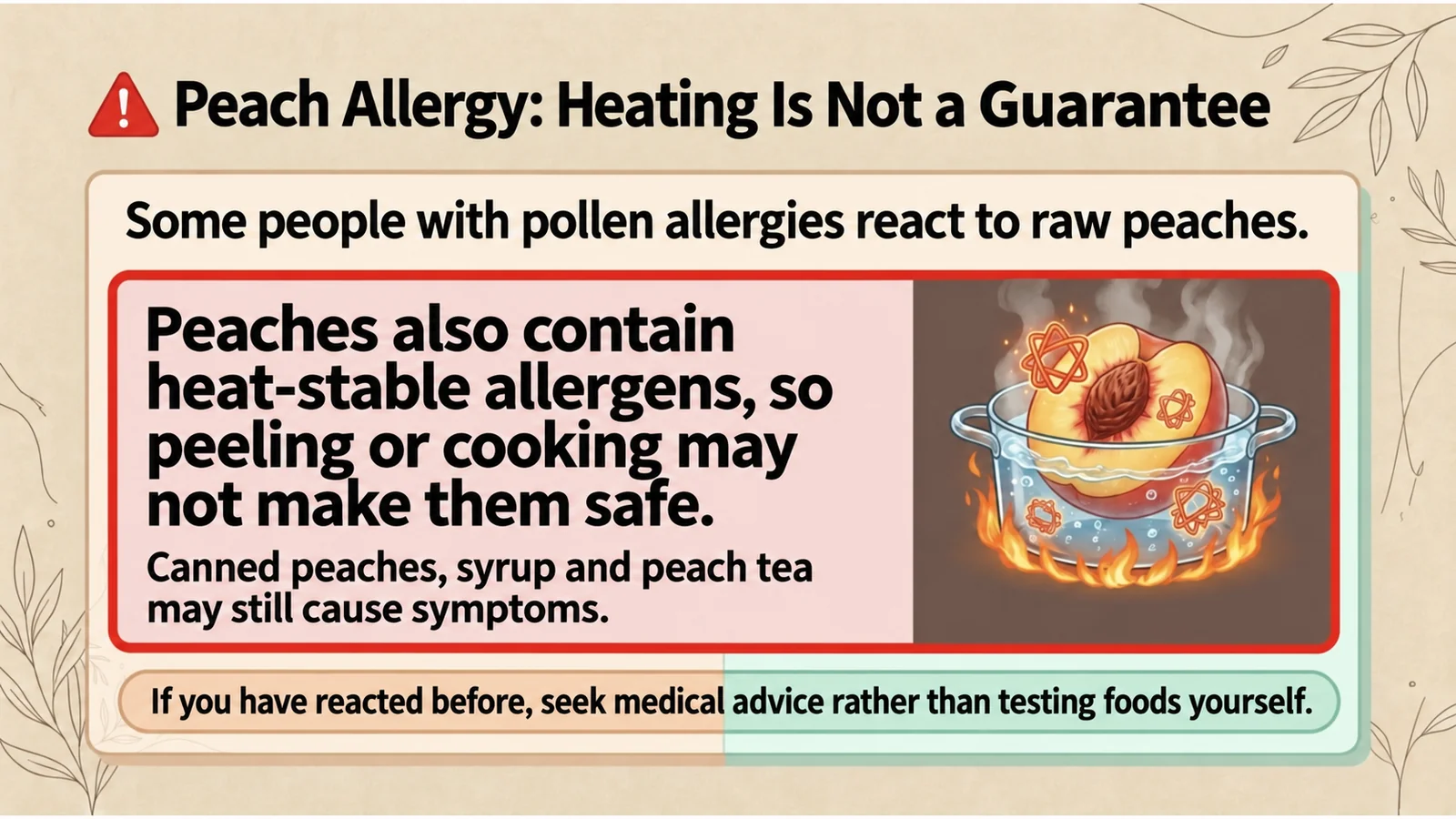
Peaches belong to the rose family, along with apples and pears. Some people with birch or alder pollen allergies experience itching or irritation in the mouth or throat after eating raw peaches, a form of oral allergy syndrome. Source: Japanese Society of Allergology (checked September 29, 2026).
Different allergenic proteins behave differently. Peaches contain both heat-sensitive proteins and more heat-stable allergens, including LTP and GRP, which can be associated with serious systemic reactions. Cooking or peeling alone does not establish that a peach is safe for someone with an allergy. Source: Clinical guideline for oral allergy syndrome (checked October 16, 2026).
If you have reacted before, canned peaches, peaches in syrup and peach tea may also be unsuitable. In Japan, peach is among the allergens for which labeling is recommended on packaged processed foods. Source: Consumer Affairs Agency (checked October 16, 2026). Do not assume that overseas labels or restaurants follow Japan’s system. Check ingredients and discuss your own risk with a clinician.
If eating fruit causes mouth or throat itching or swelling, stop eating and seek medical advice. Breathing difficulty, difficulty swallowing or widespread hives require urgent emergency help.
Remove the stone and adapt the texture for young children
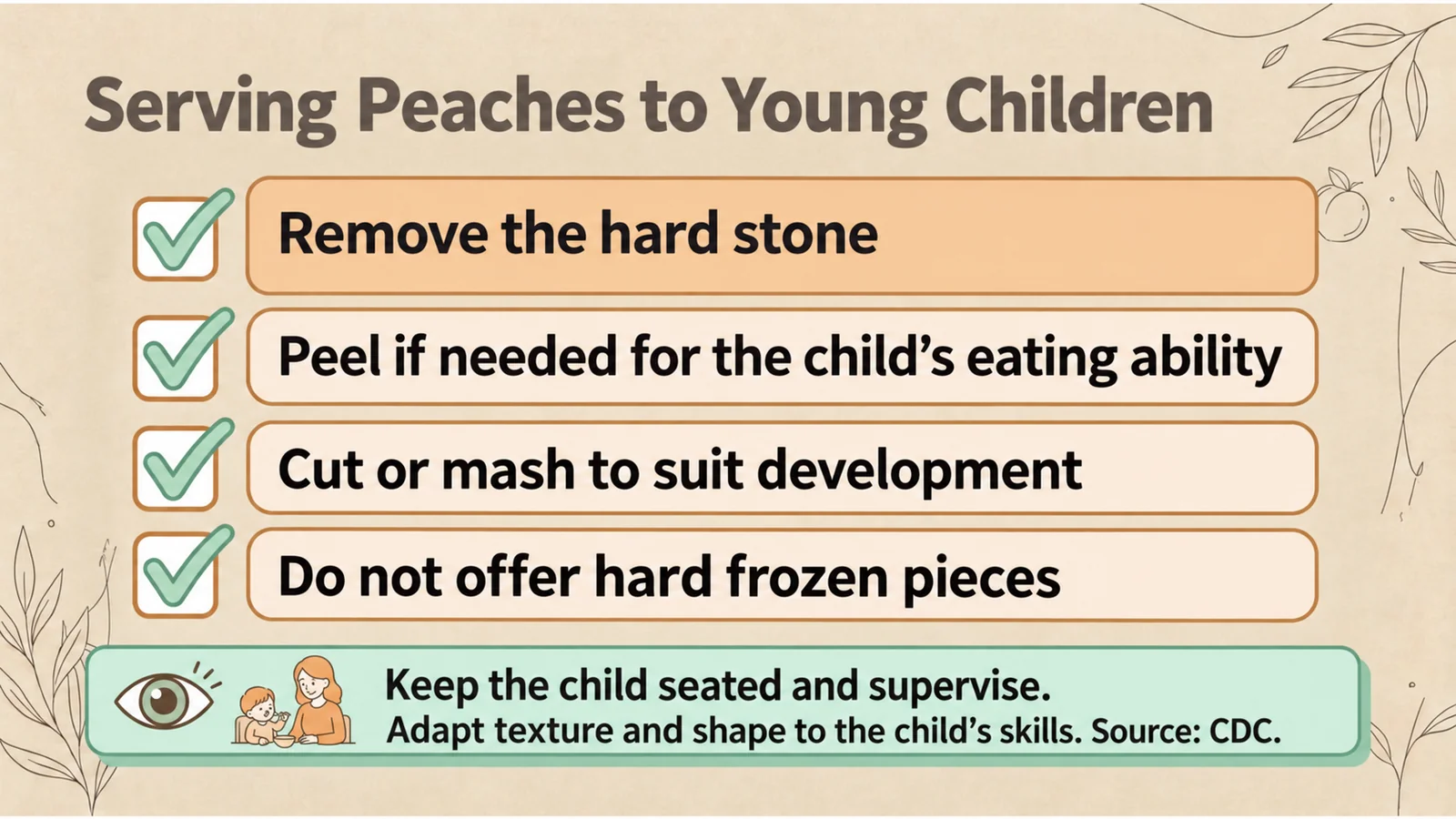
Always remove the large, hard stone. Peel, cut or mash the fruit as appropriate to the child’s eating abilities. Keep the child seated and watch them while they eat. Do not give hard frozen peach pieces directly to a small child. Source: CDC, Choking Hazards.
Can you bring peaches from Vietnam into Japan?
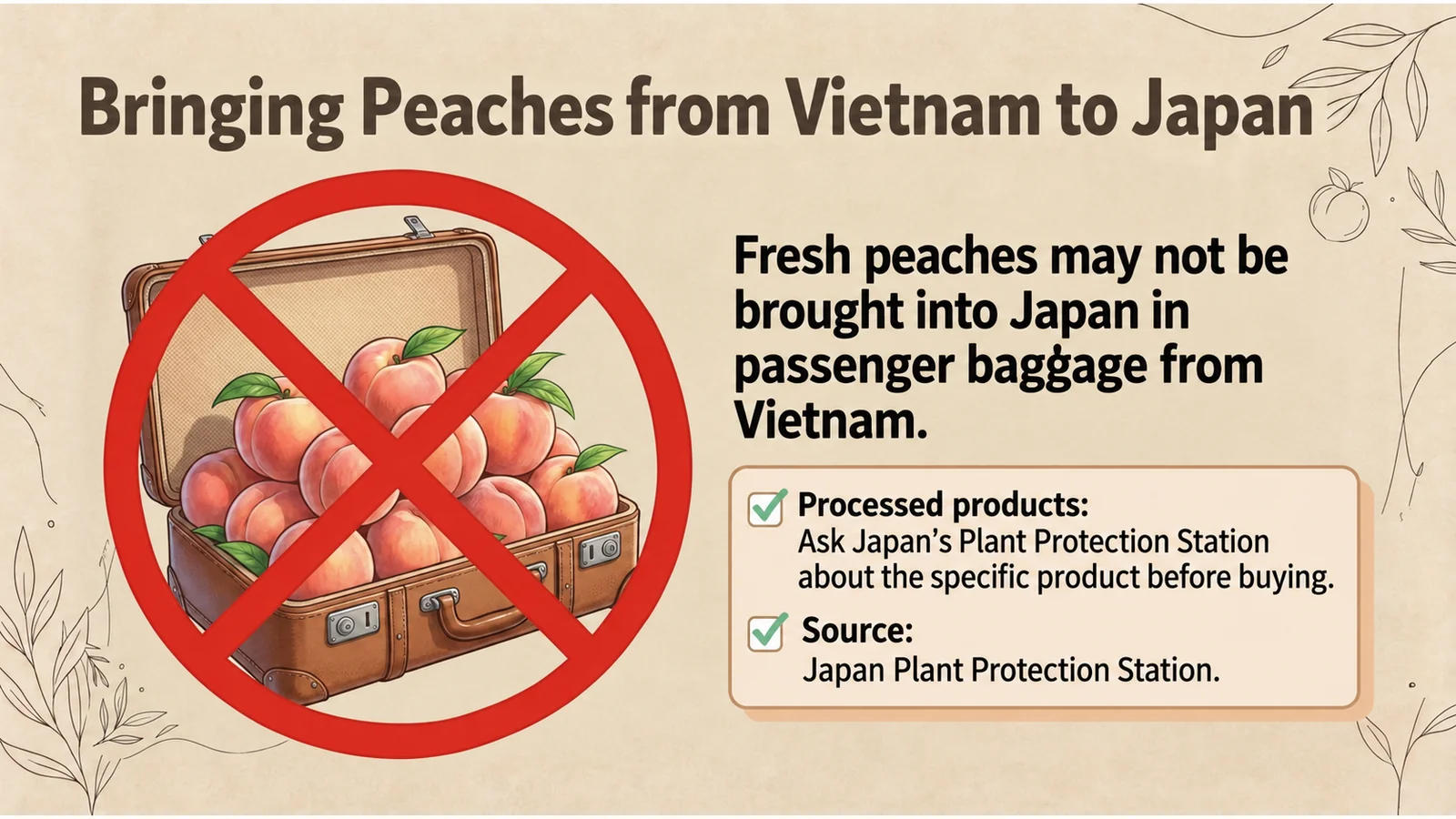
Fresh peaches may not be brought into Japan from Vietnam in passenger baggage. Japan’s Plant Protection Station lists peaches as prohibited on its Vietnam page. Source: Japan Plant Protection Station (checked October 16, 2026).
For imported peaches purchased in Vietnam, or processed souvenirs such as peaches in syrup, ask the Plant Protection Station about the specific product before buying. This article does not determine the admissibility of individual processed products.
Chinese peaches bought in Hanoi: MaxValu price and tasting diary
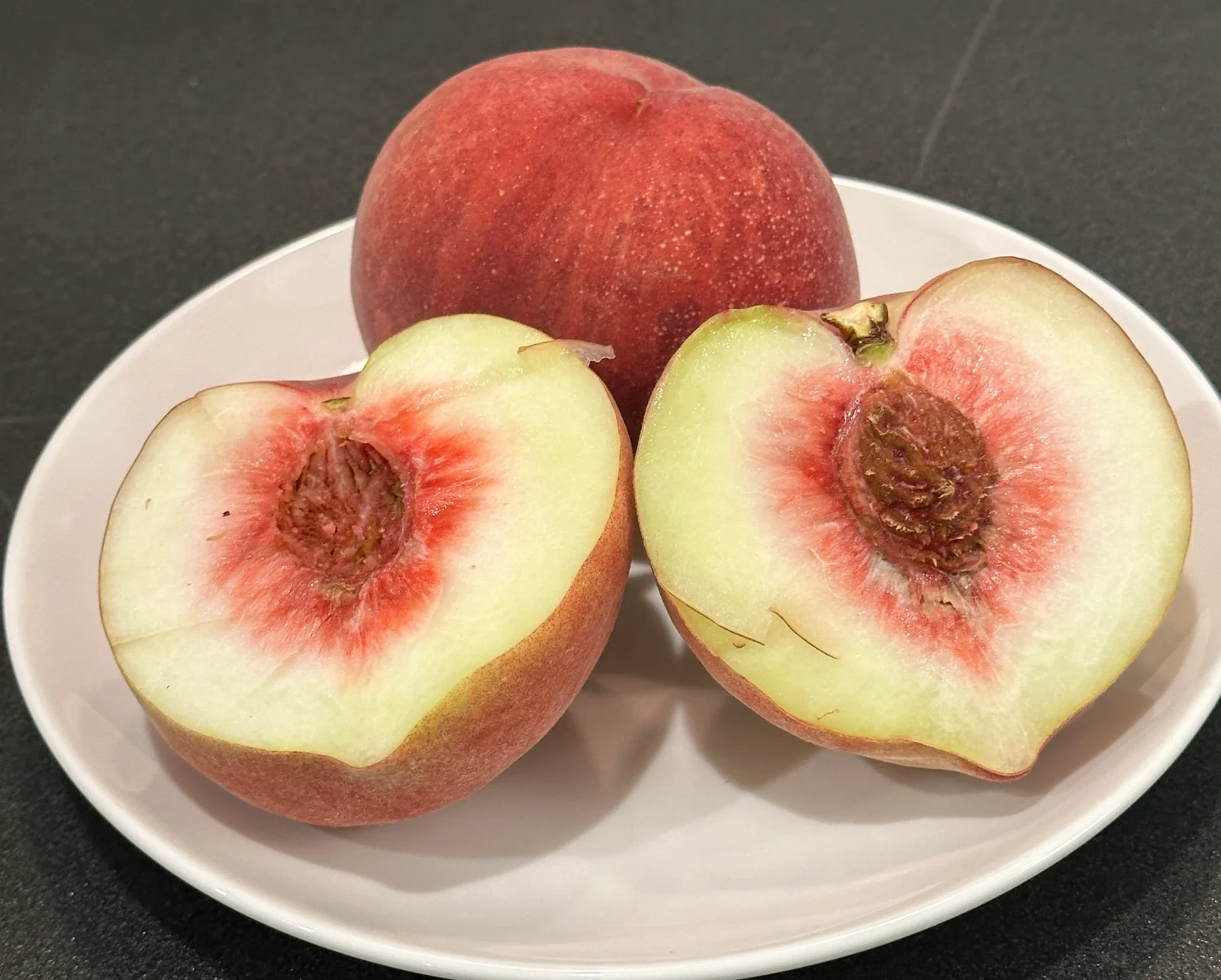
This is my record of peaches bought at a supermarket in Hanoi. The label read Trái đào tươi TQ L1. TQ abbreviates Trung Quốc, meaning China: the product was sold as fresh Chinese peaches.
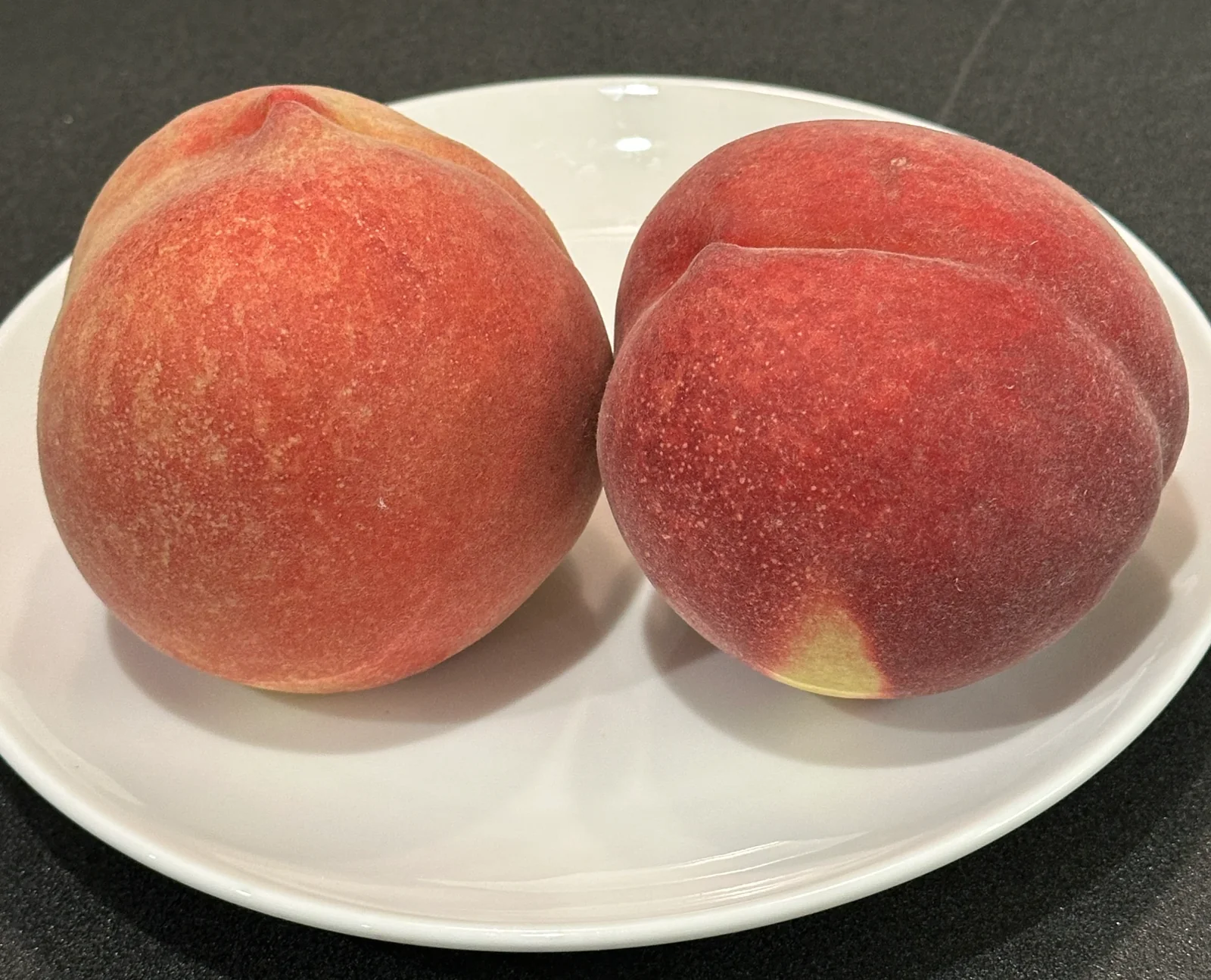
Purchase record
| Item | Recorded details |
|---|---|
| Purchase date | October 12, 2026 |
| Tasting date | October 13, 2026, the next day |
| Store | MaxValu, Khuat Duy Tien branch, Hanoi |
| Product label | Trái đào tươi TQ L1: fresh Chinese peaches; the meaning of L1 was not verified |
| Packing date | October 12, 2026 |
| Weight | 0.632 kg |
| Unit price | VND 14,900 per 100 g, equivalent to VND 149,000 per kg |
| Total price | VND 94,168 |
VND 149,000 multiplied by 0.632 kg gives VND 94,168, matching the label. This is a purchase record from one shop at one time, not a general price for Vietnam. Hanoi was the place of purchase; China was the stated origin. The label did not establish what L1 meant.
Flavor: mild sweetness and refreshing acidity
The sweetness was restrained, with a clean acidity. There was a peach aroma, but it was milder than the Japanese peaches I usually eat. The balance felt light, with a refreshing finish that suited the hot weather.
Texture: crisp and apple-like
The flesh was firm, with a crunchy, apple-like bite. Compared with the soft Japanese peaches I usually eat, these particular peaches seemed less juicy and closer in texture to an apple or green apple. They were substantial and enjoyable in their own way.
These comments describe this purchase, not all Chinese peaches or all peaches sold in Vietnam. The texture was close to the crisp type discussed above. However, the label did not give a cultivar name, so I cannot identify the variety or separate cultivar effects from maturity. Another batch with the same product label may taste different.
A practical routine
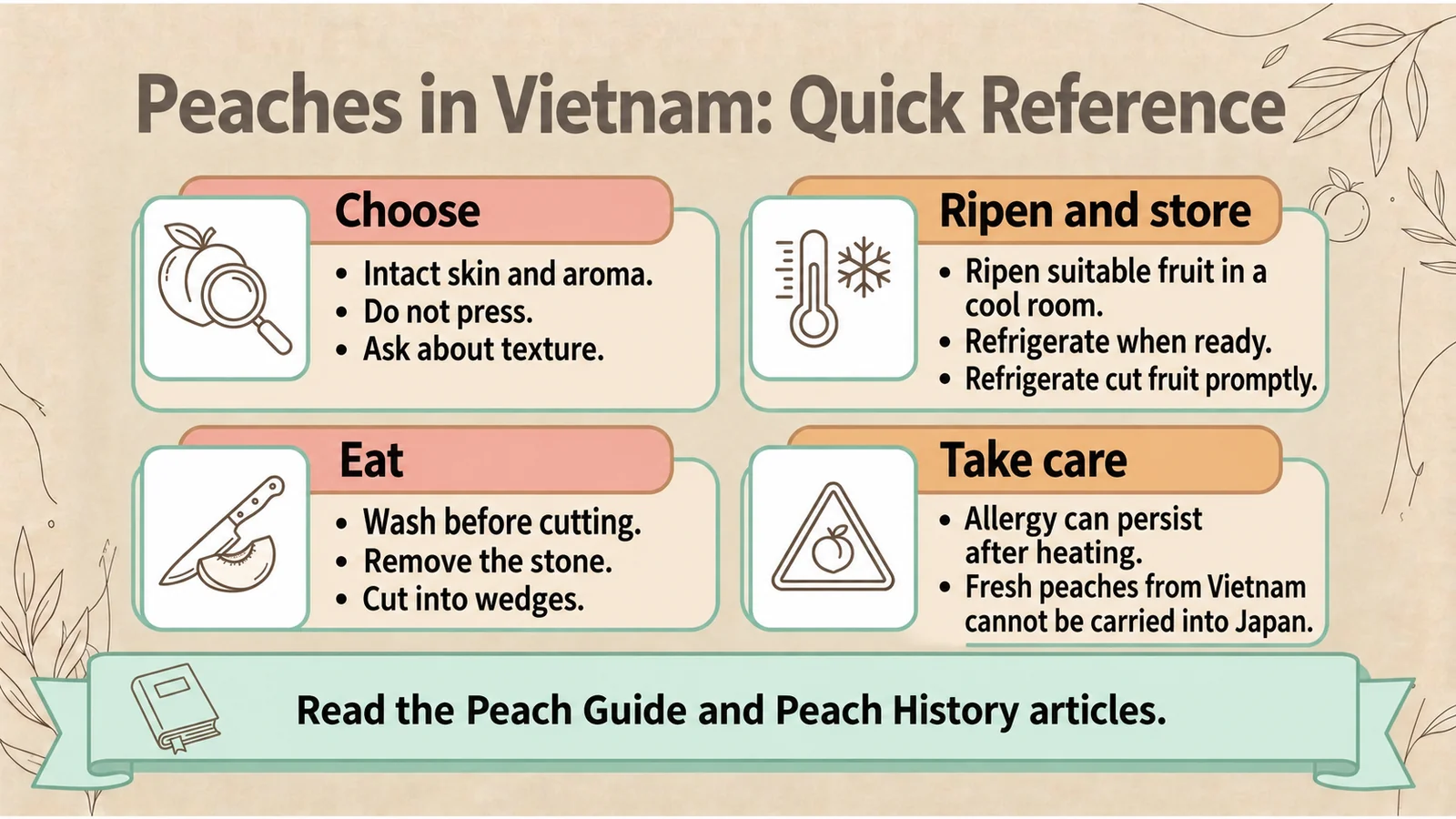
- Choose by intact skin and a pleasant aroma; do not press with your fingertips.
- Ask whether the fruit should soften or retain a crisp bite.
- If it is a suitable softening type and still needs ripening, keep it in a cool room and check it daily.
- Refrigerate when ready and eat promptly. For immediate serving, 1–2 hours of chilling is one option before cutting into wedges.
- Refrigerate cut fruit promptly and use it soon.
Remember that some peach allergens remain active after heating, and fresh peaches from Vietnam cannot be carried into Japan.
Frequently asked questions
Must every hard peach be left to ripen?
No. Some cultivars stay crisp when ripe. Even a softening cultivar may not develop good flavor if picked too early. Ask the seller about its variety and eating stage.
Can peaches and nectarines be stored in the same way?
For both, fruit that needs ripening can be kept in a cool room, then refrigerated when ready. Refrigerate cut fruit promptly.
Can I take a fresh peach bought in Vietnam back to Japan?
Japan’s Plant Protection Station lists fresh peaches from Vietnam as prohibited in passenger baggage. Processed products depend on their condition and processing, so check before buying.
More in the peach trilogy
- Peaches in Vietnam: Types, Seasons, Origins and Nutrition
- Peach History and Folklore: Momotaro, Hakuto and Tet
Sources and editorial note
Sources are linked beside the relevant guidance. The purchase dates, price, photographs and tasting notes were supplied by the site owner for the Japanese edition. This English v09 edition preserves that firsthand account; the translation process did not involve a new purchase or tasting. The Japanese source was finalized on October 16, 2026.
