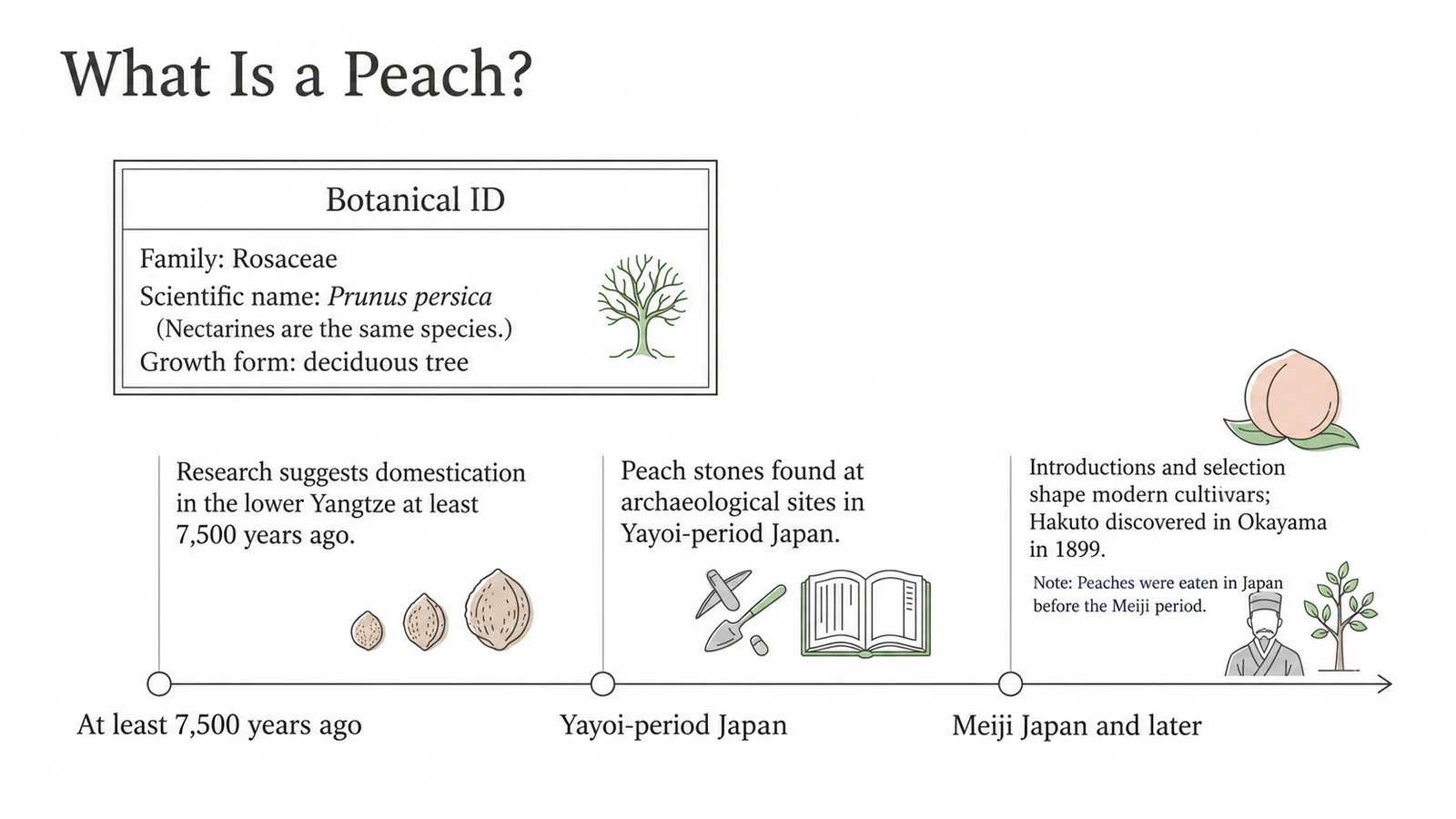
The peach is a deciduous fruit tree in the rose family, native to China. Archaeological research suggests that domestication began in the lower Yangtze region at least 7,500 years ago. Nectarines, despite their smooth skin, belong to the same species.
This guide explains the differences between white-fleshed peaches, yellow-fleshed peaches and nectarines, as well as fruit texture and nutrition per 100 g. In Vietnamese, a peach is quả đào. In northern Vietnam, peach blossoms also decorate homes for Tet, the Lunar New Year. Edible peaches are grown in highland areas such as Bac Ha and Mau Son, with reported harvest periods falling between May and July.
For ripening, cutting, storage and a photo diary of peaches bought in Hanoi, see How to Eat Peaches in Vietnam.
Contents
- What is a peach? Names, origin and classification
- The tree, flowers and fruit
- White peaches, yellow peaches and nectarines
- Peach nutrition and calories: a 100 g comparison
- Growing conditions: winter chill varies by cultivar
- Peach seasons in Vietnam and Japan
- Vietnamese peach blossoms and highland fruit
- Five things to remember
- More in the peach trilogy
- Sources and editorial note
What is a peach? Names, origin and classification
| Item | Details |
|---|---|
| English name | Peach; smooth-skinned forms are called nectarines |
| Japanese name | Momo |
| Vietnamese name | Quả đào; the flowers are hoa đào |
| Classification | Rose family, Rosaceae; genus Prunus |
| Scientific name | Prunus persica, including nectarines |
| Origin | China; research suggests domestication in the lower Yangtze at least 7,500 years ago |
| Growth habit | Deciduous tree: flowers in spring and loses its leaves in winter |
| Pollination | Many cultivars are self-fruitful; some need pollen from another cultivar |
| Texture | Some Japanese white-fleshed cultivars are soft and juicy; peaches from Bac Ha and Mau Son have been described as crisp |
| Nutrients to note | Water and potassium; yellow-fleshed peaches and nectarines also contain beta-carotene |
| Examples of Vietnamese growing areas | Bac Ha in Lao Cai Province; Mau Son in Lang Son Province |
Botanical information is based on Clemson University’s Peaches & Nectarines. Nutrition figures are from Japan’s Ministry of Education, Culture, Sports, Science and Technology (MEXT), cited below.
The tree, flowers and fruit
A deciduous tree with a stone fruit
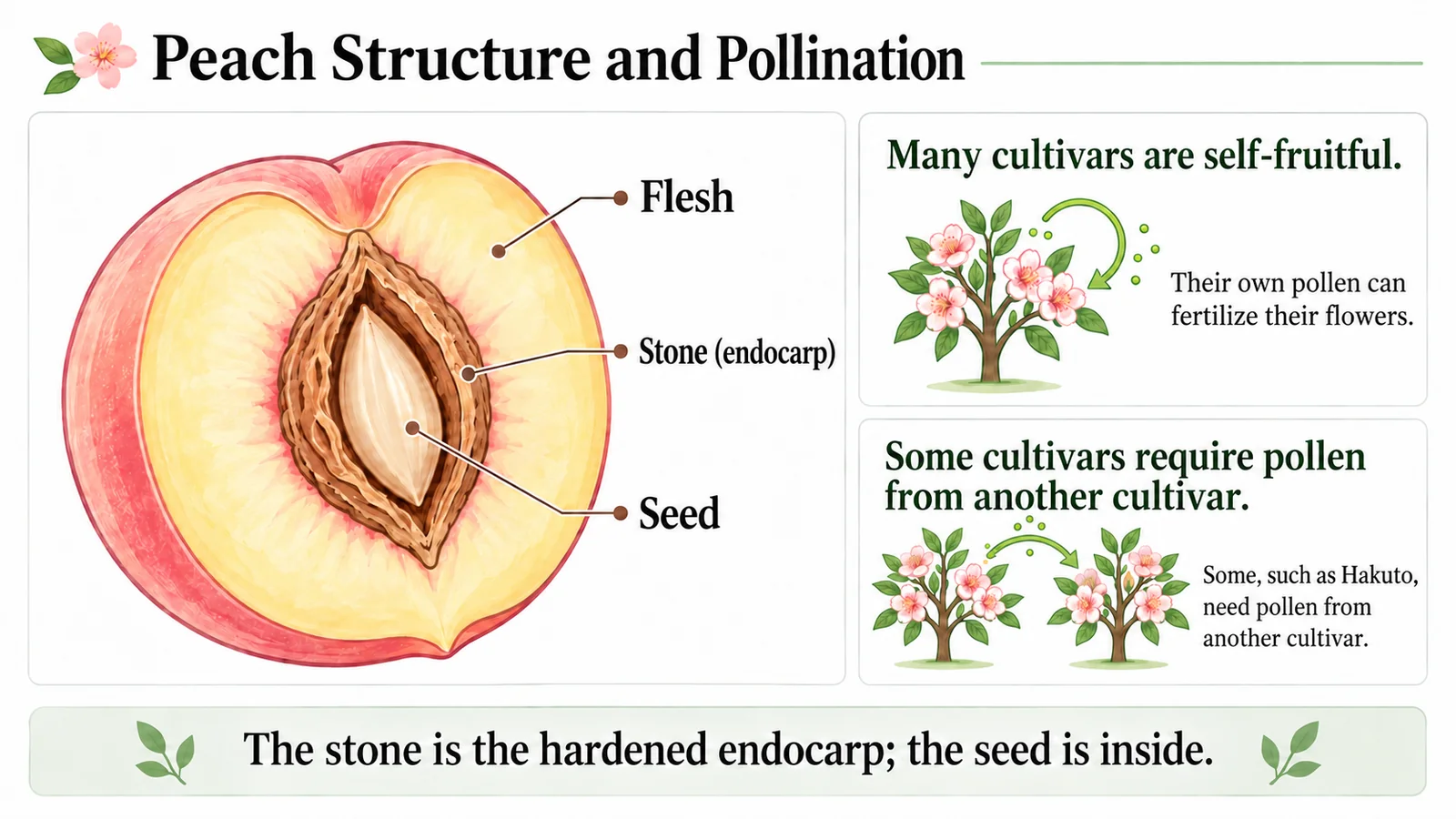
Peach trees flower in spring and bear fruit in summer. They lose their leaves and become dormant in winter. In the center of the fruit is the hard stone, or pit, formed from the endocarp. The seed is enclosed inside it. This type of fruit is called a drupe, or stone fruit. Cherries, plums and Japanese apricots are related members of the genus Prunus.
Many cultivars can fruit on their own
Many peach cultivars are self-fruitful: their own pollen can fertilize their flowers. This does not apply to every cultivar. Okayama’s historical account describes Hakuto as a cultivar that requires pollination. If you plan to grow a tree, check whether its cultivar produces viable pollen and whether it needs a pollinizer. Source: Okayama’s 150-year peach and grape history (checked September 29, 2026).
Chinese origins: evidence from archaeological stones
A 2014 study examined peach stones excavated at sites in Zhejiang, China. The authors proposed that domestication had begun in the lower Yangtze region at least 7,500 years ago. Stones became larger over time; examples from the Liangzhu culture, around 5,300–4,300 years ago, approached the form of modern cultivated peaches. Source: Zheng, Crawford and Chen, PLOS ONE, 2014 (checked September 29, 2026).
Peach stones have also been found at Yayoi-period sites in Japan, and peaches appear in the Kojiki and Nihon Shoki. Japan’s Ministry of Agriculture, Forestry and Fisheries (MAFF) describes their wider spread as a commonly eaten fruit from the Meiji period onward. This does not mean that peaches were never eaten earlier. Source: MAFF, aff, May–June 2019 (checked September 29, 2026).
White peaches, yellow peaches and nectarines
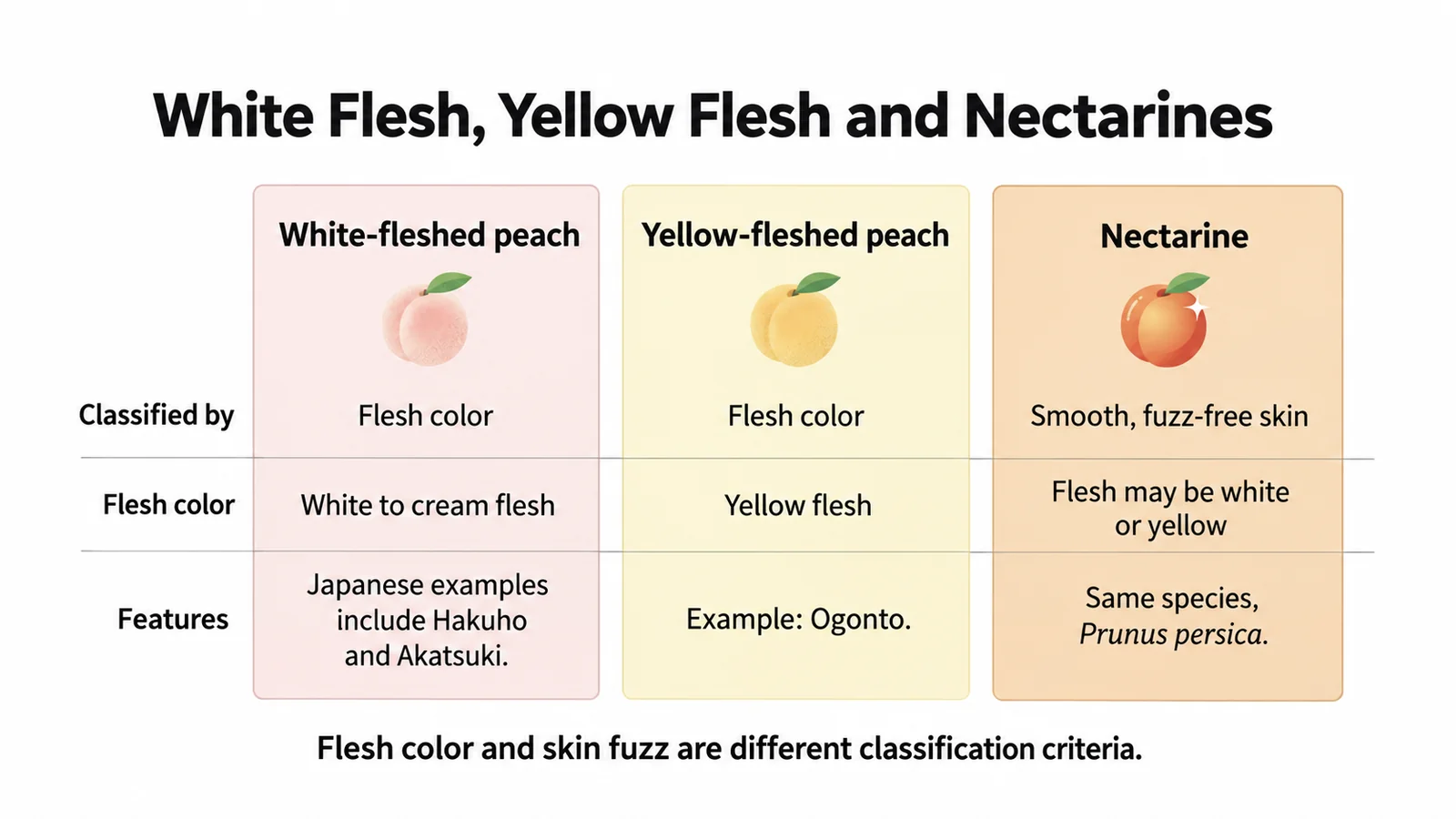
Two useful characteristics are flesh color and skin fuzz. White-fleshed and yellow-fleshed peaches are distinguished by color. Nectarines are distinguished by their smooth skin, so the categories overlap.
| Type | Examples | Features |
|---|---|---|
| White-fleshed peaches | Hakuto, Hakuho, Akatsuki, Kawanakajima Hakuto | White to cream flesh; widely eaten in Japan |
| Yellow-fleshed peaches | Ogonto and others | Yellow flesh; more beta-carotene than the white-fleshed entry in Japan’s food tables |
| Nectarines | Various cultivars | Smooth, fuzz-free skin; either white or yellow flesh |
These cultivar examples are familiar Japanese examples, not a list of varieties necessarily sold in Vietnam.
White and yellow flesh
Many peaches eaten in Japan have white flesh. The cultivar Hakuto was discovered by Jugoro Okubo in Okayama in 1899 among seedlings descended from a Shanghai peach introduced from China. Source: Okayama City (checked September 29, 2026).
MAFF describes Hakuto as a cultivar regarded as an ancestor of modern Japanese peaches. Hakuho, Akatsuki and Kawanakajima Hakuto are among the varieties developed in the subsequent history of Japanese peach growing. Source: MAFF.
Yellow-fleshed peaches include Japanese cultivars such as Ogonto.
Nectarines are peaches without fuzz
Although they may seem like a different fruit, nectarines are the same species, Prunus persica. Their defining difference is the absence of skin fuzz. Source: University of Florida IFAS (checked September 29, 2026).
Melting, non-melting and stony-hard flesh
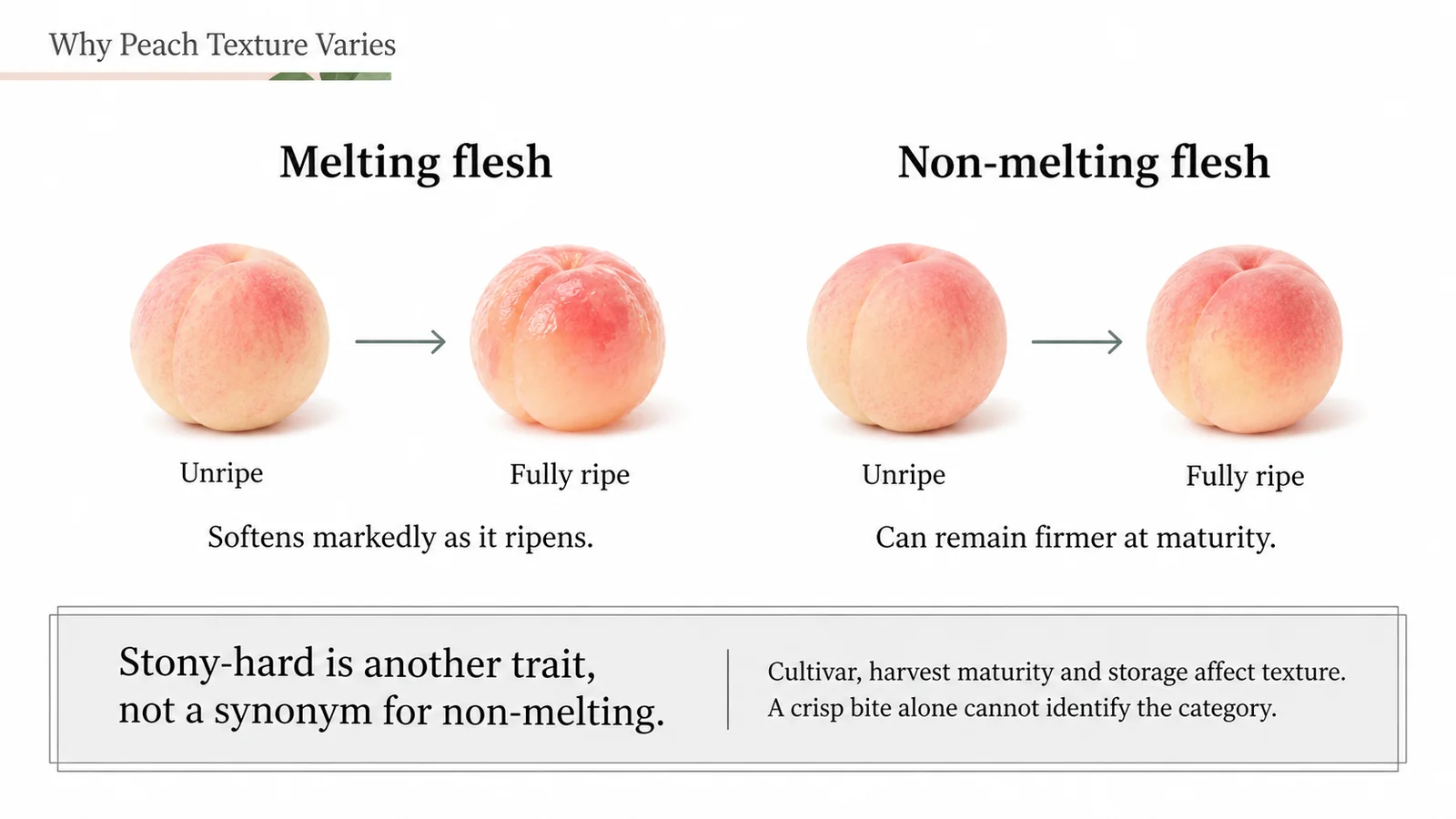
Some peaches have melting flesh that softens markedly as the fruit ripens. Non-melting types retain more firmness at maturity. The stony-hard trait is another reason a peach may resist softening; firmness alone is not enough to identify the category.
UF/IFAS explains that melting-flesh fruit becomes very soft when fully ripe and can be difficult to ship. Non-melting fruit can retain firmness even when tree-ripe. Source: Florida Peach and Nectarine Varieties.
Harvest maturity and storage also affect texture. A Vietnamese peach described as crisp cannot be classified as non-melting on that description alone.
Peach nutrition and calories: a 100 g comparison
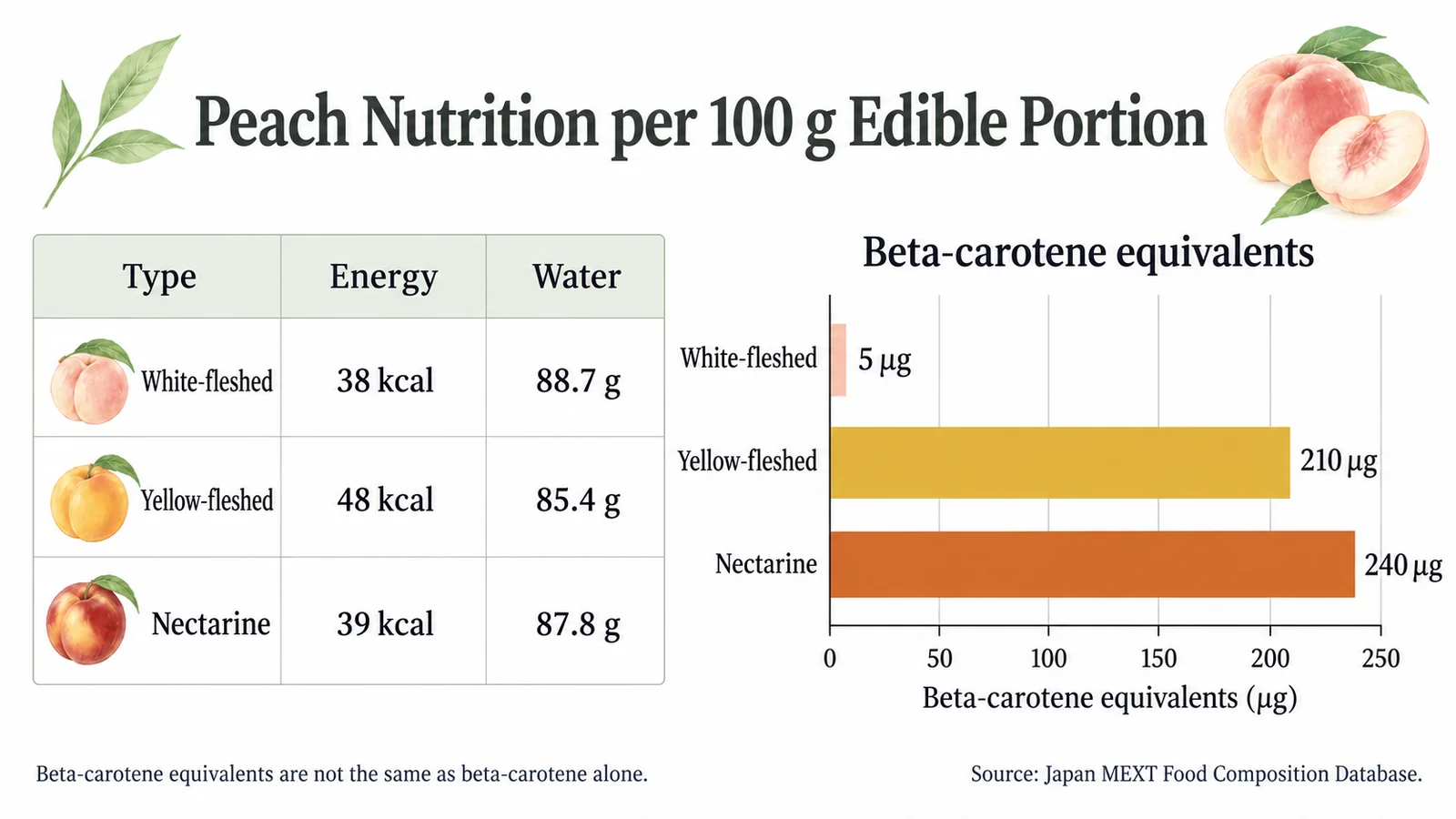
Japan’s food composition database lists white-fleshed peaches, yellow-fleshed peaches and nectarines separately. The figures below refer to 100 g of edible portion, after removing discarded parts such as the skin and stone.
| Nutrient | White-fleshed peach, raw | Yellow-fleshed peach, raw | Nectarine, raw |
|---|---|---|---|
| Energy | 38 kcal | 48 kcal | 39 kcal |
| Water | 88.7 g | 85.4 g | 87.8 g |
| Carbohydrate | 10.2 g | 13.4 g | 10.7 g |
| Dietary fiber | 1.3 g | 1.9 g | 1.7 g |
| Potassium | 180 mg | 210 mg | 210 mg |
| Vitamin C | 8 mg | 6 mg | 10 mg |
| Beta-carotene equivalents | 5 µg | 210 µg | 240 µg |
Sources: MEXT white-fleshed peach, yellow-fleshed peach and nectarine, Standard Tables of Food Composition in Japan, eighth edition with the 2023 supplement; checked October 16, 2026.
The white-fleshed entry is 88.7% water by weight and supplies 38 kcal per 100 g. One notable difference is in beta-carotene equivalents: 5 µg for white flesh, compared with 210 µg for yellow flesh and 240 µg for nectarines. The latter two values are more than 40 times the first, but this does not mean that they are 40 times more nutritious overall. Beta-carotene equivalents combine contributions from several carotenoids; they are not beta-carotene alone.
Vitamin C ranges from 6 to 10 mg per 100 g. Consider the whole diet rather than judging a fruit by one nutrient. These are not figures per peach, and Japanese reference values will not necessarily match an individual product sold in Vietnam.
Growing conditions: winter chill varies by cultivar
Some cultivars need less winter cold
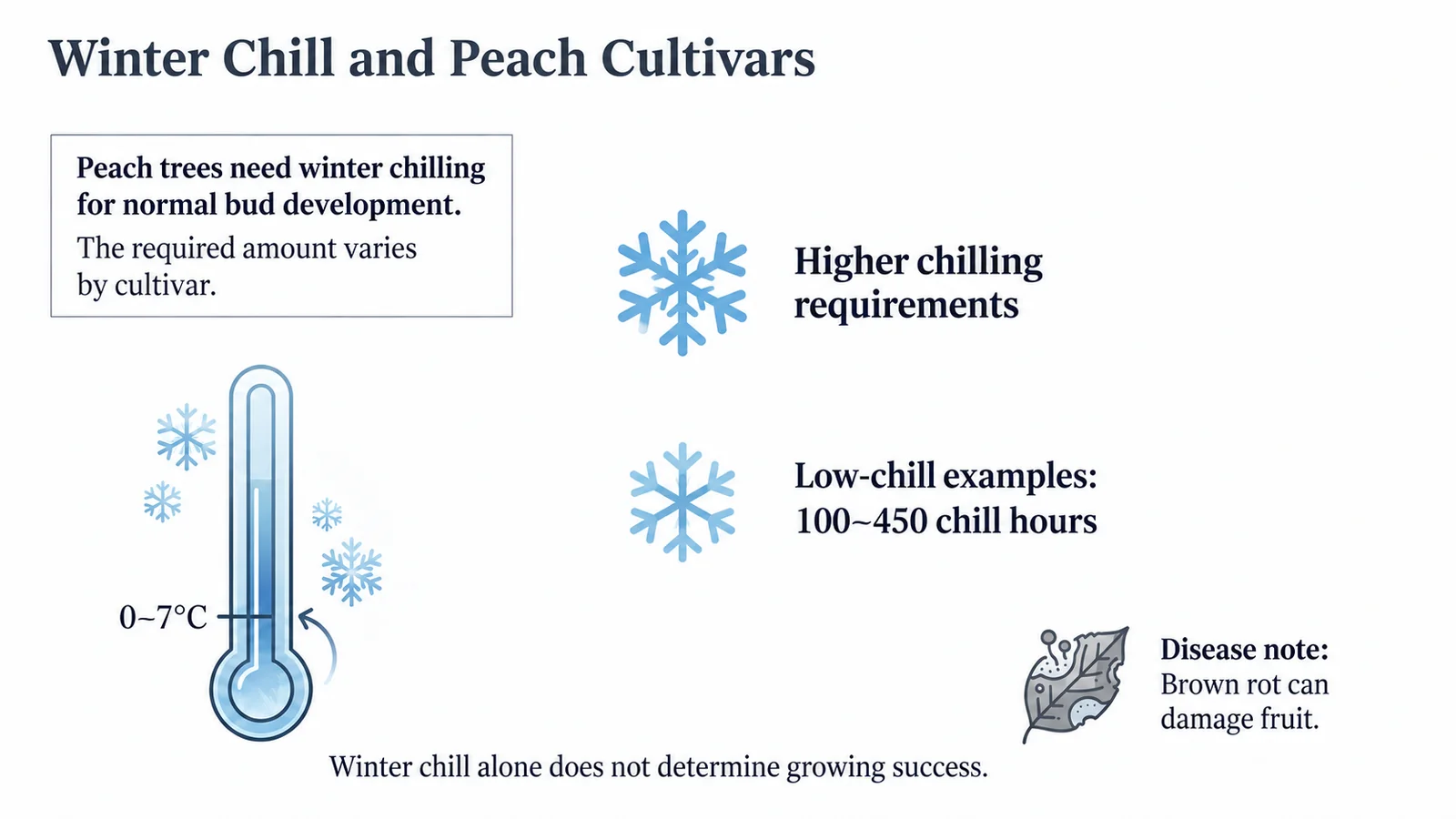
Deciduous fruit trees need a period of winter chilling for normal spring growth. Clemson’s guidance discusses counting hours below about 7°C (45°F). Insufficient chilling can delay leafing and flowering and reduce fruit quantity, size or shape. Source: Clemson University (checked September 29, 2026).
Chilling requirements vary considerably among peach cultivars. The University of Florida describes low-chill peaches needing 100–450 hours, using hours at 0–7°C as its measure. Many temperate cultivars need more chilling. Source: UF/IFAS.
Vietnamese peach production includes northern highlands that become cold in winter. Growing location and selling location are different: shops in southern Vietnam may sell fruit from the north or imported fruit.
Brown rot
Peaches are susceptible to diseases such as brown rot, which can cause fruit decay. Source: University of Georgia, Peach Diseases (checked September 29, 2026).
Peach seasons in Vietnam and Japan
In Japan, peaches are a summer fruit. MAFF reports a 2025 peach harvest of 100,600 tonnes. Yamanashi accounted for 32%, Fukushima 23%, Nagano 10%, Yamagata 8% and Wakayama 7%; together these five prefectures produced about 80% of the total. Source: MAFF, 2025 peach and plum statistics (checked October 16, 2026).
Some northern Vietnamese harvest periods overlap with, or precede, Japan’s summer season.
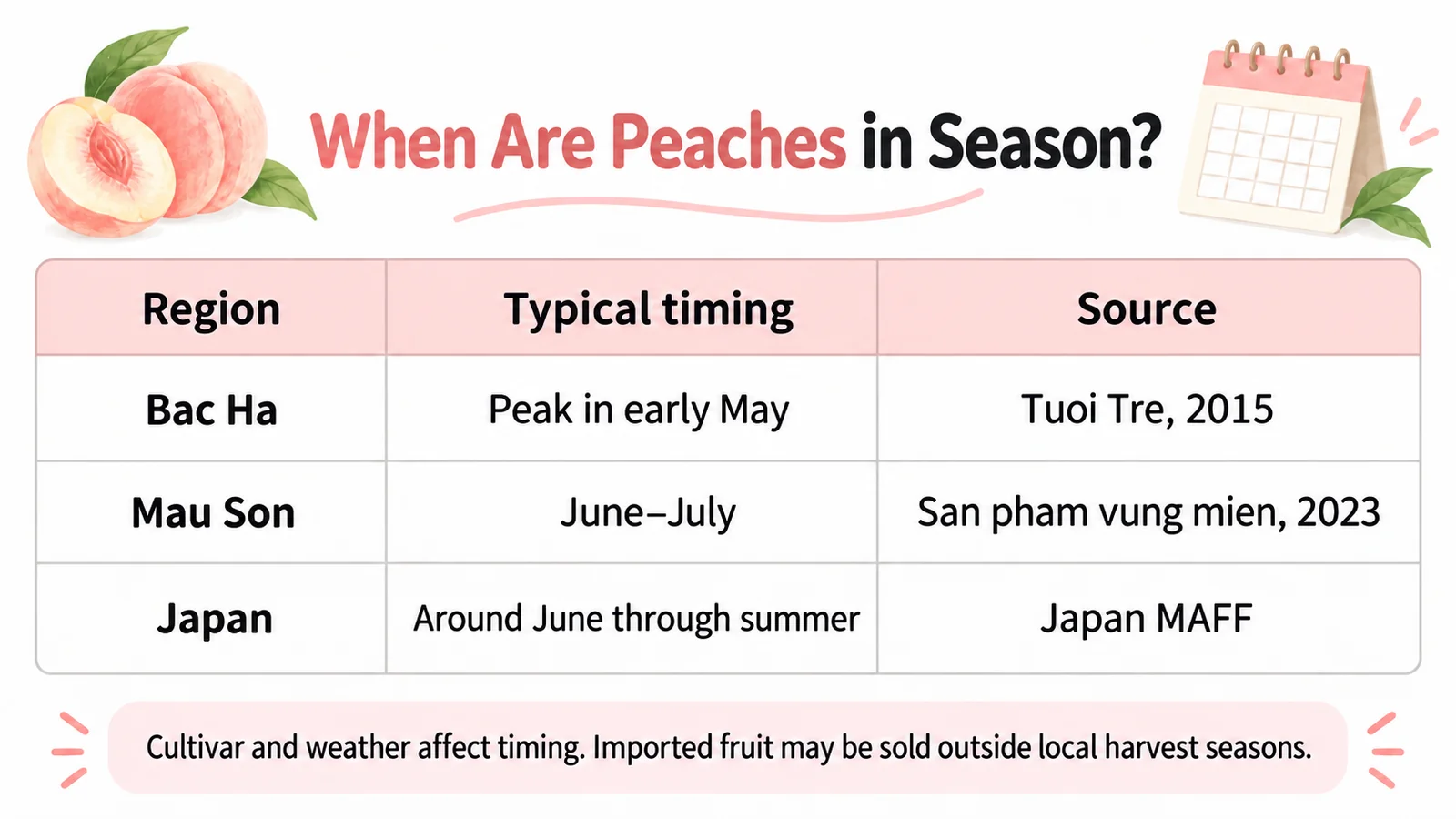
| Growing area | Timing reported | Source |
|---|---|---|
| French hybrid peaches in Bac Ha, Lao Cai | Peak in early May | Tuổi Trẻ, 2015 |
| Mau Son, Lang Son | June–July | Sản phẩm vùng miền, 2023 |
| Japan, for comparison | Around June through summer | MAFF |
Weather can shift the season from year to year. Imported peaches and nectarines broaden retail availability, so seeing a peach in a shop does not identify its harvest region. Check the origin label.
Vietnamese peach blossoms and highland fruit
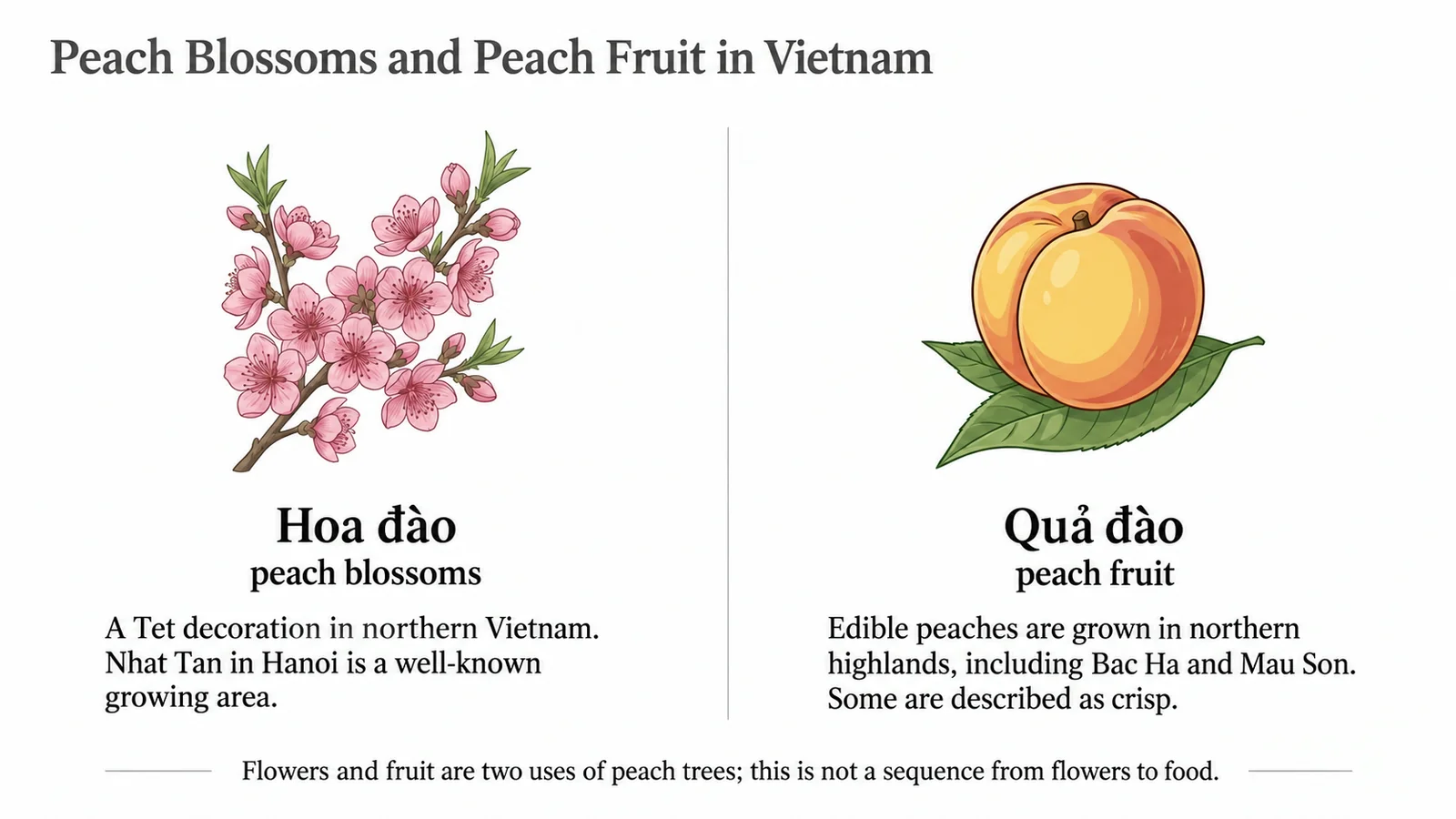
Quả đào and hoa đào
The fruit is quả đào, while peach blossoms are hoa đào.
A familiar Tet flower in the north
In northern Vietnam, peach blossom branches and potted trees are familiar Tet decorations. Nhat Tan in Hanoi is a well-known growing area. A 2020 VietnamPlus report describes flowers with up to 24 petals and trained potted trees called đào thế. Source: VietnamPlus, published January 25, 2020; checked September 29, 2026.
Peach blossom is one of the flowers displayed around Hanoi before Tet. In southern Vietnam, yellow mai blossoms are particularly popular. Read more about the associated legends in Peach History and Folklore.
French hybrid peaches in Bac Ha
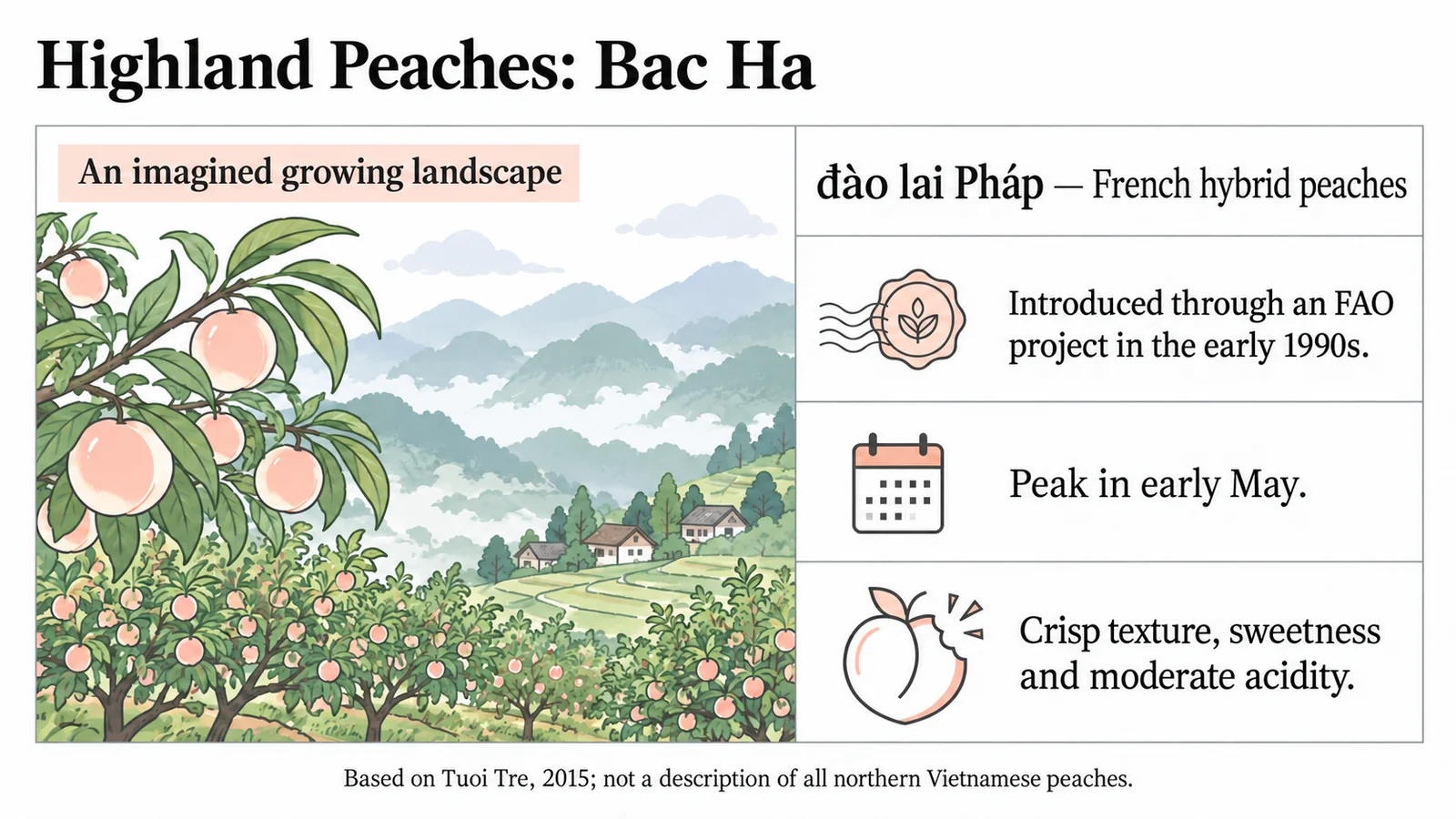
Bac Ha in Lao Cai Province, near the Chinese border, is one of Vietnam’s edible-peach growing areas. Tuổi Trẻ reports that đào lai Pháp, or French hybrid peaches, were introduced through an FAO development project in the early 1990s. At the time of the article, 70–80 hectares were grown in places including Ta Chai, Na Hoi and Ban Pho.
The report describes an early-May peak, a crisp bite rather than melting softness, and sweetness balanced by moderate acidity. Source: Tuổi Trẻ, published May 11, 2015; checked September 29, 2026. The area figure refers to that report’s period, not current acreage.
Local peaches in Mau Son
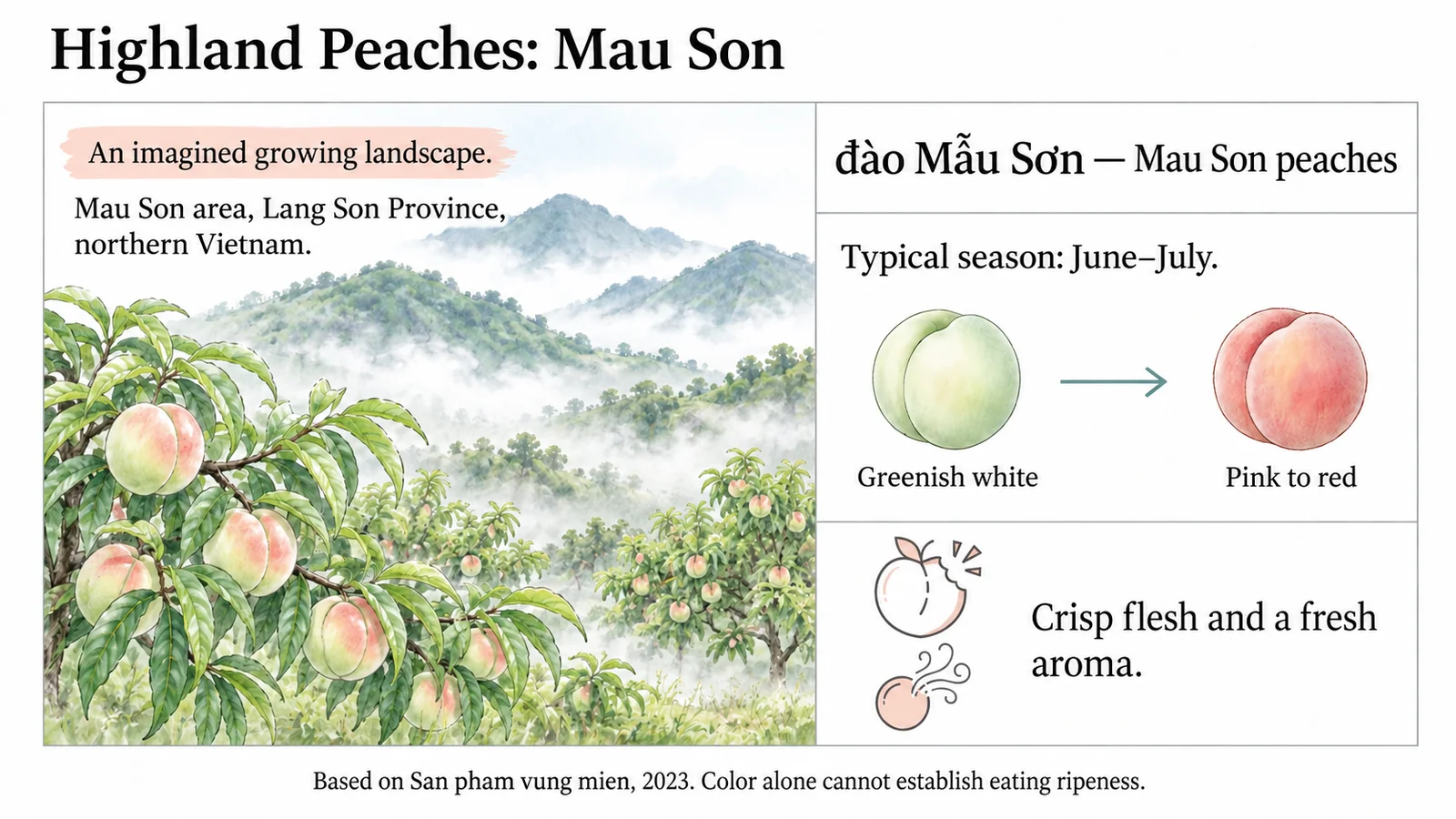
Mau Son in Lang Son Province is a cool, often misty highland near the Chinese border. Its đào Mẫu Sơn peaches are a local specialty. Sản phẩm vùng miền describes greenish-white skin that turns pink to red as the fruit ripens, fine fuzz, crisp sweet flesh and a fresh aroma.
The report gives a June–July ripening period and approximately 2.5 hectares with more than 2,000 trees at the time. Source: Sản phẩm vùng miền, 2023; checked September 29, 2026. These are historical area and tree counts.
Imported peaches and nectarines
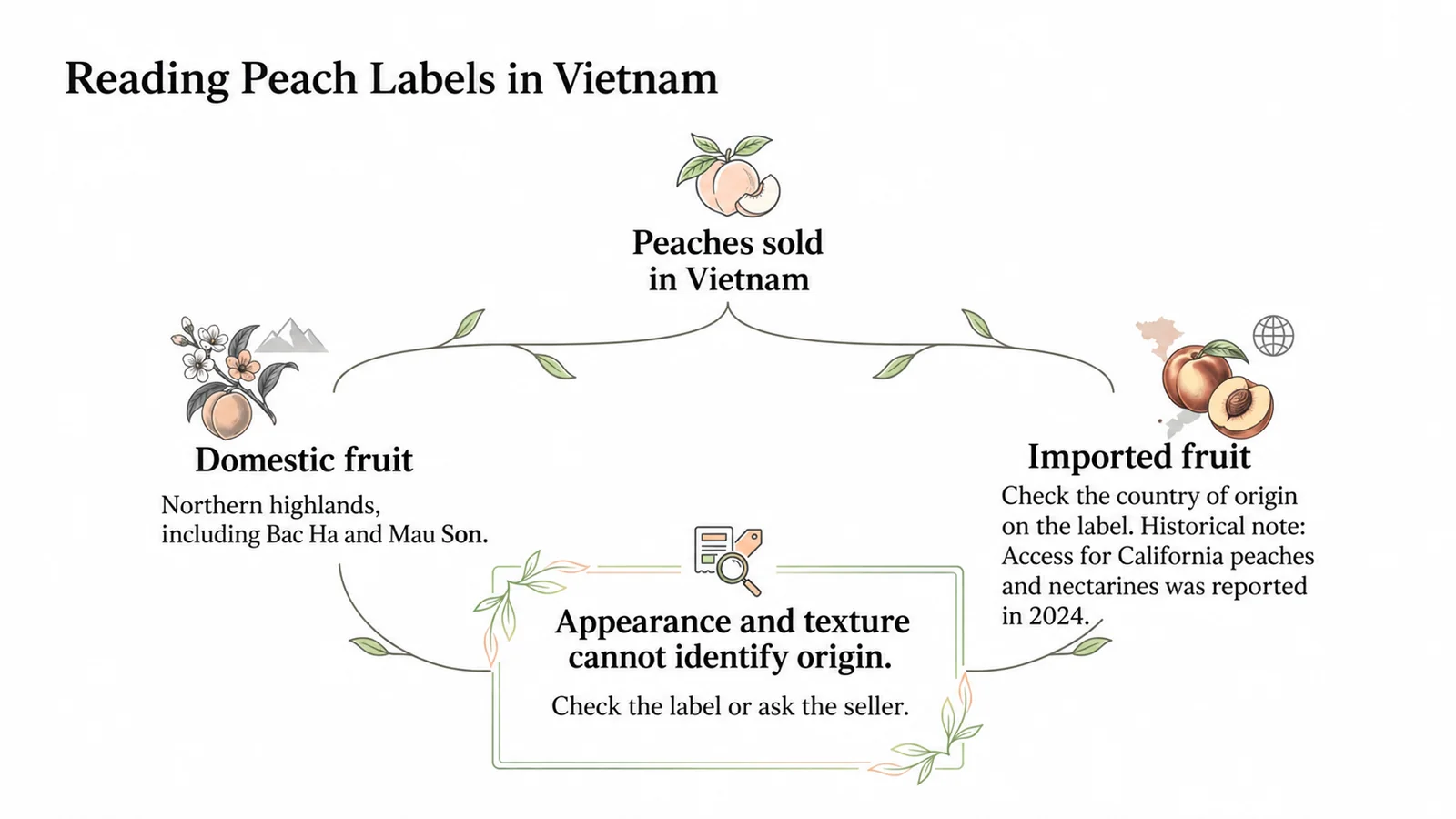
Vietnamese shops also sell imported fruit. A report published in August 2024 said that Vietnam had approved access for California peaches and nectarines in July after more than five years of negotiations. This is a historical account of that approval, not a complete statement of current import conditions. Source: Fresh Fruit Portal (checked September 29, 2026).
Keep three questions separate: What cultivar is it? Where was it grown? Which country did it come from? Appearance and texture do not establish origin. Read the packaging or price label, and ask the seller if anything is unclear.
The regions in this guide are examples; they do not represent nationwide production totals or the composition of the retail market.
Five things to remember
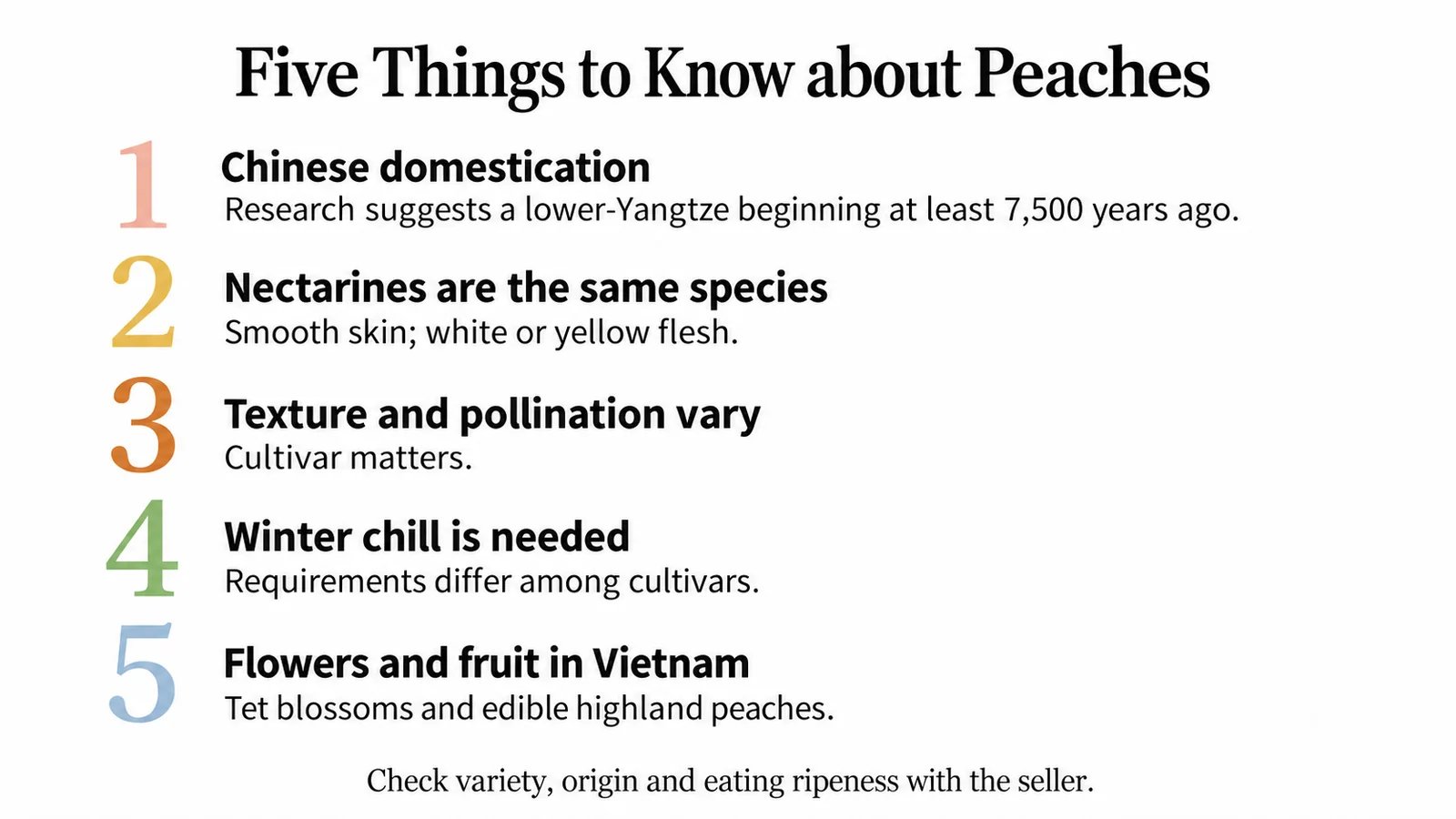
- Peaches are deciduous trees in the rose family, native to China. Research suggests domestication in the lower Yangtze at least 7,500 years ago.
- Nectarines are the same species without skin fuzz. They may have white or yellow flesh.
- Many cultivars are self-fruitful, but some need another source of pollen. Some soften markedly; others retain a firmer bite.
- Winter chilling requirements vary widely. Low-chill cultivars can require around 100 hours, though other growing conditions also matter.
- In northern Vietnam, peaches provide both Tet flowers and edible fruit. Bac Ha and Mau Son are examples of highland growing areas with reported May–July seasons.
When you see quả đào at a Vietnamese market, check whether it is domestic or imported and whether it is expected to soften or remain crisp.
More in the peach trilogy
- How to Eat Peaches in Vietnam: Ripening, Storage and a Hanoi Tasting Diary
- Peach History and Folklore: Momotaro, Hakuto and Tet
Sources and editorial note
Sources are linked beside the relevant claims. Botanical and historical sources retain the Japanese edition’s September 29, 2026 check dates; nutrition and the MAFF harvest figures were rechecked on October 16, 2026. This English v09 edition translates Japanese v09. Illustrations are explanatory artwork, not documentary photographs of farms or archaeological finds.
