
Netted melons sold in Vietnam are generally called dưa lưới. You will find orange and green flesh, with sweetness, aroma and texture varying by cultivar and ripeness.
This guide explains Vietnamese names, melon types, nutritional values and reference prices. It also looks at how the rind develops its netting and why protected cultivation helps growers manage rainfall.
For advice on a melon you have bought, see How to Eat Melon in Vietnam.
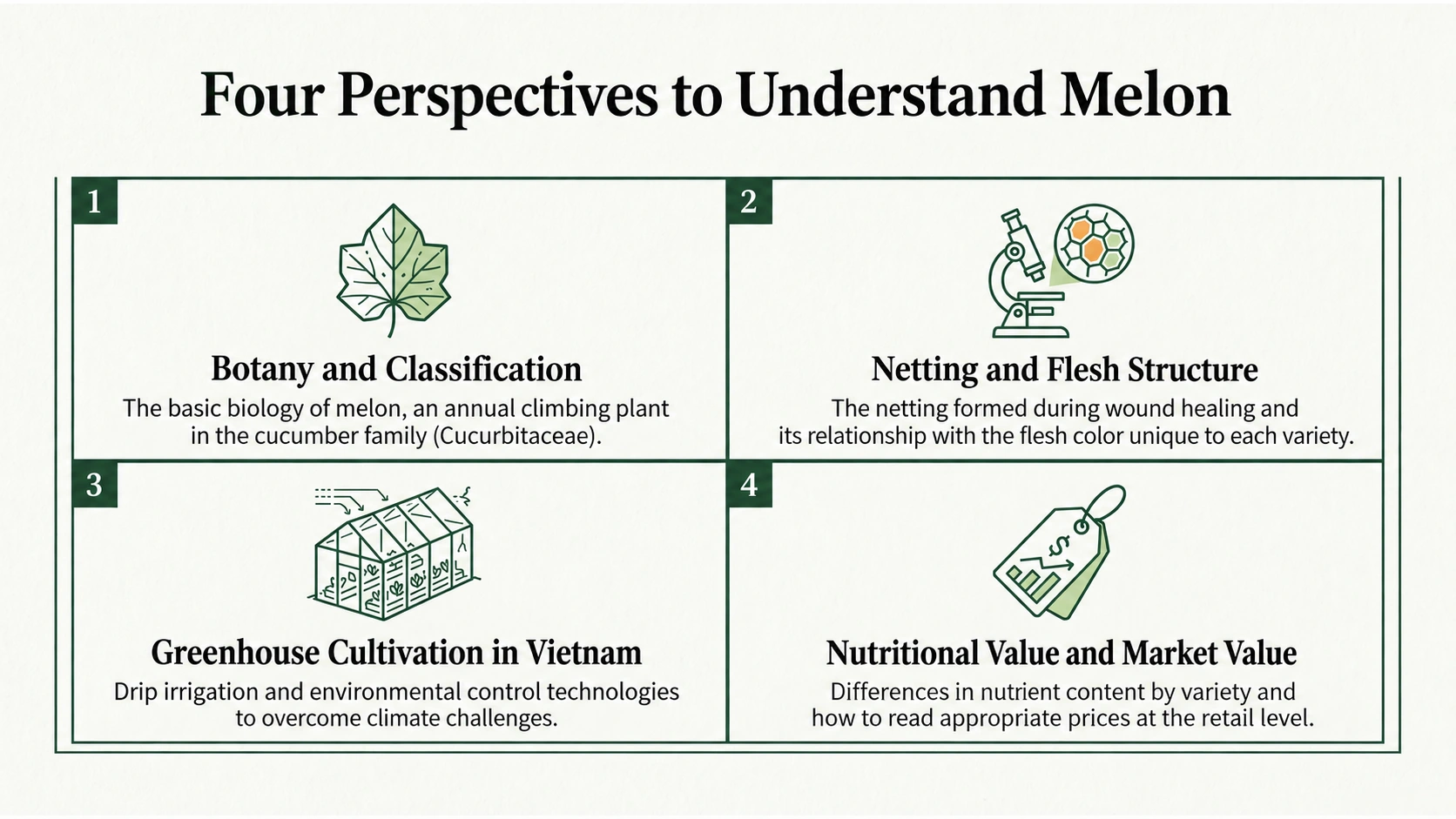
Melons in Vietnam at a glance
| Item | Details |
|---|---|
| Common English name | Melon |
| Vietnamese name | Netted melons are generally called dưa lưới |
| Scientific name | Cucumis melo L. |
| Classification | An annual vine in the cucumber genus, Cucumis, in the gourd family, Cucurbitaceae |
| Origins and domestication | Research suggests multiple domestication events in India and Africa |
| Cultivation | Open fields, low tunnels and protected structures, depending on cultivar and climate |
| Availability | Protected cultivation can allow several crop cycles; selection varies by region and shop |
| Nutrients | Potassium and vitamin C, among others; some orange-fleshed types are rich in beta-carotene |
What is melon called in Vietnamese?
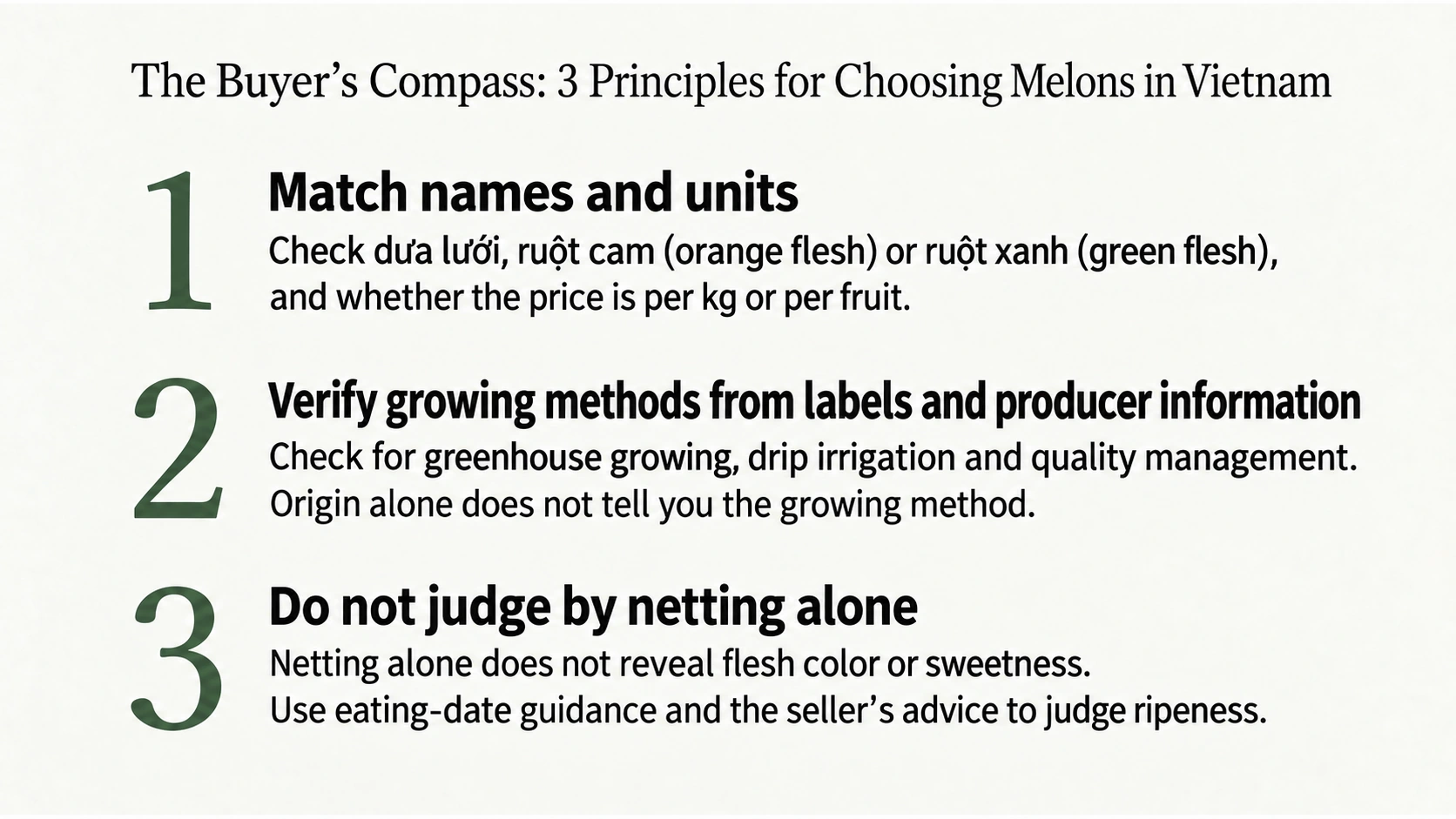
Netted melons are generally called dưa lưới; lưới means “net.” Labels describing the flesh may use ruột cam for orange flesh and ruột xanh for green flesh.
By contrast, dưa hấu means watermelon and dưa leo means cucumber. Read the whole name and check the product image rather than relying on dưa alone. Showing the Vietnamese spelling is useful when pronunciation is difficult.
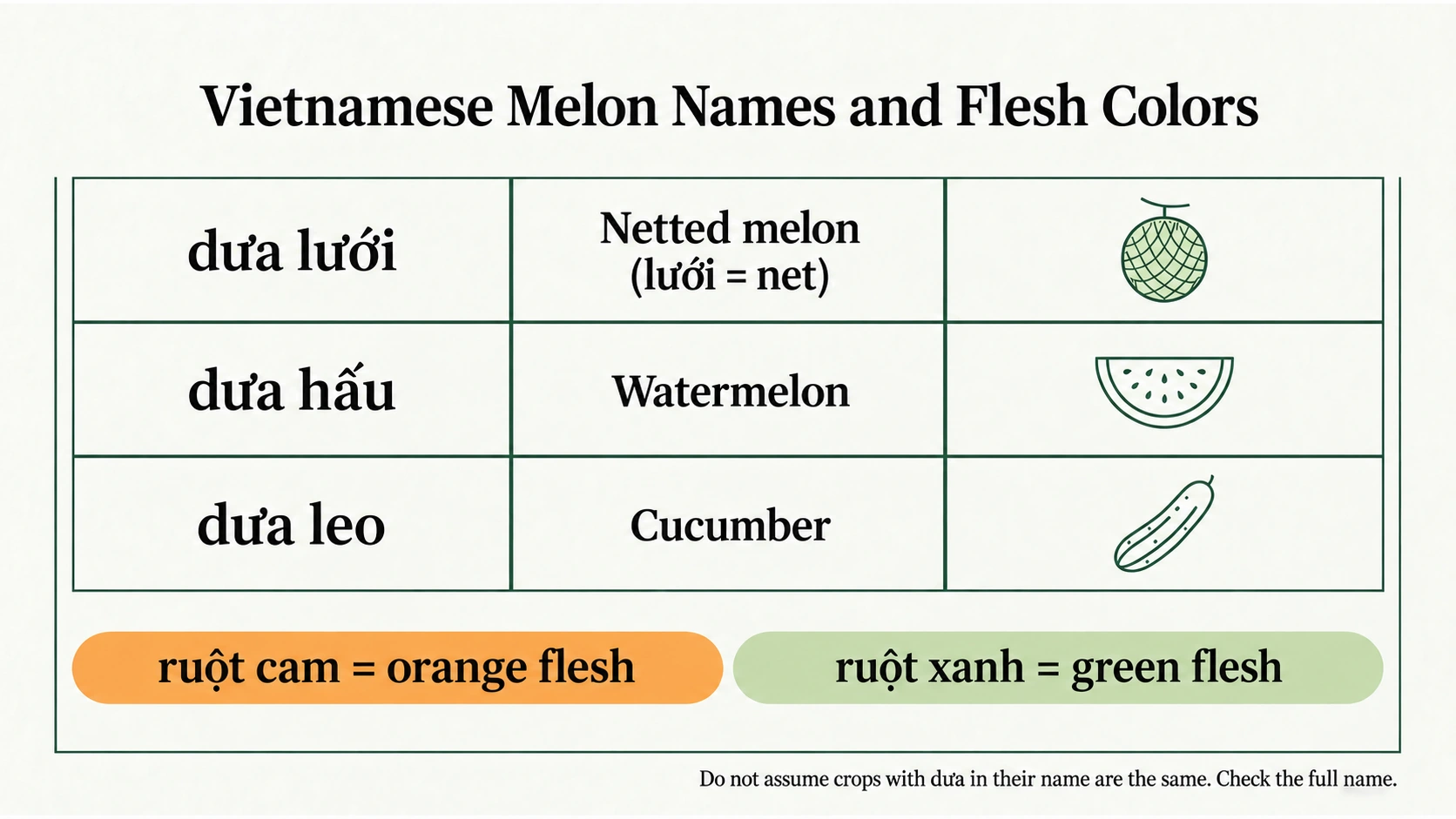
To judge likely sweetness or softness, look beyond flesh color. Check the cultivar, any ready-to-eat information and the seller’s advice.
Melon types and nutrition: orange, green and white flesh
Flesh color and rind netting are separate characteristics
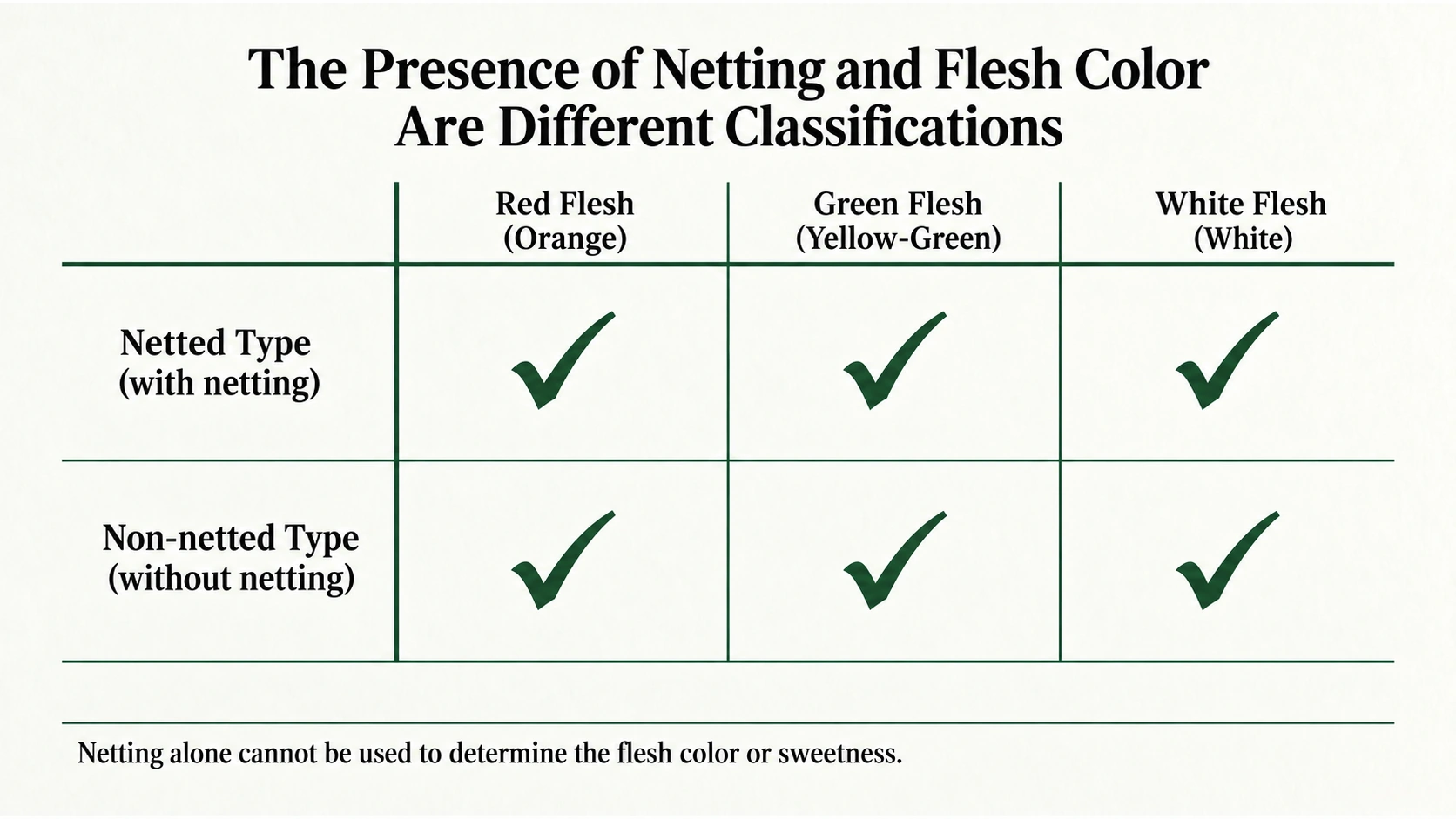
Melons may have orange, pale green or white flesh. Japanese descriptions often call orange flesh “red flesh” and pale green flesh “blue flesh.” This guide uses the visible colors to make the distinction clearer in English.
Flesh color and the presence of rind netting are separate features. Color alone does not determine rind color, texture or sugar content.
Yubari Melon is a familiar orange-fleshed example from Japan. The cultivar used is Yubari King, developed by crossing Spicy Cantaloupe and Earl’s Favourite. Source: Yubari City, “About Yubari Melon” (Japanese).
Comparing food-composition data
The following table compares two entries in Japan’s Ministry of Education, Culture, Sports, Science and Technology (MEXT) food-composition database.
| Nutrient, per 100 g edible portion, raw | Greenhouse-grown melon | Field-grown, orange-fleshed melon |
|---|---|---|
| Energy | 40 kcal | 45 kcal |
| Water | 87.8 g | 87.9 g |
| Carbohydrate | 10.3 g | 10.4 g |
| Dietary fiber | 0.5 g | 0.5 g |
| Potassium | 340 mg | 350 mg |
| Vitamin C | 18 mg | 25 mg |
| Beta-carotene | 32 μg | 3,600 μg |
Sources: MEXT, greenhouse-grown melon, raw and field-grown, orange-fleshed melon, raw, both in Japanese. Rechecked October 17, 2026.
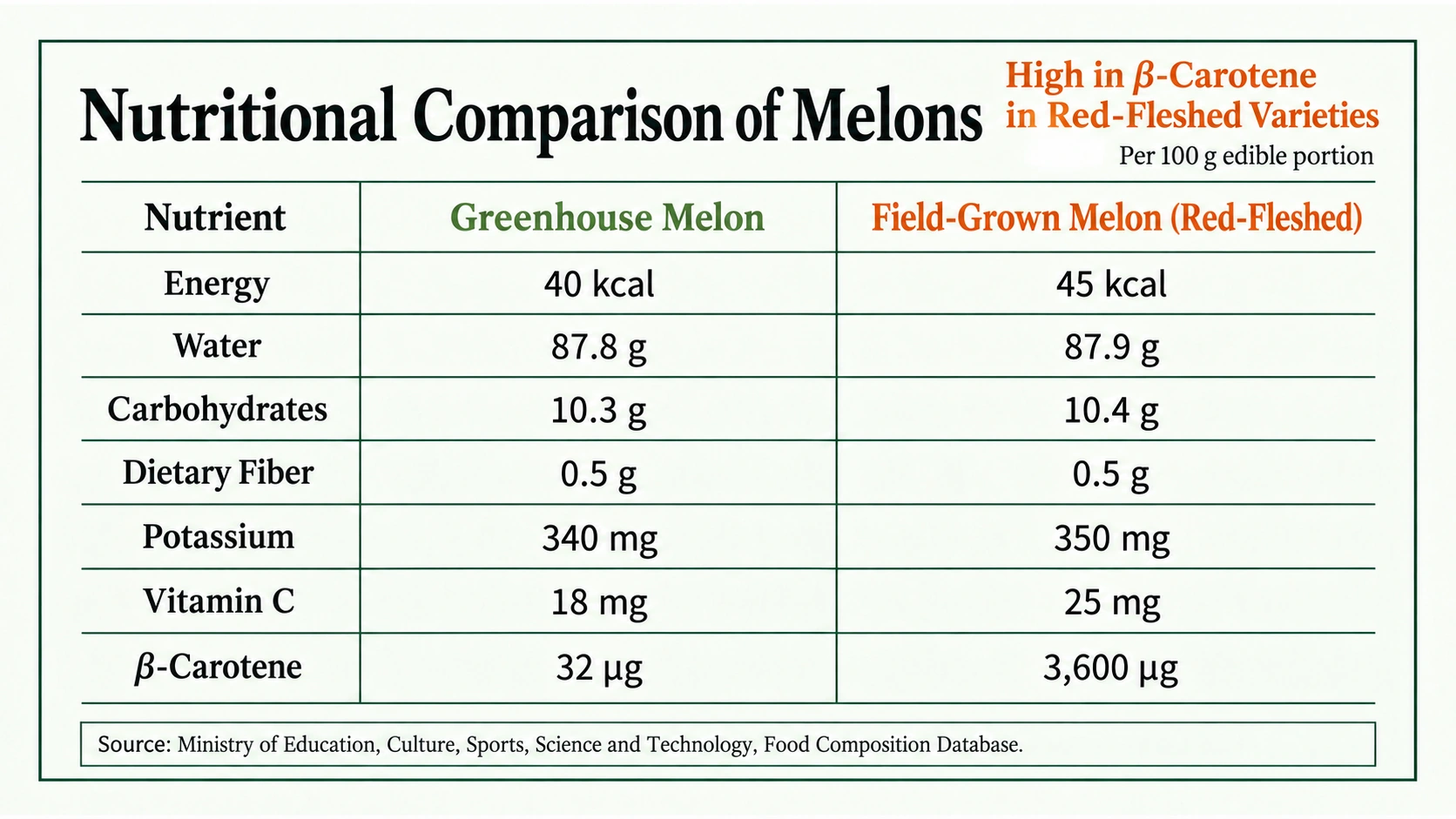
The field-grown, orange-fleshed entry contains more beta-carotene than the greenhouse-grown entry. This is a comparison of two database foods, not evidence that every orange melon has a fixed nutritional advantage over every green melon. The figures were not measured from individual Vietnamese products.
How much do melons cost in Vietnam?
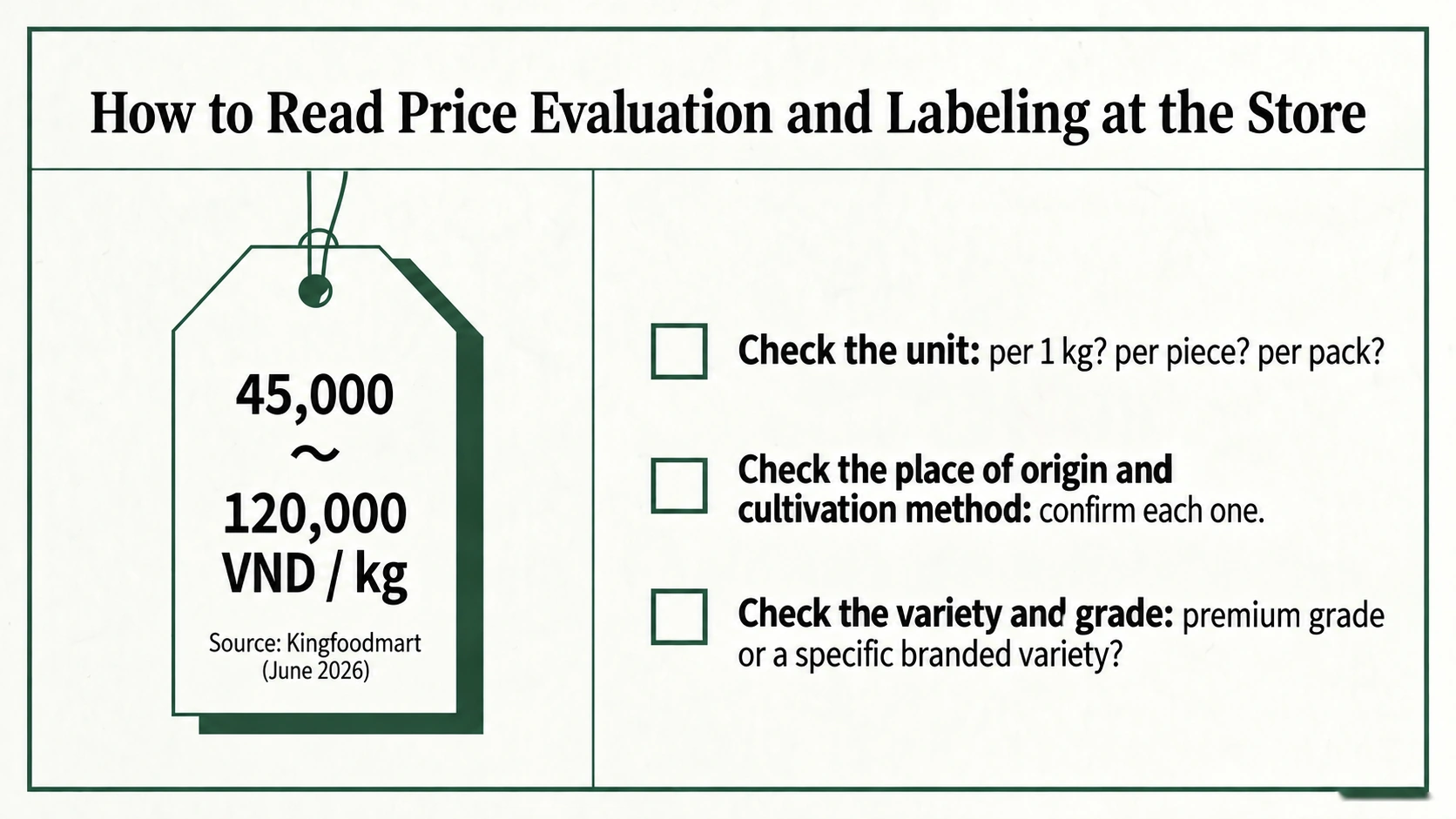
A Kingfoodmart price article, with a stated data update of June 8, 2026, gives a reference range of VND 45,000–120,000 per kilogram. Prices depend on cultivar, grade and other factors. This is neither a nationwide market average nor a promise of what a shop will charge today. Source: Kingfoodmart price guide (Vietnamese), rechecked October 17, 2026.
Check whether a price is per kilogram, per fruit or per pack. Weight, origin, cultivar and promotional pricing also matter when making comparisons.
Melon botany, origins and rind netting
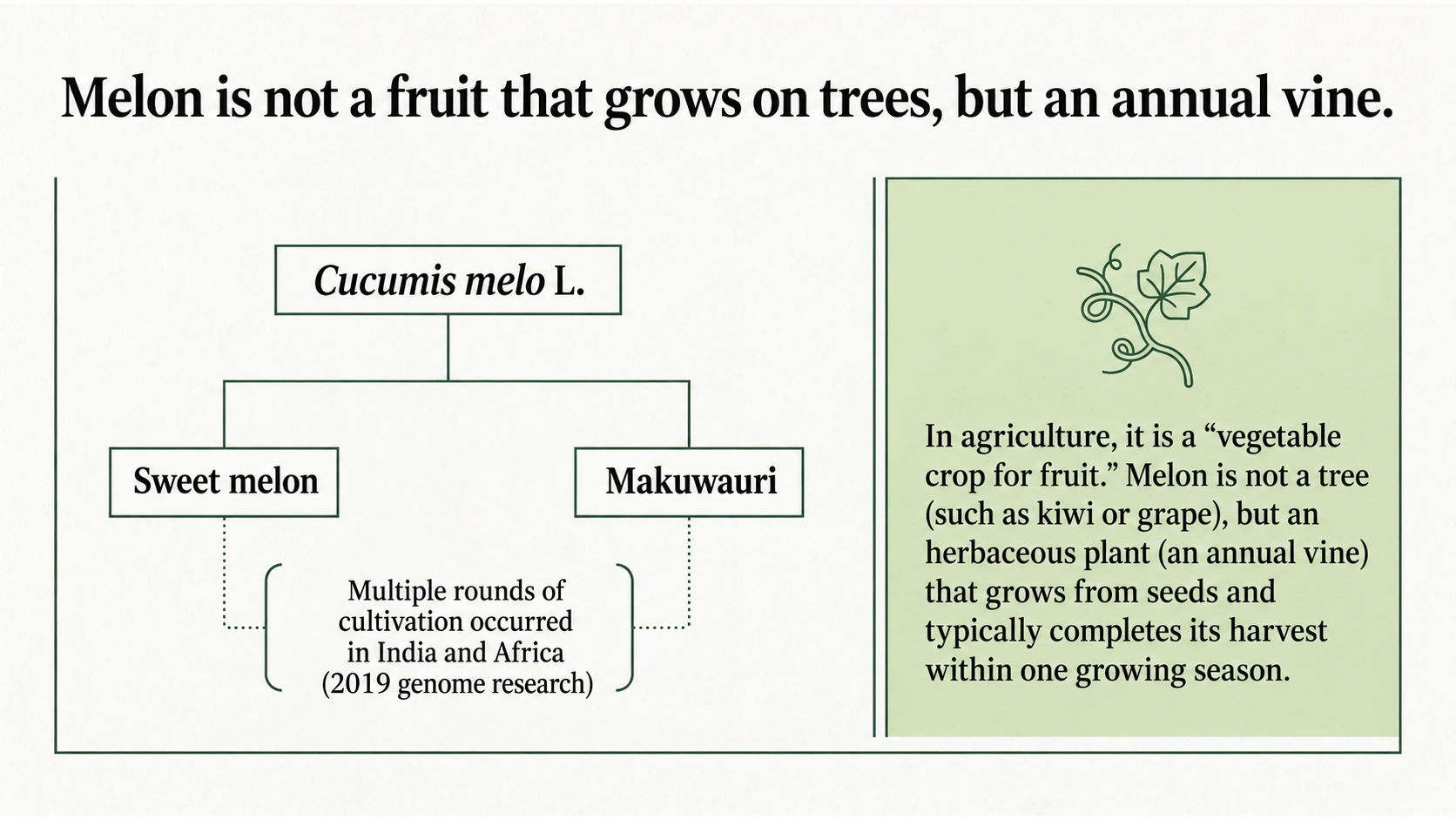
An annual vine, rather than a fruit tree
Melons are herbaceous plants grown from seed, normally harvested within a single crop cycle. Kiwifruit and grapes also climb, but their vines are woody perennials that live for years.
In Japanese agricultural classification, melons may be grouped as “fruit-like vegetables,” although they are eaten as fruit.
Why their origin cannot be reduced to one place
The history of melon is more complex than choosing either India or Africa as a single origin. A 2019 genomic study suggests three independent domestication events: two in India and one in Africa. The origin of wild plants and the places where people domesticated them are separate questions. Sources: Nature Genetics research paper and IRTA’s account of the research.
Makuwa melons belong to the same species
Makuwa melons belong to Cucumis melo, the same species as other sweet melons. Sakata’s Prince melon was also developed by crossing the makuwa-type New Melon with a Charentais-type melon. Source: Sakata Seed, “Episode 07 Melon”.
The Japanese word uri, however, is a broad term for several gourds and related crops. Cucumbers and watermelons are not all the same species as melon.
How the rind forms its netting
As a melon grows, fine cracks develop in its skin. Corky tissue forms along those cracks, creating the raised netting. A protective scab is a useful analogy: the pattern is tissue produced by the rind, rather than simply a liquid secretion that has dried. Source: research on net formation in melon rind.
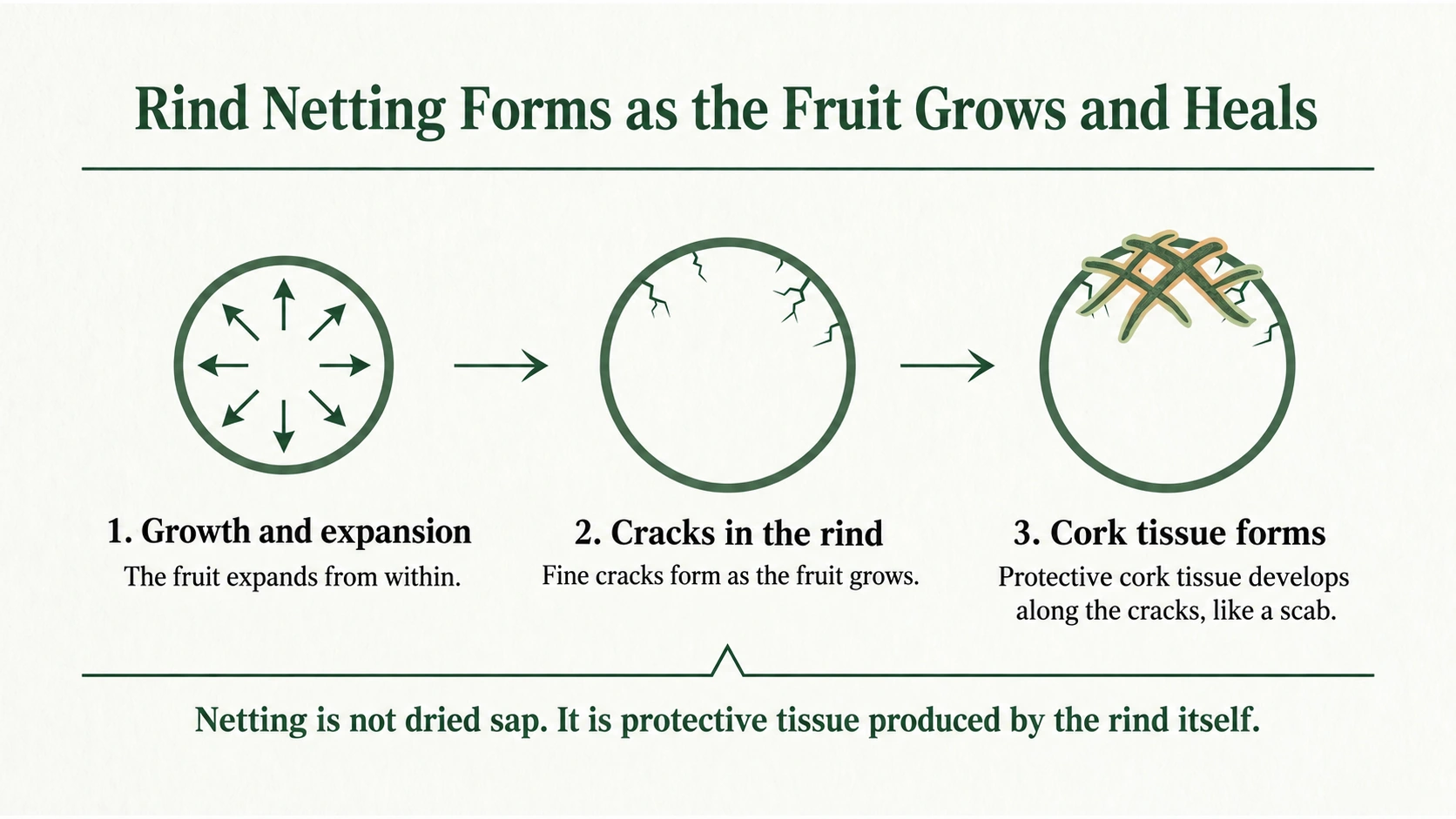
Some melons have netted rinds; others are smooth. Fine netting alone does not establish how sweet a melon will be.
Why grow melons under cover in warm Vietnam?
Warmth is only one part of cultivation
Melons favor warm conditions, but more heat is not always better. Takii Seed’s cultivation manual gives an optimum growth temperature of 18–28°C. Appropriate conditions also vary with cultivar and growth stage.
Their shallow roots favor well-drained, well-aerated soil. Growers need to avoid abrupt changes in moisture and adjust management to the stage of growth. Source: Takii Seed melon cultivation manual (Japanese).
Protected structures reduce the direct effects of rain
Vietnam’s climate varies by region and season. During wet periods, controlling water becomes harder. Rain shelters and drip irrigation can help growers manage those conditions.
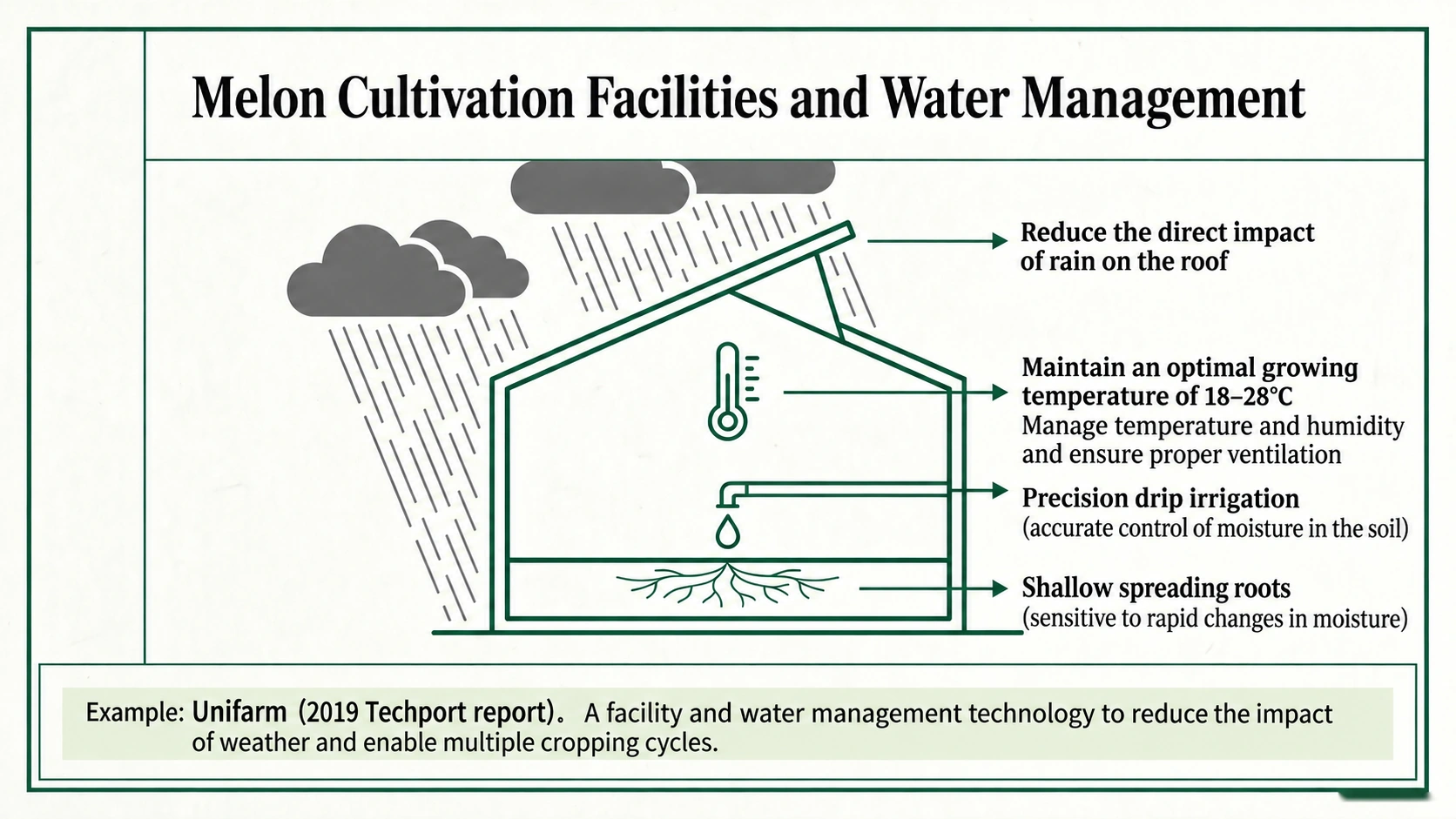
In 2019, Ho Chi Minh City’s technology-information platform Techport described Unifarm’s protected melon-growing system. It combined substrate cultivation and drip irrigation to reduce weather-related variation and allow several crop cycles. Source: Techport, April 26, 2019 (Vietnamese).
A roof does not automatically provide complete temperature or humidity control. Ventilation and irrigation remain necessary. Nor does “greenhouse-grown” alone guarantee food safety or certification.
What to watch when comparing melon prices
Auction headlines are not normal retail prices
Japan has a culture of giving premium melons as gifts. Yubari Melon is one example of a brand built through quality control and the development of distribution channels. Source: JA Yubari, “The Birth of Yubari Melon” (Japanese).
Exceptional auction bids reported in the news should not be treated as normal gift-melon prices. Comparisons with Vietnamese retail prices need to account for weight, grade, date and selling format.
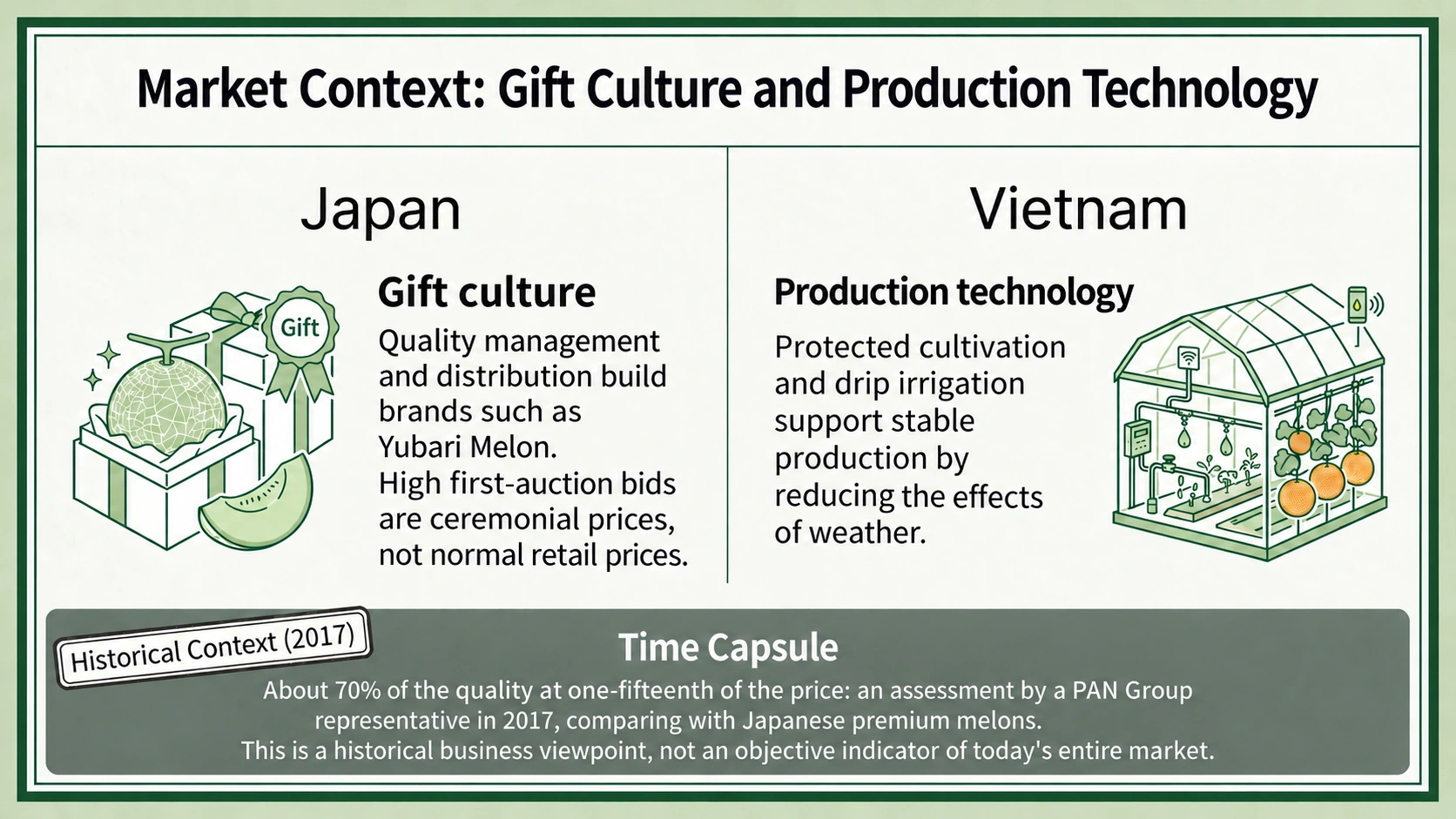
A 2017 quality-and-price claim needs context
A September 11, 2017 article on PAN Group’s website described PAN Farm and Vinaseed’s efforts to serve the domestic market and pursue exports to Japan. A company representative gave a quality-and-price comparison with premium Japanese melons for a growing project in what was then Ha Nam Province. Source: PAN Group article (Vietnamese).
This was an assessment by a participant at the time, not a comparison based on a standardized quality scale. It does not establish the quality or price of all Vietnamese melons in 2026, or present export results. It is best read as one example of an effort to produce higher-quality fruit.
Frequently asked questions
What is the Vietnamese word for melon?
Netted melons are generally called dưa lưới. On flesh-color labels, ruột cam indicates orange and ruột xanh indicates green.
Do orange and green melons have different nutrients?
Of the two food-composition entries shown here, the field-grown, orange-fleshed melon contains more beta-carotene. Individual cultivars and products sold in Vietnam will not necessarily match those values.
Are melons grown in Vietnam?
Yes. Unifarm is one example of growers using protected structures and drip irrigation. Check the origin label on the particular fruit you buy.
Choosing a melon with better information
A melon’s netting is protective rind tissue, while flesh color and cultivar bring different characteristics. Vietnam has examples of protected cultivation and water management suited to rainy conditions.
When comparing nutrients or prices, check which foods the figures describe and when the information was recorded. For practical handling, see How to Eat Melon in Vietnam. For names and gift culture, see Melon History: Name Origins and the Birth of Prince and Yubari Melons.
Sources and verification dates
The Japanese source article first checked its links on September 23, 2026. On October 17, 2026, it rechecked the two MEXT nutrient entries, Sakata and Takii’s explanations, JA Yubari’s history and the price guide’s reference range. Publication years and the price data’s update date are stated alongside the relevant claims.
