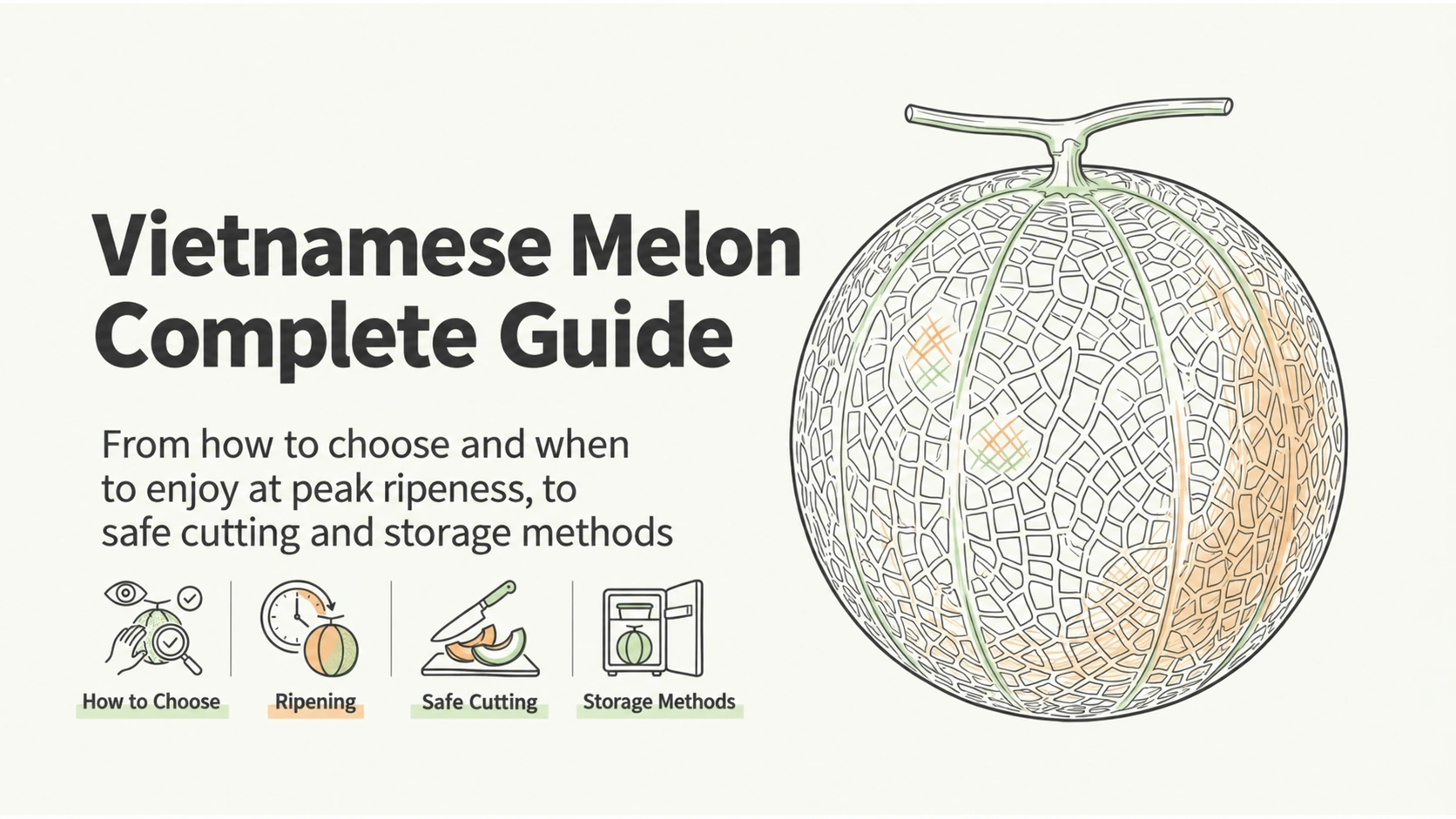
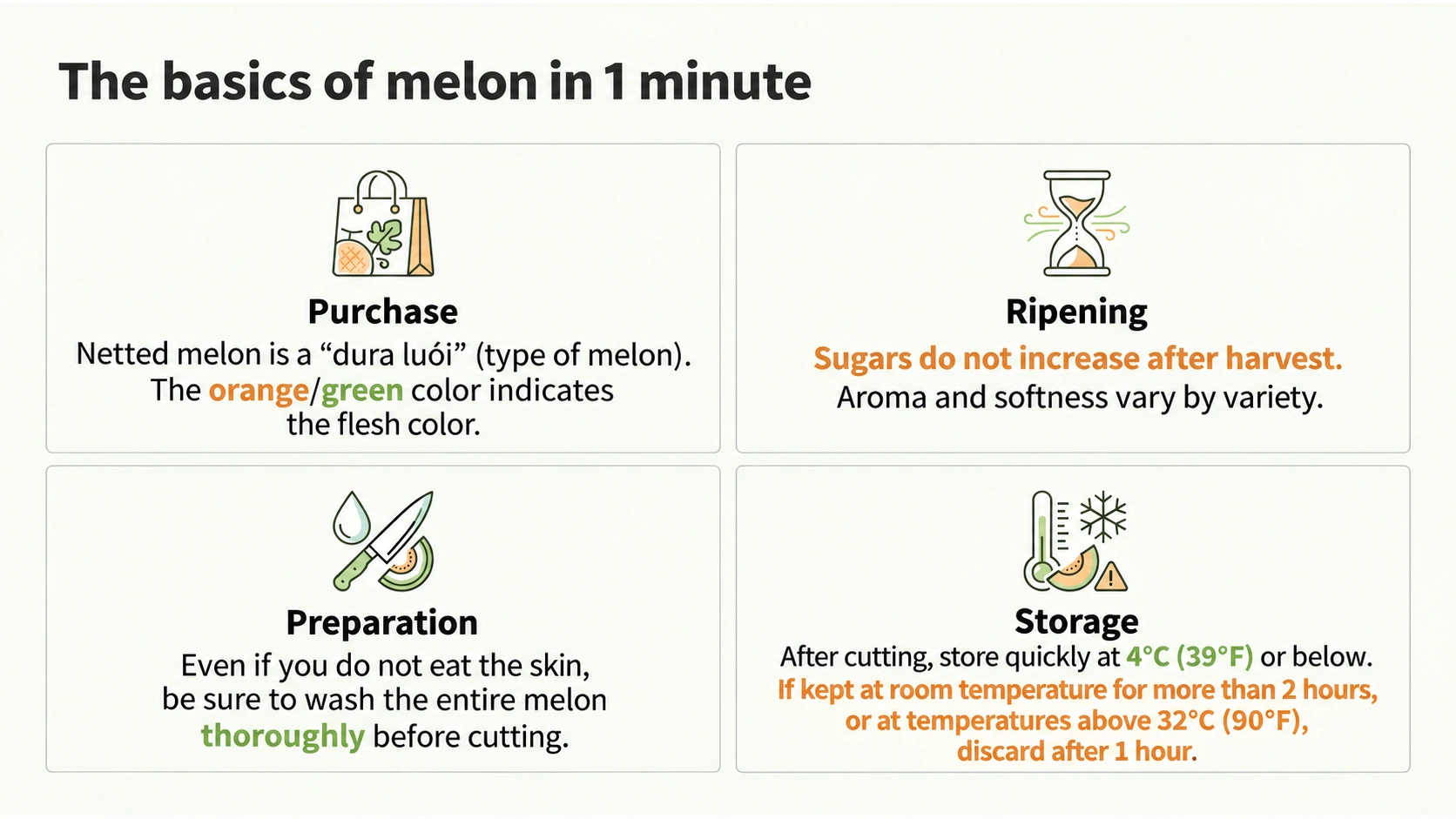
After buying a melon in Vietnam, first check any ready-to-eat guidance. Wash the outside just before cutting, and refrigerate the cut fruit promptly.
Some melons soften and develop a stronger aroma after harvest. That does not mean their sugar content increases simply because they are left to ripen. This guide covers choosing, washing, cutting and storing melons while accounting for differences between cultivars.
For varieties and nutrients, see Melons in Vietnam.
Buying and eating melon at a glance
| Item | Details |
|---|---|
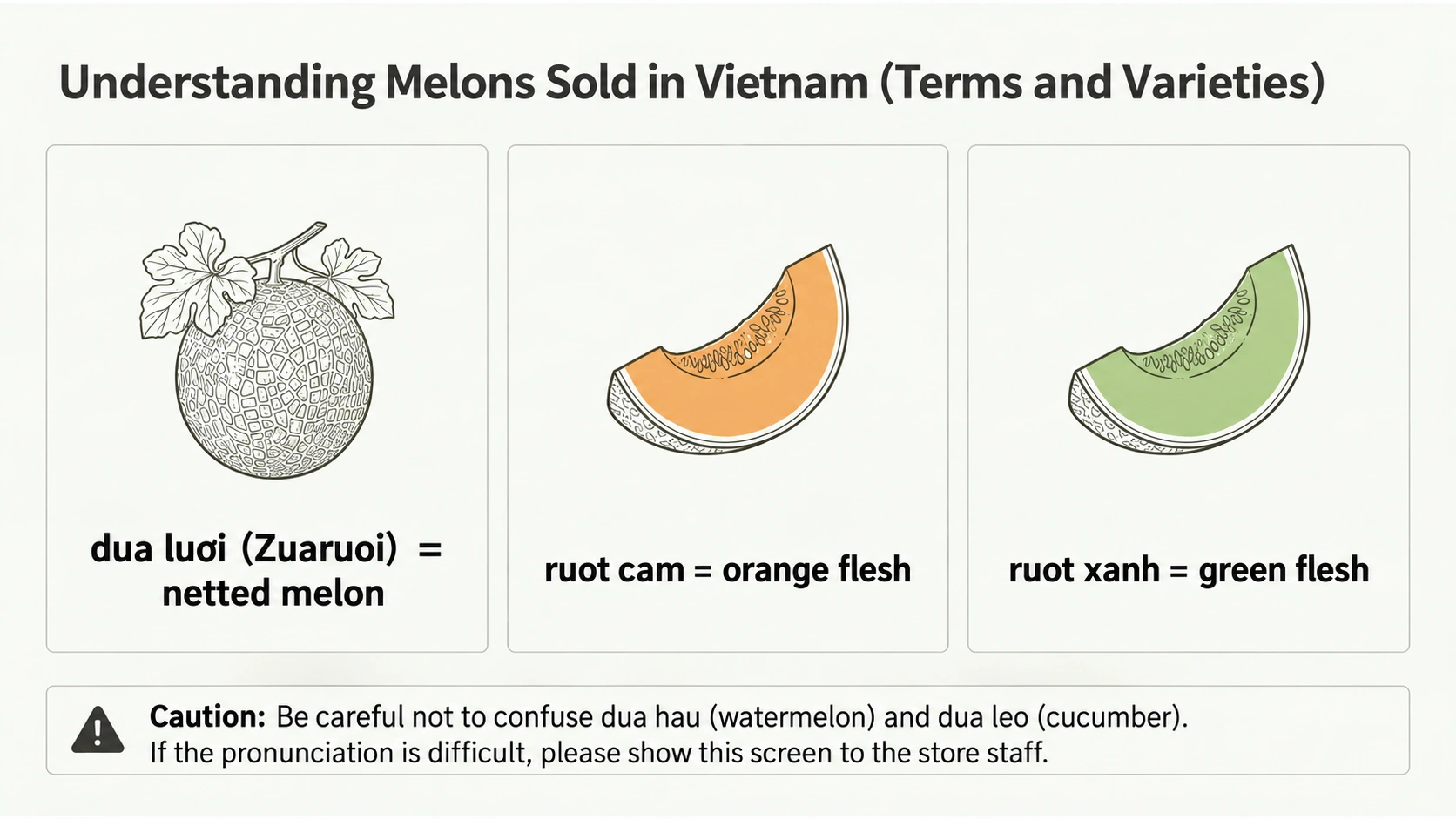
| Vietnamese name | Netted melons are generally called dưa lưới |
| Identifying the name | Show the Vietnamese spelling if pronunciation is difficult |
| Flesh-color labels | ruột cam = orange; ruột xanh = green |
| Flavor and texture | Depend on cultivar and ripeness, not flesh color alone |
| Reference price | A retail guide gives VND 45,000–120,000/kg; see the source and date below |
| What to check when buying | Damage, weight, price unit, origin and ripeness guidance |
| Basic preparation | Wash, halve, remove seeds and seed-cavity fibers, then cut into portions |
| After cutting | Cover with clean wrapping or a container and refrigerate promptly at 4°C or below |
Reading melon labels in Vietnam
Look for dưa lưới on netted melons. Dưa hấu means watermelon and dưa leo means cucumber, so read the whole name. Showing the Vietnamese spelling is useful if you are unsure how to pronounce it.
Ruột cam and ruột xanh describe flesh color rather than the cultivar itself. Orange flesh is not always soft, and green flesh is not always crunchy. Tell the seller the texture you prefer and ask when the melon should be ready to eat.
Where to buy melons and how to compare prices
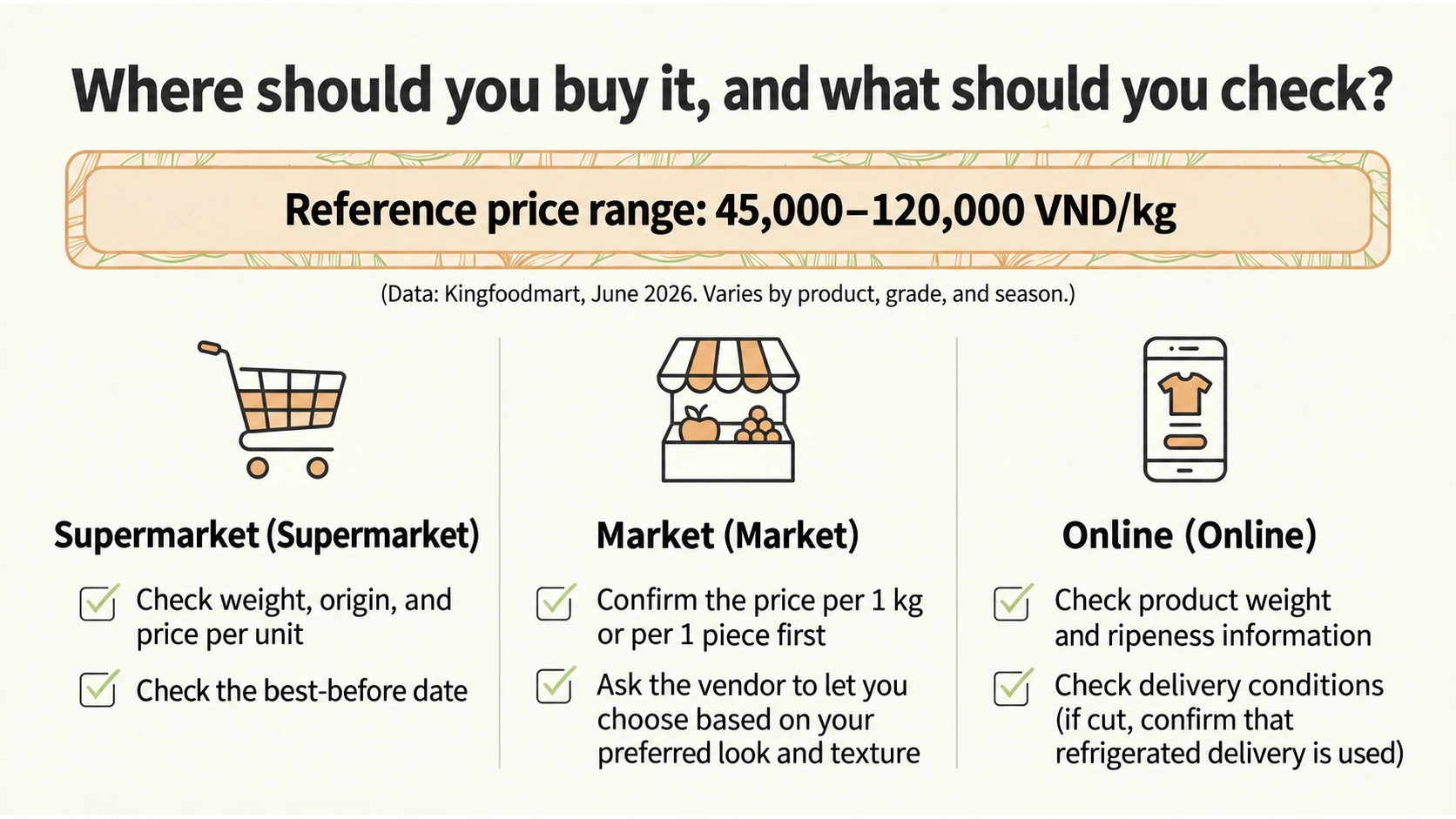
A Kingfoodmart price article gives a reference range of VND 45,000–120,000/kg, with a stated data update of June 8, 2026. Treat it as indicative information that varies with cultivar, grade and season, rather than a nationwide price. Source: Kingfoodmart price guide (Vietnamese), rechecked October 17, 2026.
When looking in supermarkets, markets or online, check the following:
- Supermarkets: weight, origin, price unit and ready-to-eat guidance.
- Markets: if no price is displayed, ask whether the quote is per kilogram or per fruit.
- Online shops: product weight, ripeness description and delivery conditions.
Choose precut fruit that is properly refrigerated. Follow its stated storage conditions and use-by instructions. Source: FDA, “Selecting and Serving Produce Safely”.
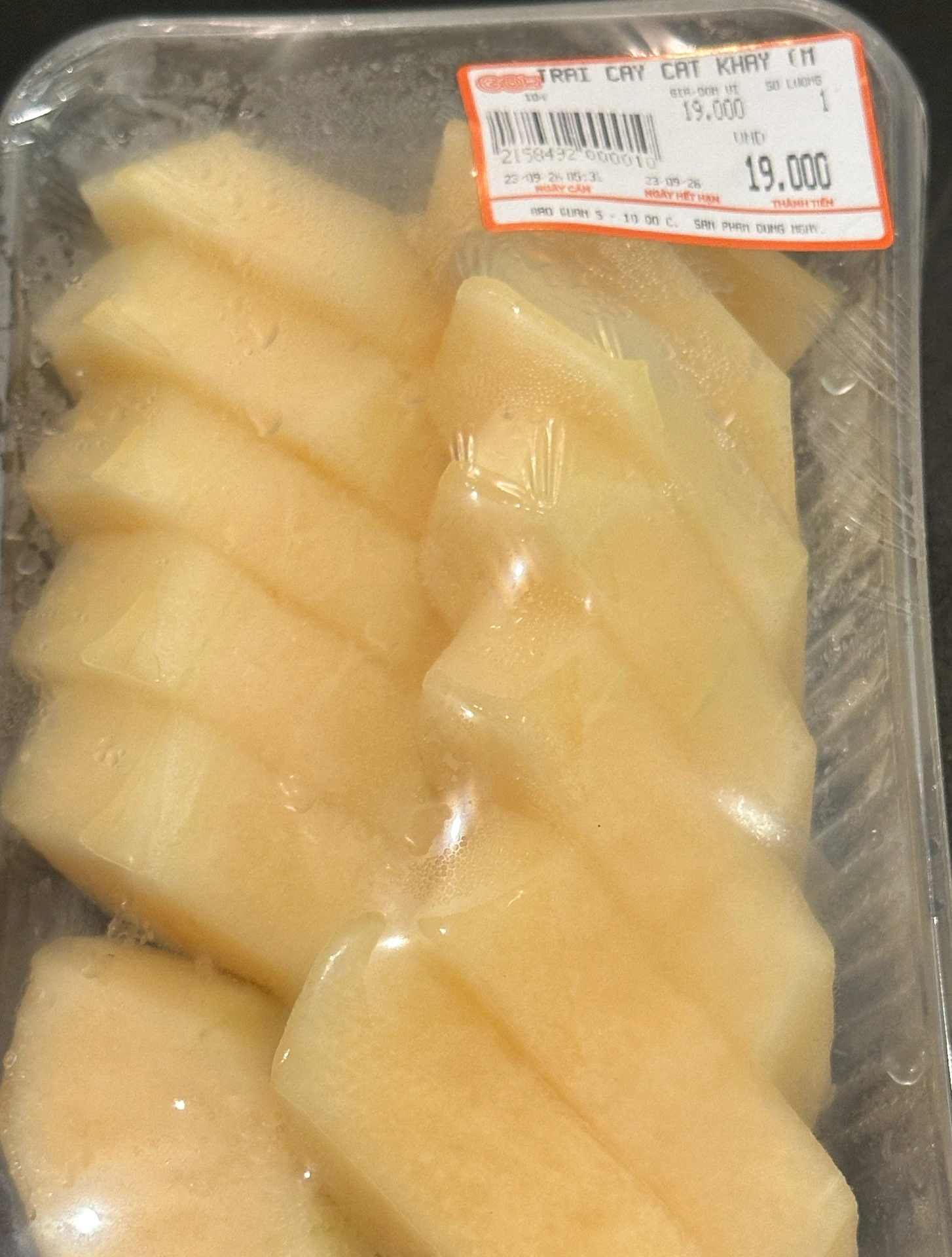
A recorded purchase: VND 19,000 for one pack
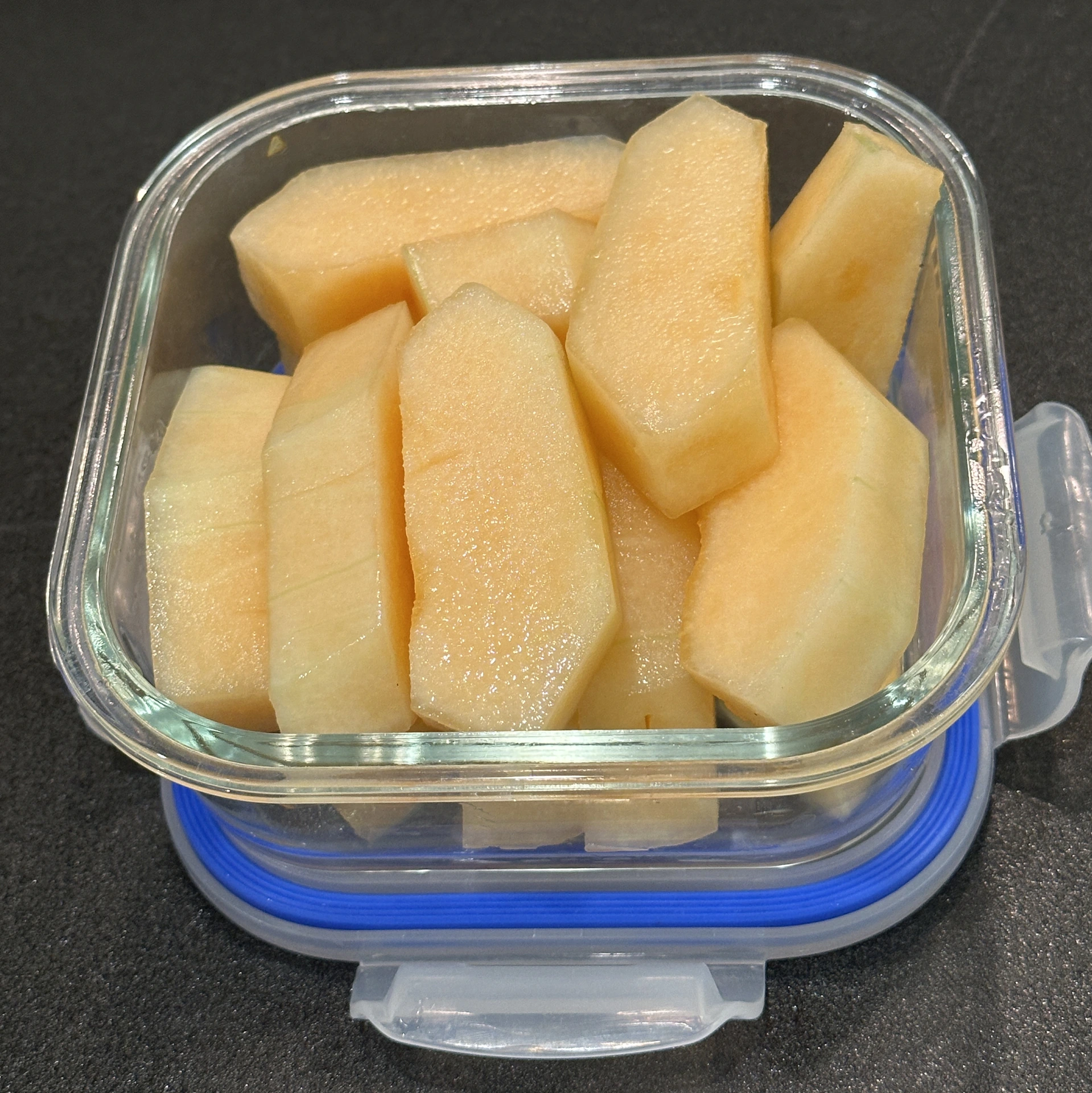
The cut melon recorded for this article cost VND 19,000 per pack. The information visible in the purchase materials is organized below. Photographs of the pack and the melon transferred to a container are shown below.
| Item checked | Record |
|---|---|
| Store shown on receipt | GO! / 104 – THANG LONG, Hanoi |
| Product format | A tray of cut fruit; identified as melon by the purchaser |
| Displayed pack price | VND 19,000 |
| Quantity and displayed total | One pack; VND 19,000 |
| Weight | Unconfirmed; no price per kilogram has been calculated |
| Cultivar and origin | Cannot be confirmed from the supplied materials |
This is one purchase example, not a current price or a national market average. Comparing it with whole melons sold by the kilogram would require the pack’s weight. Cut fruit also includes preparation such as removing rind and seeds, so the selling formats need to be distinguished.
The receipt processed the item under a name meaning “mixed cut fruit.” Its identification as melon comes from the purchaser, not from using the till description to infer a cultivar. The correspondence between the label date and receipt date has not been confirmed, so no definite purchase date is assigned.
A K-MARKET label record: 370 g for VND 44,400
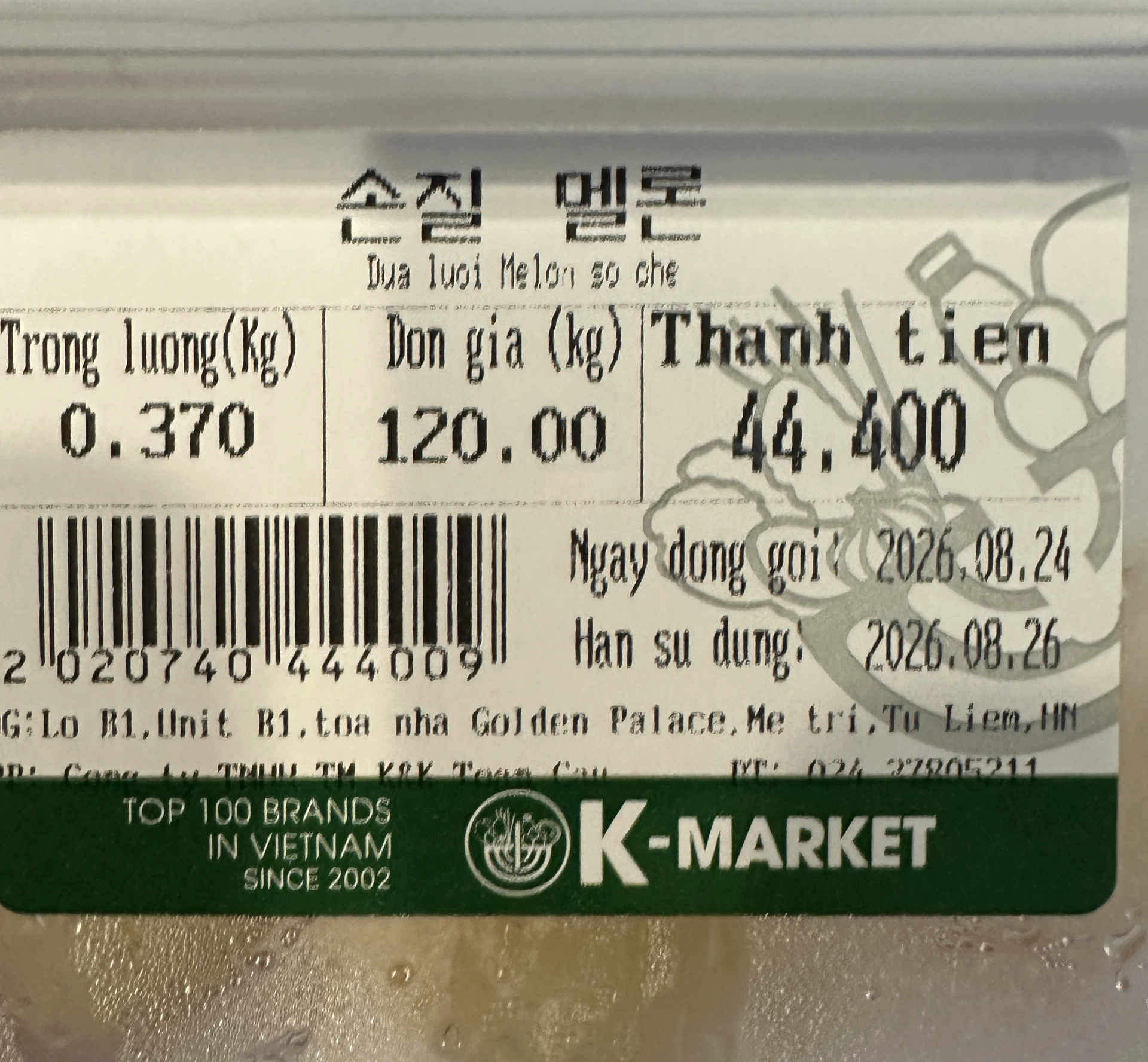
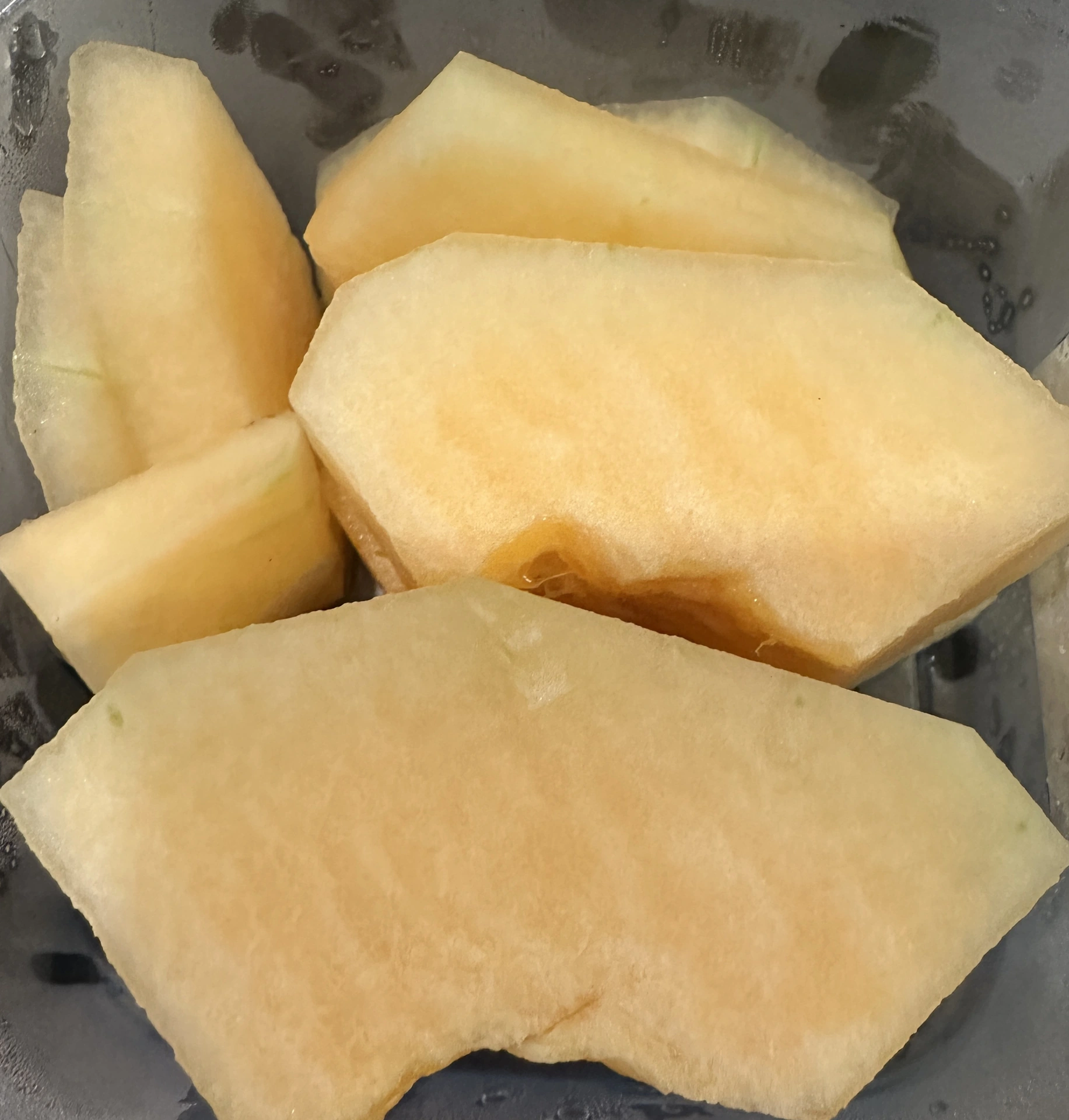
The supplied K-MARKET photograph shows the product name Dưa lưới Melon sơ chế, describing prepared melon. The readable information is presented in a table, with photographs of the label and melon below.
| Item checked | Information on the label |
|---|---|
| Store and address wording | K-MARKET; Golden Palace, Mễ Trì, Từ Liêm and HN appear at the bottom |
| Product name | Dưa lưới Melon sơ chế, meaning prepared melon |
| Displayed weight | 0.370 kg (370 g) |
| Displayed total | VND 44,400 |
| Calculated price per kilogram | VND 120,000/kg, calculated as 44,400 ÷ 0.370 |
| Packing date, Ngày đóng gói | August 24, 2026 |
| Use-by date, Hạn sử dụng | August 26, 2026 |
| Purchase date | Unconfirmed |
| Tasting date | August 25, 2026, as reported by the purchaser |
| Cultivar and country of origin | Cannot be identified from the visible label |
The unit-price field appears to read “120.00,” but its final digits are not clear enough to transcribe confidently. The table therefore uses the unit price calculated from the weight and total: 0.370 kg × VND 120,000/kg = VND 44,400, matching the displayed total. This is a record of one pack, not a current retail price or a market average.
The purchaser confirmed eating this melon on August 25, 2026. The packing date is separate from the purchase date, which remains unconfirmed. Korean wording and the K-MARKET name do not establish that the melon was grown in South Korea. This is a different product from the GO! pack recorded above; without the GO! pack’s weight, the two cannot be compared on a per-kilogram basis.
Flavor and texture: tasting notes from August 25, 2026
| Aspect | The purchaser’s impressions of this melon |
|---|---|
| Flavor | The sweetness was mild to moderate, with a clean taste. The aroma was gentle, less pronounced than that of a muskmelon. The finish was light and refreshing. |
| Texture | The flesh was juicy, with a light, crisp bite. When ripe, it became softer, releasing juice gently in the mouth. |
These are the purchaser’s personal impressions of this melon. Flavor, aroma and texture vary with cultivar and ripeness.
Eating precut melon without a knife
Precut fruit can be useful when traveling without equipment for cutting a whole melon. Check the packaging or ask the seller whether the product is ready to eat.
- Check before buying. Choose a refrigerated product and check for damaged packaging, the stated date and storage instructions.
- Keep it chilled. Refrigerate until just before eating. Do not leave it in a hot room or vehicle.
- Use clean hands and utensils. Wash your hands and use a clean fork or spoon.
- Serve the portion you will eat. Divide large pieces on a plate if necessary. Follow the product’s washing instructions: fruit labeled “prewashed” or “ready-to-eat” does not need to be washed again.
- Refrigerate leftovers promptly. Cover in a clean container, follow the label and eat promptly. Do not leave cut fruit at room temperature to ripen.
The advice on chilled products, refrigeration of cut produce and prewashed fruit follows the FDA’s produce-handling guidance.
How to tell when a melon is ready to eat
Start with damage and labeling
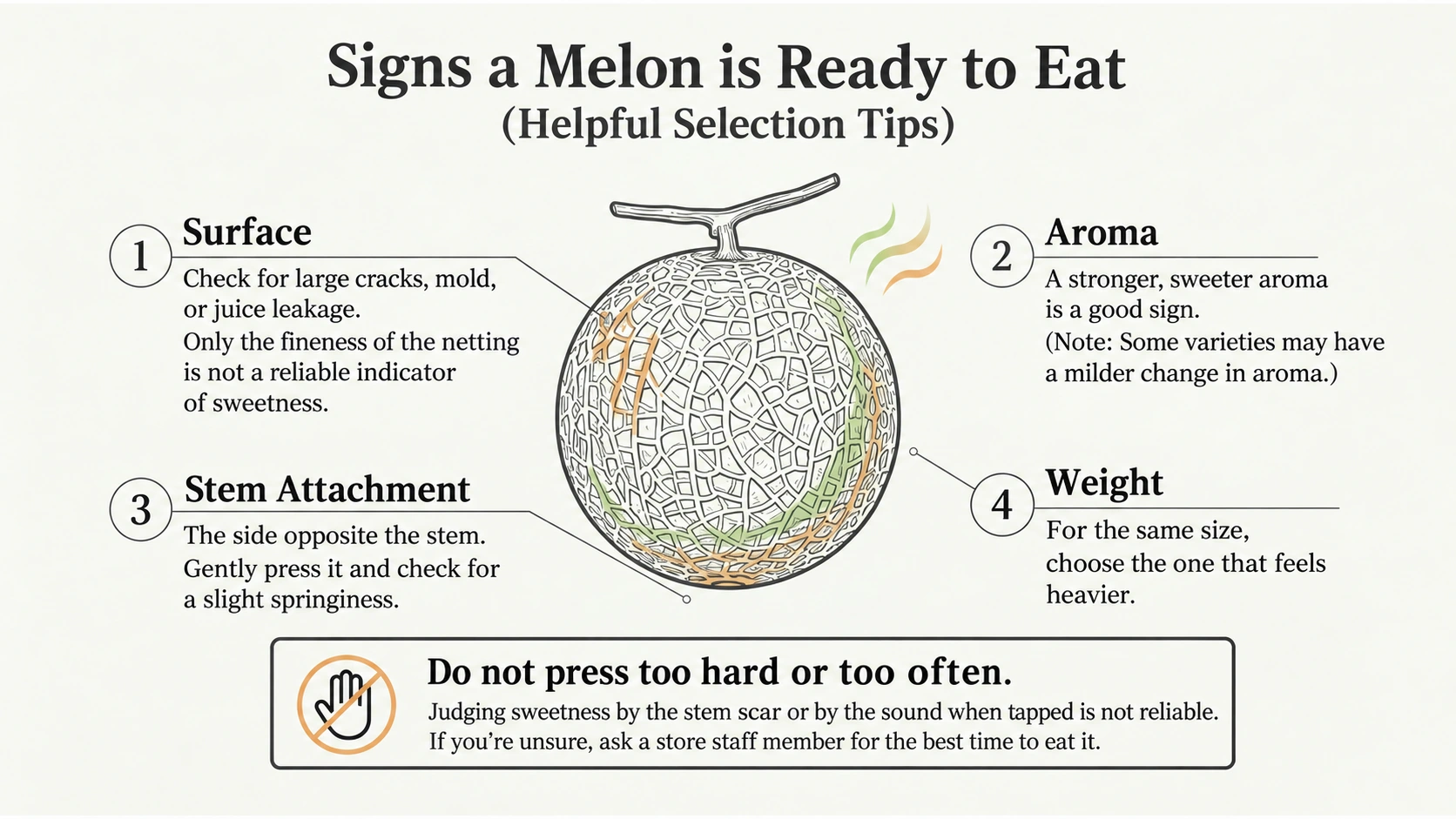
Avoid fruit with splits, mold, leaking juice or substantial deterioration. Even on a netted cultivar, fine netting alone does not reveal sugar content. Give priority to cultivar, grade and ripeness information; weight can be an additional clue when comparing fruit of a similar size.
Aroma and softness depend on the cultivar
For cultivars that develop a stronger aroma, a sweet smell may help identify eating ripeness. Slight give at the blossom end—the end opposite the stem—may also be a clue for some types. Other cultivars show less change in aroma or softness.
A withered stem or the sound made by tapping cannot establish sweetness or safety. Do not press shop fruit firmly or strike it. If you are unsure, ask about the cultivar and explain when you intend to eat it.
UC Davis’s cantaloupe factsheet also notes differences in external color between cultivars, and describes several quality indicators, including appearance and soluble-solids measurements. Source: UC Davis, “Cantaloupe”.
Ripening a firm melon: will it become sweeter?
If the cultivar softens and develops aroma after harvest, follow the seller’s advice while waiting for eating ripeness. Takii Seed also explains that netted melons can soften and become more fragrant during postharvest ripening. Source: Takii Seed cultivation manual (Japanese).
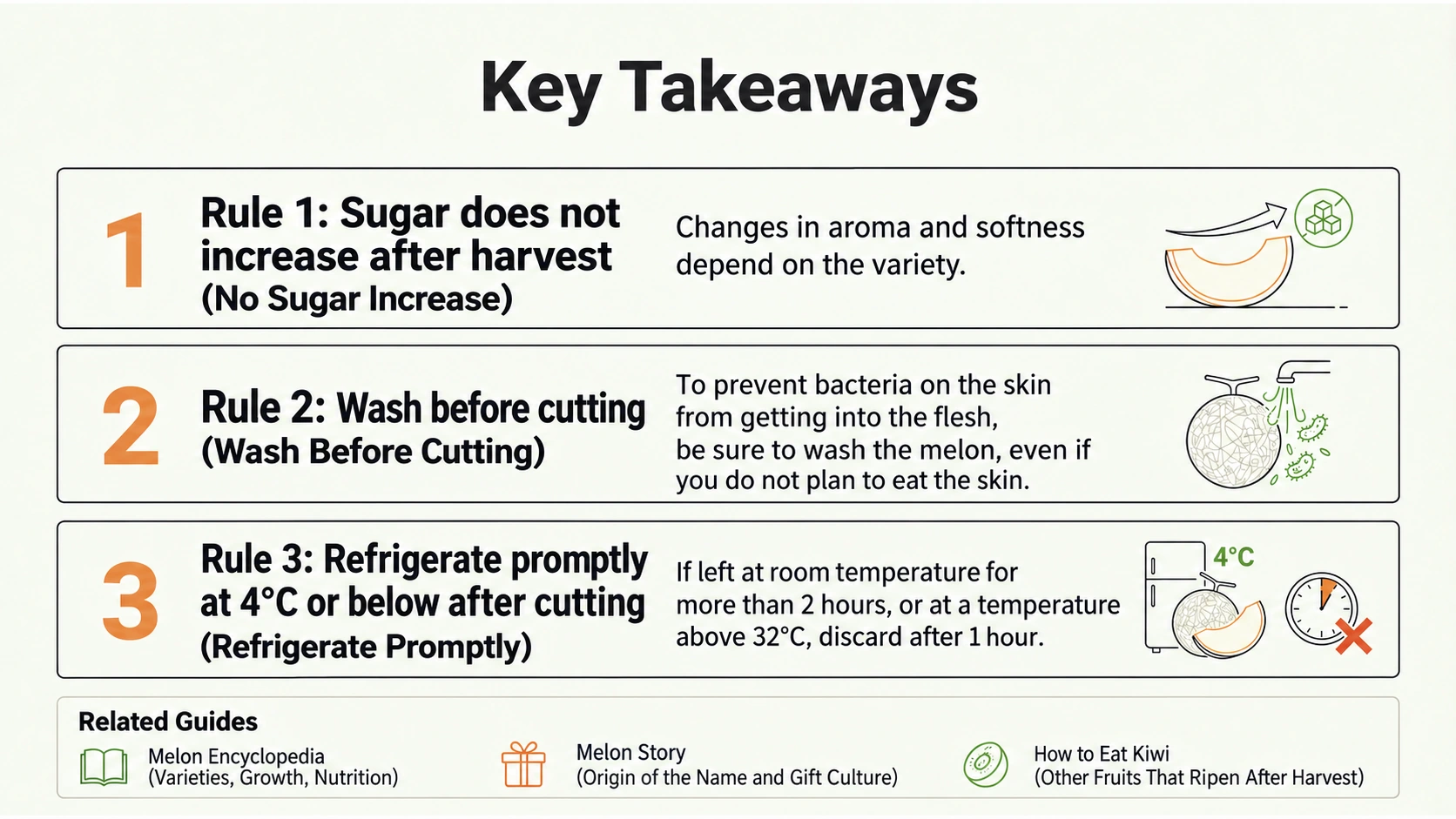
UC Davis states that cantaloupes can ripen after harvest but do not increase in sugar content. A melon harvested too early will not necessarily become adequately sweet simply by being left longer. Source: UC Davis, “Cantaloupe”.
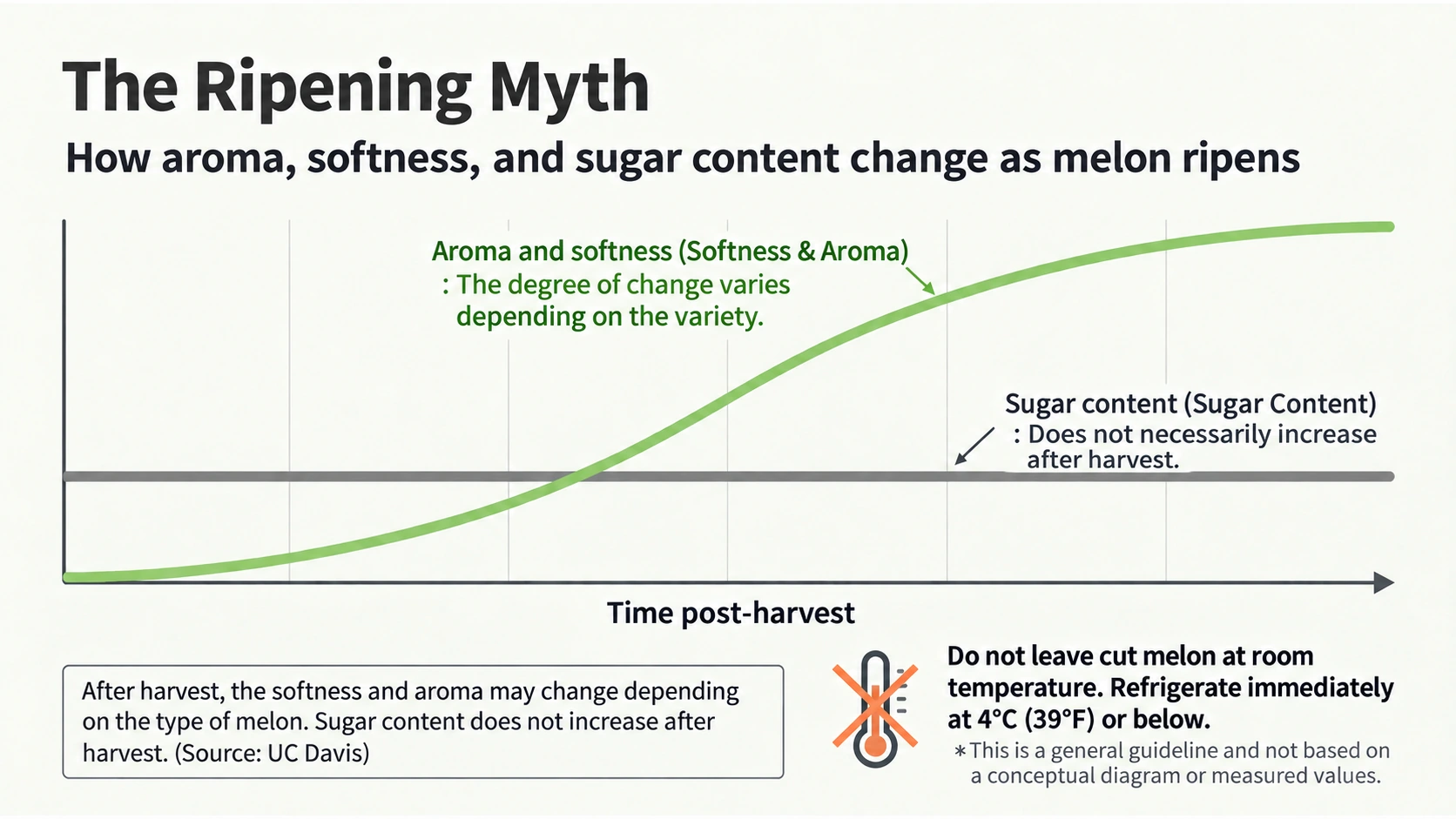
Keep the whole fruit out of direct sunlight in a cool, ventilated place, checking it daily. In a hot Vietnamese room, do not mechanically count a fixed number of “days at room temperature.” Follow the product’s guidance, refrigerate when ready to eat and do not eat spoiled fruit.
Once a melon has been cut, refrigerate it immediately rather than leaving it at room temperature to ripen.
How to wash a melon before cutting
Wash the melon before cutting even if you will not eat the rind. A knife can transfer dirt and bacteria from the surface to the flesh. This is a general principle for handling fresh produce, not just melons.
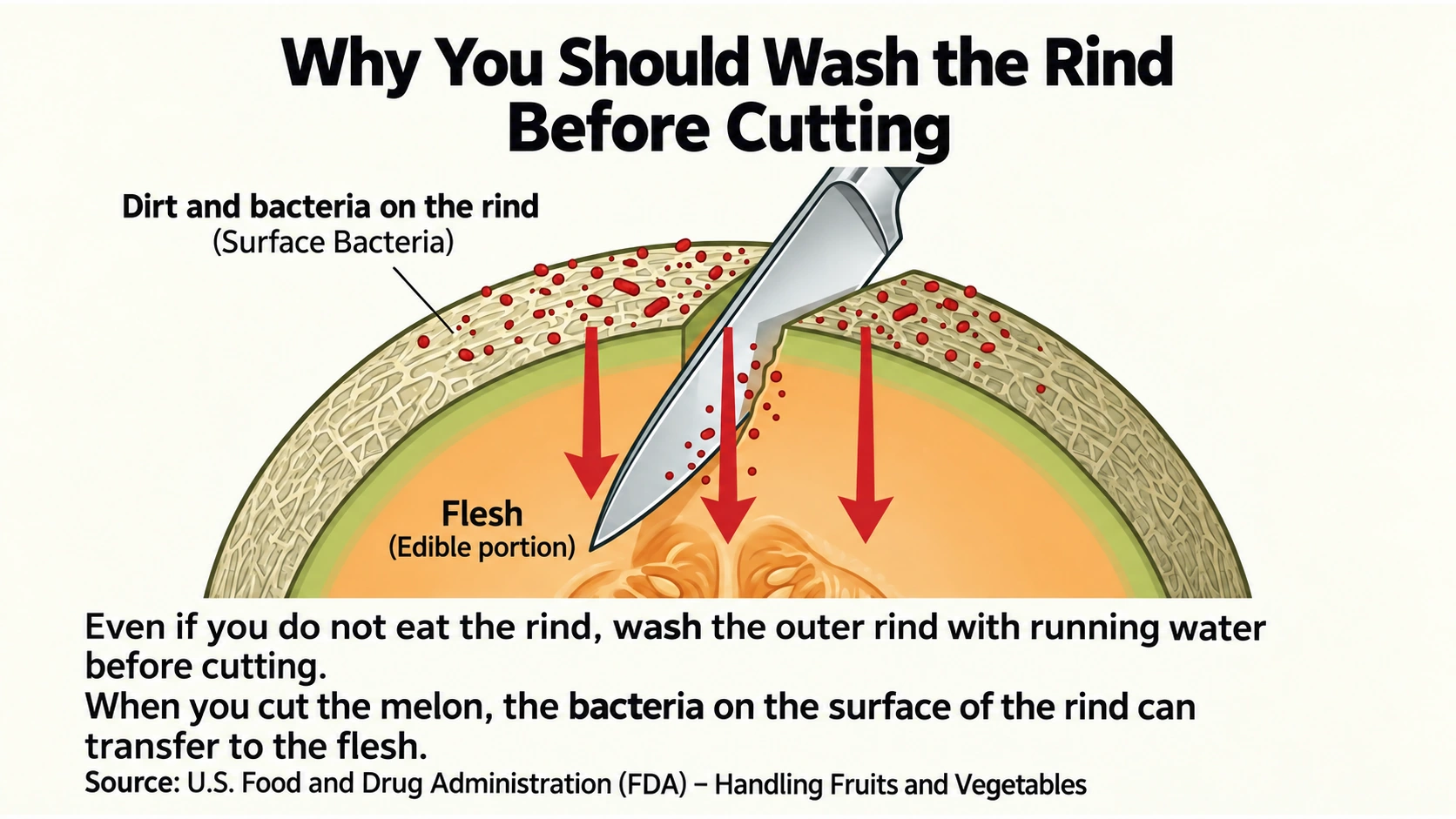
- Wash your hands with soap and running water, and clean the knife and board.
- Scrub the rind with a clean produce brush under running water suitable for drinking.
- Dry with a clean cloth or paper towel.
- Cut using clean utensils.
Do not use soap or dish detergent on the fruit itself; use running water. Washing can reduce bacteria but cannot guarantee removal of every bacterium. Source: FDA, “Selecting and Serving Produce Safely”.
How to cut melon into wedges or bite-size pieces
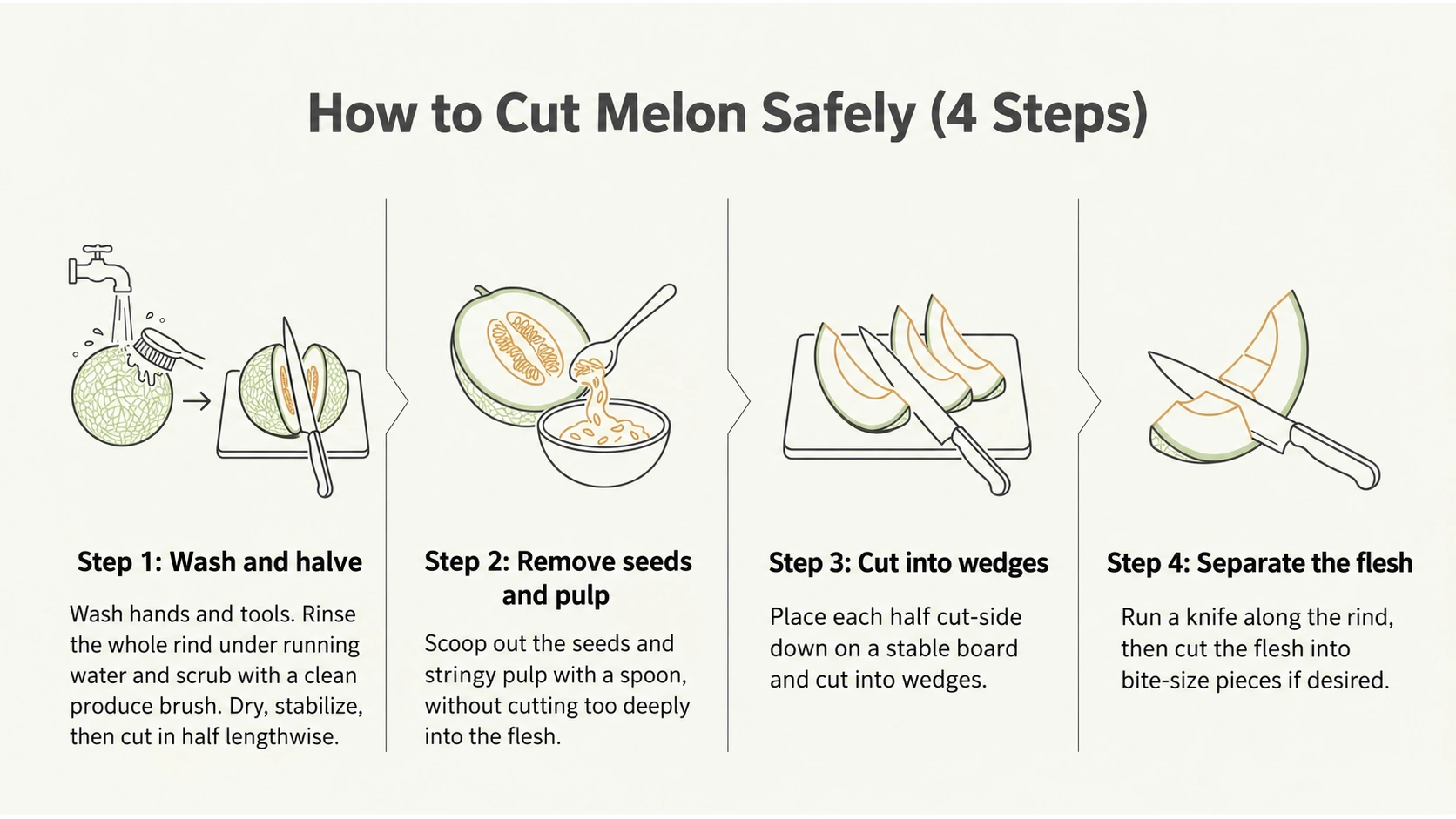
What to prepare
Use a clean knife, a stable cutting board, a spoon for the seeds and a serving plate. Have a lidded container or wrapping ready so any portion you will save can go straight into the refrigerator.
Five steps for wedges and bite-size pieces
- Wash and dry. Follow the washing steps above. Dry the outside so it is less slippery.
- Halve on a board. Keep the melon stable and cut lengthwise from the stem end toward the blossom end. If the rind is too hard for the blade to move safely, stop and improve the position rather than forcing it.
- Scoop out the seeds. With the cut side up, remove the seeds and fibrous material from the cavity using a spoon. Avoid digging deeply into the surrounding flesh.
- Make wedges. Place a half cut-side down on the board and divide it into manageable wedges.
- Remove the rind and serve. Stabilize each wedge on the board and guide the knife along the boundary between rind and flesh. Do not cut it in the palm of your hand. Cut the flesh into smaller pieces if desired.
Eating with a spoon
For a small melon, wash, halve and remove the seeds and fibers, then place a half in a dish and scoop out the flesh. Put aside and refrigerate any portion you will save before eating. Do not return a spoon that has been in your mouth to fruit intended for storage.
Adding melon to salad or yogurt
Remove the rind and cut the flesh into cubes. Add to yogurt just before eating. For salad, pieces similar in size to the other ingredients are easier to serve. These are home-serving suggestions, not a record of how the purchase described above was actually eaten.
Ways to enjoy melon
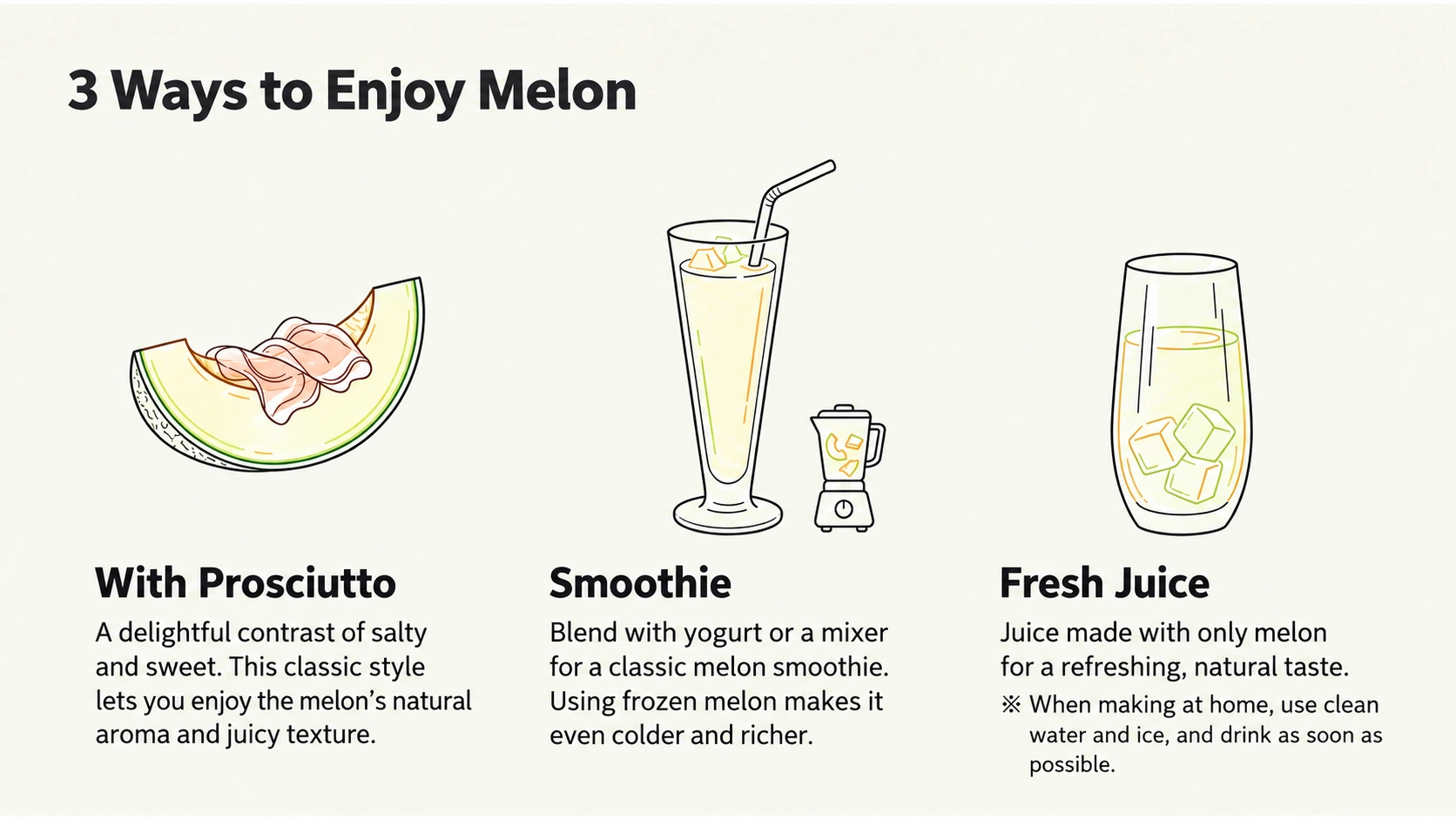
Plain or with cured ham
Wedges or cubes let you enjoy the flesh’s aroma and texture. Cured ham adds a salty contrast to melon’s sweetness and can turn it into an appetizer.
For names and the background to Japanese gift-fruit culture, see Melon History: Name Origins and the Birth of Prince and Yubari Melons.
Smoothies and juice
Blend diced melon with yogurt or other ingredients for a smoothie. In Vietnamese, sinh tố refers to a smoothie, while nước ép means pressed juice.
When preparing drinks yourself, use clean equipment and water and ice suitable for drinking. Drink promptly after making them. Frozen melon flesh can give a colder, thicker texture.
Storing melon: whole, cut or frozen
| Condition | Storage approach |
|---|---|
| Whole, waiting for eating ripeness | Follow cultivar-specific and seller guidance; keep out of direct sun and excessive heat, and check daily |
| Whole, ready to eat | Refrigerate and eat promptly |
| Cut | Cover with clean wrapping or a container and refrigerate promptly at 4°C or below |
| For freezing | Remove seeds and rind, cut into pieces and seal. Texture changes on thawing, so consider using it in smoothies |
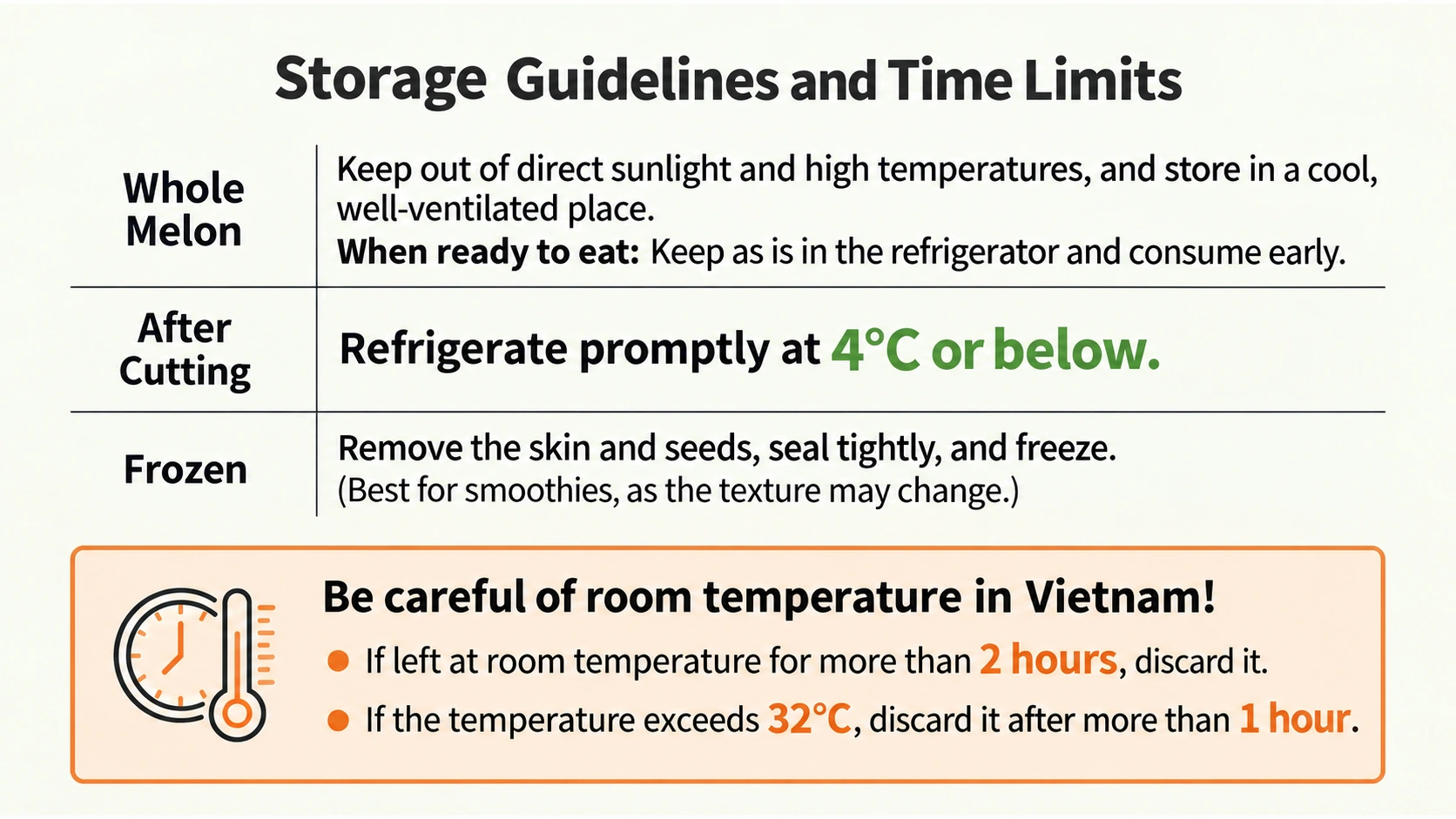
Foods requiring refrigeration, including cut melon, should not remain at room temperature for more than two hours, or more than one hour above 90°F—about 32°C. Discard food left beyond those limits. These are not suggested waiting times: the basic rule is to refrigerate promptly after cutting. Source: FDA, “Are You Storing Food Safely?”.
Check the actual temperature where the melon is stored, rather than relying on a compartment labeled “vegetable drawer.” Do not leave cut fruit out for long periods to avoid a possible loss of flavor from chilling.
If you have pollen or food allergies
Similarities between pollen proteins and fruit proteins can cause pollen-food allergy syndrome, also called oral allergy syndrome (PFAS/OAS), with symptoms such as an itchy mouth or throat. The American Academy of Allergy, Asthma & Immunology lists ragweed pollen and melon as an example of cross-reactivity. Source: AAAAI, “Food Allergy”.
Having hay fever does not mean everyone must avoid melon. If symptoms occur after eating it, stop and seek medical advice. If you have reacted before, do not test your safety by trying a small amount on your own. Breathing difficulty or throat swelling requires immediate emergency medical care.
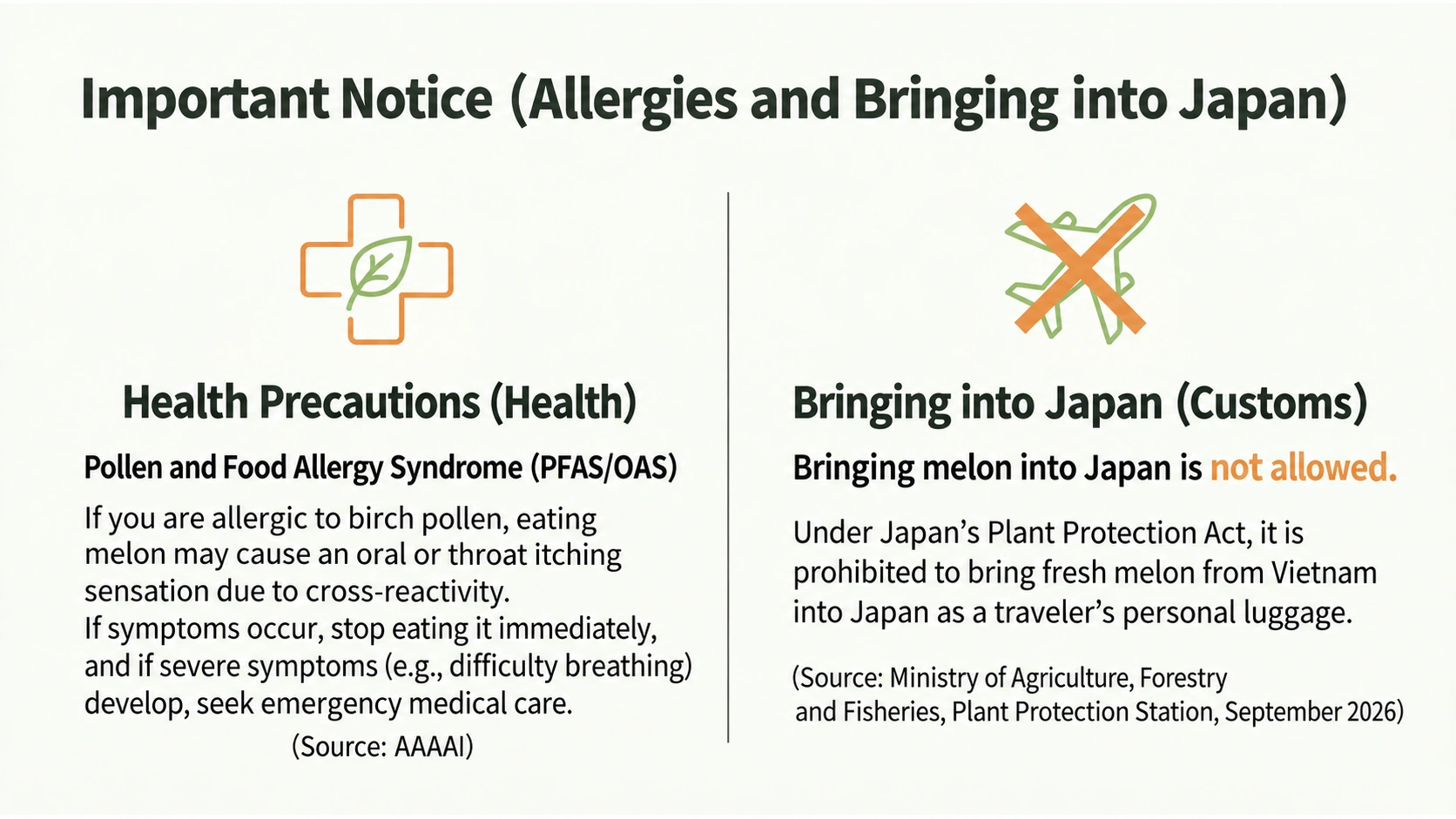
Can you bring a melon from Vietnam into Japan?
The Plant Protection Station’s Vietnam guidance, rechecked on October 17, 2026, lists melon as prohibited. Travelers cannot bring fresh melons from Vietnam into Japan in their luggage. Check the latest official guidance before traveling. Source: Japan’s Plant Protection Station, Vietnam page (Japanese).
Frequently asked questions
Will a firm melon become sweeter if I leave it?
Some types become softer and more aromatic. However, UC Davis states that cantaloupe does not gain sugar after harvest. Check the cultivar and ready-to-eat guidance rather than judging by firmness alone.
Does finer netting mean better flavor?
Netting alone cannot tell you. Consider cultivar, ripeness and any signs of deterioration together.
Do I need to wash a melon before cutting?
Yes. Even if you will not eat the rind, wash and dry the outside and use a clean knife and cutting board.
Can cut melon be stored at room temperature?
No. Cover it in a clean container and refrigerate promptly at 4°C or below. Follow purchased products’ storage and date instructions. Discard it after more than two hours out of refrigeration, or more than one hour where the air temperature exceeds about 32°C.
Before serving
Choose by cultivar and ripeness information, rather than flesh color or netting alone. Wash the whole melon just before cutting, use clean equipment and refrigerate any remaining portions immediately.
Related articles
- Varieties, nutrients and cultivation: Melons in Vietnam.
- Names, history and gift culture: Melon History: Name Origins and the Birth of Prince and Yubari Melons.
Sources and verification dates
The Japanese source article first checked its links on September 23, 2026. On October 17, 2026, it rechecked FDA washing and refrigeration guidance, UC Davis and Takii’s ripening explanations, AAAAI’s cross-reactivity information and Japan’s plant-quarantine restrictions. The price article’s data update is June 8, 2026; its reference range was rechecked on October 17, 2026.
