Coconut Field Guide: Taste, Nutrition, Varieties, Water and Milk
Published October 9, 2026
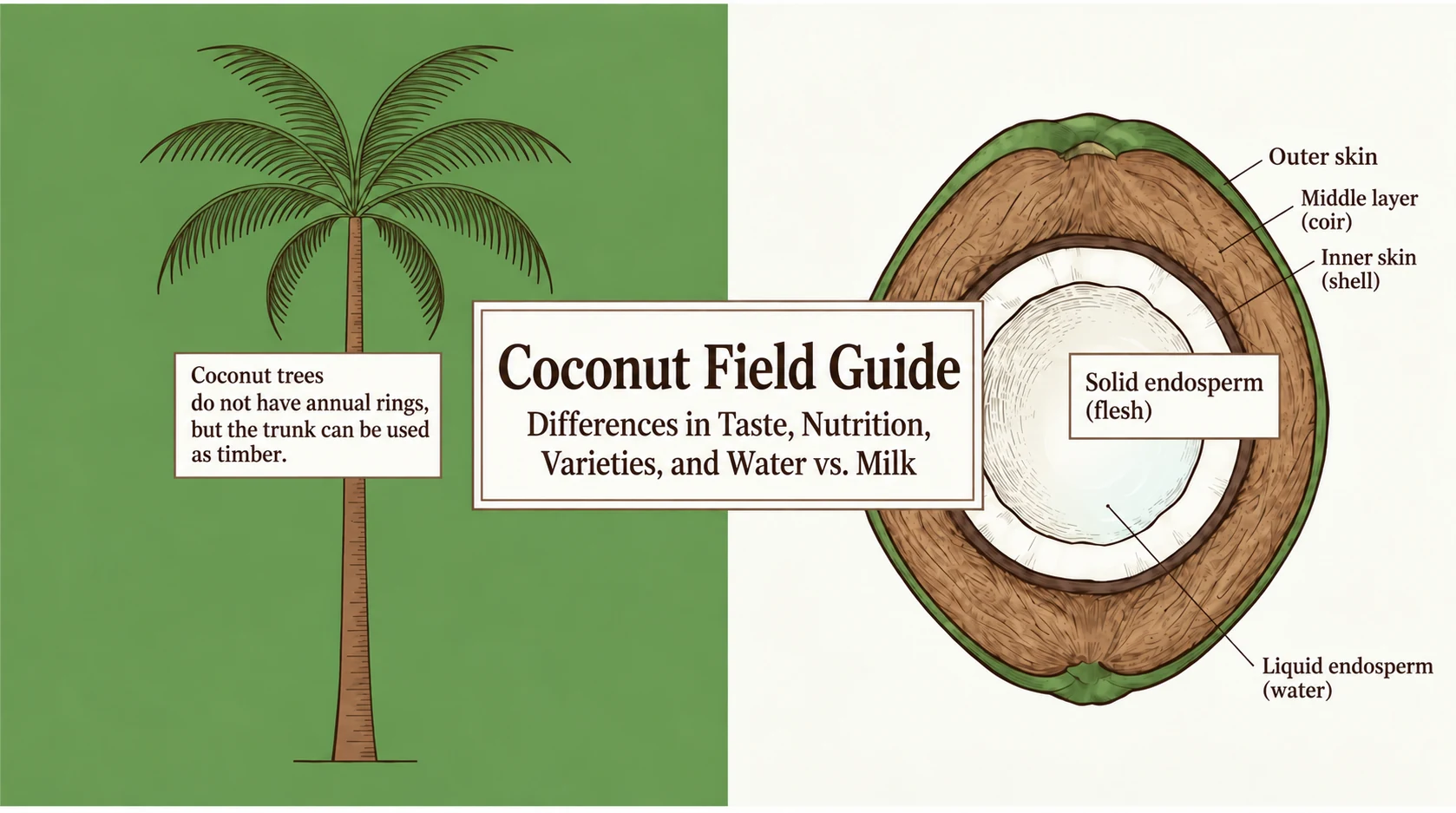
A tropical shoreline would hardly be complete without the coconut palm and its fruit. In Vietnam, drinking through a straw inserted into a young coconut is an everyday sight. The white flesh is also used to make milk and oil.
How does coconut water differ from coconut milk, and what kind of fruit is a coconut despite the word “nut”? This illustrated guide covers its taste, nutrients, varieties, the palm’s trunk without growth rings, and coconut-growing regions in Vietnam.
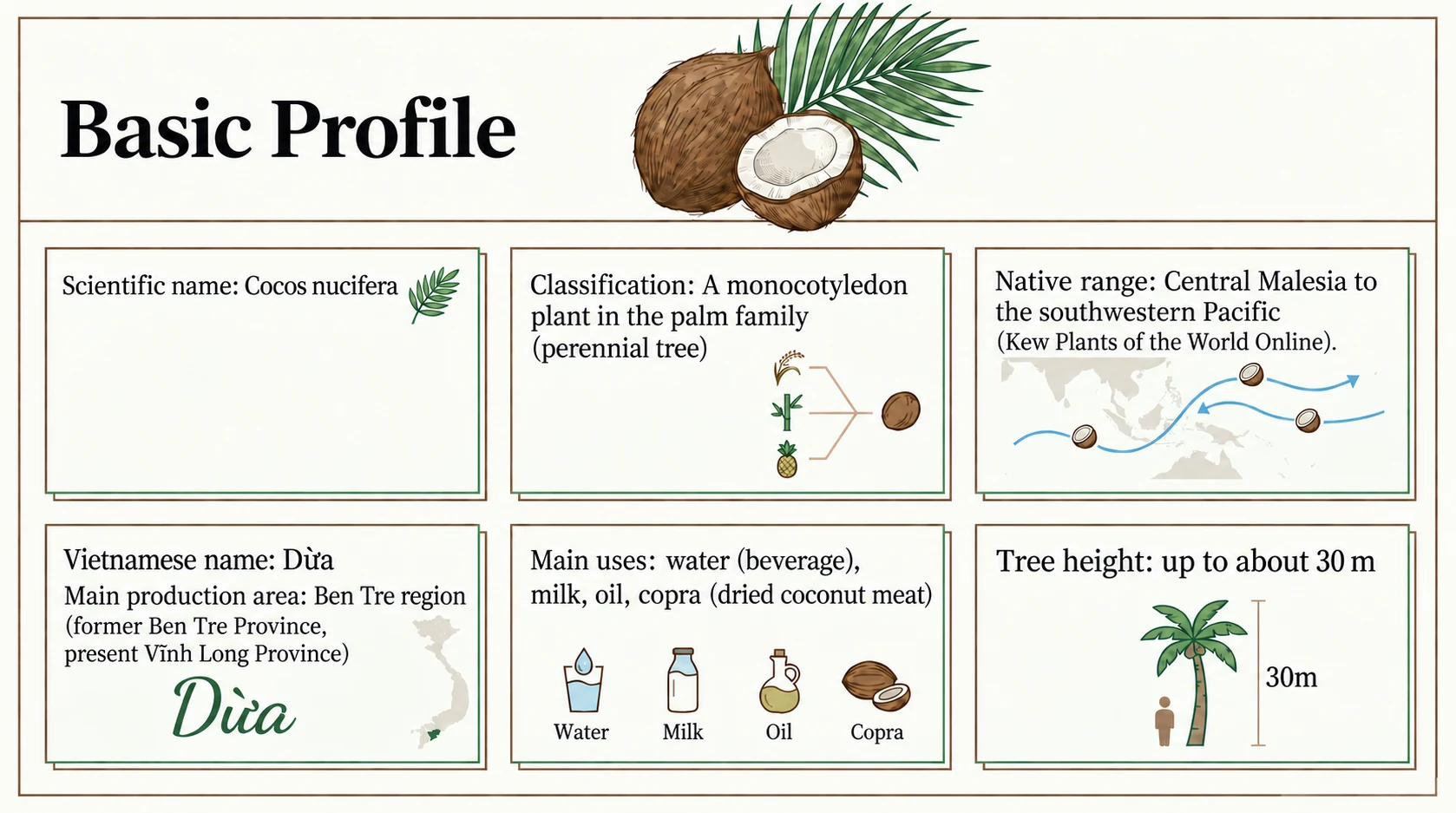
What Is a Coconut? Quick Facts
| Item | Details |
|---|---|
| Common name | Coconut; the plant is the coconut palm |
| Vietnamese name | Dừa |
| Scientific name | Cocos nucifera |
| Classification | Evergreen tree in the palm family, genus Cocos; a monocot |
| Native range | Kew gives the native range as Central Malesia to the southwestern Pacific. Domestication may have occurred independently in island Southeast Asia and the Indian Ocean region. |
| Height | Up to about 30 m |
| Availability in Vietnam | A familiar fruit and drink available year-round. The Ben Tre area, formerly Ben Tre Province and now part of Vinh Long Province, is a major growing region. |
| Main uses | Coconut water for drinking, coconut milk, coconut oil, and copra (dried flesh) |
Sources are listed at the end of this article.
Building Timber Without Growth Rings: Inside a Coconut Palm Trunk
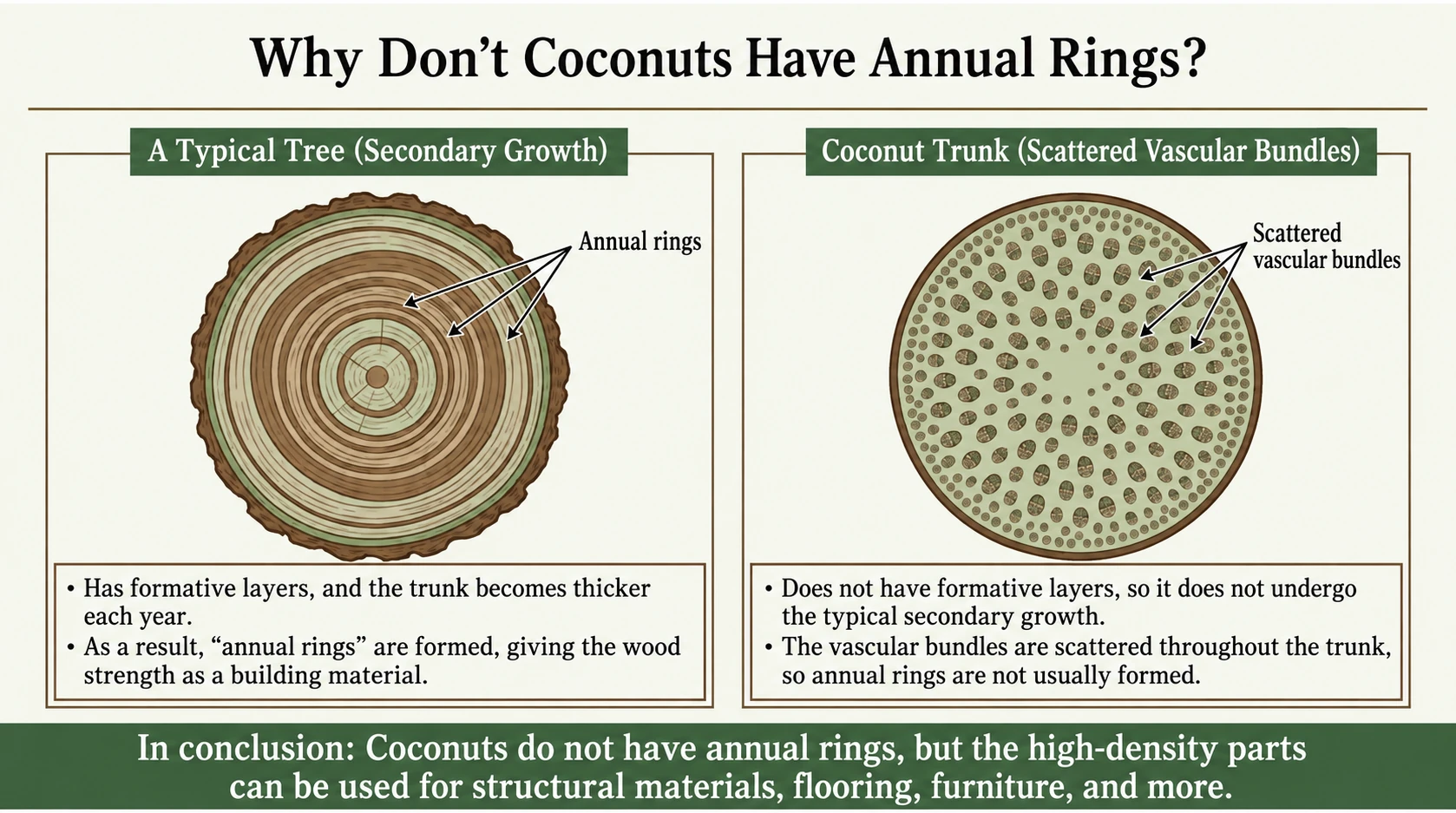
Kew describes the coconut palm as a “tree,” but botanically it is a monocot, like rice and bamboo. Its trunk thickens and develops differently from those of typical broadleaf and coniferous trees.
Typical trees thicken through secondary growth produced by a cambium, forming growth rings. Coconut palms lack that mechanism. Their vascular bundles are scattered through softer ground tissue, so the trunk has no concentric growth rings. Density is generally higher toward the outside and lower near the center and upper parts of the trunk.
This structural difference does not make the trunk unusable as timber. FAO describes techniques for sawing old coconut palms and using high-density sections for structural timber, floors, stairs, and furniture. Variation in density and limited durability make selection, drying, and preservation important for each intended use.
One Growing Point, Usually No Branches
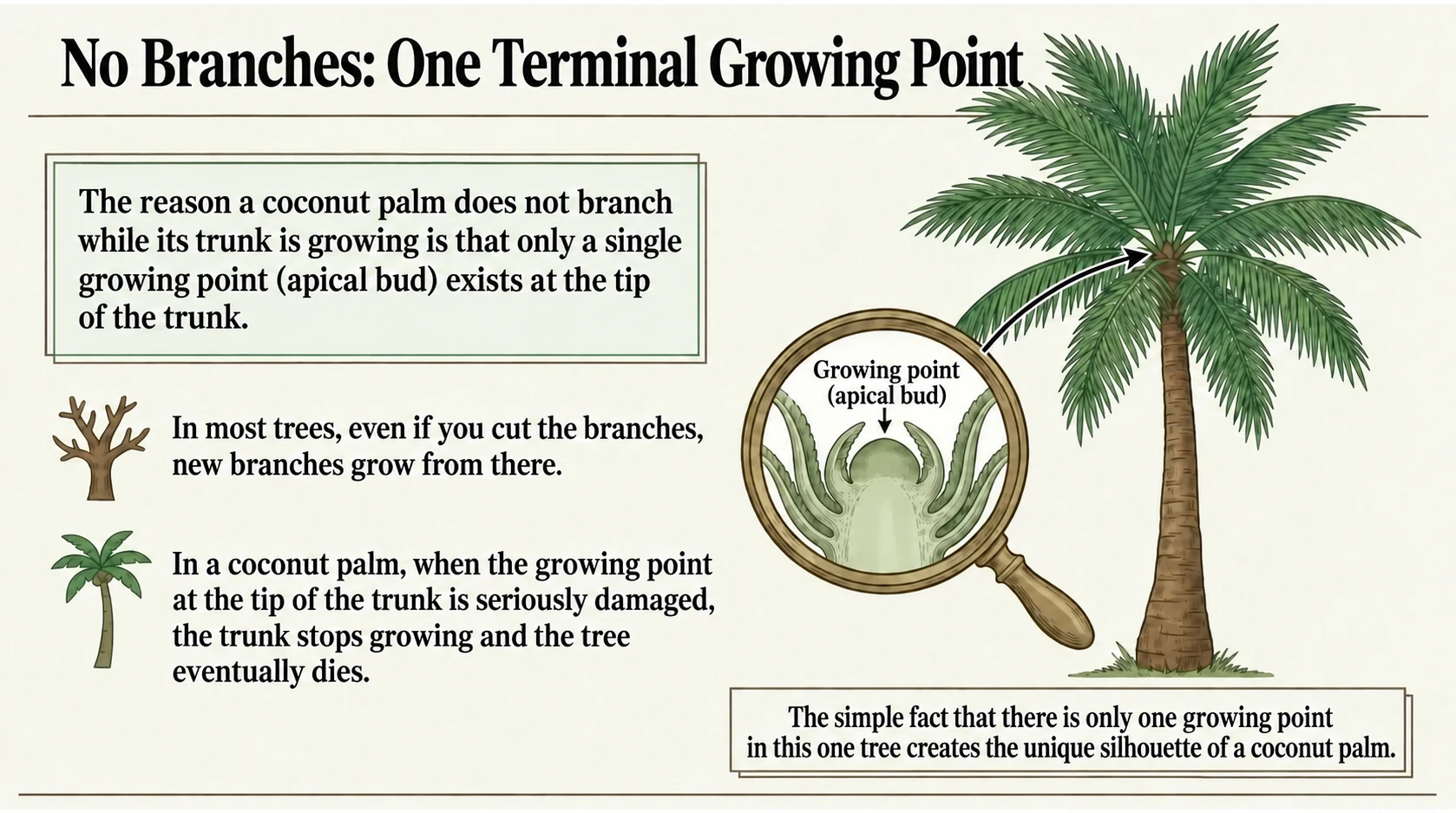
A coconut palm normally grows without branching, producing leaves from a single growing point, or terminal bud, at the top of its trunk. It cannot continue growing by producing another shoot at a cut branch in the way many ordinary trees can.
Severe damage to the terminal growing point prevents the palm from producing new leaves and trunk tissue and can kill it. Its inability to redirect growth to branch buds helps explain the coconut palm’s straight silhouette.
Ocean Dispersal: A Fruit That Can Cross the Sea
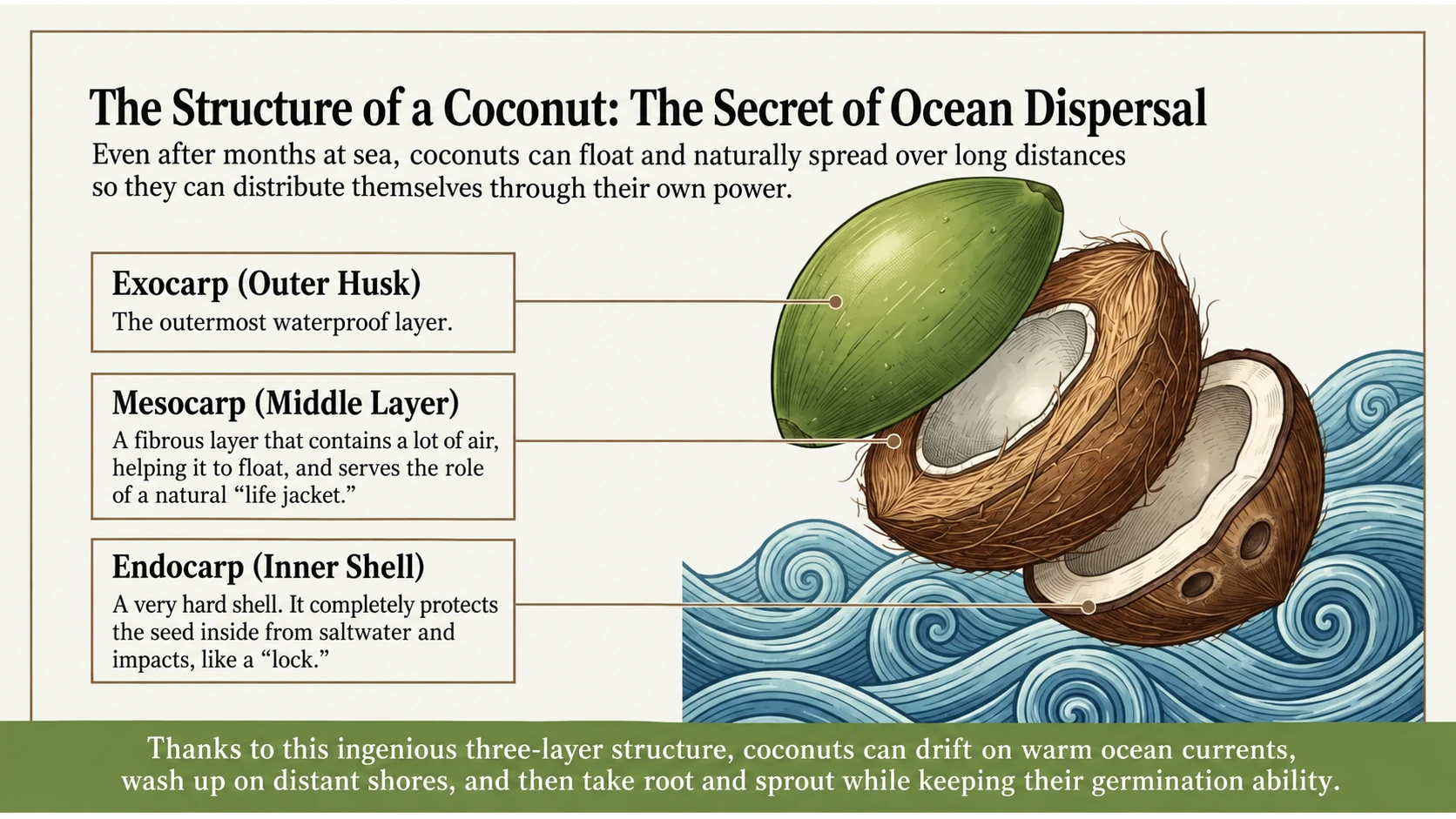
Coconuts float well in seawater. A fruit that falls into the sea can travel far on ocean currents, reach a sandy shore, and germinate there, extending the plant’s range.
The thick fibrous layer of the fruit wall—the mesocarp, or coir—helps it float. The hard inner shell, the endocarp, protects the seed and helps it survive the journey to a place where it can germinate. Human cultivation, migration, and trade also played major roles in its worldwide distribution. Read more in Coconut History and Stories.
A “Nut” in Name, a Drupe in Botany
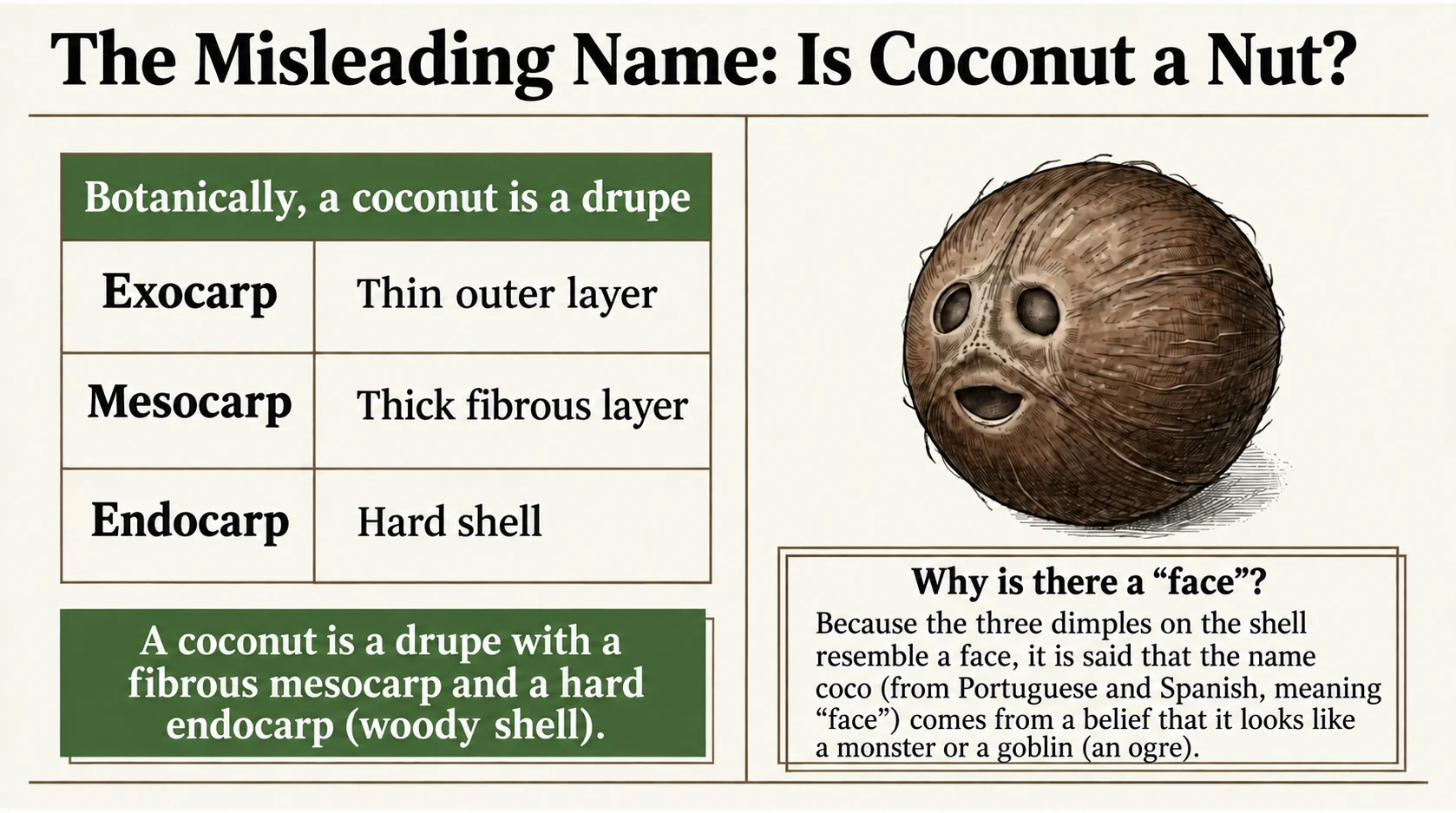
Its name suggests a nut, but botanically a coconut is a type of drupe with a fibrous mesocarp and a hard endocarp. Peaches and cherries are also drupes; a major difference is that the coconut’s mesocarp becomes dry and fibrous.
The “coco” in “coconut” is said to come from Portuguese and Spanish words for a grimacing monster or bogeyman, because the shell’s three pits resemble a face. “A smiling face” is not an accurate translation. Japan’s Standard Tables of Food Composition list coconut water and coconut milk in the fruit category. Food-table groupings and botanical fruit classifications are separate systems.
Nutrition and Uses: Water, Milk, and Oil
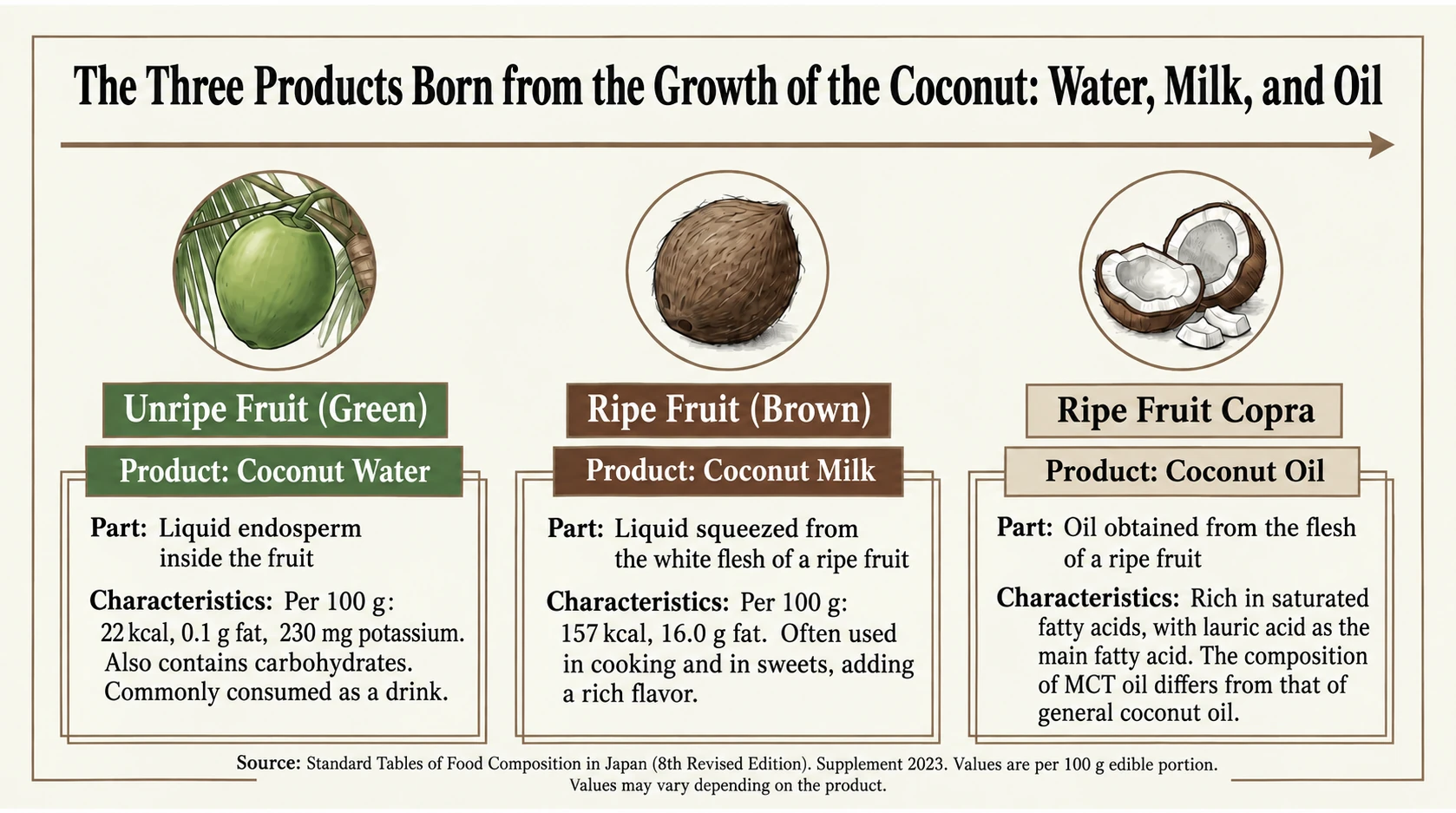
A coconut is an unusual fruit that yields three products with very different properties.
| Product | What it is | Characteristics |
|---|---|---|
| Coconut water | The liquid endosperm inside an immature, green coconut | Per 100 g edible portion: 22 kcal, 0.1 g fat, 230 mg potassium, and 6 mg magnesium. It also contains carbohydrate. |
| Coconut milk | Liquid pressed from mature white flesh (solid endosperm) with water | Per 100 g edible portion: 157 kcal, 16.0 g fat, 230 mg potassium, and 28 mg magnesium. Adds richness to cooking and desserts. |
| Coconut oil | Oil obtained from the endosperm of mature fruit | Rich in saturated fatty acids, principally lauric acid. Its fatty-acid composition differs from that of commonly sold MCT oil. |
As the fruit matures, the white flesh, or solid endosperm, thickens and can be used for milk and oil. Copra is this flesh after drying. The figures above are reference values per 100 g edible portion from Japan’s Standard Tables of Food Composition, eighth revised edition, 2023 supplement, published by MEXT. Values vary by variety and product.
Coconut oil contains substantial saturated fat, chiefly lauric acid. It is not the same as ordinary MCT oil, and blanket health claims such as “unlikely to be stored as body fat” are not justified.
Coconut Types and Varieties Around the World and in Vietnam
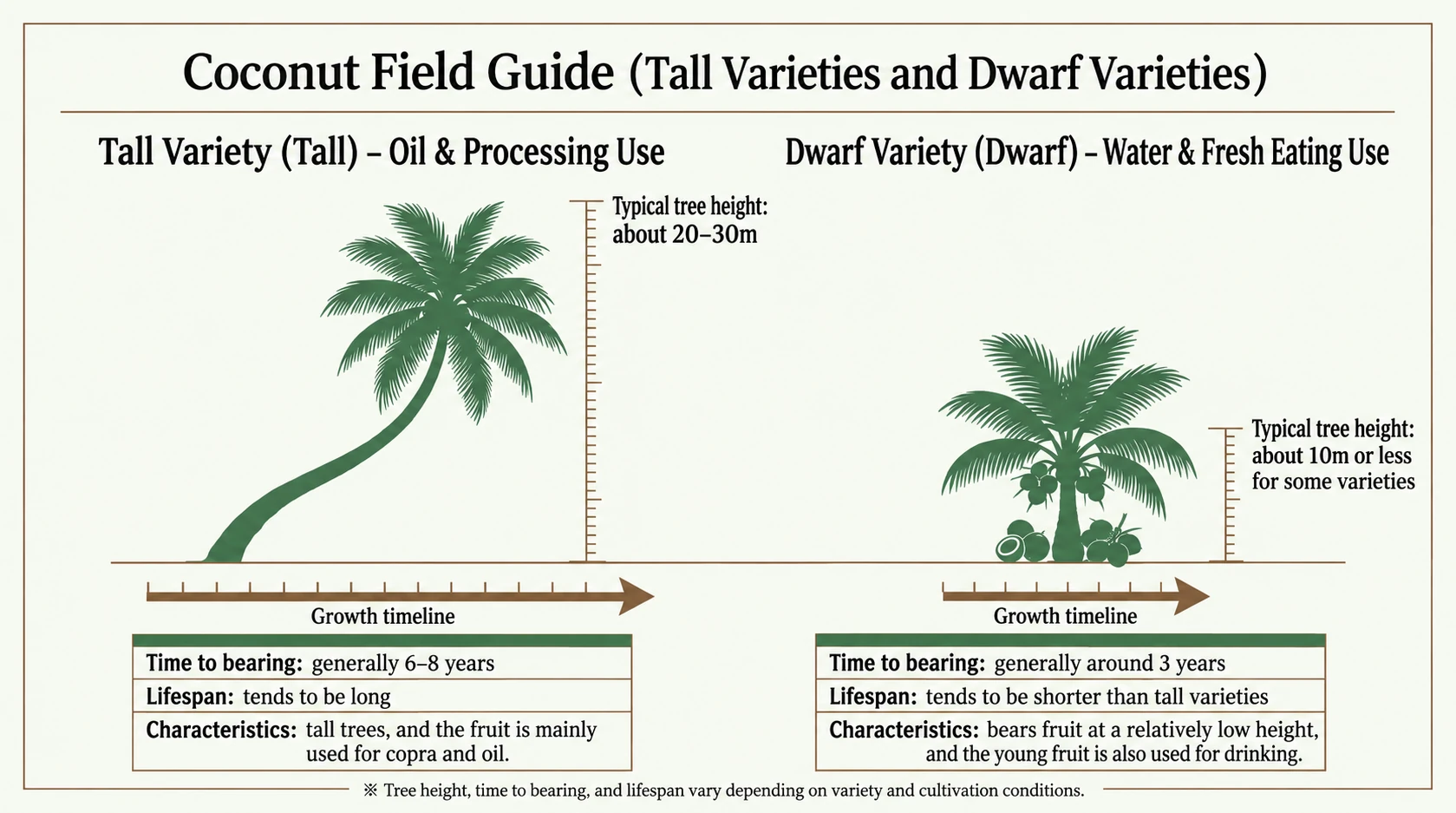
Coconut varieties are broadly divided into Tall and Dwarf groups.
| Group | Height | Time to first fruit | Lifespan | Characteristics |
|---|---|---|---|---|
| Tall | About 30 m | 6–8 years | 80–90 years | Grows tall; suitable for processing, including copra for oil |
| Dwarf | Shorter than Tall types, but some mature varieties reach around 10 m or more | Generally earlier than Tall types | Generally shorter than Tall types | Fruits earlier; many varieties are grown for drinking the water from young fruit |
Height, fruiting age, and lifespan vary with variety and growing conditions. The group name alone does not determine a fixed value.
Common Varieties in Vietnam
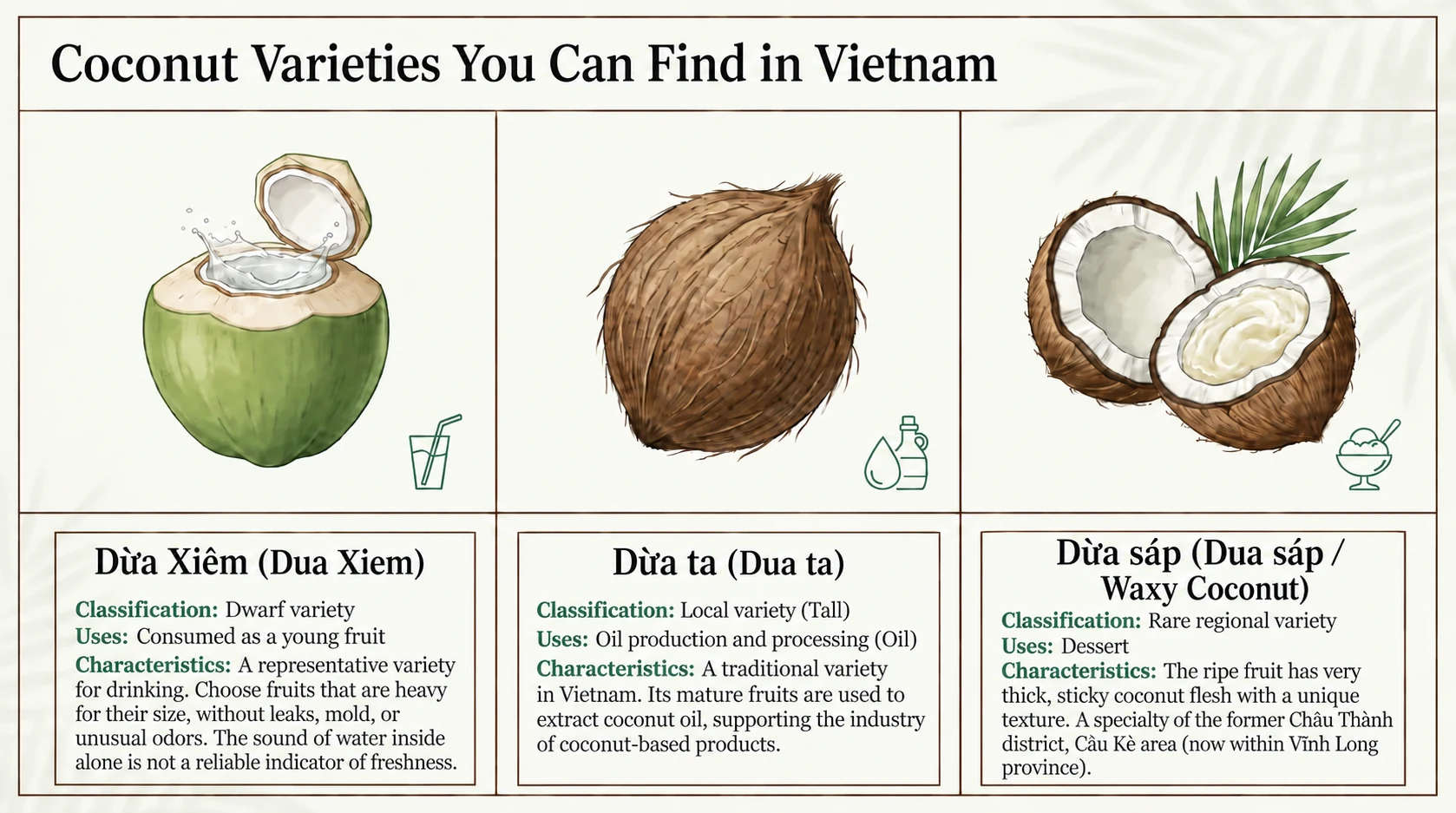
- Dừa Xiêm: A representative Dwarf variety grown for drinking the water from young fruit. A sloshing sound alone does not establish freshness. Choose fruit without damage, leaks, mold, or unusual odors; among fruit of similar size, look for good weight.
- Dừa ta (local coconut): A Vietnamese Tall type suited to producing copra and oil from mature fruit.
- Dừa sáp (wax coconut): A specialty of the Cau Ke area in former Tra Vinh Province, now Vinh Long Province. The mature endosperm becomes unusually thick and viscous.
Coconuts in Vietnam: Growing Regions, Prices, and Enjoyment
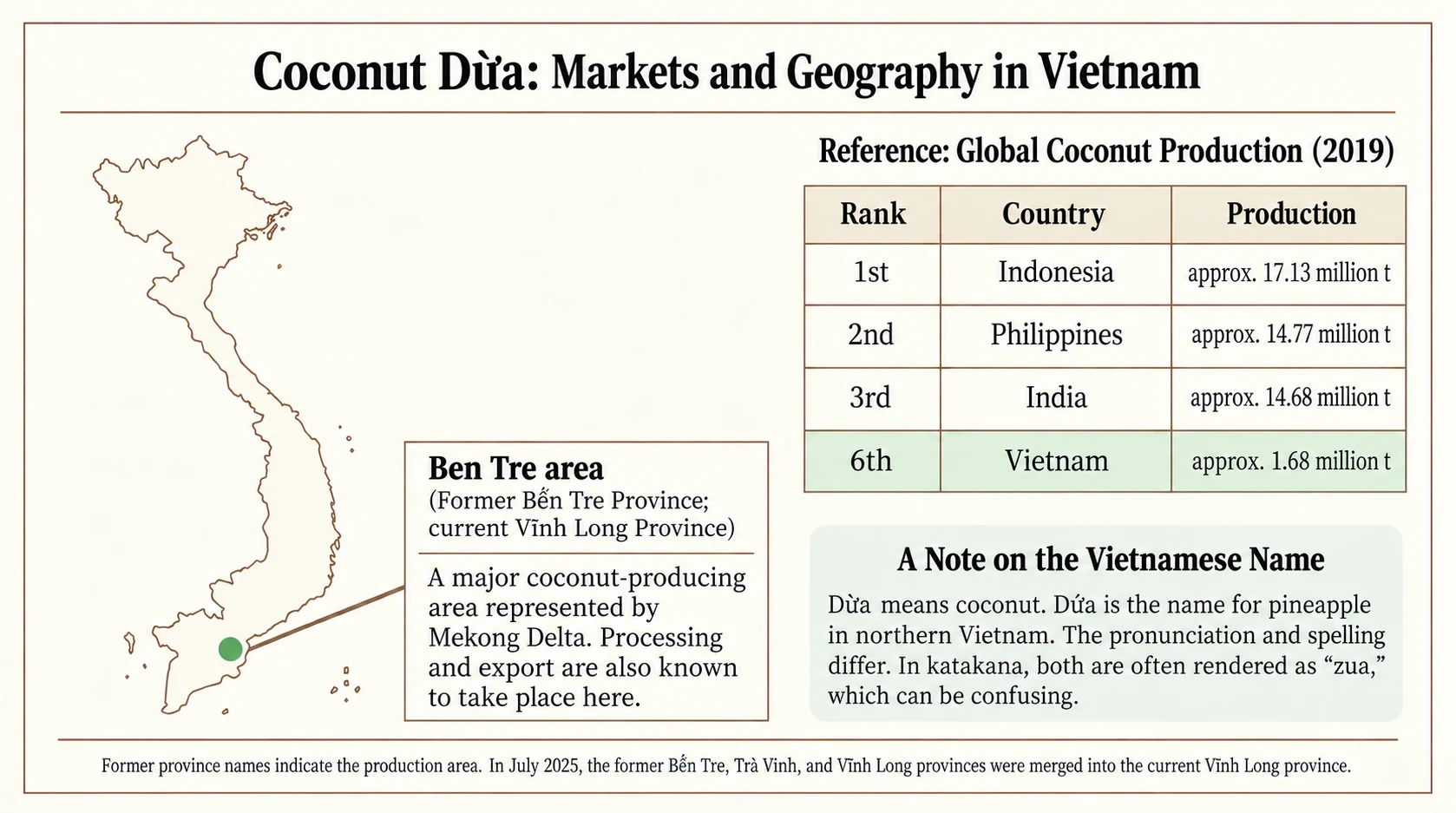
In Hanoi, where I live, coconuts are called “Dừa.” This is easily confused with “Dứa,” the northern Vietnamese name for pineapple. These are different words with different tone marks and pronunciation, although both tend to be written the same way in Japanese katakana. Beginners learning Vietnamese often mix them up.
The Ben Tre area in the Mekong Delta is a well-known coconut-growing region. A 2022 introduction by the Consulate-General of Japan in Ho Chi Minh City stated that the then Ben Tre Province accounted for about half of Vietnam’s production. This is a historical reference figure. In July 2025, the former Ben Tre, Tra Vinh, and Vinh Long provinces merged into the present Vinh Long Province. This article also uses former place names such as “the Ben Tre area” when discussing agriculture and culture.
I once bought a fresh drinking coconut for 31,000 VND (about ¥190) at a Hanoi market. A familiar way to serve it is to shave the top flat, make a hole, insert a straw, and let the customer drink it on the spot.
Coconut Production and Markets
To finish the overview, here is some context on the global coconut market.
In the 2019 reference figures, Indonesia, the Philippines, and India were the leading producers. Vietnam ranked sixth, with about 1.68 million tonnes. These are historical statistics, not current rankings.
| Rank | Country | Production (2019, FAO statistics) |
|---|---|---|
| 1 | Indonesia | About 17.13 million tonnes |
| 2 | Philippines | About 14.77 million tonnes |
| 3 | India | About 14.68 million tonnes |
| 6 | Vietnam | About 1.68 million tonnes |
Rankings change by year. The table uses the same historical 2019 figures as the infographic.
The Philippines is a major exporter of processed products such as copra and coconut oil. Coconut shells also supply material for charcoal and activated carbon, alongside the fruit’s food and drink uses.
Bringing Coconuts from Vietnam into Japan: Conditional Permission
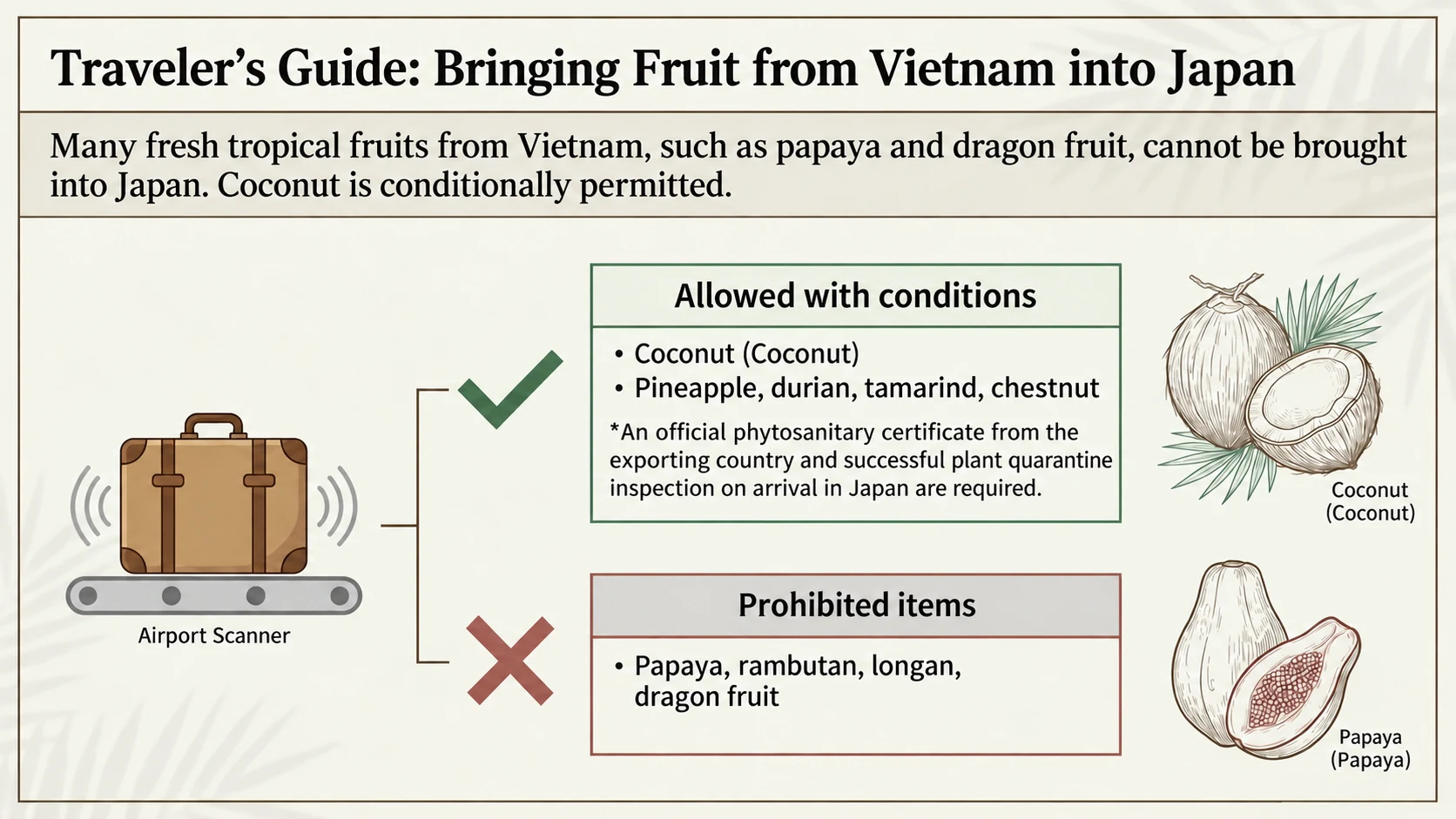
Japan’s Plant Protection Station lists five fruit items that travelers may bring from Vietnam subject to conditions: coconut, tamarind, durian, pineapple, and chestnut. Coconut is included in this list. A phytosanitary certificate issued by the exporting country’s government authority is required, and the fruit must pass plant quarantine inspection at the arrival airport or seaport.
The same page lists papaya, rambutan, longan, and dragon fruit among fruits that cannot be brought in. This guidance concerns fruit carried by travelers; commercial cargo has separate import conditions.
Frequently Asked Questions
What is the difference between coconut water and coconut milk?
Water is the liquid found mainly inside young fruit. Milk is made by pressing mature white flesh together with water, making it white and richer in fat.
Is a coconut a fruit or a nut?
It is generally treated as a fruit and botanically classified as a drupe with a fibrous mesocarp and hard endocarp. Despite its name, it is not a botanical nut.
Is a coconut palm a tree or a grass?
Kew describes it as a tree, and botanically it is a monocot. It lacks the cambium and growth rings of typical trees, but its trunk can be used as coconut timber.
Which coconuts can you drink in Vietnam?
Dừa Xiêm is a common choice for drinking young coconut water. At stalls and markets, staff can open the fruit and insert a straw for you. See How to Eat Coconut in Vietnam for prices and tips on choosing one.
Recap: Coconut Taste, Nutrition, and Varieties
Here are the main points of this guide.
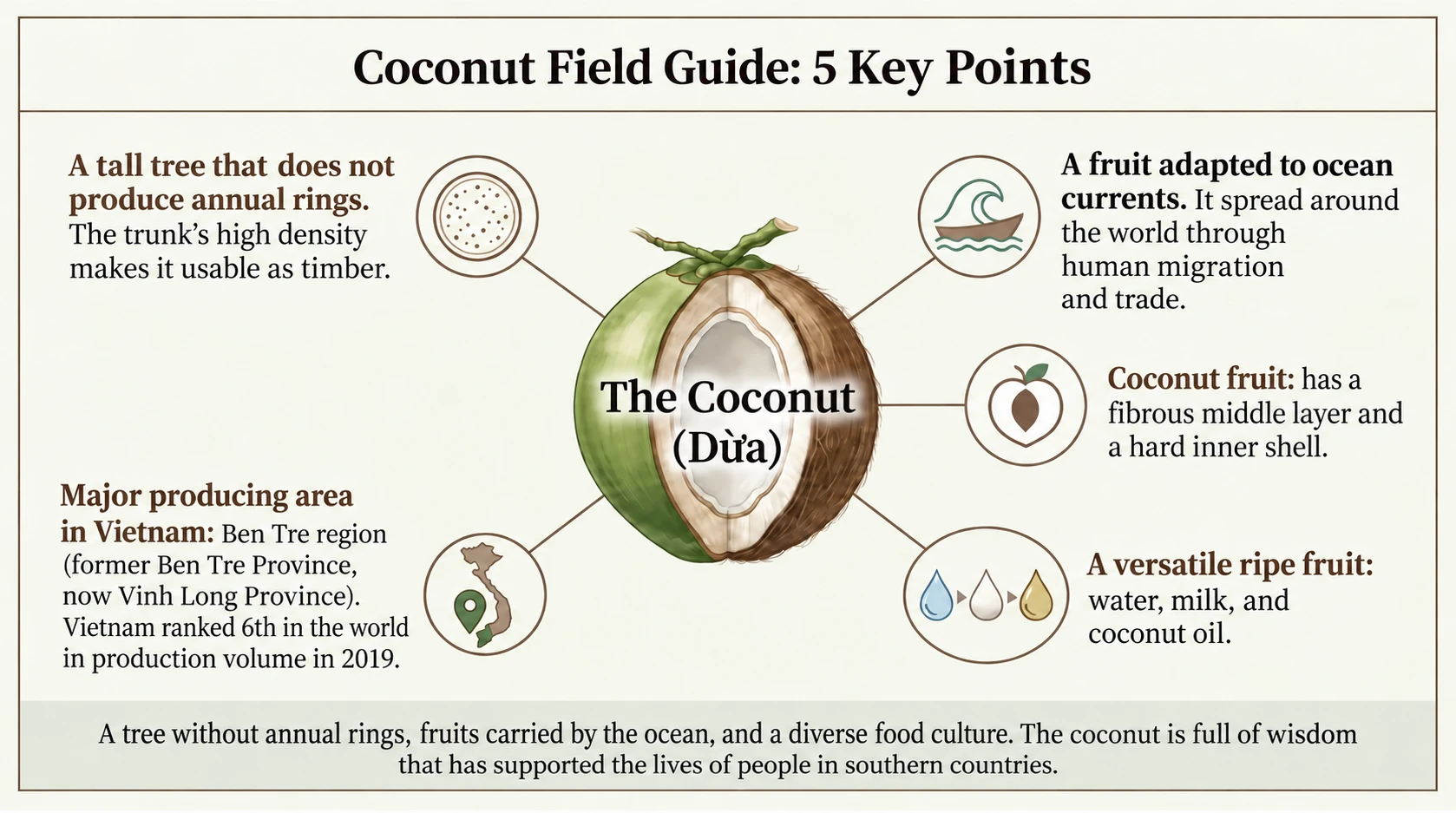
- The coconut palm is a monocot tree that can reach around 30 m. It lacks the growth rings of typical trees, but selected parts of its trunk can be used as timber.
- The trunk normally has no branches and a single growing point at its tip. The protective fruit wall also enables ocean dispersal.
- Botanically, a coconut is a drupe, like a peach, rather than a nut.
- Young fruit yields coconut water; the solid endosperm of mature fruit is used for milk and oil.
- Ben Tre, now part of Vinh Long Province, is a major growing area in Vietnam. Vietnam ranked sixth in the 2019 FAO figures. Travelers can bring coconuts from Vietnam into Japan only with the required certificate and arrival inspection.
Explore the fruit’s spread by ocean currents and human migration in Coconut History and Stories. For prices, choosing fruit, drinking, and storage, see How to Eat Coconut in Vietnam. You can also browse 15 Fruits to Try in Vietnam.
Sources
- MEXT Food Composition Database: Coconut Water (Japanese)
- MEXT Food Composition Database: Coconut Milk (Japanese)
- Vietnam Government: Provincial Administrative Reorganization in 2025 (Vietnamese)
- Kew Plants of the World Online: Cocos nucifera
- FAO: Coconut palm stem processing—technical handbook
- PLOS ONE: Independent Origins of Cultivated Coconut
- Japan Plant Protection Station: Vietnam (Japanese)
- Coconut Palm — Wikipedia (Japanese)
- Coconut — Wikipedia (Japanese)
- Coconut Timber — BFPRO (Japanese)
- Palm Varieties — GreenSnap (Japanese)
- Can a Palm Recover After Losing Its Growing Point? (Japanese)
- Is Coconut a Fruit, Nut, or Seed? — Arupaka Matome (Japanese)
- Coconut Water — Belmise (Japanese)
- Coconut Milk versus Coconut Water — Listonic (Japanese)
- Coconut Water — Calorie Slism (Japanese)
- MCT Oil and Coconut Oil: Differences — VALX (Japanese)
- Growing Dwarf Coconut Trees – Agri Farming
- Dừa sáp Syrup — Vietnam Porter (Japanese)
- Buying a Fresh Drinking Coconut in Vietnam — Hanoi Diary (Japanese)
- Ben Tre in Southern Vietnam — Consulate-General of Japan in Ho Chi Minh City (Japanese, 2022)
- Coconut Production Rankings — Urahyoji (Japanese)
- World Coconut Production — GLOBAL NOTE (Japanese)
- The Philippine Coconut Industry — JETRO (Japanese)
- Vietnam — Japan Plant Protection Station (Japanese)
About the Author

Chuta
Based in Hanoi, Vietnam, Chuta buys fruit at local markets and supermarkets and writes about its taste, seasons, selection and preparation. Drawing on life in Vietnam, he introduces tropical fruits that are less familiar to readers in Japan.
About Fruit Guide