Praised as the “king of fruits,” durian can also startle people with its powerful aroma. This fruit of Southeast Asian forests appears in travelers’ and naturalists’ accounts, while in Vietnam its name has become entwined with a tragic love story.
This article follows its native range and name, 15th-century travel accounts, Wallace’s 19th-century praise, Vietnamese folklore and modern export industry. Keeping documented history distinct from inherited stories, it explores the many ways people have viewed durian.
For taste, aroma and varieties, see the Durian Guide. For buying and eating it, see How to Eat Durian in Vietnam.
Durian’s Native Range: Sumatra to Borneo
The Royal Botanic Gardens, Kew database lists the native range of cultivated durian, Durio zibethinus, as Sumatra to Borneo. Introduced to the Malay Peninsula, Indochina, the Philippines and elsewhere, it has become one of Southeast Asia’s characteristic fruit trees.
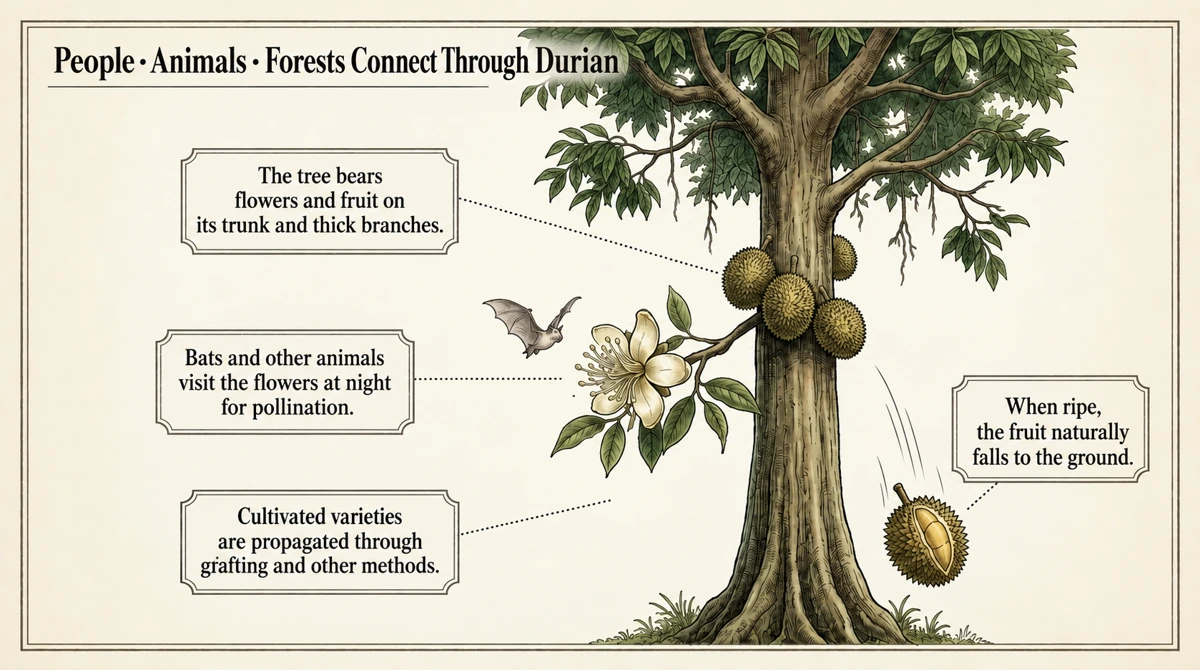
Cultivated varieties are propagated through grafting and other methods, while animals carrying pollen help fruit set. Human cultivation and tropical forest ecosystems have both sustained this fruit.
Durian History: A 15th-Century Account Reaches Europe
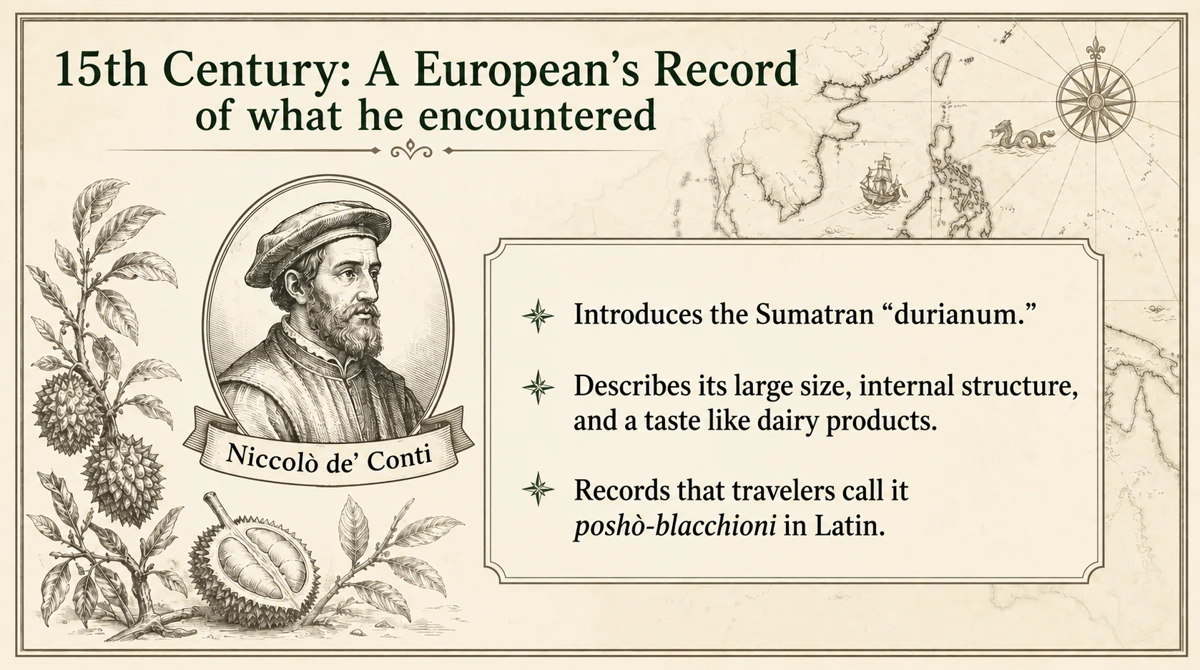
The travels of Venetian merchant Niccolò de’ Conti are among the earliest known accounts that brought news of durian to Europe. After his 15th-century travels in Asia, the humanist Poggio Bracciolini recorded his story in Latin.
The account describes a green fruit known in Sumatra, discussing its size, internal structure and a taste resembling cheese or rich butter. These dairy comparisons convey an impression of dense, rich flesh.
The 15th-century record shows that durian was already known by name in Sumatra and that information about it reached Europe.
Why the “King of Fruits”? Wallace’s Account
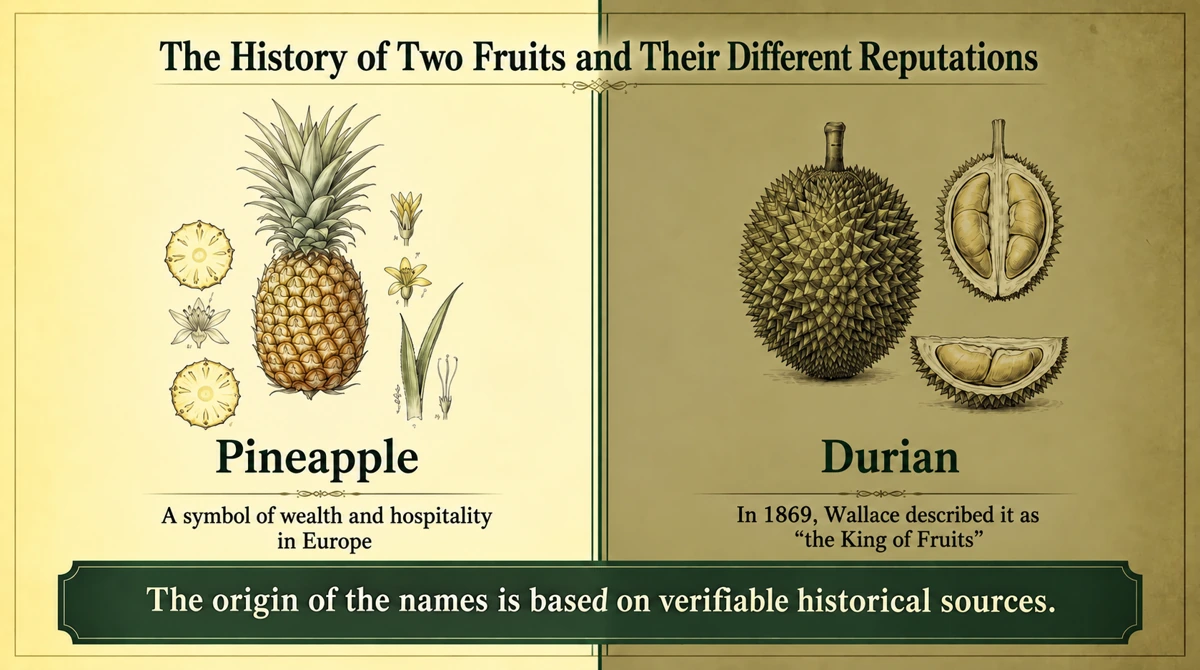
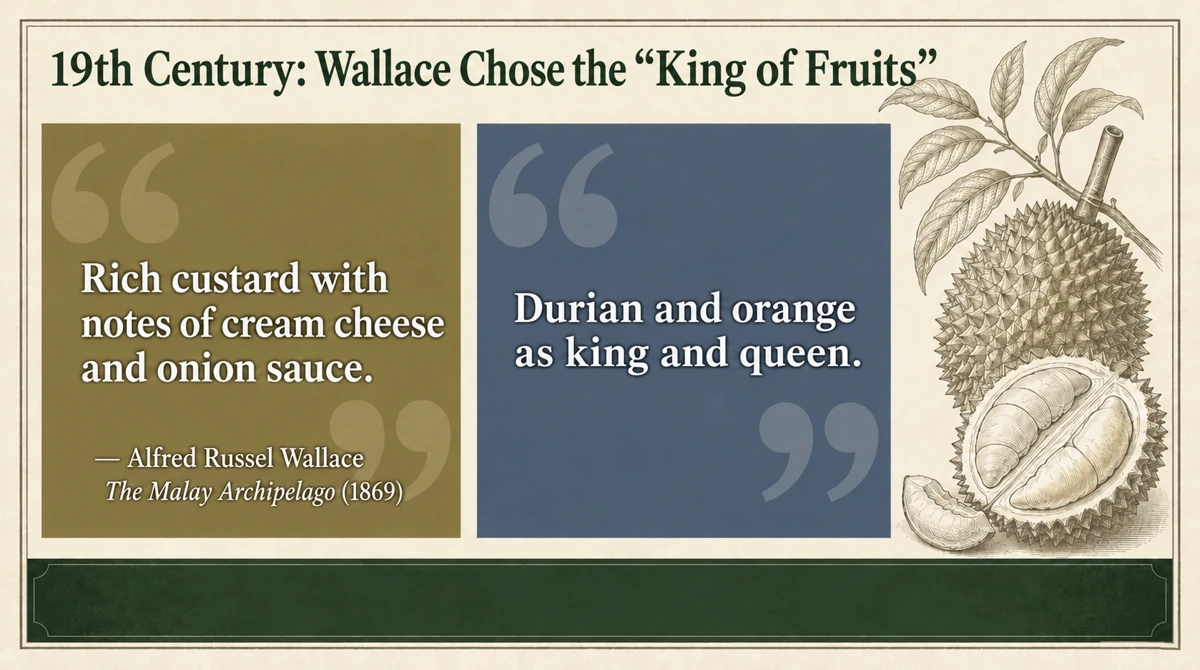
A famous, verifiable source describing durian as a king is Alfred Russel Wallace’s The Malay Archipelago, published in 1869. Wallace explored Southeast Asia between 1854 and 1862. He described the flesh in terms of rich almond-flavored custard with notes of cream cheese and onion sauce, among others.
He praised eating durian as an experience worth a voyage to the East. Choosing two fruits with contrasting qualities, he paired durian and orange as king and queen. The history of today’s familiar “king of fruits” designation can be traced at least as far back as this primary source.
Wallace also noted the danger of ripe fruit falling from tall trees and injuring people. Praise and caution sit together in the same account, a combination well suited to durian.
Colonial Encounters: Aroma as a Cultural Boundary
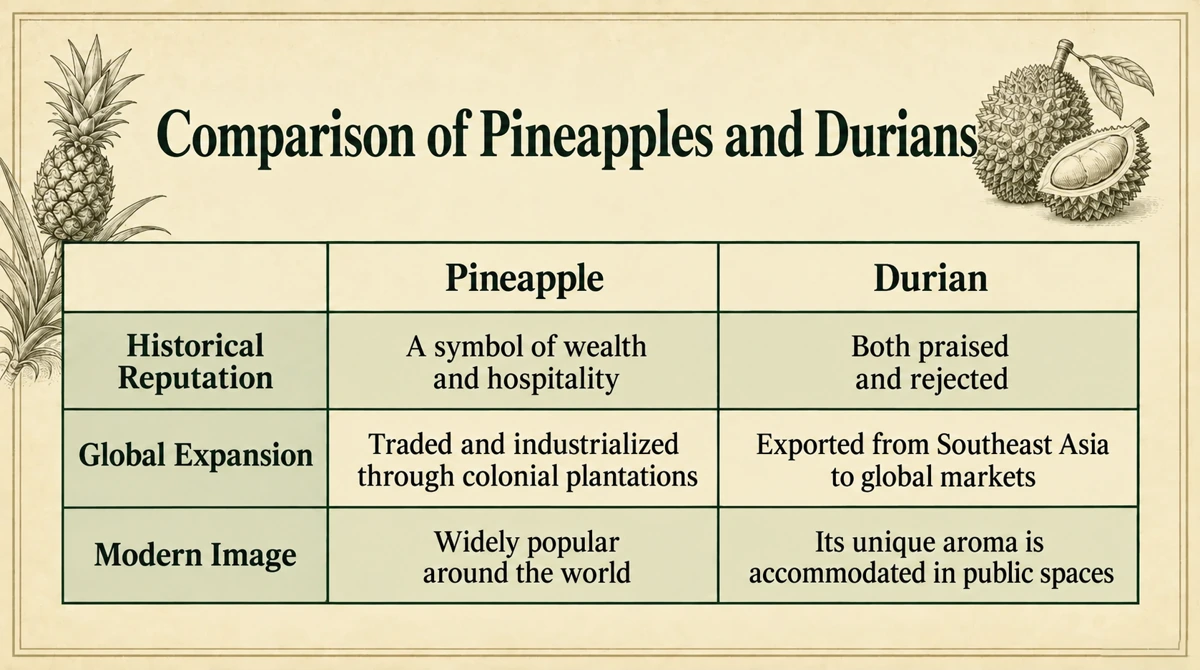
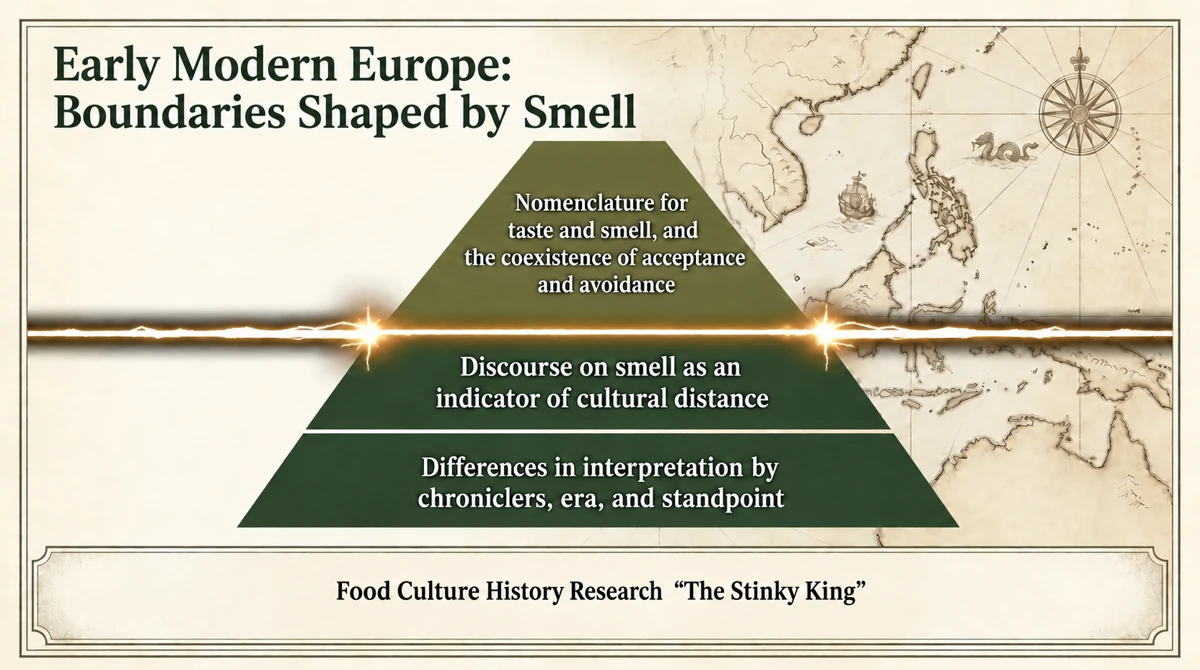
European accounts repeatedly praise the flavor while rejecting the smell. The food-history study The Stinky King examines Western responses in colonial Southeast Asia and argues that reactions to aroma could express distance between colonizers and local society, beyond personal taste.
A writer’s eating habits and social position influence judgments about smell. Reading each account in its historical context helps reveal more than a simple preference or dislike.
Durian in Modern Public Spaces
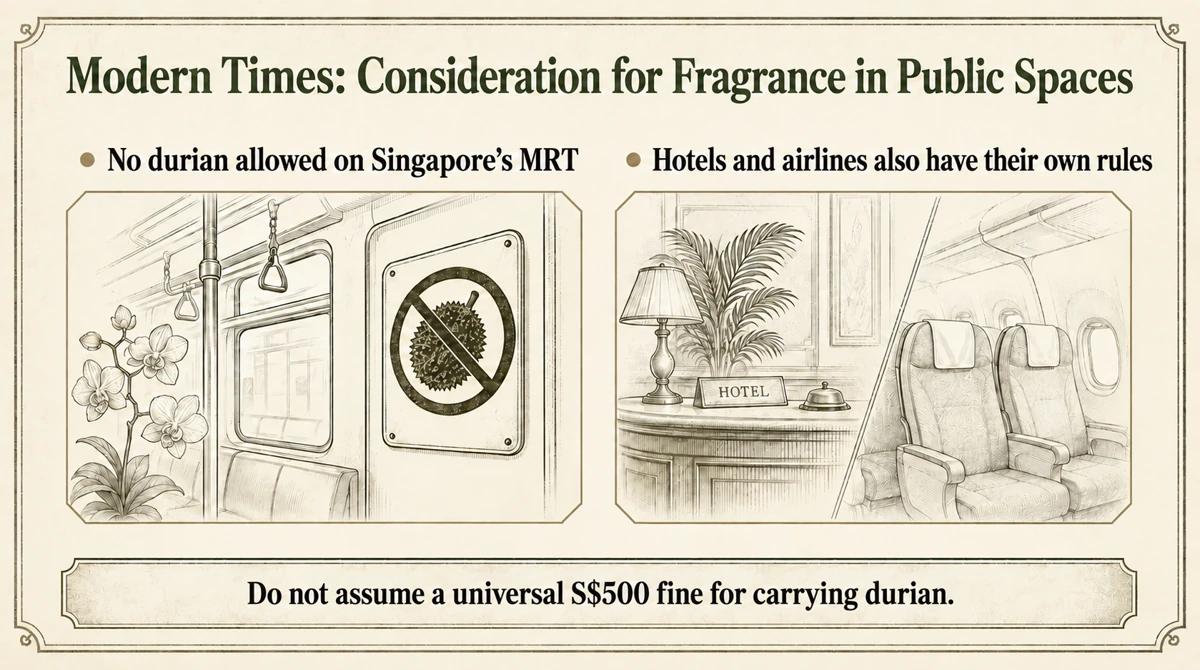
Prohibition signs depicting durian still appear on Singapore’s MRT and in other public transport settings. Check the station or operator’s instructions before carrying it aboard.
In enclosed spaces, a strong aroma can affect other people. Hotels and airlines have their own rules, so check before buying or transporting durian.
The Vietnamese Name: Tragic Love and Folk Etymology
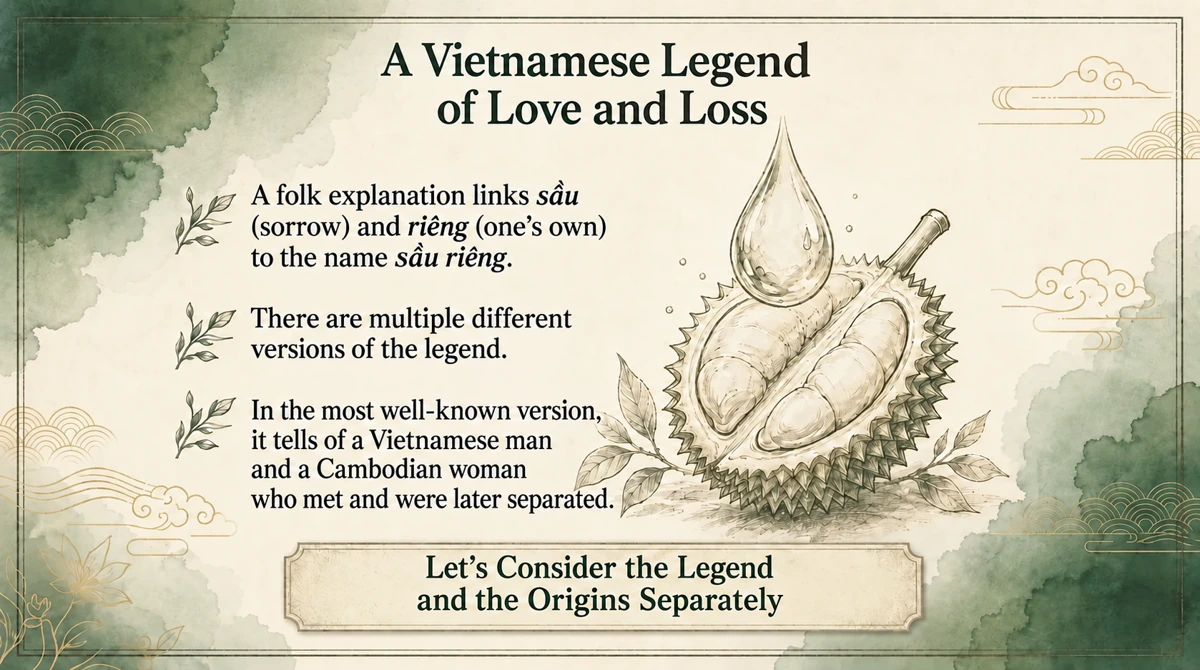
The Vietnamese “Sầu riêng” can be read as “sầu” (sorrow) and “riêng” (one’s own), giving rise to tragic love stories. This is folk etymology; linguistically, the name is thought to be a borrowing from a neighboring language.
There are several versions of the tale. A commonly told version follows a Vietnamese man who travels to Cambodia, his meeting and parting with a local woman, and the fruit called “tu-rên” that he brings home. The sorrowful story reflects people’s imagination as they interpret the fruit’s name through familiar words.
Folklore is not a substitute for historical evidence. It can still be appreciated as an example of a borrowed sound being reinterpreted through a familiar word for sorrow and incorporated into a local story.
Varieties and Growing Regions in Vietnam
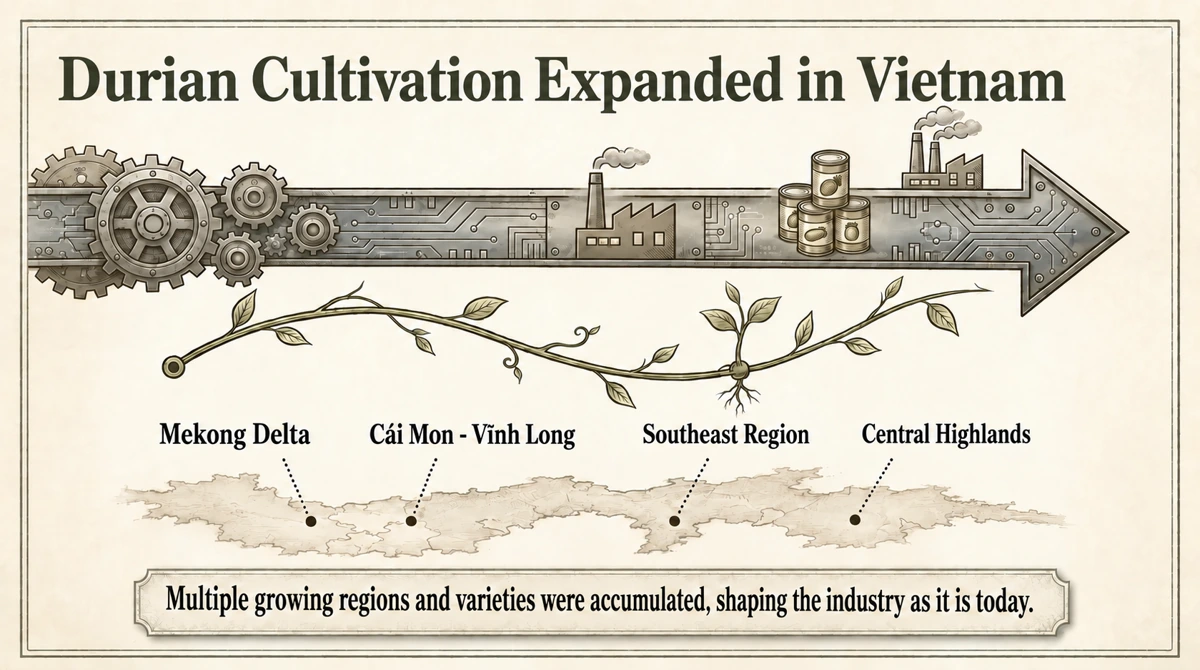
Durian cultivation developed in Vietnam’s Mekong Delta, southeastern region and Central Highlands. Cái Mơn lies in the former Bến Tre province and is now identified with Vĩnh Thành in Vĩnh Long province. Regional fruit growing and trade helped durian spread.
The major variety Ri6 was selected in Vĩnh Long and named after its grower, Sáu Ri. Monthong-type durian is also called Dona in Vietnam. The growth of different varieties and producing regions shaped today’s Vietnamese durian industry.
The Chinese Market: A New Chapter in the 21st Century
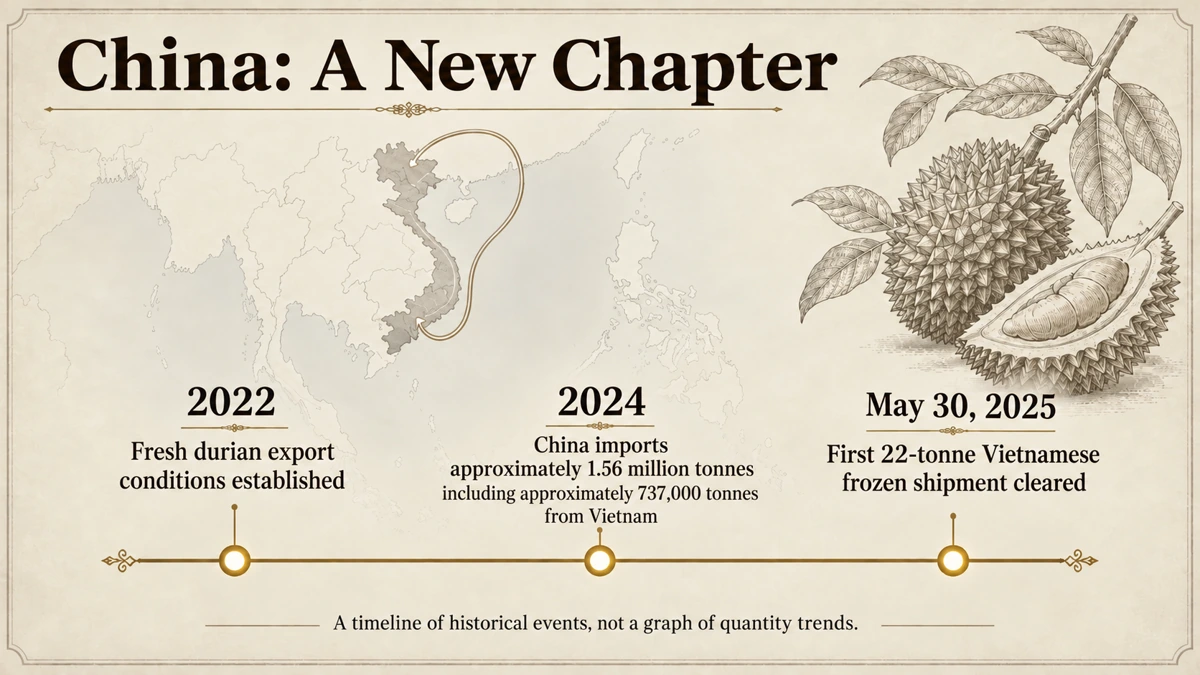
Fresh-durian phytosanitary conditions between Vietnam and China were established in 2022, followed by rapid growth in official exports. Of China’s 1.56 million tonnes of durian imports in 2024, approximately 737,000 tonnes were from Vietnam. These quantities refer to 2024.
Frozen-durian export conditions were agreed in August 2024. According to Vietnam’s Ministry of Agriculture and Environment, the first 22-tonne shipment cleared Chinese customs on May 30, 2025. A fruit once mentioned in a travel narrative has grown into a large cross-border industry.
Durian History and Stories: A Fruit That Divides Opinion
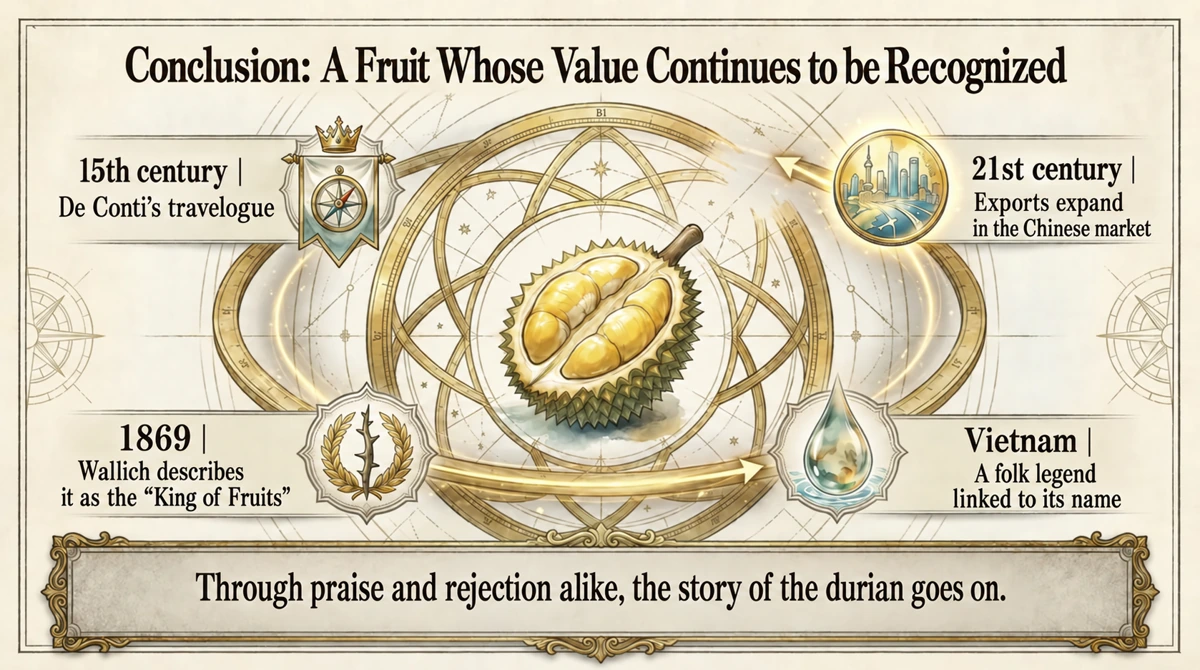
The 15th-century traveler’s account conveyed a dairy-like taste; Wallace praised the fruit as a king in the 19th century. During the colonial period, reactions to its smell reflected cultural boundaries, while today the Chinese market reshapes distribution. Historical records and folklore reveal the many different ways people have seen durian.
Durian has been retold precisely because opinion never settles on a single judgment. The next time you encounter its aroma, consider not only whether you like it, but also the centuries of human responses accumulated around it.
Frequently Asked Questions About Durian History
Why is durian called the king of fruits?
In The Malay Archipelago (1869), Wallace compared durian and orange to a king and queen. It is one of the best-known historical sources documenting the designation “king of fruits.”
Where is durian native?
The Royal Botanic Gardens, Kew lists the native range of Durio zibethinus as Sumatra to Borneo.
Does Sầu riêng mean one’s own sorrow?
That interpretation is well-known Vietnamese folk etymology. The word is thought to have been borrowed from a neighboring language. Its linguistic origin should be distinguished from the tragic love legend.
Further Reading
- Ecology, taste, aroma, nutrition and varieties: Durian Guide
- Prices, choosing, opening and storage: How to Eat Durian in Vietnam
- More fruit to enjoy in Vietnam: 15 Vietnamese Fruits
References
- Royal Botanic Gardens, Kew: Durio zibethinus L.
- Alfred Russel Wallace: The Malay Archipelago (1869)
- The Fruit of Contradiction: Research discussing Niccolò de’ Conti’s account
- Andrea Montanari: The Stinky King: Western Attitudes toward the Durian in Colonial Southeast Asia
- Thanh Niên: Lắt léo chữ nghĩa: Vì sao gọi là sầu riêng?
- Vietnam Ministry of Agriculture and Environment: Frozen durian exports: A breakthrough
- Vietnam Ministry of Industry and Trade: Agricultural, Forestry and Fishery Market Report (January 31, 2025)
- Singapore Statutes Online: Rapid Transit Systems Regulations
- Vĩnh Long Tourism: Cái Mơn (2026)
- Vĩnh Long Tourism: Sầu riêng Ri 6
