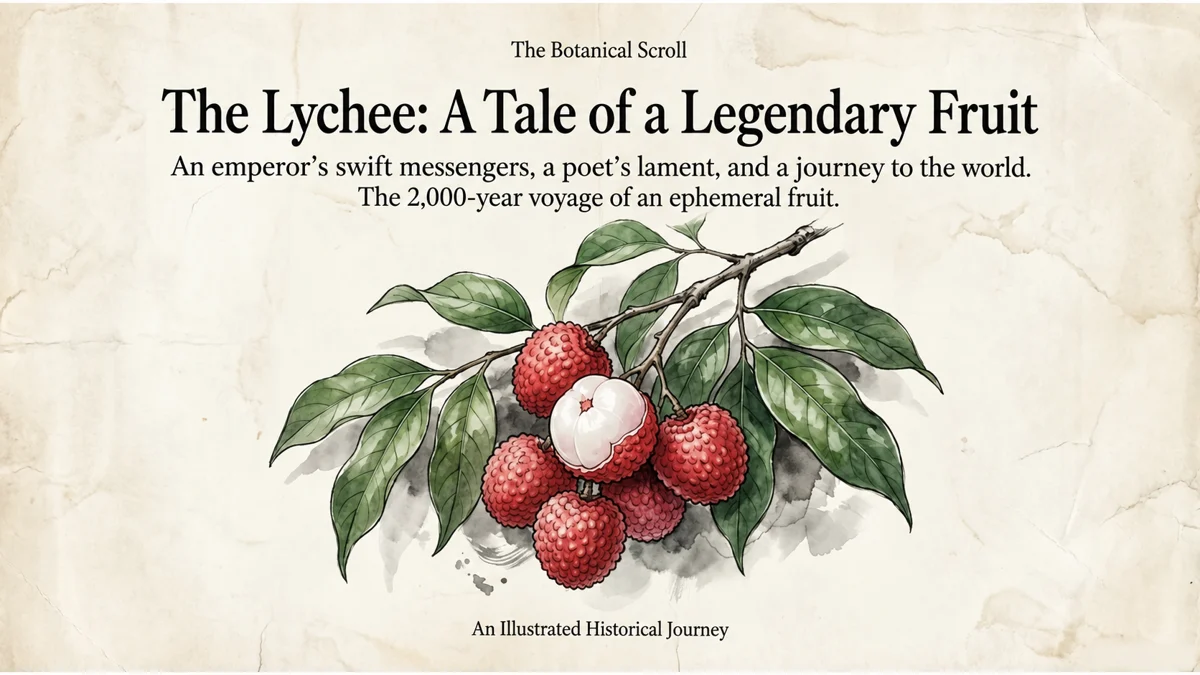
At the end of the imperial courier’s road was a fragile fruit.
Lychee is native to regions including southern China and northern Vietnam and has been cultivated in southern China for at least 2,000 years. Stories associate it with Yang Guifei of the Tang court, and the writings of Bai Juyi and Su Shi.
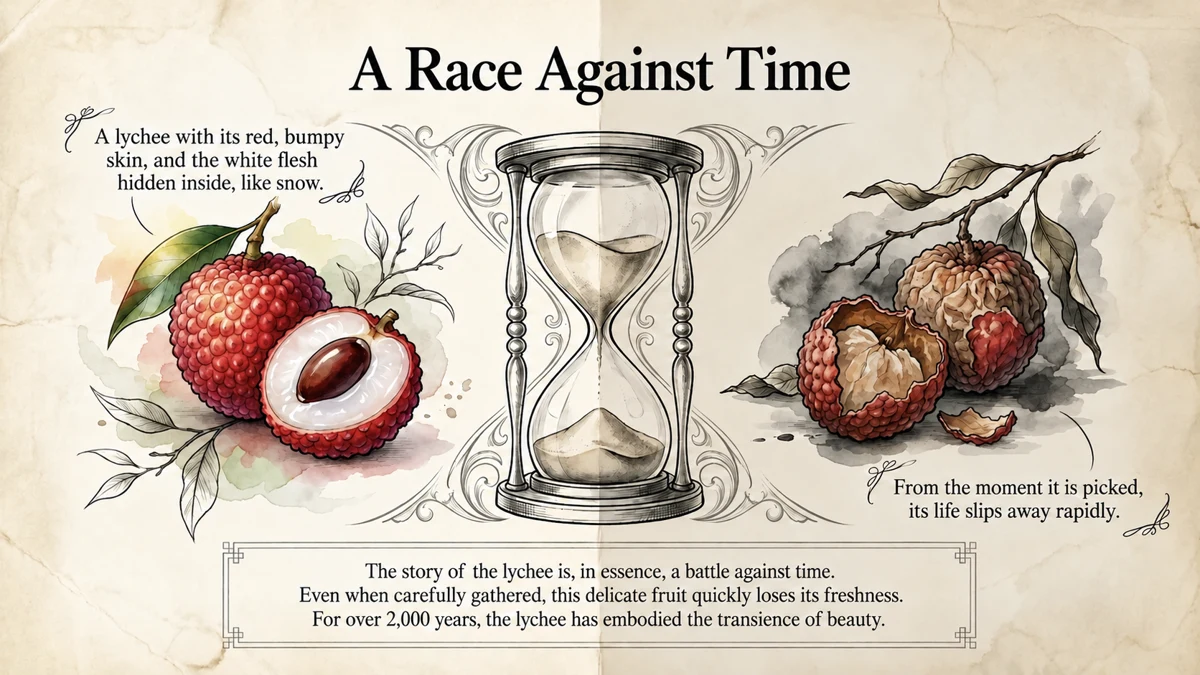
Inside the red, bumpy rind is translucent white flesh. Once picked, the fruit begins losing moisture and quality, with changes in color, aroma and flavor.
Compared with pineapple, lychee is particularly vulnerable after harvest. Its history repeatedly turns on the difficulty of delivering fruit while it is still fresh.
This article follows imperial anecdotes, poets’ accounts, cultivation in India and Taiwan, and Vietnam’s growing regions. For taste, season, nutrients and cultivars, see Lychee Guide. For buying and peeling, see How to Eat Lychee in Vietnam.
Lychee’s Origins: Southern China and Northern Vietnam
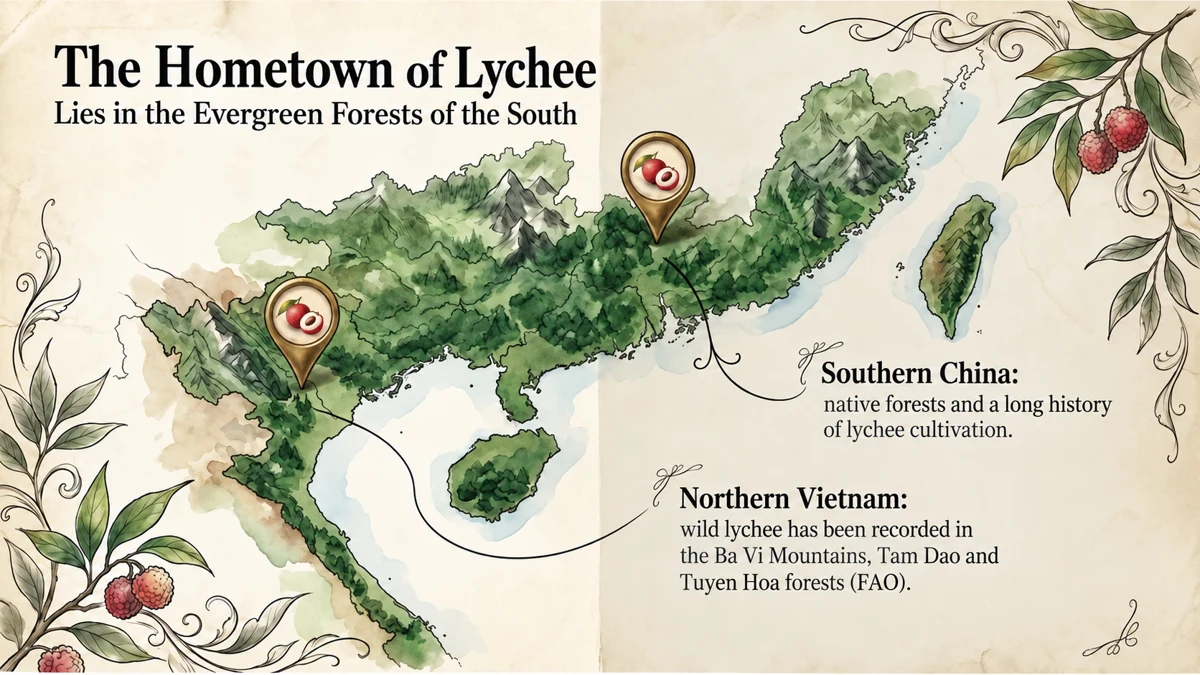
Southern China, including Guangdong, Guangxi, Fujian and Hainan, has a long association with lychee cultivation and native forests.
FAO also identifies northern Vietnam as part of its native range, with wild trees reported in the Ba Vi Mountains and the forests of Tam Dao and Tuyen Hoa. These records connect the fruit with local forests, rather than only with imported orchards.
Accounts of Vietnamese rulers sending lychees to a Chinese emperor should be treated as reported traditions, rather than proof of a particular historical shipment. Native trees nevertheless establish a long botanical connection with the region.
Emperor Wu of Han and the Fuli Palace
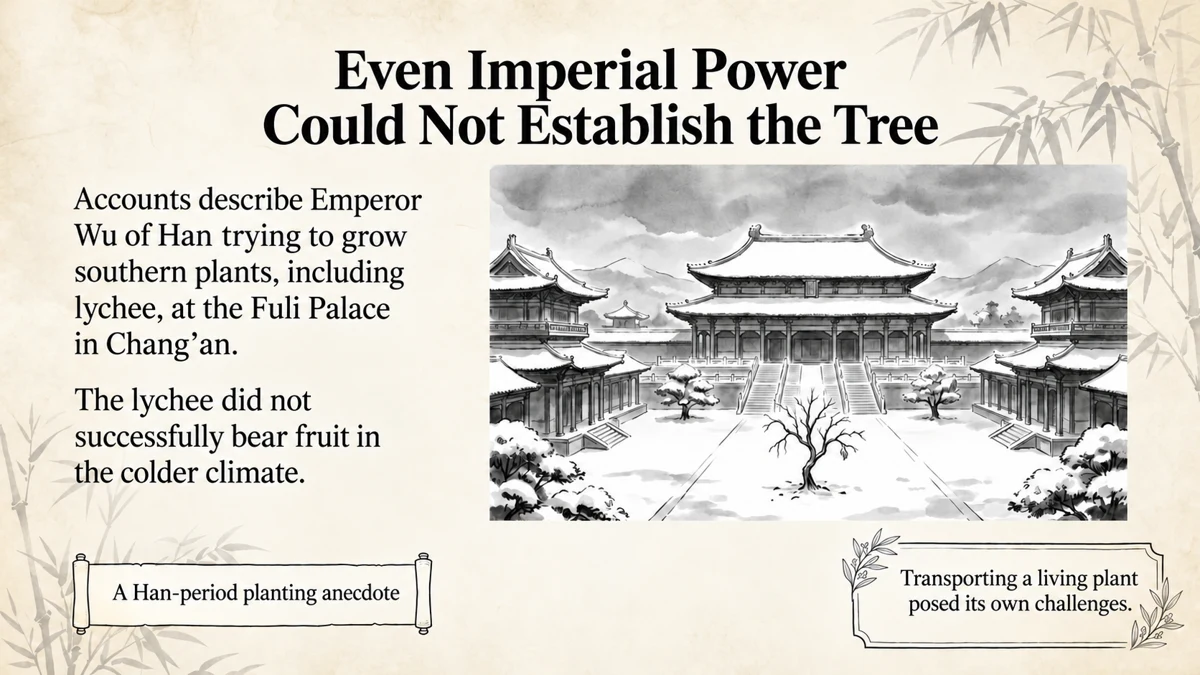
After Emperor Wu of Han’s southern campaigns around 111 BCE, accounts describe his effort to grow southern plants at the Fuli Palace in the imperial gardens at Chang’an.
Lychee is sensitive to cold. The story describes repeated attempts to transport and establish trees that did not successfully bear fruit in Chang’an’s colder climate.
The episode is an imperial anecdote about the limits of transporting a living plant. Its details should not be confused with a modern cultivation trial.
Yang Guifei and the Legend of Swift Lychee Deliveries
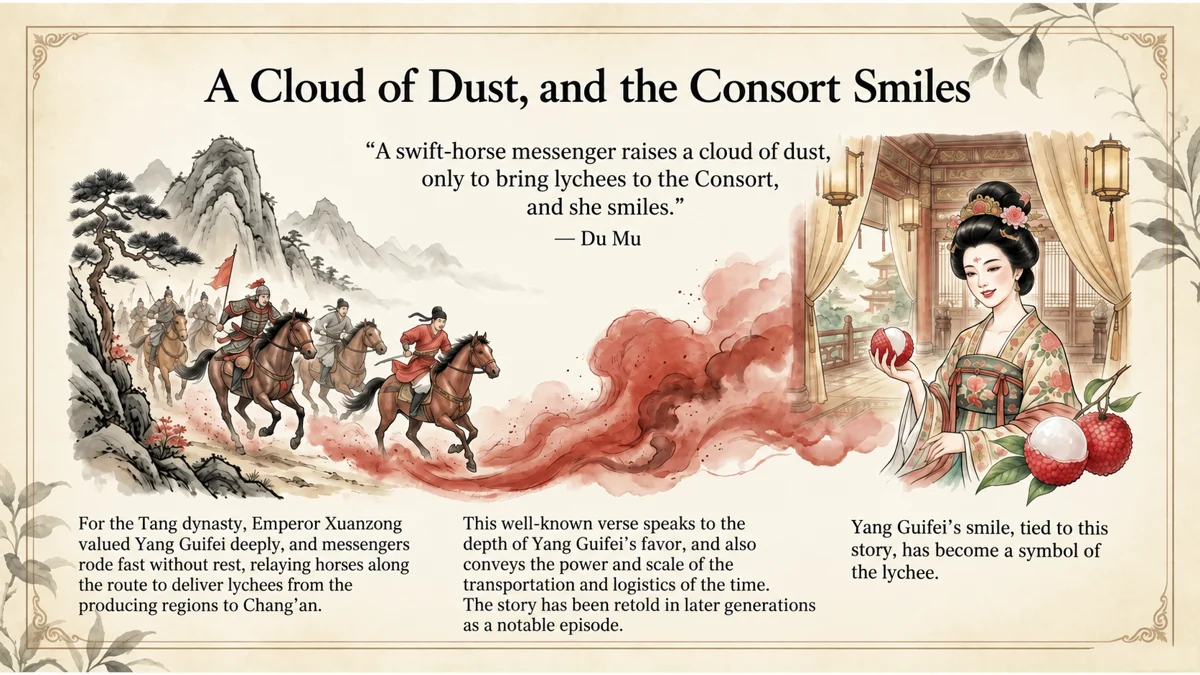
The best-known lychee story belongs to the Tang period.
Yang Guifei, a consort of Emperor Xuanzong, was said to love lychees. Couriers reportedly relayed fresh fruit to Chang’an for her. Du Mu later used the story in a poem.
In paraphrase, Du Mu describes a rider raising red dust and making the consort smile, while onlookers do not know that lychees have arrived.
Behind the luxurious image lies a demanding supply system. Accounts of tribute deliveries describe couriers traveling day and night at severe cost to people and horses. Du Mu’s poem is often read as criticism of court extravagance.
The exact growing region and route remain debated. Lingnan and the Fuzhou area of Sichuan appear in competing explanations. Later poetry and historical accounts should not be treated as a fully documented delivery itinerary.
The popular cultivar name Feizixiao, meaning the consort’s smile, is associated with this story. See Lychee Guide for cultivar names.
Bai Juyi’s Record of Lychee’s Short-Lived Freshness
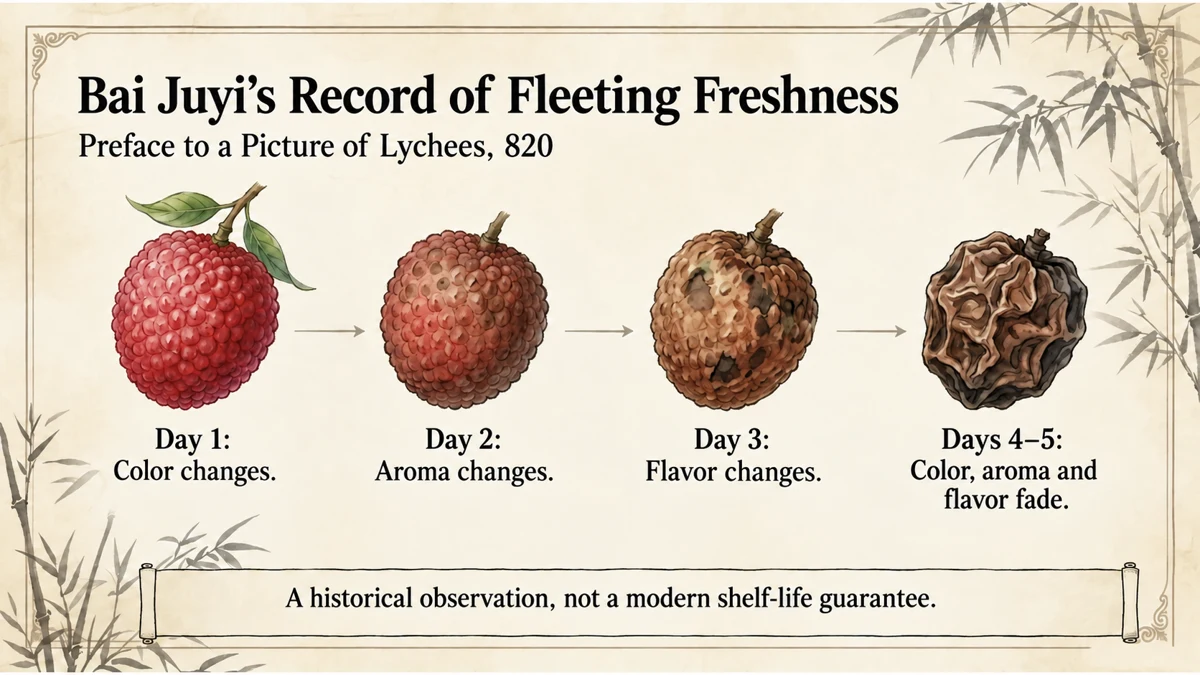
Decades later, Bai Juyi served in Zhongzhou, near present-day Chongqing. He commissioned an illustration of lychee and wrote the short text commonly called Preface to a Picture of Lychees.
In paraphrase, he describes color changing after a day, aroma after two days and taste after three; after four or five days, all three qualities have largely disappeared.
The text dates to 820. It is the source of the familiar day-by-day description discussed in Lychee Guide. It is a historical observation, not a universal modern storage timetable.
For readers in the north who had never seen lychee, the picture and prose conveyed something of the fruit’s appearance and fleeting freshness. This is an interpretation of the work’s purpose.
Su Shi’s Poem About Three Hundred Lychees
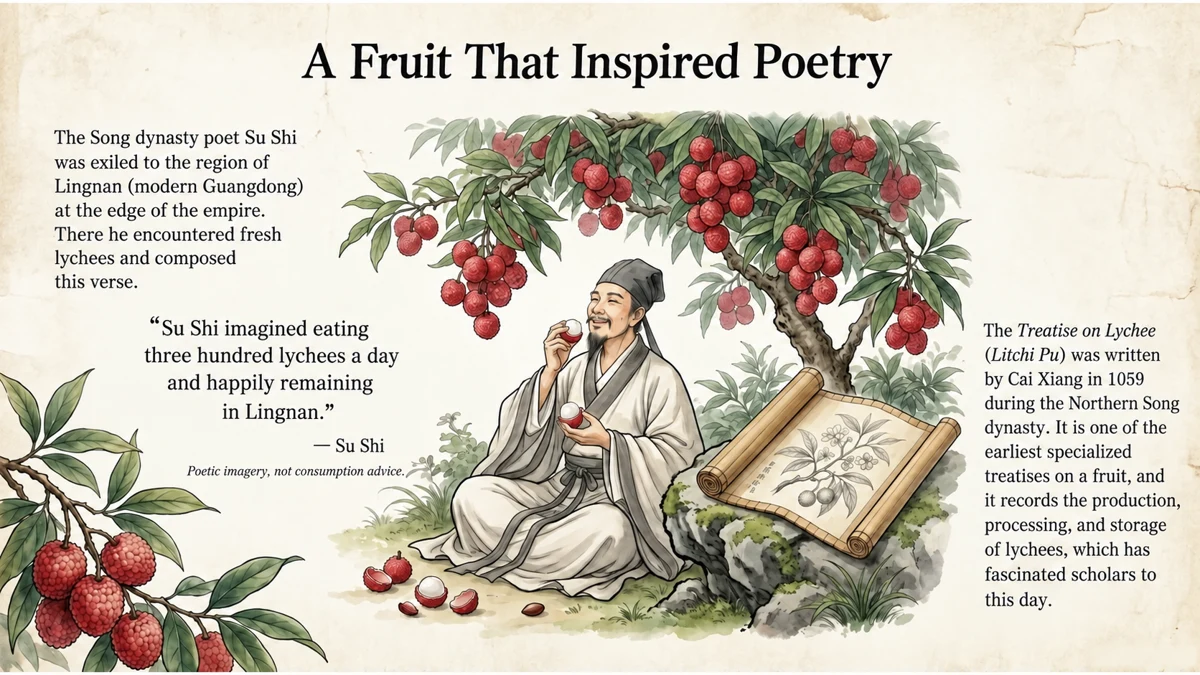
During the Song period, Su Shi was demoted to Huizhou in Lingnan, far from the political center.
After tasting local lychees, he wrote a poem celebrating the region.
In paraphrase, the poem presents springlike surroundings and seasonal fruit, then imagines eating three hundred lychees a day and happily remaining in Lingnan.
The extravagant number belongs to poetry. It is not advice about how much fruit to eat. The verse became a lasting association between lychee and the region.
Cai Xiang’s 1059 Treatise on Lychee described growing regions, cultivars, cultivation, processing and storage. It is an early specialized fruit treatise, without needing to claim an uncontested world-first status.
How Lychee Cultivation Spread Around the World
Despite this long history of appreciation, lychee cultivation spread relatively slowly around the world.
Sources differ on its arrival in India. FAO’s historical account gives both a late-seventeenth-century introduction and a date of 1789 via Myanmar in different passages. These should be presented as differing accounts rather than one certain year.
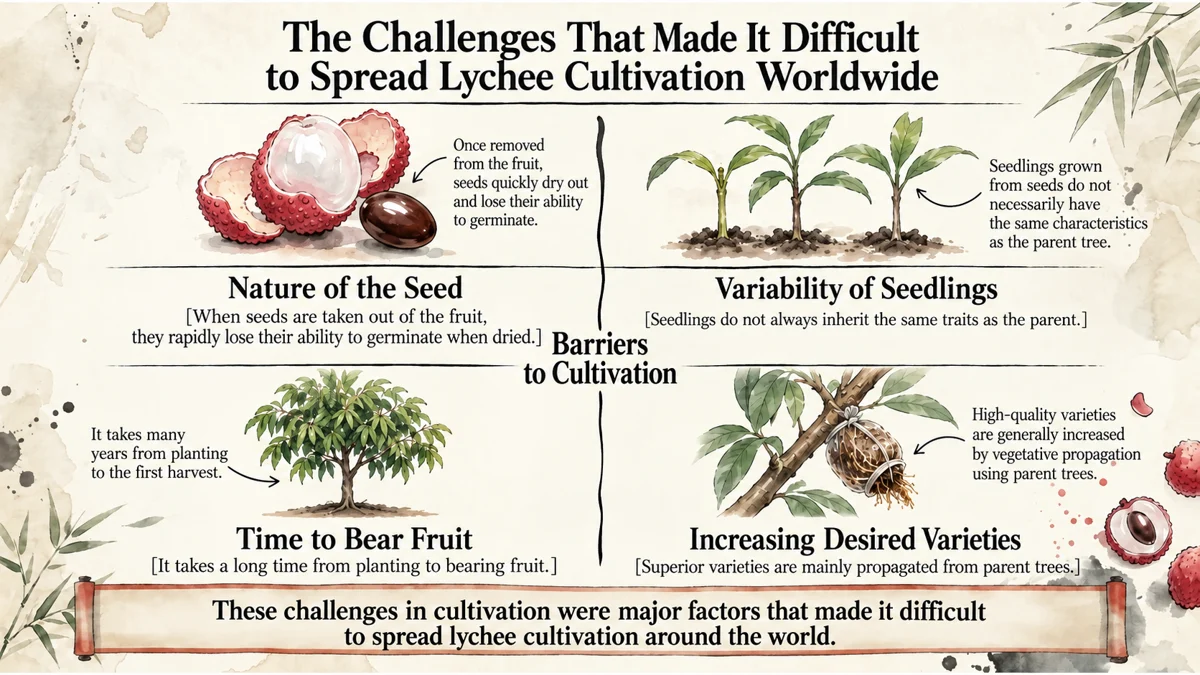
FAO identifies short seed life and unreliable cropping in some climates as obstacles. Extracted seeds quickly lose viability when dry, and seedling trees do not reliably reproduce a valued cultivar. Air layering provides a way to propagate selected trees.
Historical accounts place introductions to Réunion in 1764, Hawaii in 1873 and Florida in the 1880s. These dates describe reported introductions, not the entire history of local cultivation.
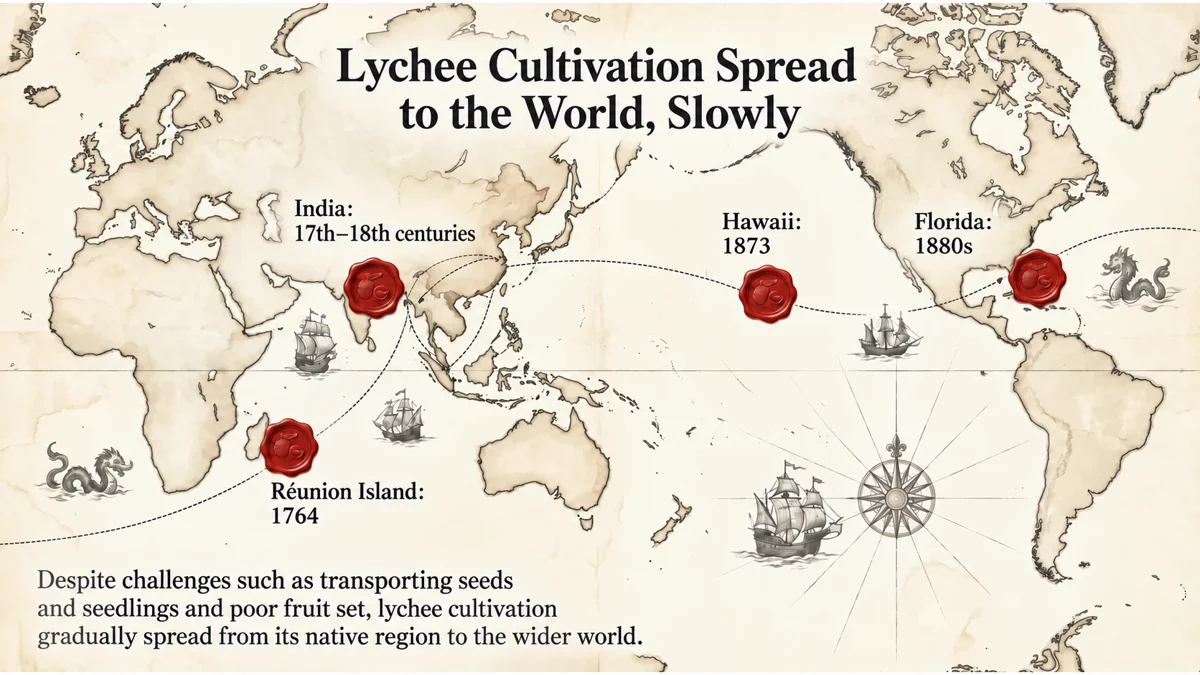
Even where trees became established, distant delivery of fresh fruit required better handling and temperature control. Establishing an orchard and preserving harvested fruit posed separate challenges.
Taiwan’s Summer Lychee: Yuhebao
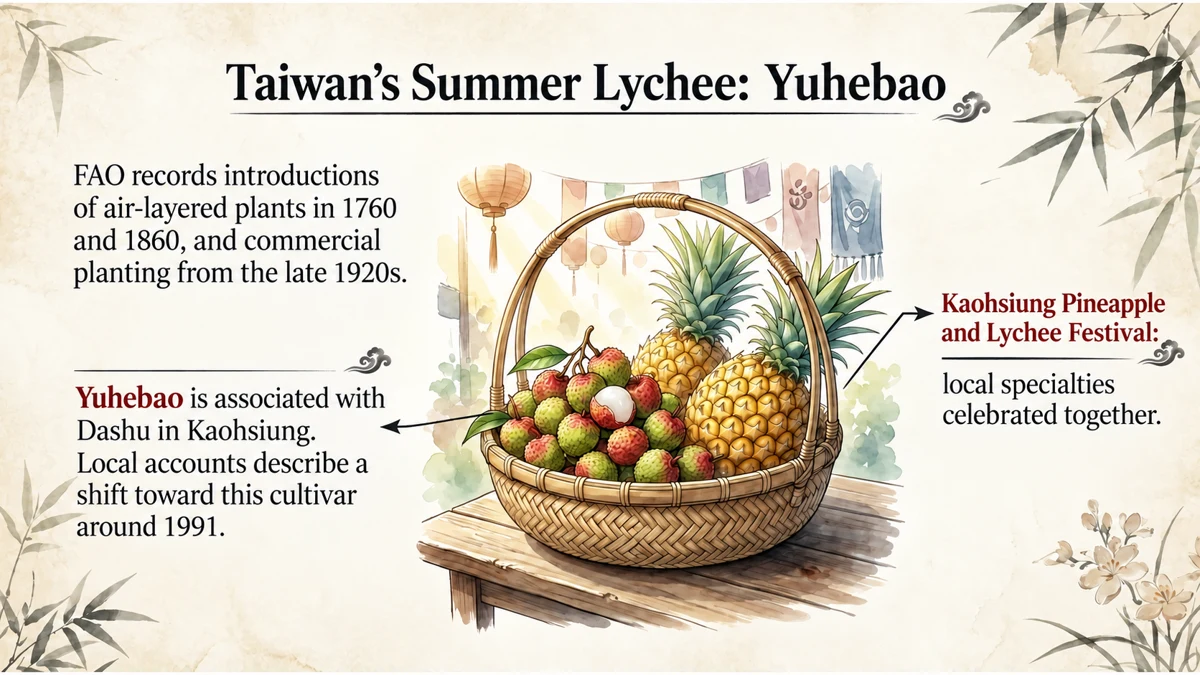
FAO records air-layered plants reaching Taiwan in 1760 and again in 1860, with commercial planting in southern areas beginning in the late 1920s. Dashu in Kaohsiung is a well-known modern growing area.
Dashu became associated with Yuhebao lychee as local cultivation shifted from other varieties. Local accounts connect this development with policies around 1991. An undated share of production should not be read as a current statistic.
Kaohsiung’s pineapple and lychee festival celebrates Yuhebao lychee alongside local pineapple. The two fruits meet as regional specialties.
India’s Shahi Litchi and GI Protection
Muzaffarpur in Bihar is an important Indian lychee-growing region. Shahi litchi is known for sweet, aromatic fruit; its name carries a royal association.
The name alone does not establish a direct connection with Mughal history. Shahi Litchi of Bihar received Indian geographical indication registration in 2018.
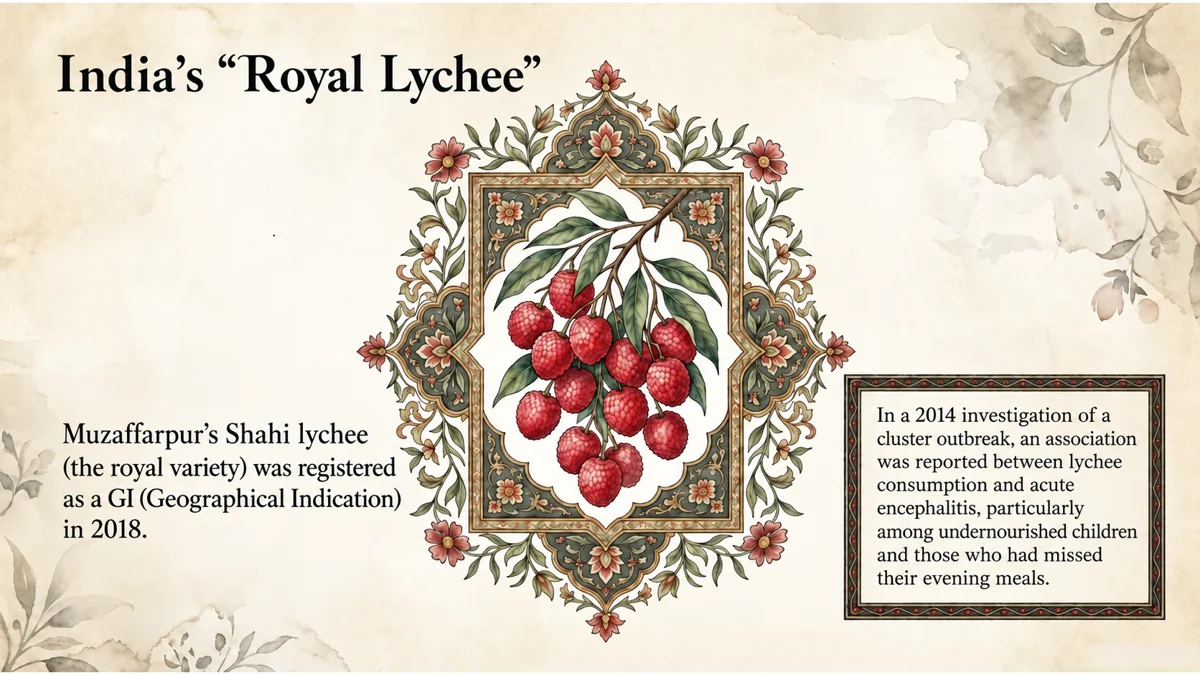
The area is also associated with a serious 2014 childhood encephalopathy outbreak. The case-control study linked illness with lychee consumption and missing the previous evening meal. This is especially relevant to undernourished children and should not be generalized into the same risk for every ordinary adult portion.
The Lychees of Chang’an: A Novel and Its 2025 Adaptations
The old story of imperial deliveries has also inspired modern fiction.
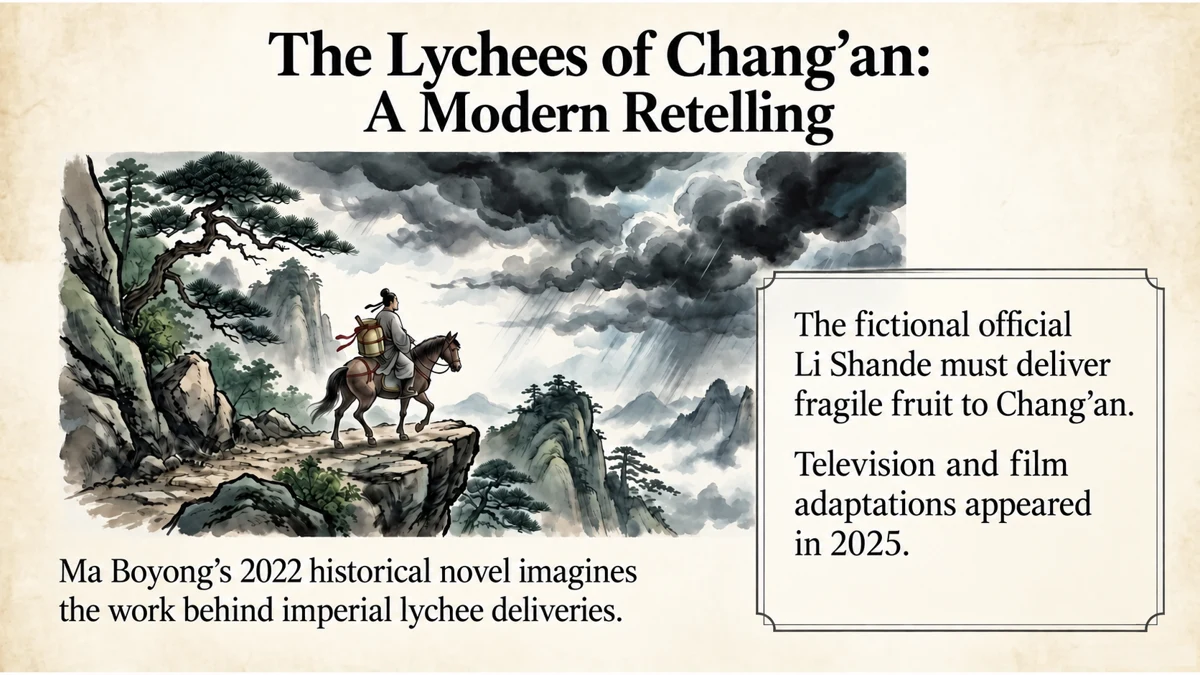
Ma Boyong’s 2022 novel The Lychees of Chang’an imagines the official Li Shande attempting to deliver fragile fruit from Lingnan to the Tang capital. It explores the labor behind a luxurious court demand, as historical fiction.
Television and film adaptations appeared in 2025. These works dramatize the story rather than provide documentary evidence for the exact events of the Tang period.
Vietnam: Native Forests and Modern Growing Regions
Chinese court and literary records dominate many lychee stories. Vietnam adds a connection with native forests as well as contemporary agriculture.
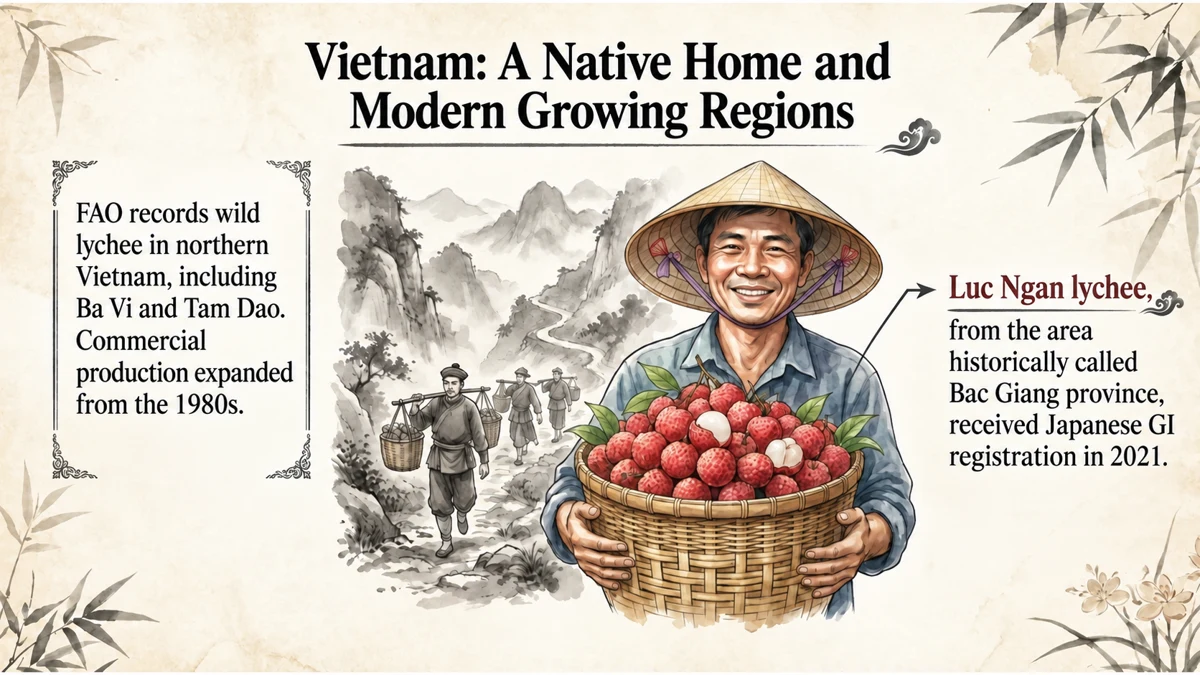
Northern Vietnam lies within the native range described by FAO. Unlike an introduced crop, lychee has a botanical connection with the region’s forests. Reported tribute traditions add cultural context, without establishing a precise delivery date.
FAO describes expansion of commercial Vietnamese production from the 1980s. Luc Ngan lychee later received registration under Japan’s GI system in 2021. The area’s historical province name, Bac Giang, is retained where referring to those records. See Lychee Guide for production and GI details.
Lychee Biology: The White Edible Aril
Before closing the story, return briefly to the living plant.
Lychee is an evergreen member of the soapberry family, related to rambutan and longan. Its sweet white edible part is an aril around the seed. Moisture loss causes rind browning after harvest; cool, humid handling helps retain quality.
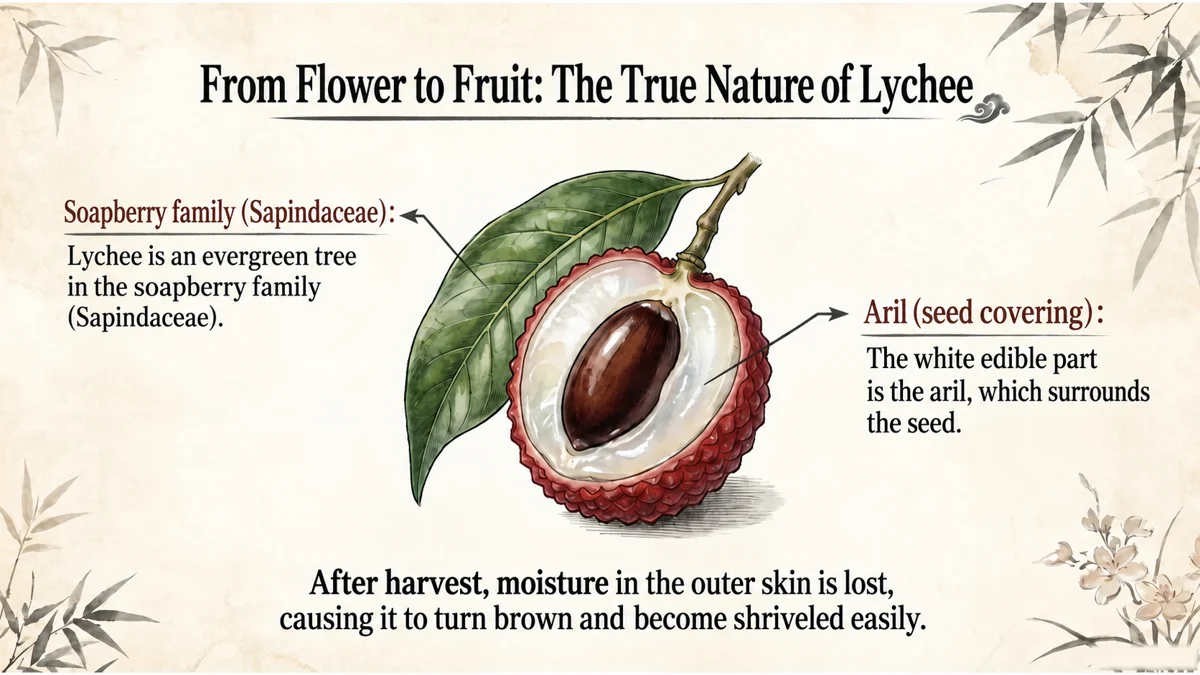
The fragility Bai Juyi described has a botanical basis. See Lychee Guide for biology and varieties.
Fragility as Part of the Story
From southern forests to Han imperial gardens, from Tang couriers to Song poems, then to Taiwan’s festivals, India’s growing regions and modern screens, the fruit accumulated different regional meanings.
Its movement was constrained by short-lived seeds, the transport of living plants, unreliable cropping and the handling of fresh fruit. These factors together help explain its slow commercialization outside established growing regions.
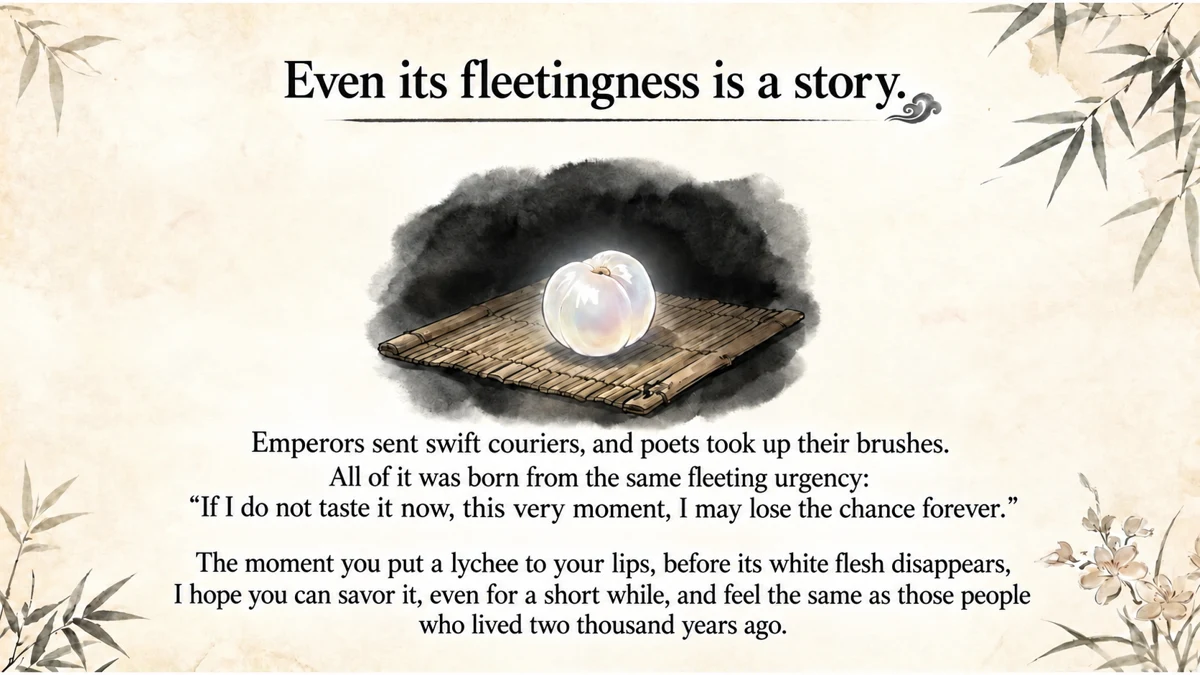
Its short-lived freshness may also help explain its literary appeal: a delicacy that must arrive and be enjoyed before it changes.
When you next peel a lychee, enjoy its fresh, juicy aril while it is at its best. The effort to preserve that brief pleasure is a recurring theme in its history.
Frequently Asked Questions About Lychee History
Where is lychee native?
FAO describes an area including southern China, northern Vietnam and the Malay Peninsula, and records wild trees in northern Vietnam.
Did Yang Guifei really love lychees?
The story is well known through Du Mu’s poetry and later accounts. The growing region and route have competing explanations, so the details remain uncertain.
How long has lychee been cultivated?
Records and historical accounts associate it with cultivation and tribute in southern China for at least 2,000 years.
Why did lychee cultivation spread slowly?
Short seed life, variable seedling traits, slow bearing and the transport and propagation of living plants all posed obstacles.
Related Articles
- Taste, season, nutrition, cultivars and growing regions: Lychee Guide
- Choosing, peeling, prices and storage: How to Eat Lychee in Vietnam
- More fruit to enjoy in Vietnam: 15 Vietnamese Fruits
References
- FAO: Lychee cultivation and history
- www.atuwen.com — original source referenced by the Japanese manuscript
- www.ourchinastory.com — original source referenced by the Japanese manuscript
- ppfocus.com — original source referenced by the Japanese manuscript
- Classical Chinese literary text (in Chinese)
- Classical Chinese literary text (in Chinese)
- m.fznews.com.cn — original source referenced by the Japanese manuscript
- www.etvbharat.com — original source referenced by the Japanese manuscript
- www.avocadosource.com — original source referenced by the Japanese manuscript
- India GI registry: Shahi Litchi of Bihar
- www.agriharvest.tw — original source referenced by the Japanese manuscript
- dashu.kcg.gov.tw — original source referenced by the Japanese manuscript
- www.chinafilm.gov.cn — original source referenced by the Japanese manuscript; www.chinadaily.com.cn — original source referenced by the Japanese manuscript
- saigoneer.com — original source referenced by the Japanese manuscript
- For the corresponding background sources, see Lychee Guide and Lychee History and Stories.
- 2014 Muzaffarpur encephalopathy case-control study
- FAO: Lychee cultivation and history
- University of Hawaii: The Litchi in Hawaii
- UC Davis: Lychee postharvest handling
FAO: Lychee Production in China — cultivar names
FAO: Lychee origins and historical introductions
Vietnam Government: 2025 provincial administrative changes (in Vietnamese)
