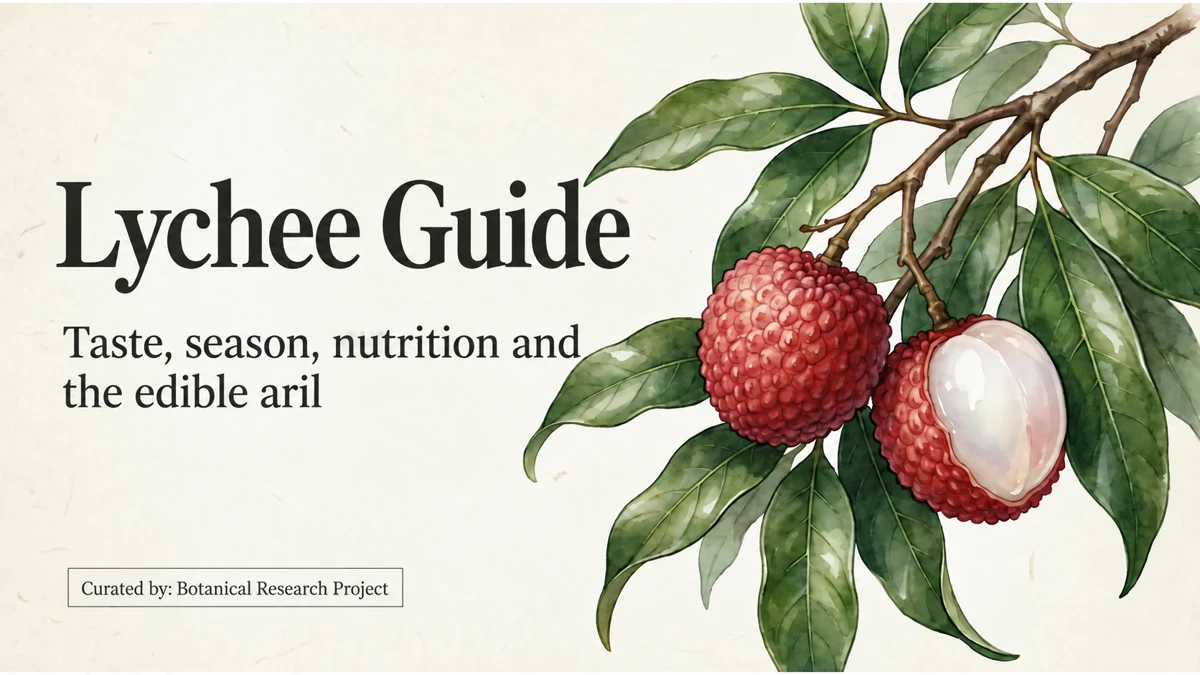
Lychee is a fruit in the soapberry family, with rich sweetness, a floral aroma and springy, juicy flesh. Its main season is roughly May–July in Vietnam and June–July for Japanese-grown fruit.
Lychee is an evergreen tree in the soapberry family. Its white edible part is an aril surrounding the seed, rather than tissue derived from the fruit wall. This guide explains its biology, origins, varieties and Vietnamese growing regions. For choosing and peeling, see How to Eat Lychee in Vietnam.
What Is Lychee? Taste, Season and Basic Facts
| Item | Details |
|---|---|
| Name | Lychee / Litchi |
| Scientific name | Litchi chinensis Sonn. |
| Classification | Evergreen tree, family Sapindaceae, genus Litchi; related to rambutan and longan |
| Native range | Southern China, northern Vietnam and the Malay Peninsula, as described by FAO |
| Tree height | About 10–15 m |
| Japanese season | Usually June–July; small domestic crop, with frozen and canned products available year-round |
| Vietnamese season | Usually May–July; main harvest varies by region and cultivar |
| Main nutrients | Vitamin C, folate and potassium |
Sources are listed at the end of the article.
Lychee Biology: The White Edible Aril
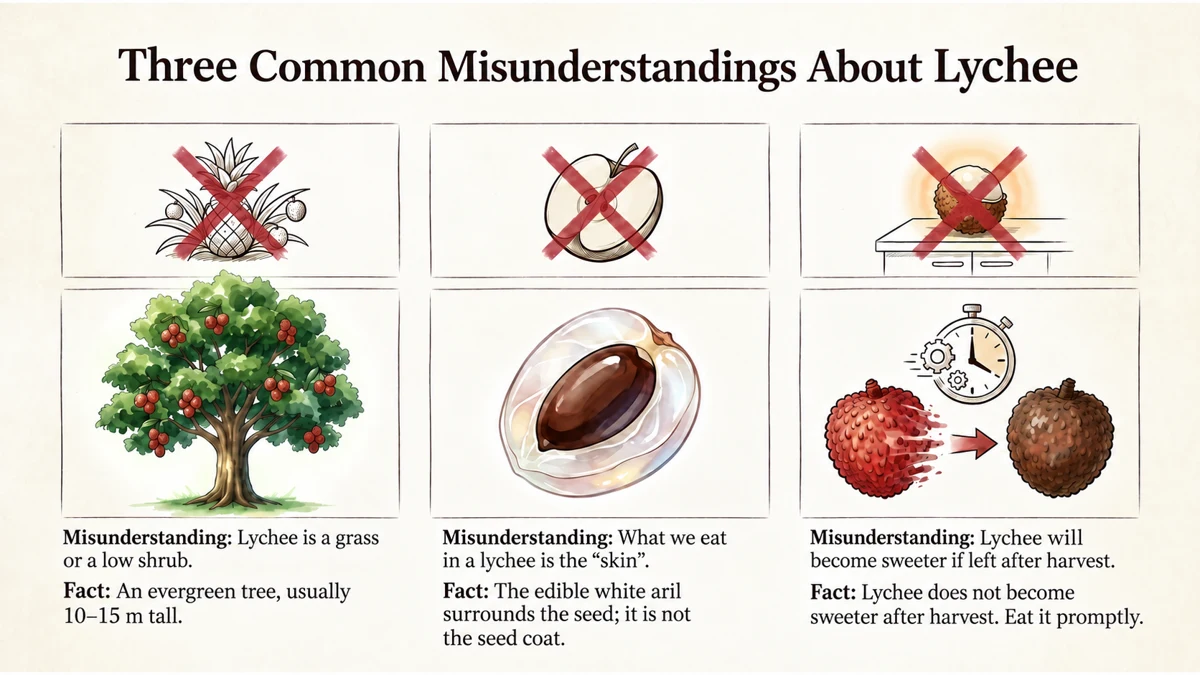
Lychee grows on an evergreen tree that can reach about 10–15 m, unlike the herbaceous pineapple. FAO describes an area including southern China, northern Vietnam and the Malay Peninsula as its native range. Its scientific name is Litchi chinensis.
Rambutan and longan, also familiar in Vietnam, belong to the same family. Their edible parts share some similarities in appearance and texture.
The White Edible Part Is an Aril, Not the Seed Coat
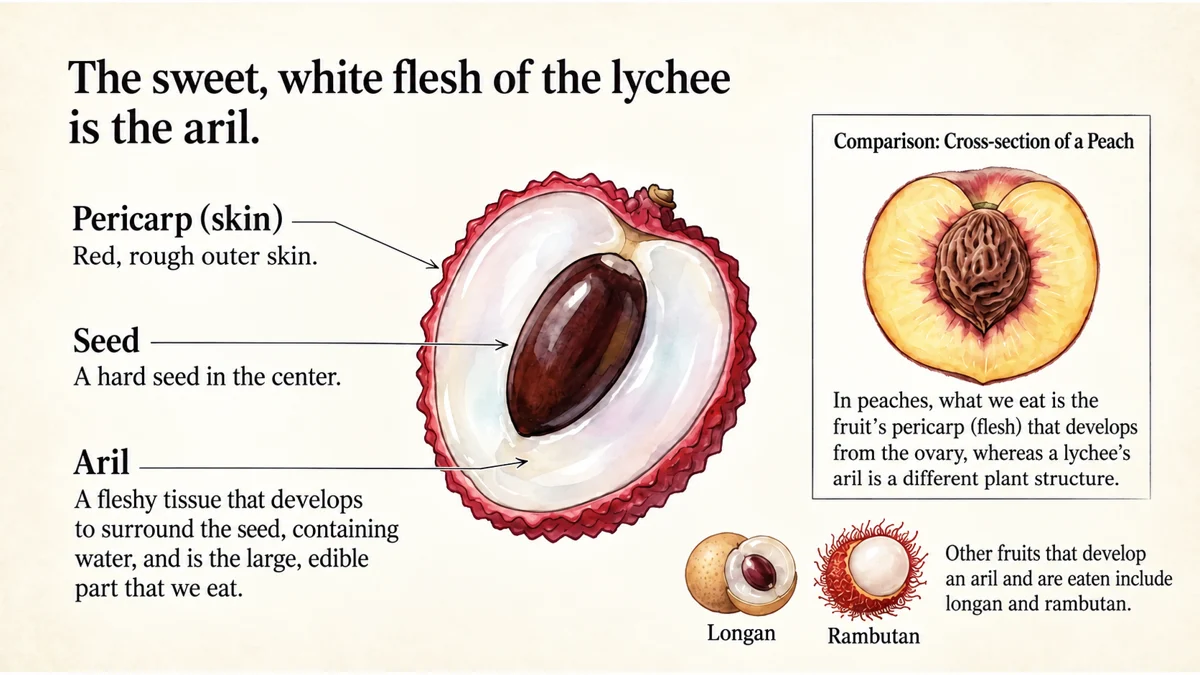
Peeling the red, bumpy rind reveals translucent white flesh. Although usually called flesh in everyday language, it has a more specific botanical name.
It is an aril: additional tissue that develops around the seed. It is distinct from the seed coat itself. Longan and rambutan also have edible arils.
In a peach, the edible tissue develops from the fruit wall, specifically the mesocarp. The everyday word “flesh” therefore covers tissues with different botanical origins.
Thousands of Flowers, Relatively Few Fruits
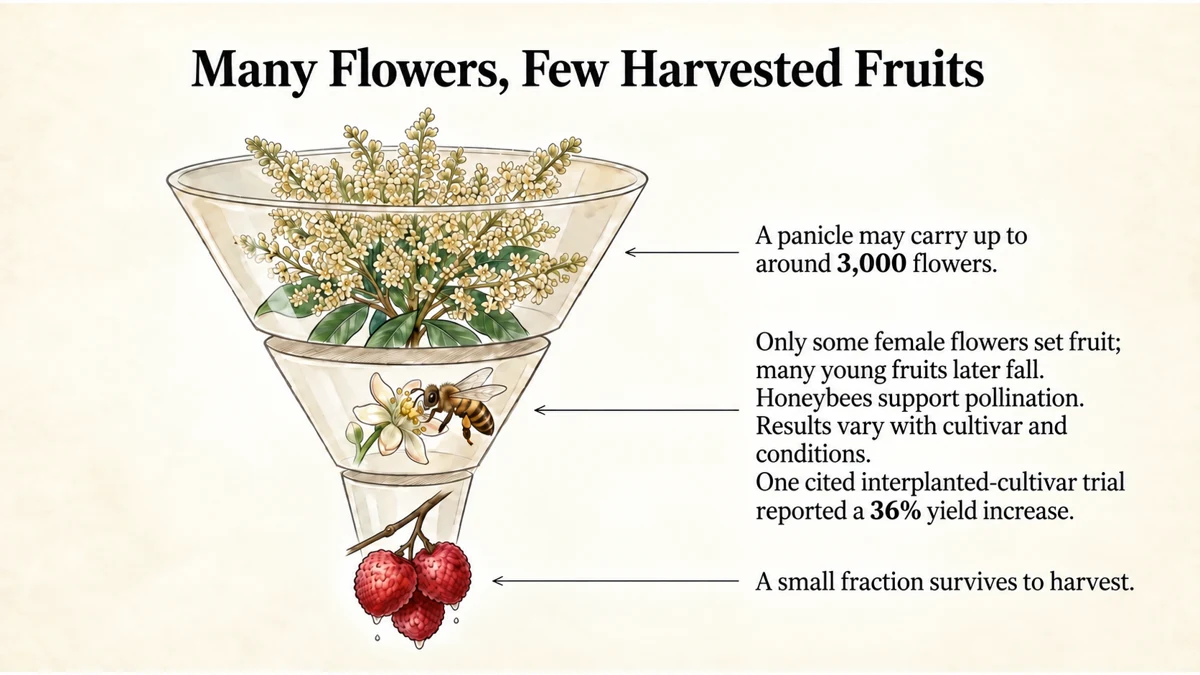
A lychee panicle can bear hundreds to around 3,000 flowers. Only a fraction set fruit, and many young fruit fall before harvest. The source reports about 2–20% fruit set among female flowers and roughly 1–7% retention to harvest; the denominator and growing conditions matter.
Honeybees are important pollinators. Particular trials reported roughly threefold fruit set with bee visits compared with bagged panicles and a 36% yield increase in an interplanted cultivar trial. These are individual research results, not guaranteed gains for every orchard.
Fruit Growing in Clusters
Developing fruits cluster at the tips of branches, sometimes with dozens on a single branch.
Rapid Quality Loss After Harvest
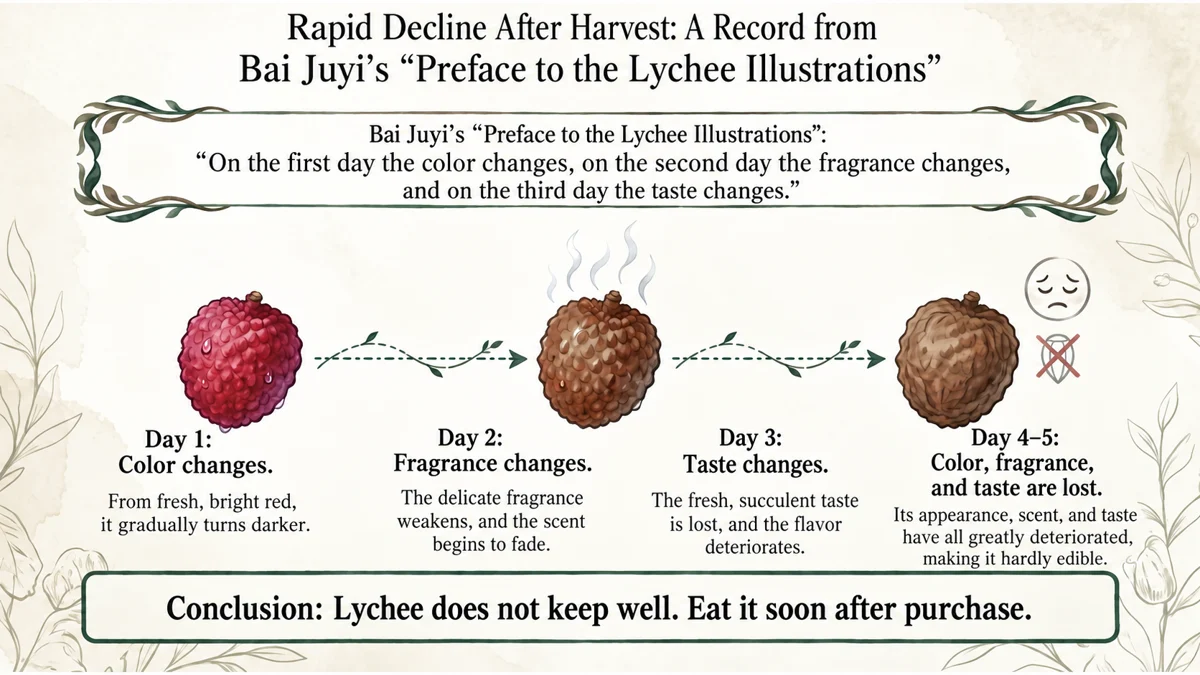
Lychee loses quality rapidly after harvest. Bai Juyi’s 820 text describes changes in color, aroma and taste over successive days; Lychee History and Stories explains this literary record. The rind readily browns as it loses moisture. Cool temperatures and high humidity help preserve quality. Brown skin does not always mean the edible part has lost its flavor.
Lychee is non-climacteric: it does not become sweeter through ripening after harvest. Buy fresh fruit and eat it promptly.
Lychee Varieties and Vietnamese Growing Regions
Many lychee cultivars exist, particularly in China, where cultivation has a long history. Cai Xiang’s 1059 Treatise on Lychee is an early specialized work on a fruit. See Lychee History and Stories for historical context.
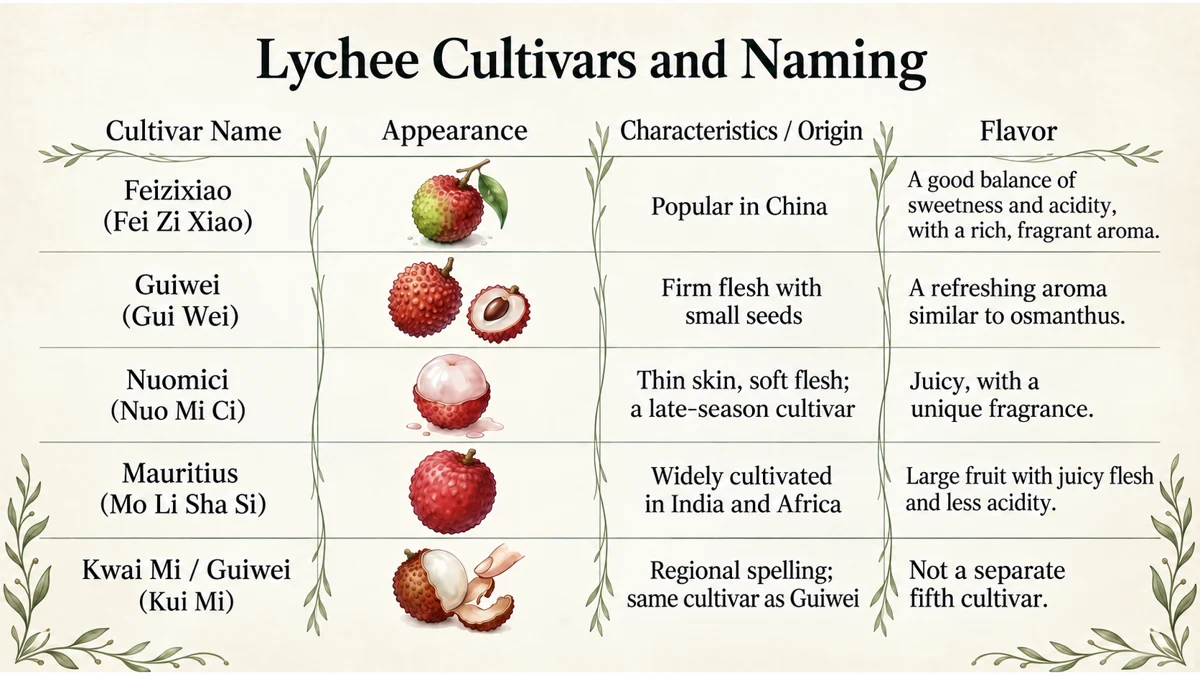
Here are several familiar cultivar names. Regional spellings can refer to the same cultivar.
- Feizixiao: A familiar Chinese cultivar with a balance of sweetness, acidity and aroma.
- Guiwei: Often described as firm-fleshed with small seeds and an osmanthus-like aroma.
- Nuomici / No Mai Chee: A late cultivar with tender, juicy flesh and distinctive aroma.
- Mauritius: Grown in several countries, including parts of Africa; juicy flesh and cultivar-dependent acidity.
- Kwai Mi / Kwai May: Regional spellings associated with Guiwei, rather than a distinct fifth cultivar.
Growing Regions in Vietnam
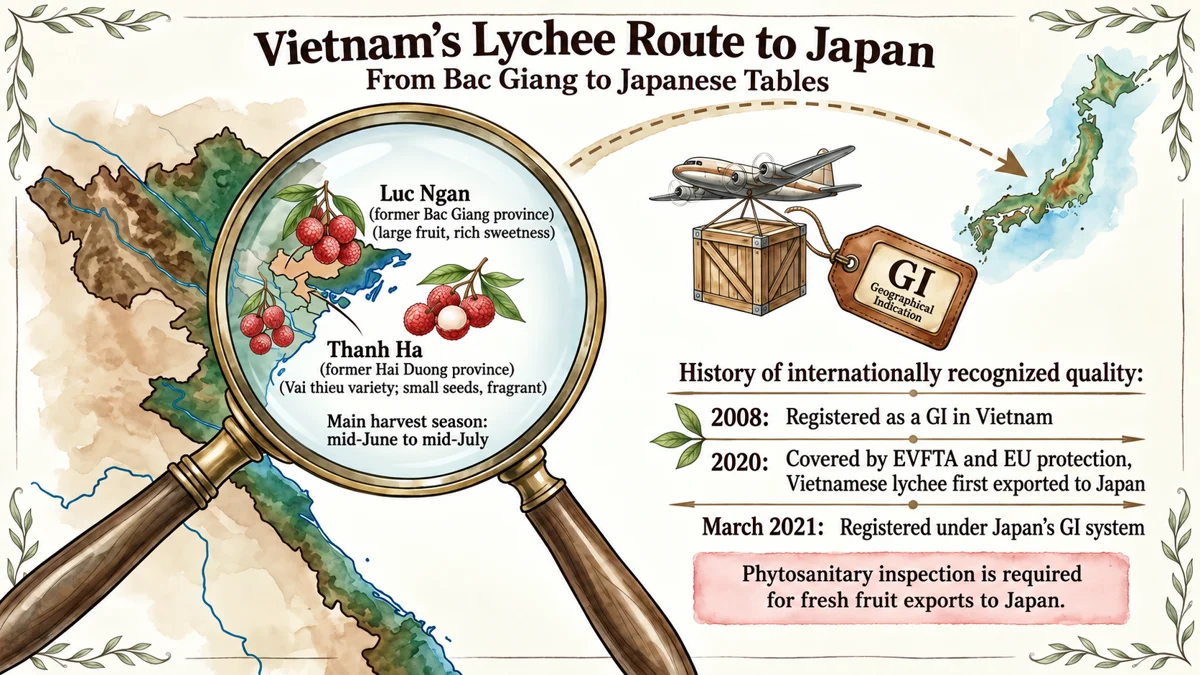
Luc Ngan, north of Hanoi in the area historically called Bac Giang province, is a major growing region. Its main crop is generally harvested in June and July, depending on cultivar and season. Historical province names are used here to match the cited sources, rather than as current administrative boundaries.
Luc Ngan lychee received Vietnamese geographical indication protection in 2008, EU protection under the EVFTA in 2020, and registration in Japan in March 2021. The GI recognizes geographical origin and product characteristics; it is separate from plant quarantine clearance.
Thanh Ha, in the area historically called Hai Duong province, is another well-known growing region associated with fragrant Vải thiều fruit and relatively small seeds.
Lychee Precautions: Avoid Large Amounts on an Empty Stomach
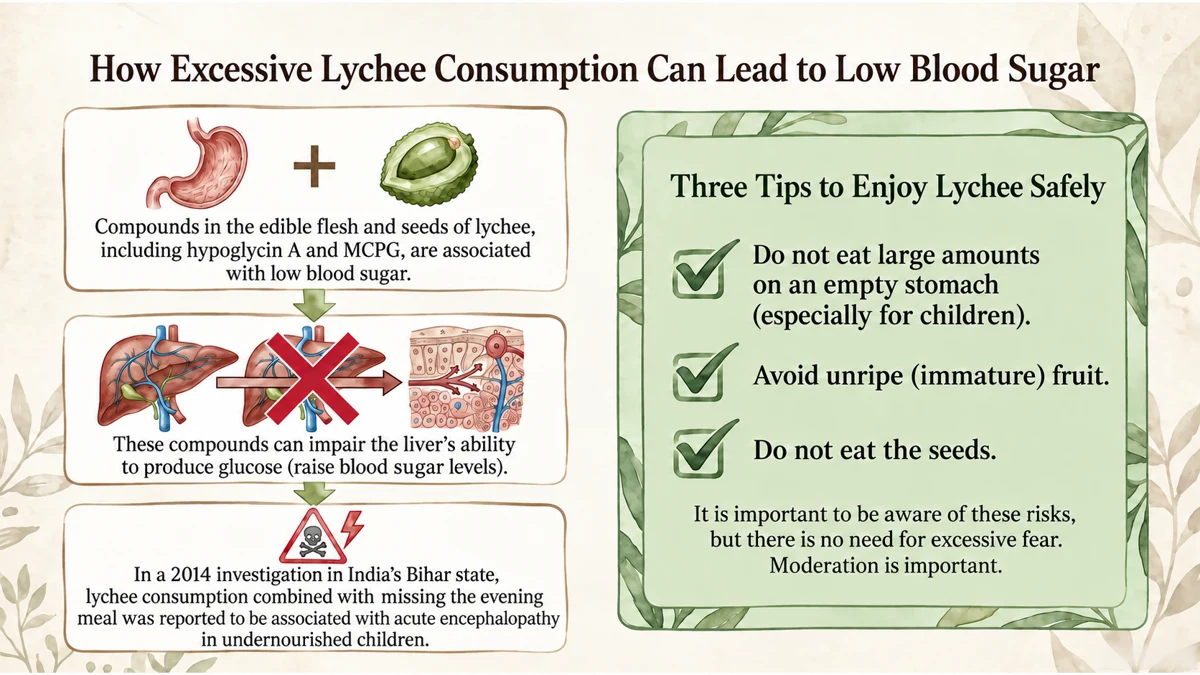
Avoid eating large amounts of lychee on an empty stomach, particularly in the case of children.
Hypoglycin A and methylenecyclopropylglycine (MCPG), compounds associated with impaired glucose metabolism, have been detected in edible lychee arils as well as seeds. A case-control investigation of a 2014 outbreak in Muzaffarpur, India, linked childhood acute encephalopathy with lychee consumption and missing the preceding evening meal.
That study does not establish the same risk from ordinary consumption by healthy adults. Undernourished children who skip meals are an especially concerning group. The following practical precautions are relevant.
- Avoid large amounts on an empty stomach, particularly for children.
- Avoid unripe fruit.
- Do not eat the hard seeds.
Enjoy moderate portions alongside a normal diet rather than replacing meals with large amounts of fruit.
Lychee Nutrition
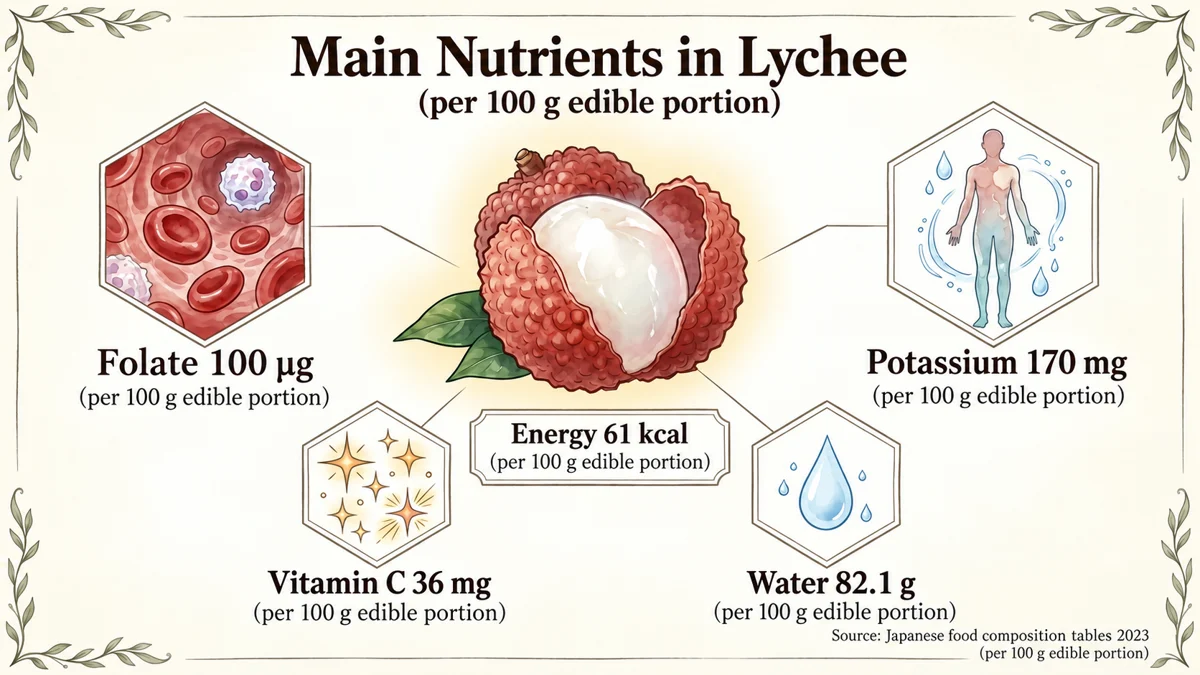
The following reference values apply to 100 g of raw edible lychee.
| Nutrient | Amount per 100 g |
|---|---|
| Energy | 61 kcal |
| Water | 82.1 g |
| Potassium | 170 mg |
| Calcium | 2 mg |
| Folate | 100 µg |
| Vitamin C | 36 mg |
These are standard values from Japan’s food composition tables. Variety, origin and maturity affect composition. A single food cannot be assumed to prevent or treat anemia or swelling; consider the diet as a whole.
Lychee Production and Markets
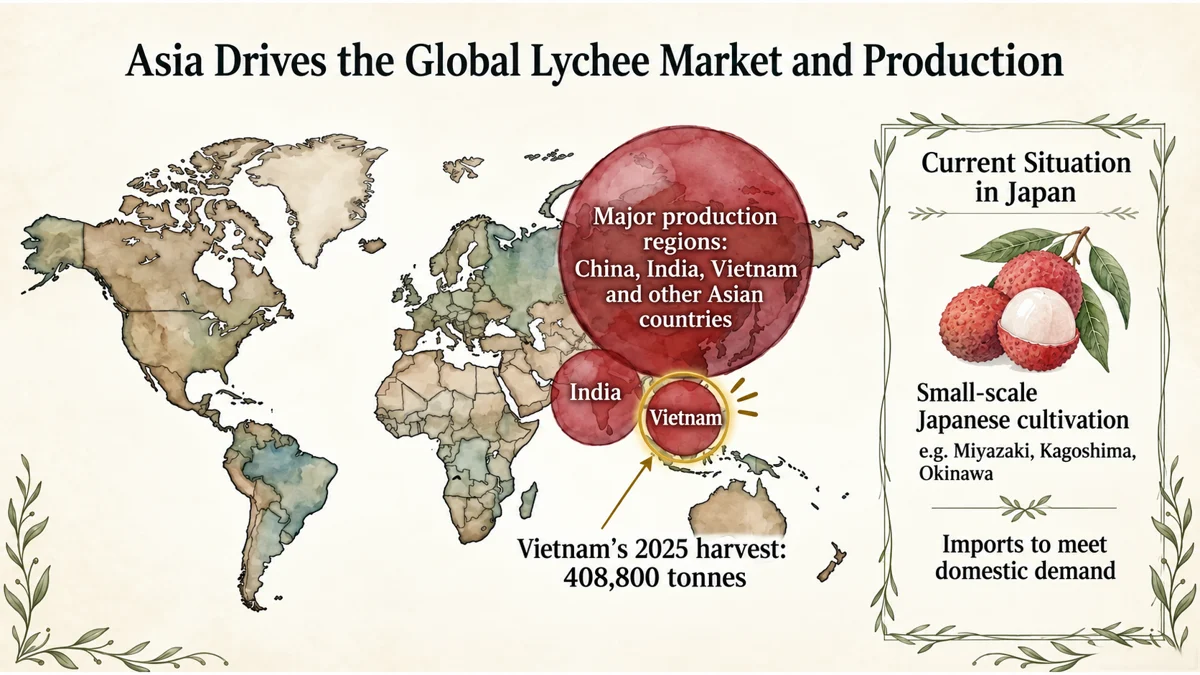
China, India and Vietnam are important growing countries. Statistics from different years and with different coverage should not be used as a precise current world ranking.
Vietnam’s National Statistics Office reported 408,800 tonnes of lychee in 2025. Japan approved conditional commercial imports of Vietnamese Thiều lychee in December 2019, with the first commercial shipments in 2020. Approved shipments must meet specified treatment and inspection requirements. This does not permit travelers to bring market-bought fresh fruit in their baggage.
Japan also grows small quantities in warm regions including Miyazaki, Kagoshima and Okinawa. Miyazaki’s 2025 crop survey recorded 22.6 tonnes. Local availability and quantities are limited.
Frequently Asked Questions About Lychee
What does lychee taste like?
Lychee is richly sweet and floral, with springy, juicy flesh. Acidity and aroma vary by cultivar.
When is lychee in season?
Roughly May–July in Vietnam and June–July for Japanese-grown fruit. Frozen and canned products can be available year-round.
What is the white edible part of lychee?
It is usually called flesh, but botanically it is an aril around the seed, distinct from the seed coat.
Can you eat lychee skin and seeds?
Do not eat the rind or hard central seed. Eat the white aril. See How to Eat Lychee in Vietnam for peeling and storage.
Lychee Guide: Key Points
Here are the main points.
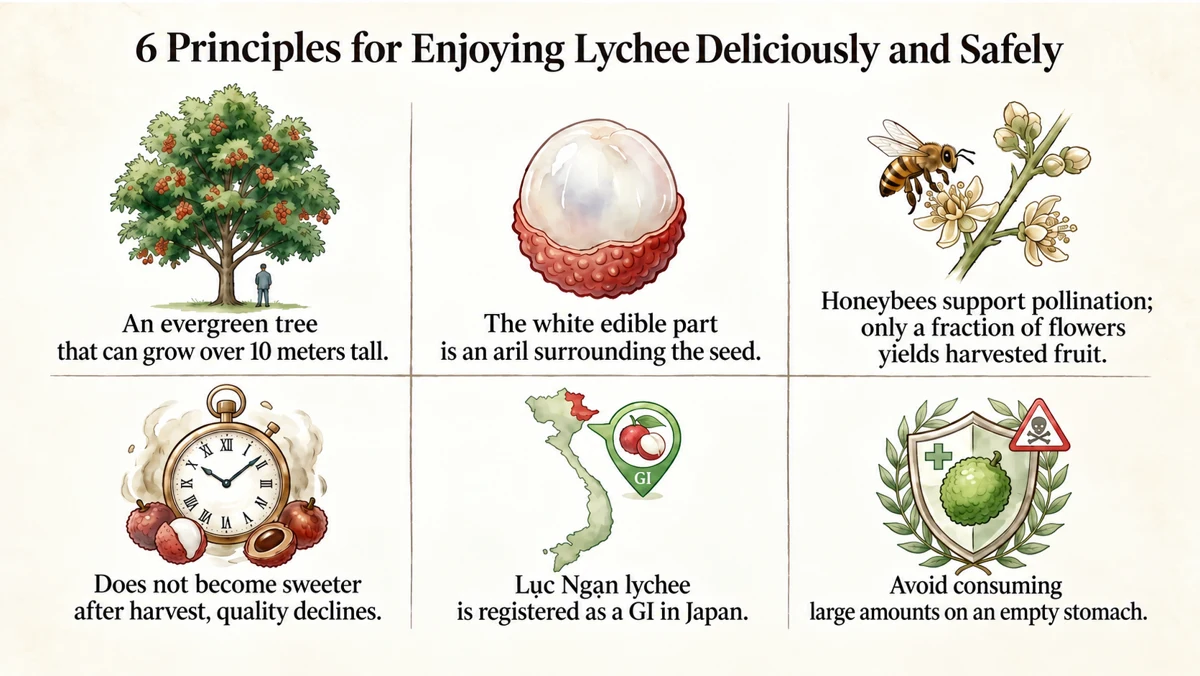
- Lychee is an evergreen tree in the soapberry family, related to longan and rambutan.
- Its white edible part is an aril surrounding the seed.
- Panicles can carry thousands of flowers, but relatively few fruits survive to harvest. Bees support pollination.
- It does not become sweeter after harvest and loses quality quickly. Eat it promptly.
- Avoid large amounts on an empty stomach, especially for undernourished children who have missed meals.
- Vietnam is an important producer. Luc Ngan lychee is registered under Japan’s GI system.
For choosing, peeling and local dishes, see How to Eat Lychee in Vietnam. Explore the fruit’s history in Lychee History and Stories, or browse 15 Vietnamese Fruits.
References
- foodslink.jp — original source referenced by the Japanese manuscript
- ja.wikipedia.org — original source referenced by the Japanese manuscript
- FAO: Lychee cultivation and history
- ja.wikipedia.org — original source referenced by the Japanese manuscript
- Fukuoka University of Education: Fruit morphology (in Japanese); ja.wikipedia.org — original source referenced by the Japanese manuscript
- BeeAware: Lychee flowering and pollination
- Queensland research: Lychee flowering and fruit set
- BeeAware: Lychee flowering and pollination
- spc.jst.go.jp — original source referenced by the Japanese manuscript
- m.fznews.com.cn — original source referenced by the Japanese manuscript
- www.hk01.com — original source referenced by the Japanese manuscript
- sanchoku-prime.com — original source referenced by the Japanese manuscript
- www.arukikata.co.jp — original source referenced by the Japanese manuscript
- vietnam-gift.com — original source referenced by the Japanese manuscript
- Luc Ngan Lychee: Japanese GI record
- www.hokkoku.co.jp — original source referenced by the Japanese manuscript
- www.jetro.go.jp — original source referenced by the Japanese manuscript
- www.viet-jo.com — original source referenced by the Japanese manuscript
- 2014 Muzaffarpur encephalopathy case-control study
- Hypoglycin A and MCPG in lychee arils
- Japanese Food Composition Tables: Raw lychee
- Vietnam National Statistics Office: 2025 production
- Miyazaki Prefecture: 2025 Fruit Crop Survey (in Japanese)
- UC Davis: Lychee postharvest handling
FAO: Lychee Production in China — cultivar names
FAO: Lychee origins and historical introductions
Vietnam Government: 2025 provincial administrative changes (in Vietnamese)
