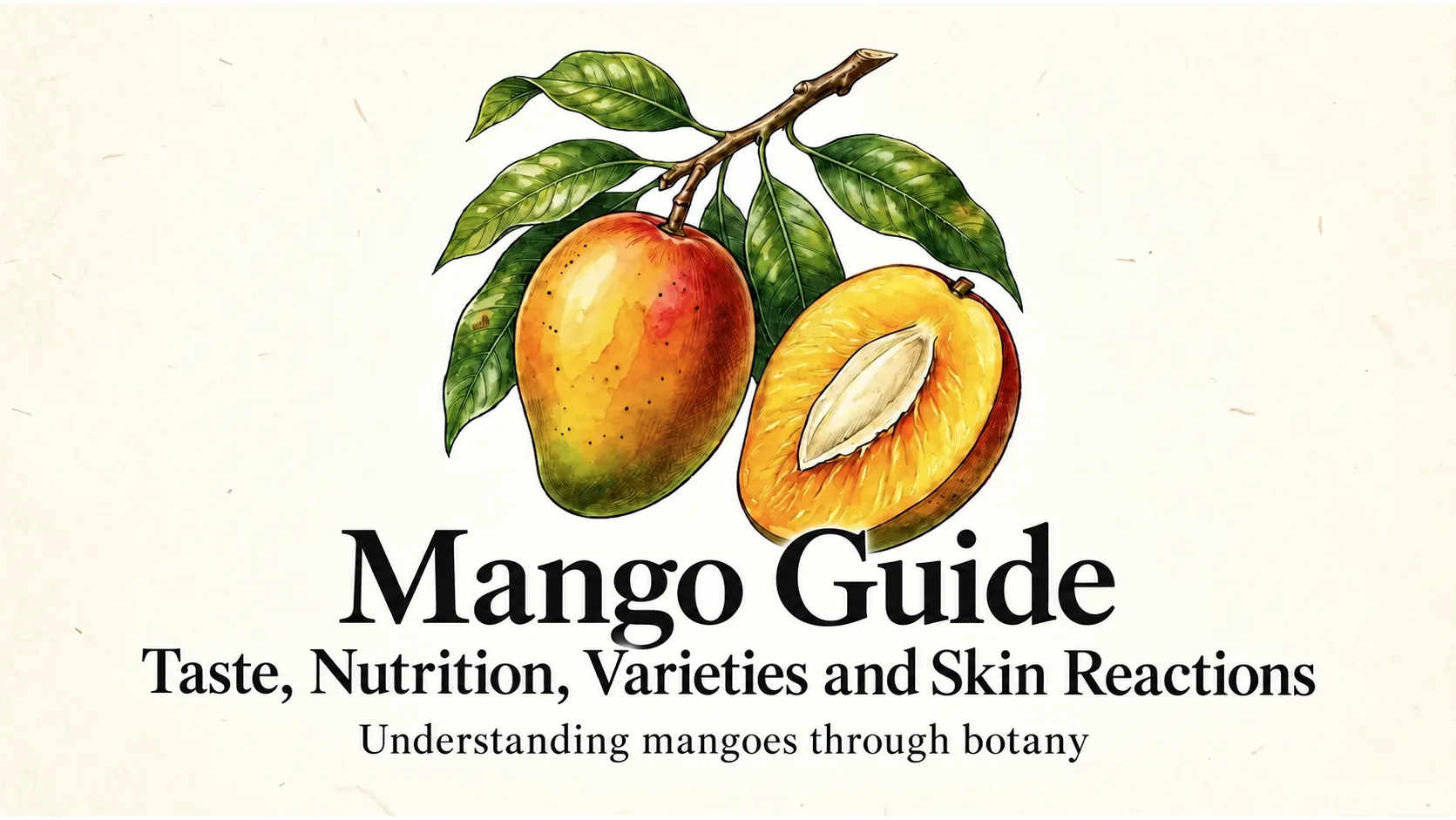
A fully ripe mango offers a rich fragrance and deep sweetness. More than 1,000 cultivars are sometimes reported worldwide, with skins ranging from yellow and green to red.
Mango is an evergreen tree in the Anacardiaceae family, which also includes lacquer trees. Reactions to its peel and sap are connected to its chemistry. This guide covers taste, nutrients, varieties, growth, ripening, Japanese production and plant quarantine.
For prices, choosing, cutting and storage, see How to Eat Mangoes in Vietnam. For origins, names and the fruit’s journey around the world, see Mango History and Stories.
Mango basics: taste, nutrition and varieties
| Item | Details |
|---|---|
| English name | Mango |
| Vietnamese name | Xoài |
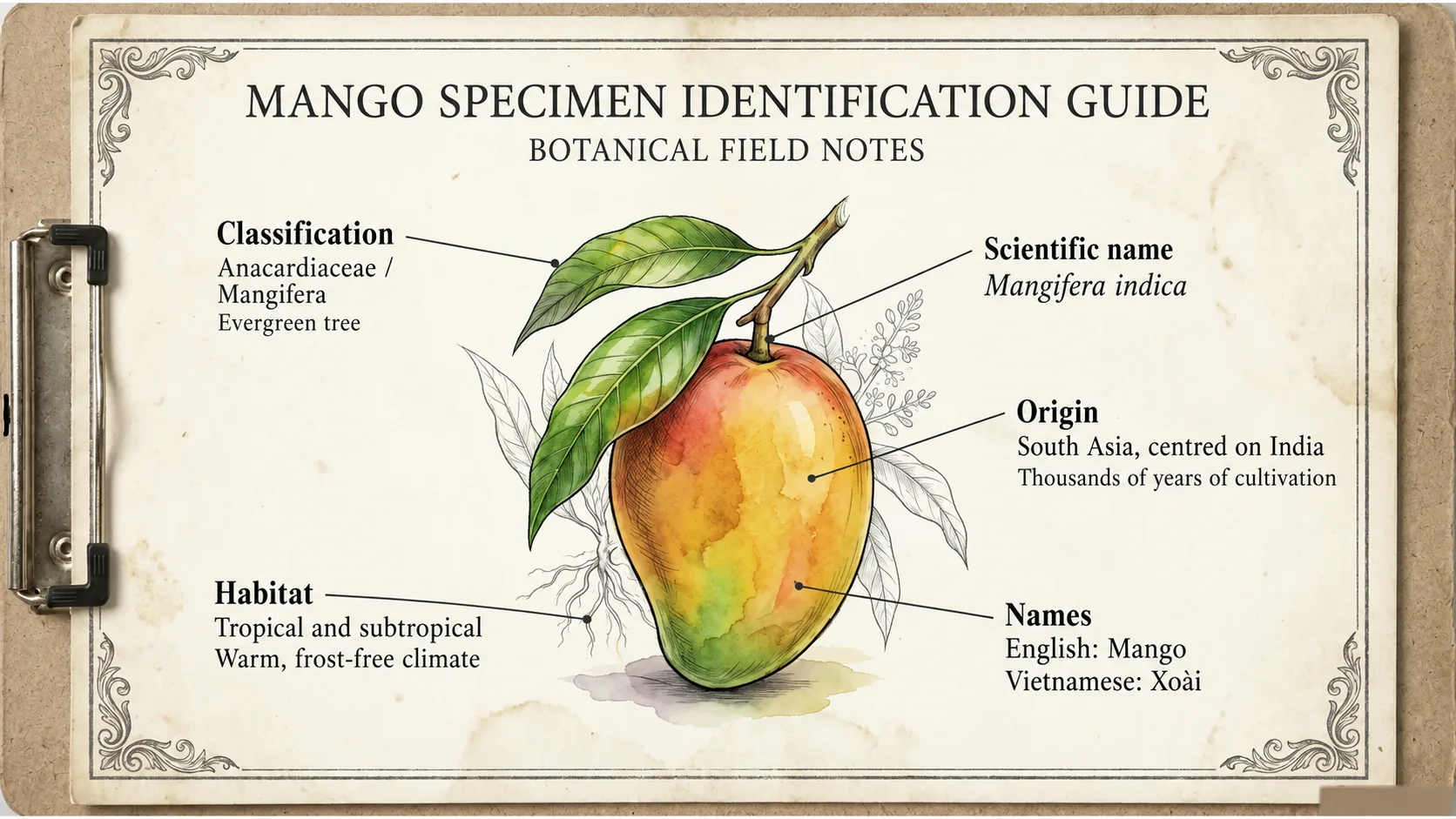
| Scientific name | Mangifera indica |
| Classification | Evergreen tree in the genus Mangifera, family Anacardiaceae |
| Origins | Cultivated mangoes originate in South Asia, centred on India. Related species are also diverse in Southeast Asia. |
| Growing conditions | Tropical and subtropical conditions; a warm, frost-free climate |
| Japanese season | Mainly spring to summer. Timing differs by growing area and production system in Okinawa, Miyazaki and Kagoshima. |
| Availability in Vietnam | An everyday fruit seen throughout the year in Hanoi markets and supermarkets, according to the author’s observations |
| Key nutrients | Beta-carotene, vitamin C, alpha-tocopherol, folate and dietary fibre |
Sources are listed at the end of the article.
What do mangoes taste like?
Ripe mangoes are fragrant, sweet, soft and juicy. Unripe green mangoes have firmer flesh and stronger acidity. Flavour, fragrance and fibrousness vary with cultivar and ripeness.
What family does mango belong to?
We often think of mango simply as a tropical fruit. Unlike pineapple, a perennial herb described in the Pineapple Guide, mango is a true tree. It belongs to Anacardiaceae and can reach roughly 30–40 metres under natural conditions.
Its botanical family provides a clue to one of its less familiar characteristics.
Why mango peel and sap can cause a rash
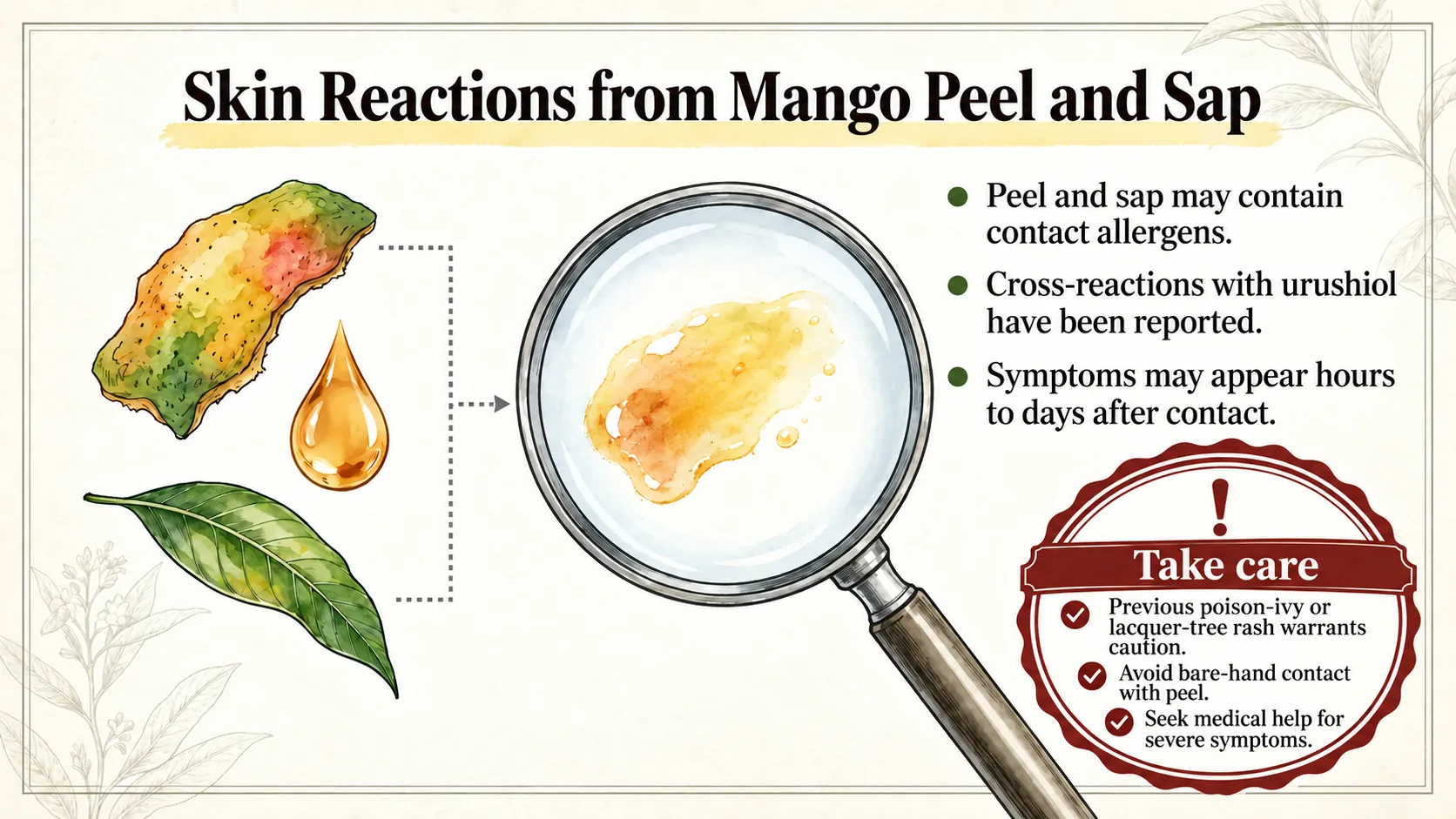
Anacardiaceae includes lacquer trees, pistachios and cashews. Mango peel and sap contain potential contact allergens, including alkenyl resorcinols. Cross-reactions with urushiol have been reported.
Sensitised people may develop redness, itching or blisters on their hands or around their mouth. This is often delayed contact dermatitis, appearing hours to days after contact. It differs from immediate food-allergy symptoms such as oral discomfort, hives or breathing difficulty. Seek medical help promptly for severe symptoms, and avoid handling the peel with bare hands if you have a relevant history.
Hundreds of flowers, few harvested fruits
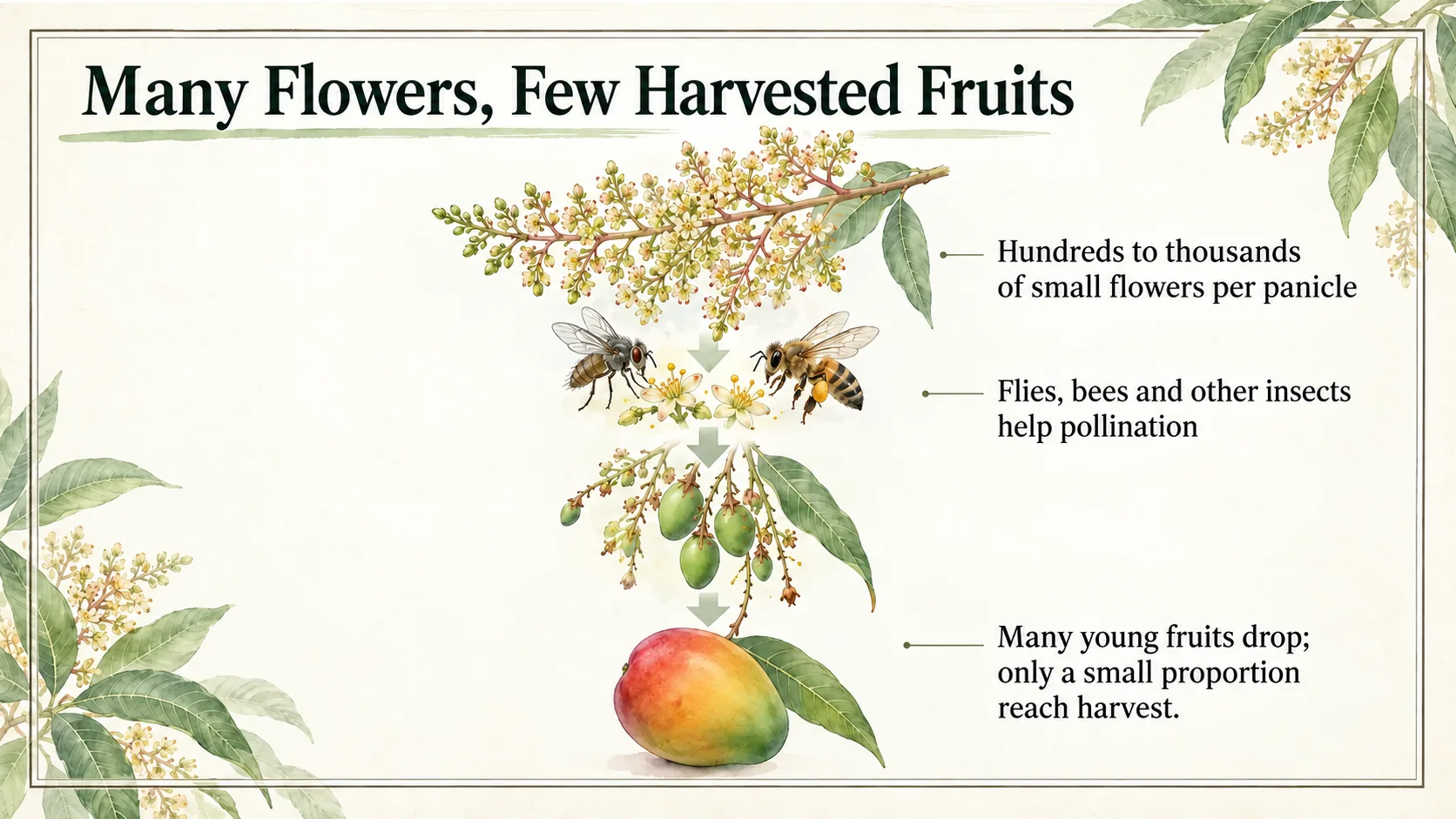
A mango panicle carries hundreds to thousands of tiny flowers. Only a small proportion progress through fruit set and survive natural fruit drop to harvest. Cultivar, temperature, tree condition and pollination all affect the result, so a single universal fruit-set percentage is misleading.
Flies, bees and other insects visit mango flowers and help pollination. Insect pollinators are also used in some Japanese greenhouse production. Many cultivars are self-compatible, but insect activity and conditions during flowering still affect fruit set.
Grafting preserves cultivar qualities
Mango is a perennial fruit tree, and grafted nursery trees are widely used. They tend to bear earlier than seedlings and preserve the fruit qualities of the parent cultivar. Even in self-compatible cultivars, pollinating insects and suitable flowering conditions help reliable production.
Well-managed mature trees can remain productive for many years. Lifespan and productive life depend on cultivar, climate, disease and management.
Why mangoes ripen after harvest
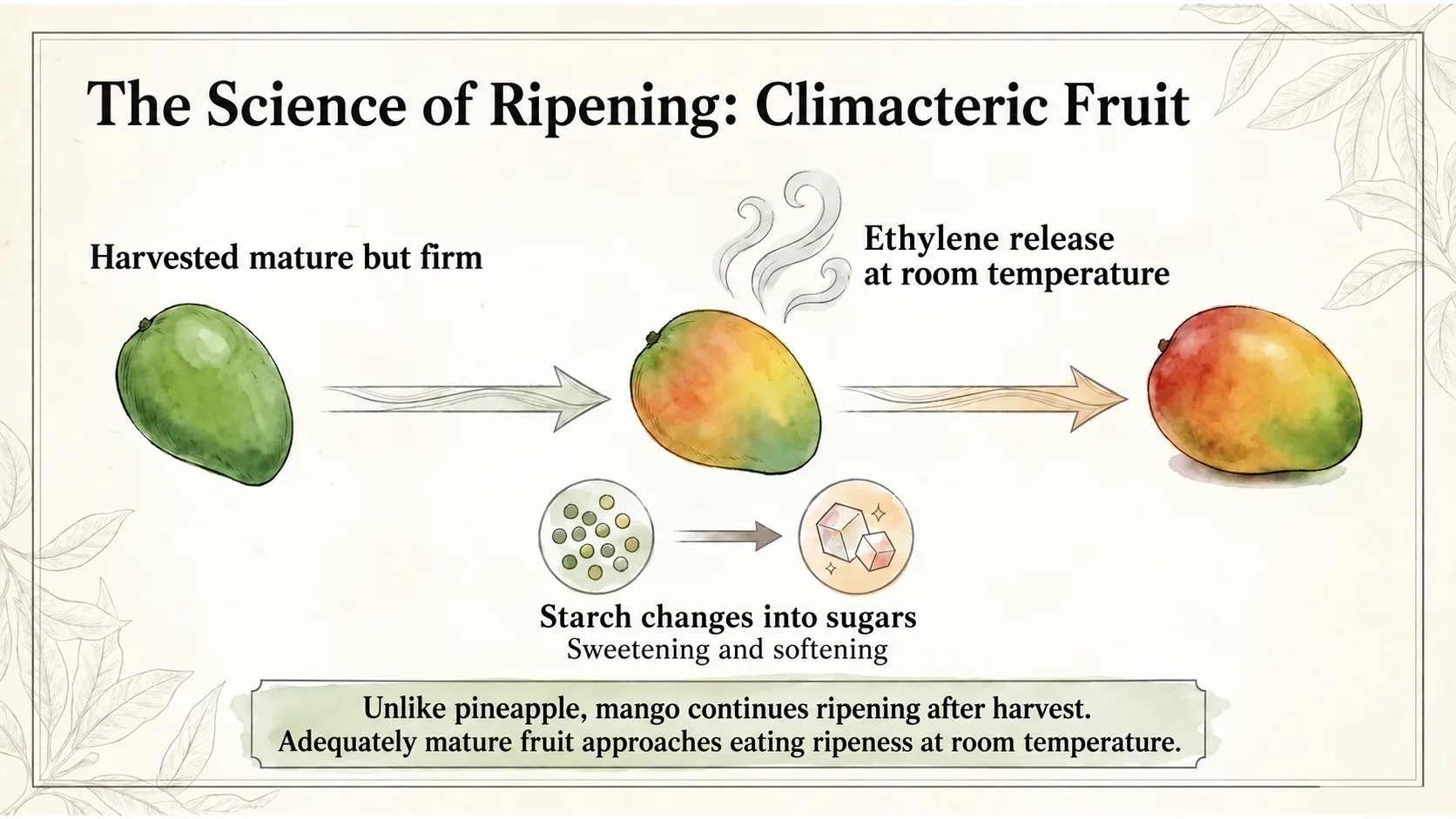
Pineapples do not become sweeter after harvest, but mangoes can continue ripening. Mango is a climacteric fruit: ethylene production supports ripening, starch breakdown and softening after harvest. This is why fruit harvested at adequate maturity gradually approaches eating ripeness at room temperature.
Mango varieties around the world and in Vietnam
More than 1,000 mango cultivars are sometimes reported. Here are examples from major growing regions and from Vietnam.
Well-known varieties worldwide
India grows many mango cultivars. Alphonso is particularly associated with a rich aroma and intense sweetness.
- Thailand: Yellow-skinned Nam Dok Mai is well known for sweetness and balanced acidity. Maha Chanok is also sold.
- Mexico: Haden, Kent, Keitt and Manzanillo are familiar cultivars, with differing balances of sweetness, acidity and texture.
- Taiwan: Cultivars include Jinhuang, Irwin and local small mangoes.
- Japan: Irwin accounts for the great majority of domestic mango production.
Representative Vietnamese varieties
Two well-known Vietnamese cultivars are Xoài Cát Chu and Xoài Cát Hòa Lộc.
- Xoài Cát Chu: Relatively low in fibre and sweet when ripe. Grown in areas including Đồng Tháp in the Mekong Delta, it is the Vietnamese cultivar approved for conditional commercial export to Japan.
- Xoài Cát Hòa Lộc: A prized southern Vietnamese cultivar, with yellow skin, sweetness and fragrance when ripe.
Production and markets: the world, Japan and Vietnam
The statistics behind mango markets deserve a little care.
FAOSTAT’s commonly cited international category combines mangoes, mangosteens and guavas; it does not measure mangoes alone. India is the largest producer in that combined category. India’s APEDA reports approximately 31,800 tonnes of fresh mango exports for 2025/26. Domestic consumption is substantial. Always check the year and commodity definition before comparing statistics.
Okinawa, Miyazaki and Kagoshima are major Japanese growing areas. Heated greenhouses are used in Miyazaki and Kagoshima, while Okinawa also uses unheated protected cultivation. Seasons vary accordingly. Okinawa also grows Keitt, which can retain green skin when ripe.
Miyazaki’s “Taiyō no Tamago” brand selects naturally fallen ripe fruit meeting standards including at least 15 degrees Brix, a weight of at least 350 grams and specified appearance criteria.
Protected cultivation manages temperature, rain exposure and disease during flowering and fruit development. Flies and bees may assist pollination. Suitable temperature and humidity depend on growth stage, region and facilities, so growers follow local guidance rather than one universal setting.
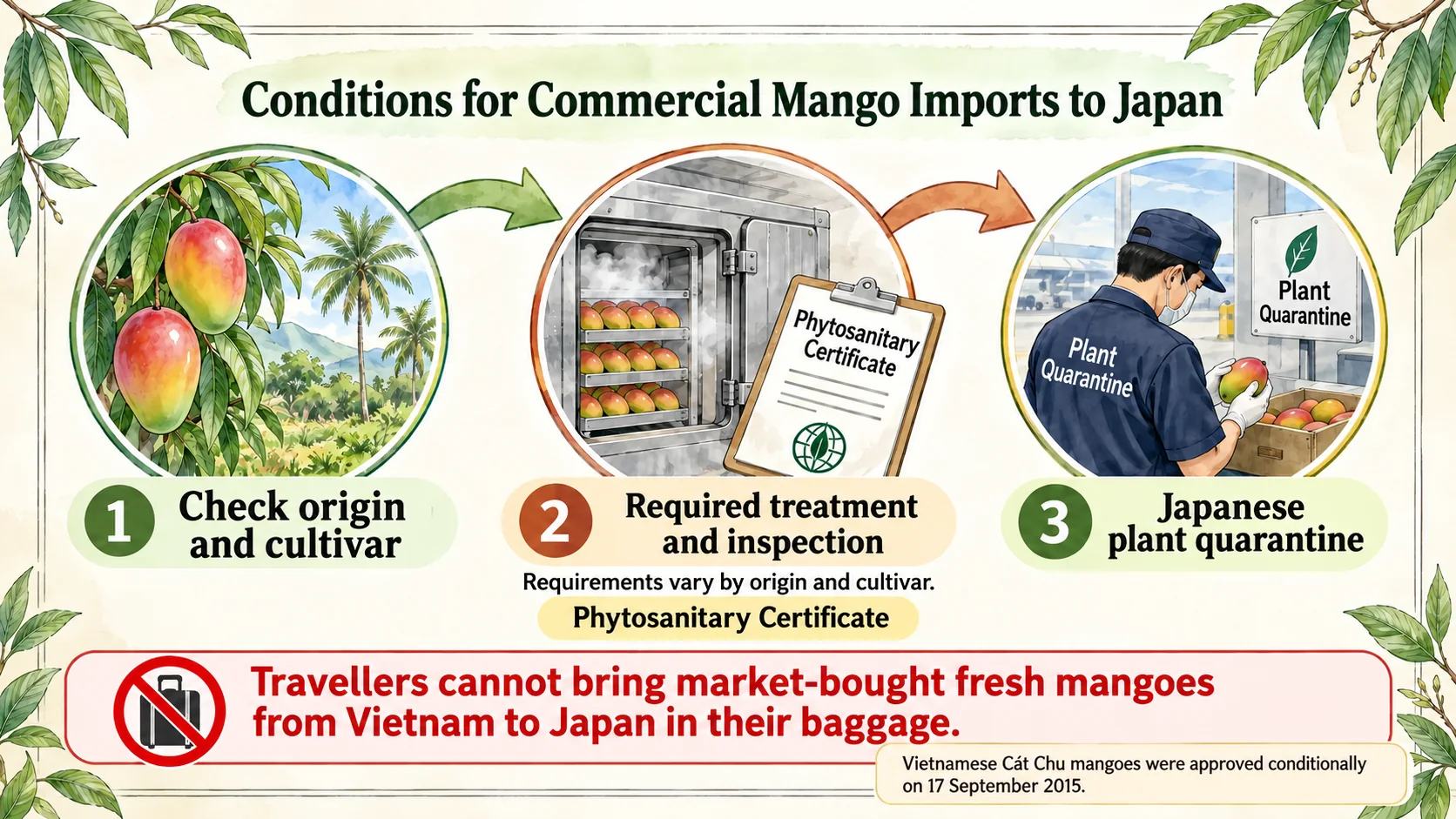
Japan permits imports of fresh fruit only under origin- and cultivar-specific plant-quarantine requirements, which can include treatment, inspection and a phytosanitary certificate. Vapor-heat schedules differ. Vietnamese Cát Chu mangoes were approved for conditional commercial import on 17 September 2015. Travellers cannot simply bring market-bought fresh mangoes from Vietnam into Japan in their baggage.
Mango nutrition per 100 grams of edible flesh
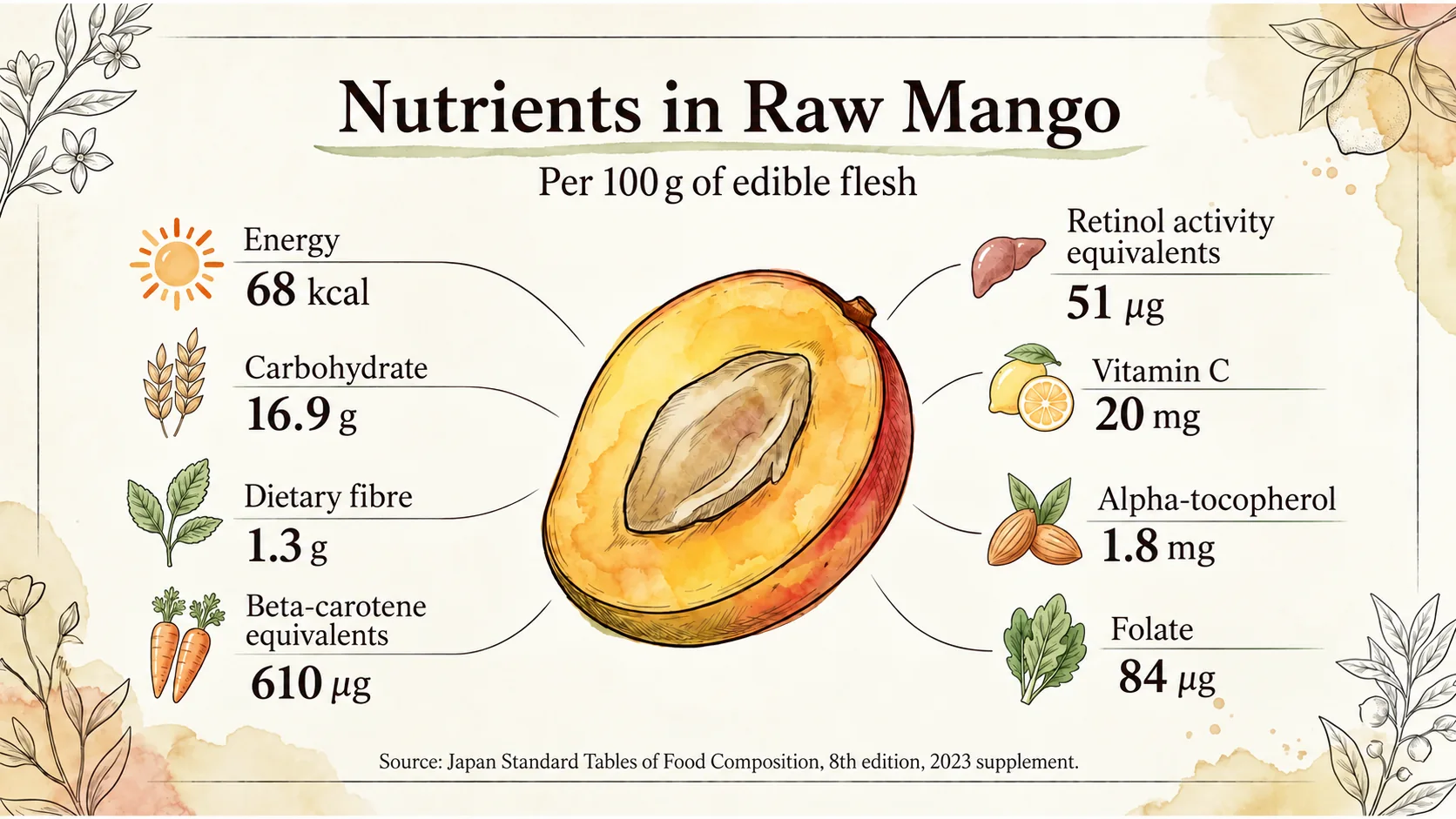
The Japanese food-composition reference gives the following values for raw mango.
- Beta-carotene equivalents: 610 μg; retinol activity equivalents: 51 μg per 100 g
- Vitamin C: 20 mg per 100 g
- Alpha-tocopherol (vitamin E): 1.8 mg per 100 g
- Folate: 84 μg per 100 g
- Dietary fibre: 1.3 g per 100 g
Japan’s Standard Tables of Food Composition, eighth edition with the 2023 supplement, list raw mango at 68 kcal per 100 g of edible flesh, with 16.9 g carbohydrate and 13.8 g available carbohydrate expressed as monosaccharide equivalents. Actual values vary with cultivar and ripeness.
Enjoying mangoes with a little more understanding
Keep these points in mind.
- Mango is an evergreen tree in Anacardiaceae; grafting preserves cultivar qualities.
- Peel and sap can cause delayed contact dermatitis in sensitised people.
- A panicle has hundreds to thousands of flowers, but few fruits survive to harvest; insects help pollination.
- Adequately mature fruit continues ripening after harvest through ethylene activity, unlike pineapple.
- Vietnam grows cultivars including Cát Chu and Cát Hòa Lộc among the many mango varieties worldwide.
Explore 15 Fruits Vietnamese People Eat After Meals for more fruit ideas. For practical shopping and preparation, read How to Eat Mangoes in Vietnam; for origins and cultural history, read Mango History and Stories.
References
Main sources
- MEXT: Food Composition Database, raw mango
- JIRCAS: Mango pollination
- JIRCAS: Mango flowers
- JIRCAS: Introduction of mango to Japan
- JIRCAS: Mango production in Japan
- JIRCAS: Irwin characteristics and evaluation
- MAFF Plant Protection Station: Conditional import approval
- MAFF Plant Protection Station: Bringing plants into Japan
- Medical review: Contact Allergy Induced by Mango
- APEDA: Mango
- Miyazaki Brand Promotion: Taiyō no Tamago ripe mangoes
