
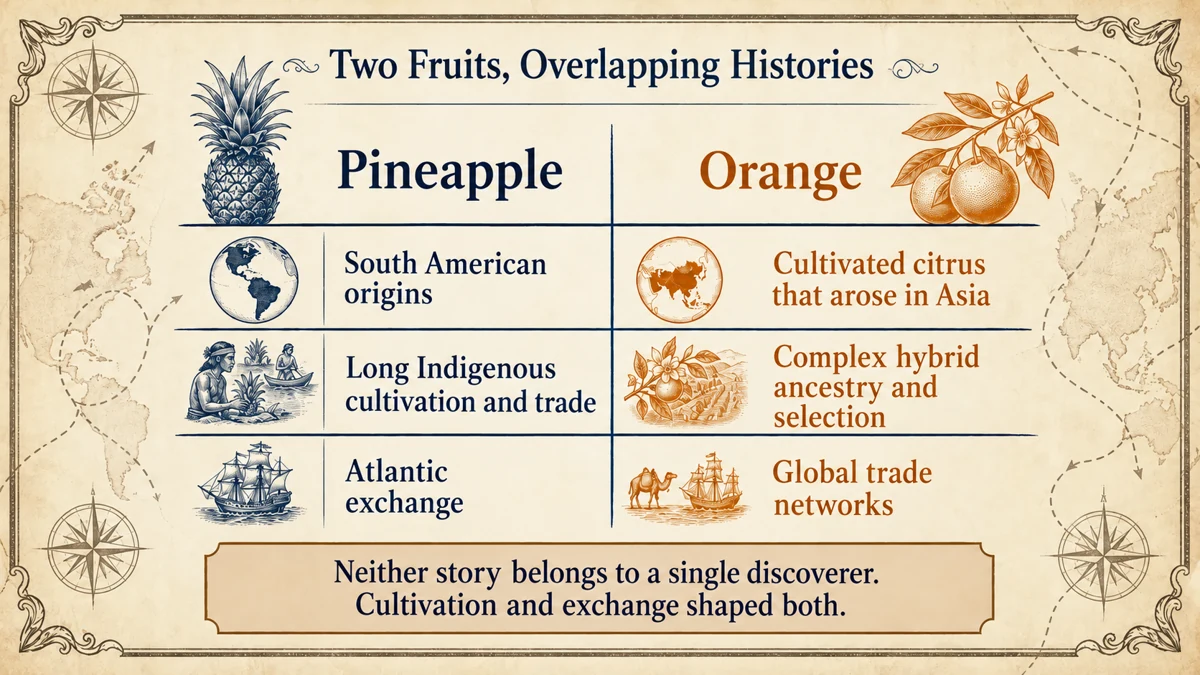
Orange is cultivated citrus that arose in Asia and spread through Arab and Islamic trade networks and Portuguese maritime commerce. The English fruit name preceded the colour name. This article follows citrus from an ancient Chinese parable to the Atlantic crossing of 1493 and a Vietnamese proverb.
Our Pineapple History follows a South American fruit that spread through Indigenous trade to the Caribbean, where Columbus’s expedition encountered it in 1493.
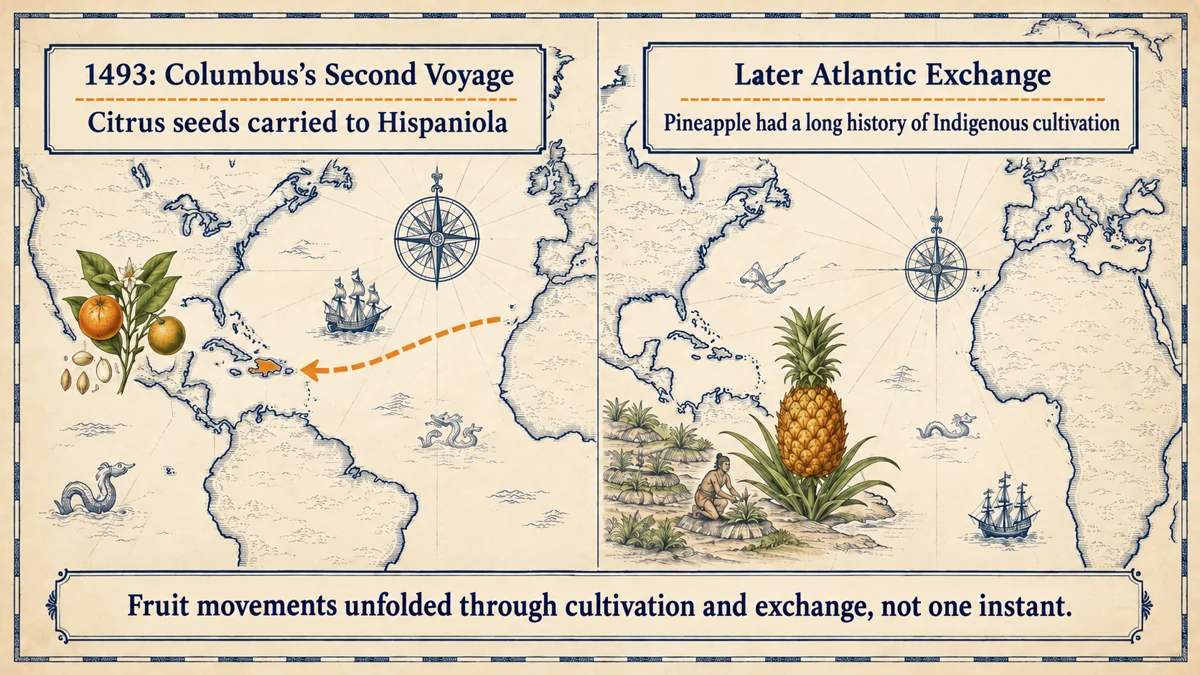
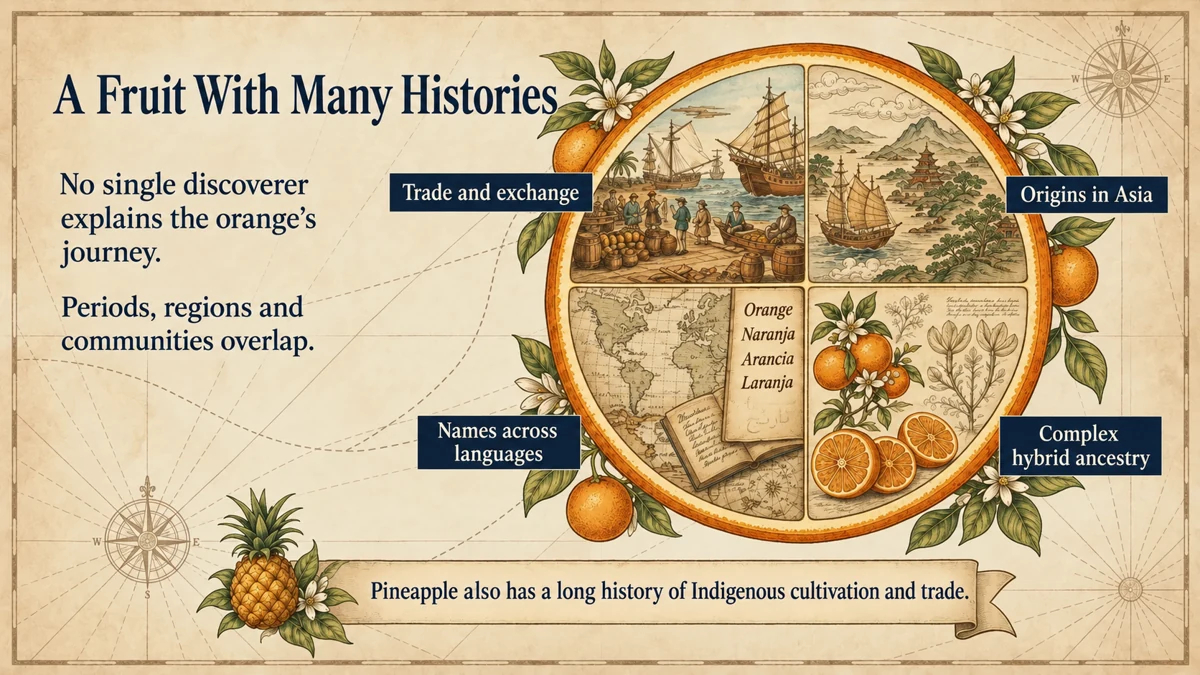
The orange’s journey also has a milestone in 1493. According to the FAO, Columbus carried citrus seeds to the Western Hemisphere on his second voyage and planted them on Hispaniola. That expedition also encountered Caribbean pineapples. The year symbolises an era of plant exchange, though the orange’s history reaches much further back: Asian cultivation, the spread of citrus through Arab and Islamic networks, and the later promotion of sweet oranges by Portuguese merchants. No single “discoverer” can explain its journey.
A voyage across centuries, shaped by many people rather than one discoverer.
Citrus Culture in Ancient China
For the orange’s complex mandarin and pummelo ancestry, reflected in the scientific name Citrus × sinensis, see our Orange Guide.
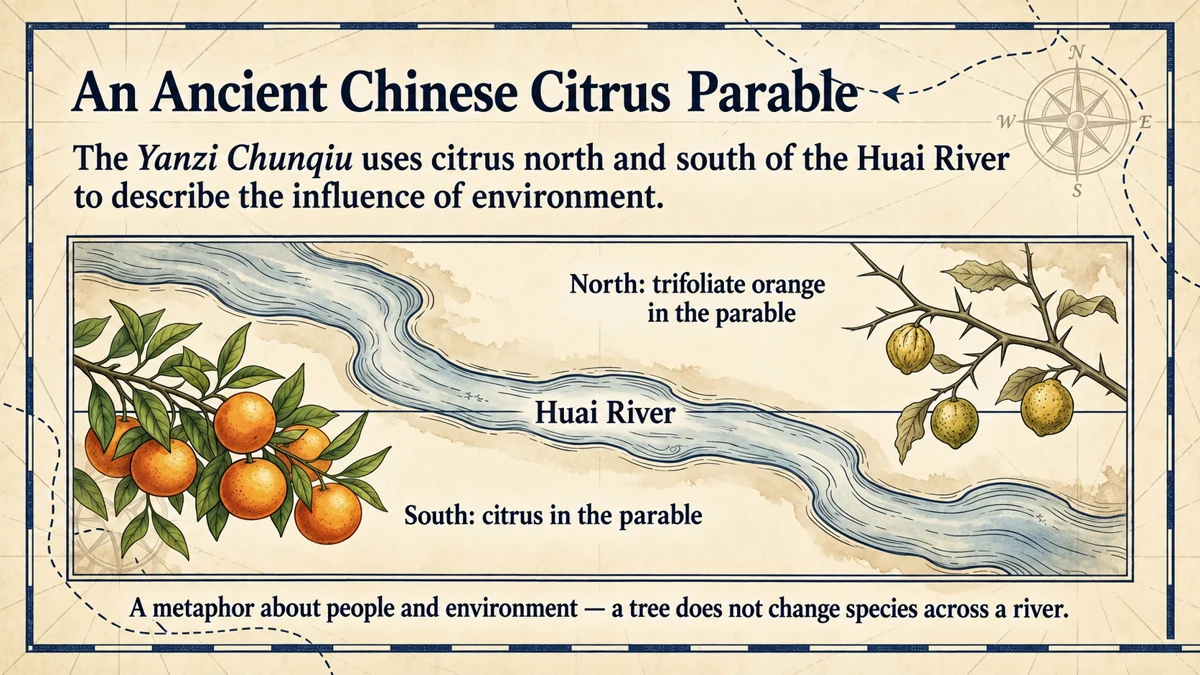
An ancient Chinese parable illustrates how long citrus has been part of human culture. In the Yanzi Chunqiu, the envoy Yan Ying responds to the king of Chu with a comparison: citrus growing south of the Huai River bears one kind of fruit, while that north of it bears another, because the land and water differ. The saying, often called “southern citrus, northern trifoliate orange”, remains a familiar idiom about the influence of environment.
The citrus in the story probably refers to a mandarin-related fruit, rather than modern sweet orange. A tree does not literally turn into a different species when moved across a river. The parable is a metaphor about human environment, not a modern botanical explanation.
Bitter Orange: Through the Arab World to Europe
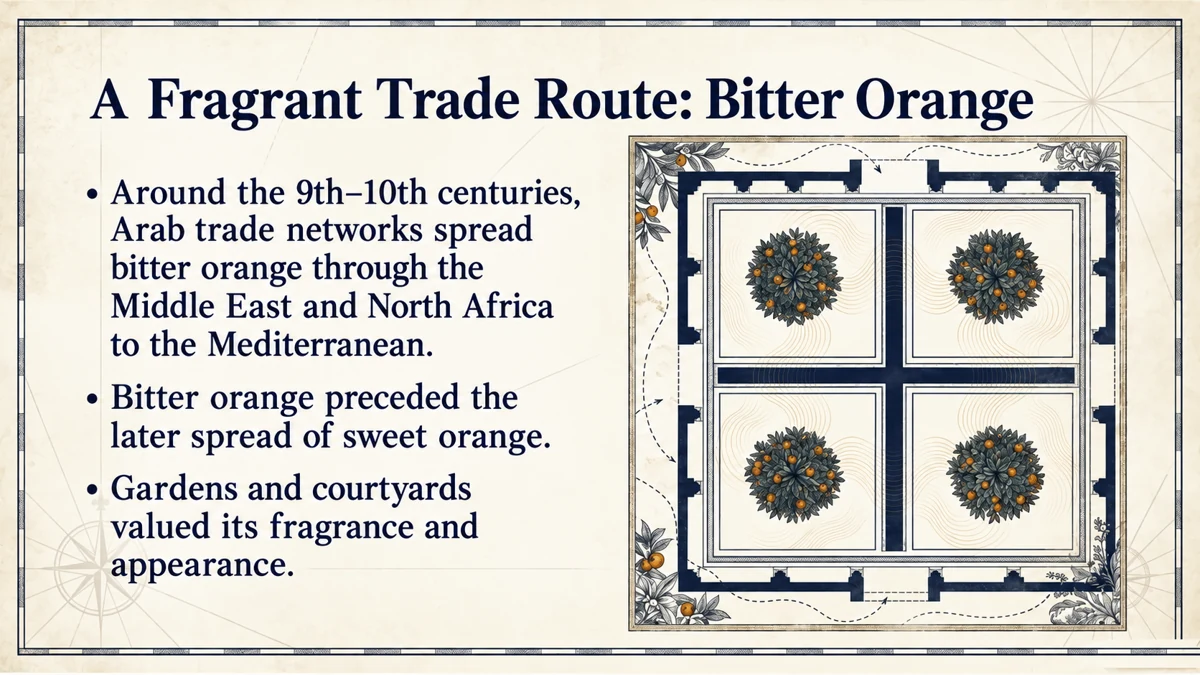
The orange that spread around the medieval Mediterranean was bitter orange, rather than the sweet orange commonly eaten today. Other citrus, notably citron, had reached the region earlier.
During roughly the ninth and tenth centuries, Arab trade networks helped spread bitter orange through the Middle East and North Africa. Islamic expansion and exchange connected Sicily and the Iberian Peninsula. Citrus was grown in gardens and courtyards for its appearance and fragrance, as well as its uses. Irrigation supported cultivation. For many medieval Europeans, an “orange” meant the sour fruit.
1493: Citrus Crosses the Atlantic
The story returns to 1493, the year also featured in the pineapple’s journey.
The FAO states that Columbus carried citrus seeds west on his second voyage in 1493 and planted them on Hispaniola. The seventeen-ship expedition aimed to establish settlements and also transported other crops and livestock. The sources reviewed here do not establish the precise citrus variety or planting date.
The same expedition is said to have encountered pineapple on Guadeloupe. This does not establish that pineapple was taken back to Europe in 1493, so a literal picture of the two fruits passing each other across the Atlantic that year would be misleading. The voyage nevertheless symbolises exchange between the Old and New Worlds.
Names and the “Portugal Orange”
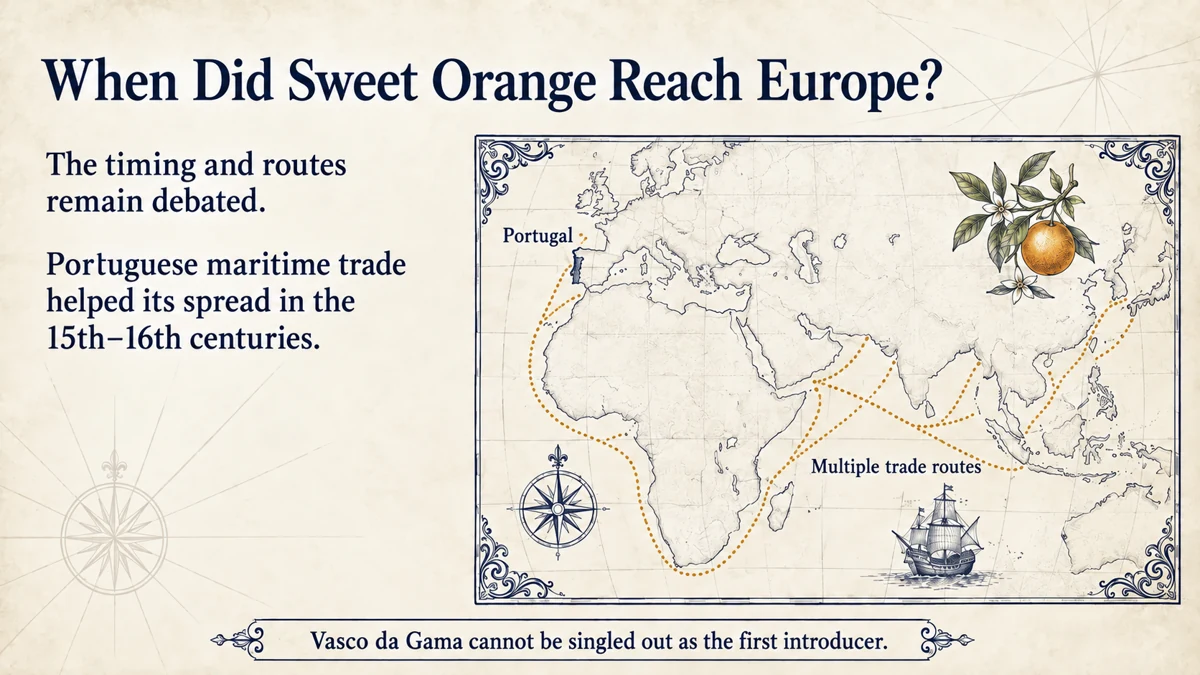
Sweet orange became widely known in Europe considerably later than bitter orange. Records place cultivation in Italy in the fifteenth century, and it spread through the Mediterranean by the early sixteenth century. Portuguese merchants played a major role, but the first person and date of introduction remain uncertain. Accounts of Vasco da Gama seeing good oranges in East Africa in 1498 do not prove that he first brought sweet orange to Europe.
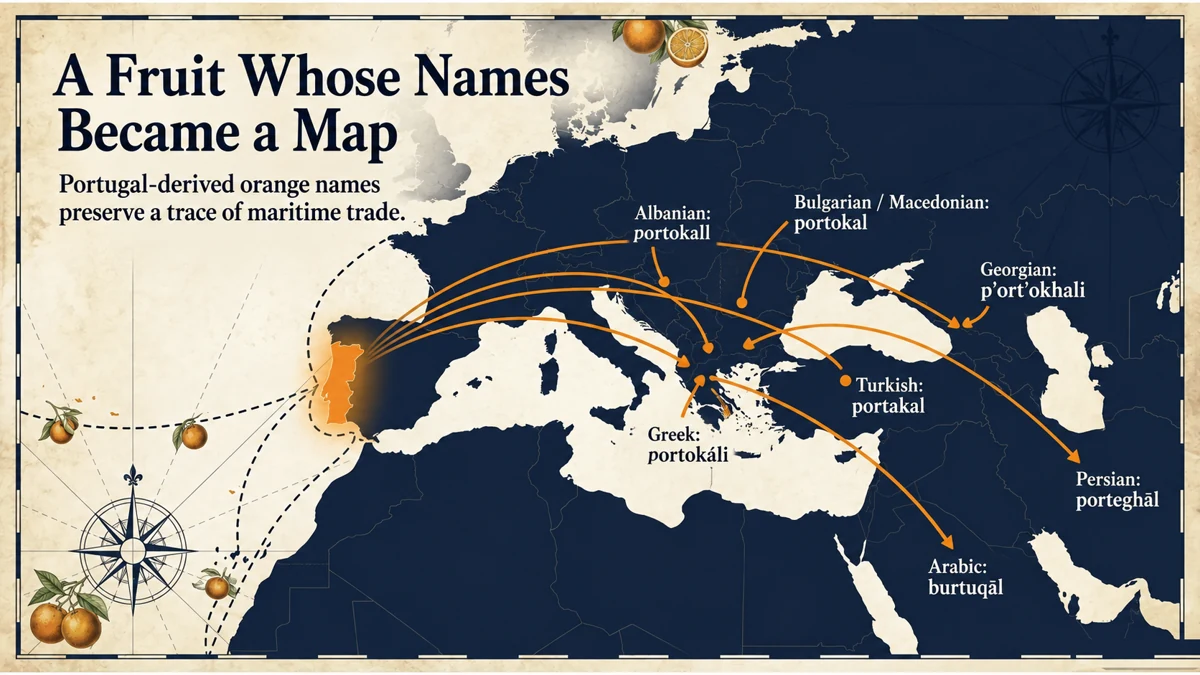
By the seventeenth century, sweet oranges were associated with the name “Portugal orange”. Related words survive in many languages: Albanian portokall, Arabic burtuqāl, Azerbaijani portağal, Bulgarian and Macedonian portokal, Georgian p’ort’okhali, Persian porteghāl, Turkish portakal and Greek portokáli. Their connection to Portugal preserves a trace of trade in everyday speech.
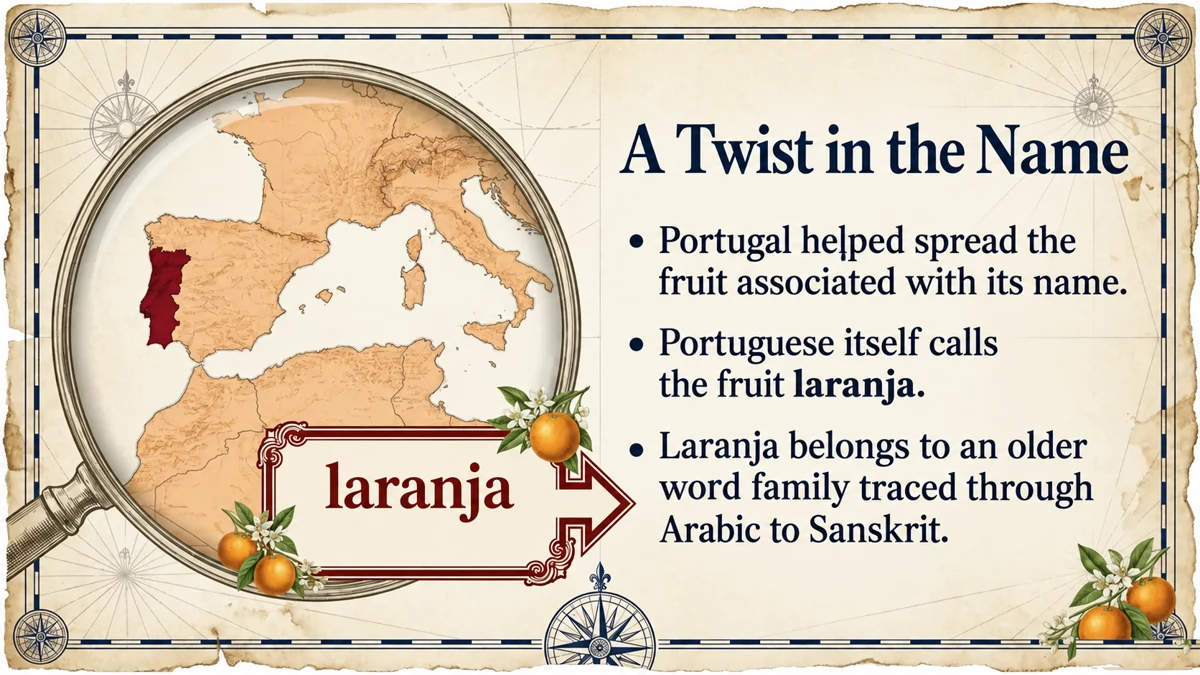
Yet Portuguese itself calls the fruit laranja, not a word based on Portugal. Laranja belongs to the older family of fruit names that travelled through Arabic and can be traced back to Sanskrit. The country associated with another family of orange names kept using an older one of its own.
Cam and Quýt in a Vietnamese Proverb
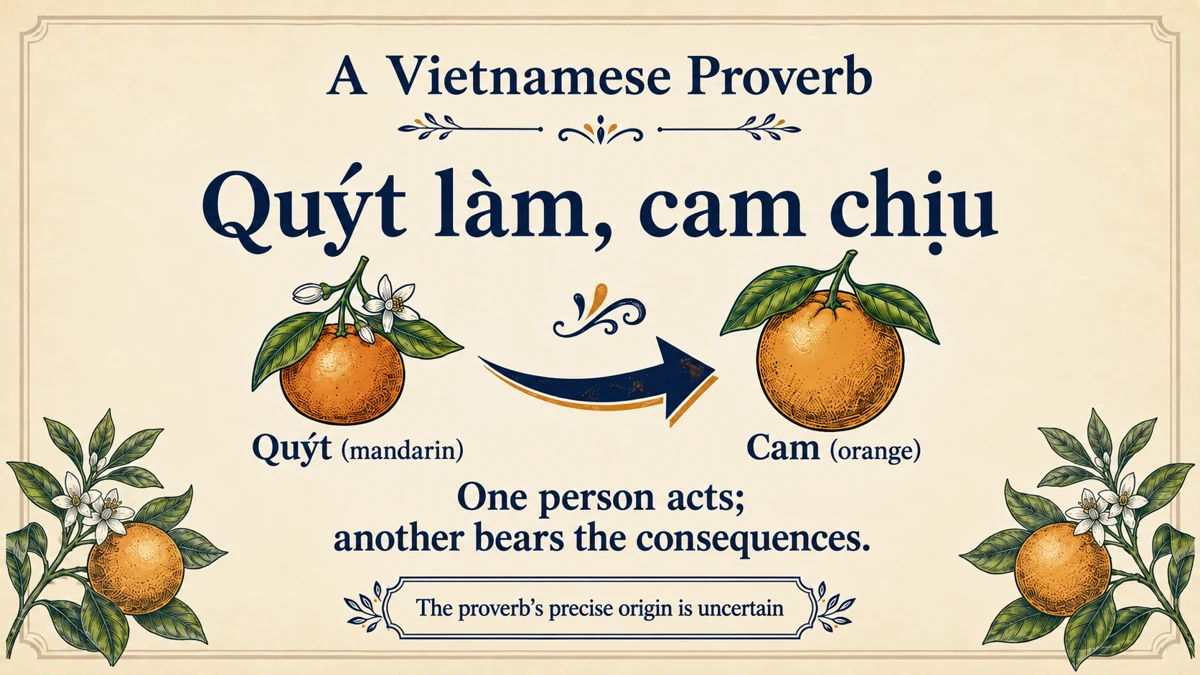
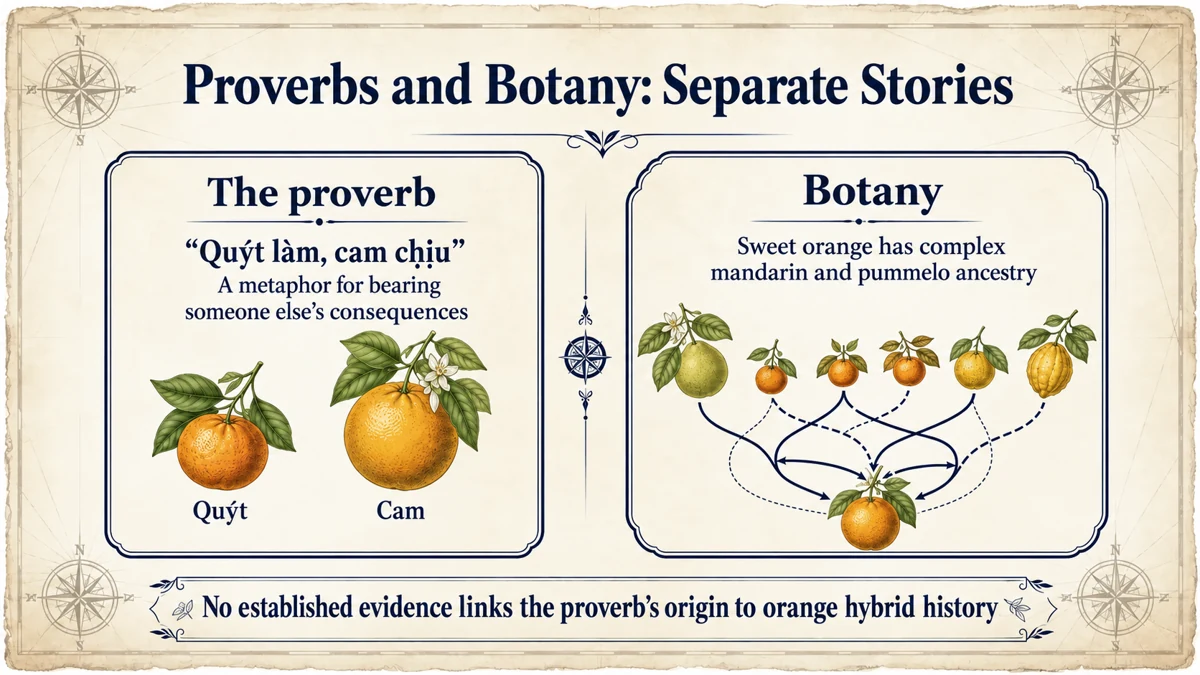
The research for this article did not identify a specifically Vietnamese origin myth for oranges. Instead, a familiar proverb offers a cultural connection: Quýt làm, cam chịu, literally “the mandarin does it; the orange bears it”. It describes one person suffering the consequences of someone else’s actions.
Several explanations of its origin circulate, but none was established conclusively here. Citrus cross-pollination can affect seed numbers and fruit set; some studies report changes in juice properties for particular cultivar combinations. This does not support a universal rule that growing quýt nearby always worsens cam flavour. The proverb’s meaning and proposed origin stories should be treated separately.
Why Orange History Resists One Simple Story
Pineapple also has a long history of Indigenous cultivation and trade that cannot be reduced to Columbus in 1493. Orange likewise resists a story with one heroic discoverer.
Its journey has many layers: citrus in ancient Chinese parables; bitter orange spreading around the Mediterranean through Arab and Islamic networks; citrus seeds crossing the Atlantic in 1493; and sweet oranges spreading in Europe during the fifteenth and sixteenth centuries. Portuguese trade left its mark in fruit names, while Vietnamese cam and quýt live on in a proverb.
The next time you hold an orange, remember a little of this history: a fruit shaped by many communities, across several regions and centuries.
For orange biology, nutrition, varieties and growing regions, see our Orange Guide.
Frequently Asked Questions About Orange History
Where Did Sweet Orange Originate?
Sweet orange is thought to have arisen in Asia, including southern China. It is cultivated citrus with complex mandarin and pummelo ancestry, rather than a single wild species brought directly into cultivation.
Which Came First: The Fruit Name or the Colour?
The fruit name came first. Its word history reaches back to Sanskrit, and English records of the colour name begin in the early sixteenth century.
Who Brought Oranges to Europe?
No single person can be identified. Bitter orange spread through Arab and Islamic networks, while Portuguese maritime trade helped promote sweet orange during the fifteenth and sixteenth centuries.
What Does “Quýt Làm, Cam Chịu” Mean?
Literally, “the mandarin does it; the orange bears it”. It describes someone suffering for another person’s actions. Its precise origin is uncertain.
Related Orange Articles
- Explore orange biology, nutrition and varieties in Orange Guide.
- For choosing, cutting and eating oranges in Vietnam, see How to Eat Oranges in Vietnam.
- Discover a South American fruit shaped by Indigenous cultivation and Caribbean trade in Pineapple History.
- Browse other fruits to enjoy in Vietnam Fruit Guide.
References
- Chinese Wikipedia: Southern citrus, northern trifoliate orange
- FAO: Principles and Practices of Small- and Medium-Scale Fruit Juice Processing, Chapter 11
- AGRIS: Cuándo y cómo se introdujo la naranja dulce en España
- Tastes of History: A Brief History of Food — Oranges
- Portugal Resident: Oranges — A Brief History of Our Daily Staple
- Omniglot Blog: Portugal Oranges and Chinese Apples; Medium: The Origin of the Word “Portakal”
- Vietnamese public-service source: Quýt làm, cam chịu; Thanh Niên: Lắt léo chữ nghĩa — Quýt làm cam chịu
- Scientia Horticulturae: Effects of cross-pollination by ‘Murcott’ tangor on ‘Qicheng 52’ navel orange
