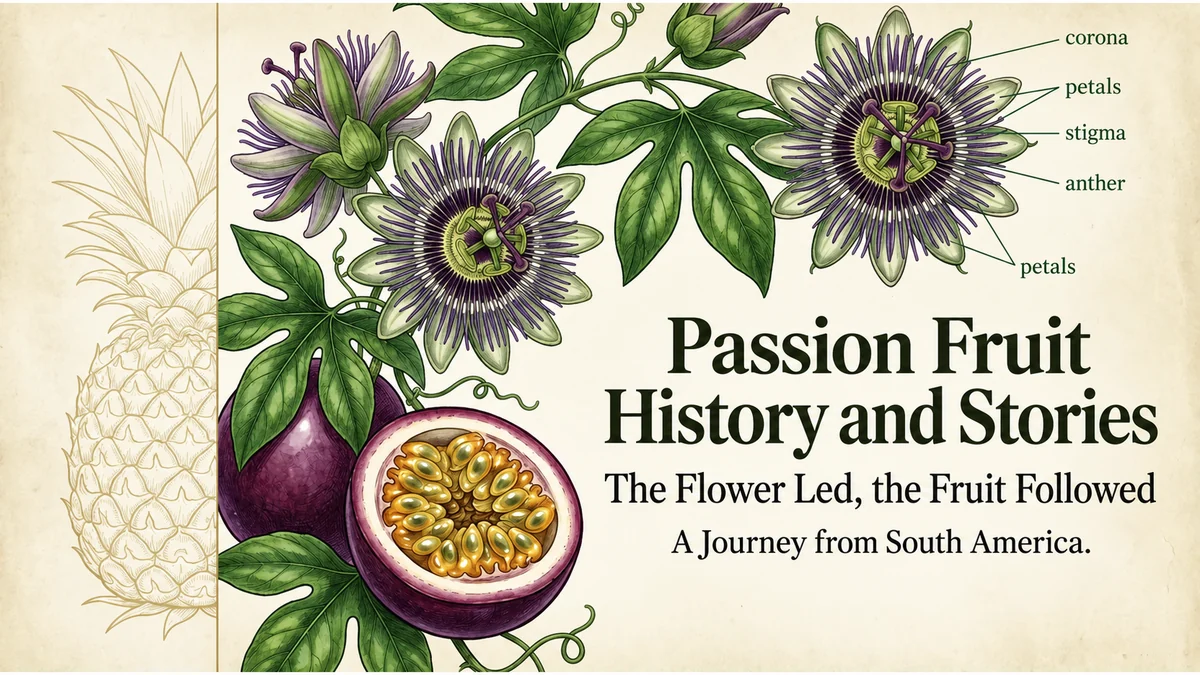
Two fruits from similar South American origins, travelling around the world at different speeds.
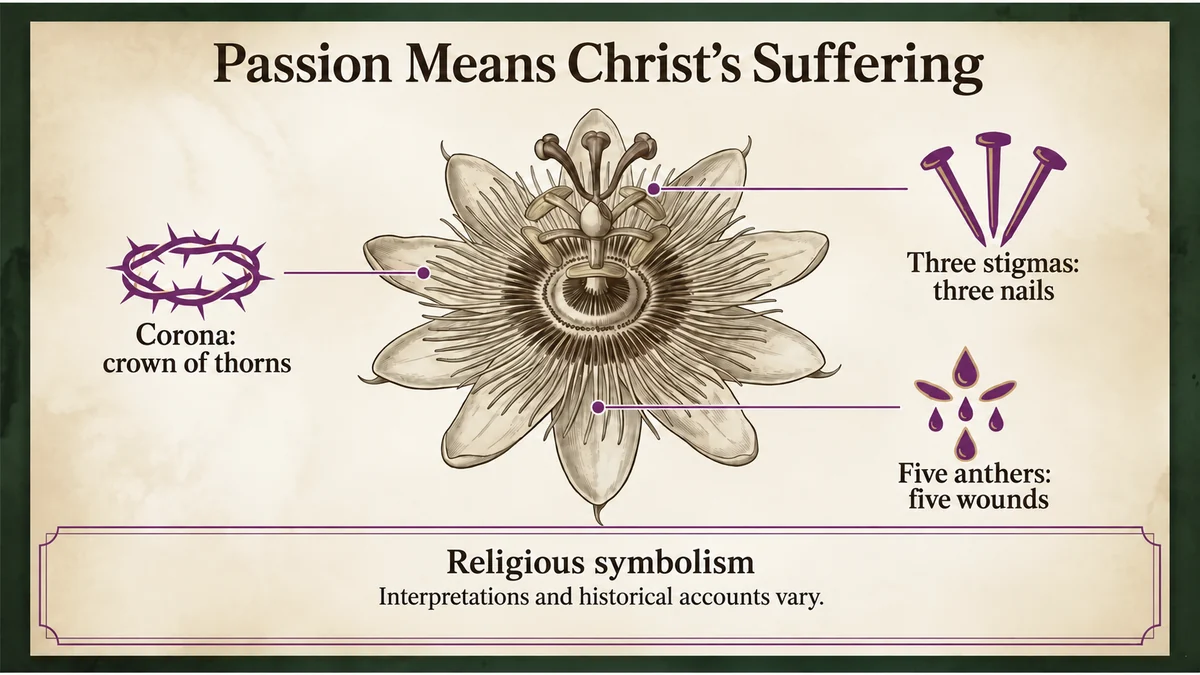
A ring of filaments, five anthers and three stigmas: as described in Passion Fruit Guide, Christian interpreters saw the Passion of Christ in these flower parts. That religious meaning gave passion fruit its English name.
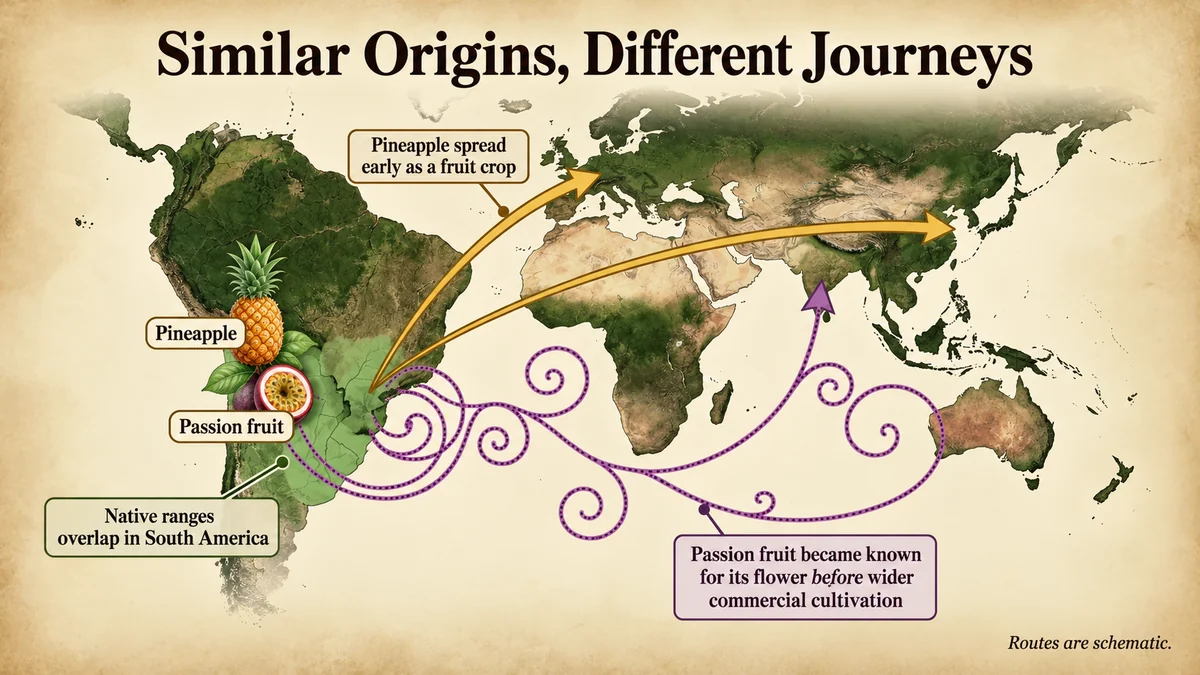
This story is a companion to the pineapple story. The two fruits have overlapping South American origins, yet their international journeys emphasized different things. Pineapple spread prominently as a fruit crop. Passion flowers attracted religious and botanical attention before passion fruit became a widely cultivated commercial crop.
Their histories offer a way to compare how taste, symbolism, trade and cultivation shape a fruit’s journey.
South American Origins
The companion pineapple story begins in the South American lowlands around southern Brazil and Paraguay.
Passion fruit begins nearby. Kew’s Plants of the World Online places the native range of Passiflora edulis in Brazil, Paraguay and northeastern Argentina. Its use in South America predates European arrival, although this article cannot identify a single people or date as the beginning of cultivation.
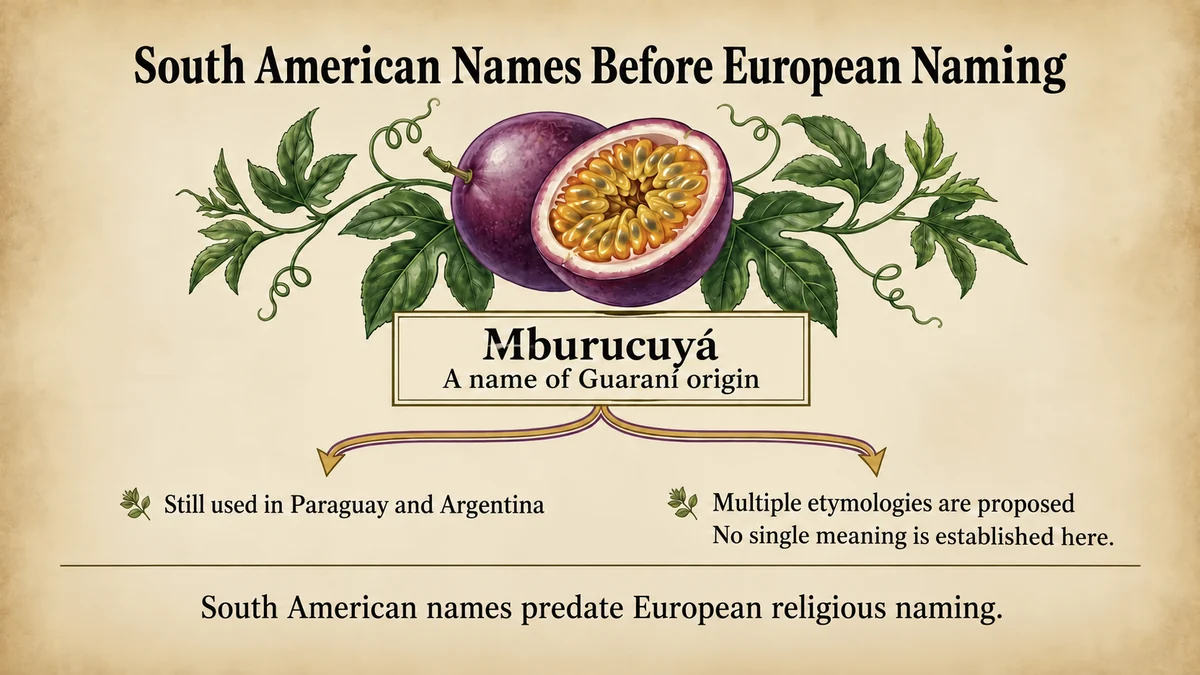
The plant also had local names before the European religious name. Mburucuyá, commonly associated with Guaraní, remains in use in places including Paraguay and Argentina. Several explanations of its etymology circulate; the sources consulted do not establish one definitive meaning.
Both fruits started their journeys with names and uses rooted in South American life.
How the Flower Became a Symbol of Christ’s Passion
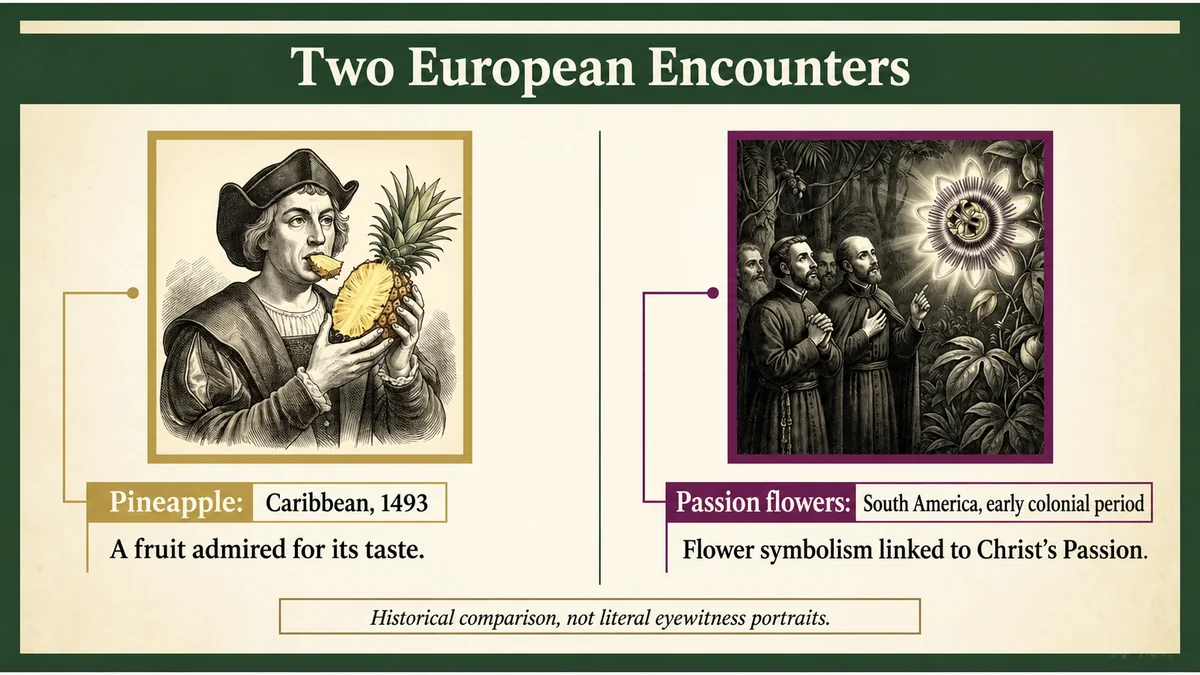
The pineapple story recounts the European encounter with the fruit in the Caribbean during Columbus’s 1493 voyage. Pineapple was admired as something to taste and grow.
European accounts of passion flowers emerged in the early colonial period. Spanish and Portuguese Christian observers in South America became interested in the unusual flower, but the story developed along a different path from pineapple’s.
Christian interpretations associated the corona with the crown of thorns, five anthers with five wounds, and three stigmas with three nails. Accounts differ over the exact people and dates involved. These associations belong to religious symbolism, rather than botanical explanation.
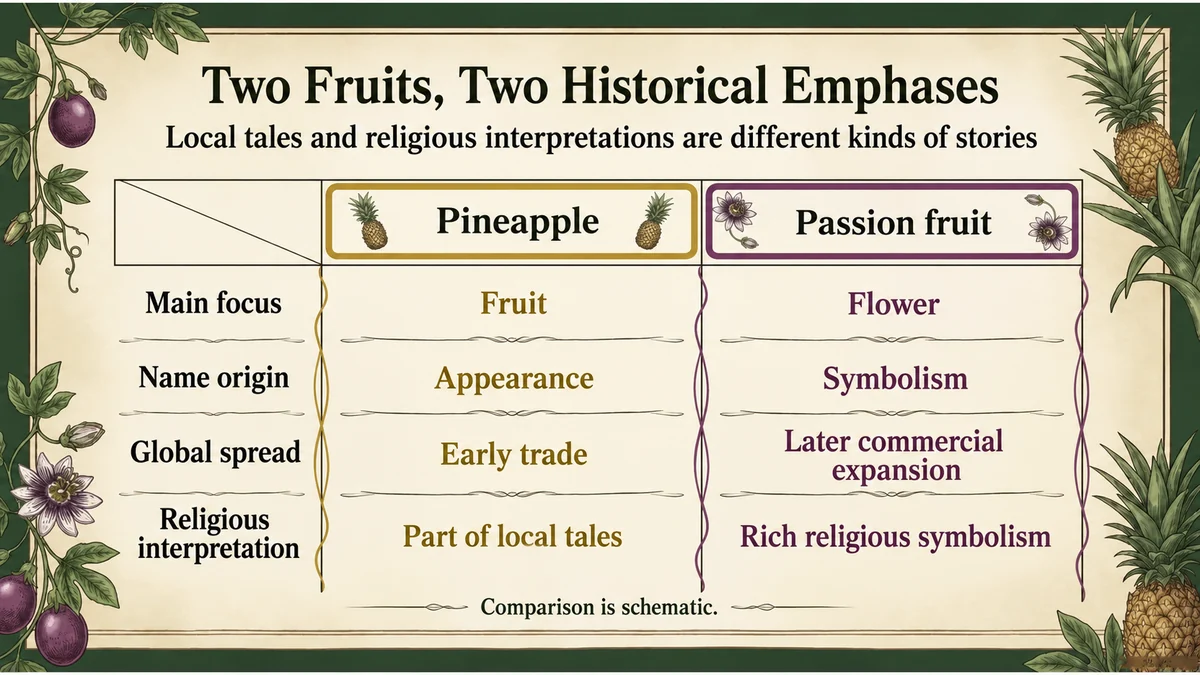
The English name “pineapple” describes a resemblance to a pine cone and uses the old fruit term “apple.” “Passion fruit” instead reflects meaning attached to its flower. Neither English name replaced all the local names used in the fruits’ native regions.
Scientific Names: From Passiflora to Passiflora edulis
Pineapple’s European history is often told through encounters with the fruit during early maritime exploration.
For passion flowers, religious interpretation and botanical study became prominent parts of the international story. Scientific naming followed its own chronology.
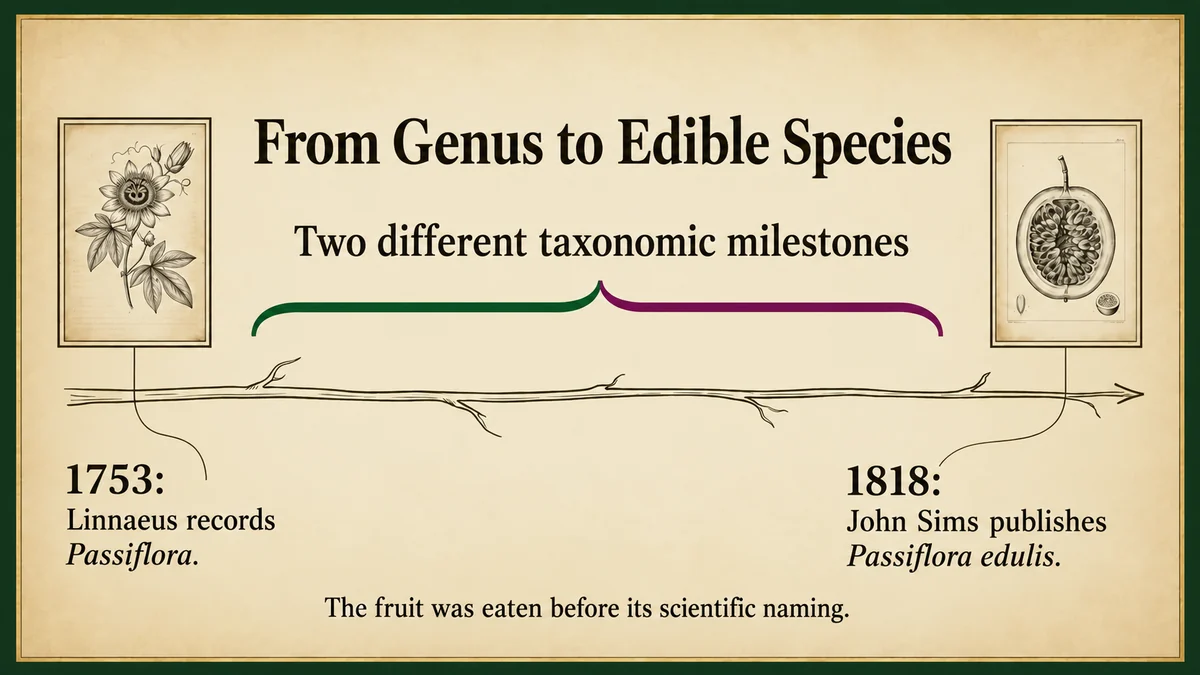
In 1753, Carl Linnaeus recorded the genus Passiflora in Species Plantarum. The name carried forward the flower’s association with Christ’s Passion.
In 1818, John Sims published the species name Passiflora edulis. The epithet edulis means “edible.” These two taxonomic milestones were 65 years apart.
The naming of an edible species did not mark the discovery that people could eat the fruit. South American use came earlier. It shows how botanical classification developed after the flower had attracted international attention.
The Spread of Cultivation
Pineapple was carried through tropical maritime trade routes during the sixteenth century, reaching regions in Africa and Asia.
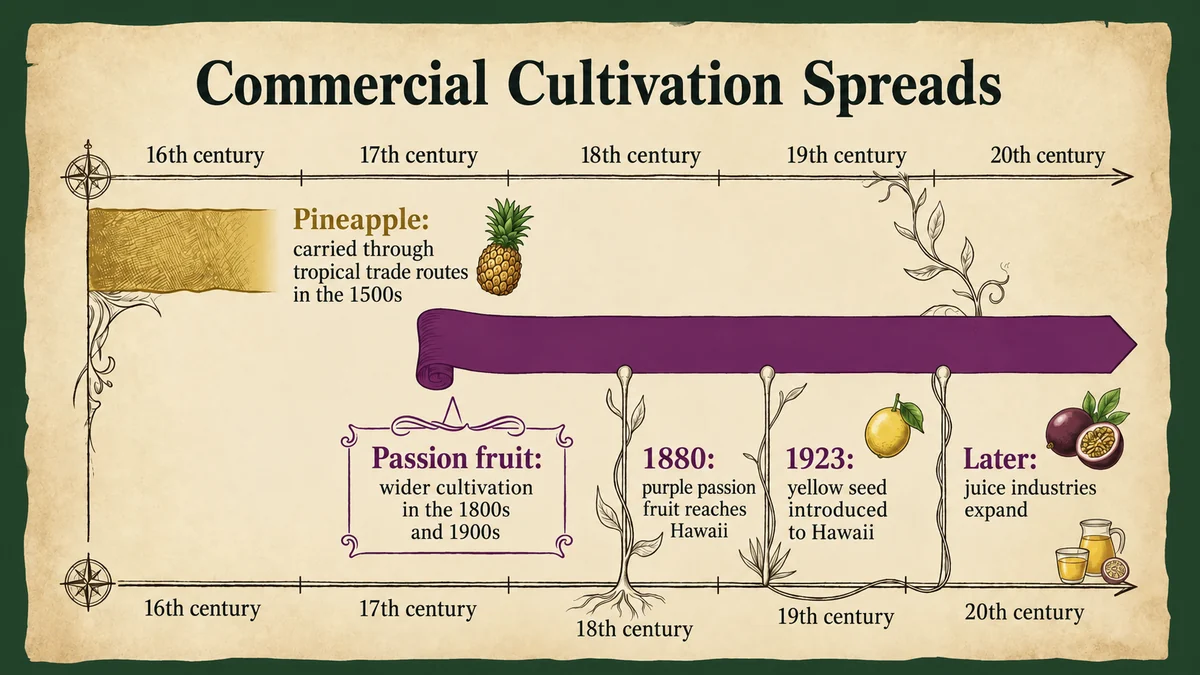
Wider commercial cultivation of passion fruit became more prominent in the nineteenth and twentieth centuries. Purple passion fruit was established in Australia by the late nineteenth century and introduced to Hawaii in 1880. Historical accounts describe yellow passion fruit seed reaching the Hawaiian agricultural experiment station in 1923 after an Australian visit by a Florida grower.
During the later twentieth century, commercial growing and juice processing expanded in Brazil. Brazil became a major producer, but its share of global production varies with the year and dataset.
These histories describe different patterns of international expansion. Pineapple moved early through tropical trade routes, while passion fruit’s commercial cultivation became especially visible later.
Vietnam: From Modest Cultivation to an Export Crop
The companion pineapple story describes the introduction of processing varieties to southern Vietnam around 1936–1937.
Passion fruit is reported to have reached Vietnam during the early twentieth-century French colonial period. Accounts name places in the Central Highlands, including the former provinces of Lâm Đồng, Kon Tum, Gia Lai and Đắk Lắk. Initially its roles were modest: shade, ornament and fruit for refreshing drinks. Those historical place names reflect the geography used in the sources.
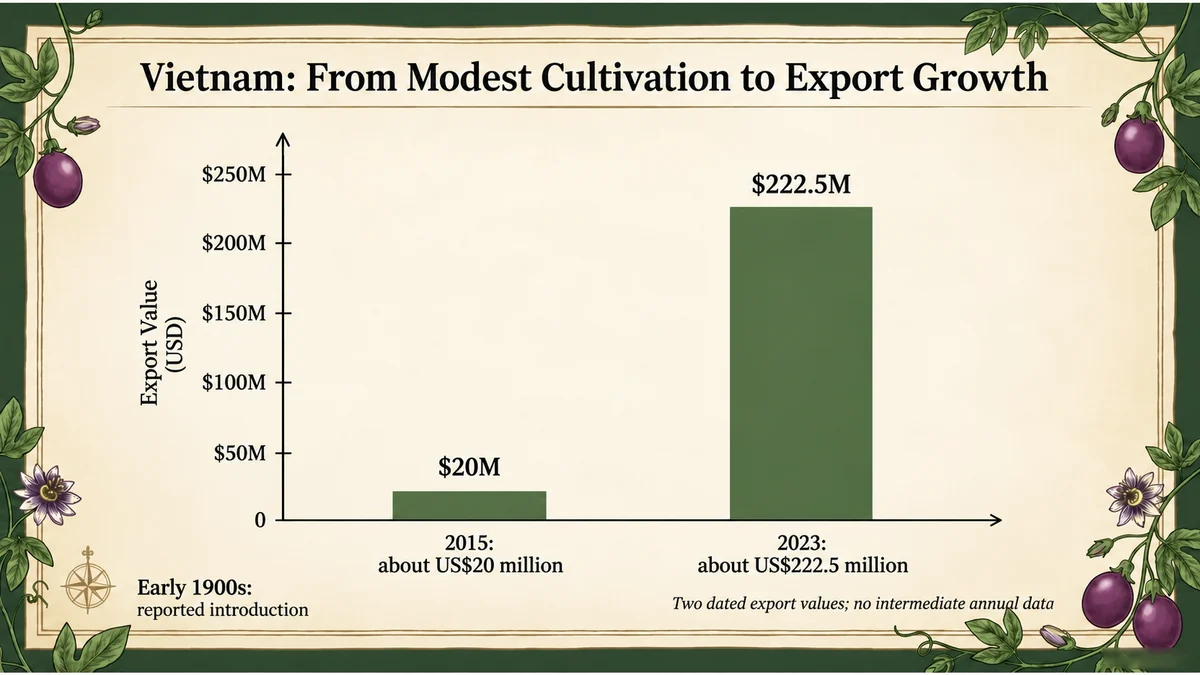
Reports describe relatively small-scale cultivation before 2015, including Lâm Đồng and Đắk Nông. Dated export figures cited in Passion Fruit Guide rise from about US$20 million in 2015 to about US$222.5 million in 2023. They illustrate a major expansion, rather than a complete annual record or a current ranking.
Passion fruit’s Vietnamese history thus has a different emphasis from a planned processing-crop introduction: an initially modest presence followed by much wider commercial attention.
Arrival in Japan: Records and Traditions
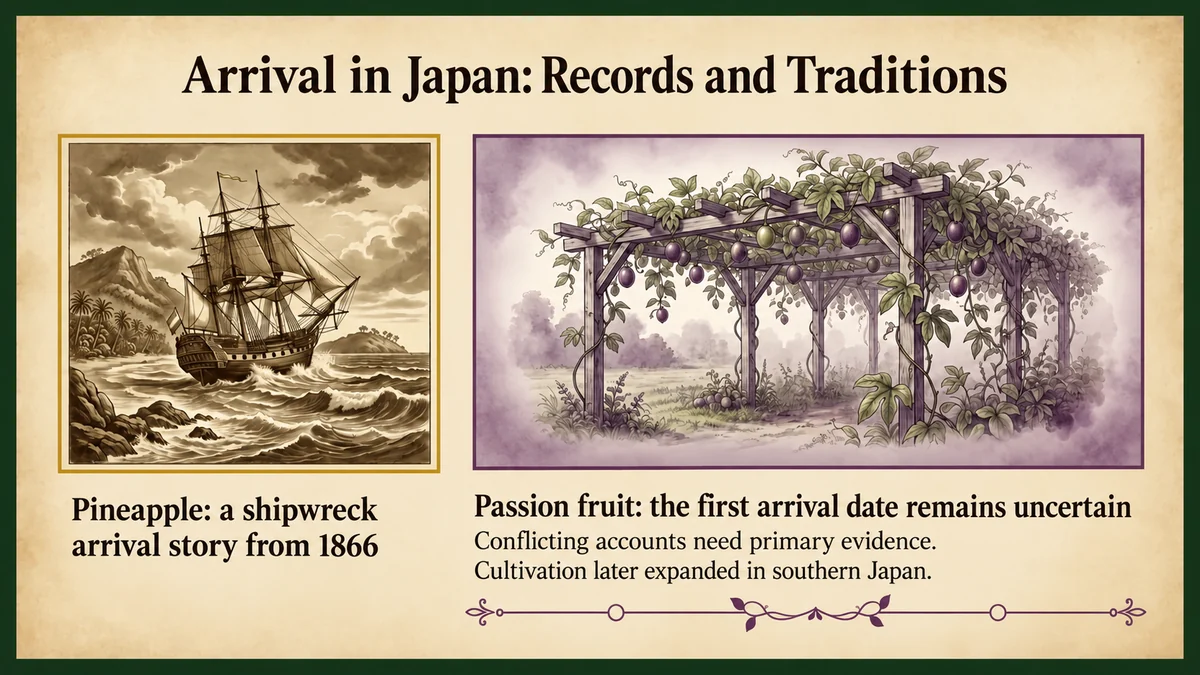
The pineapple story includes an account of plants reaching Ishigaki after a Dutch shipwreck in 1866. Such vivid arrival stories need to be distinguished from the wider history of cultivation.
For passion fruit, the sources consulted did not establish one securely documented first-arrival date. Claims of arrival in the Meiji period or the eighteenth century conflict and need primary evidence. Later accounts describe cultivation expanding in Okinawa and southern Kyushu during the twentieth century. This article treats the exact first arrival as uncertain.
The comparison is between a memorable arrival tradition and a fruit whose earliest Japanese presence is less clearly documented here.
Looking for Vietnamese and Southeast Asian Folk Tales
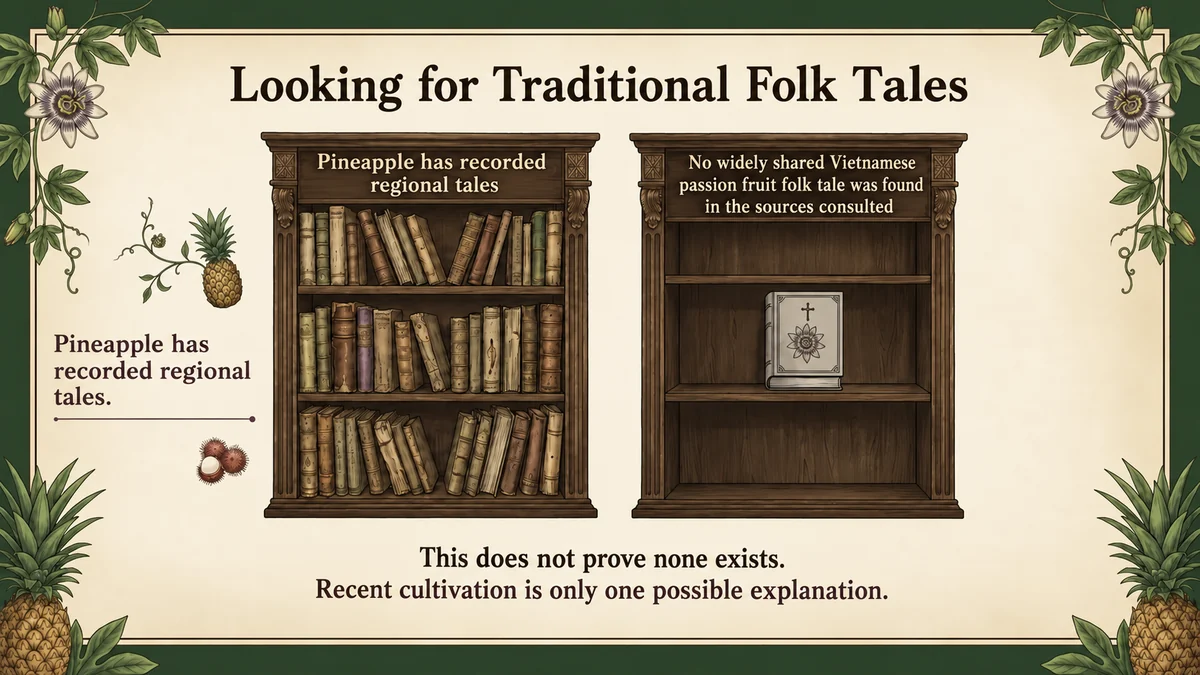
The pineapple story introduces regional tales, including the Philippine story of the girl Piña and a Vietnamese tale linking the fruit with a mother’s tears.
For passion fruit, no widely shared traditional Vietnamese or Southeast Asian tale was found in the sources consulted. This does not establish that no such tale exists. Its relatively recent regional cultivation is one possible explanation for a smaller recorded folklore, but that remains a hypothesis.
The religious story associated with passion flowers is a different kind of narrative: an interpretation brought by Christian observers. Local tales passed through communities and religious teaching attached to a plant should be understood in their own contexts.
The Flower Led, the Fruit Followed
Pineapple’s international history moved through maritime trade, elite cultivation and later canning industries. The edible fruit remained a central attraction, although local use and cultivation long preceded these European and industrial stages.
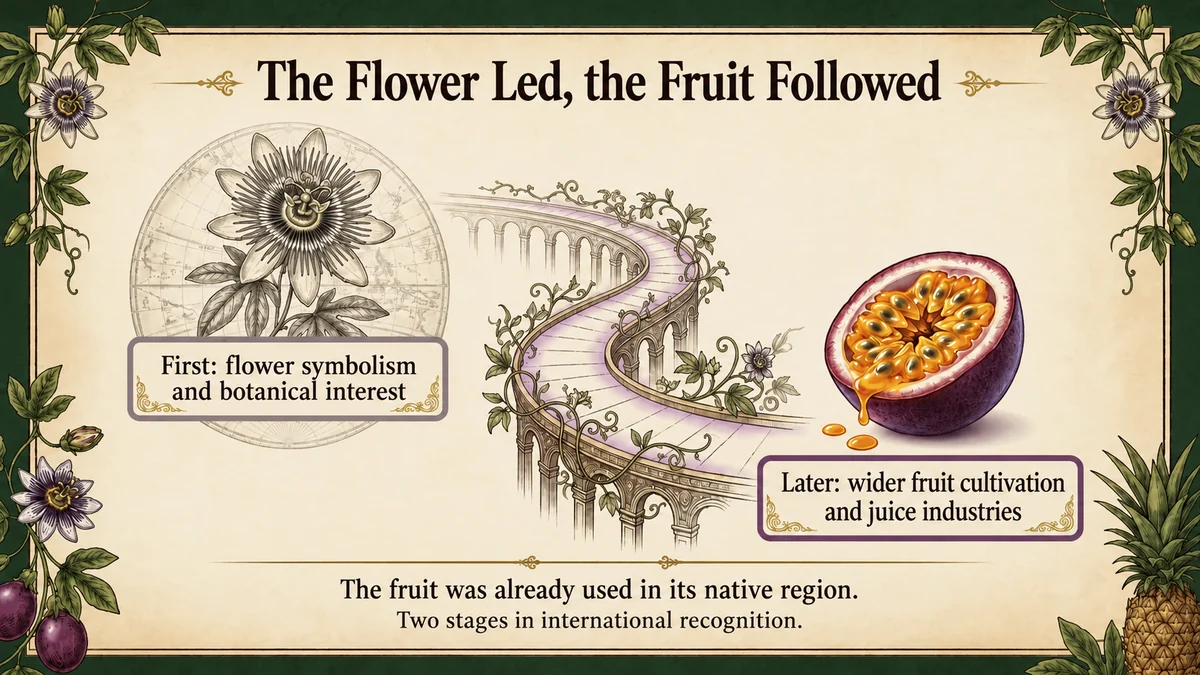
Passion fruit grew in a similar South American region, but international recognition followed another pattern. Religious symbolism drew attention to the flower. Botanical classification developed later, and commercial fruit cultivation expanded widely during the nineteenth and twentieth centuries. These stages overlapped; scientific naming did not begin fruit eating, and later commercial expansion did not erase earlier local use.
The next time you open a passion fruit and scoop its aromatic pulp, remember this layered journey: a familiar South American plant whose flower and fruit attracted international attention in different ways.
Related Articles
- Names, flowers, varieties and nutrition: Passion Fruit Guide.
- Buying, choosing, cutting and enjoying the fruit: How to Eat Passion Fruit in Vietnam.
- A companion journey from South America: Pineapple History and Stories.
- Other fruits you can encounter in Vietnam: Vietnam Fruit Guide: 15 Fruits.
References
- Wikipedia — Passiflora edulis
- Twisted Alchemy — The Surprising Origin of the Passion Fruit
- Wikipedia — Mburucuyá
- Unstoppable Stacey — Why Is It Called Passion Fruit?
- uCatholic — The Flower of the Five Wounds
- Capfruit — Passion Fruit
- GetNews — Passion fruit naming and flower symbolism
- Passionflow — Passion Flower History
- Purdue University Horticulture — Passionfruit, by Julia F. Morton
- Royal Botanic Gardens, Kew — Passiflora edulis Sims
- Royal Botanic Gardens, Kew — A Passion for Passion Flowers
- University of Hawai‘i — History of Hawaii’s Fruits and Nuts
- Vietnam Government News — Economic Potential of Passion Fruit
- Vetter — Vietnam’s Passion Fruit Exports
- Japan Wow — Passion Fruit History and Cultivation in Japan
