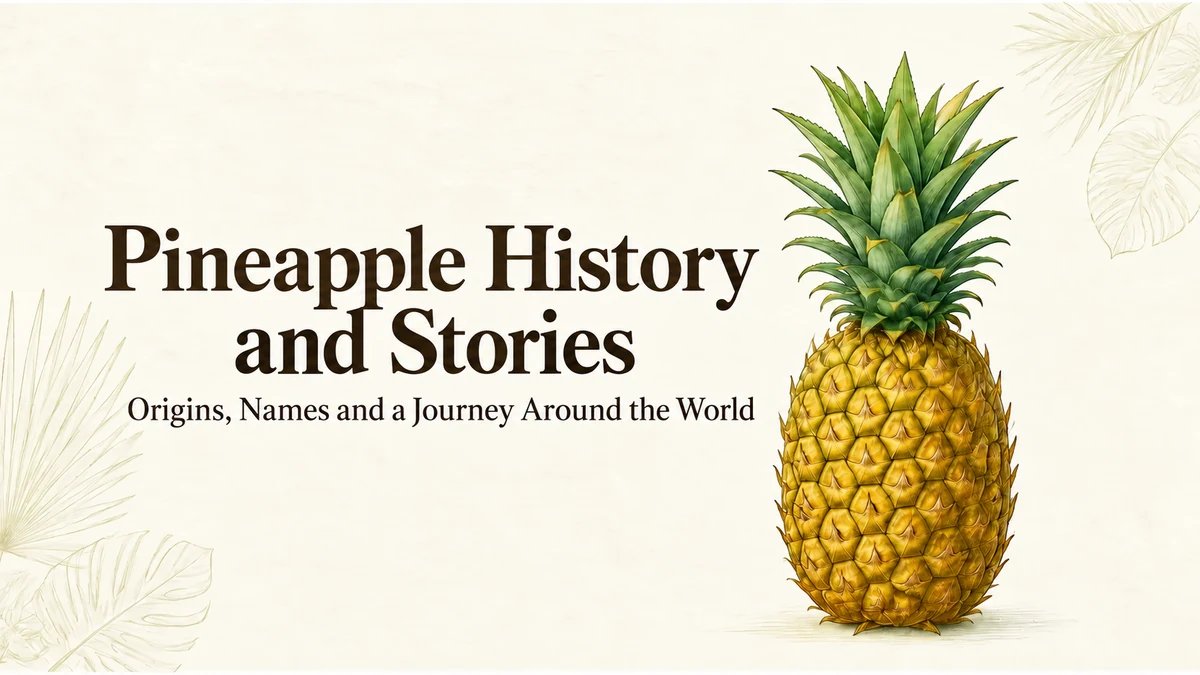
An illustrated journey through pineapple history, names and stories.
An armour-like skin. Green leaves like a crown.
Even on a supermarket shelf, a pineapple looks like a traveller from a distant land. Its journey has been long: cultivated in South America, carried across oceans, displayed at royal tables and eventually shared worldwide in cans and juice. Along the way, it became a sign of good fortune and welcome, and even the subject of family folktales.
This is the story of one fruit’s journey through history, language and local traditions.
What you will learn: its origin, English name, journey to Europe, Hawaiian processing industry, arrival in Japan, and legends and symbols in Taiwan, the Philippines and Vietnam.
It began in South America
Pineapple is thought to originate in the South American lowlands around southern Brazil and Paraguay.
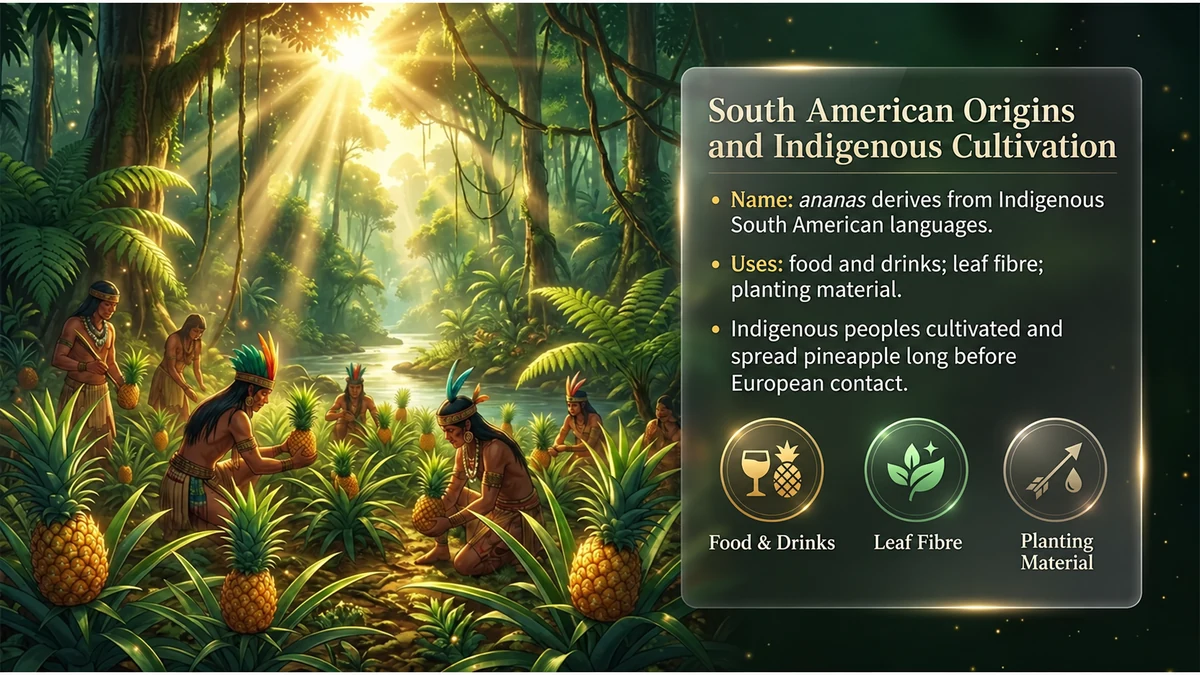
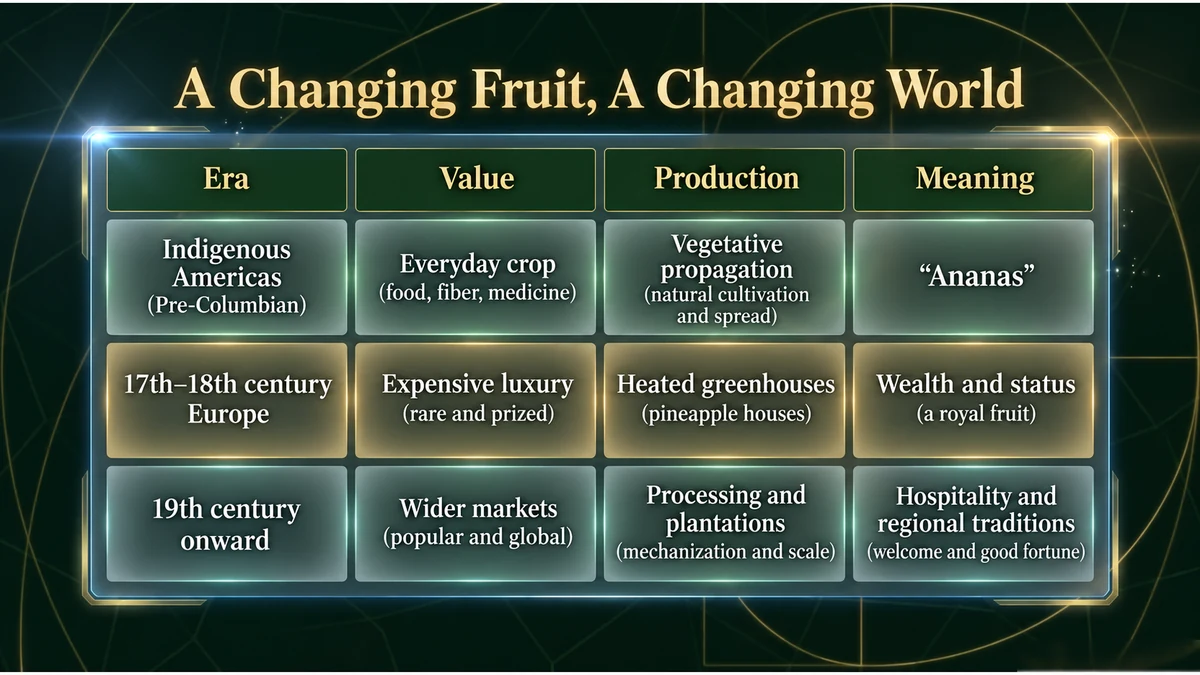
Indigenous peoples of the Americas were the first to cultivate it and incorporate it into everyday life. By propagating plants vegetatively, they spread pineapple widely across tropical America before the end of the fifteenth century.
The name ananas comes from Indigenous South American languages. It survives in French and many other languages, carrying a memory of the fruit’s homeland.
Names from Tupi-Guarani languages are associated with the botanical name Ananas comosus and the word ananas. Indigenous communities used pineapple for food, fermented drinks and leaf fibre.
1493: a European encounter
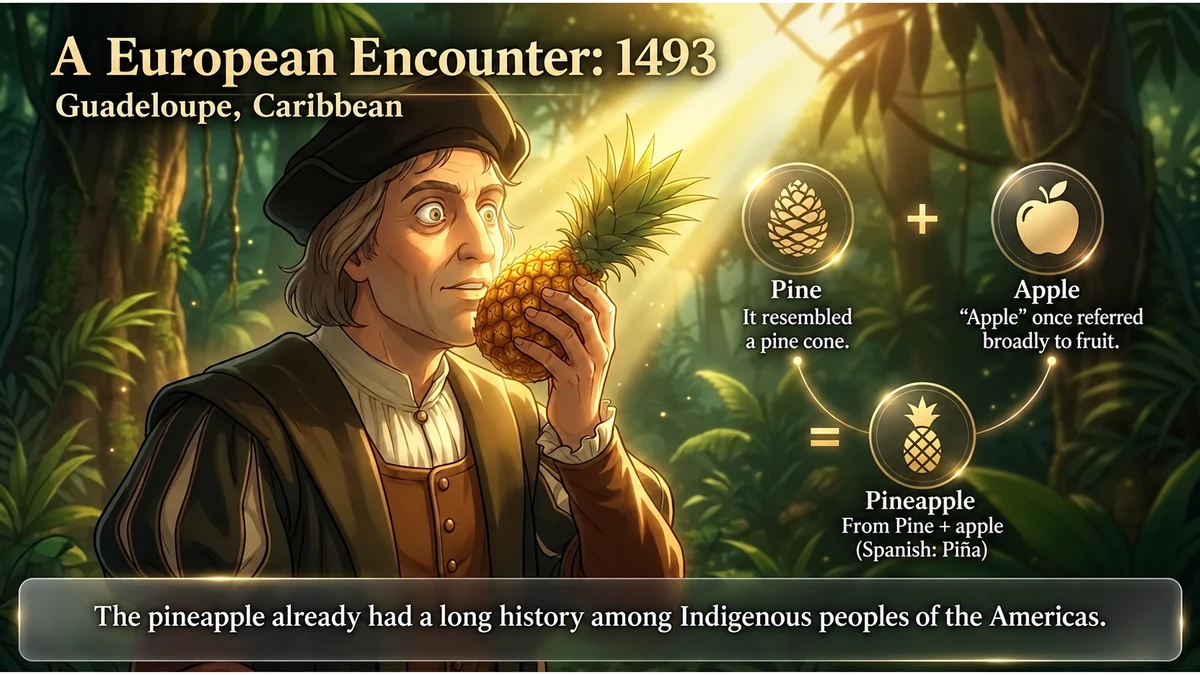
In 1493, Christopher Columbus’s expedition is said to have encountered pineapple on Guadeloupe during his second Caribbean voyage.
To Europeans, its shape resembled a pine cone. The English word pineapple eventually came to refer to this fruit.
European accounts praised its taste, but the origins of some familiar quotations are uncertain. They are not presented here as Columbus’s own words.
The expedition did not discover a fruit unknown to humanity. People had cultivated and shared it long before. The year 1493 marks a European encounter, rather than the beginning of pineapple history.
After this encounter, plants crossed the Atlantic and travelled to Africa, India, China and Southeast Asia. By the end of the sixteenth century, pineapple was cultivated in many tropical regions.
Plants crossed two oceans
The journey into Asia cannot be reduced to a single line on a map. Portuguese ships carried pineapple from Brazil towards Africa and India in the early 1560s, and it was reportedly familiar in Goa and Cochin by the late 1570s. It had reached the Mughal court by the late 1580s. Spanish ships also took plants across the Pacific to the Philippines during the 1580s. Different ports and trading networks helped carry planting material through Southeast Asia.
Pineapple can be propagated from its crown and from shoots. A plant carried to one port could establish there and provide planting material for another voyage.
A paper from the International Society for Horticultural Science describes Queen-type pineapple reaching southern Vietnam around the sixteenth century. Precise records identifying who carried it, when or to which port are scarce, and more than one route may have contributed.
A fruit to display
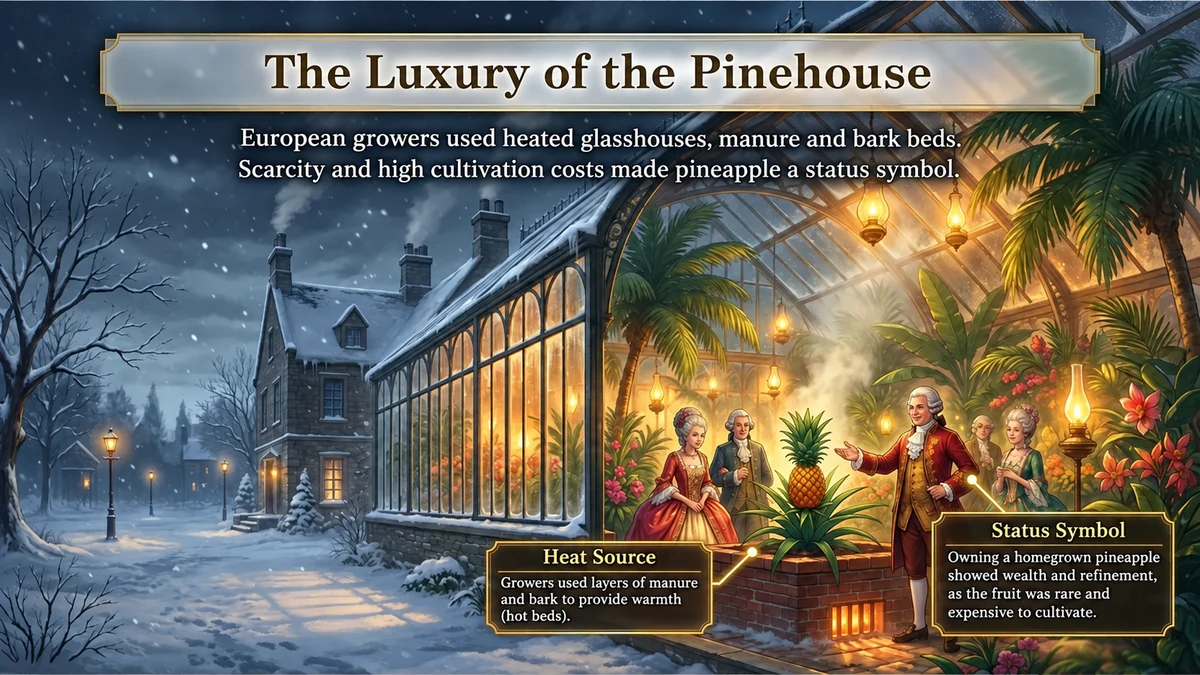
Growing a tropical pineapple in cold Europe was difficult. Glasshouses, fuel and years of care made production expensive. Transport was also challenging, so a single fruit could represent a considerable investment.
In seventeenth- and eighteenth-century Europe, pineapple became associated with wealth and power. It appeared as a banquet centrepiece and in architectural and furniture decoration. Display could matter more than eating.
With its crown of leaves, it was treated as a royal fruit.
Stories of hiring a pineapple for a single evening are widely repeated. Precise costs and the extent of the practice are less certain, so they are best treated as anecdotes illustrating rarity.

From royal fruit to everyday fruit
As ships became faster and growing and preservation techniques improved, pineapple’s role changed. Large-scale cultivation and canning could supply distant markets reliably, while refrigerated transport allowed fresh fruit to travel further.
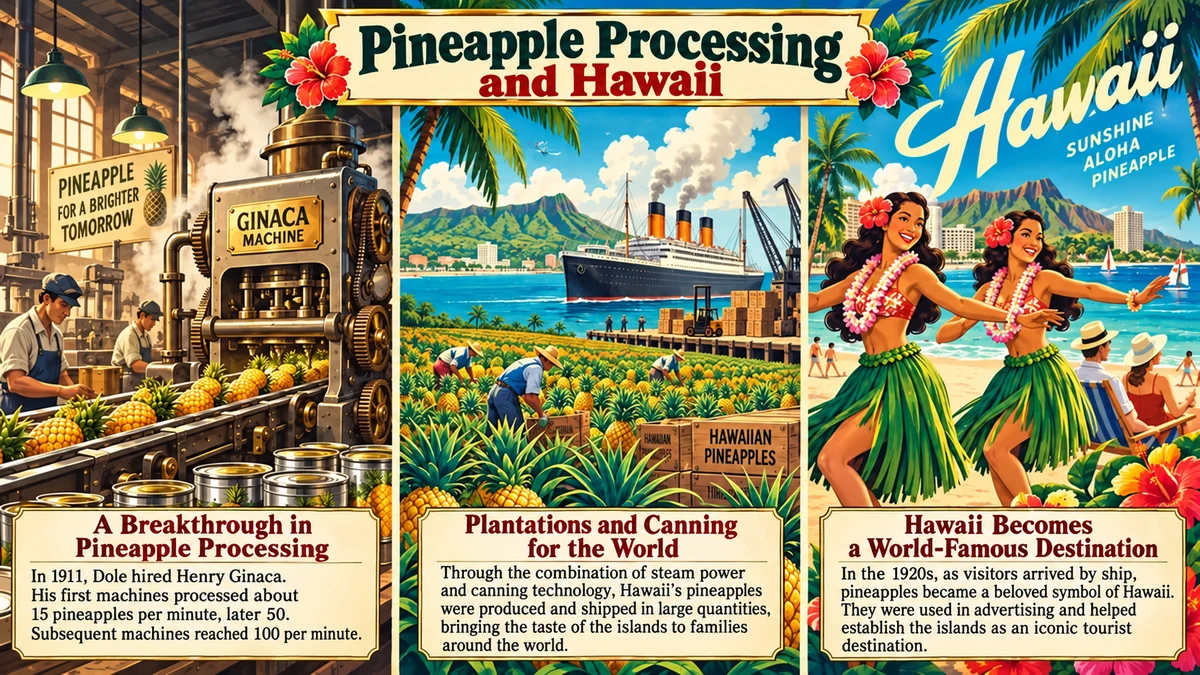
Hawaii’s canning industry helped make pineapple widely available. In 1911, James Dole hired engineer Henry Ginaca to automate fruit preparation. The machine shaped fruit into cylinders, trimmed the ends and removed the core. Early versions increased processing from roughly 15 to 50 fruits per minute, and later machines reached 100. During the 1920s, passenger liners and tourism also linked pineapple to the image of Hawaii as a tropical paradise.
A fruit once admired in banquet halls reached household tables as canned rings, juice, cakes and savoury dishes. It found a place in both desserts and local cooking traditions.
Wider availability also came with questions about plantation expansion, labour and land use. Pineapple’s travels are part of the history of modern trade and industrialisation.
In Japan’s southern islands
Okinawa is closely associated with pineapple cultivation in Japan.
Its arrival is traditionally linked to an unexpected event. In 1866, a Dutch ship reportedly ran aground near Ishigaki, and local people planted seedlings that washed ashore. Plants later reached Okinawa’s main island from the Ogasawara Islands in 1888, and Smooth Cayenne was introduced to Motobu in 1927.
Commercial cultivation developed later. Okinawa’s records describe 53 farming households arriving from Taiwan around 1935 with planting material, expanding pineapple for canning on Ishigaki. By the 1960s it was an important crop alongside sugarcane. The subtropical climate and well-drained acidic soils supported cultivation.
After the canning era, attention increasingly turned to fresh-eating cultivars: small fruit that can be pulled apart, mild acidity, distinctive aroma and sweetness. Pineapple breeding continues in Okinawa’s fields.
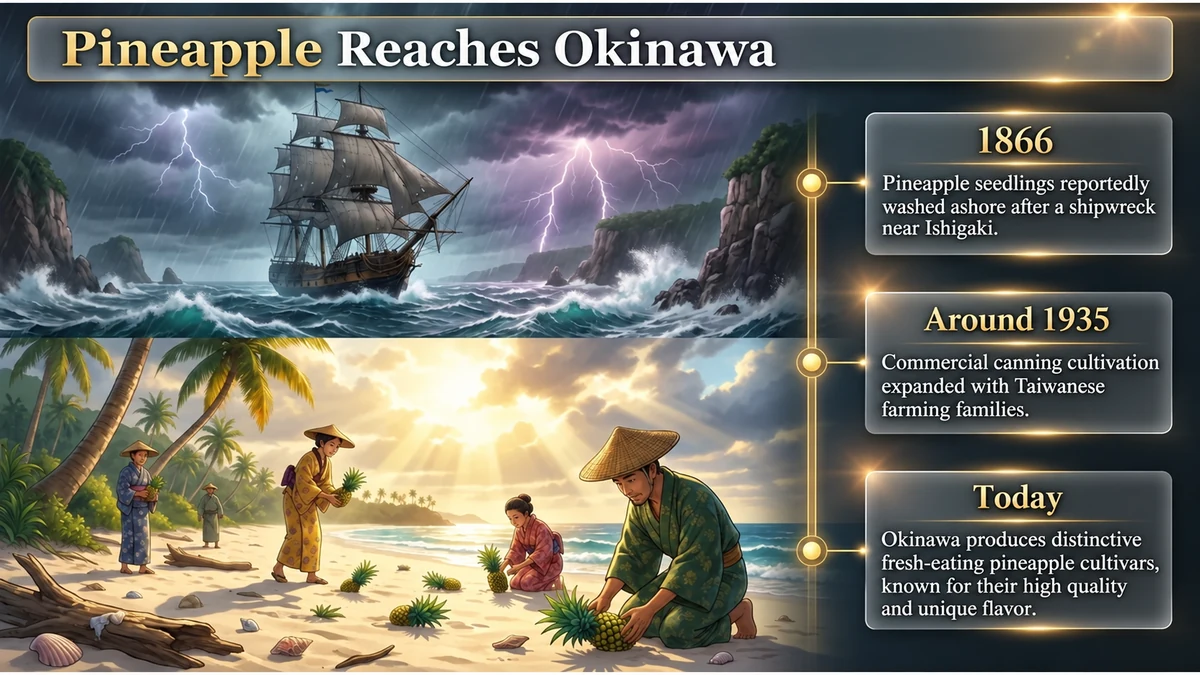
The reported arrival in 1866 and commercial expansion around 1935 were separate stages in Okinawa’s pineapple history.
Vietnam: from local fruit to industrial crop
Southern Vietnam’s production changed significantly around 1936–1937, when Smooth Cayenne was introduced for canning and processing factories were established around Saigon.
A locally grown fruit became a crop supplying factories. In the Mekong Delta, it could grow on acidic soils poorly suited to rice. Vietnam’s planted area reportedly reached about 43,000 hectares in 1988, then declined as processed-product markets weakened.
Okinawa and Vietnam are far apart, yet both saw canning stimulate production, followed by changing markets and interest in fresh and higher-value fruit.
One fruit, many flowers
The pineapple’s surface is covered with scale-like eyes.
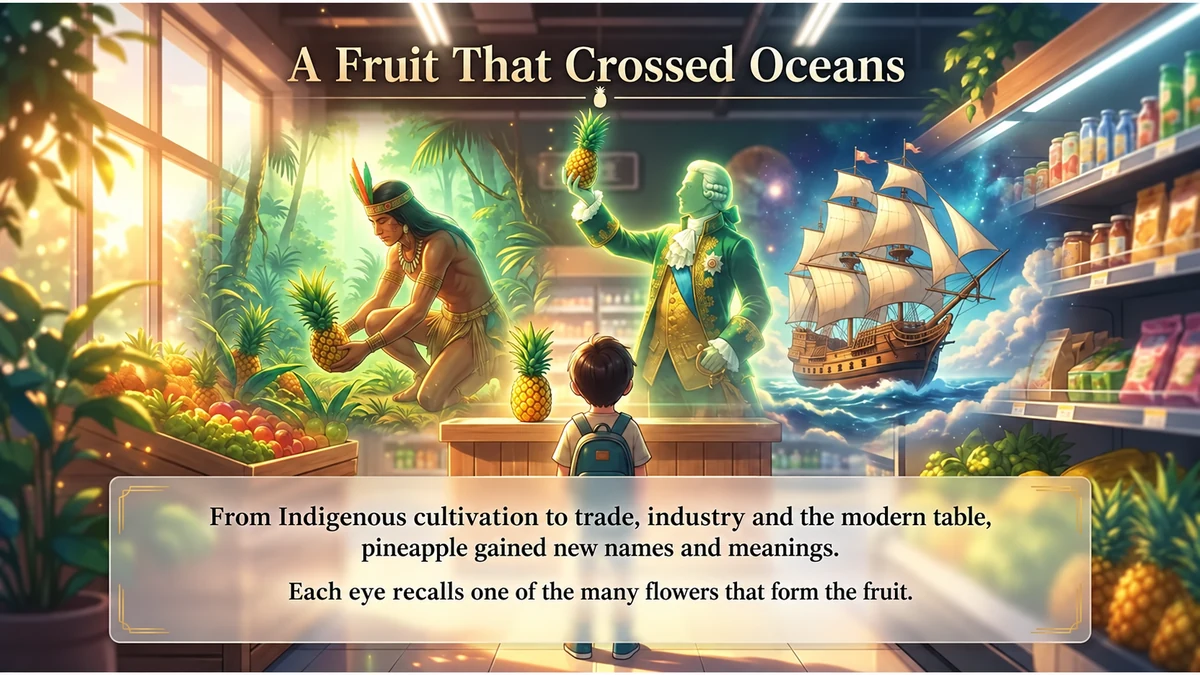
It does not develop from one flower. Roughly 100–200 flowers contribute to a multiple fruit: individual fruitlets and associated tissues fuse as they develop. Each eye recalls an individual flower.
Many flowers’ lives come together in the fruit we slice.
The enzymes known as bromelain, along with fruit acids, can contribute to mouth irritation. Bromelain is also used to tenderise meat. Stop eating if you feel discomfort; severe allergic symptoms require urgent medical attention.
Different stories from the same fruit
The following are local folktales and cultural symbols, rather than solely historical events. People have given the fruit’s crown, scent and many eyes meanings shaped by their own traditions.
Scotland: luxury turned into architecture
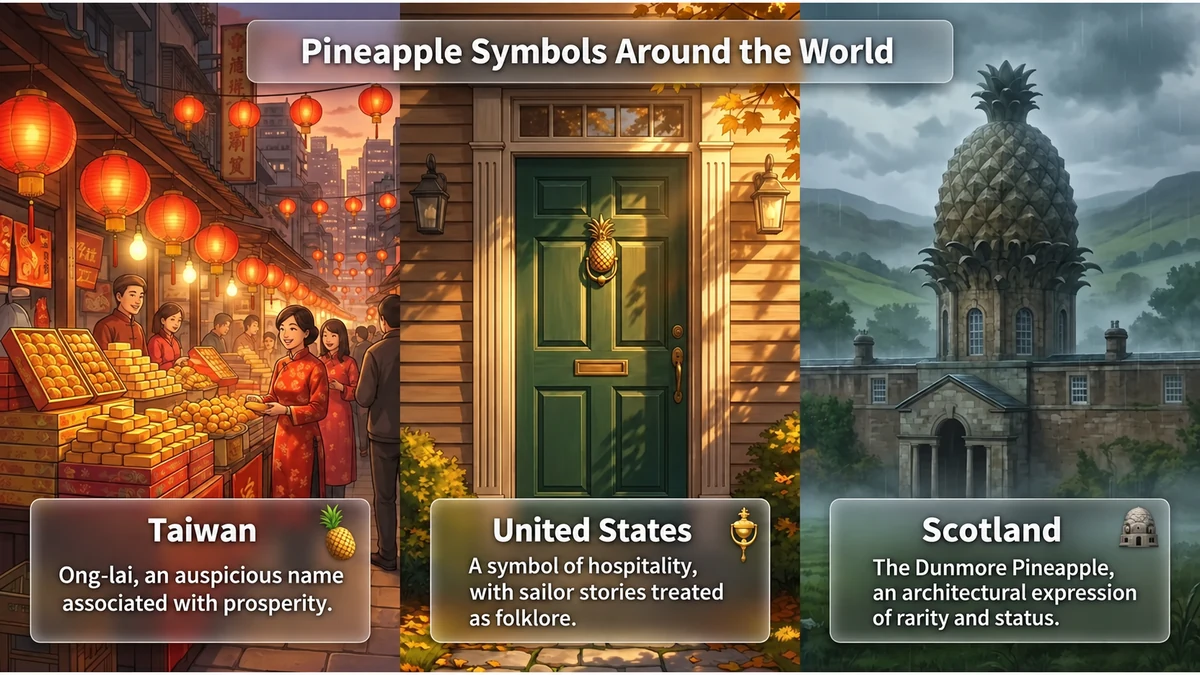
Scotland’s Dunmore Pineapple has a huge stone pineapple rising above its roof. The estate’s eighteenth-century summerhouse and surrounding cultivation facilities expressed a fascination with unusual fruit. The building is dated to 1761, while the exact history of the pineapple feature is less certain.
A tropical fruit was an extraordinary luxury in Scotland. Giving it a starring role in architecture reveals its rarity and appeal.
Taiwan: good fortune arrives
In Taiwanese Hokkien, pineapple is commonly called ong-lai. Its sound evokes the arrival of prosperity, making the fruit an auspicious offering and gift for openings or new homes.
Here it was the sound of the name, as well as its crown-like shape, that gave the fruit meaning.
United States: a welcome at the doorway
One familiar story says sailors displayed pineapple at their homes on returning safely from a voyage. Neighbours supposedly took it as an invitation to a welcoming gathering.
How much of this story is historical is unclear. Some accounts suggest pine cones were involved in decoration and later confused with pineapples. Nevertheless, pineapple as a sign of welcome remains a familiar American tradition.
Philippines: Piña, the girl with many eyes
The Philippines has a folktale called Alamat ng Pinya, or the Legend of the Pineapple.
Piña repeatedly asks her mother where household tools are instead of looking for them. Her ill mother wishes she had many eyes to find things herself. The girl disappears, and a strange fruit covered with eyes grows in the garden. The mother regrets her words, and the fruit takes her daughter’s name.
Versions differ, but the story can be read as a lesson about diligence and the harm of words spoken in anger.
Another piña: a traditional textile
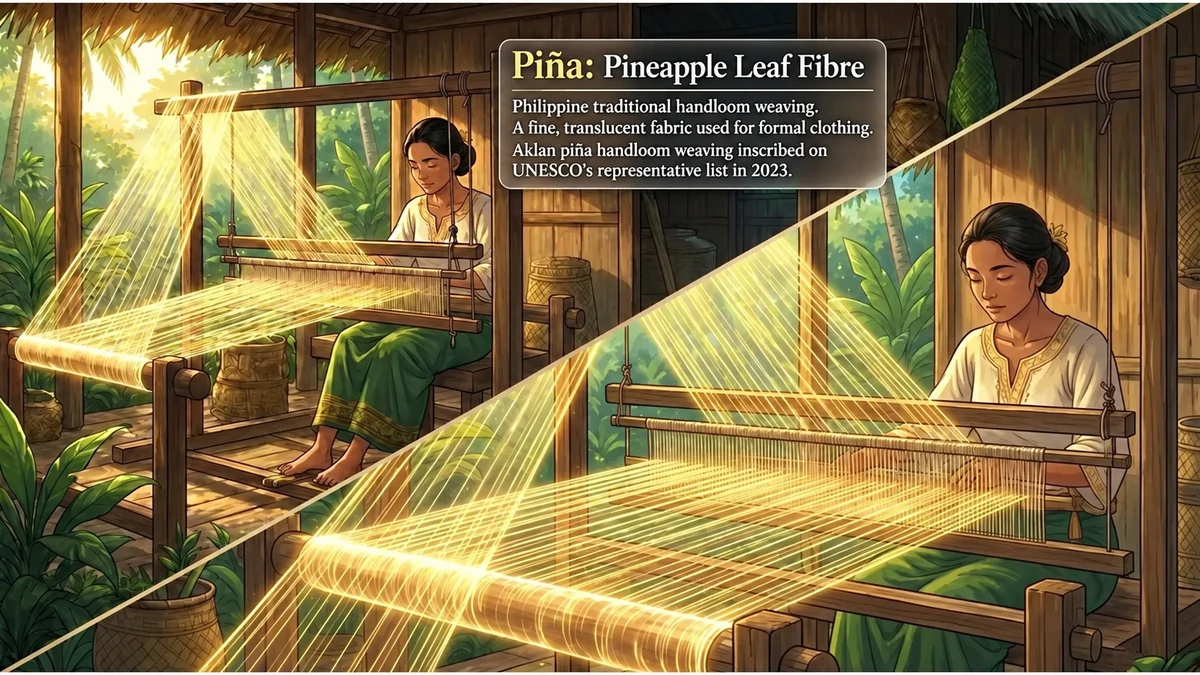
Piña also names a fine traditional cloth made from pineapple leaf fibres.
After pineapple reached the Philippines during the Spanish colonial period, leaf-fibre weaving developed into a craft. The translucent material is used for formal clothing, including the barong Tagalog and terno. It also reached elite European fashion in the nineteenth century.
The delicate fibres require skilled hand work. Aklan piña handloom weaving was inscribed on UNESCO’s Representative List of the Intangible Cultural Heritage of Humanity in December 2023.
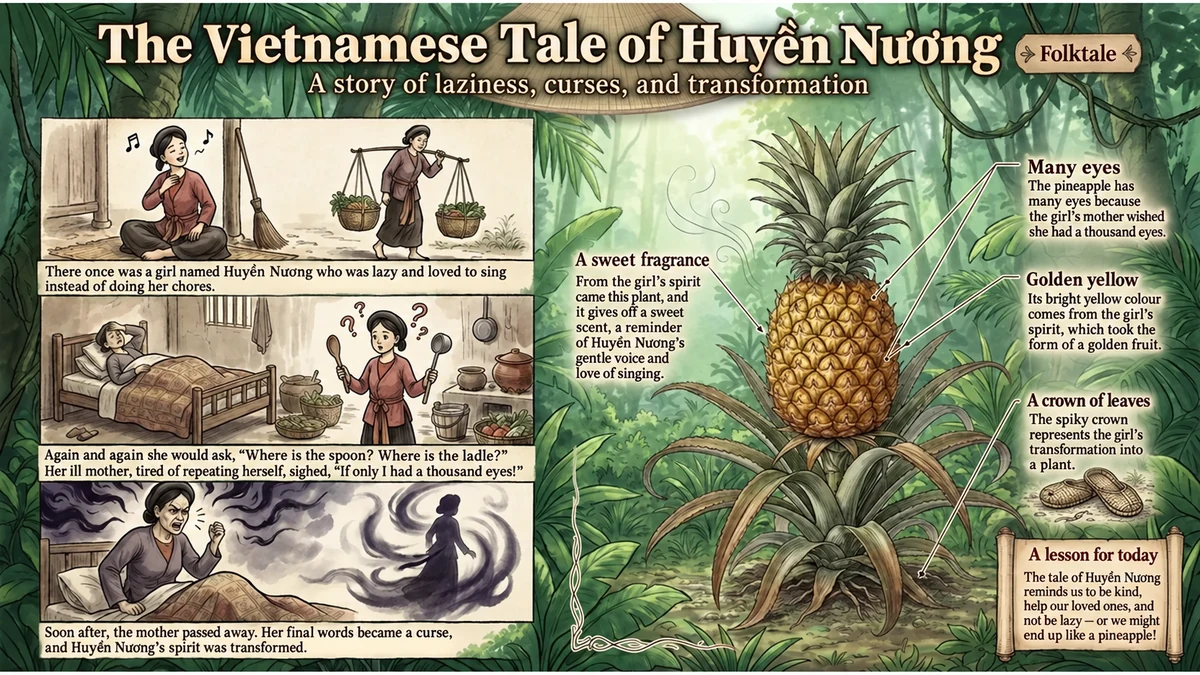
Vietnam: Huyền Nương and her mother’s tears
Vietnam has a similar tale, often introduced as Sự tích quả dứa or Sự tích trái thơm. Huyền Nương, a fifteen-year-old girl unfamiliar with household work, repeatedly asks her ill mother where tools are. In frustration, her mother says that many eyes would help her find them.
The girl vanishes, and a fruit with many eyes appears in the garden. Her mother’s tears are said to turn it yellow and give it a sweet fragrance.
The Philippine and Vietnamese stories are remarkably similar. Their order and any route of transmission are uncertain. Similar-looking fruit may also have inspired parallel explanations.
The journey continues at the table
From South American lowlands to the Caribbean, then Europe, Africa, Asia and Pacific islands.
As it travelled, pineapple acquired new names and roles: an Indigenous crop, a royal treasure, a plantation commodity and a summer snack. It evokes prosperity in Taiwan, welcome in the United States, and family stories in the Philippines and Vietnam.
The scent released when its tough skin is cut may still connect the modern table to that long journey.
Next time you eat pineapple, pause to look at its eyes. Behind each one are a flower, people and a long history of journeys across seas.
One fruit carries many histories.
Frequently asked questions
Where does pineapple originate?
It is thought to originate in South American lowlands around southern Brazil and Paraguay.
Where does the English name pineapple come from?
Pine refers to the fruit’s resemblance to a pine cone, while apple once referred to fruit more broadly. Ananas, used in many languages, comes from Indigenous South American languages.
When did pineapple reach Japan?
Records describe seedlings washed ashore and planted on Ishigaki in 1866, followed by later commercial cultivation in Okinawa.
Related articles
- Choosing, cutting, eating and storage: How to Eat Pineapple in Vietnam
- Botany, varieties, nutrition and season: Pineapple Guide
- More fruit to enjoy in Vietnam: Vietnam Fruit Guide: 15 Fruits
References
- Royal Botanic Gardens, Kew: Ananas comosus
- FAO: Pineapple — Post-harvest Operations
- Smithsonian Libraries and Archives: Pineapple — A Global History
- Teresa Nobre de Carvalho: From the Americas to the Philippines — The Travels of the Pineapple
- International Society for Horticultural Science: Pineapple Production in South Vietnam — Constraints and Potentials
- National Trust for Scotland: The Pineapple
- Taiwan Ministry of Agriculture: Pineapple storage and the fruit’s crown
- USC Digital Folklore Archives: The Story of Pina
- Eva.vn: The Vietnamese pineapple folktale
- Okinawa Prefecture: Agriculture in Okinawa
- Okinawa Prefecture: A history of agriculture, forestry and fisheries
- Smithsonian Libraries and Archives: The Prickly Meanings of the Pineapple
- ASME: Ginaca Pineapple Processing Machine
- SFO Museum: From Pineapple to Piña — A Philippine Textile Treasure
- UNESCO: Aklan piña handloom weaving
- Orion Breweries: Pineapple in Okinawa
