Peaches have been enjoyed as food and imagined as trees with the power to ward off evil. In an old Chinese legend, two gods beneath a giant peach tree capture harmful demons. In Japan’s Kojiki, peaches drive away pursuers and receive the name of a deity. In northern Vietnam, a story about protection from demons helps explain the custom of displaying peach branches at Tet, the Lunar New Year.
This article follows those stories across China, Japan and Vietnam, alongside the development of Japanese white-peach cultivars.
Contents
- A timeline of peach history
- China: domestication research and Peach Blossom Spring
- The protective tree of Dushuo Mountain
- Japan: Makimuku’s peach stones and the deity in the Kojiki
- Momotaro was not always born directly from a peach
- 1875: Chinese peaches arrive in Okayama
- 1899: Hakuto is found among seedlings
- Vietnam: Tet branches and highland peaches
- The people behind peach history
- More in the peach trilogy
- Sources and editorial note
A timeline of peach history
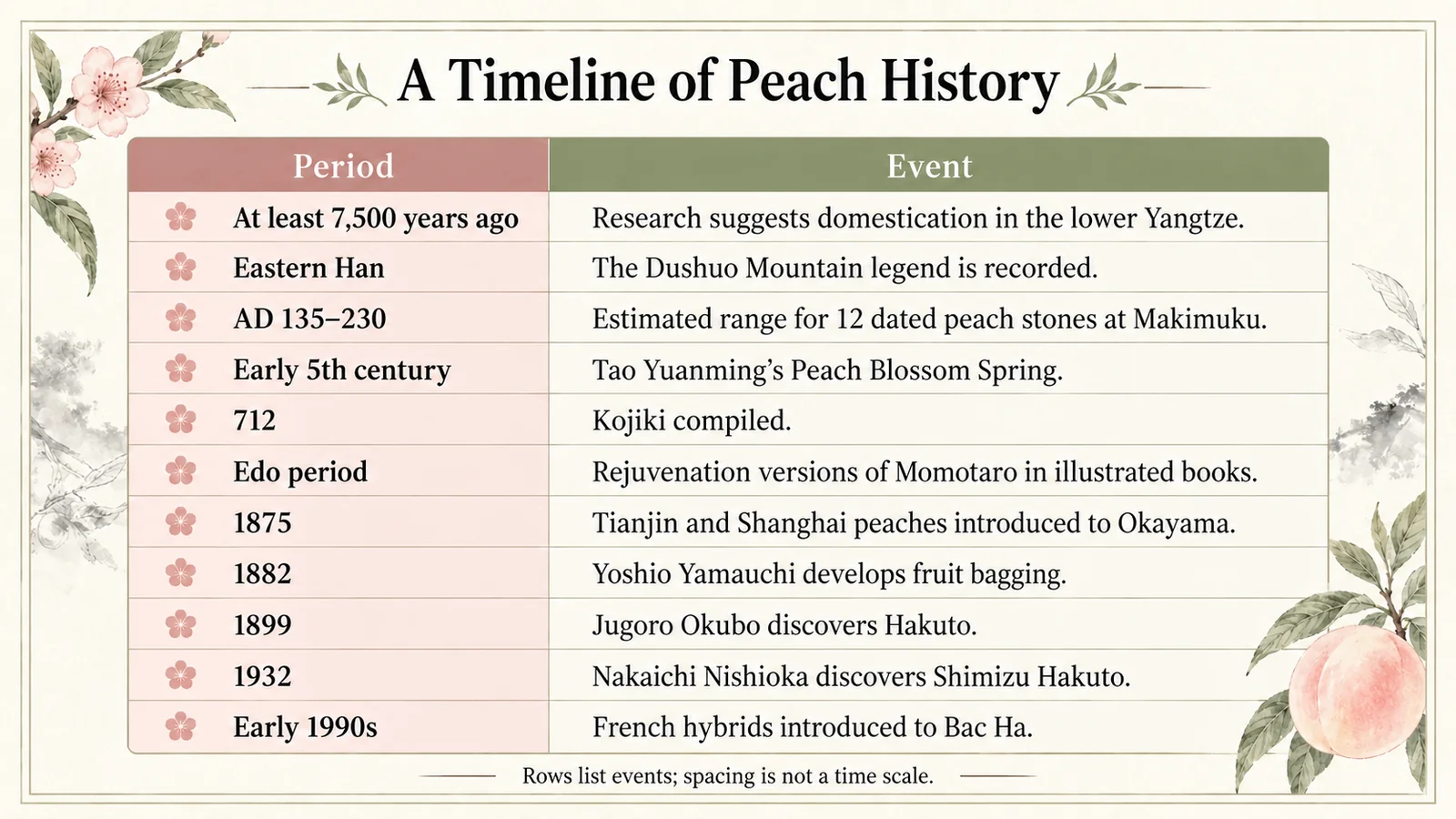
| Date or period | Event |
|---|---|
| At least 7,500 years ago | Research suggests that peach domestication had begun in the lower Yangtze region |
| Eastern Han period | Lunheng quotes a legend attributed to the Classic of Mountains and Seas about a giant peach tree and two gods on Dushuo Mountain |
| Approximately AD 135–230 | A calibrated date range estimated from 12 peach stones tested from the Makimuku site in Japan |
| Early fifth century | Tao Yuanming writes Peach Blossom Spring, the source of the idea of a peach-blossom utopia |
| 712 | The Kojiki is compiled, including the story of Izanaki driving off pursuers with peaches |
| Edo period | Rejuvenation versions of Momotaro feature in illustrated popular books |
| 1875 | Tianjin and Shanghai peaches are introduced from China to Okayama |
| 1882 | Yoshio Yamauchi develops fruit bagging in Okayama |
| 1899 | Jugoro Okubo discovers Hakuto |
| 1932 | Shimizu Hakuto is discovered in Okayama |
| Early 1990s | French hybrid peaches are introduced to Bac Ha, Vietnam |
The sections below explain the context and sources. Legends are presented as legends, rather than as events established by archaeology.
China: domestication research and Peach Blossom Spring
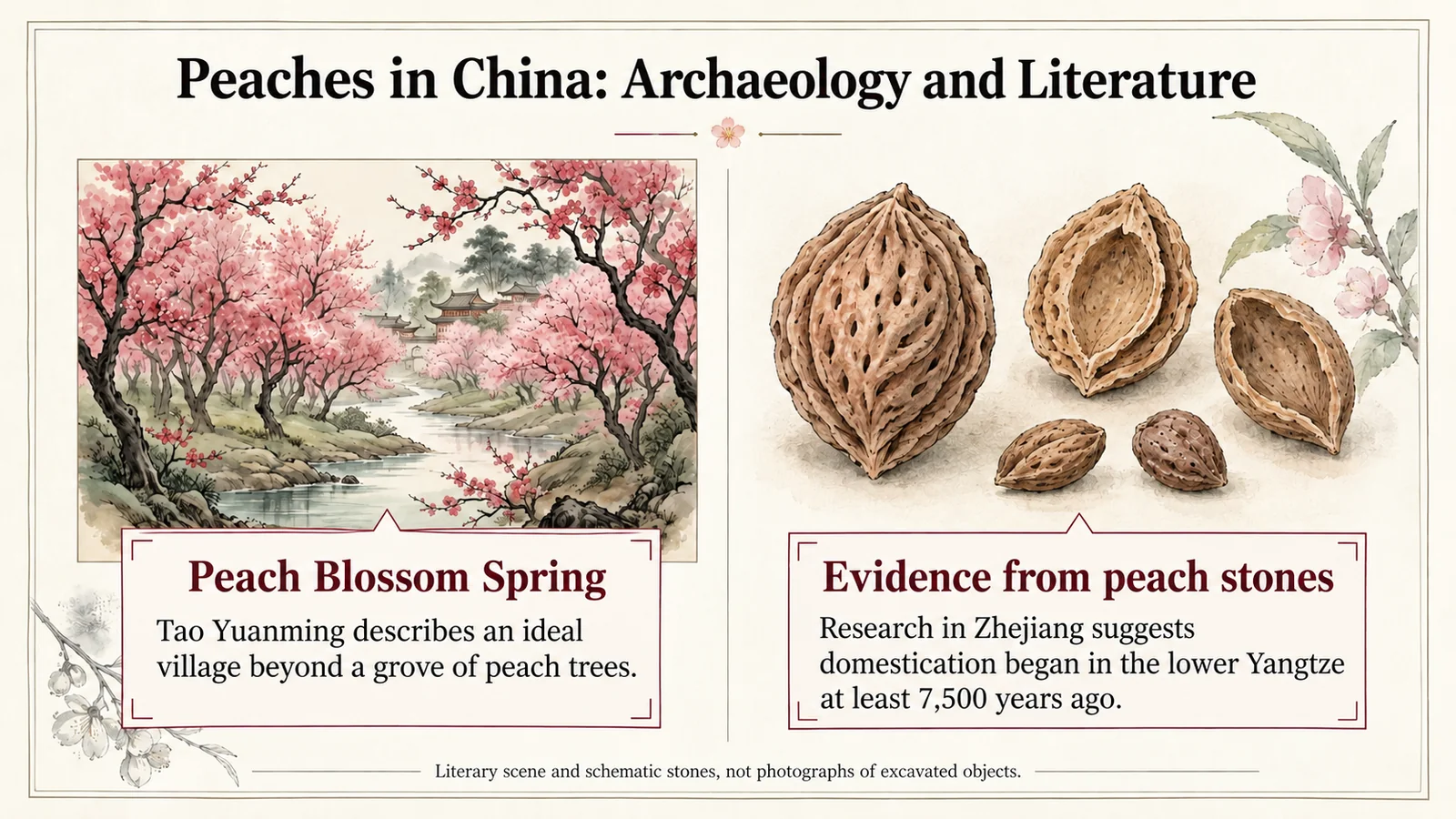
As the Peach Guide explains, peaches are native to China. A 2014 study examined peach stones—the hard endocarp surrounding the seed—from sites in Zhejiang. The authors proposed that domestication had begun in the lower Yangtze region at least 7,500 years ago. Source: Zheng, Crawford and Chen, PLOS ONE (checked September 29, 2026).
Peaches also occupy a special place in Chinese literature. One enduring example is the expression associated with Peach Blossom Spring, a place removed from the troubles of ordinary society.
In Tao Yuanming’s story, a fisherman from Wuling travels upstream during the Jin period and discovers a grove of peach blossoms lining both banks. Beyond a cave lies a village whose residents live apart from the conflicts of the outside world. After leaving, the fisherman tries to return but cannot find the way again. Source text: Peach Blossom Spring, Wikisource (checked September 29, 2026).
The story gave rise to the idea of a peach-blossom utopia, known in Japanese as togenkyo. The peach grove marks the threshold to an ideal world. This is a literary image, distinct from the physical evidence used to study domestication.
The protective tree of Dushuo Mountain
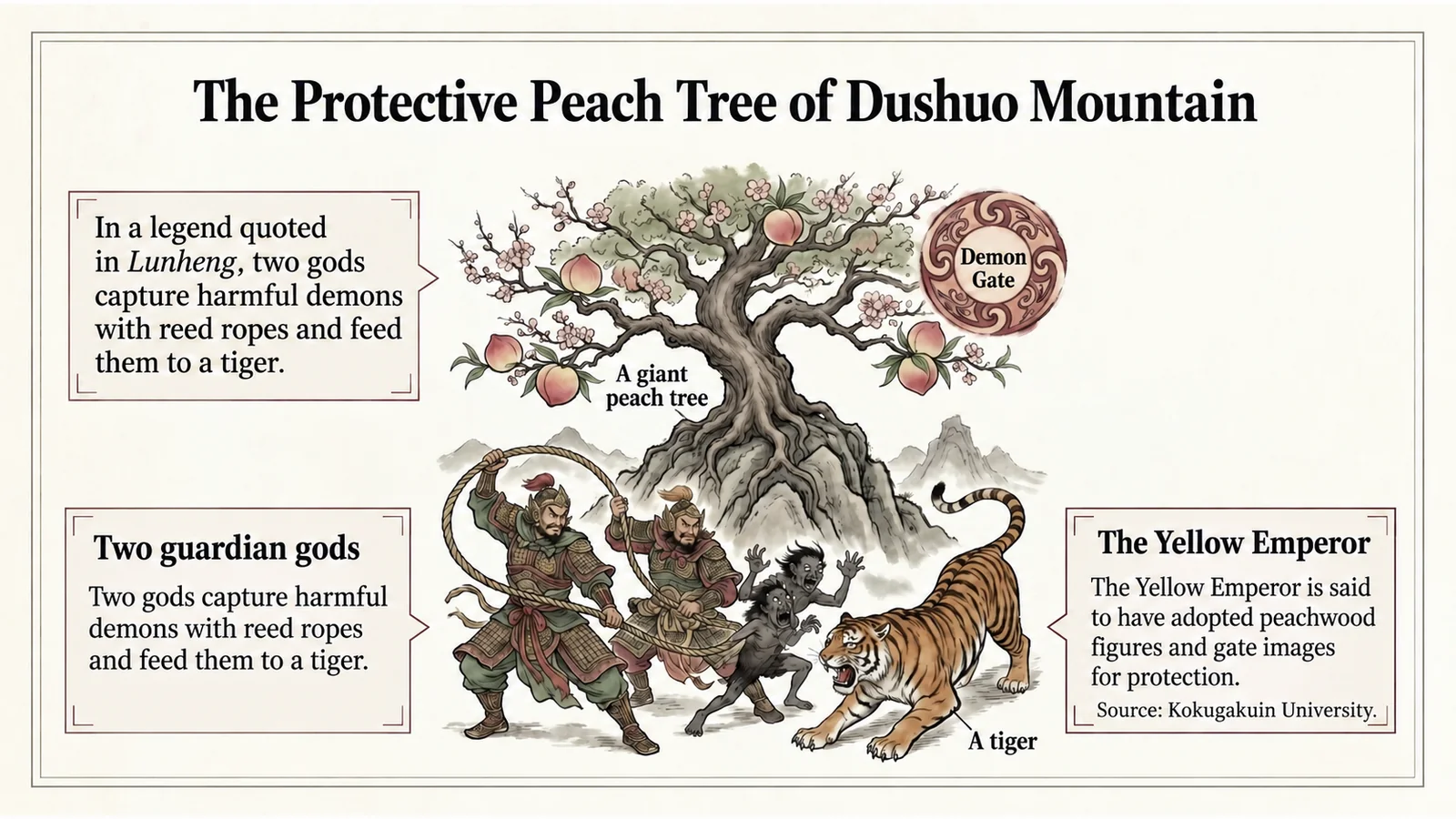
One reason peaches were treated as special was the belief that they could repel harmful spirits.
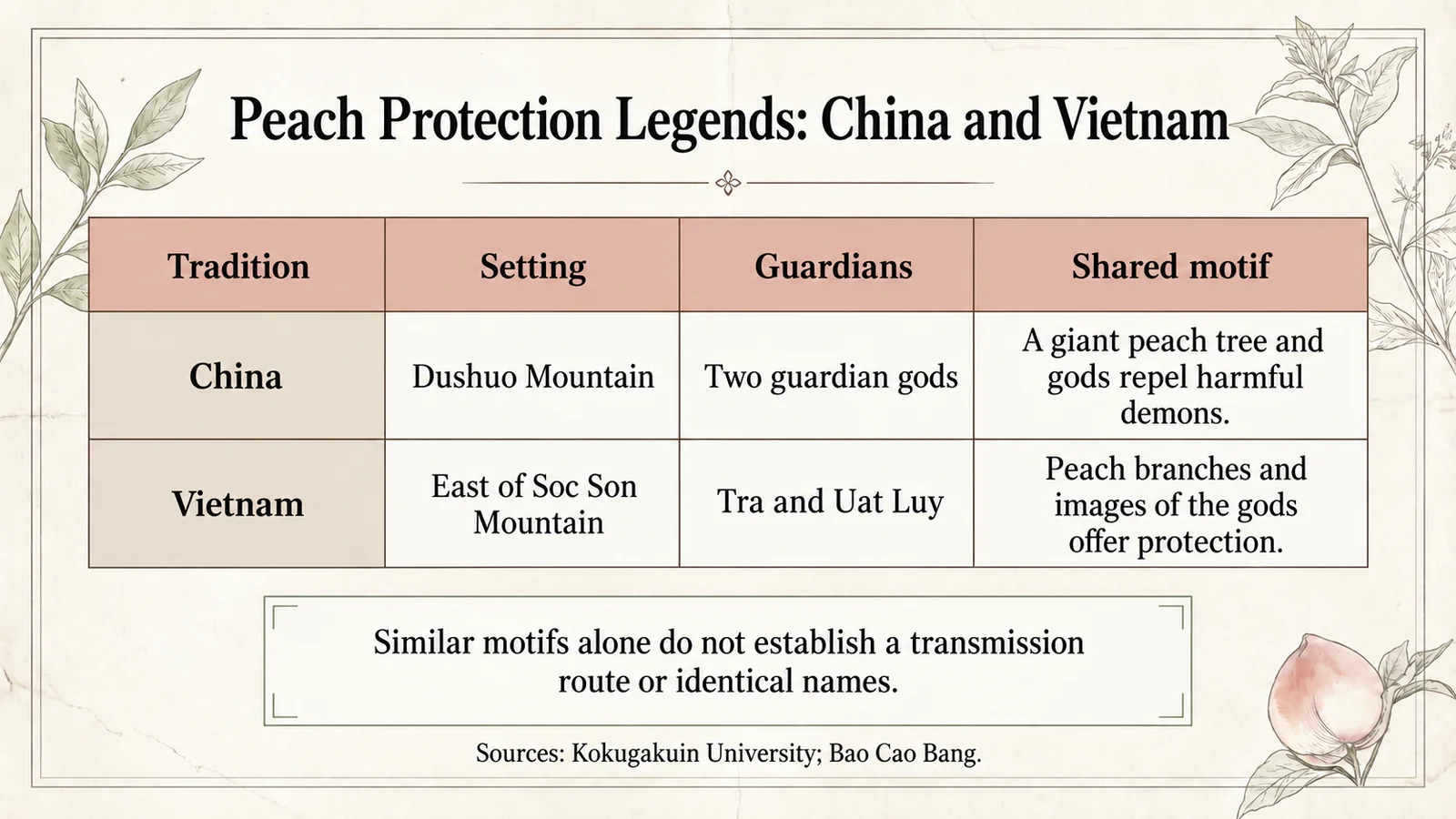
Kokugakuin University’s account describes a passage in Lunheng, an Eastern Han text, quoting the Classic of Mountains and Seas. A huge peach tree stood on Dushuo Mountain. Among its northeastern branches was a “demon gate,” through which spirits passed. Two guardian gods captured those that harmed people, bound them with reed ropes and fed them to a tiger.
The legend says that the Yellow Emperor followed this example by setting up peachwood figures, depicting the gods and tiger on gates, and hanging reed ropes to keep harmful spirits away. Source: Kokugakuin University, entry on Okamuzumi no Mikoto (checked October 16, 2026).
The same account notes protective uses of peach in other Chinese classics, including the Book of Rites and the Zuo Commentary. Remember the combination of a peach tree and two guardian gods: a similar motif appears later in the Vietnamese story.
Japan: Makimuku’s peach stones and the deity in the Kojiki
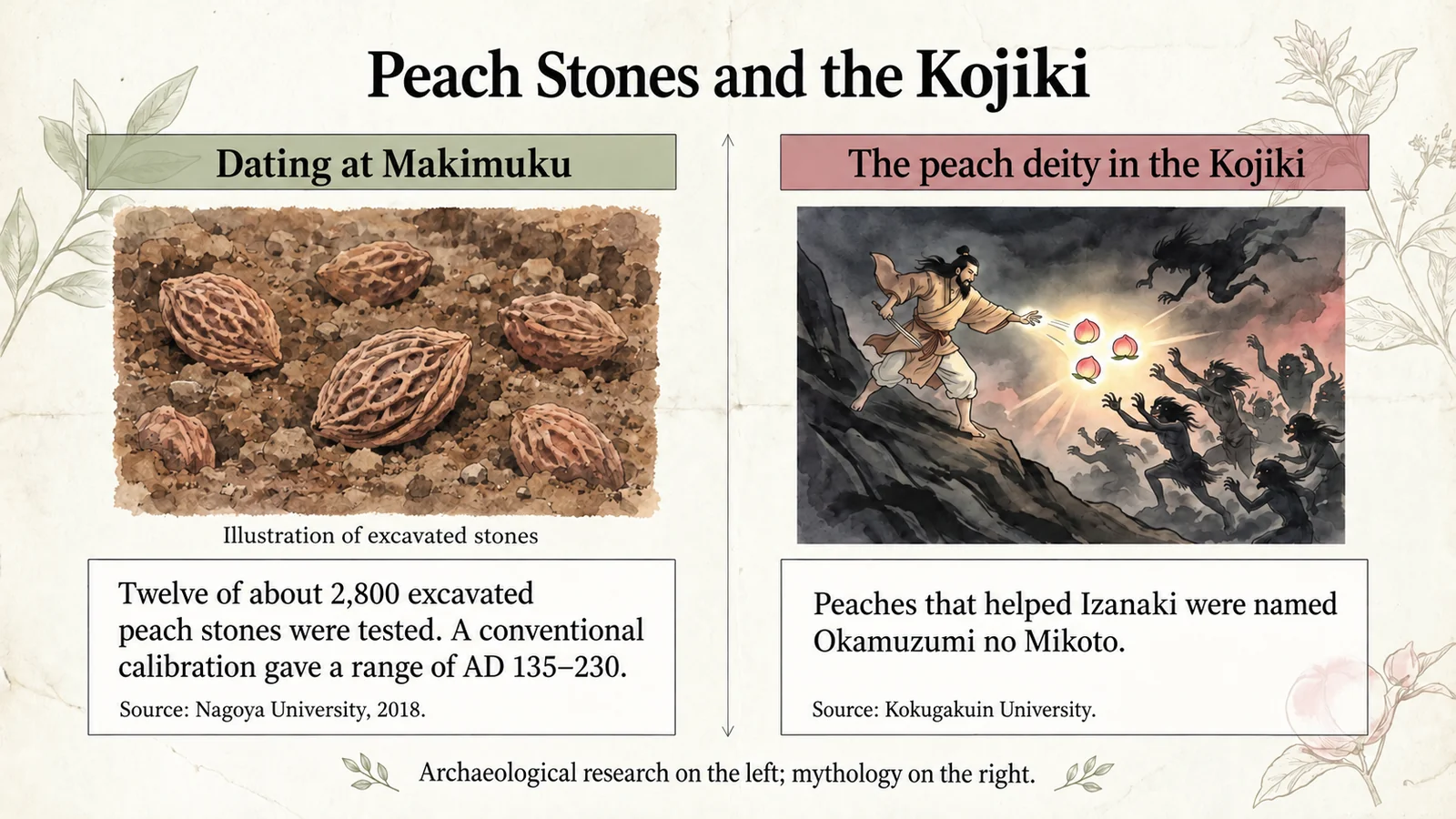
Peaches reached Japan early in its history. At the Makimuku site in Sakurai, Nara, excavations in 2009 uncovered approximately 2,800 peach stones in a pit near the remains of a large building. The stone is the hard endocarp, not the seed itself.
A team including Nagoya University tested 12 of these stones using radiocarbon dating. Their report gives a range of AD 135–230 under a conventional calendar-age calibration. Source: Nagoya University, June 15, 2018 (checked September 29, 2026).
Makimuku is known as one proposed location of Yamatai. Dating these stones does not, by itself, establish why they were collected or deposited.
Peaches also appear in a dramatic episode of the Kojiki, compiled in the early eighth century. Izanaki follows his deceased wife Izanami into the land of the dead. After seeing her transformed appearance, he flees. Pursued by hostile beings, he takes three peaches at the foot of Yomotsu Hirasaka and throws them to drive the pursuers away.
He then tells the peaches to help people in distress just as they helped him, and gives them the name Okamuzumi no Mikoto.
Kokugakuin’s commentary discusses an interpretation of this name as a great divine power that repels harmful spirits, and relates the peach’s protective role to beliefs transmitted from China. Source: Kokugakuin University (checked October 16, 2026).
As in the Dushuo Mountain legend, the peach is portrayed as a means of driving threatening forces away.
Momotaro was not always born directly from a peach
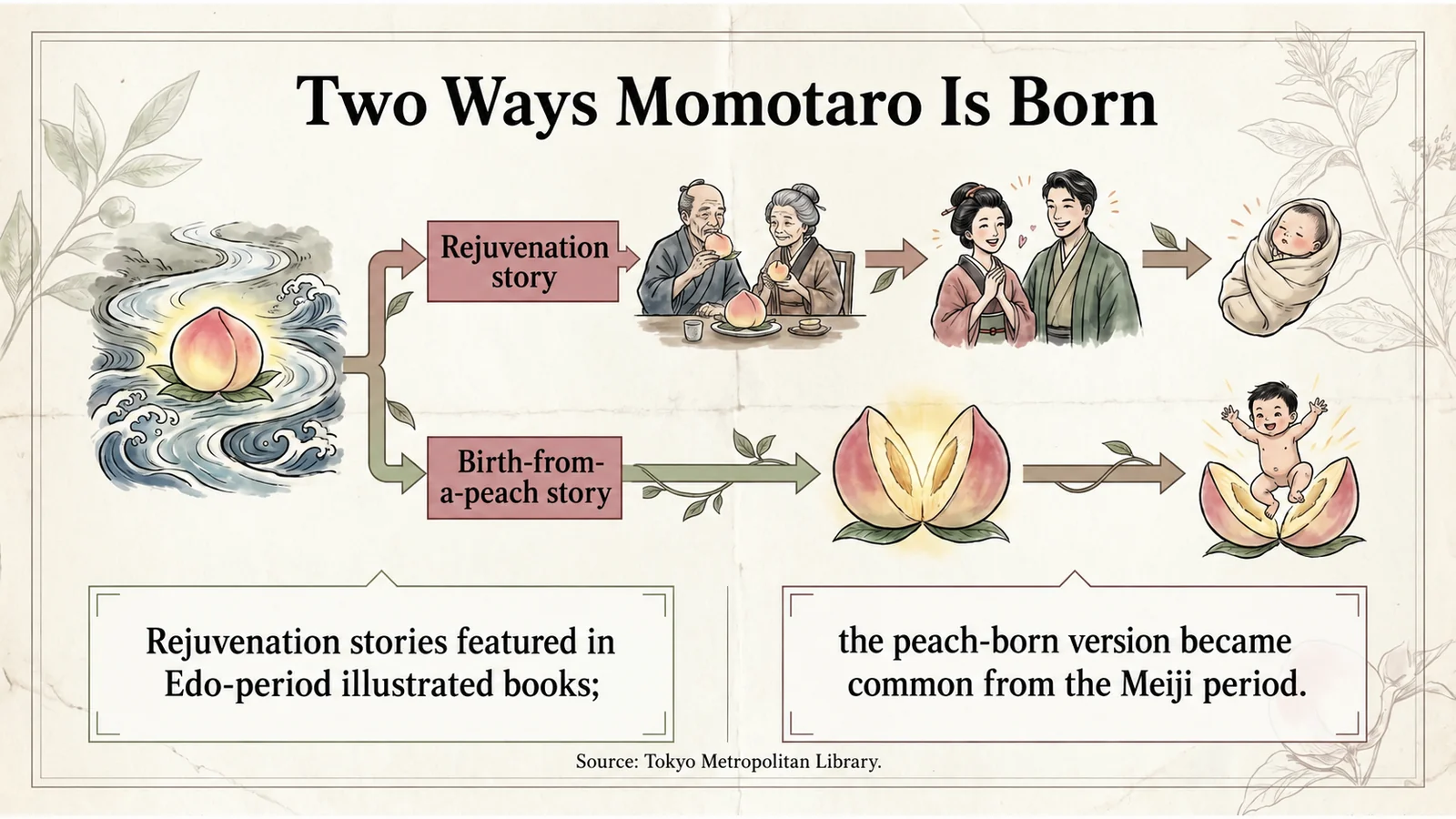
The best-known Japanese peach tale is Momotaro, the Peach Boy. In the familiar version, a boy emerges from a large peach found floating down a river and later sets out to defeat demons. But that was not the only way his birth was told.
Tokyo Metropolitan Library describes two forms:
- The rejuvenation version: an elderly couple eats a peach, becomes young again and has a child.
- The peach-born version: the boy emerges directly from the peach.
In the illustrated popular books called kusazoshi, examples from the akahon through kibyoshi periods used the rejuvenation version. Stories combining the two forms later appeared. The version in which the boy is born directly from the peach became common from the Meiji period onward. Source: Tokyo Metropolitan Library, Momotaro in Board Games (checked September 29, 2026).
The peach that restores youth and the child who defeats demons bring together two recurring themes: vitality and protection from evil.
1875: Chinese peaches arrive in Okayama
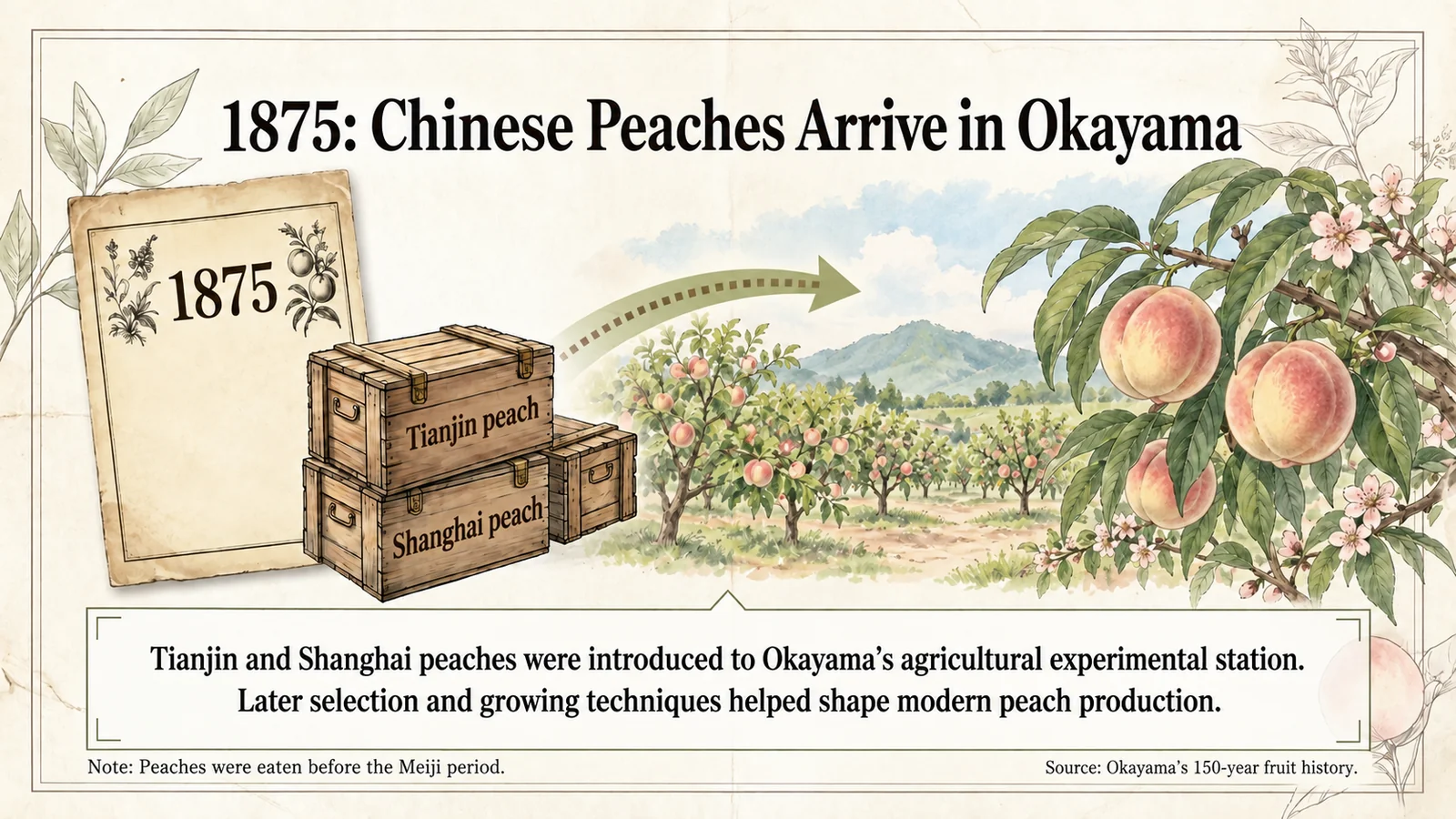
So far, we have mainly followed peaches through literature and belief. They were also eaten before the Meiji period. From that period onward, introductions and selection helped shape the large, sweet Japanese peaches familiar today.
Okayama’s account of 150 years of peach and grape growing records the introduction of Tianjin and Shanghai peaches from China to the prefecture’s agricultural experimental station in 1875. It presents this as the beginning of Okayama’s modern peach-growing story.
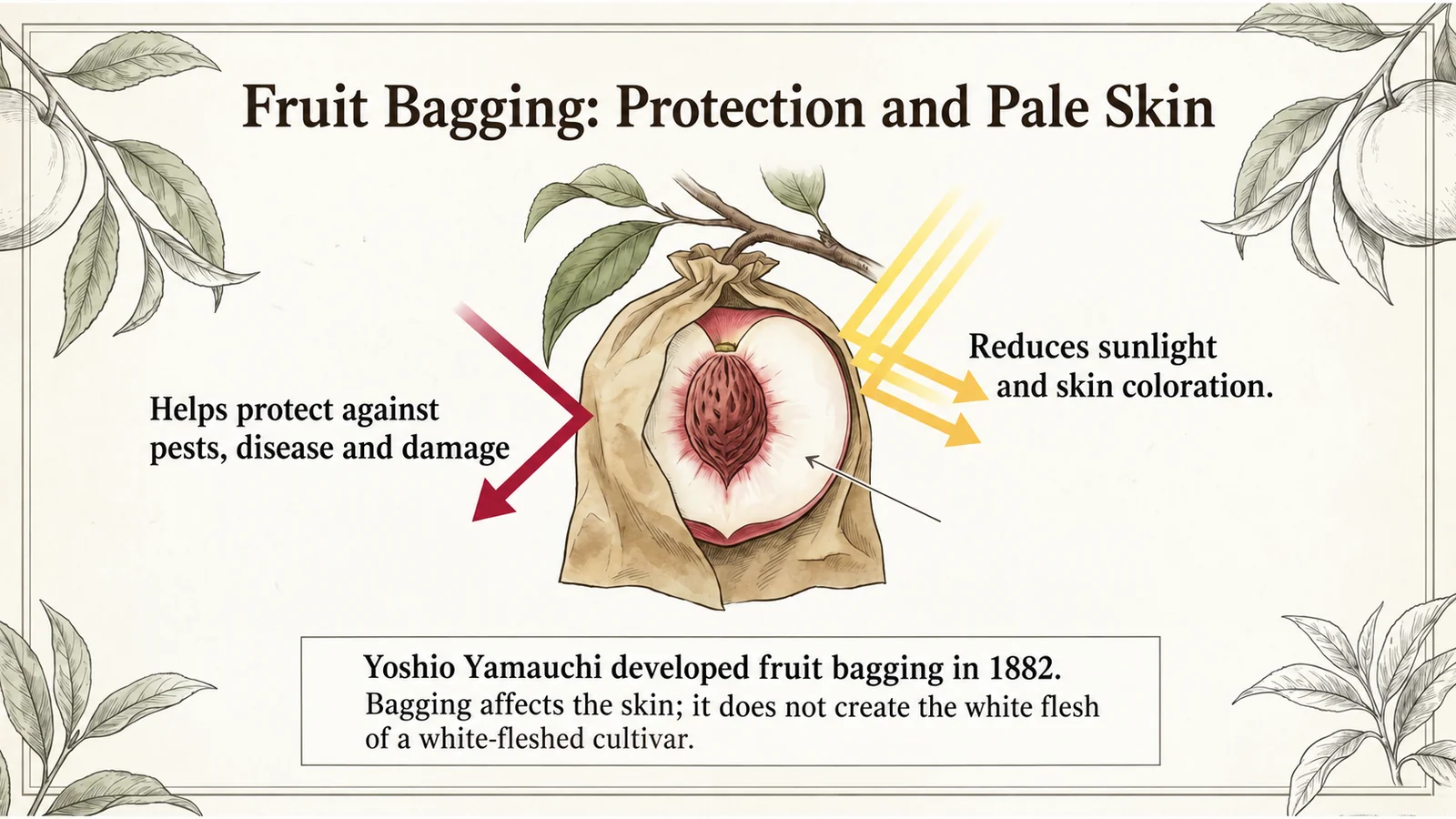
Growing these peaches involved a struggle with pests. In 1882, Yoshio Yamauchi developed the practice of enclosing each fruit in an individual bag. The prefectural history describes this innovation as part of the development of Okayama’s pale-skinned, smooth-textured peaches. Source: Okayama’s peach and grape history (checked September 29, 2026).
Bagging helps protect fruit against pests, disease and damage, and reduces skin coloration by limiting sunlight. This should be distinguished from the white flesh of the Hakuto cultivar.
1899: Hakuto is found among seedlings
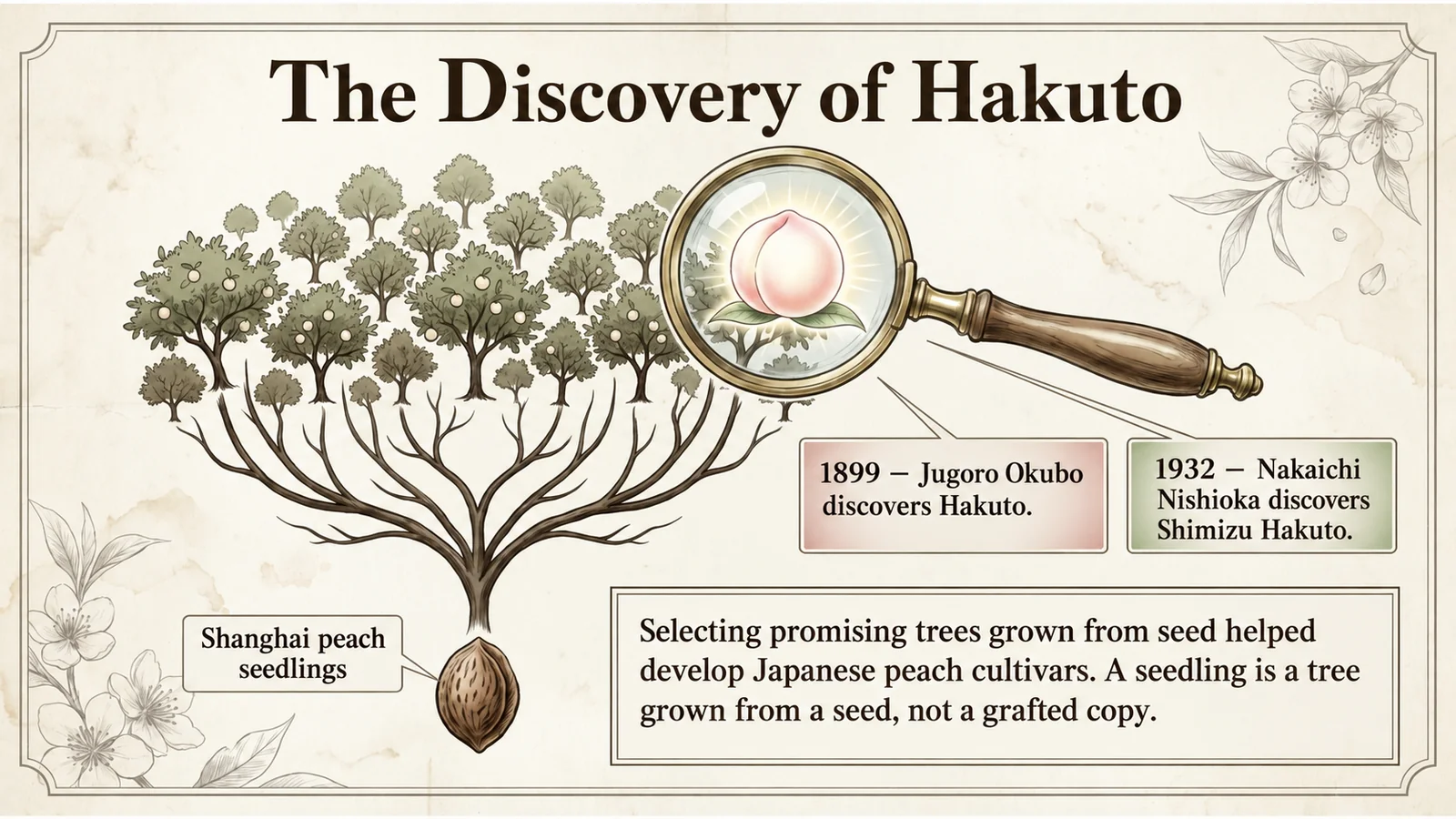
In 1899, a cultivar was discovered that would become central to Japanese peach history.
Okayama City describes Jugoro Okubo, born in 1867, as a grower who studied fruit cultivation as a young man and found the peach known as Hakuto among seedlings descended from a Shanghai peach. A seedling is a tree grown from seed, rather than a grafted copy. Okubo continued developing cultivars and produced a peach called Okubo in 1927. Source: Okayama City, memorial to Jugoro Okubo (checked September 29, 2026).
MAFF describes Hakuto as a cultivar regarded as an ancestor of modern Japanese peaches. Hakuho, Akatsuki and Kawanakajima Hakuto are among the names that followed in Japan’s wider cultivar history. Source: MAFF.
In Okayama in 1932, Nakaichi Nishioka discovered Shimizu Hakuto, often described in local accounts as the queen of peaches. Source: Okayama’s peach and grape history.
Peaches had long been both food and objects of belief. Modern selection and cultivation added another chapter, leading to the diversity of Japanese white-peach cultivars.
Vietnam: Tet branches and highland peaches
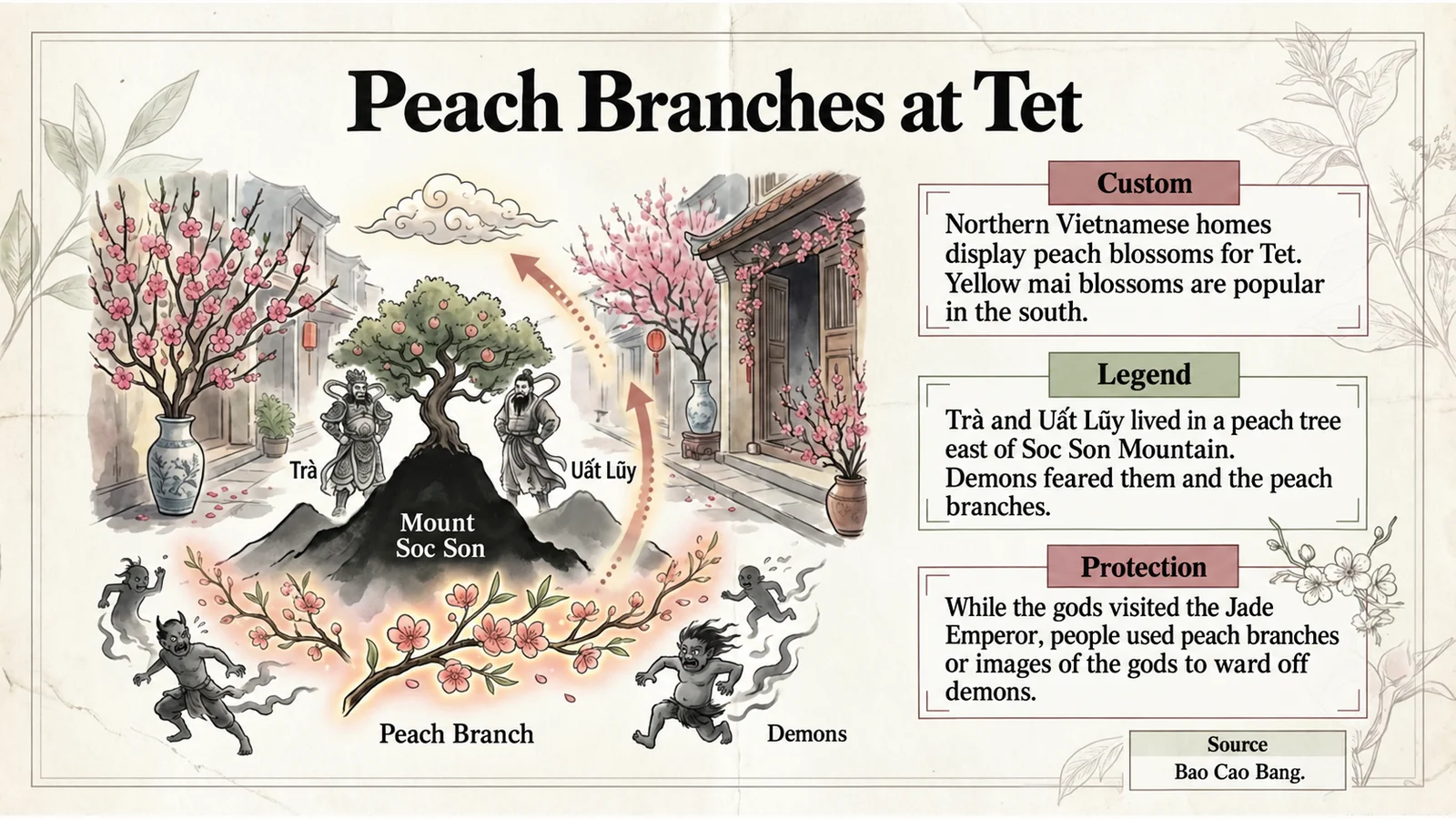
Before Tet in northern Vietnam, streets fill with pink-blossomed peach branches and potted trees. One explanation for displaying them is the story known as Sự tích hoa đào, the origin tale of peach blossoms.
In the version reported by Báo Cao Bằng, a great old peach tree stood east of Soc Son Mountain. Two gods, Trà and Uất Lũy, lived there. Demons feared them so much that even a peach branch could make them flee.
At the end of the year, however, the gods had to go to heaven to greet the Jade Emperor. While they were away, people displayed peach branches or drew images of the gods on red paper and placed them at their gates. The story presents this as the origin of displaying peach branches for Tet. In the south, yellow mai blossoms are more commonly favored. Source: Báo Cao Bằng, published February 13, 2015; checked September 29, 2026.
Recall the Chinese story: a great peach tree, two gods and protection from demons. The stories share recognizable motifs. Those similarities alone do not establish a precise route of transmission or prove that the gods’ names are identical.
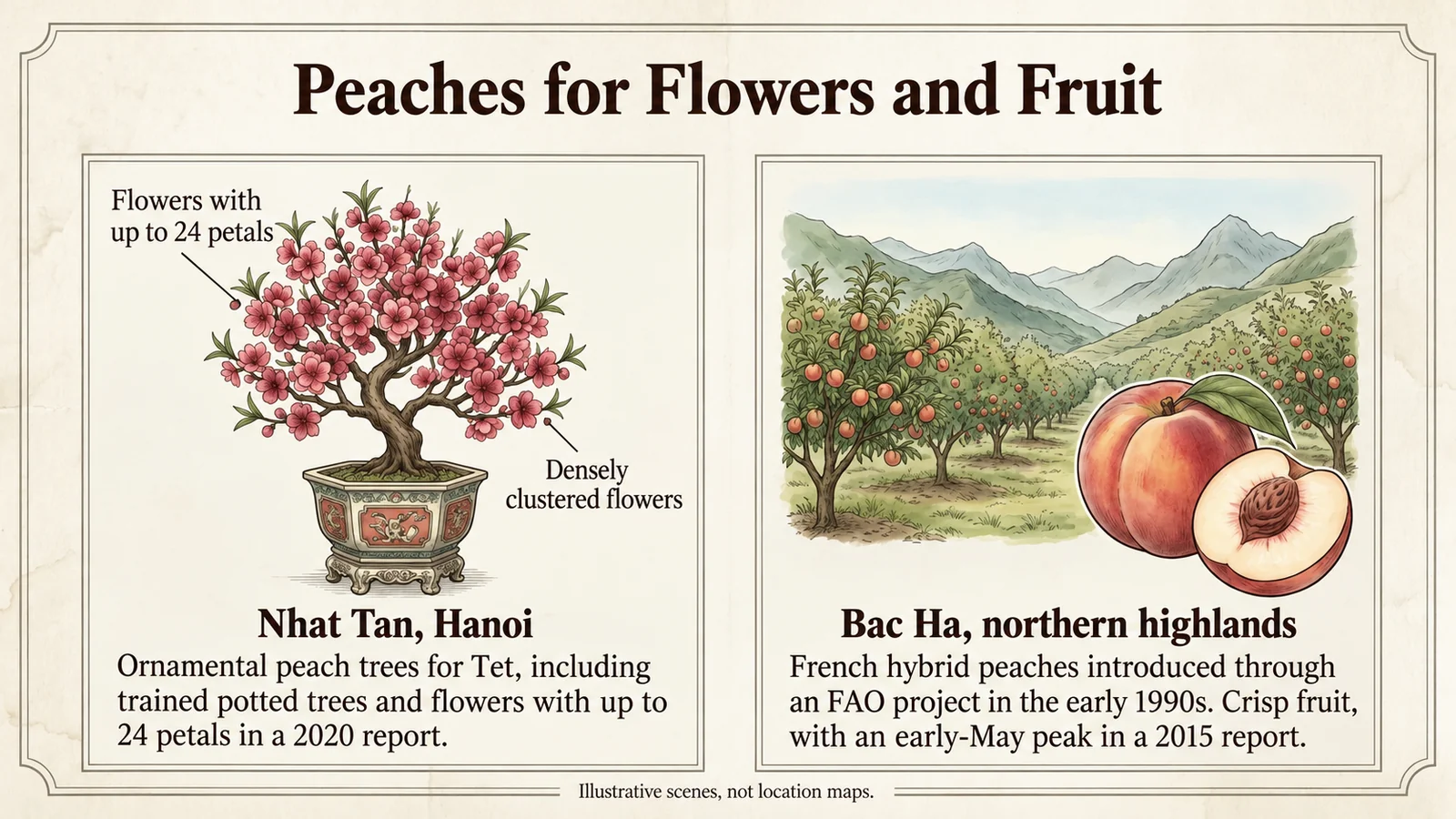
In present-day Hanoi, Nhat Tan is well known for peach blossoms. VietnamPlus describes trained potted trees called đào thế and flowers with up to 24 petals. Source: VietnamPlus, published January 25, 2020; checked September 29, 2026.
Vietnam also grows peaches for fruit. The introduction of a cultivar in the 1990s is one episode in that history, not the beginning of all edible-peach cultivation in the country.
In Bac Ha, Lao Cai Province, French hybrid peaches were introduced through an FAO project in the early 1990s. Tuổi Trẻ describes crisp fruit with an early-May harvest peak. Source: Tuổi Trẻ, published May 11, 2015; checked September 29, 2026. See the Peach Guide for more about growing areas and seasons.
The people behind peach history
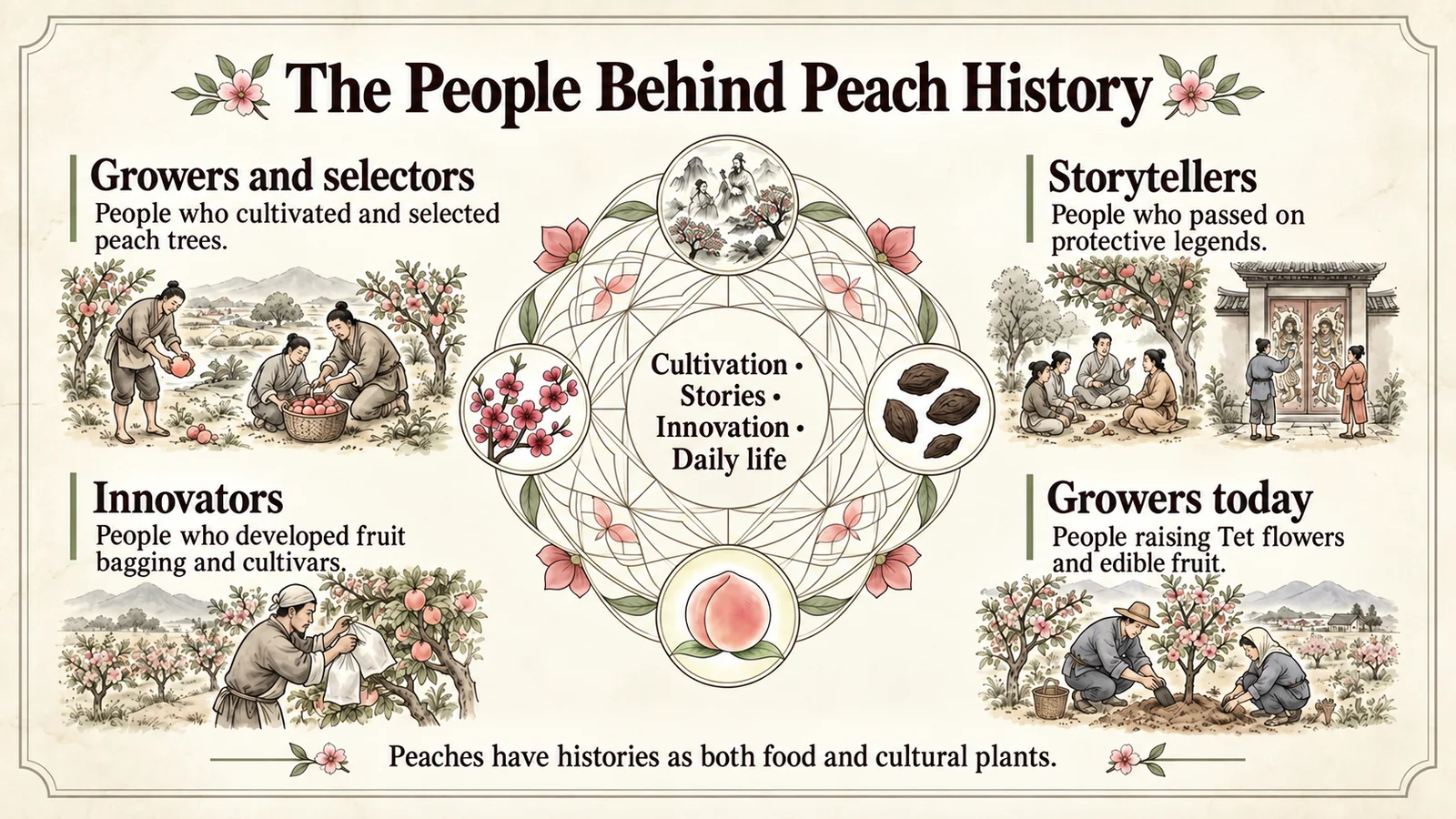
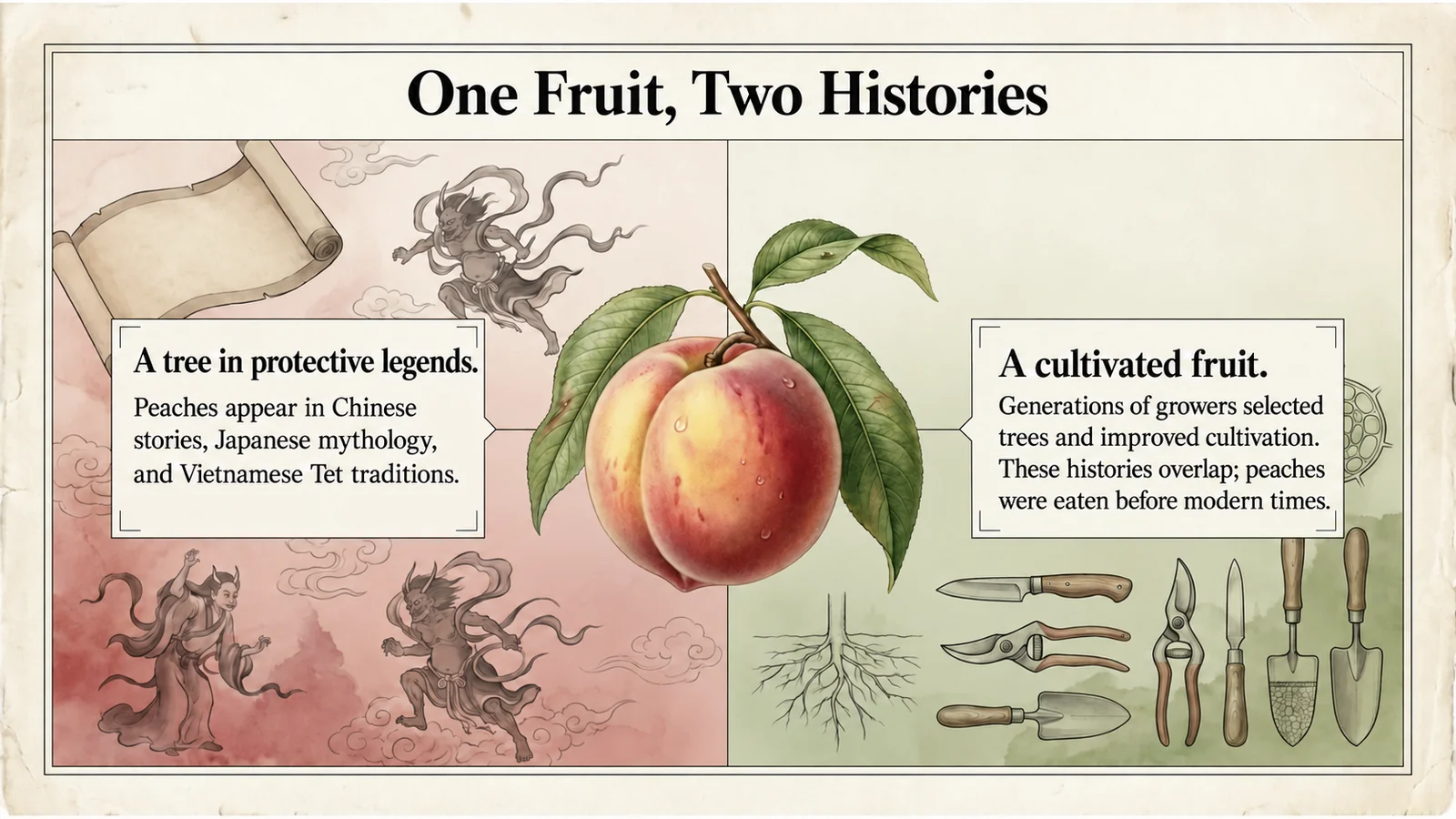
Peach history does not belong to just one country. Chinese protective legends, Japan’s Kojiki and Momotaro, and Vietnamese Tet stories all give the peach powers beyond its role as food. Meanwhile, growers selected trees and developed techniques that changed the fruit itself.
The people behind that history include:
- Those who cultivated and selected peach trees along the Yangtze.
- Storytellers who passed on legends of peach trees and guardian gods.
- Growers who developed the practice of bagging individual fruit.
- People who selected promising white peaches from seedlings descended from Chinese trees.
- Nhat Tan growers raising Tet flowers, and highland growers raising fruit in Vietnam today.
If you see peach branches in Hanoi before Tet, the story of the two guardian gods offers another way to appreciate them.
More in the peach trilogy
- Peaches in Vietnam: Types, Seasons, Origins and Nutrition
- How to Eat Peaches in Vietnam: Ripening, Storage and a Hanoi Tasting Diary
Sources and editorial note
Sources are linked beside the relevant passages. Historical claims, archaeological interpretations and legends are kept distinct. Source check dates are inherited from the Japanese v09 edition; the Kokugakuin account was rechecked on October 16, 2026. This English v09 edition uses explanatory illustrations rather than photographs of excavated finds or historical events.
