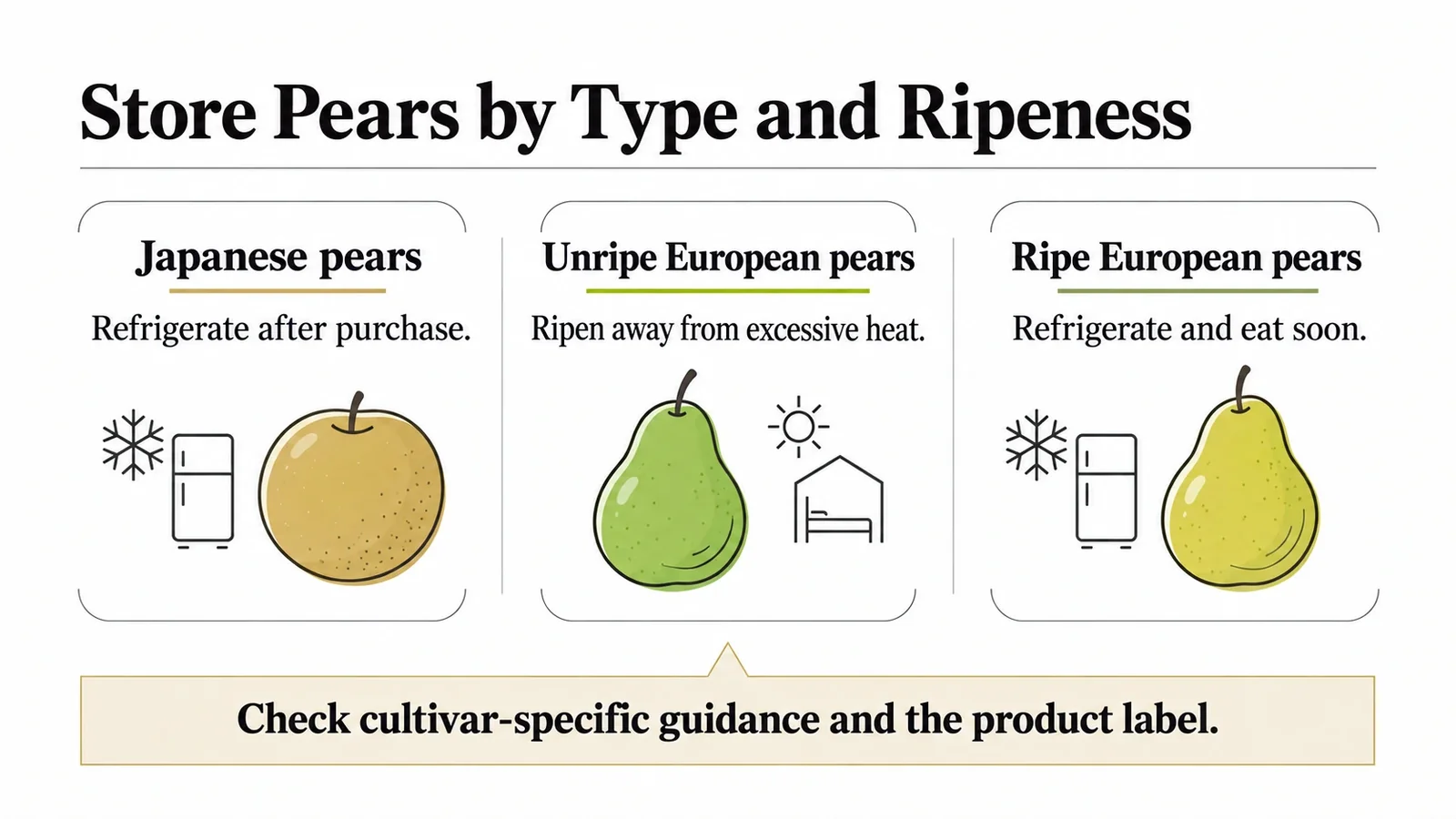
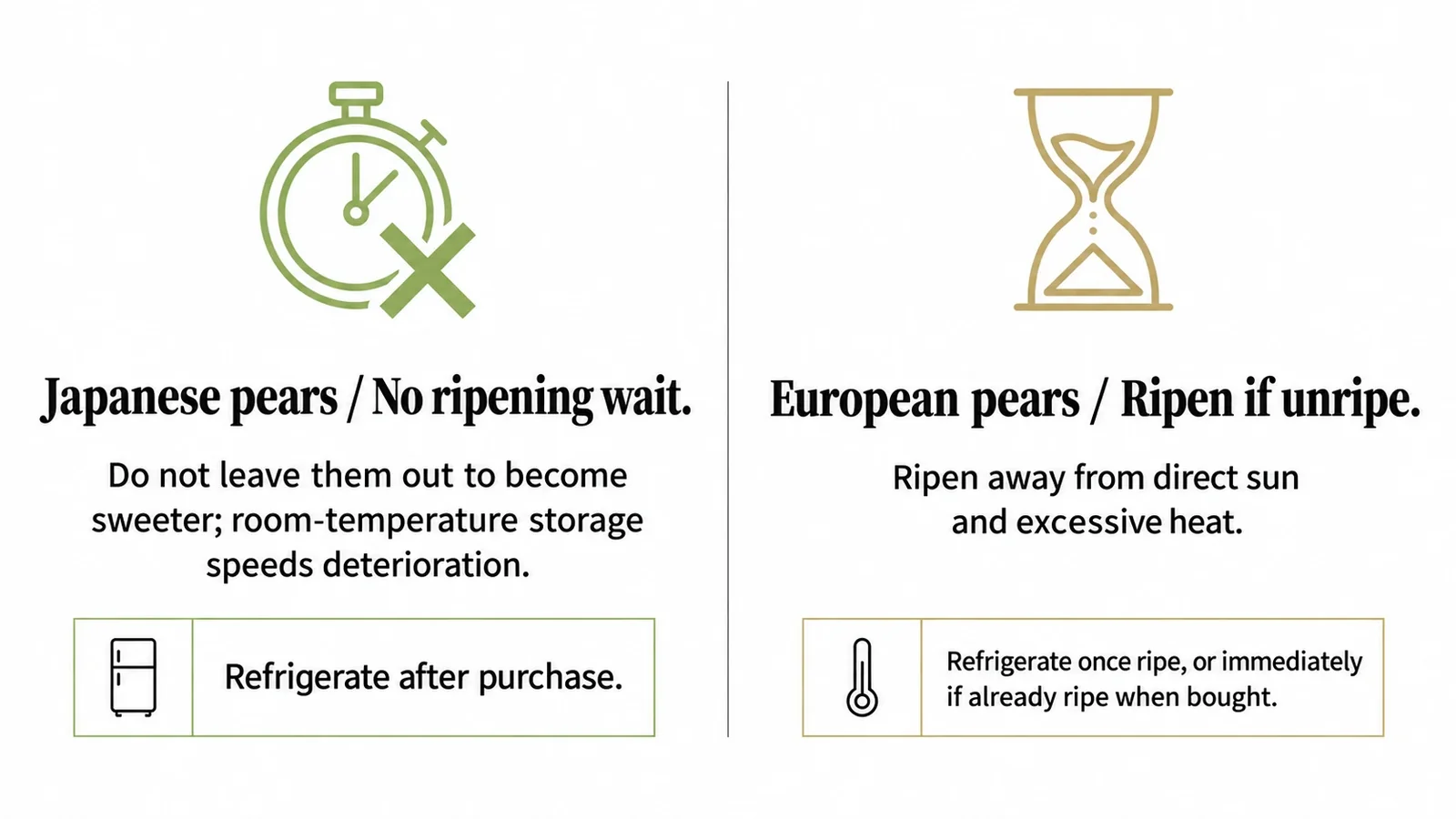
Japanese pears are not fruits to leave out after purchase in the hope that they will become sweeter. Refrigerate them and enjoy them soon. Unripe European pears, by contrast, need ripening; those already ready to eat should be refrigerated. In Vietnamese shops, check the product name or ask the retailer rather than relying on shape alone.
This guide covers useful shopping vocabulary, selection, ripeness, cutting, storage and eating precautions. It concerns pears bought in Vietnam, not only pears grown there. You will also find the price and tasting notes for a Chinese green pear bought in Hanoi, with the author’s own photographs.
Contents
- Quick guide to eating and storing pears
- Buying pears in Vietnam: names and labels
- Japanese pears: do not wait for them to soften
- Ripening European pears: check around the stem
- Washing and cutting pears into 4–8 wedges
- Other ways to enjoy pears
- Storing whole, cut and frozen pears
- Eating precautions: allergy symptoms and young children
- Can you bring pears from Vietnam into Japan?
- A Chinese green pear bought in Hanoi: price, photos and tasting notes
- From buying to serving: five steps
- More in the pear trilogy
- References and source dates
Quick guide to eating and storing pears
| Question | Main point |
|---|---|
| Name in shops | quả lê |
| Choosing Japanese pears | Taut skin, a well-rounded broad base, and good weight for their size |
| Ripening | Do not wait for Japanese pears to soften; ripen unripe European pears |
| European pear ripeness | Gently check around the stem; color changes depend on the cultivar |
| Sweeter areas of Japanese pears | Near the blossom end and skin; flesh near the core is more acidic |
| Chilling | Refrigerate Japanese pears after purchase and take them out just before eating |
| Whole-fruit storage | Wrap in paper towel, place in a plastic bag and keep stem-side down in the refrigerator’s produce drawer |
| After cutting | Use an anti-browning treatment if desired, refrigerate promptly and eat soon |
Selection guidance comes from Higashimatsuyama City; eating and storage guidance from JA Tottori Chuo. The Japanese source edition checked these on September 29, 2026.
Buying pears in Vietnam: names and labels
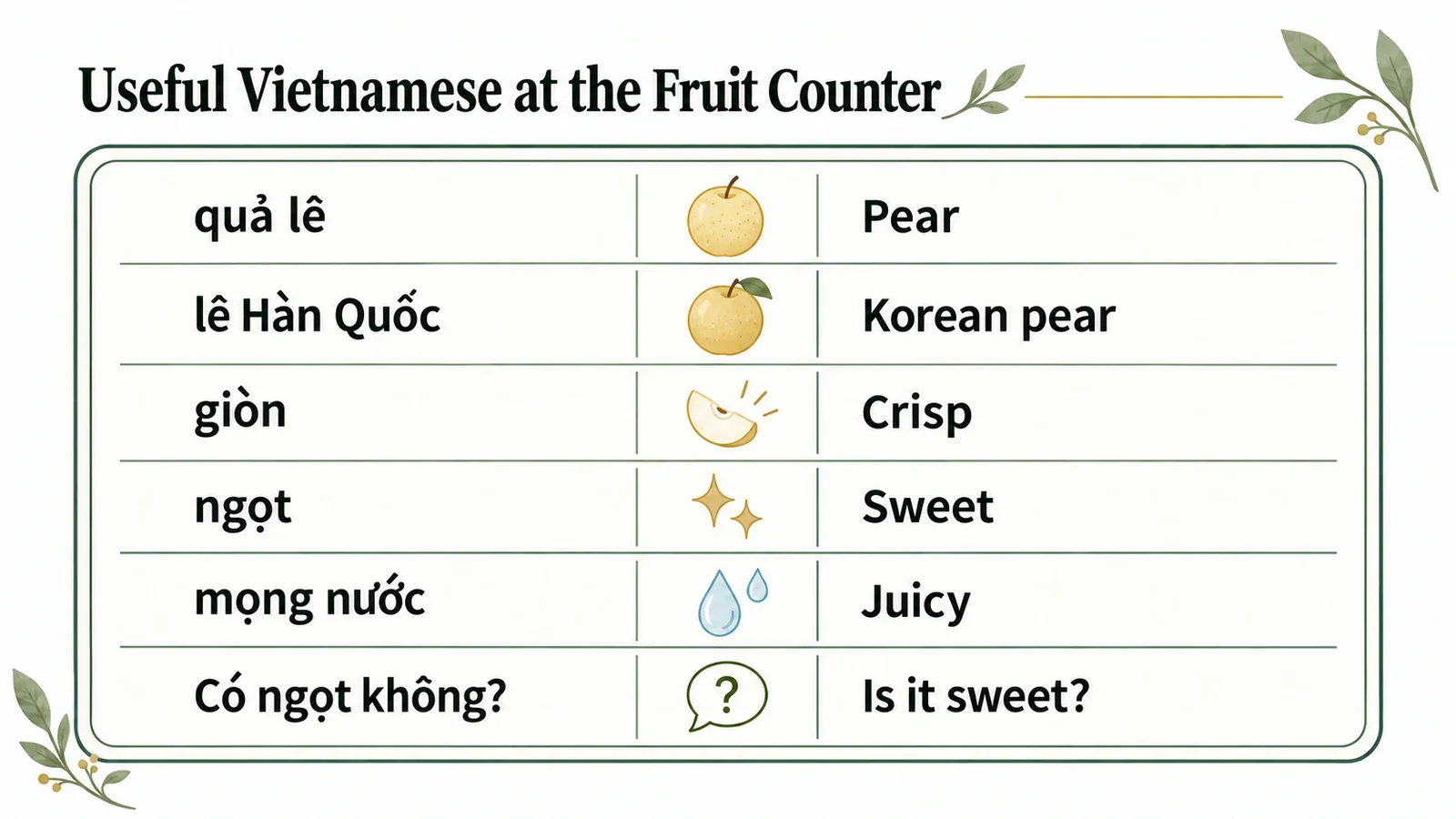
Useful Vietnamese words
Vietnamese supermarkets and fruit shops sell locally grown pears alongside imports, including Korean pears. Asian and European types may both be called lê, so check the name and label and ask whether ripening is needed. The pear guide explains the groups and examples of local growing areas.
| Vietnamese | Meaning |
|---|---|
| quả lê | Pear |
| lê Hàn Quốc | Korean pear |
| giòn | Crisp or crunchy |
| ngọt | Sweet |
| mọng nước | Juicy |
Có ngọt không? means “Is it sweet?” and can open a conversation with the seller. Label wording varies by shop, so use these terms as a guide and check the price label or packaging for the growing origin.
Choosing Japanese pears: skin, weight and condition
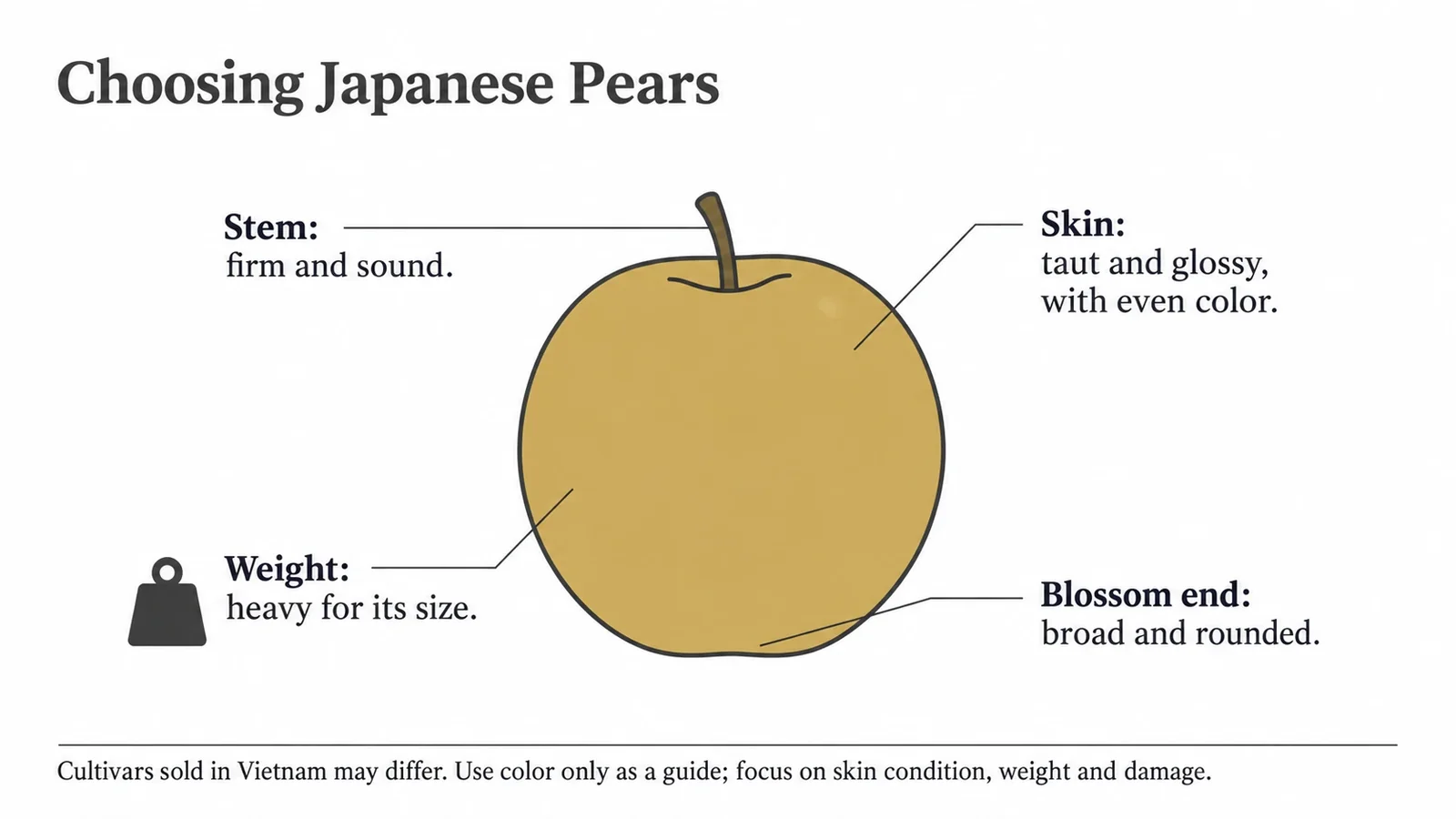
Higashimatsuyama City, a Japanese pear-growing area in Saitama, lists these signs:
- A well-shaped fruit with taut skin.
- Good weight compared with another fruit of the same size.
- A firm, sound stem.
- Even skin color.
- A broad, rounded blossom end, opposite the stem.
Its guidance also notes that rough brown dots become less prominent as the surface smooths with maturity. Green-skinned types such as Nijisseiki become sweeter as they turn yellowish, while russet types such as Kosui develop a suitable reddish tone over yellow. Source: Higashimatsuyama City.
Cultivars sold in Vietnam may differ from Japanese examples. Treat color clues as secondary and focus on tautness, weight and absence of damage.
Japanese pears: do not wait for them to soften
Japanese pears are not suited to being left out after harvest to gain sweetness. Their crisp flesh is characteristic, so firmness alone does not mean they are unripe.
Clemson University explains that Asian pears, including Japanese pears, taste best ripened on the tree. Source: Clemson University HGIC. JA Tottori Chuo also recommends refrigeration, noting that Japanese pears deteriorate at room temperature rather than benefiting from waiting to ripen. Source: JA Tottori Chuo.
Enjoy fruit harvested at eating maturity while it is fresh. Refrigerate after purchase. Cultivar and storage history affect condition, so the purchase date alone cannot establish quality.
Ripening European pears: check around the stem
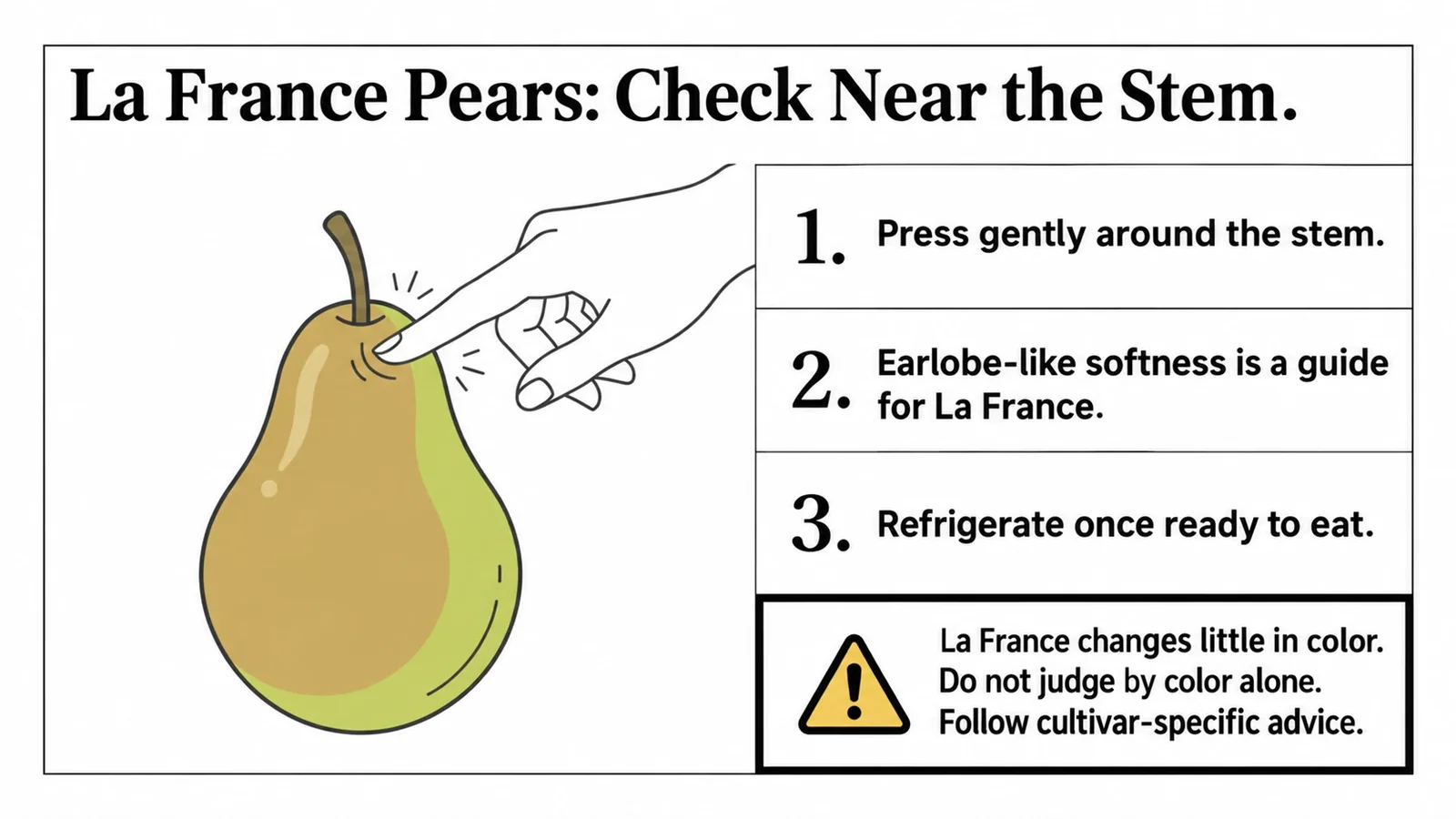
European pears are generally ripened after harvest. Yamagata’s guidance for La France gives two useful clues:
- Softness around the shoulders: gently check near the stem for an earlobe-like softness.
- Skin color: La France changes little in color when ripe, so color alone is unreliable.
For a firm European pear, follow its label or the retailer’s advice and ripen it away from direct sunlight and excessive heat. Gently check around the stem each day. Once ripe, refrigerate and eat soon. If already ripe when purchased, refrigerate it immediately. Temperature changes the pace of ripening, so judge condition rather than relying on a fixed number of days.
Washing and cutting pears into 4–8 wedges
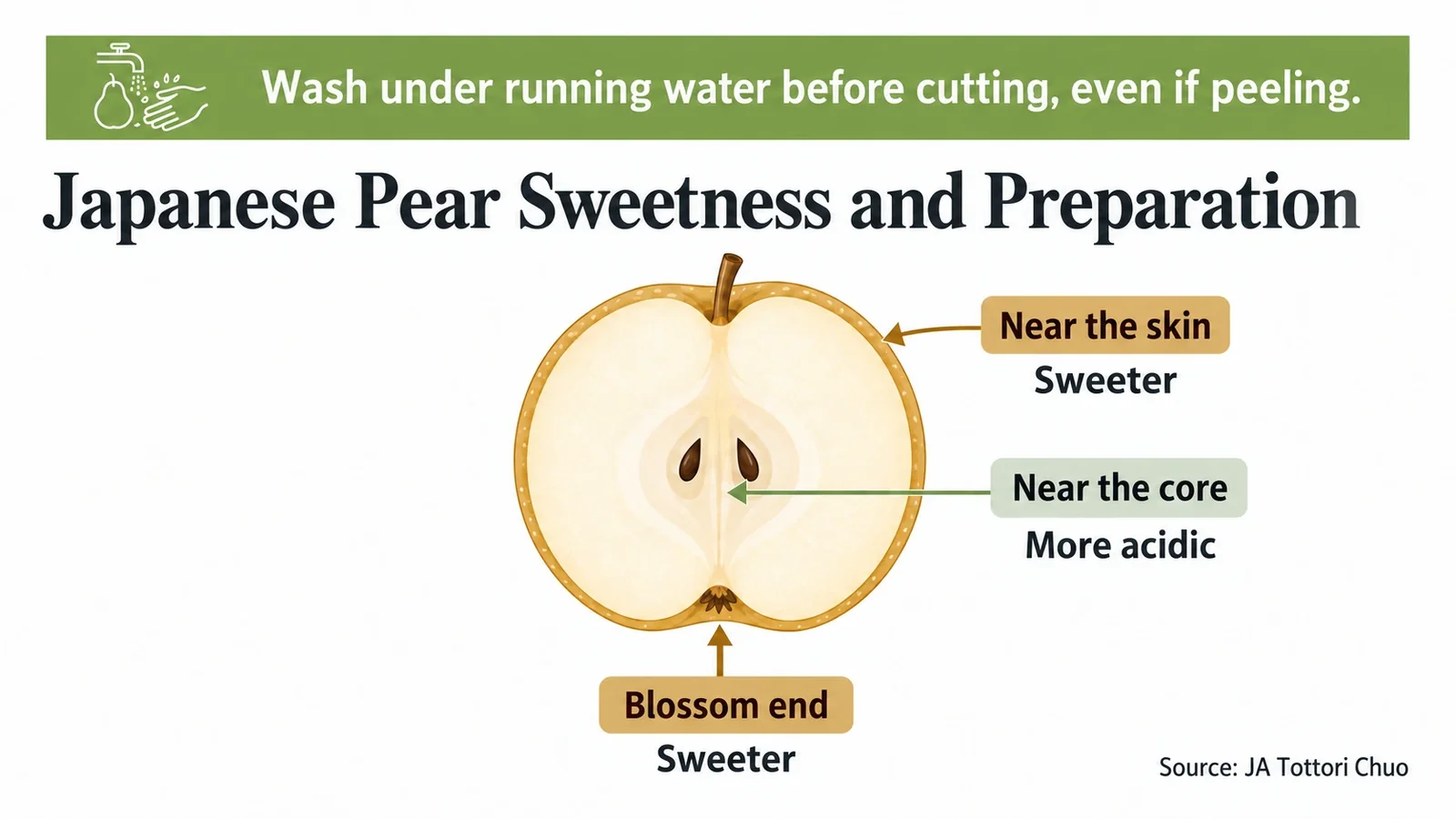
Wash before cutting, even if peeling
Start with clean hands, a clean knife and a clean cutting board. Gently wash the pear under running water. Washing before peeling helps keep surface dirt from being carried into the flesh by the knife. Do not use soap or dishwashing detergent. Source: FDA, 7 Tips for Cleaning Fruits and Vegetables.
Basic wedge-cutting steps
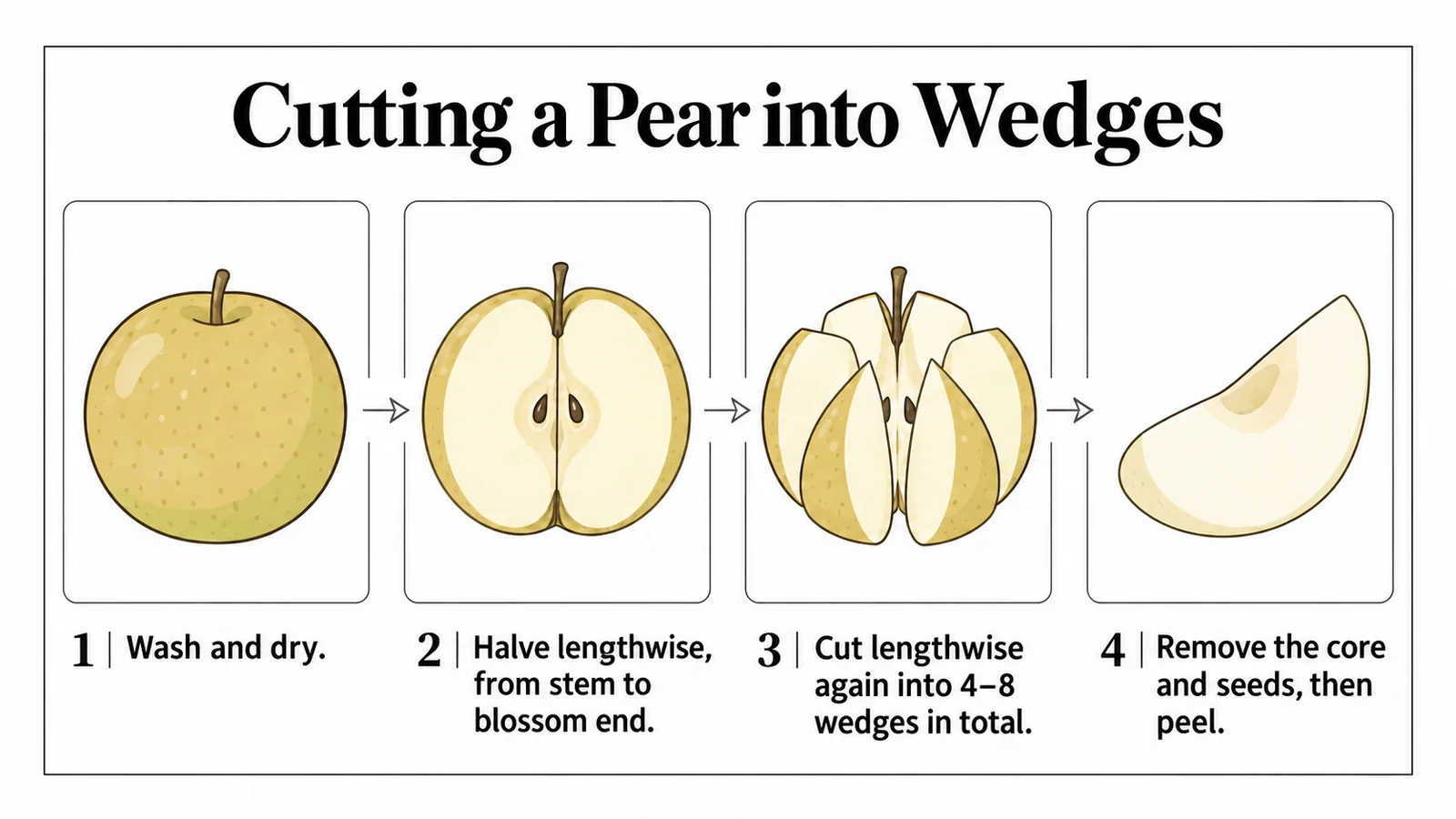
- Dry the washed pear and cut it in half lengthwise.
- Cut each half lengthwise, from stem end to blossom end, into two to four pieces, giving four to eight wedges in total.
- Cut a V-shaped notch to remove the core and seeds.
- Peel the wedges.
JA Tottori Chuo describes Japanese pears as sweetest near the blossom end and skin, with more acidity near the core. A lengthwise wedge includes both stem and blossom ends, distributing those differences within each piece. Removing the core thoroughly makes the sweet flesh more enjoyable. Source: JA Tottori Chuo, How to Eat Pears.
Keep refrigerated until serving
JA Tottori Chuo suggests chilling pears before eating for enjoyment. For Japanese pears, refrigeration should already be the storage method from purchase onward. Take out the chilled fruit just before serving, cut and enjoy.
Other ways to enjoy pears
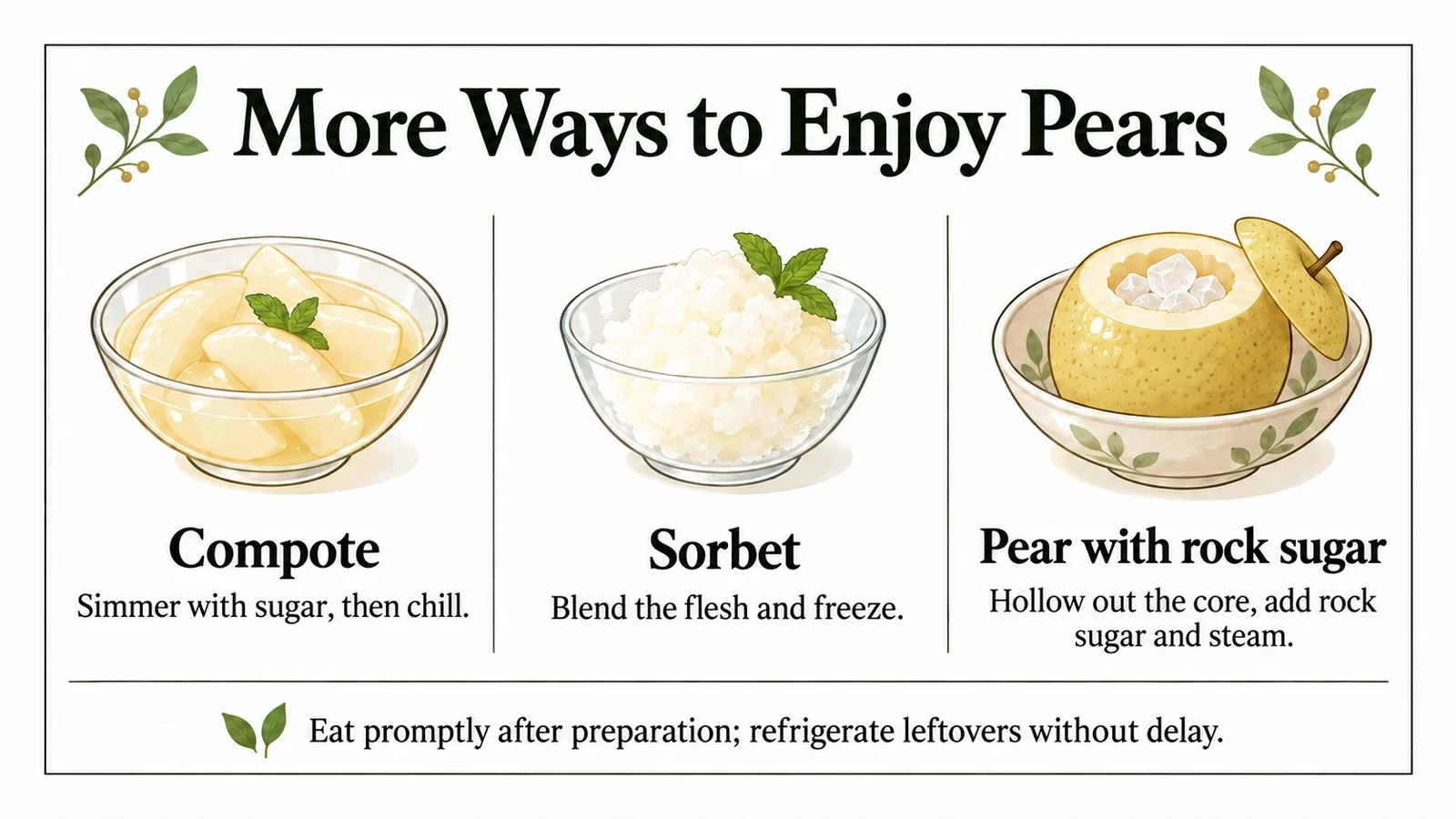
Besides eating them fresh, try:
- Compote: simmer with white wine and sugar, then chill, as described by JA Tottori Chuo.
- Sorbet: blend the flesh and freeze it, also suggested by JA Tottori Chuo.
- Pear steamed with rock sugar: lê hấp đường phèn, a preparation described in Vietnamese media.
For the steamed dish, the top is cut off like a lid, the core is hollowed out, and rock sugar is placed inside before steaming. VnExpress describes a rock-sugar method and another version with ingredients such as jujubes. Cooking time varies with fruit size and method. It is included here as a food preparation, not as a treatment for coughs or other symptoms. Source: VnExpress, October 8, 2024.
Cooked pears become softer than raw pears. Eat promptly and refrigerate leftovers without delay.
Storing whole, cut and frozen pears
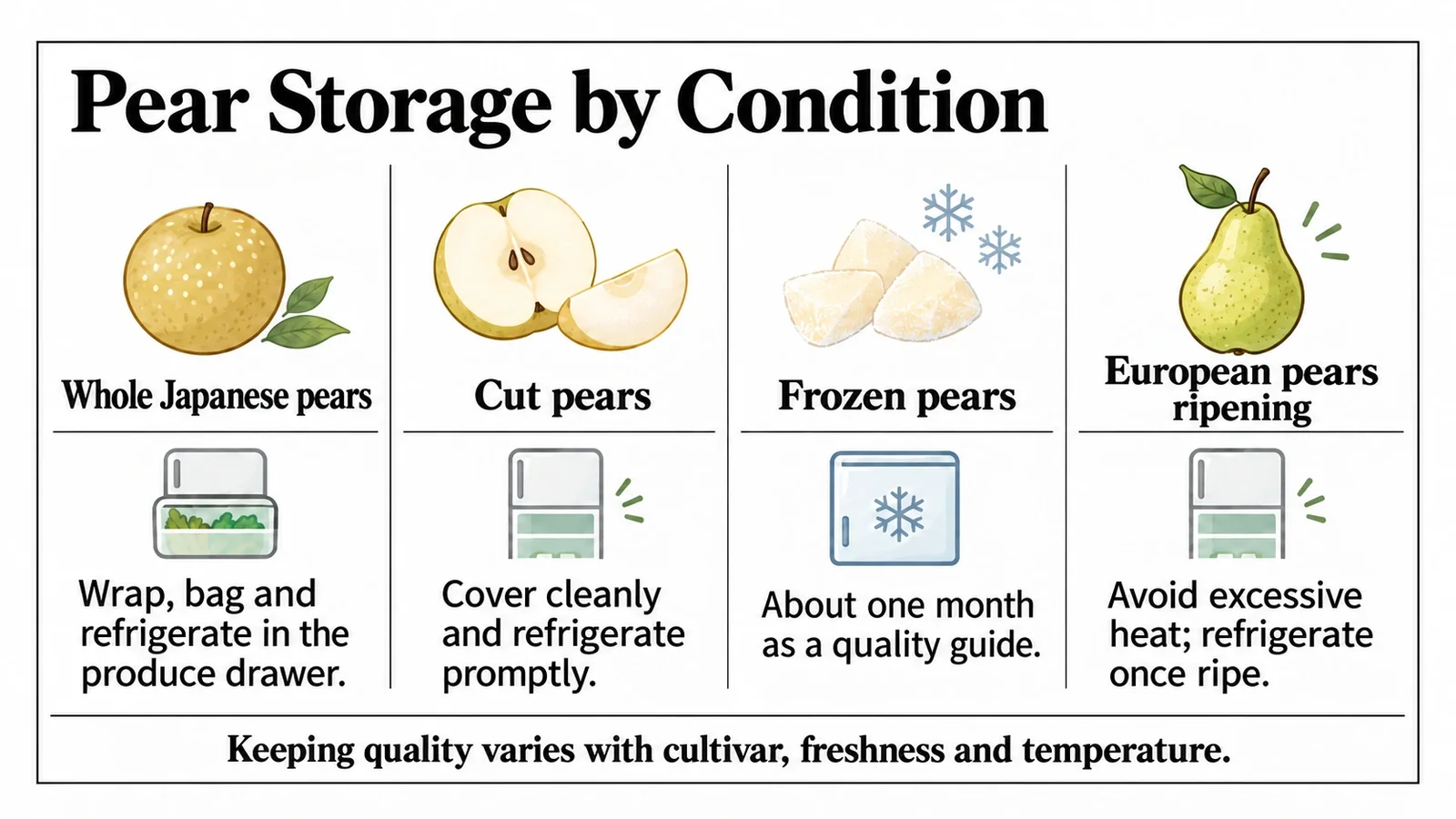
The following summarizes JA Tottori Chuo’s storage guidance.
| Condition | Storage method | Timing and quality |
|---|---|---|
| Whole Japanese pear | Wrap in paper towel, bag and refrigerate stem-side down in the produce drawer | Eat soon; cultivar, freshness and temperature matter |
| Cut pear | If desired, use salt or sugar water against browning, then cover and refrigerate | Eat promptly; anti-browning treatment does not guarantee storage life |
| Frozen pear | Wrap and place in a freezer bag | About one month as a quality guide; partially thaw in the refrigerator |
| European pear still ripening | Follow product guidance and avoid excessive heat | Refrigerate once ready to eat |
JA Tottori Chuo gives broad estimates of one week to one month for refrigerated whole Japanese pears and three to four days after cutting. These are not guarantees of the safety or keeping quality of an individual fruit. Pears bought in Vietnam may have an unknown harvest and storage history, so it is better to eat them soon than count on a long storage period.
Reducing browning after cutting
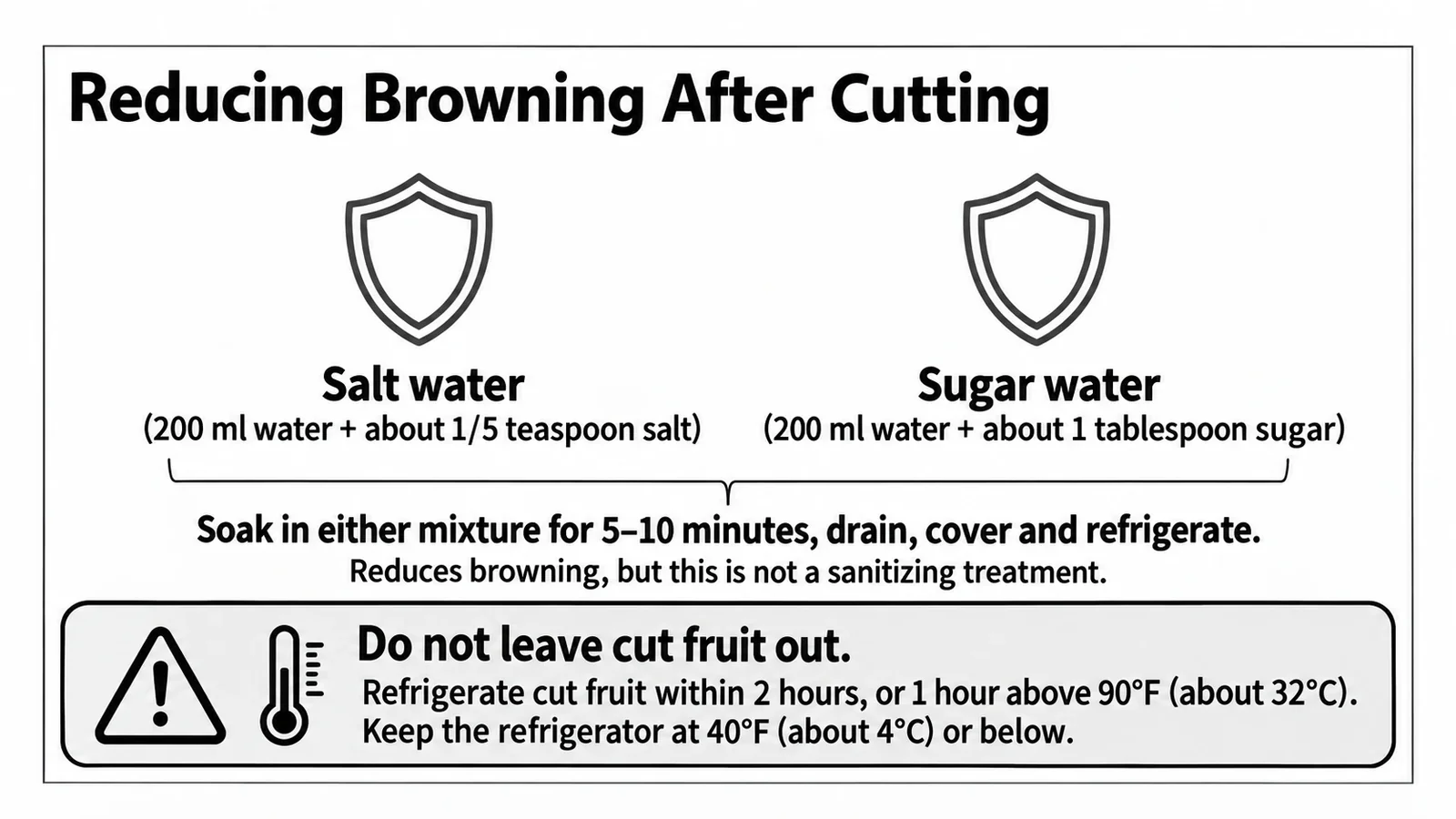
Cut pear flesh can turn brown when exposed to air. JA Tottori Chuo suggests a five-to-ten-minute soak in either of these mixtures:
- Salt water: about one-fifth teaspoon of salt in 200 ml water.
- Sugar water: about one tablespoon of sugar in 200 ml water.
Drain, cover with clean wrapping or place in a clean container, and refrigerate. These mixtures reduce browning; they are not sanitizing treatments.
Do not leave cut pears sitting at room temperature. The US Centers for Disease Control and Prevention (CDC) advises refrigerating cut fruit within two hours, or one hour when the temperature exceeds 90°F, about 32°C. Keep the refrigerator at 40°F, about 4°C, or below. Source: CDC, Preventing Food Poisoning, checked in the Japanese v09 edition on October 17, 2026.
Signs a pear should be discarded
Do not eat pears with:
- Mold on the surface or cut flesh.
- Brown, collapsing flesh with leaking juice.
- An unusual, unpleasant fermented smell.
A European pear naturally softens as it ripens, so softness alone does not mean it has spoiled. FDA advises discarding produce that looks rotten. Do not simply cut off a moldy area and eat the remainder; if its condition is doubtful, discard it. Source: FDA, Selecting and Serving Produce Safely.
Eating precautions: allergy symptoms and young children
Itching in the mouth or throat
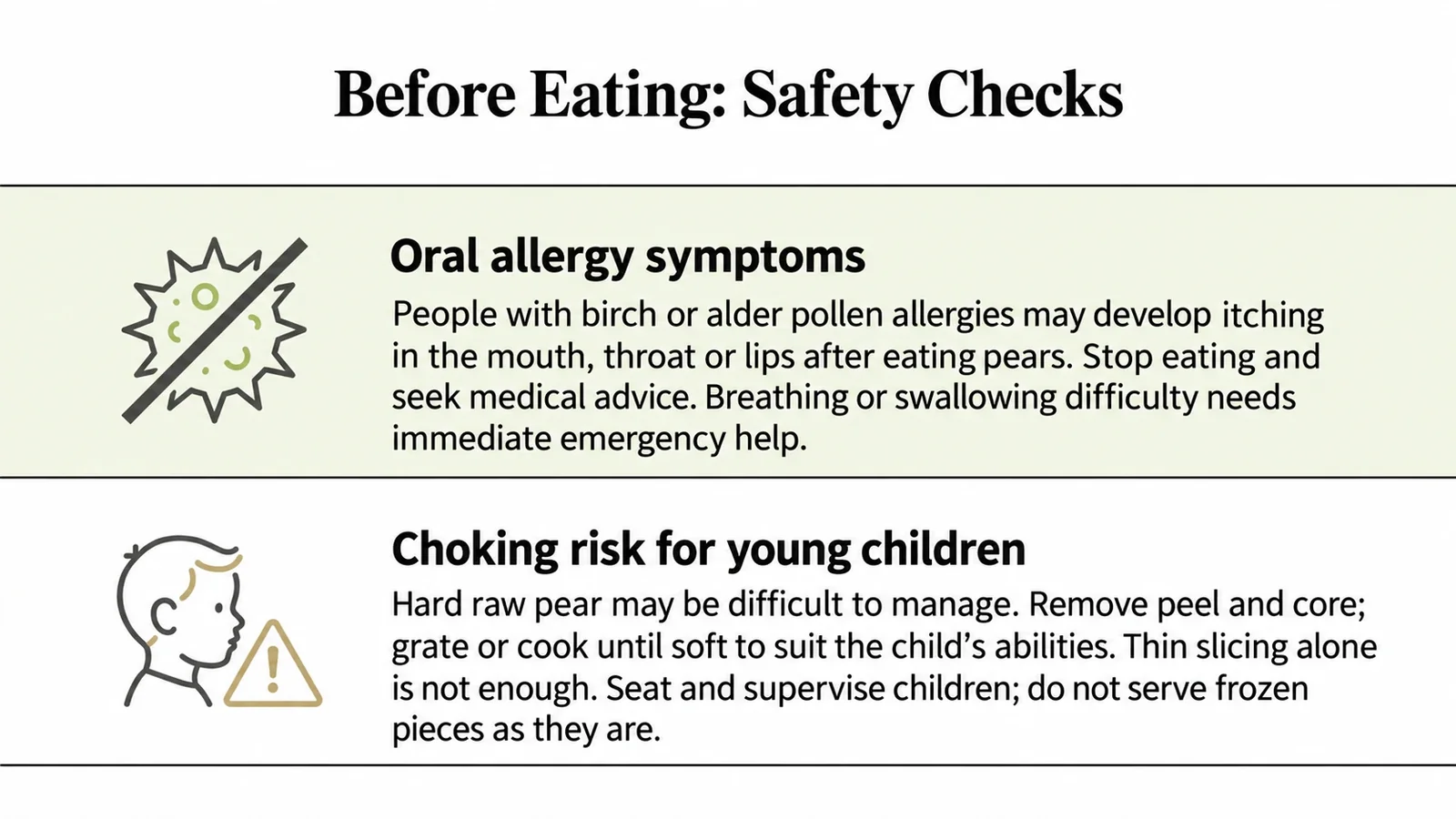
Pears belong to the rose family, like apples and peaches. The Japanese Society of Allergology explains that some people with birch-family pollen allergies, including birch and alder, can develop itching or irritation of the mouth, throat or lips within minutes of eating related fruits. This is often called oral allergy syndrome. Its explanation includes proteins in European pears among those involved.
Heating may reduce reactions in some cases, but anyone who has had symptoms should seek medical advice rather than trying heated fruit on their own. Source: Japanese Society of Allergology.
Stop eating if itching or swelling develops and seek medical advice. Breathing or swallowing difficulty requires immediate emergency help.
Prepare pears for the child’s eating ability
Hard, crisp raw pear can be difficult for a young child to manage. Remove the peel and core and adapt the texture to the child’s development, for example by grating it or cooking it until soft. Thin slicing alone does not necessarily make it safe. Have children sit while eating, with an adult watching. Do not hand them frozen pear pieces to eat as they are. Source: CDC, Choking Hazards.
Can you bring pears from Vietnam into Japan?
Travelers cannot bring fresh pears from Vietnam into Japan in personal baggage. Japan’s Plant Protection Station lists pears among the fruits that cannot be brought in from Vietnam. Source: Plant Protection Station, Vietnam, checked in the Japanese v09 edition on October 17, 2026.
For imported fruit bought in Vietnam, such as Korean pears, or a processed pear product, contact the Plant Protection Station before buying it as a souvenir, giving the product’s origin and condition. This article does not decide whether an individual product is admissible.

A Chinese green pear bought in Hanoi: price, photos and tasting notes
This is the author’s own supermarket purchase record. The receipt names the item “LE XANH TQ – LC”. “LE XANH” is lê xanh, green pear, and “TQ” abbreviates Trung Quốc, China. It was sold as a Chinese green pear.
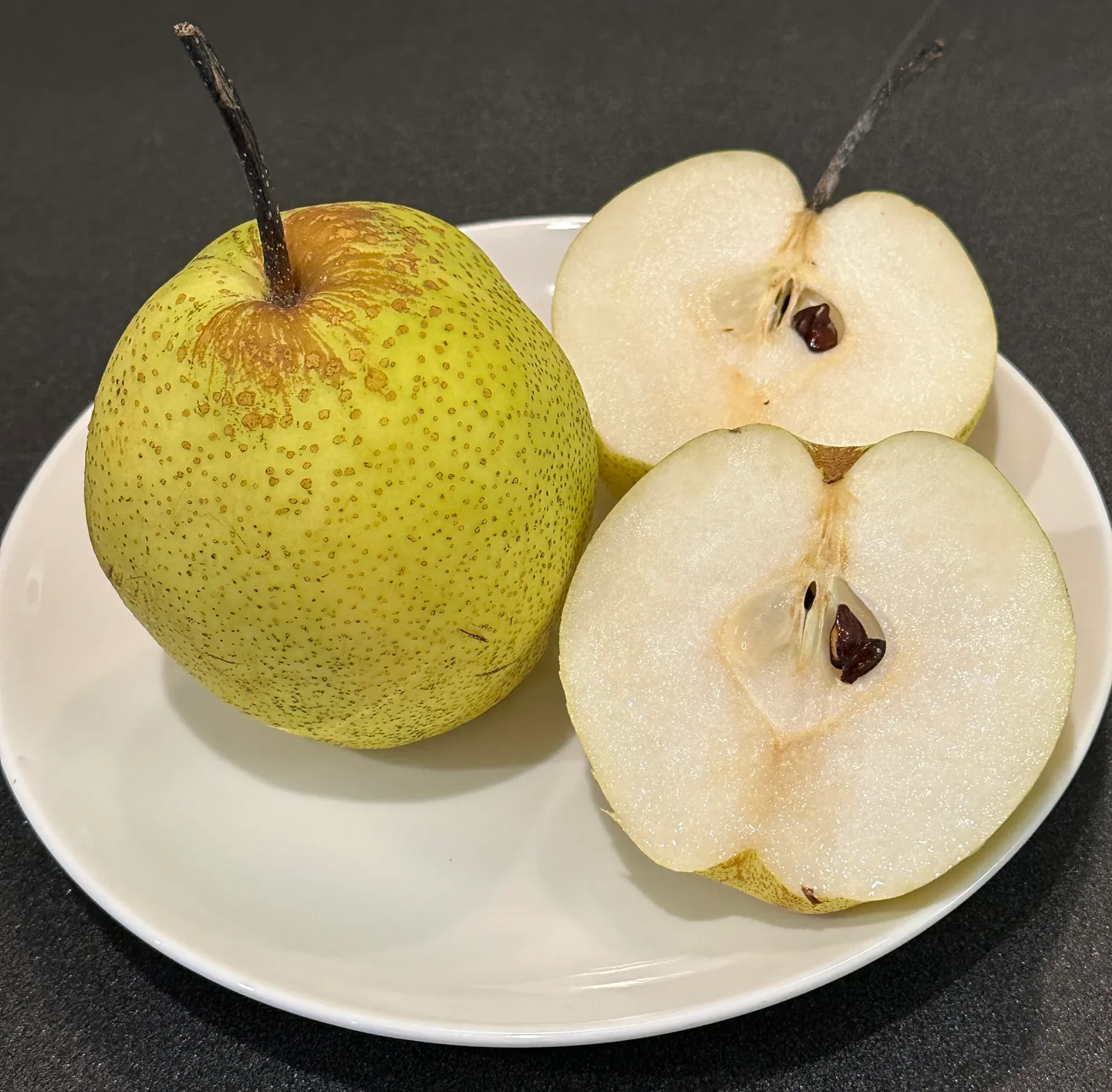
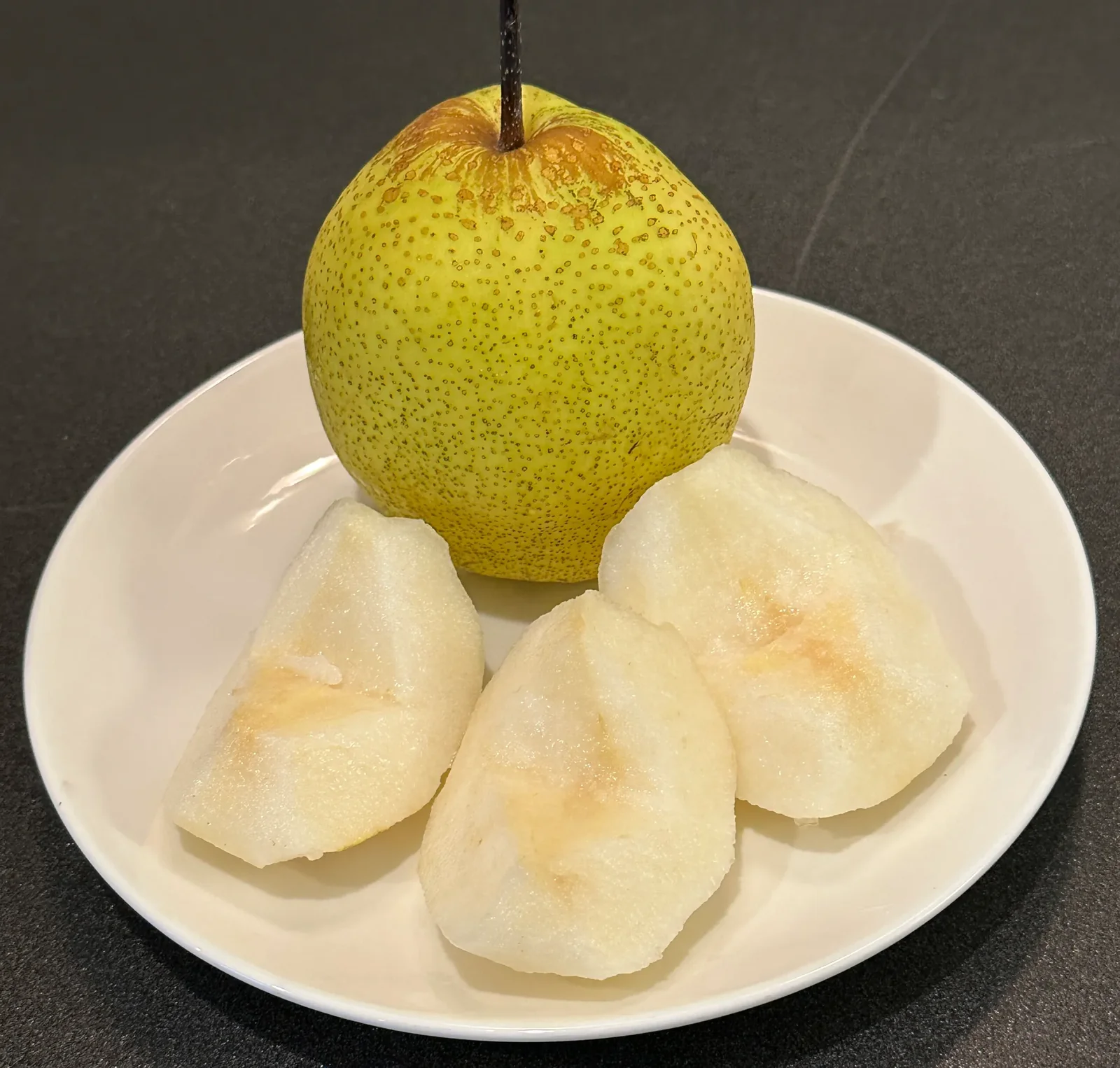
Photographs by the author.
Purchase record
| Item | Details |
|---|---|
| Purchased | August 23, 2026 |
| Tasted | August 24, 2026, the following day |
| Shop | MaxValu, Khuat Duy Tien branch, Hanoi |
| Receipt product name | LE XANH TQ – LC: green pear, Chinese origin. The meaning of “LC” could not be established from the label |
| Weight | 0.734 kg |
| Unit price | VND 29,000/kg |
| Price paid | VND 21,286 |
VND 29,000/kg × 0.734 kg = VND 21,286, matching the receipt. This records one shop on one date, not a Vietnam-wide market price. The purchase location was Hanoi; the indicated growing origin was China. These are recorded separately.
The origin differs from that of Bắc Hà’s local green pears. The shared name “green pear” does not establish whether the cultivar is the same.
Taste and texture
Flavor: sweetness was mild to moderate, with a clean, refreshing character. Plenty of juice and a hint of acidity balanced the sweetness. The aroma was gentle, with a light finish.
Texture: the flesh was firm and crisp, with an apple-like crunch and plenty of juice. It had not become overly soft, and the bite remained enjoyable.
This particular purchase delivered the crisp texture described here. The receipt did not name a cultivar, so it cannot be identified. Fruit sold under the same label will not necessarily taste the same every time.
From buying to serving: five steps
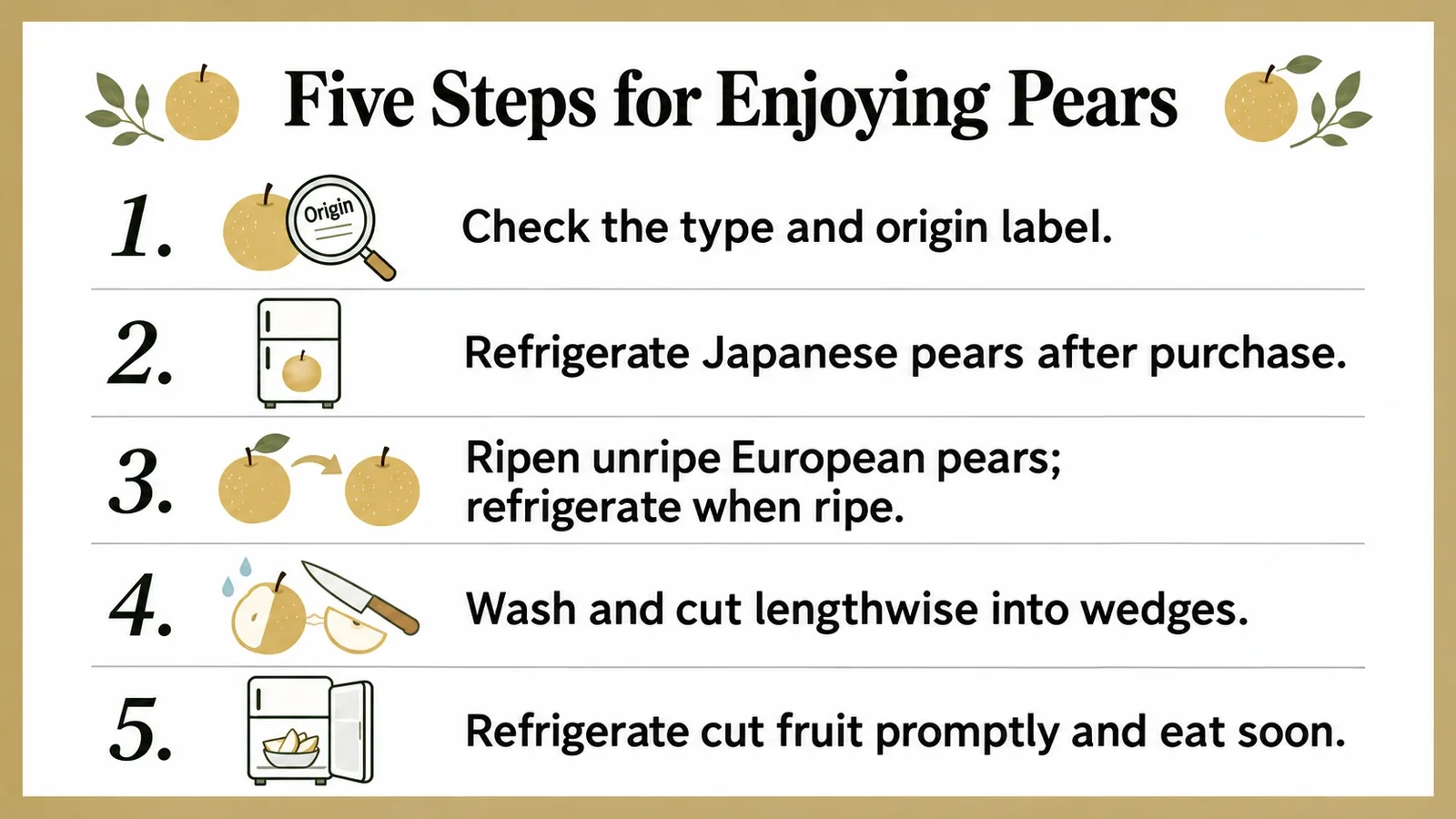
- Check the name or ask the retailer whether it is an Asian-type or European pear and whether ripening is needed.
- Choose Japanese pears by skin condition, weight and lack of damage, then refrigerate after purchase.
- Ripen unripe European pears away from excessive heat and check around the stem for readiness.
- Wash just before preparing, cut into wedges, and remove the core and seeds.
- Refrigerate cut fruit promptly and eat soon, even after an anti-browning treatment.
Stop eating if you develop mouth or throat symptoms. Remember that fresh pears cannot be carried from Vietnam into Japan in travelers’ baggage.
More in the pear trilogy
- Pears in Vietnam: Varieties, Nutrition and Seasons
- Pear History and Stories: Japan, Taiwan and Vietnam
References and source dates
The Japanese source edition first checked the references on September 29, 2026, with later checks recorded in its revision notes. This translation retains those dates and does not claim a fresh check of every reference. Prices and tasting impressions describe the specific purchase above.
- Higashimatsuyama City: Choosing delicious pears
- JA Tottori Chuo: Storing pears
- JA Tottori Chuo: How to eat pears
- Clemson University HGIC: Asian Pear
- Oishii Yamagata: La France ripeness
- VnExpress: Pear preparations, October 8, 2024
- Japanese Society of Allergology: Oral allergy syndrome
- FDA: 7 Tips for Cleaning Fruits and Vegetables
- FDA: Selecting and Serving Produce Safely
- CDC: Preventing Food Poisoning
- CDC: Choking Hazards
- Japan Plant Protection Station: Vietnam entry restrictions
