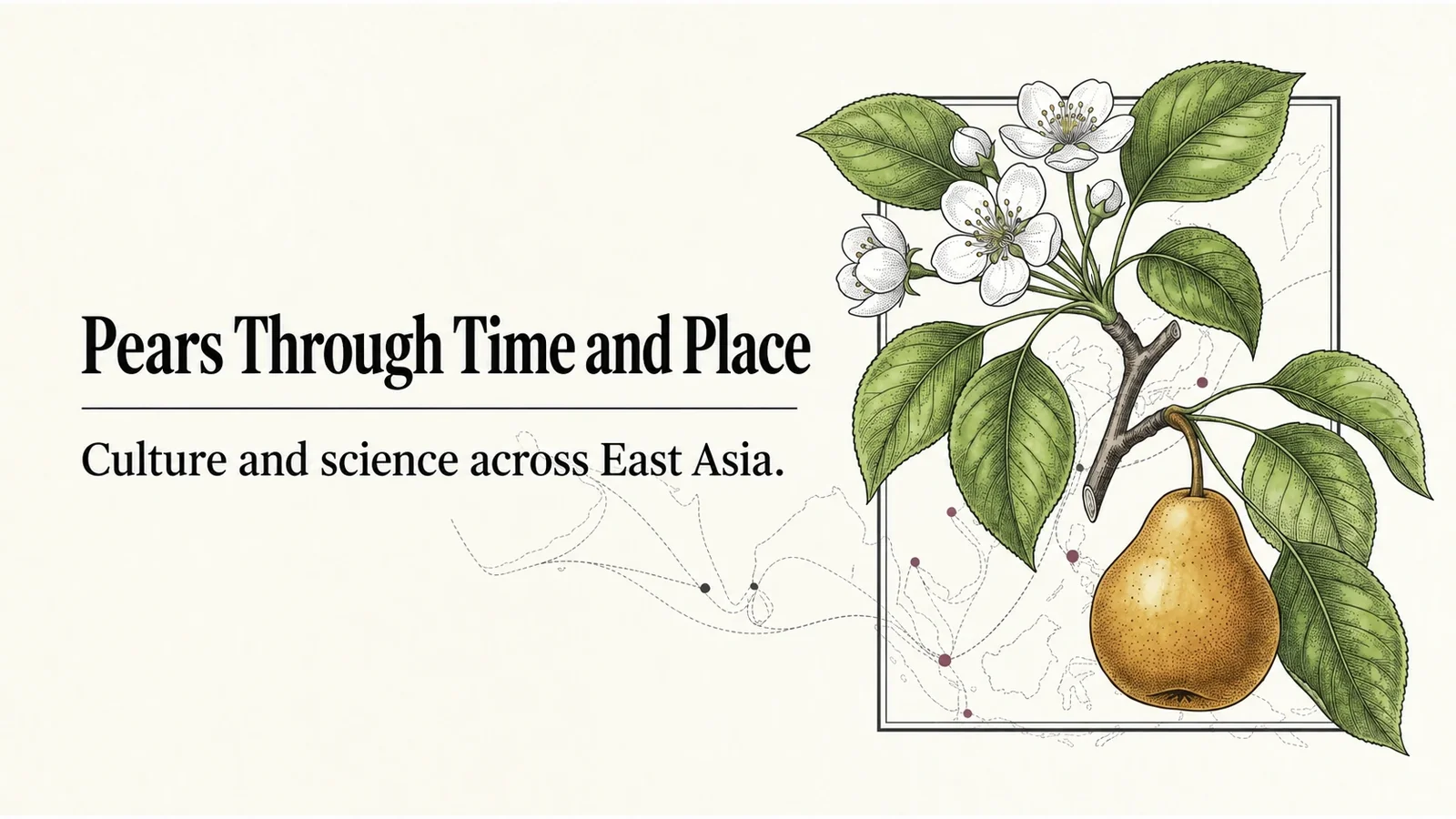
Japanese pear names preserve the people, households and hopes behind them. Nijisseiki, meaning ‘Twentieth Century’, began with a tree found by a 13-year-old boy and was named with hopes for the new century. Chojuro took the traditional house name of a pear-growing family.
The Japanese term rien, “Pear Garden”, for the kabuki world traces back to the story of Tang emperor Xuanzong teaching music and performance in a garden planted with pear trees.
This article follows Chinese stories, Japanese cultivar history, Taiwanese grafting techniques, and Vietnamese literature and cultivation.
Contents
- A timeline of pear history
- China’s pear stories: the Pear Garden and Kong Rong
- Early pears in Japan: seeds and written records
- 1888: a 13-year-old discovers Nijisseiki
- 1893: Chojuro, a household name and a resilient pear
- 1904: ten saplings travel to Tottori
- Black spot disease and the breeding of Gold Nijisseiki
- Taiwan’s grafted pears: flower buds from colder places
- Vietnam: pear blossoms in The Tale of Kiều and orchards in Bắc Hà
- The people behind the history of pears
- More in the pear trilogy
- References and source dates
A timeline of pear history
| Period or year | Event |
|---|---|
| Yayoi period | Charred pear seeds from Japan’s Toro archaeological site date to this period |
| Tang dynasty | Emperor Xuanzong is said to have taught pupils in a pear garden, the origin of “Pear Garden” as a performing-arts term |
| 1888 | Thirteen-year-old Kakunosuke Matsudo finds the tree that becomes Nijisseiki in Ohashi village, Chiba |
| 1893 | Chojuro is discovered in Daishigawara, Kanagawa |
| 1897 | A pear disease outbreak helps the disease-tolerant Chojuro spread |
| 1904 | Nijisseiki receives its name; Eiji Kitawaki of Tottori buys ten saplings |
| 1962 | Gamma irradiation of Nijisseiki begins |
| 1976 | A technique for producing temperate pears in Taiwan’s lowlands is developed |
| 1981 | A branch less susceptible to black spot disease is found on Nijisseiki |
| 1986 | Taiwan begins importing pear scionwood from Japan, according to the cited account |
| 1990 | Gold Nijisseiki receives its name and designation |
| 1991 | Gold Nijisseiki is registered as a cultivar under Japan’s Seed and Seedling Law |
| 2012 | Vietnam recognizes Taiwanese-origin VH6 as a new cultivar |
The sections below explain each event and its sources. Traditional accounts are identified as such rather than presented as independently established facts.
China’s pear stories: the Pear Garden and Kong Rong
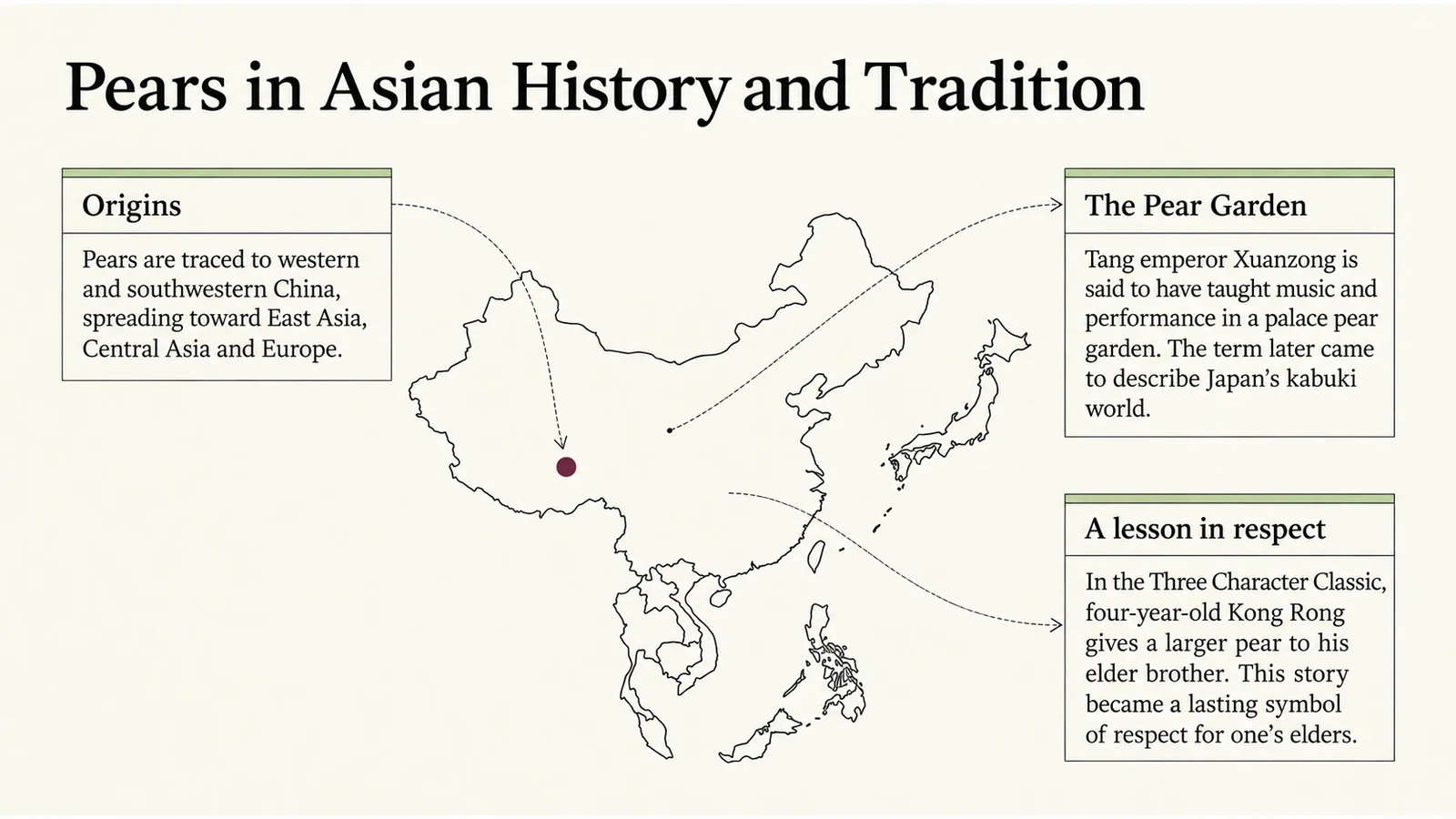
Kawasaki City’s agricultural account places the origins of pears in western and southwestern China. It describes one route of spread through East Asia to Japan and another toward Central Asia and Europe. Source: Kawasaki City.
Pear-related expressions and stories remain part of Chinese culture.
In Japan, the kabuki world is called rien, the Pear Garden. The Japan Arts Council’s kabuki dictionary traces this name to Tang emperor Xuanzong personally teaching music and performance to pupils in a palace garden planted with pear trees. His pupils became known as the emperor’s Pear Garden disciples. Edo-period scholars of Chinese learning are said to have borrowed this expression for kabuki, where it became established. Source: Japan Arts Council, Kabuki Dictionary.
Another familiar story appears in the Three Character Classic, a traditional elementary text: at four years old, Kong Rong was able to yield a pear to others. In this account, the young Kong Rong of the Eastern Han dynasty gives the larger pear to his elder brother and takes a smaller one himself. It has long been told as a lesson in respect for elders. Source: Sanzijing.org.
Early pears in Japan: seeds and written records
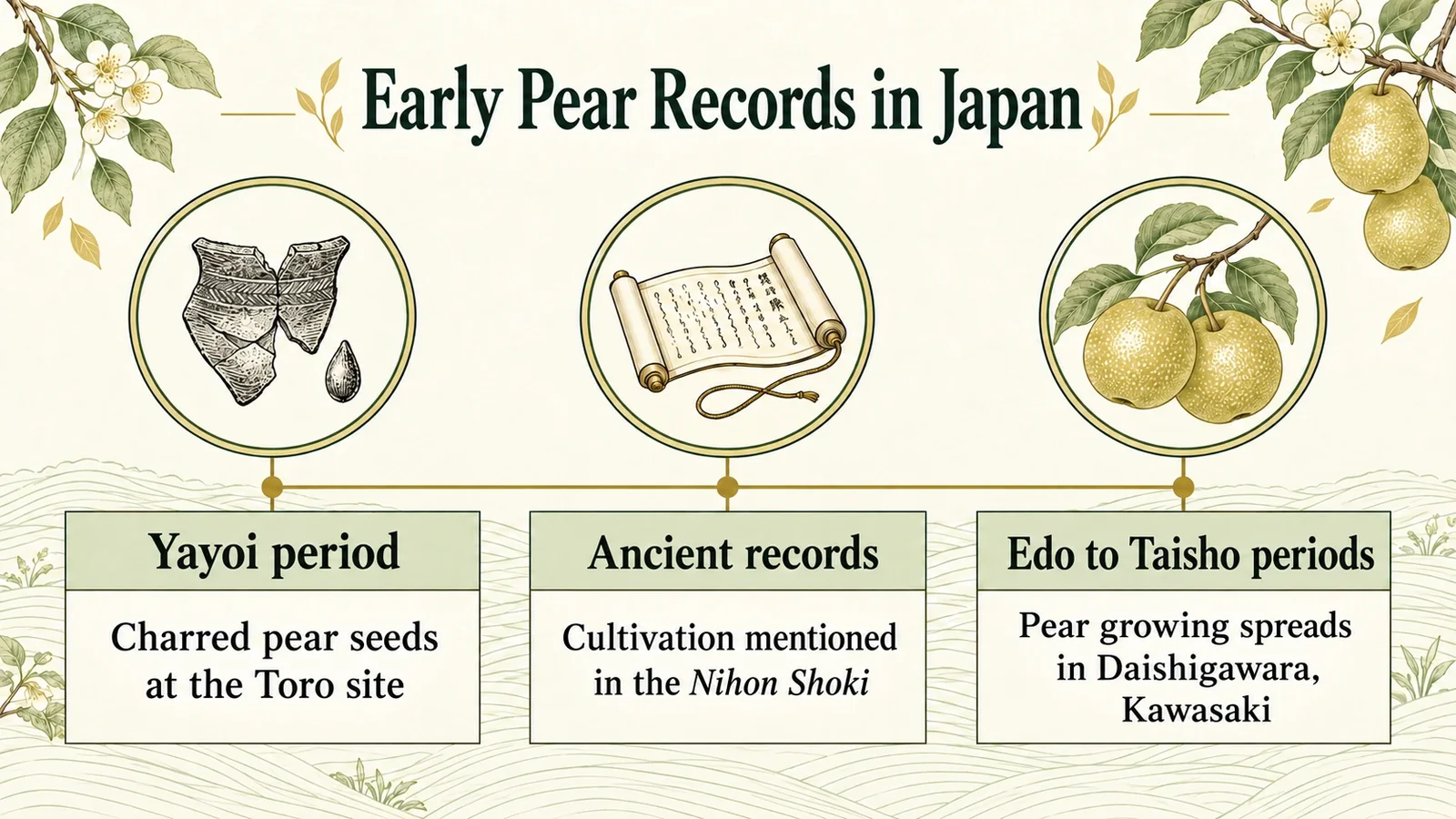
Japan’s association with pears is also old. Kawasaki City notes charred pear seeds from the Yayoi-period Toro site in Shizuoka and cultivation references in the Nihon Shoki. Cultivated Japanese pears are traced to wild Japanese pears occurring in areas including central and southern Japan. Source: Kawasaki City.
Pear-growing areas developed during the Edo period. In Kawasaki, records place pears in Daishigawara, now part of Kawasaki Ward, in the early Edo period. More substantial cultivation is said to have begun during the Kansei era. By the Taisho period, Kawasaki had become one of the Kanto region’s major pear-producing areas.
Orchards in these areas would eventually produce cultivars that changed Japanese pear growing.
1888: a 13-year-old discovers Nijisseiki
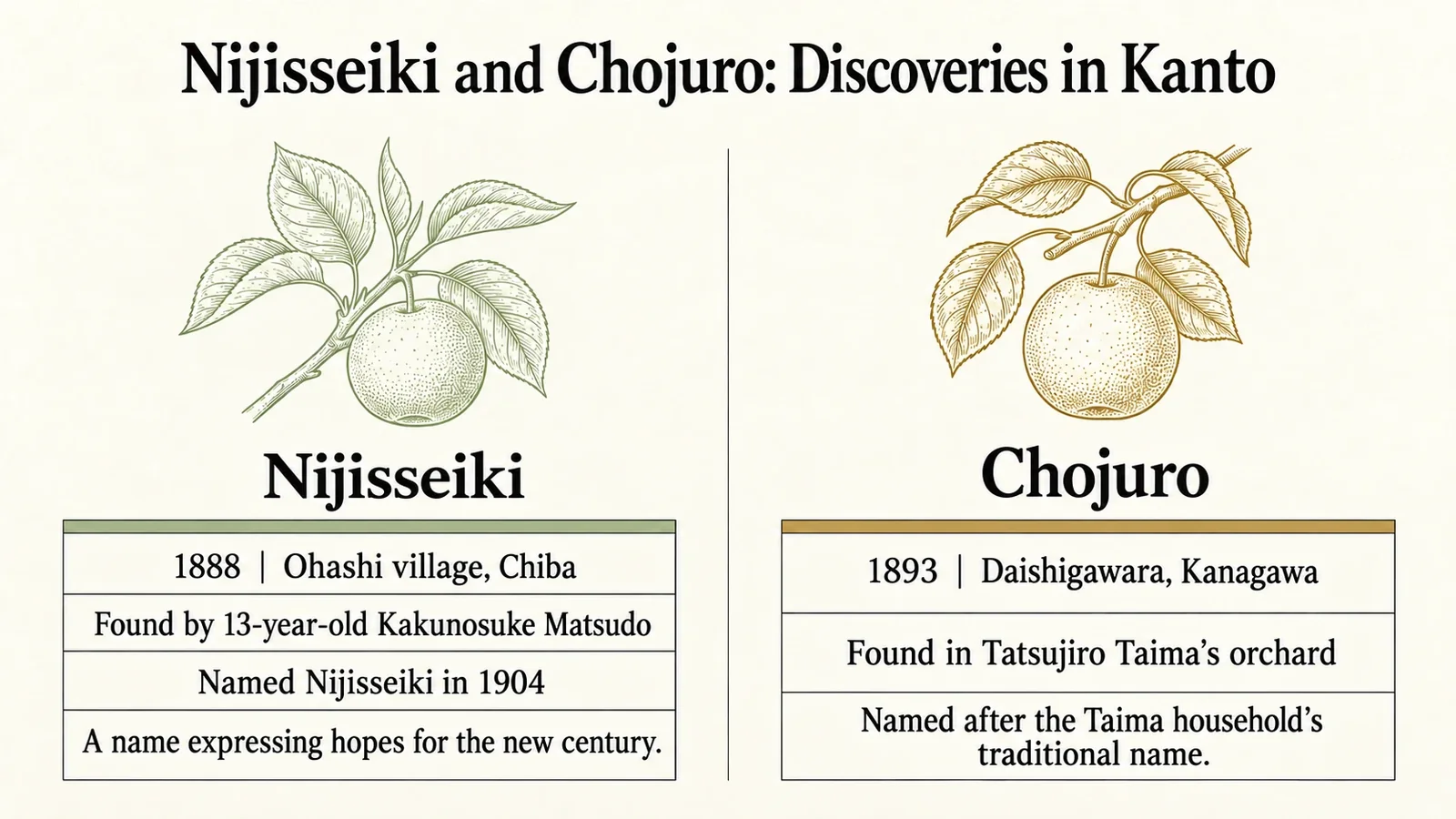
According to Matsudo City, Kakunosuke Matsudo, then 13, found a pear tree in 1888 in Ohashi village, now Nijisseikigaoka Nashimoto-cho in Matsudo, Chiba.
In 1904 the pear was named Nijisseiki, “Twentieth Century”, with the hope that it would become a cultivar representative of the new century. Source: Matsudo City.
The discovery site is now Nijisseiki Park. Alongside its commemorative monument stands a monument of gratitude donated by Tottori Prefecture. Why would Tottori thank a town in Chiba? The answer lies in the cultivar’s later journey.
1893: Chojuro, a household name and a resilient pear
Five years later, in 1893, a distinctive pear was found in Tatsujiro Taima’s orchard in Daishigawara, Kawasaki, now Dekino in Kawasaki Ward. The Taima household was known by the traditional house name Chojuro, which became the cultivar’s name.
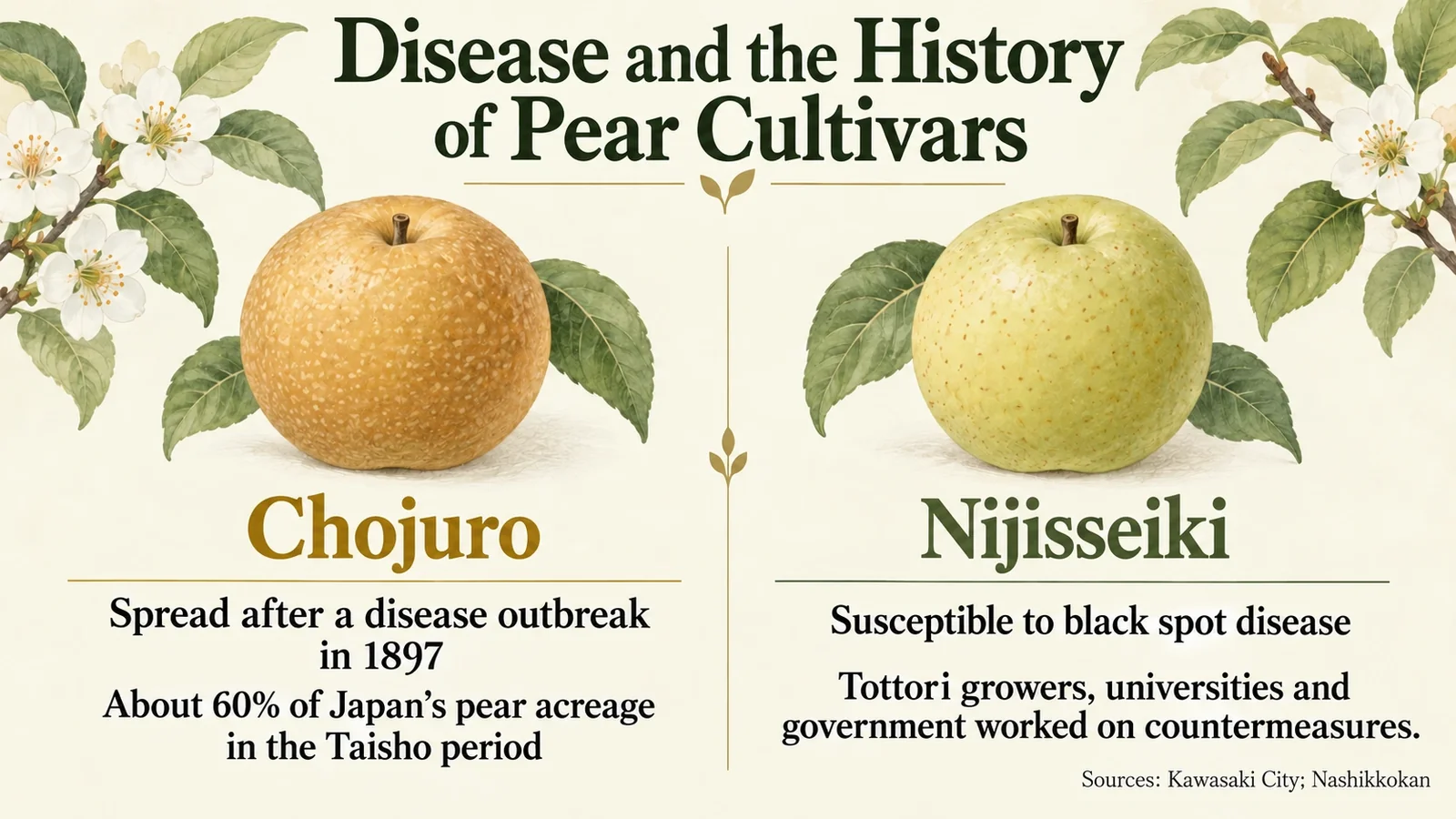
It initially attracted little attention. The turning point came in 1897, when a pear disease outbreak caused widespread losses. Kawasaki City’s account describes Chojuro as escaping damage while also producing large harvests. Its cultivation spread until, in the Taisho period, it occupied about 60% of Japan’s pear-growing area. Source: Kawasaki City.
From the mid-1960s into the early 1970s, newer, sweeter and juicier cultivars such as Kosui, Shinsui and Hosui increasingly displaced it. A Chojuro monument still stands at Kawasaki Daishi temple.
A single household’s name once represented more than half the country’s pear acreage. Chojuro’s story also shows how disease can change a cultivar’s fortunes.
1904: ten saplings travel to Tottori
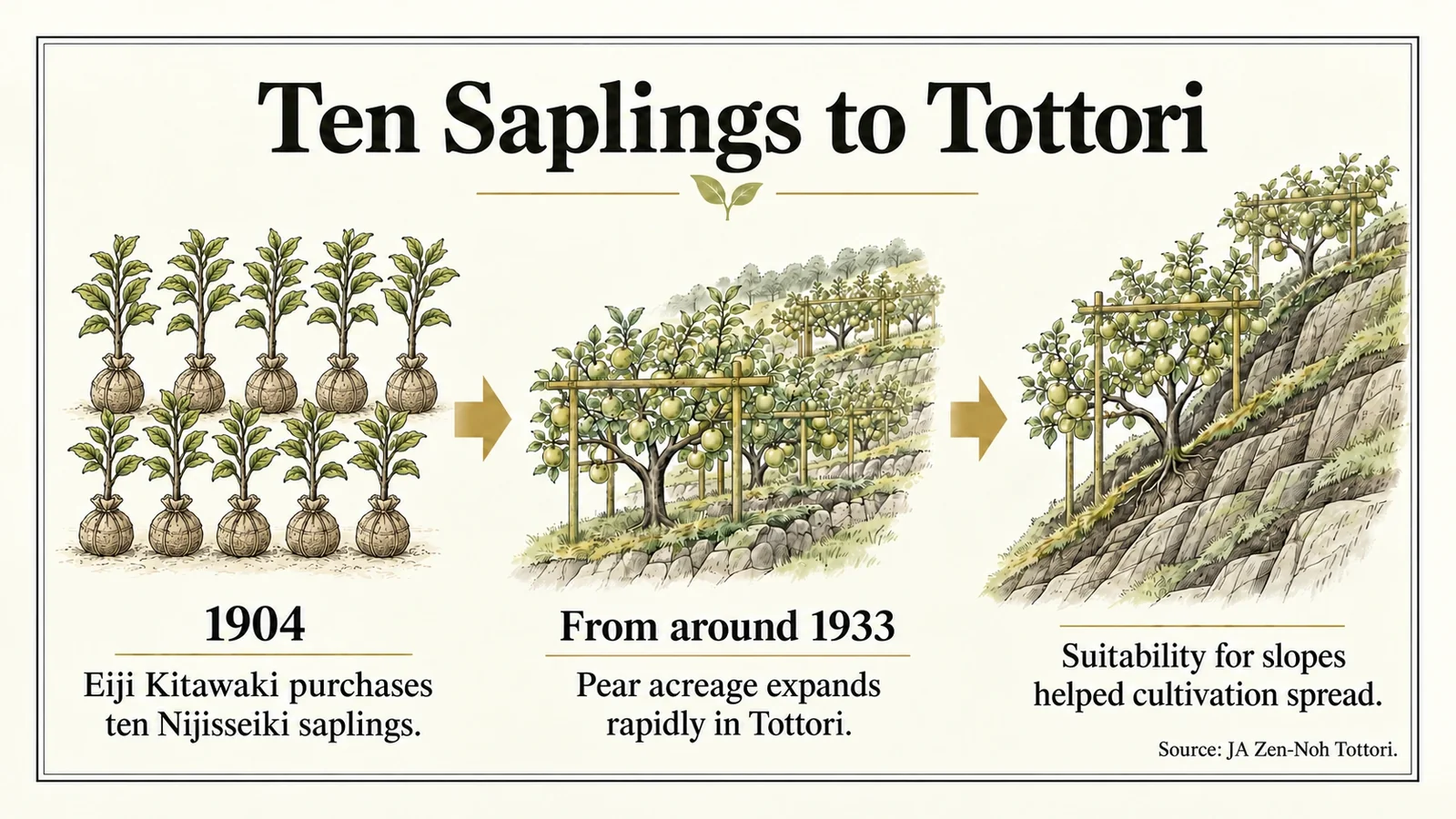
The year Nijisseiki received its name also marked its beginning in Tottori. JA Zen-Noh Tottori credits Eiji Kitawaki of Katsurami, Tottori City, who purchased ten Nijisseiki saplings in 1904. Source: JA Zen-Noh Tottori.
Plantings expanded rapidly from around 1933. The cultivar’s suitability for steep slopes is cited as one reason it spread in mountainous Tottori. The prefecture became Japan’s leading Nijisseiki-producing area, and the pear became one of its signature fruits.
A tree discovered in Chiba led to ten saplings in Tottori and eventually a prefectural specialty. This connection explains Tottori’s monument of gratitude at Matsudo’s Nijisseiki Park.
Black spot disease and the breeding of Gold Nijisseiki
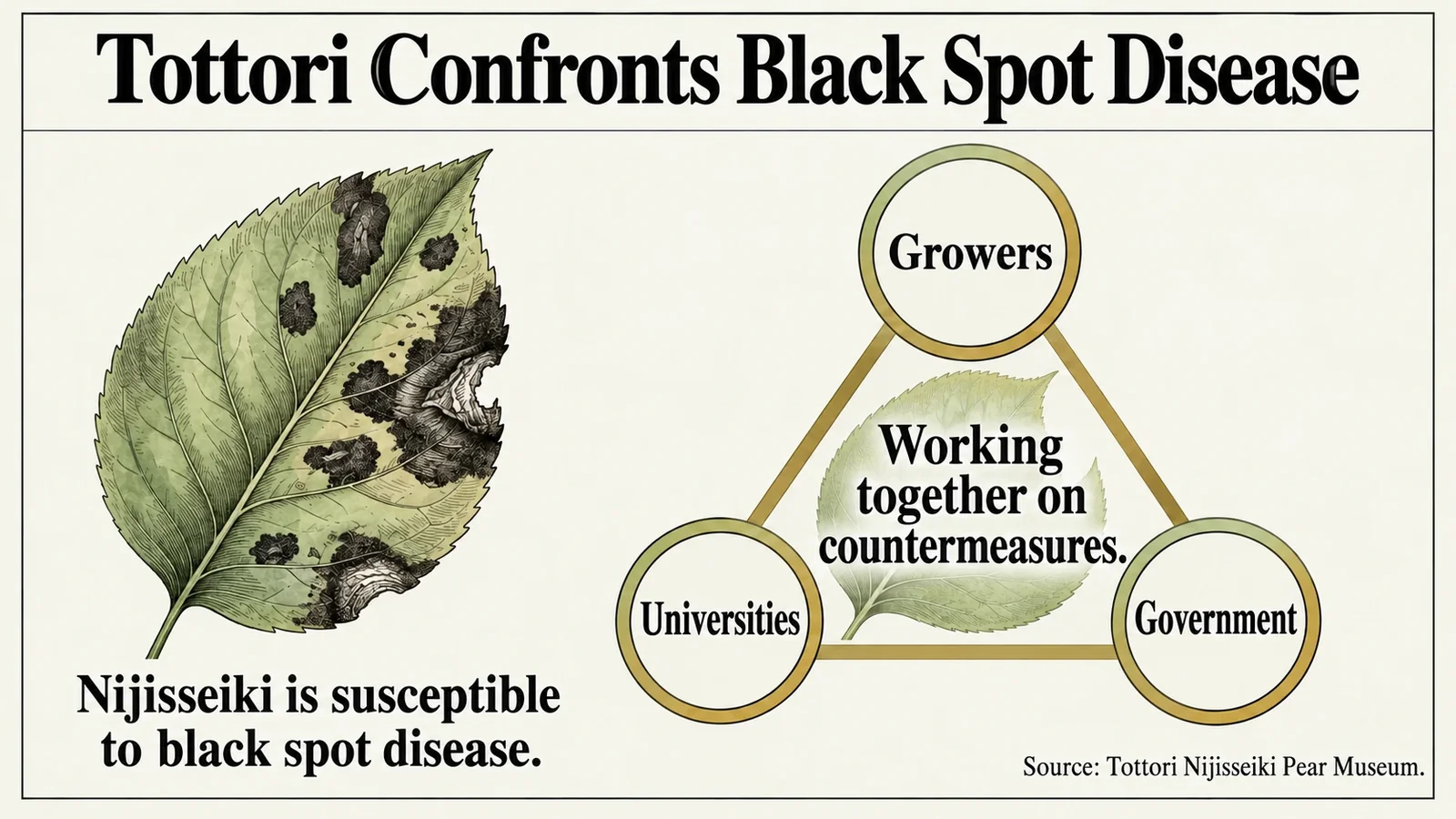
Nijisseiki had a major weakness: susceptibility to black spot disease.
The Tottori Nijisseiki Pear Museum, Nashikkokan, describes the disease spreading from the late Meiji period, causing some prefectures to give up growing the cultivar. In Tottori, growers, universities and government bodies worked together on countermeasures and revived production. Source: Nashikkokan.
The search for resistance led to an unusual breeding method. At the radiation-breeding facility in Ibaraki, a gamma field placed a radiation source at the center of a circular field with a radius of 100 m. Plants around it were exposed to gamma rays over long periods. Source: ATOMICA, Gamma Field.
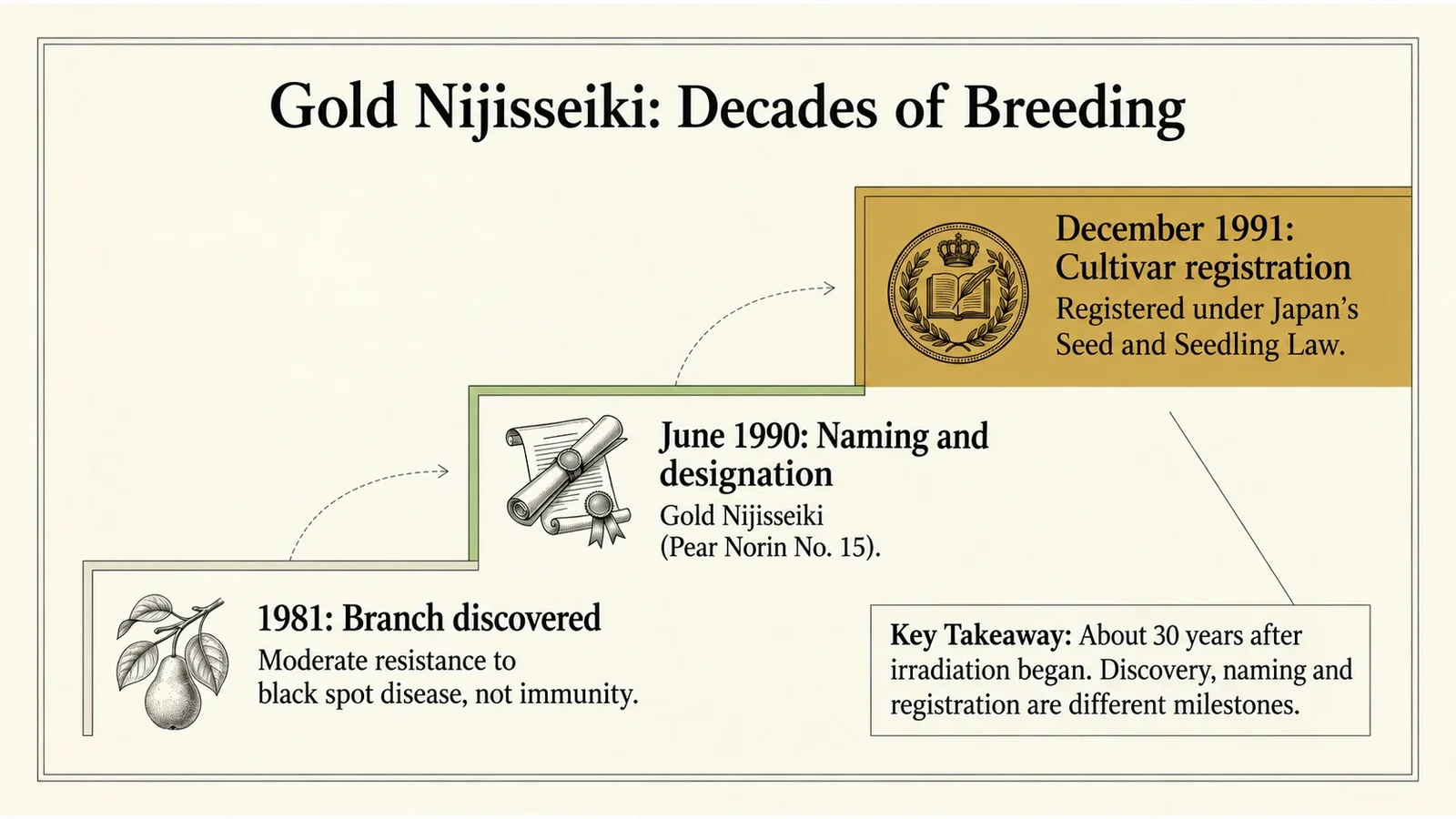
Researchers found a branch on a Nijisseiki tree that was less susceptible to black spot disease. It became Gold Nijisseiki, also designated Pear Norin No. 15. A breeding report describes the selected branch as having moderate resistance, compared with the susceptible original. Gold Nijisseiki is therefore not a cultivar that can never develop the disease. Source: Japanese Journal of Breeding, 43(3), 1993.
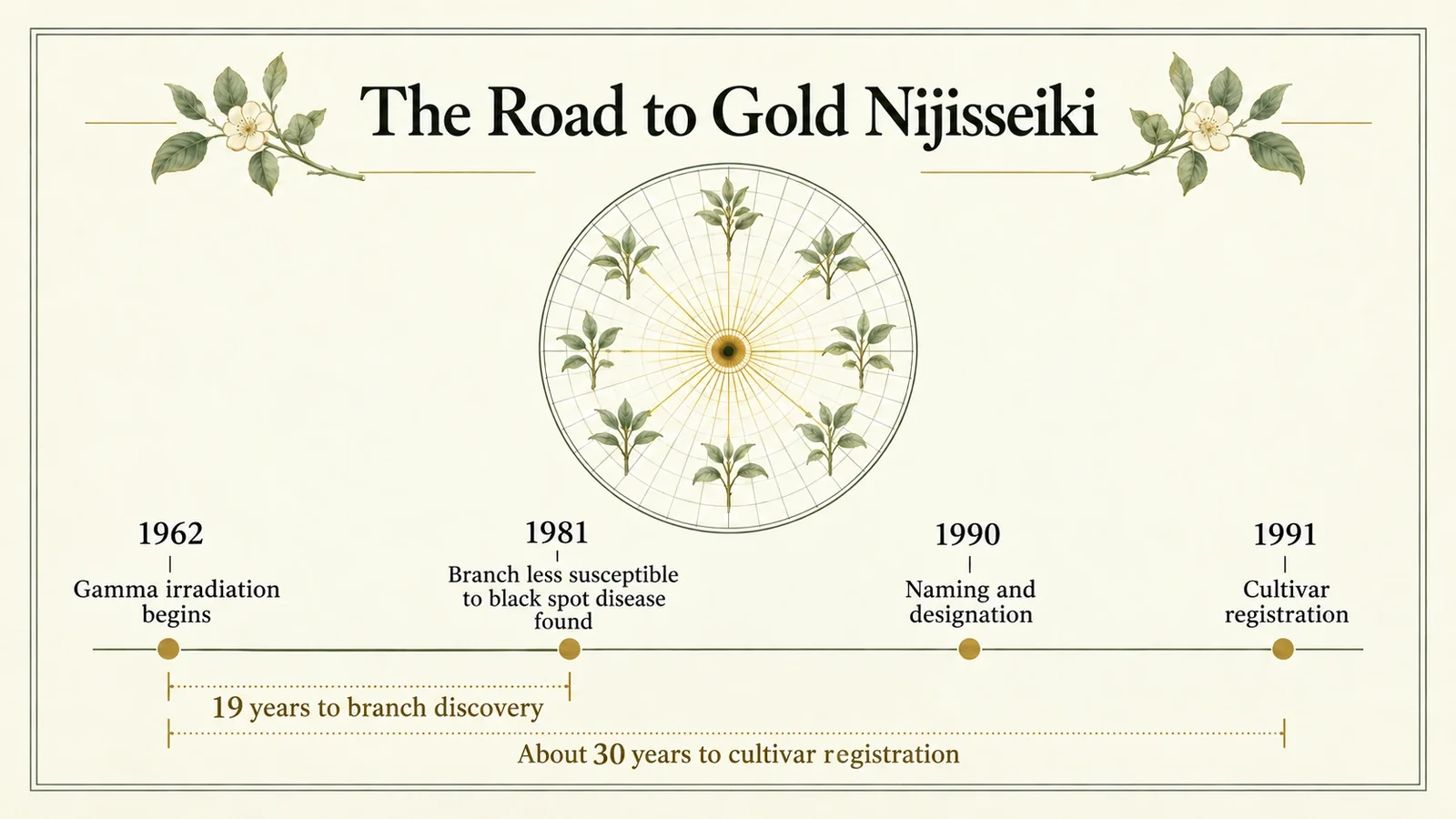
The development record dates the start of irradiation to 1962 and discovery of the resistant branch to 1981. Naming and designation followed in 1990, then cultivar registration under the Seed and Seedling Law in December 1991. These are separate milestones: 19 years from the start of irradiation to discovery, and about 30 to cultivar registration. Sources: Plant Protection, 52(9), p. 415, Bulletin of the National Institute of Agrobiological Resources, No. 12.
Taiwan’s grafted pears: flower buds from colder places
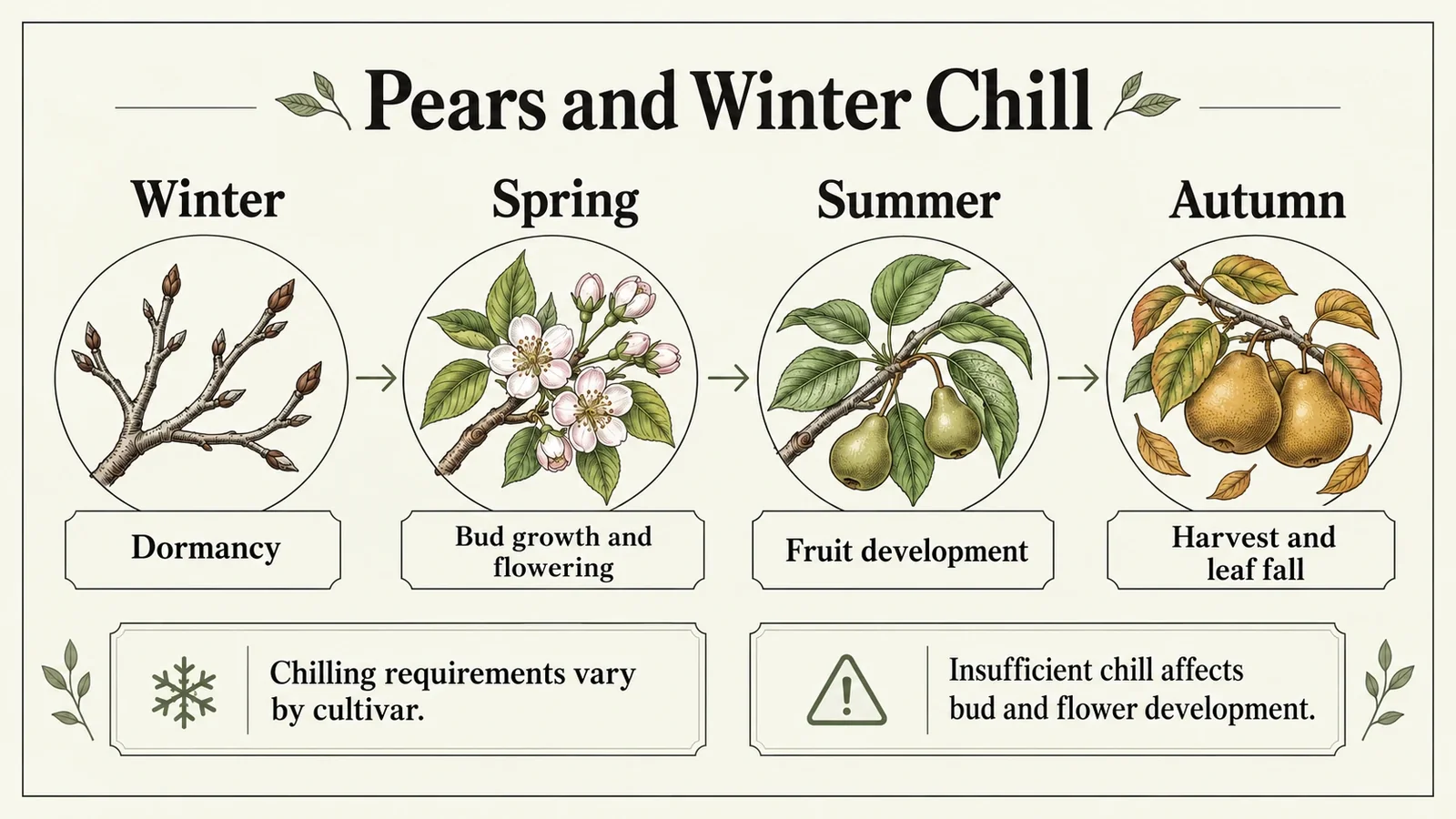
As explained in the pear guide, Japanese pears need winter chill for normal spring flowering. How can growers produce them in warm lowlands where winter cold is insufficient?
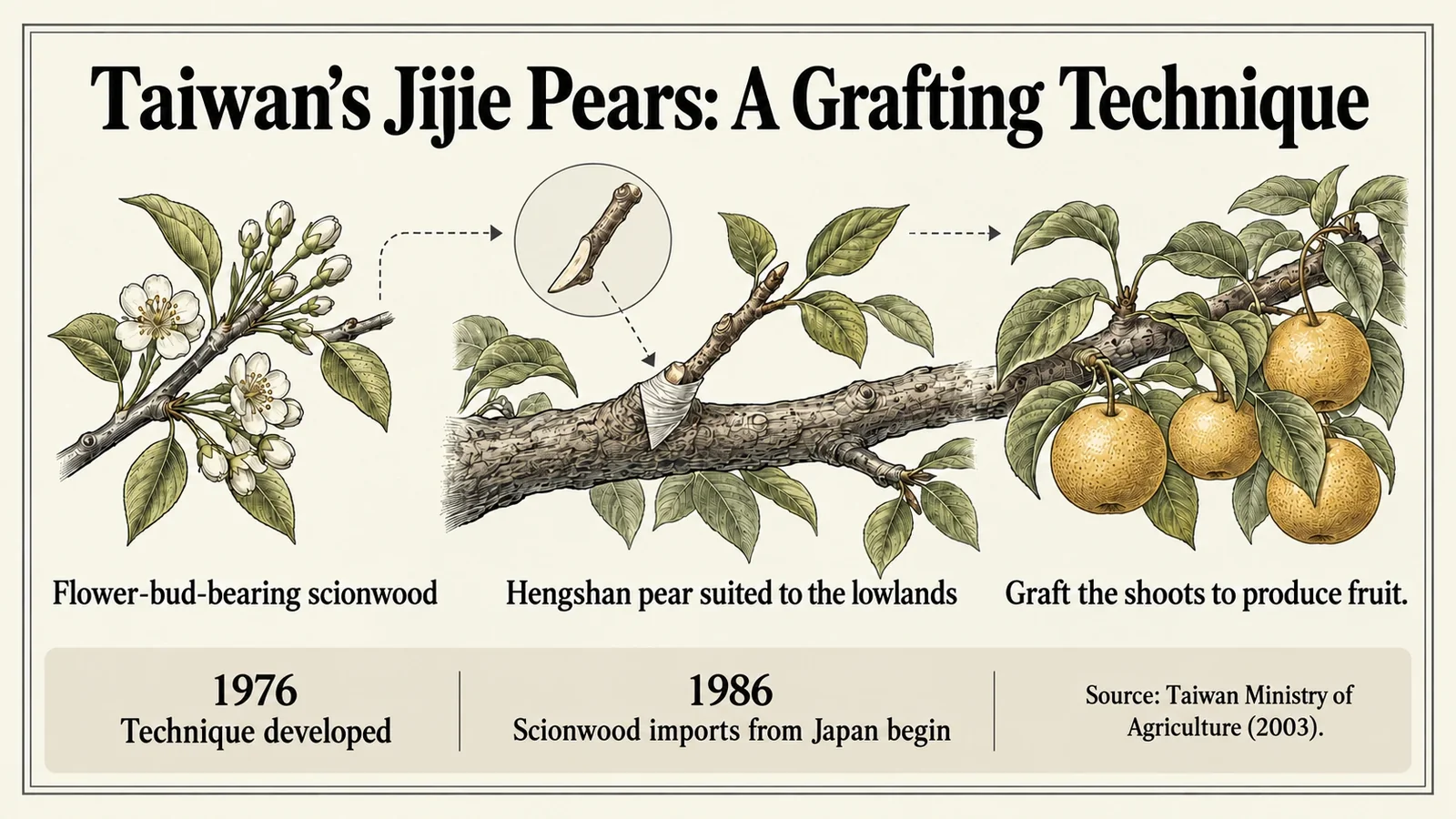
Taiwan developed its own answer. According to Taiwan’s Ministry of Agriculture, in 1976, farmer Zhang Rongsheng of Dongshi, Taichung, developed a technique for producing temperate pears in the lowlands.
The method grafts flower-bud-bearing shoots, or scionwood, sourced from Taiwan’s mountains or Japan onto branches of the local Hengshan pear, which grows in the lowlands. This is grafting, not crossbreeding. The scions have completed the cold-period preparation needed by their flower buds, allowing Japanese pear fruit to develop in the warmer lowlands.
The resulting crop is known as jijie pears, or grafted pears. A January 2003 report described mainly Hosui and Shinko, harvested from May to July, two to four months earlier than temperate pears grown in the mountains at that time. Source: Taiwan Ministry of Agriculture.
The same account says early scionwood came from Taiwan’s Lishan area, with imports from Japanese growing areas beginning in 1986. Pest and disease management in scion orchards, together with virus testing, helped secure the necessary flower buds. The technique did not rely exclusively on Japanese scions from its beginning in 1976.
Vietnam: pear blossoms in The Tale of Kiều and orchards in Bắc Hà
Vietnam has its own pear stories.
In Nguyễn Du’s (1765–1820) classic verse narrative Truyện Kiều, The Tale of Kiều, the second section opens with spring scenery as Kiều and her companions go out for the Qingming festival:
Ngày xuân con én đưa thoi,
Thiều quang chín chục đã ngoài sáu mươi.
Cỏ non xanh tận chân trời,
Cành lê trắng điểm một vài bông hoa.
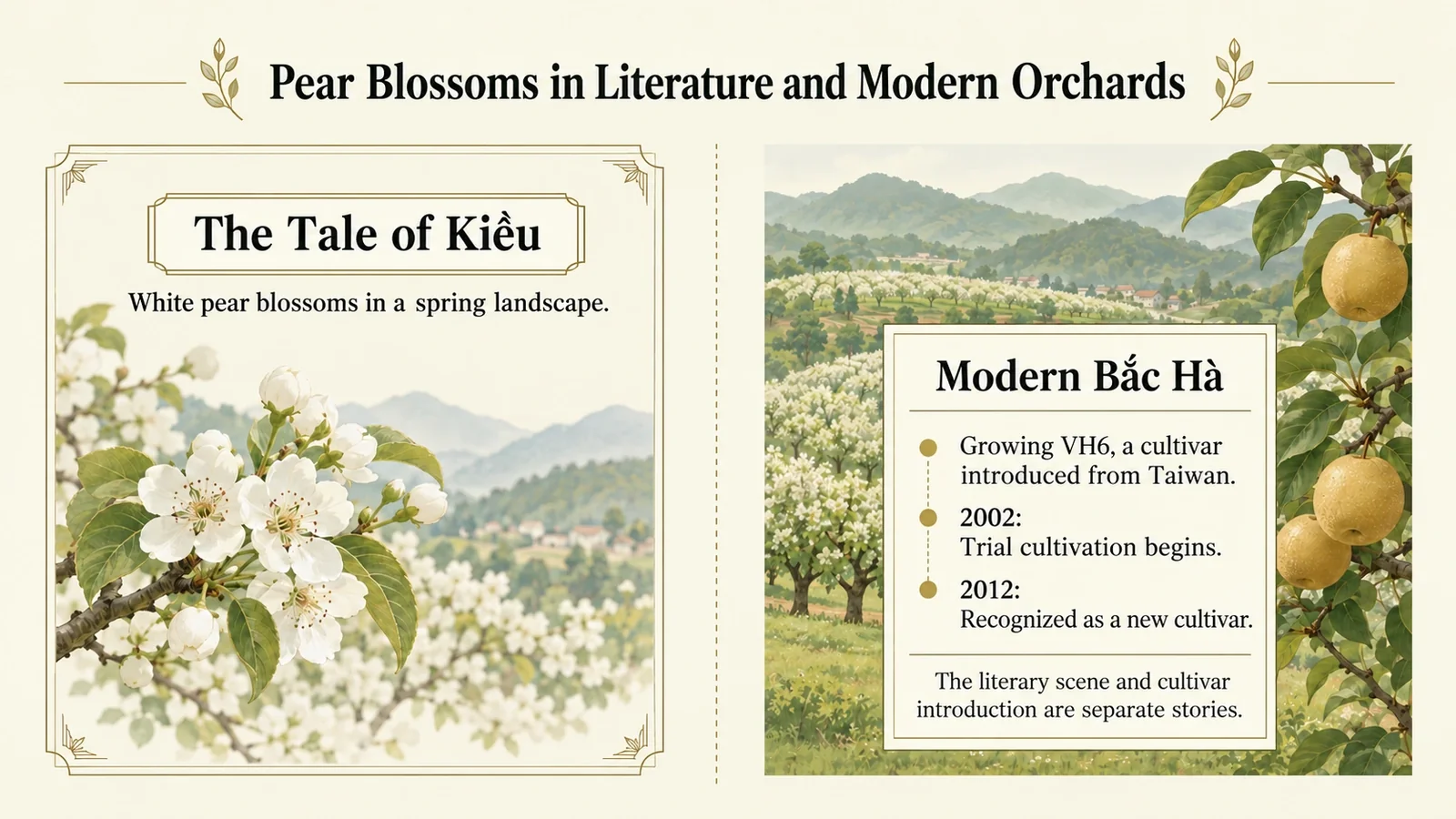
An approximate English rendering of the passage is: “In spring, swallows dart like a weaver’s shuttle; of spring’s ninety bright days, more than sixty have passed. Young green grass stretches to the horizon, and a pear branch is dotted with a few white blossoms.” Source: Thi Viện, Hồi 02: Kiều chơi tết thanh minh.
The scene of white pear flowers against green grass is a familiar spring passage taught in Vietnamese schools. Some textual versions use “rợn” rather than “tận” in the third line.
In modern Vietnam, pears are grown in northern mountain areas. In Bắc Hà, Lào Cai, trials of the Taiwanese-origin cultivar VH6 began in 2002, followed by recognition as a new cultivar in 2012. Source: Vietnam National Agricultural Extension Center, June 8, 2021.
Taiwan’s jijie pears concern a grafting technique; VH6 concerns a cultivar introduced to Vietnam. They should not be treated as the same cultivation system. Both, however, illustrate efforts to grow pears under local conditions. In literature, pear blossoms color the spring landscape; in Bắc Hà today, fruit growing also provides farm income.
The people behind the history of pears
Pear history crosses national borders. Traditional stories developed in China, cultivars were discovered in Japan, growers confronted disease, and farmers in Taiwan and Vietnam adapted production to local climates.
Many people contributed to that history.
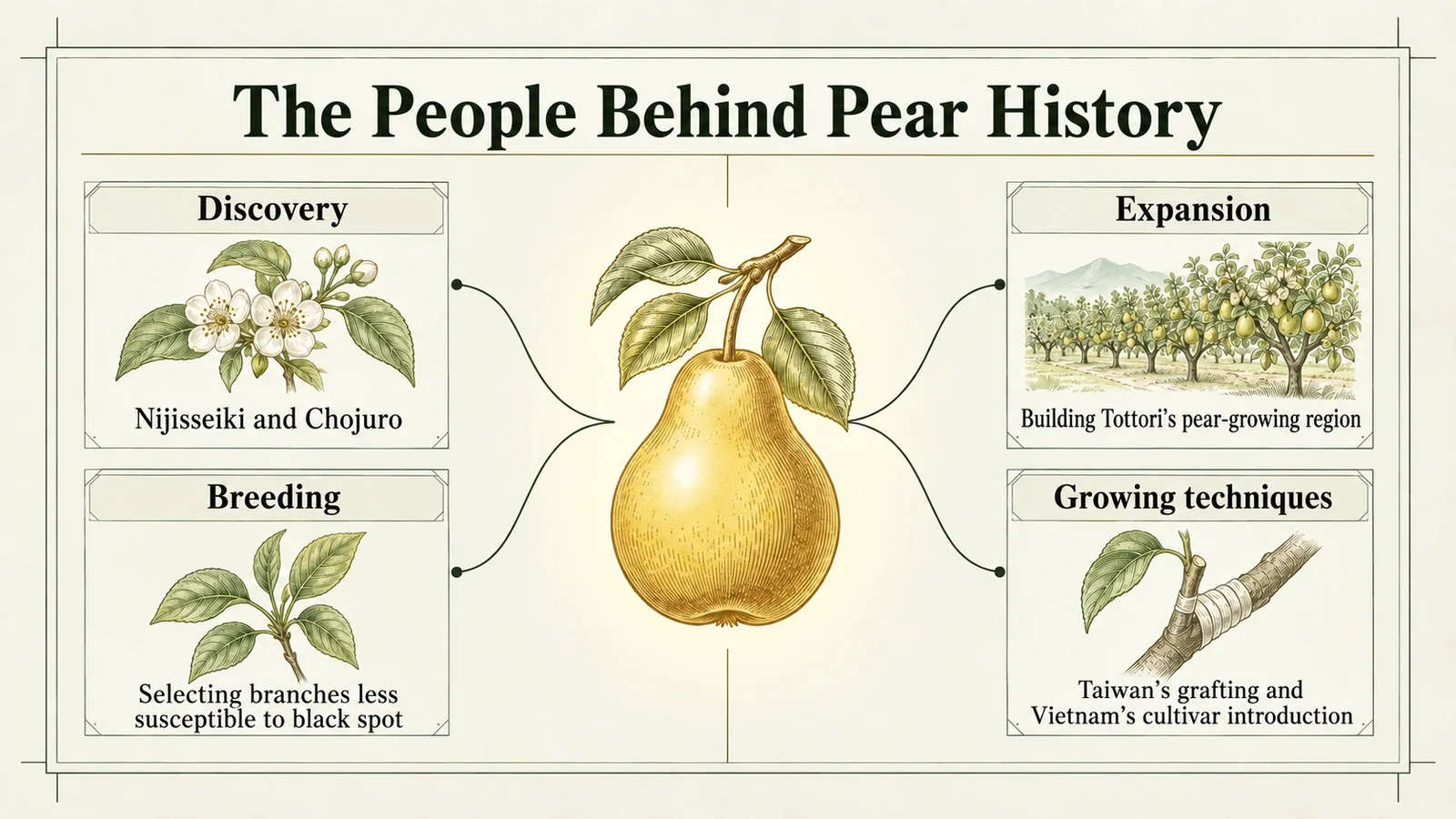
- A 13-year-old who found a tree, and a household that ran a pear orchard.
- A grower who bought ten saplings and helped establish a regional specialty.
- Researchers who selected a less susceptible branch and carried it through trials and registration.
- Taiwanese farmers who grafted flower-bud-bearing shoots from the mountains and Japan to produce fruit in warm lowlands.
- Farmers who grew a Taiwanese-origin cultivar in Vietnam’s northern mountains.
The next time you see quả lê in Vietnam, its long journey may make a familiar fruit look a little different.
More in the pear trilogy
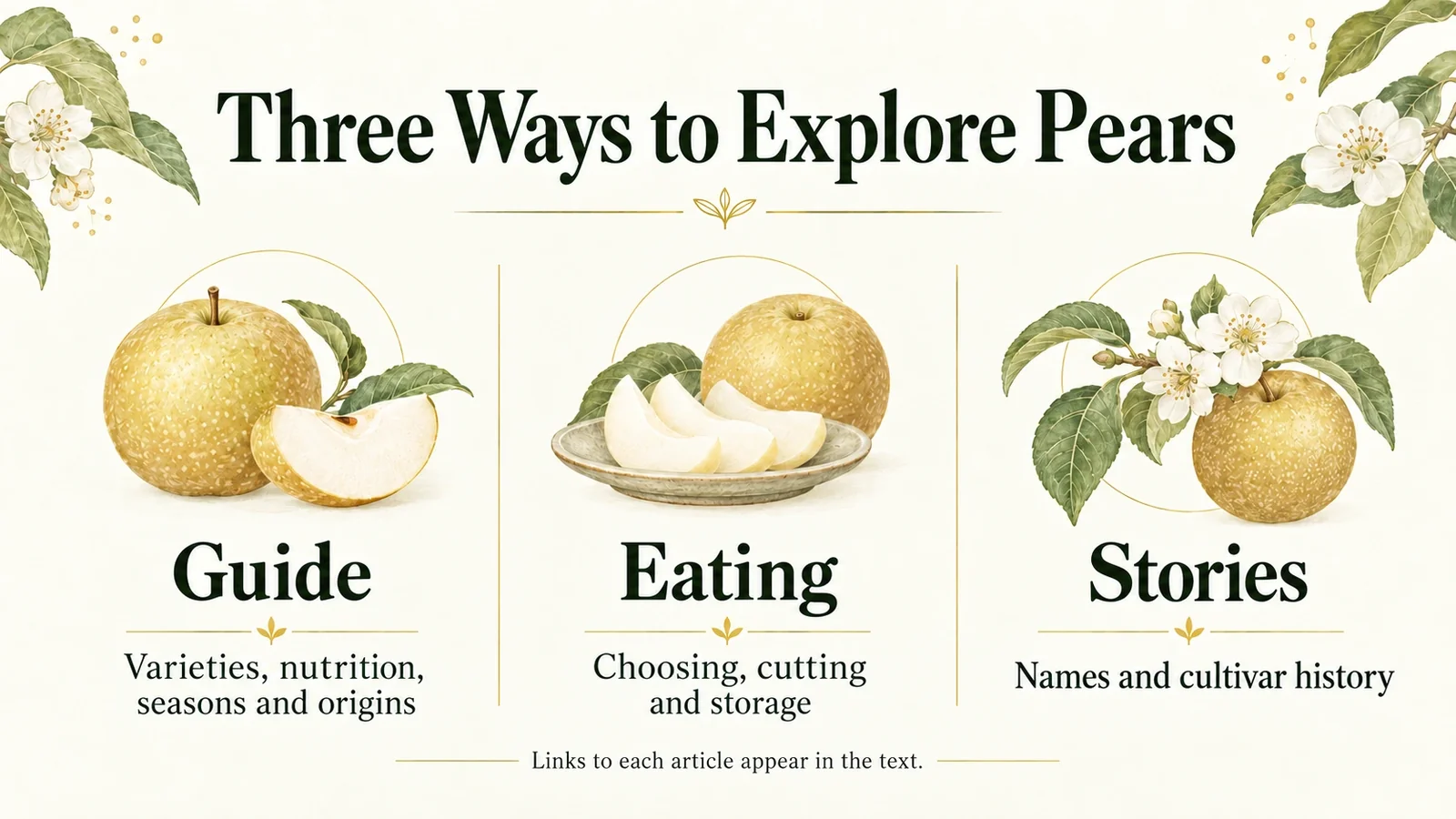
- Pears in Vietnam: Varieties, Nutrition and Seasons
- How to Eat Pears in Vietnam: Buying, Ripening and Storage
References and source dates
The Japanese source edition first checked these references on September 29, 2026; later checks are documented in its revision notes. This translation preserves that evidence history rather than claiming a new review of every source. Dates and historical figures refer to the cited accounts.
- Kawasaki City: The story of pears
- Japan Arts Council: Kabuki Dictionary, Rien
- Sanzijing.org: Kong Rong yielding a pear
- Matsudo City: The birthplace of Nijisseiki
- JA Zen-Noh Tottori: Nijisseiki pears
- Nashikkokan: The story of Nijisseiki
- Sanada et al.: Breeding Gold Nijisseiki, 1993
- ATOMICA: Gamma Field
- Taiwan Ministry of Agriculture: Pear industry issues and responses, 2003
- Thi Viện: The Tale of Kiều, section 2
- Vietnam National Agricultural Extension Center: VH6 cultivation
- Plant Protection 52(9): Disease-resistant pear cultivars
- Bulletin of the National Institute of Agrobiological Resources, No. 12
