Watermelon Guide: Varieties, Season, Nutrition and Origins
Published October 8, 2026

Have you ever wondered whether watermelon is a fruit or a vegetable? It sits in the fruit section of the supermarket, yet Japan’s agricultural statistics classify it as a “fruit vegetable.”
Watermelon is an annual trailing vine in the gourd family. This guide introduces its classification, origins, varieties, season and nutrition. Drawing on life in Vietnam, I also explore how varieties, food culture and distribution differ between Japan and Vietnam.
Watermelon at a glance
| Item | Details |
|---|---|
| English name | Watermelon |
| Japanese name | Suika; written 西瓜 |
| Vietnamese name | Dưa hấu |
| Scientific name | Citrullus lanatus |
| Classification | Annual herbaceous vine in the genus Citrullus, family Cucurbitaceae; it does not grow on a tree |
| Origins | Africa. A 2021 genomic study identified Sudan’s Kordofan melon as the closest known relative of cultivated watermelon and a possible progenitor |
| Season in Vietnam | Grown throughout the year; demand and shipments increase before Tết, the Lunar New Year |
| Main growing areas in Vietnam | The Mekong Delta, including the area historically known as Long An Province |
| Nutritional components | Potassium, vitamin C, beta-carotene and citrulline |
Sources are listed at the end of this article. Historical province names are retained where they identify the locations used in the Japanese source.
Fruit or vegetable? Botany and agricultural statistics
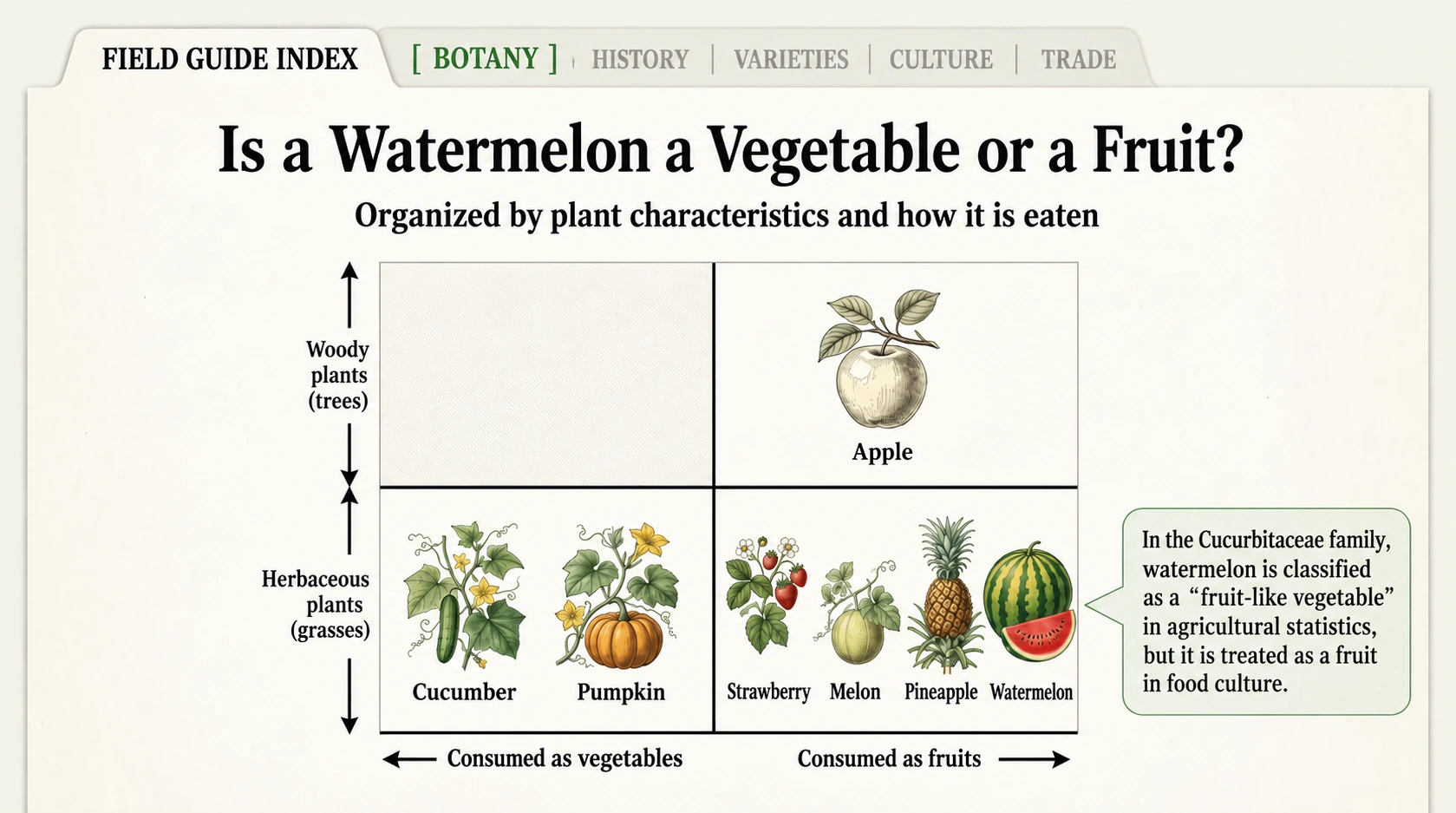
While people sometimes wonder whether pineapple grows on a tree or a herbaceous plant, watermelon raises another question: is it a vegetable or a fruit? Its plant structure helps explain the different answers.
A “fruit vegetable” in Japan’s agricultural statistics
Watermelon is an annual vine in the gourd family, alongside cucumbers, pumpkins and melons. It is a herbaceous plant grown from seed, rather than a woody tree. Pineapple, another fruit often mentioned in this discussion, is also herbaceous, though perennial.
Botanically, a watermelon is a type of berry called a pepo, with a firm outer rind. Other members of the gourd family have the same type of fruit.
Japan’s vegetable production statistics group watermelon with melons and strawberries as “fruit vegetables”: crops treated as vegetables in agricultural classification but eaten like fruit, often as dessert. Thus, watermelon can be a fruit botanically and in everyday food culture while belonging to a vegetable category in agricultural statistics.
The closest known relative is in Sudan
Watermelon’s origins were long associated with southern Africa’s Kalahari Desert. The wild tsamma melon found there was often described as a direct ancestor of cultivated watermelon.
A genomic study published in 2021 instead identified the white-fleshed Kordofan melon of Sudan as the closest known relative of cultivated watermelon. The researchers described it as a possible progenitor. That does not establish it conclusively as the direct ancestor; it shows how new evidence is changing our understanding of domestication.

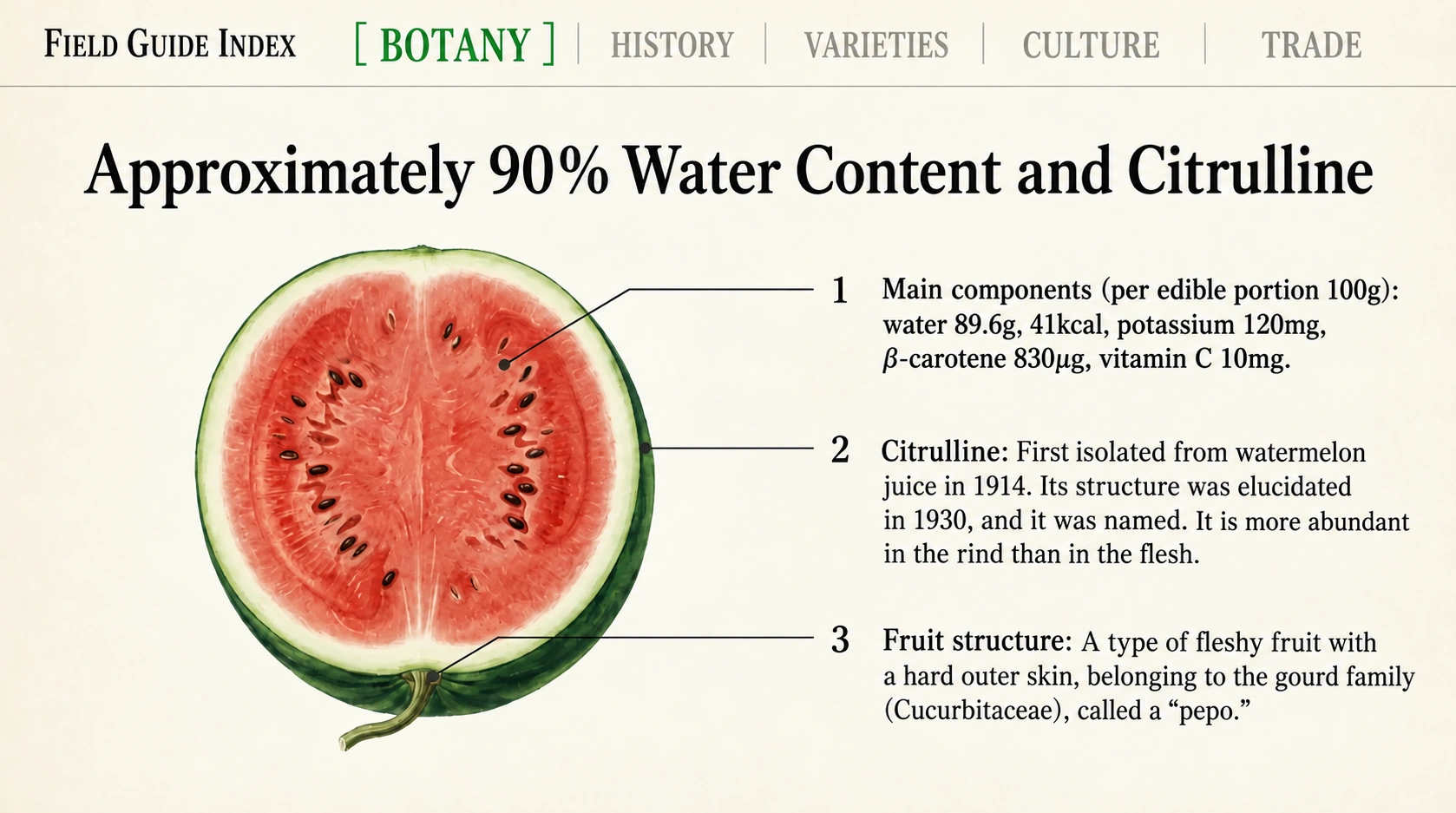
Citrulline: an amino acid named after watermelon
Watermelon’s scientific name is Citrullus lanatus. The amino acid citrulline takes its name from the genus Citrullus. Japanese researchers first isolated it from watermelon juice in 1914; Mitsunori Wada described and named it in a 1930 paper.
Citrulline has been reported at higher concentrations in the rind than in the flesh. Concentrated watermelon preparations have a history of use in folk remedies, but they are not medicines proven to treat particular conditions. Traditional uses and established clinical effects should be considered separately.
Seedless and square watermelons: innovations from Japan
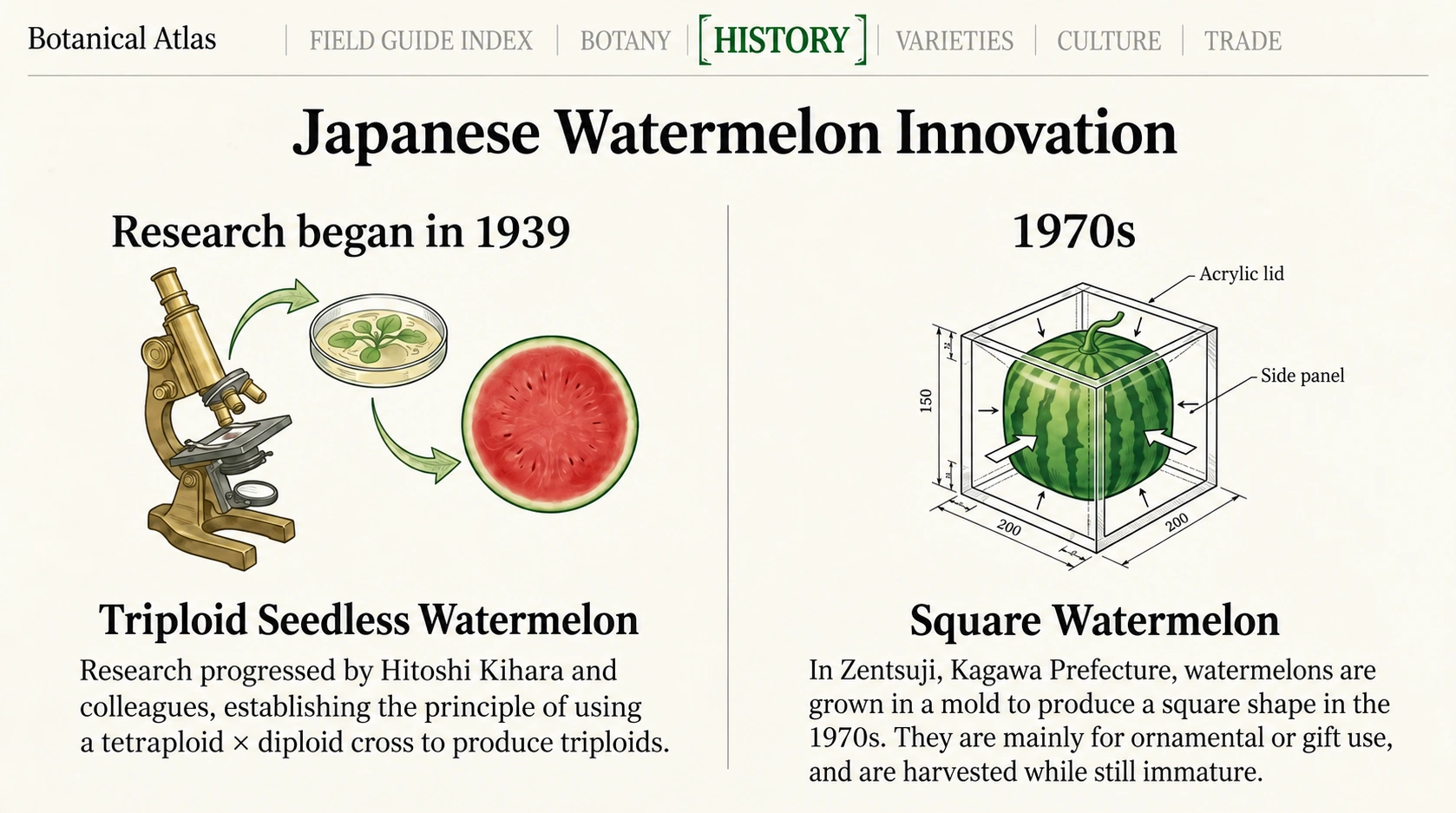
Some well-known watermelon innovations originated in Japan. Hitoshi Kihara and colleagues began research using polyploidy in 1939, establishing the principle of producing triploid seedless watermelons by crossing tetraploid and diploid plants.
Square watermelons are generally traced to growers in Zentsuji, Kagawa Prefecture, in the 1970s. Developing fruit is placed inside a square mold. These watermelons are mainly sold as ornamental or gift items and are usually harvested immature to preserve the shape.
Watermelon nutrition: calories, water and citrulline
The Japanese food composition database gives the following values for 100 g of edible raw red-fleshed watermelon:
| Component | Amount |
|---|---|
| Energy | 41 kcal |
| Water | 89.6 g |
| Carbohydrate | 9.5 g |
| Dietary fiber | 0.3 g |
| Potassium | 120 mg |
| Vitamin C | 10 mg |
| Beta-carotene | 830 μg |
Water makes up almost 90% of the edible flesh, helping explain watermelon’s popularity as a refreshing summer snack. Potassium is involved in the body’s fluid and sodium balance, while vitamin C and beta-carotene contribute to nutrition. Citrulline is being studied for its role in processes related to blood flow.
These observations about nutrients do not mean that eating watermelon has been proven to improve a particular medical condition. Its high water content and relatively low energy content make it an easy fruit to enjoy as a snack.
Varieties and growing areas: Japan, the world and Vietnam
China dominates global production
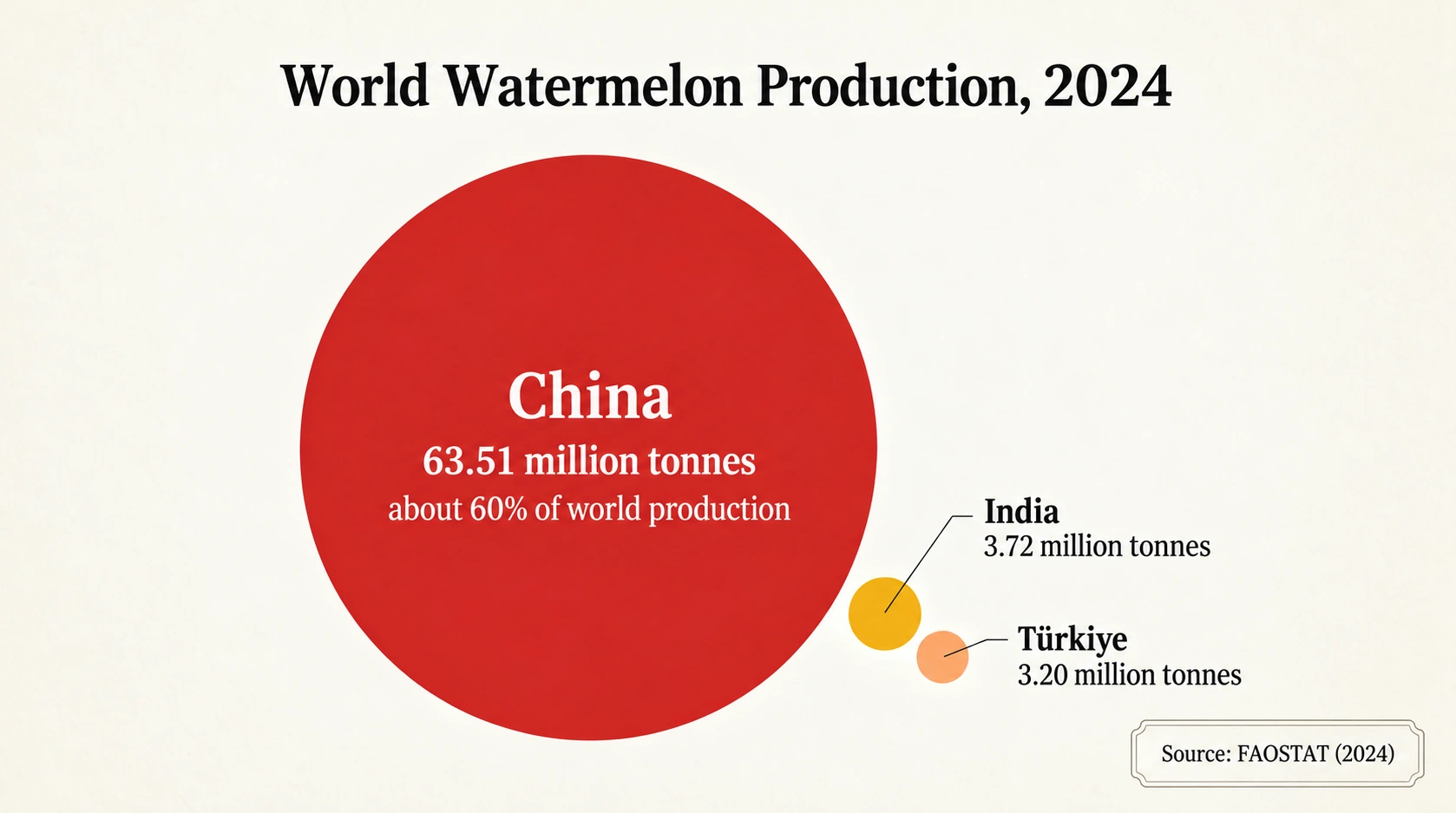
The 2024 FAO figures used in the Japanese article put China first at approximately 63.51 million tonnes, India second at 3.72 million tonnes, and Türkiye third at 3.20 million tonnes. China accounts for roughly 60% of global production.
Japanese growing areas and premium varieties
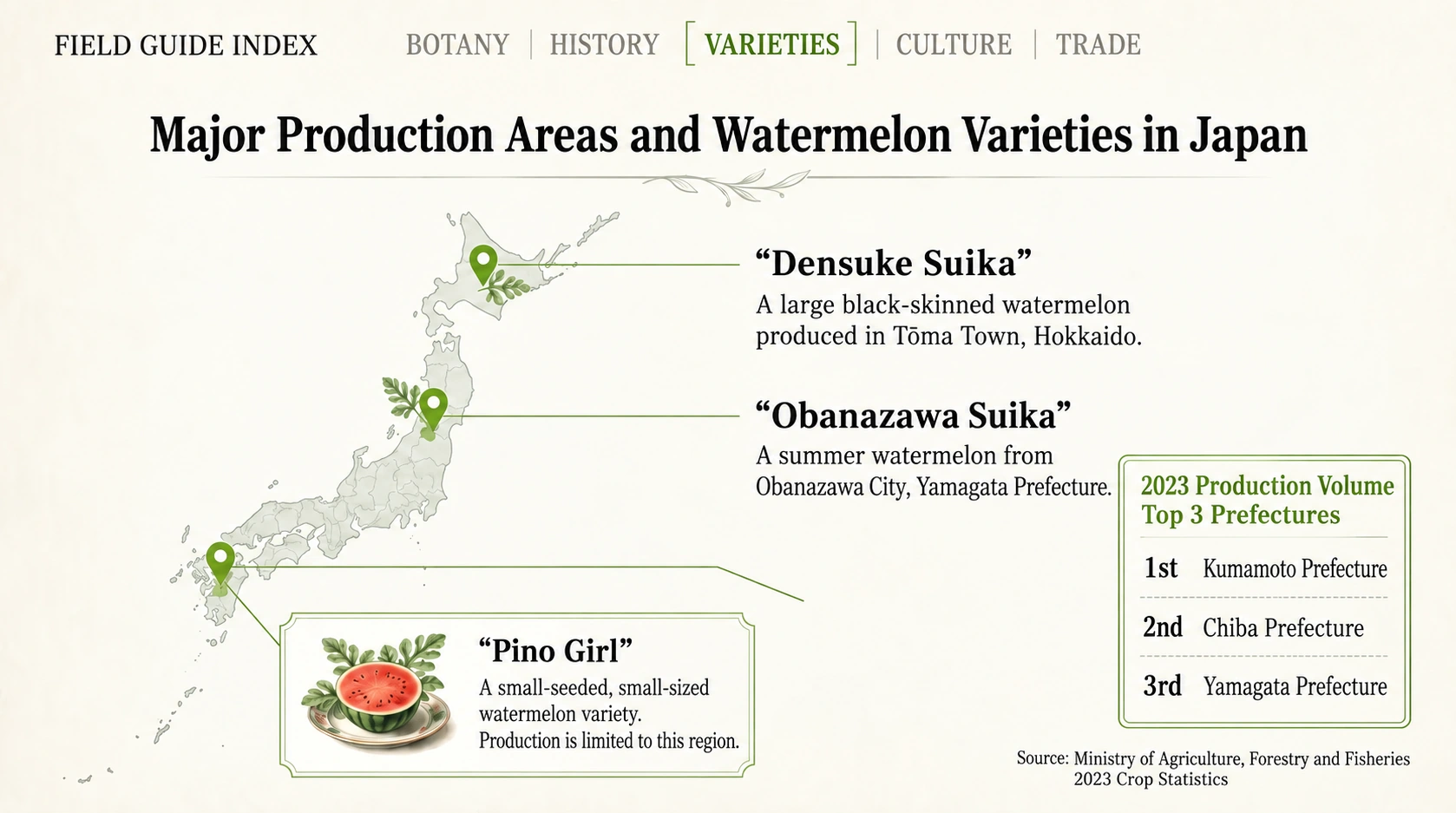
Kumamoto, Chiba and Yamagata are major watermelon-producing prefectures in Japan, ranking in that order for shipment volume in the 2023 figures cited here. Familiar names include Obanazawa watermelon from Yamagata, dark-skinned Densuke watermelon from Toma in Hokkaido, and the small-fruited Pinogirl, known for its small seeds. Size and sweetness vary with variety, grade and growing conditions.
Vietnamese names and growing areas
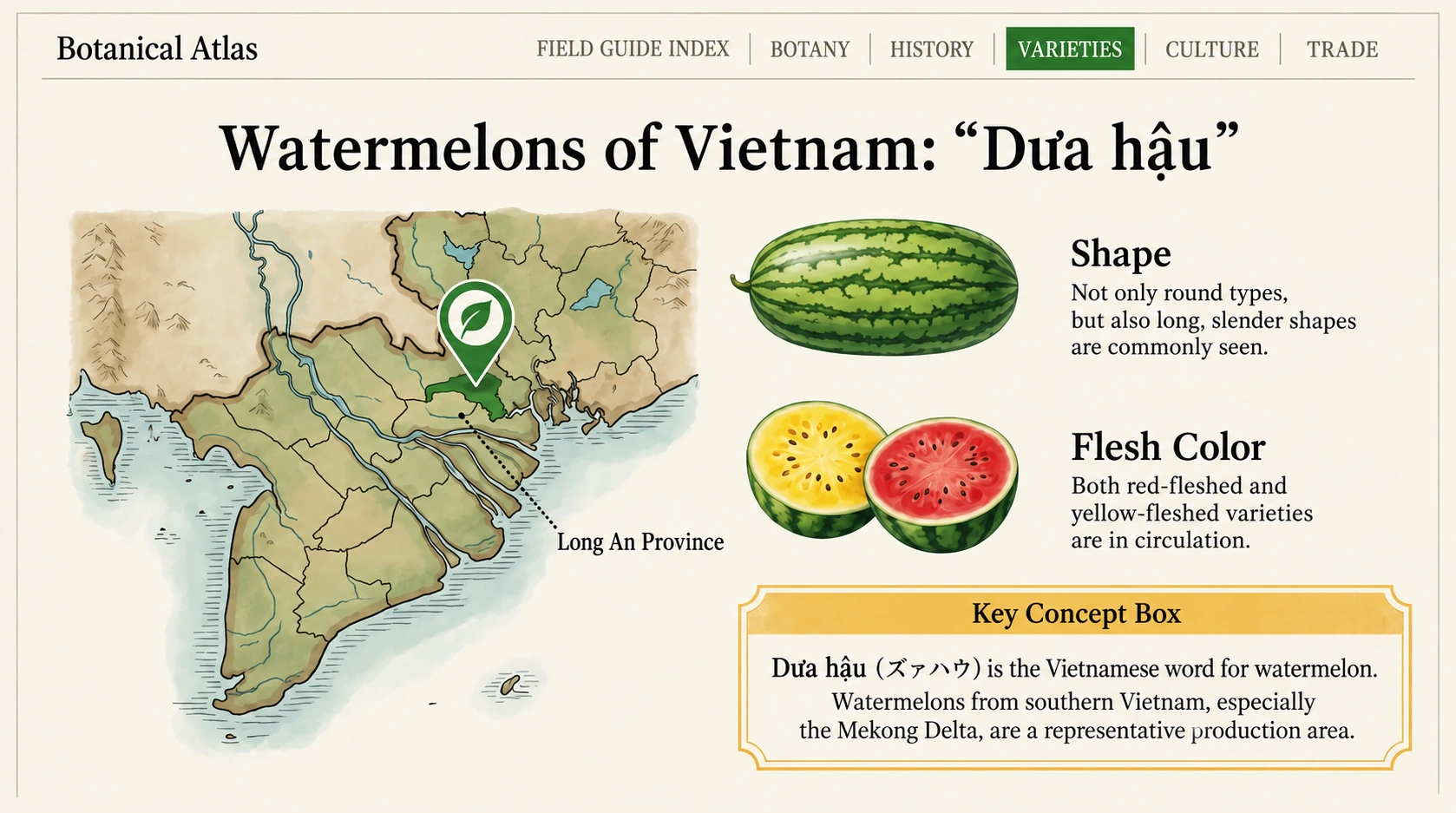
In Vietnamese, watermelon is dưa hấu. Markets sell red- and yellow-fleshed varieties, as well as both round and elongated fruit. The Mekong Delta is an important growing region, including the area referred to as Long An in the Japanese source.
Tết offerings and the legend of Mai An Tiêm
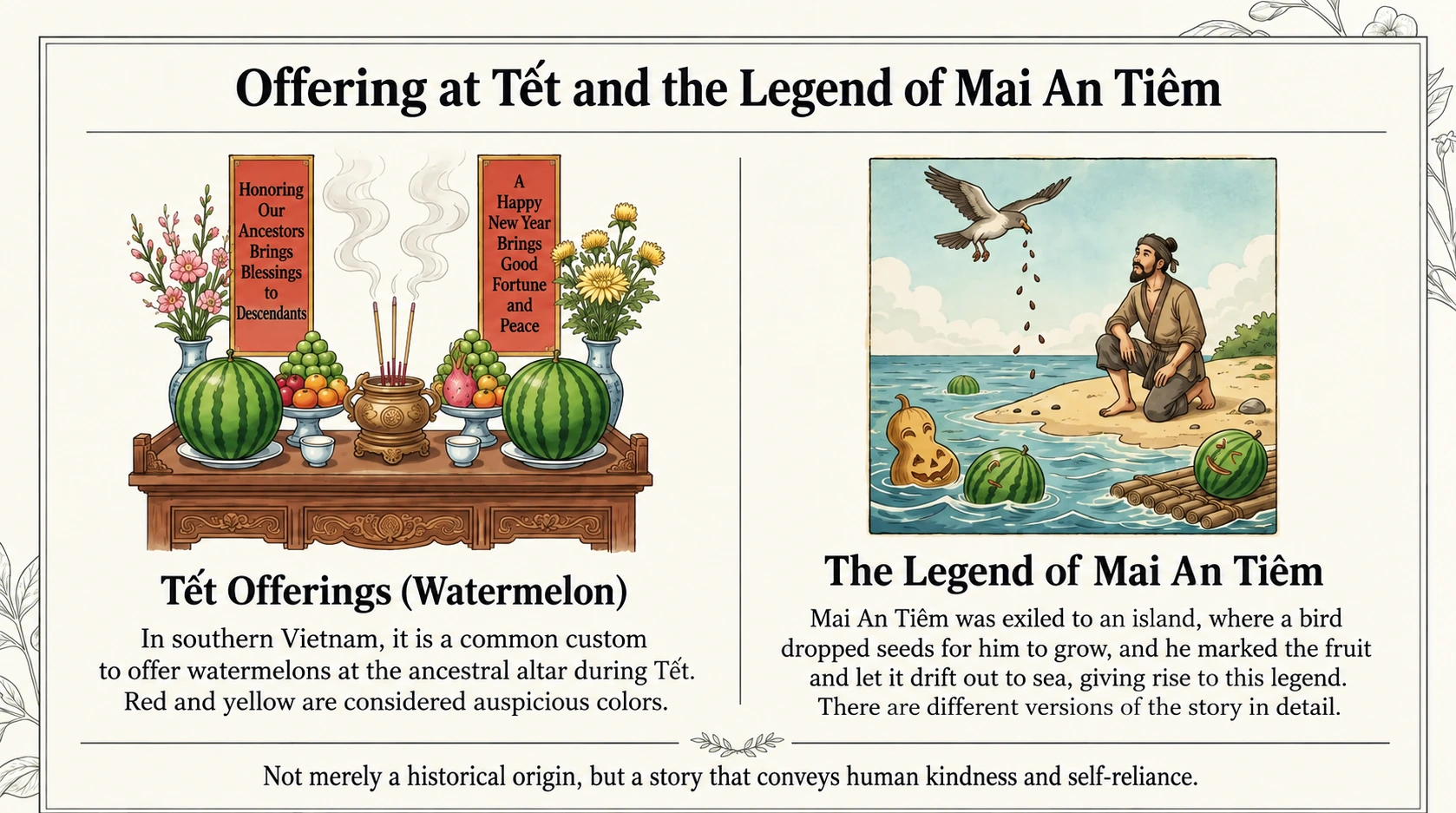
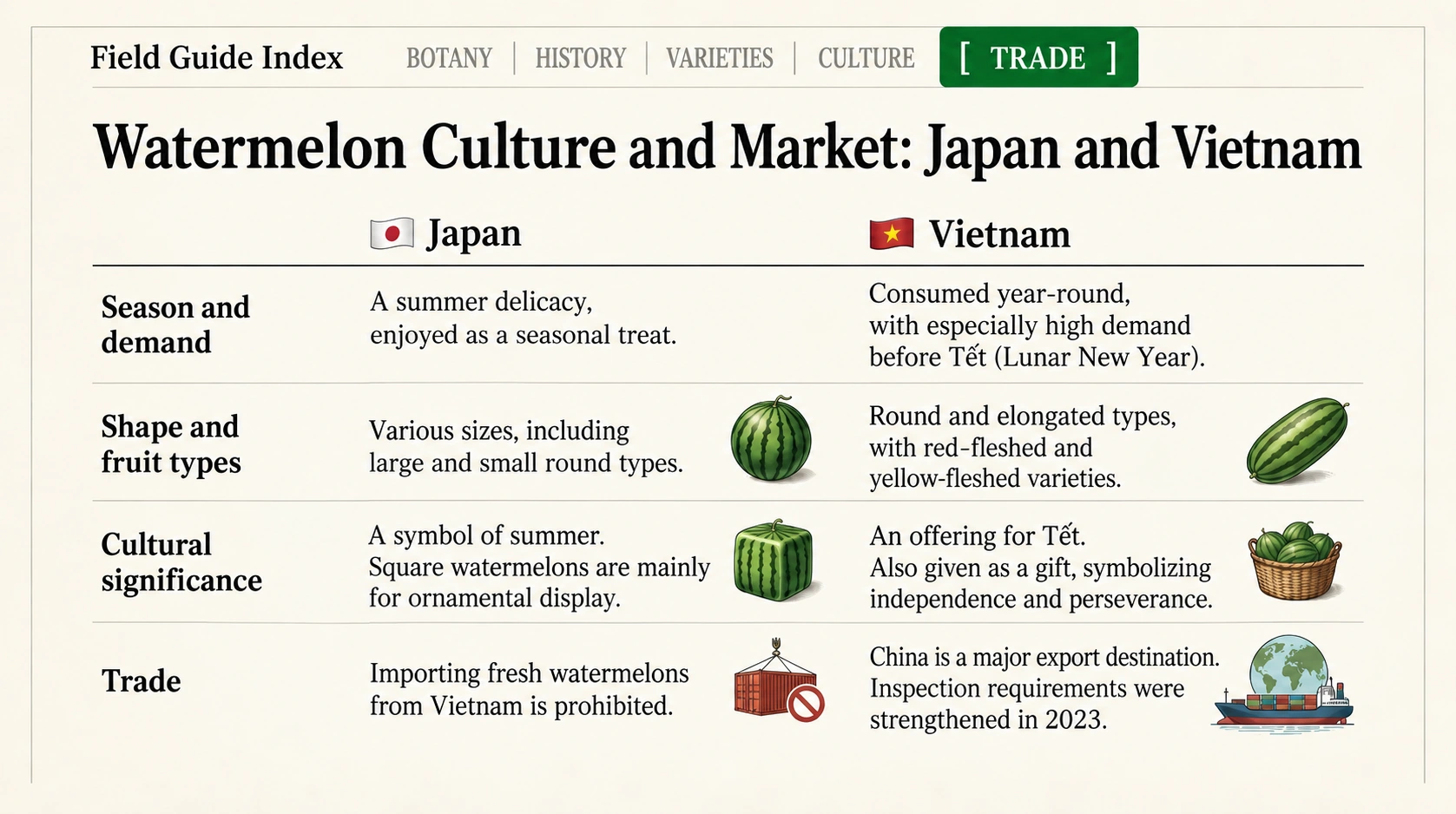
Demand for watermelon rises before Tết. Particularly in southern Vietnam, watermelons are placed on ancestral altars. Red and yellow are associated with good fortune, so flesh color is sometimes discussed in that cultural context.
One Vietnamese origin tale tells of Mai An Tiêm, an adopted son of a Hùng king, who was exiled to an island. He grew watermelons from seeds brought by birds. In one version, he marked the fruit and floated it out to sea, attracting merchants; news of his achievements eventually reached the king, who invited him back. Versions differ, but the tale is celebrated for its themes of diligence and self-reliance. Read more in The History and Stories of Watermelon.
Vietnam’s watermelon exports and Japan’s import restrictions
Exports to China and the formal phytosanitary route
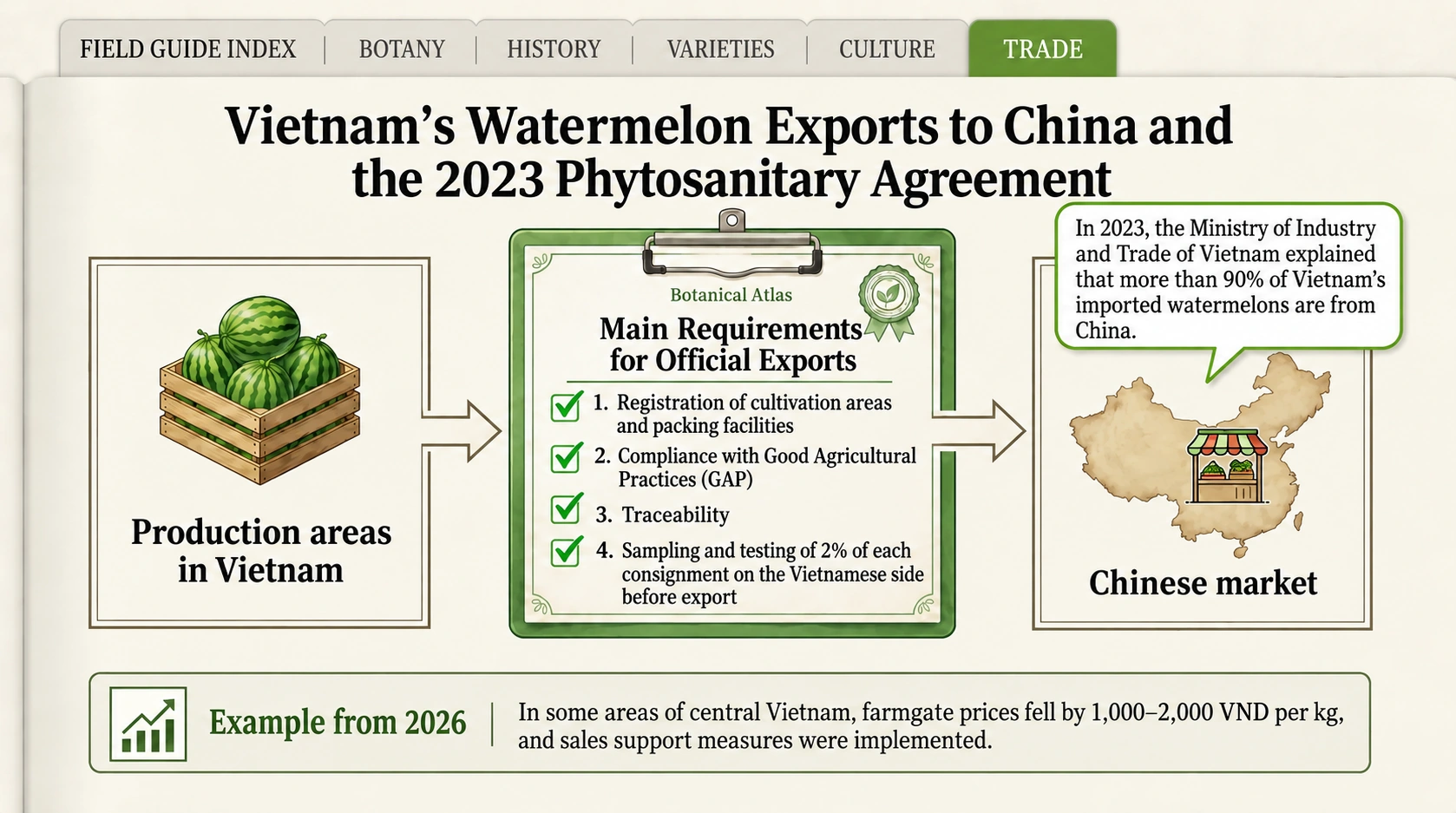
China is an important market for Vietnamese watermelon. In August 2023, Vietnam’s Ministry of Industry and Trade stated that Vietnam supplied more than 90% of China’s watermelon imports. In December that year, Vietnam’s Ministry of Agriculture and Rural Development and China’s General Administration of Customs signed a phytosanitary protocol setting out formal export conditions.
Requirements include registered growing areas and packing facilities, good agricultural practices, and traceability. The protocol also specifies that Vietnam’s pre-export inspection should sample 2% of each consignment.
Oversupply and transport disruptions can cause farm-gate prices to fall sharply, prompting “rescue” sales, known as giải cứu. Reports cited in the Japanese article described prices falling to VND 1,000–2,000 per kilogram in parts of Gia Lai in 2026, with retailers helping sell the crop. These are reported historical examples, not current retail quotations.
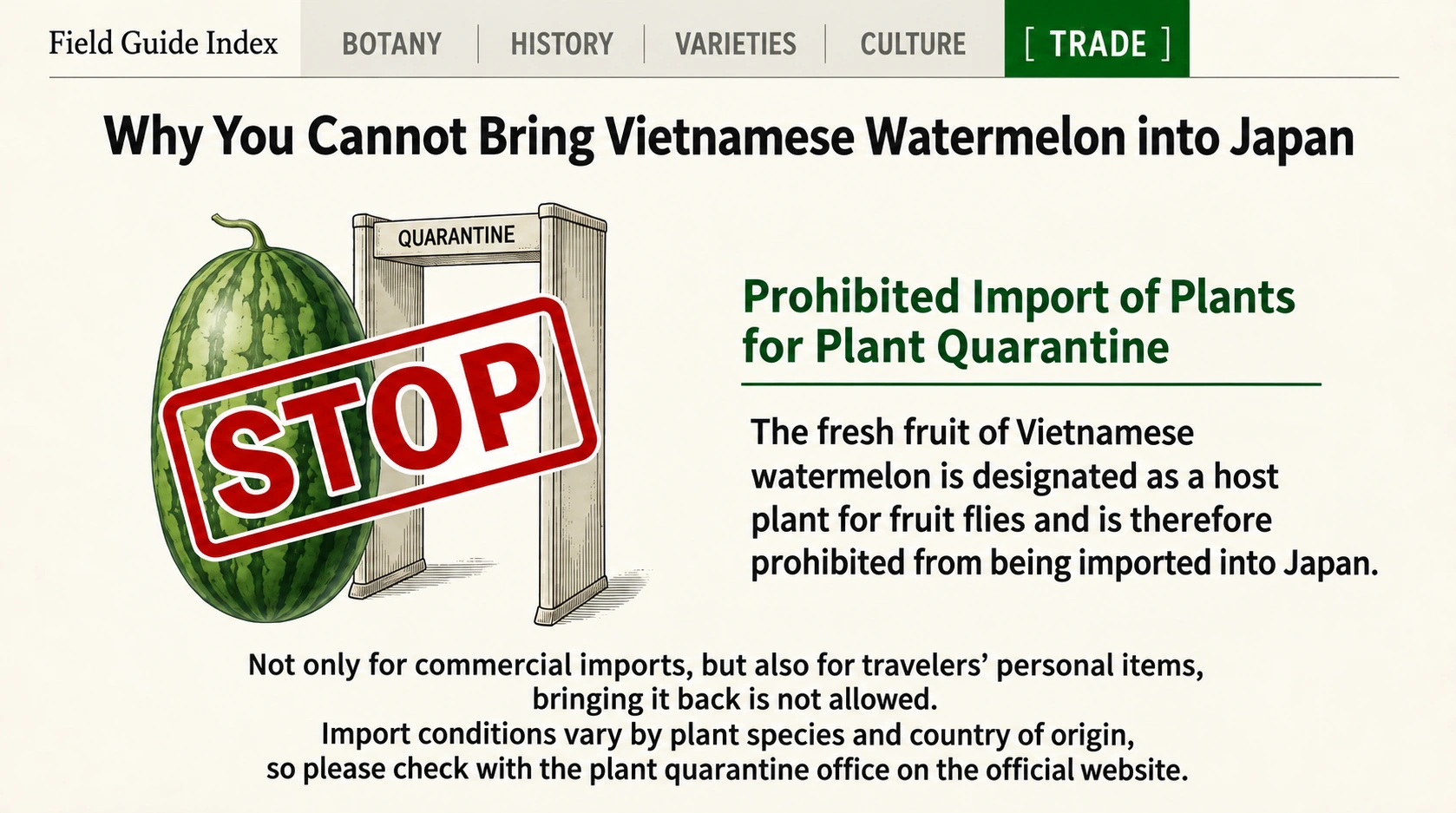
Fresh Vietnamese watermelon cannot be taken into Japan
Japan’s plant quarantine rules list fresh Vietnamese watermelon as a prohibited import because it is a host of specified fruit flies. An ordinary phytosanitary certificate does not make it admissible. Watermelon was also absent from the Vietnam market-access request list checked for the Japanese article in September 2026; the prohibition itself follows from the applicable quarantine rules.
This restriction covers travelers’ souvenirs as well as commercial imports. Processed products may be treated differently depending on ingredients and processing, so check with Japan’s Plant Protection Station before bringing them.
Frequently asked questions
Is watermelon a fruit or a vegetable?
Botanically it is a fruit. Japan’s agricultural statistics classify it as a “fruit vegetable,” while shops and everyday food culture generally treat it as fruit.
When is watermelon in season?
Summer is the familiar season in Japan. In Vietnam, watermelon is easy to find throughout the year, with demand and shipments increasing before Tết.
Where did watermelon originate?
Africa. A 2021 genomic study identified Sudan’s Kordofan melon as the closest known relative of cultivated watermelon and a possible progenitor, rather than a conclusively established direct ancestor.
What nutrients does watermelon contain?
Red-fleshed watermelon contains water, potassium, vitamin C and beta-carotene. Citrulline has been reported at higher concentrations in the rind than in the flesh.
Can I take fresh Vietnamese watermelon home to Japan?
No. Fresh watermelon from Vietnam is prohibited under Japan’s plant quarantine rules. Processed products have different conditions; check the Plant Protection Station’s latest guidance.
Bringing the guide together
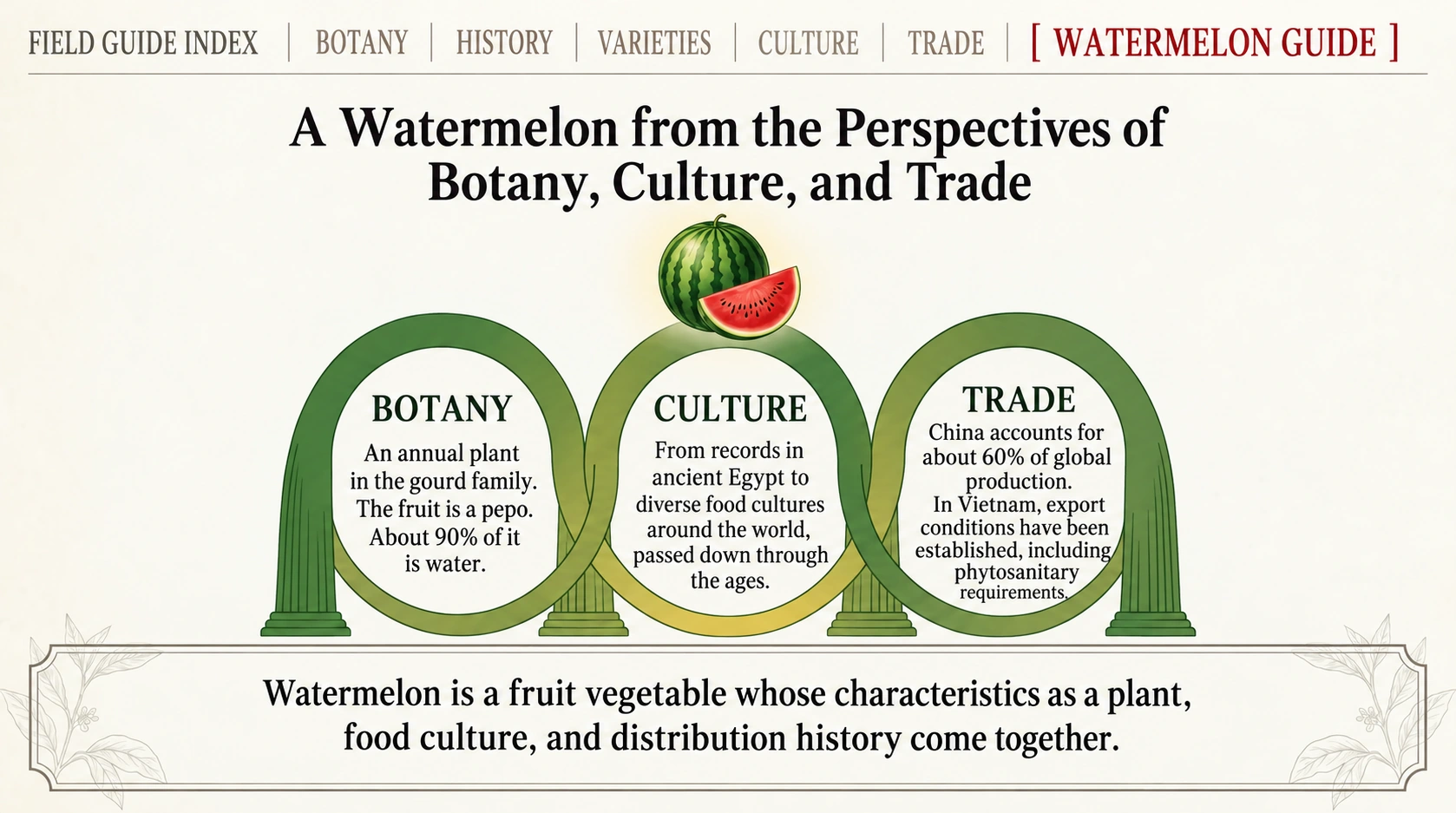
- Watermelon is an annual herbaceous vine in the gourd family, not a tree fruit. Its statistical and everyday food classifications differ.
- Citrulline takes its name from Citrullus. Research points to the Kordofan melon as a close relative and possible progenitor.
- Almost 90% of its flesh is water; it also supplies potassium, vitamin C and beta-carotene.
- China dominates world production. Japan has major growing areas and premium brands, while Vietnam’s watermelon culture includes everyday eating and Tết offerings.
- Vietnam exports watermelon to China under agreed phytosanitary conditions. Fresh Vietnamese watermelon remains prohibited for entry into Japan.
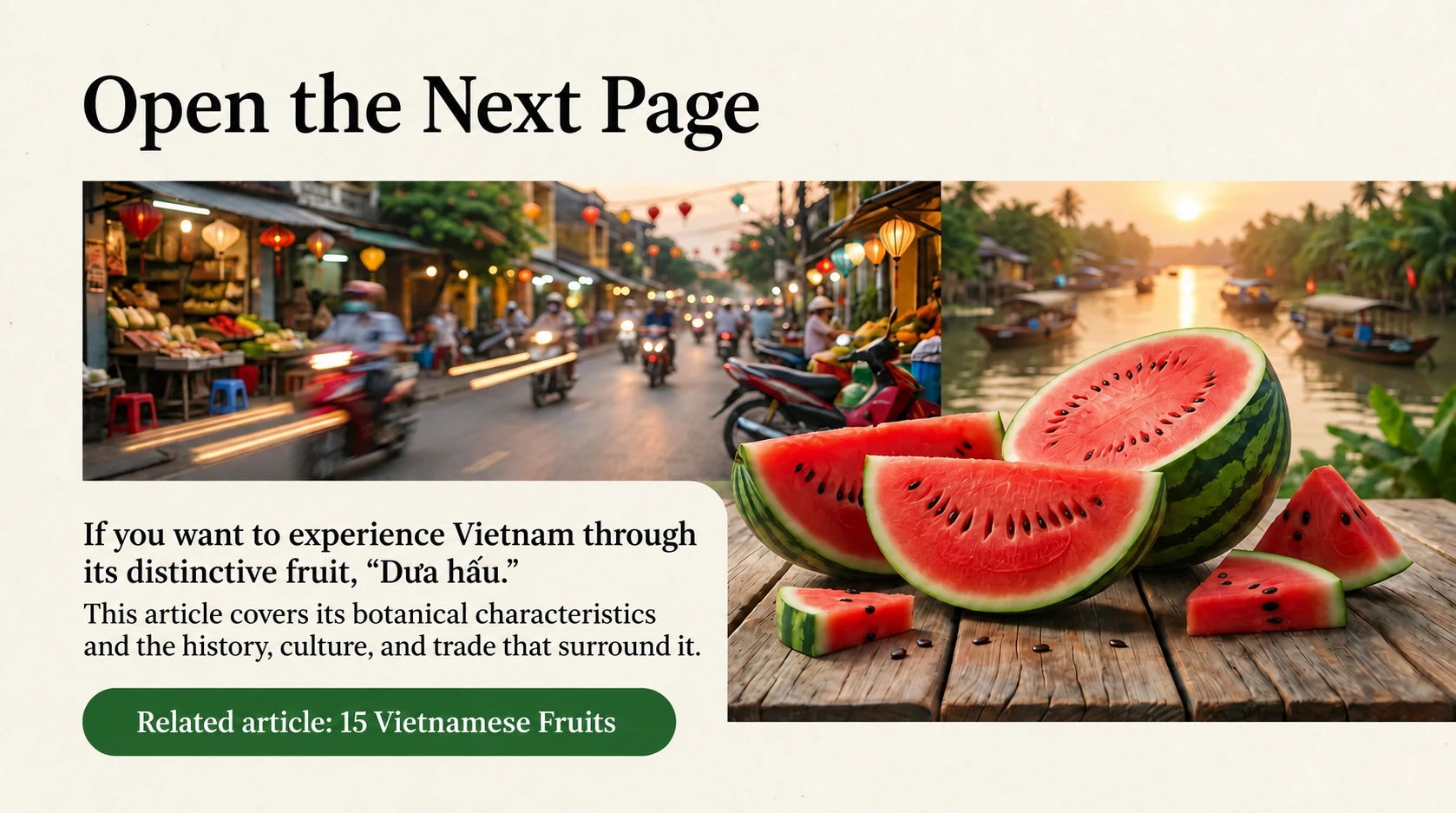
For cultural background, continue to The History and Stories of Watermelon. For buying, cutting and storing it, see How to Eat Watermelon in Vietnam. You can also browse 15 Fruits to Try in Vietnam (in Japanese).
References
- Japan MAFF: vegetable classification (in Japanese)
- Renner et al. (2021): A chromosome-level genome of a Kordofan melon illuminates the origin of domesticated watermelons, PNAS
- Mitsunori Wada (1930): On the occurrence of a new amino acid in watermelon
- Japan MEXT: raw red-fleshed watermelon, food composition (in Japanese)
- FAOSTAT: crop production, yield and harvested area
- Japan MAFF: 2023 vegetable production and shipment statistics (in Japanese)
- Vietnamese government: Vietnamese watermelon to be exported to China
- China Customs: phytosanitary requirements for Vietnamese watermelon (in Chinese)
- Japan Plant Protection Station: import conditions for Vietnam (in Japanese)
- Japan MAFF: Vietnam market-access requests (in Japanese)
About the Author

Chuta
Based in Hanoi, Vietnam, Chuta buys fruit at local markets and supermarkets and writes about its taste, seasons, selection and preparation. Drawing on life in Vietnam, he introduces tropical fruits that are less familiar to readers in Japan.
About Fruit Guide