How to Buy and Eat Apples in Vietnam: Washing, Cutting and Storage
Published October 8, 2026
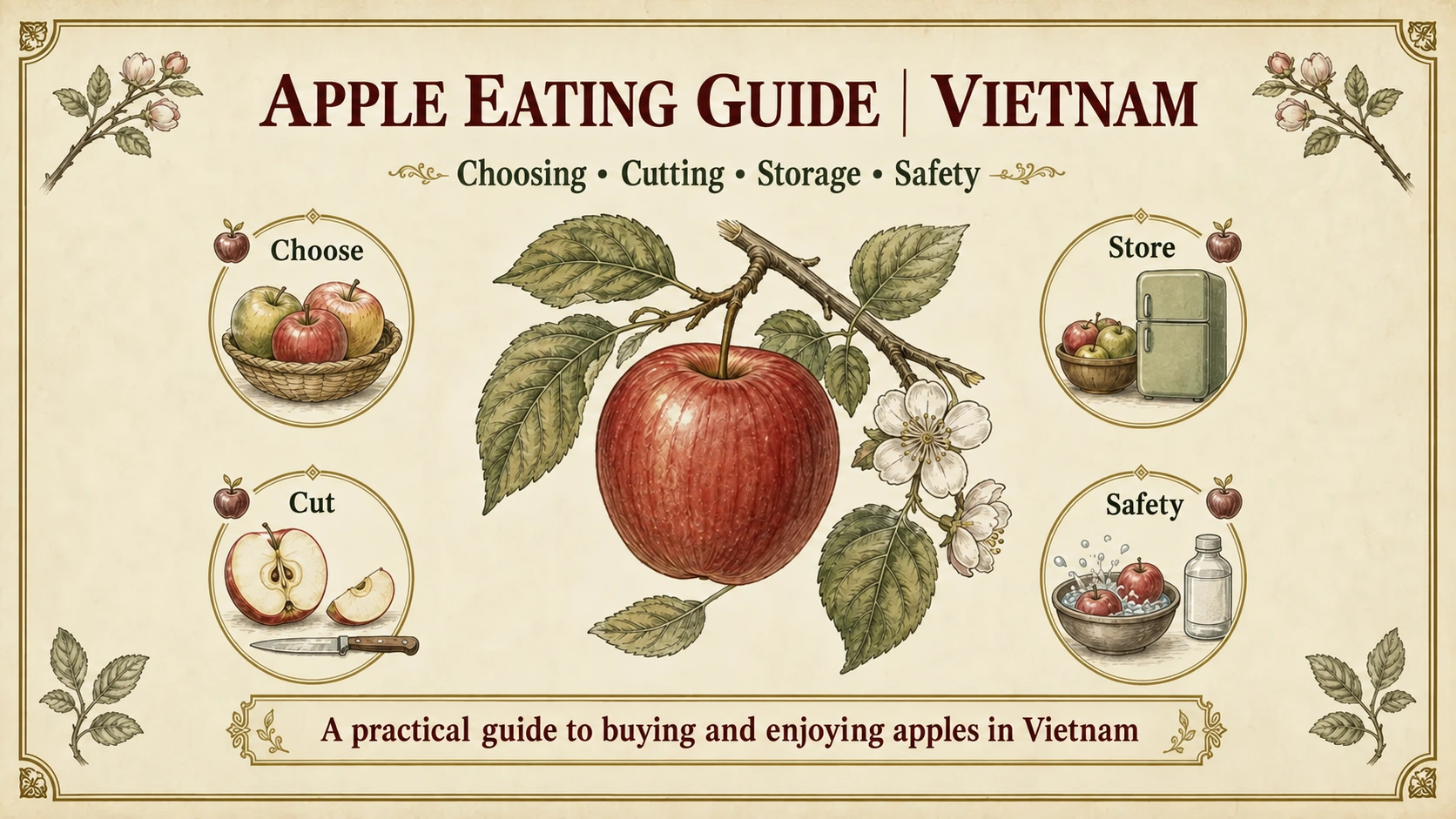
Which apple should you choose in Vietnam, and what should you expect to pay? Shops stock imports from many countries, with considerable differences in taste and price.
Eating them is straightforward. Adults who can chew comfortably can wash an apple under running water and bite into it. Wedges or round slices also require little preparation.
Choosing what to buy can be more confusing. Reference prices published by Kingfoodmart in April 2026 ranged from VND 60,000 to 380,000 per kg. The word táo can also refer to a fruit other than an apple.
This guide follows the order of buying and eating: understanding varieties and prices, choosing fruit, washing, cutting and storing it. For growing conditions and names, see Apples in Vietnam; for history and gift culture, see The Story of Apples.
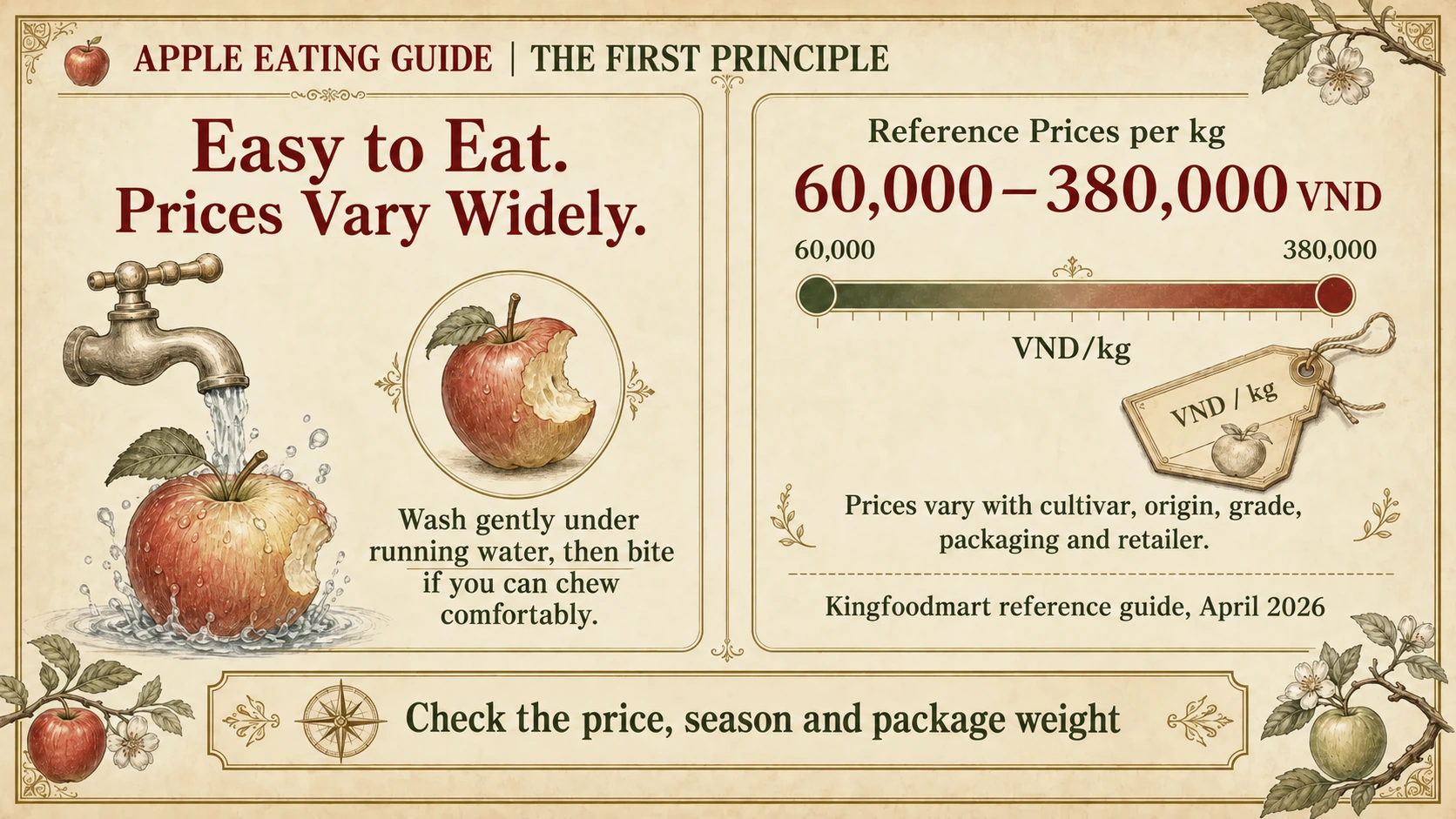
We will move from finding apples to checking prices, choosing, cutting, eating and storing them.
Buying and eating at a glance
| Item | Details |
|---|---|
| Vietnamese name | táo tây; also bôm, mainly in southern Vietnam; sometimes simply táo |
| Approximate pronunciation | “tao tie”; “bom” — Vietnamese tones matter |
| Taste | Depends on variety, from sweet Fuji, Envy and Gala to tart Granny Smith |
| Texture | Crisp and crunchy |
| Availability | Year-round through imports; gift selections often expand before Tet |
| Example price range | VND 60,000–380,000 per kg, depending on variety, origin and store; Kingfoodmart reference prices published in April 2026 |
| Convenient places to buy | Supermarkets, imported-fruit specialists and online stores |
| Basic preparation | Wash and bite into it; for portions, cut into wedges or round “star-cut” slices |
| Other ways to enjoy | Nước ép táo, juice; salad táo, salad; mứt táo, candied táo, traditionally made from Indian jujube, with modern apple adaptations |
| Ease of preparation | Ready after washing for people able to chew safely; do not serve hard raw apple pieces directly to infants and toddlers |
Táo tây, and bôm in southern Vietnam
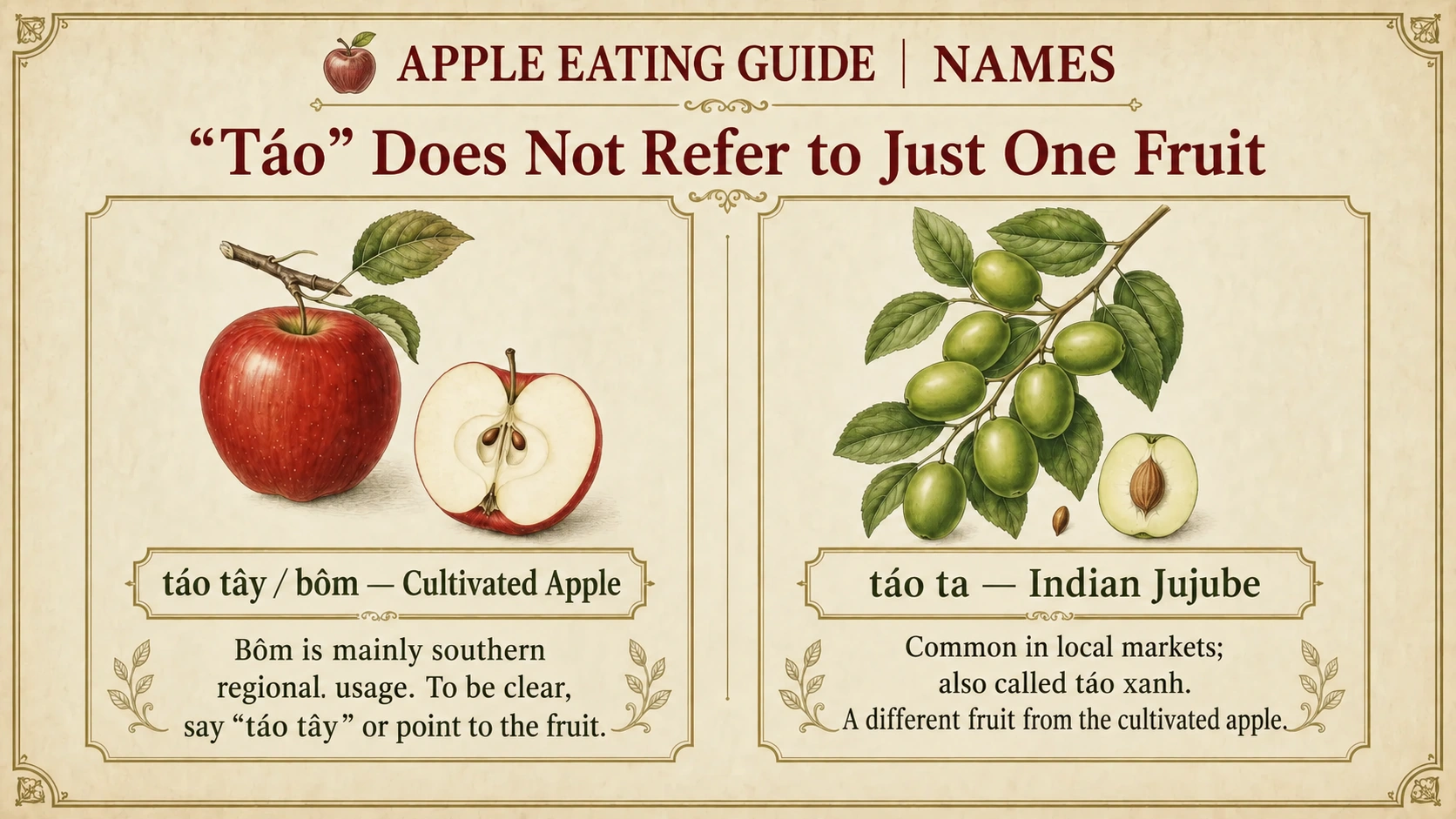
The Vietnamese name táo tây means “Western táo.” Bôm is another name, considered a borrowing from French pomme. Dictionaries treat it as regional or dialect usage, mainly in the south. To make clear that you want a cultivated apple, say táo tây and check the actual fruit or label.
Be careful when a fruit is called simply táo. As explained in Apples in Vietnam, táo ta, Ziziphus mauritiana, is Indian jujube, a different, smaller fruit. It is a specialty of Ninh Thuan, formerly Ninh Thuan Province and now part of Khanh Hoa.
Retail price lists sometimes place táo xanh Ninh Thuận, green táo from Ninh Thuan, alongside imported apples under the same táo heading. Saying táo tây or pointing to the fruit is a more reliable way to buy what you intend.
Apple varieties: Gala, Fuji, Envy and more
Apples in Vietnamese shops come from many origins and varieties. Common examples include:
- Gala: often from the United States or New Zealand. Mildly sweet, approachable and generally affordable; a useful starting point.
- Fuji: available from the United States and Japan. Developed in Japan and known for strong sweetness. Depending on origin, maturity and storage, translucent areas associated with watercore may occur.
- Envy: from the United States and New Zealand. Sweet and juicy, often sold in higher price ranges.
- Granny Smith: green apples from the United States and New Zealand, with pronounced tartness suited to salads and cooking.
- Rockit: small New Zealand apples, often sold several to a cylindrical container. Their compact size makes them convenient for eating with the skin.
Choose Fuji or Envy for sweetness, Granny Smith for noticeable acidity, or Gala if you are unsure where to start.
Apple prices and where to buy in Vietnam
The following reference prices, per kilogram, were published by supermarket retailer Kingfoodmart on April 22, 2026. The page compares examples for supermarkets and premium fruit shops but does not state the number of stores surveyed or the dates individual prices were collected. Treat it as one retailer’s indicative guide. Even Fuji prices vary with origin, grade, size and packaging.
| Variety or category | Example origins listed | Supermarket reference price, VND/kg | Premium-shop reference price, VND/kg |
|---|---|---|---|
| Gala | United States, New Zealand | 60,000–90,000 | 90,000–130,000 |
| Fuji, red | United States, Japan | 70,000–120,000 | 130,000–200,000 |
| Granny Smith, green | United States, New Zealand | 90,000–120,000 | 120,000–155,000 |
| Dazzle | New Zealand | 100,000–150,000 | 145,000–200,000 |
| Envy | United States, New Zealand | 180,000–280,000 | 250,000–380,000 |
| Rockit, small | New Zealand | 180,000–250,000 | 249,000–320,000 |
| Organic | France, United States, Australia | 90,000–150,000 | 180,000–350,000 |
Source: Kingfoodmart’s reference price guide, updated April 22, 2026 and rechecked October 8, 2026. Origins are examples from the listing, not a complete list of countries growing each variety. Organic is a cultivation and certification category, not a variety. Prices change with season, exchange rates, discounts, grade and pack size; check the shelf label when purchasing.
Gala and Envy may cost several times as much as each other. Variety branding, origin, grade, size, packaging, sales channels, transport and storage all affect price. Trying Gala or Fuji before moving to premium varieties can help you discover your preferences.
| Preference or purpose | Varieties to consider |
|---|---|
| Strong sweetness | Fuji, Envy |
| Mild sweetness and affordability | Gala |
| Pronounced tartness | Granny Smith |
| Smaller fruit | Rockit |
Taste also changes with maturity and storage. Use the reference table and current store labels to compare prices.
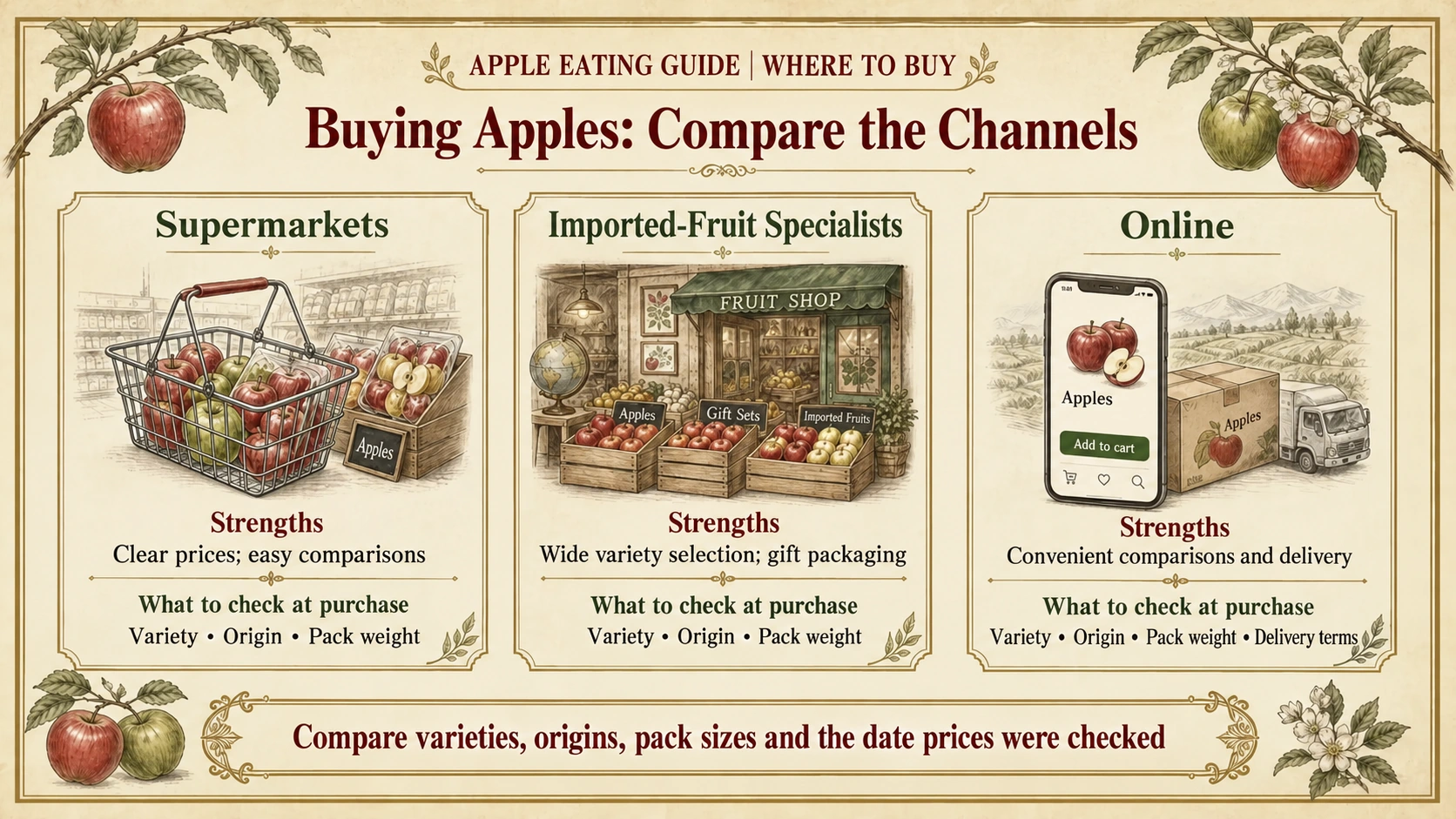
Supermarkets
Large supermarkets such as WinMart, Big C/GO! and Lotte Mart offer apples by weight and in bags. Origin labels and clearly displayed prices make them relatively straightforward for first-time shoppers.
Imported-fruit specialists
Chains such as Klever Fruits and Farmers Market offer detailed variety selections and gift boxes. Prices tend to be higher than supermarket prices, but gift products are easier to compare. A higher price alone does not guarantee freshness or quality.
Online shopping
Chain stores’ websites and delivery apps also sell apples. You cannot inspect individual fruit, but listings can help you compare variety, origin, pack weight and delivery conditions.
Japanese apples sometimes appear as expensive gift products. Vietnamese reporting in September 2024 described Sekai Ichi apples selling for over VND 500,000 each. That was a particular retail example, not a general market price.
How to choose good apples
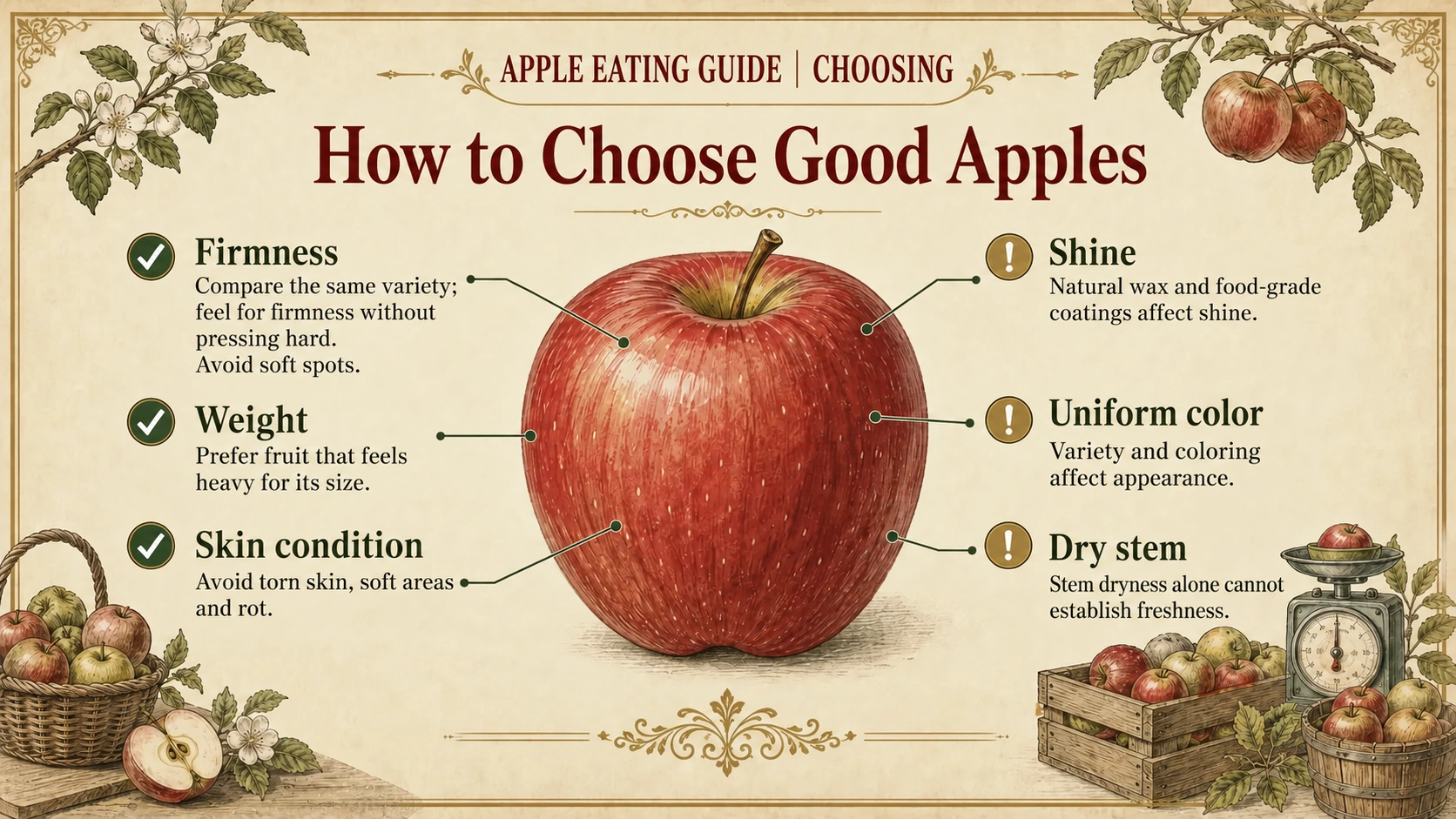
Appearance cannot reveal an apple’s entire internal condition. Nevertheless, three characteristics are useful when comparing fruit in a shop.
- Firmness: compare apples of the same variety and choose ones that feel firm and full. Do not press hard with your fingertips and damage the merchandise. Localized soft areas can indicate bruising or deterioration.
- Weight: among apples of the same variety and similar size, favor fruit that feels heavy for its size.
- Skin condition: avoid torn skin, softened areas and rot. Damage can spread from a bruised spot.
Other commonly suggested signs are less reliable for imported apples. Shine may reflect a postharvest coating. Uniform color varies by cultivar, coloring and grade. A dry stem cannot reliably establish harvest age after long transport. Fruit stickers do not necessarily show an arrival date; use them mainly to check origin.
How to cut apples: wedges and the star cut
Apples can be eaten with the skin or cut into portions. Choose according to the eater’s chewing ability and the intended use.
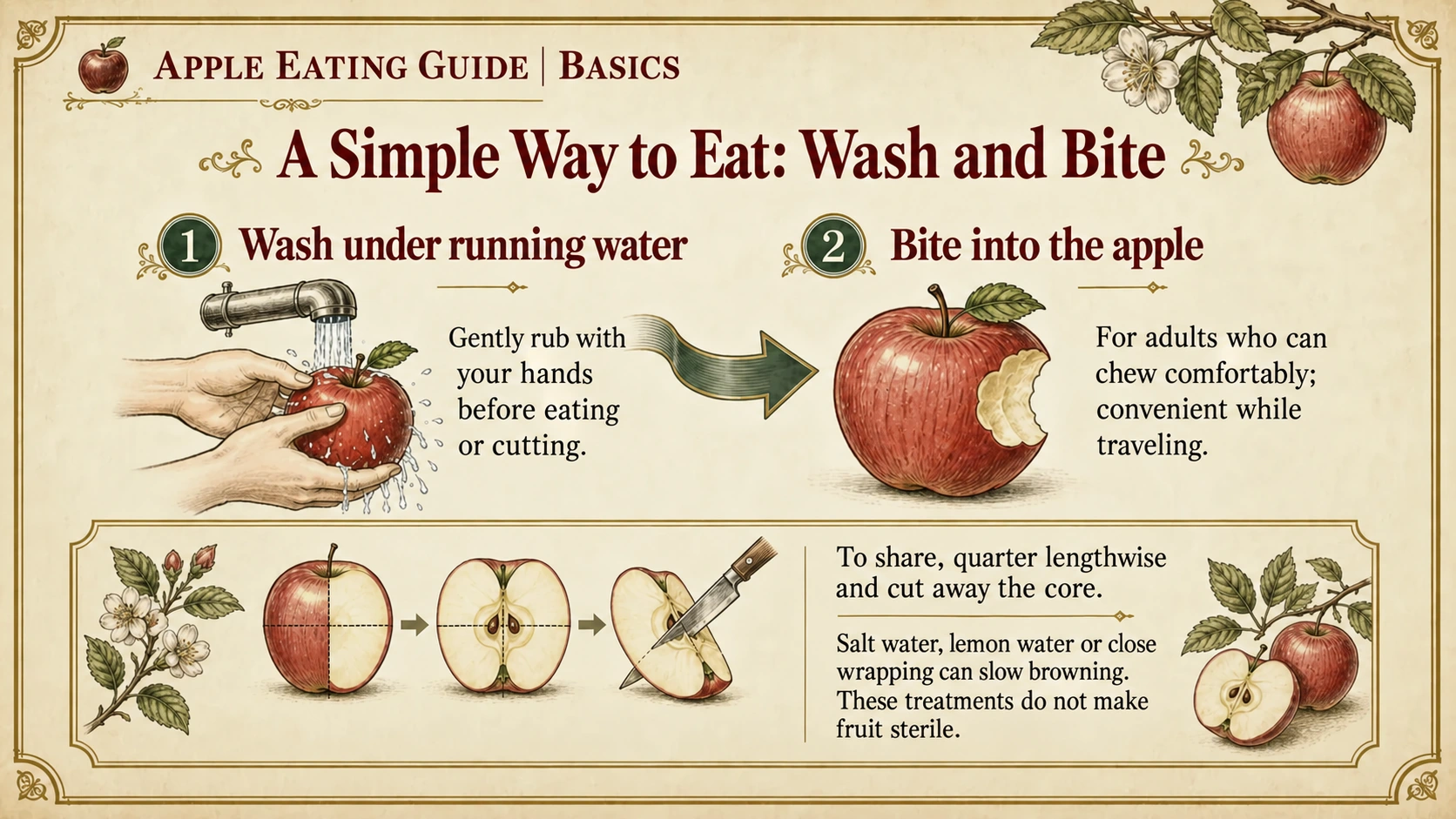
Adults who can chew comfortably can wash an apple well and bite into it. This is convenient when traveling without a knife or cutting board.
Two cutting methods are particularly useful when sharing.
Wedges
- Wash well and dry.
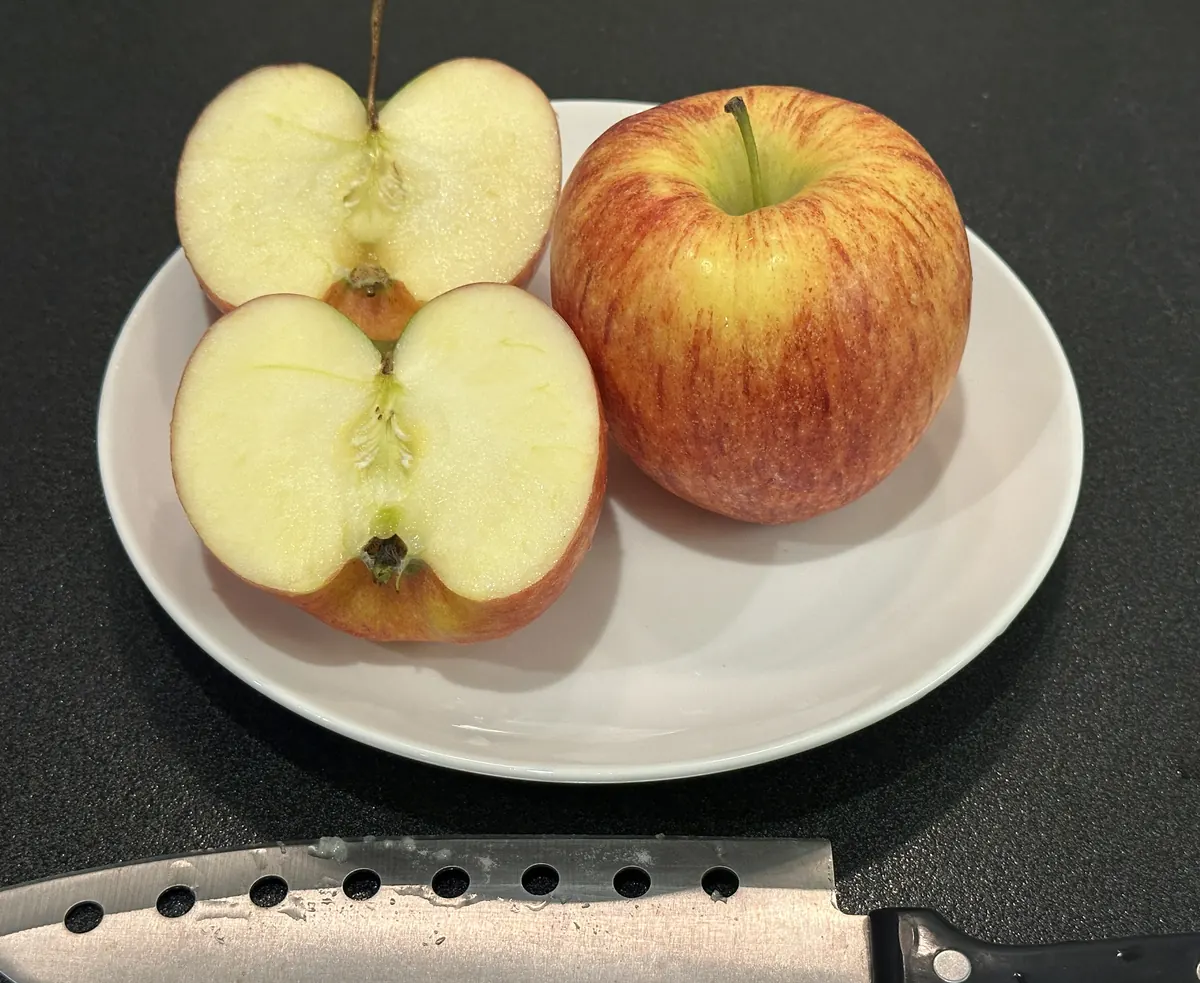
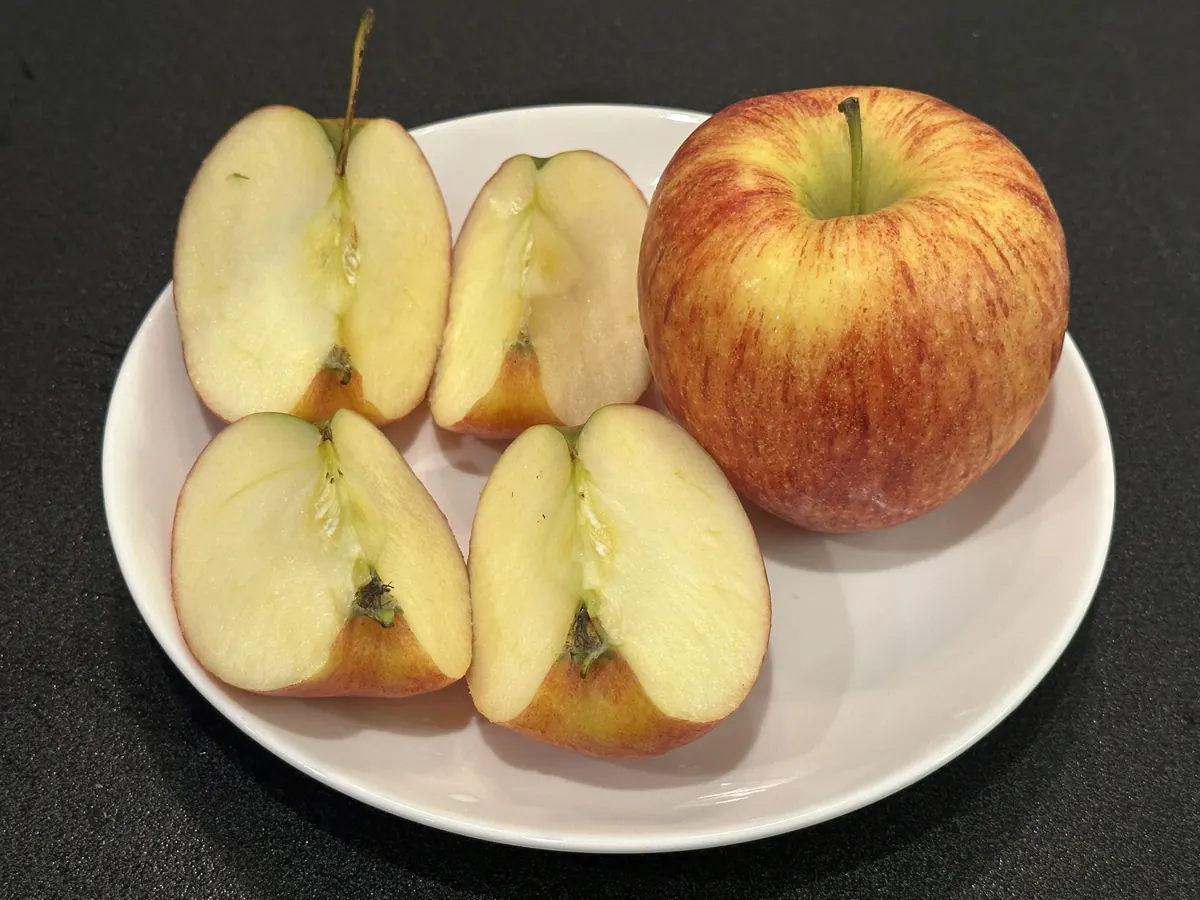
- Cut lengthwise in half, then halve each piece to make quarters.
- Cut diagonally into the center of each quarter to remove a triangular section containing the core.
- Divide further, for example into eight wedges, to make suitable portions.
The star cut: round slices
This method, also introduced by Japan’s Ministry of Agriculture, Forestry and Fisheries, involves laying the apple on its side and cutting across it into rounds. The core in the middle looks like a star, giving the cut its name.
- Place the apple on its side on a stable cutting board. Use a damp cloth or nonslip mat underneath if the board slides.
- Hold the apple with fingertips away from the blade’s path and cut down into slices of your preferred thickness. Adjust for chewing ability. Do not serve hard raw rounds directly to infants or toddlers.
- Remove seeds and the hard core, then divide into suitable portions.
Round slices make the skin easy to eat, although wedges can also retain it. Japan’s MEXT Food Composition Database gives 1.9 g of fiber per 100 g with skin, compared with 1.4 g without skin, and 6 mg of vitamin C with skin, compared with 4 mg without. Leaving only the stem, seeds and hard core as waste also reduces scraps.
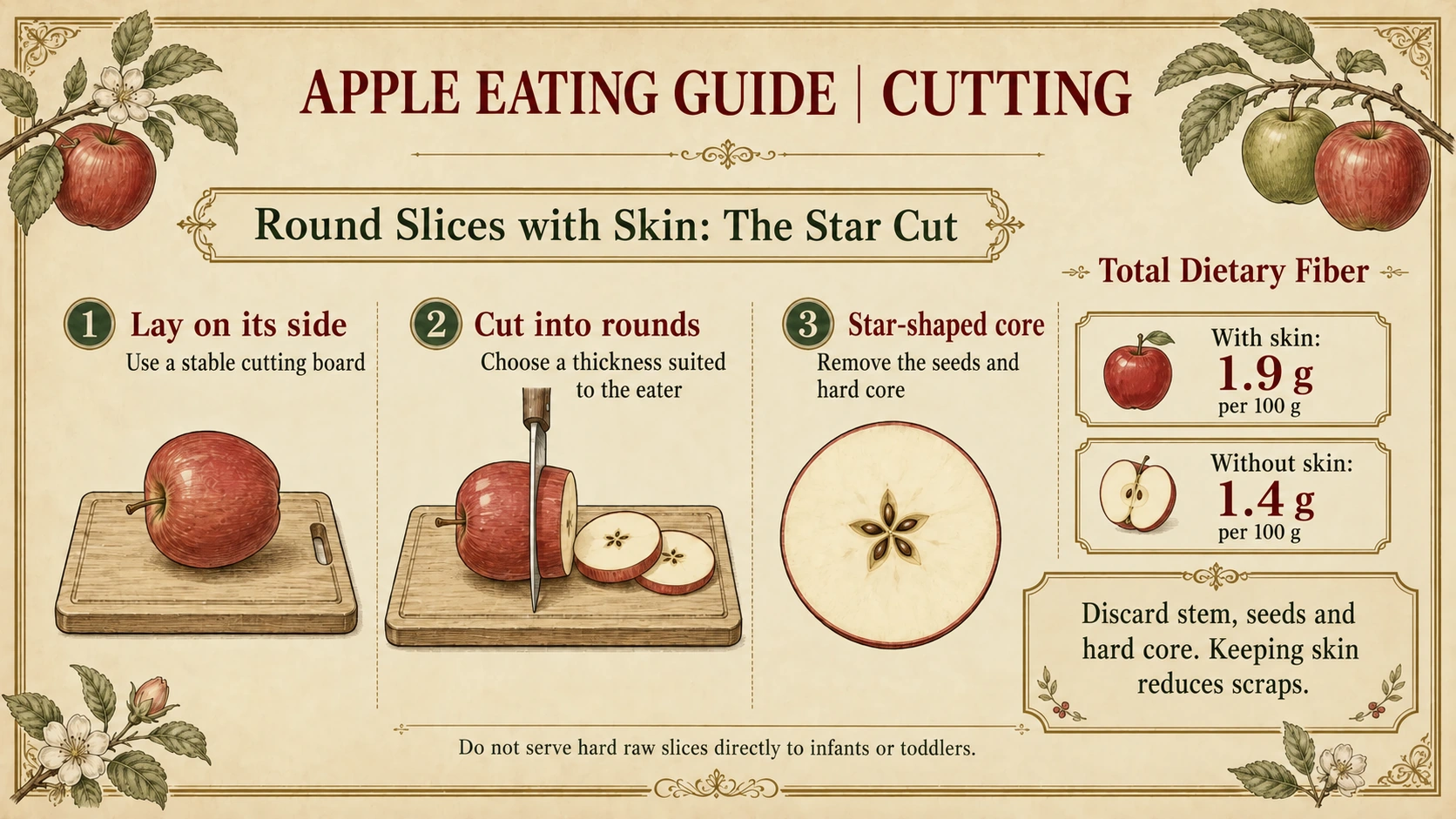
Seeds remain visible in the center of round slices. Accidentally swallowing a few whole seeds is usually not a problem for adults, but remove them before serving children. As explained below, this cutting method alone does not make raw apples suitable for infants and toddlers.
Preventing browning after cutting
Cut apples brown when flesh polyphenols oxidize after exposure to air. Polyphenol oxidase drives the reaction. Browning can therefore be slowed by inhibiting the enzyme or reducing contact with oxygen. Common methods include briefly dipping slices in dilute salt water or lemon water, or covering the cut surface closely with food wrap.
Ways to enjoy apples in Vietnam
1. Eat them fresh
The simplest way is familiar in Vietnam too: wash well and bite into the apple, skin included.
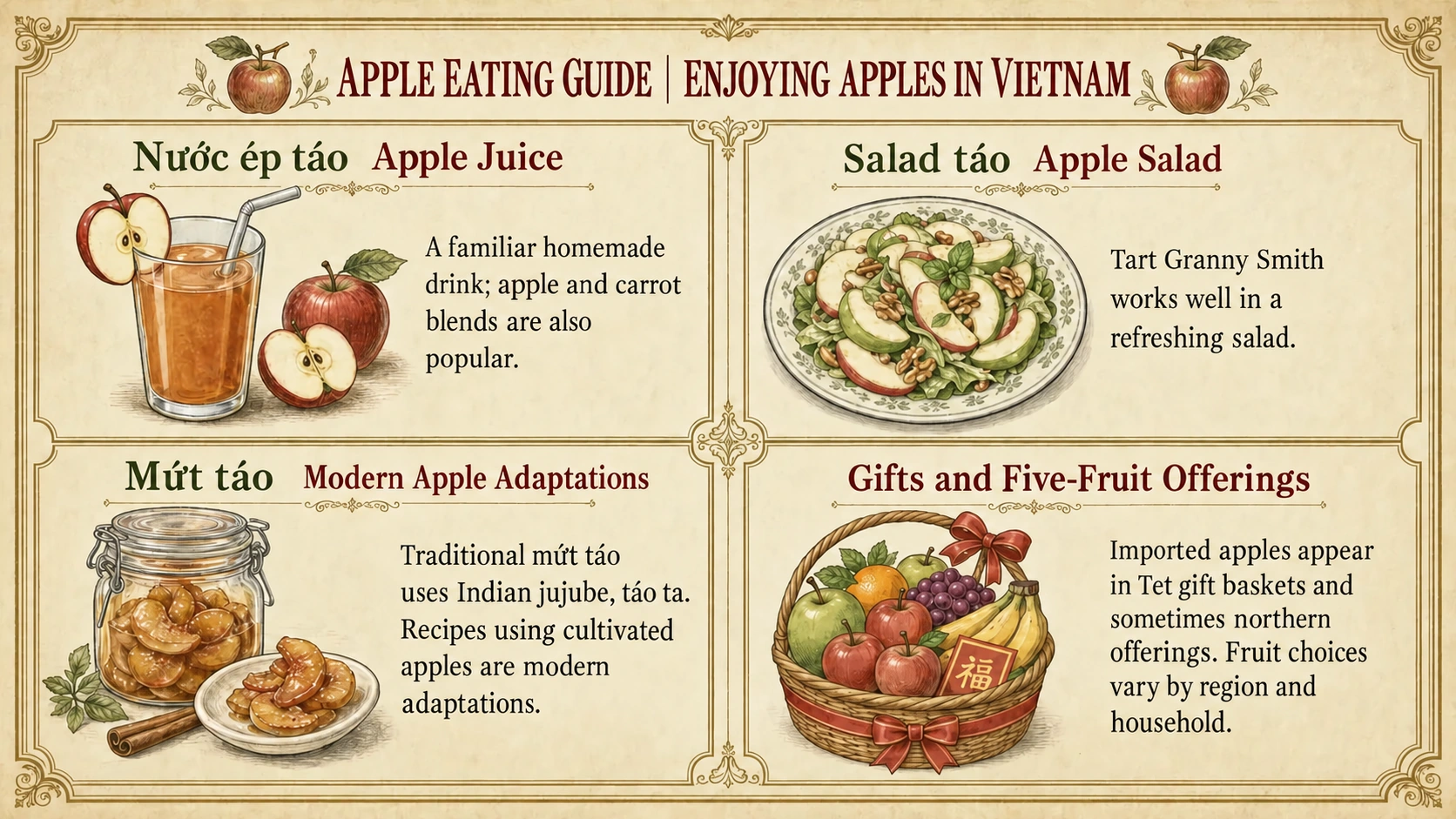
2. Nước ép táo: apple juice
Apple juice is a familiar homemade drink. Red or green apples can be used, and recipes combining apples with carrots are also popular.
3. Salad táo: apple salad
Slice or dice apples and combine them with vegetables. Tart Granny Smith works well. The result offers a refreshing contrast after rich dishes.
4. Mứt táo: candied táo
Tet’s candied-fruit sweets, mứt Tết, include mứt táo. Traditionally, however, this is made with Indian jujube, táo ta, rather than cultivated apples. The name táo plays two roles here too.
Modern recipes also adapt the sweet using cultivated apples. One method slices red apples, soaks them in salt water for about 30 minutes, dries them for 4–5 hours, then cooks them slowly with sugar, cinnamon powder and orange juice.
5. Give them as gifts
As explored in The Story of Apples, apples in Vietnam are both food and gifts. Imported-fruit baskets appear in shops as Tet approaches. Táo may also be included in northern Vietnam’s New Year mâm ngũ quả, the five-fruit offering for ancestral altars.
Selections vary by region, household and period; there is no universally fixed set of five species. Apples are not an indispensable traditional fruit, but gifting and offerings are among their roles in contemporary Vietnam.
How to store whole and cut apples
Place cut apples in a clean container or cover them with food wrap, refrigerate promptly and eat soon. A treatment that reduces browning does not make prolonged room-temperature storage safe.
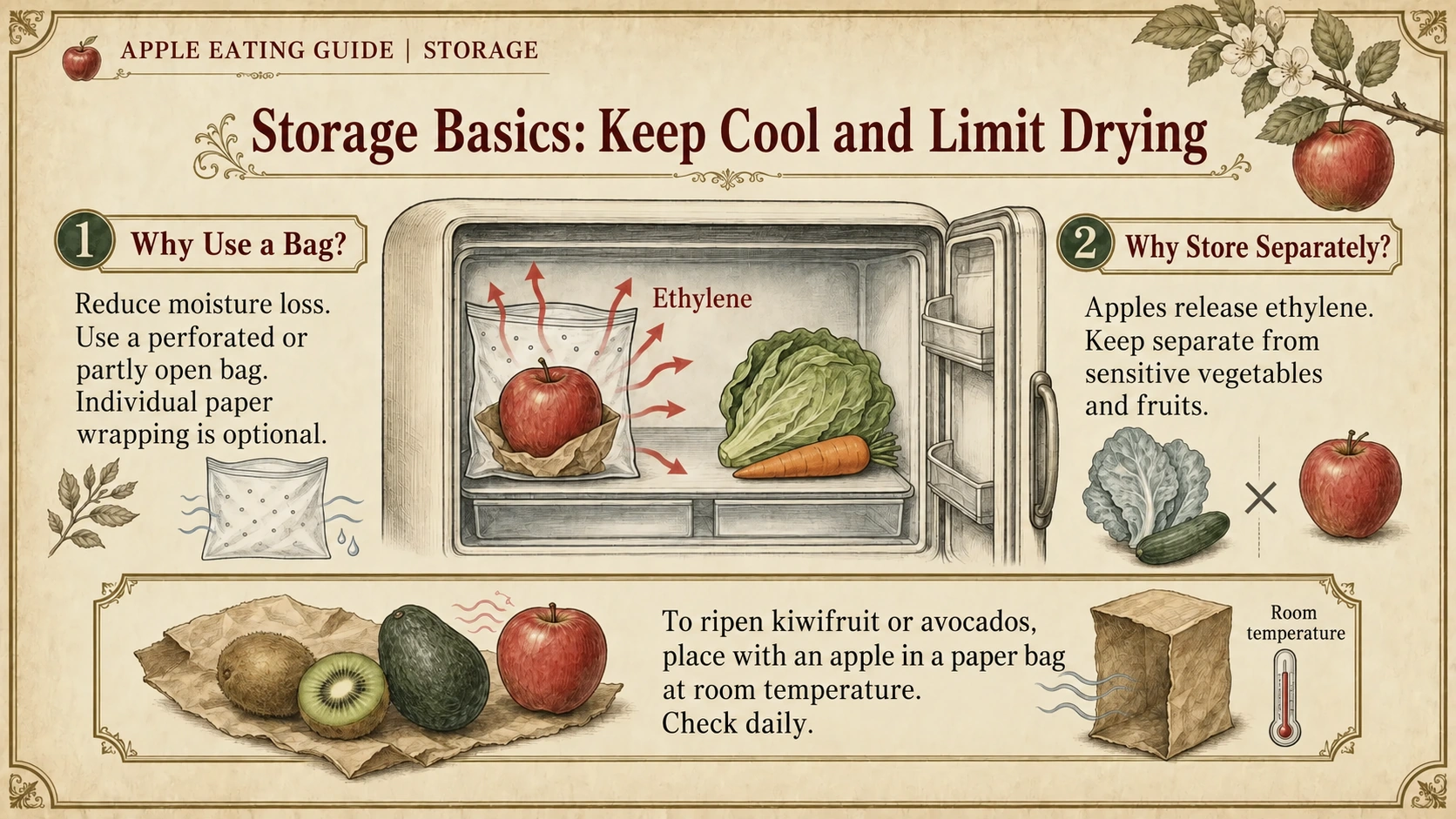
Whole apples generally keep longer than many fruits. At home:
- Put them in a perforated plastic bag, or leave the bag opening partly open.
- Store them in the refrigerator’s crisper drawer.
Japanese storage guides also commonly recommend wrapping each apple in newspaper or kitchen paper before bagging to reduce drying.
The bag has two purposes: limiting moisture loss and separating apples from nearby produce. Apples release ethylene gas, which promotes ripening and can accelerate deterioration in surrounding fruit and vegetables.
Do not seal the bag completely; some ventilation helps prevent condensation and ethylene accumulating inside.
You can also use ethylene deliberately. To help ripen hard kiwifruit or avocados, place them with an apple in a paper bag at room temperature. Check daily so they do not become overripe.
Washing apples and eating them safely
Surface wax and the question of apples that keep for a month
People buying imported apples in Vietnam sometimes worry that a fruit staying sound for a month must have been treated with harmful chemicals.
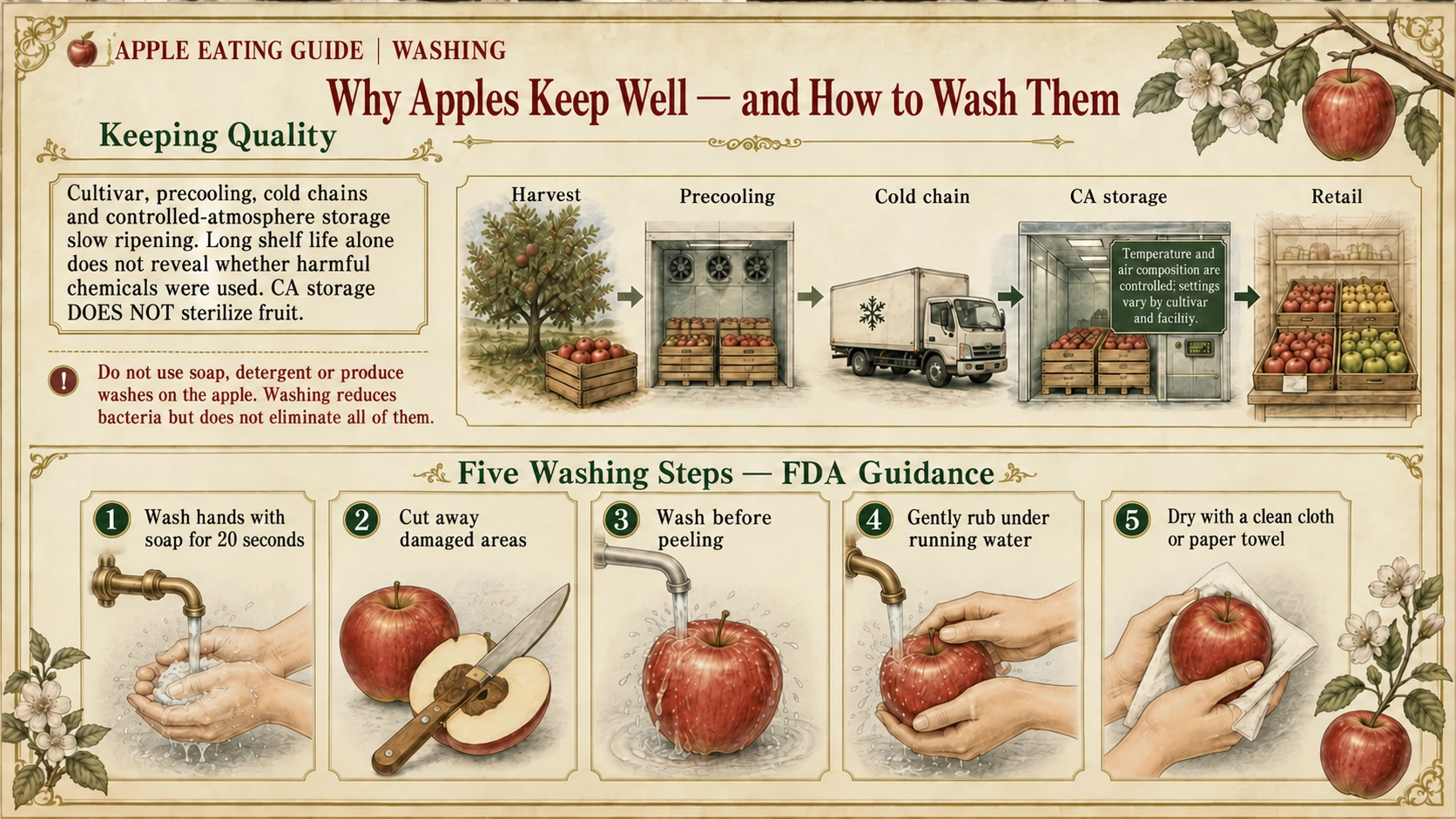
Keeping quality depends on the cultivar, precooling after harvest, the cold chain and controlled-atmosphere, or CA, storage. CA storage manages temperature and oxygen and carbon dioxide levels to slow respiration and ripening. Settings and storage periods differ by cultivar and facility. Long shelf life alone cannot establish whether harmful chemicals were or were not used.
CA storage slows ripening; it does not sterilize fruit. Keeping well does not remove the need to wash an apple.
Two kinds of wax should be distinguished. Apples have a natural waxy surface that reduces water loss and protects the fruit. Some apples also receive postharvest food-grade coatings, such as carnauba wax or shellac, to reduce drying or preserve shine. Coatings depend on the product and exporting country. Appearance alone cannot reliably identify a coating or show whether one was applied.
There is no reliable home test to distinguish the two. The research reviewed here did not find evidence for claims that pouring hot water over an apple and observing a white film identifies applied wax.
Wash under running water and rub gently
The US Food and Drug Administration gives the following advice for fresh produce:
- Wash your hands with soap and warm running water for 20 seconds.
- Cut away damaged areas.
- Even if peeling, wash the fruit before removing the skin.
- Wash under running water while gently rubbing with your hands.
- Dry with a clean cloth or paper towel.
The FDA advises against washing produce with soap, detergent or commercial produce washes. Follow the running-water method rather than mixing household cleaning solutions. Vigorous rubbing can damage the skin. Running water and gentle hand rubbing are the basic approach.
The FDA also notes that washing can reduce bacteria but does not eliminate them completely. A washed apple is not sterile.
What if you swallow apple seeds?
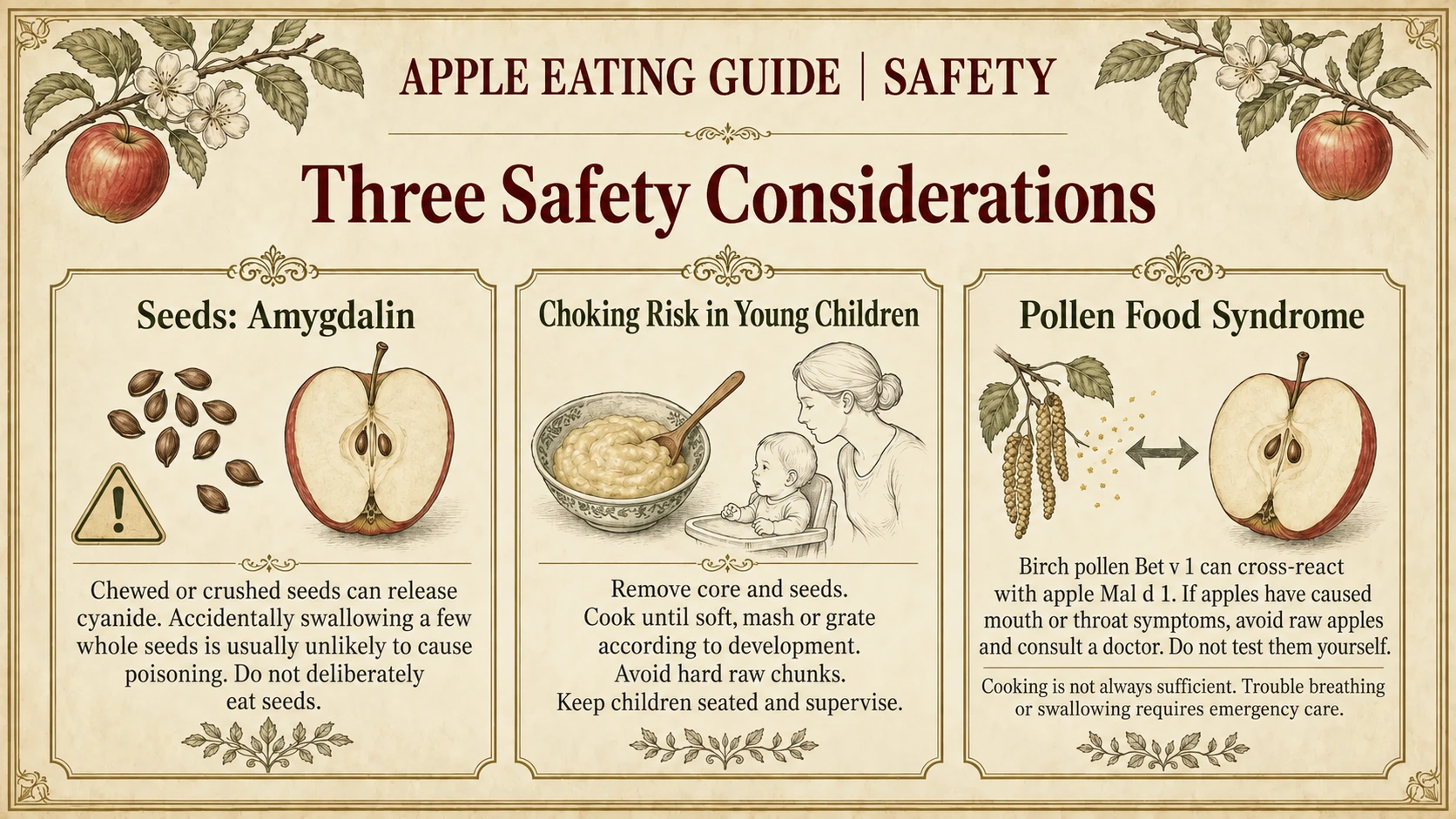
Apple seeds contain amygdalin, a cyanogenic glycoside. When seeds are chewed or crushed, cyanide can be released during digestion.
Accidentally swallowing the whole seeds from one apple is generally unlikely to cause poisoning because their hard outer coats allow them to pass through the body intact. Avoid chewing or crushing and eating large quantities of seeds. Do not deliberately eat them.
Serving young children
Hard raw apple can cause choking in infants and toddlers. The US Centers for Disease Control and Prevention lists raw apples among foods presenting choking hazards.
- Remove the core and seeds completely. Do not serve raw star-cut rounds as they are.
- Match texture and shape to the child’s development: cook until soft, mash or grate as appropriate. Avoid hard raw chunks.
- Keep the child seated; do not allow eating while walking or running.
- An adult should supervise meals closely.
The convenience of biting into a whole apple applies to people with sufficient chewing ability.
Pollen-related apple allergy
People with birch pollen allergy may experience itching or swelling in the mouth or throat after eating apples, sometimes called oral allergy syndrome or pollen food syndrome.
This involves immune cross-reactivity. The major birch pollen allergen Bet v 1 belongs to the PR-10 group, as does the apple allergen Mal d 1, so the immune system may respond to their similarities.
If apples have previously caused mouth or throat symptoms, avoid raw apples and consult a medical professional rather than testing small amounts yourself. Mal d 1 is heat-sensitive, so some people can tolerate cooked apples. Other apple allergens, including Mal d 2 and Mal d 3, are more resistant to heat. Cooking is therefore not a guarantee of safety; discuss suitability with a doctor. Difficulty breathing or swallowing requires immediate emergency care.
Can you bring apples from Vietnam into Japan?
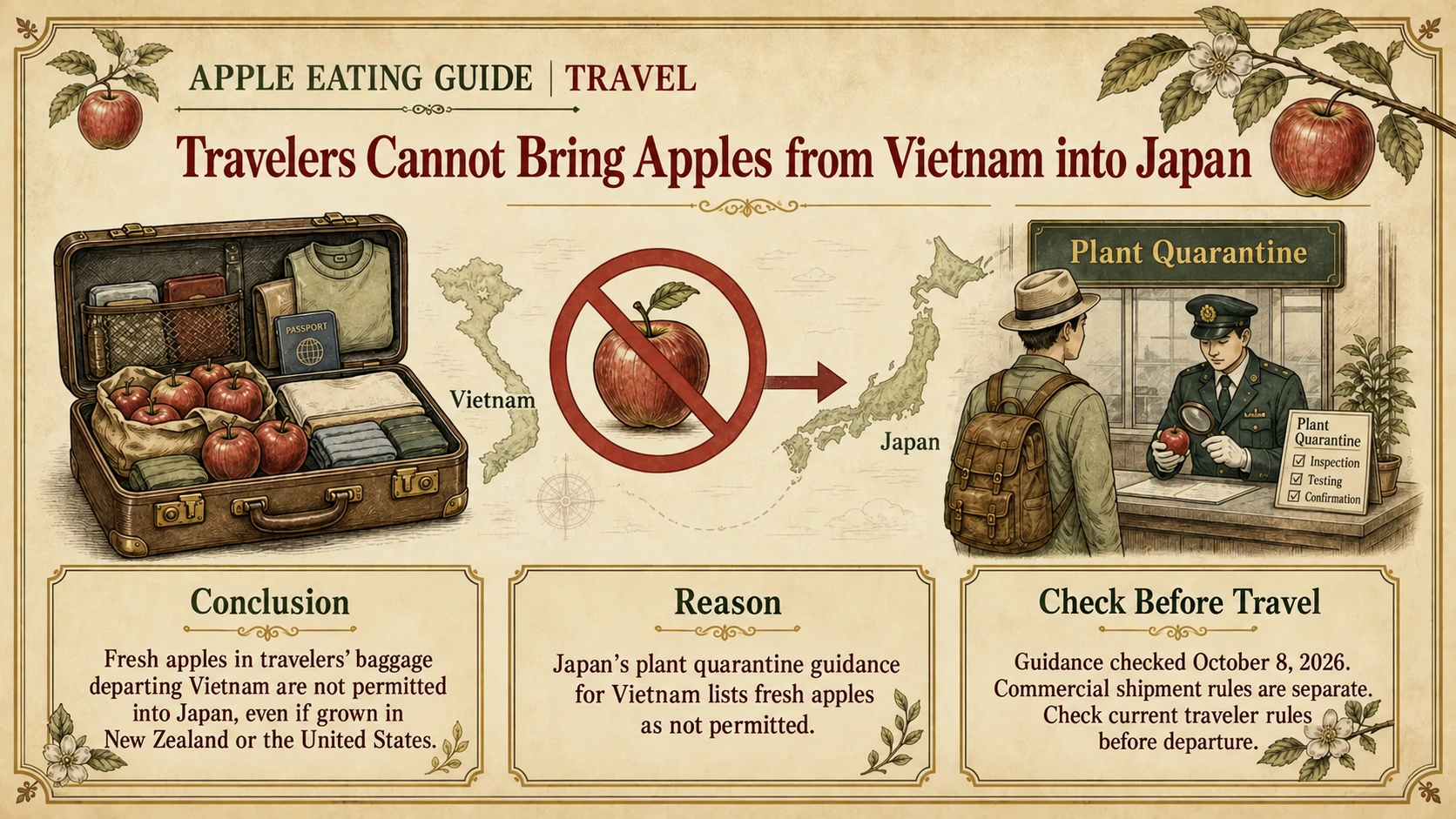
Fresh apples in travelers’ baggage from Vietnam cannot be brought into Japan. Under the current plant quarantine system, fresh apples from Vietnam are classified as prohibited.
Japan’s Plant Protection Station explicitly lists apples as not permitted on its Vietnam page. This applies to apples carried out of Vietnam even if they were grown in New Zealand or the United States. Buying them in Hanoi does not create an exemption based on their original country of production.
The Plant Protection Station’s Vietnam guidance was checked on October 8, 2026. Check the latest requirements before traveling.
The author’s tasting notes
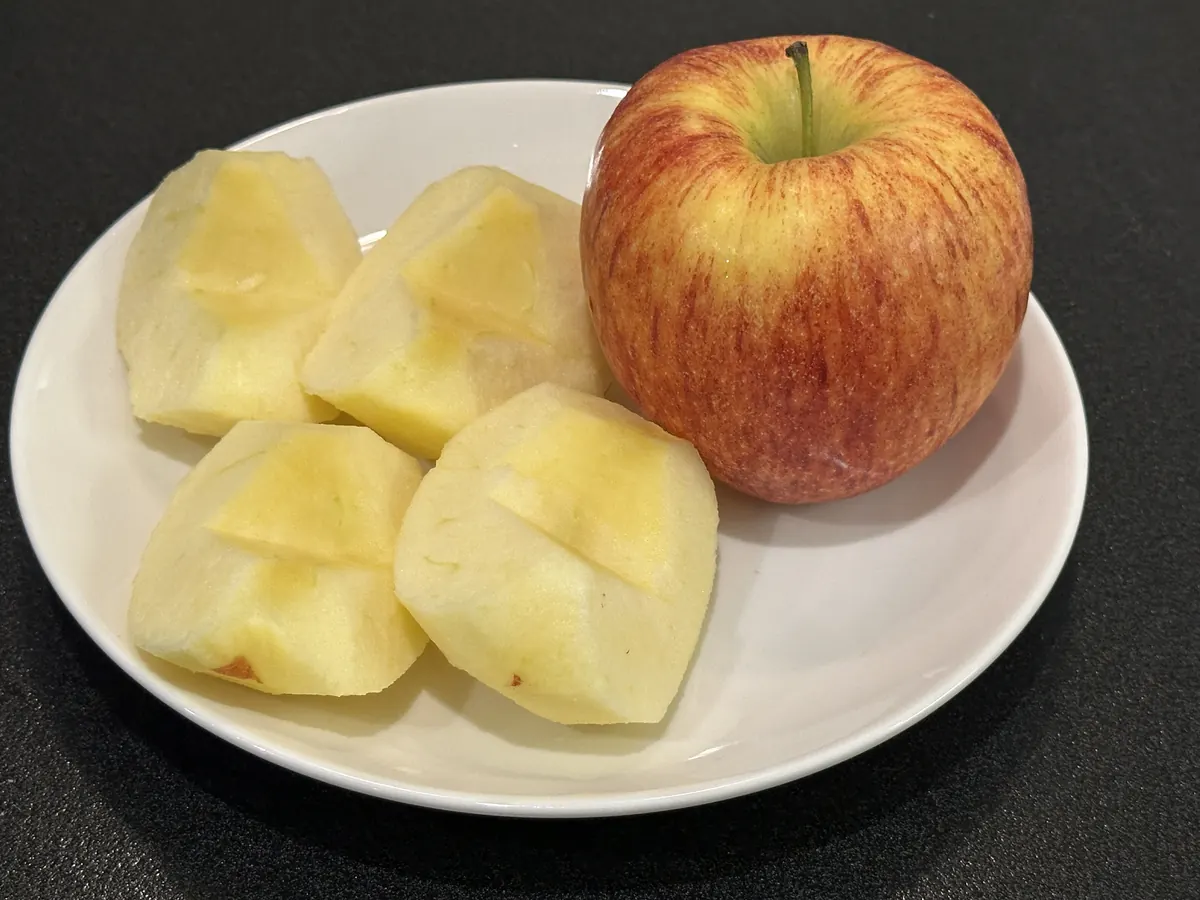
Purchase record
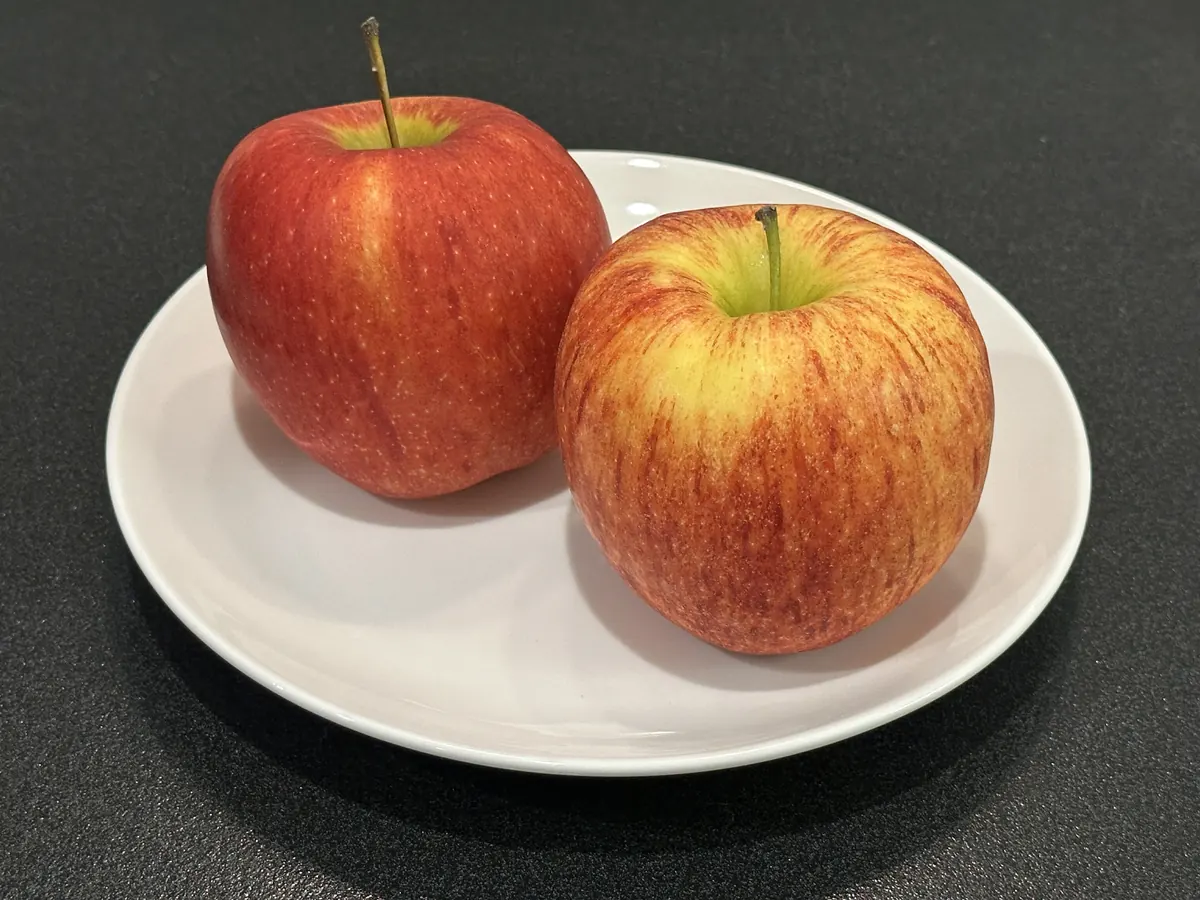
Location: supermarket. Date: September 2026.
Price: VND 109,988 for two apples, weighing 0.582 kg, approximately VND 188,983 per kg.
Tasting impression
Crisp texture, with a good balance of sweetness and acidity.
Recommendation for beginners: ★★★★★
Frequently asked questions
Can you eat apple skin?
Yes, after washing well. Keeping the skin increases fiber and vitamin C intake. Round star-cut slices offer an easy way to eat it without peeling.
Should you wash a white film or sticky surface?
Apples have natural wax and may also have postharvest food-grade coatings. There is no reliable home method to distinguish them. In either case, follow FDA advice: gently rub under running water and dry with a clean cloth or paper towel. Do not use soap, detergent or commercial produce washes.
Is accidentally swallowing seeds dangerous?
Swallowing the intact seeds from one apple is generally unlikely to cause poisoning. Avoid chewing or crushing and consuming large quantities. Remove seeds before serving children.
Are any cultivated apples grown in Vietnam?
Most cultivated apples in shops are imported. However, growing examples are recorded in northern highland areas. Fuji and Granny Smith trials were reported in Sapa, Lao Cai, and cultivated apples have also been reported in Sin Ho, Lai Chau. Historical examples do not establish today’s production scale or retail supply. Fruits piled up as Vietnamese-grown táo are often Indian jujubes, táo ta, rather than cultivated apples.
Can you take them back to Japan?
No. Japan’s plant quarantine guidance classifies fresh apples from Vietnam as not permitted. This applies to apples in baggage departing Vietnam regardless of their original growing country.
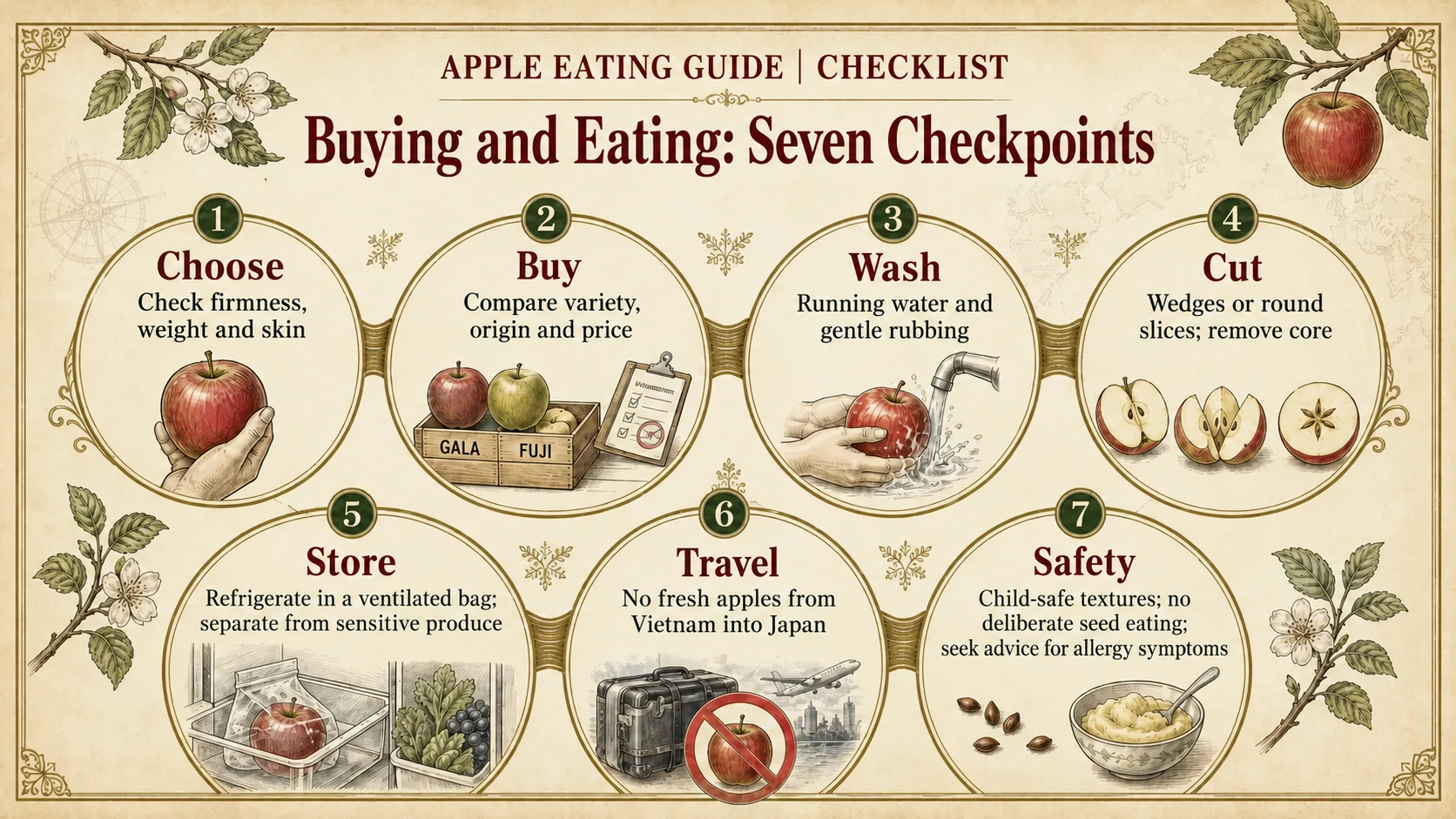
Practical points for buying and eating apples in Vietnam
For adults able to chew comfortably, apples are convenient fruit that can be washed and eaten whole. Choosing varieties and judging prices usually requires more thought than cutting them.
- Choose: check firmness, weight and unbroken, sound skin. Shine, uniform color and stem dryness alone are unreliable for imported fruit.
- Buy: the April 2026 reference guide ranges from VND 60,000 to 380,000 per kg. Start with a variety such as Gala or Fuji before trying premium options.
- Cut: eat whole if suitable for your chewing ability, or share wedges or round star-cut slices with skin.
- Enjoy: eat fresh, make nước ép táo or salad táo, or give as a gift. Traditional Tet mứt táo uses Indian jujube, although modern apple adaptations exist.
- Wash: rub gently under running water and dry with a clean cloth or paper towel. Do not use soap, detergent or produce washes.
- Take care: remove cores and seeds for infants and toddlers, and cook until soft, mash or grate according to their development. Hard raw apple can cause choking. Avoid chewing large quantities of seeds. Seek medical advice if apples have caused mouth or throat symptoms.
- Store: wrap individually in paper if desired, place in a perforated or partly open bag, and refrigerate in the crisper. Keep separate from other produce because apples release ethylene.
- Travel: fresh apples carried in baggage from Vietnam are prohibited from entry into Japan under the guidance checked here.
Try buying one at a supermarket and checking its origin label. For travelers who can eat them safely, apples provide an easy fruit option requiring only washing.
Learn more about apples
- Biology, nutrition, varieties and market trends: Apples in Vietnam.
- Central Asian origins, forbidden-fruit imagery and contemporary Vietnamese culture: The Story of Apples.
- A wider selection: 15 Fruits to Try in Vietnam (Japanese).
References
- Kingfoodmart: indicative apple prices by variety; updated April 22, 2026; store count and individual observation dates unspecified: kingfoodmart.com.
- CafeF: apple coatings and controlled-atmosphere storage, explained by Dr Vu Thi Tan of Hanoi University of Science and Technology: cafef.vn.
- US FDA: Selecting and Serving Produce Safely; running water, gentle rubbing and no produce detergents: www.fda.gov.
- US FDA: Chemicals in Foods; food-grade wax coatings: www.fda.gov.
- US CDC: Choking Hazards; hard raw apples and young children: www.cdc.gov.
- Oregon State University Extension: Apple basics; firmness, weight and skin condition: extension.oregonstate.edu.
- Oregon State University Extension: Picking and Storing Apples and Pears; perforated storage bags: extension.oregonstate.edu.
- Poison Control: An Apple a Day Keeps the Doctor Away, But What About the Seeds?: www.poison.org.
- Anaphylaxis UK: Pollen Food Syndrome; symptoms and effects of heating: www.anaphylaxis.org.uk.
- Research review: apple allergy; heat-sensitive Mal d 1 and more heat-resistant Mal d 2 and Mal d 3: pmc.ncbi.nlm.nih.gov.
- Ngoc Chau Fruits: choosing, washing and eating apples; Vietnamese retail guidance: ngocchaufruits.com.
- Điện máy XANH: choosing crisp apples and storing them: www.dienmayxanh.com.
- Điện máy XANH and VOH: apple varieties, juice, salads and modern candied-apple recipes: www.dienmayxanh.com, voh.com.vn.
- Japan MAFF: the apple star cut, round slices: www.maff.go.jp.
- Weathernews: star-cut apples and the name’s origin: weathernews.jp.
- MEXT Food Composition Database: raw apples with and without skin; 2023 supplement to the eighth edition: fooddb.mext.go.jp, fooddb.mext.go.jp.
- Kudamono Navi and Nichirei Foods: apple storage and ethylene: www.kudamononavi.com, www.nichireifoods.co.jp.
- Furunavi: apple storage and browning: furunavi.jp.
- WIRED Japan: amygdalin in apple seeds: wired.jp.
- Journal of the Oto-Rhino-Laryngological Society of Japan: cross-reactivity involving Bet v 1 and Mal d 1: www.jstage.jst.go.jp.
- Vietnamese government news: Traditional foods offering to ancestors on Tet festival: en.baochinhphu.vn.
- VnExpress: traditional Tet mứt táo made with Indian jujube: vnexpress.net.
- Vietnamese dictionary: bôm as regional usage: vtudien.com.
- Mia.vn: northern Vietnam’s five-fruit offerings: mia.vn.
- ANTV: imported-fruit gifts at Tet, also cited in The Story of Apples: antv.gov.vn.
- 24H, September 4, 2024: a Sekai Ichi apple retail example above VND 500,000: www.24h.com.vn.
- Japan Plant Protection Station: fresh apples from Vietnam prohibited in travelers’ baggage: www.maff.go.jp.
- Japan Plant Protection Station and MAFF: traveler rules and market-access requests: www.maff.go.jp, www.maff.go.jp.
- FAO and Báo Lai Châu: historical apple introductions and cultivation in northern highland areas: www.fao.org, www.baolaichau.vn.
- Vietnamese government: 2025 provincial administrative reorganization: baochinhphu.vn.
About the Author

Chuta
Based in Hanoi, Vietnam, Chuta buys fruit at local markets and supermarkets and writes about its taste, seasons, selection and preparation. Drawing on life in Vietnam, he introduces tropical fruits that are less familiar to readers in Japan.
About Fruit Guide