The History and Stories of Watermelon: From Africa to Japan and Vietnam
Published October 8, 2026
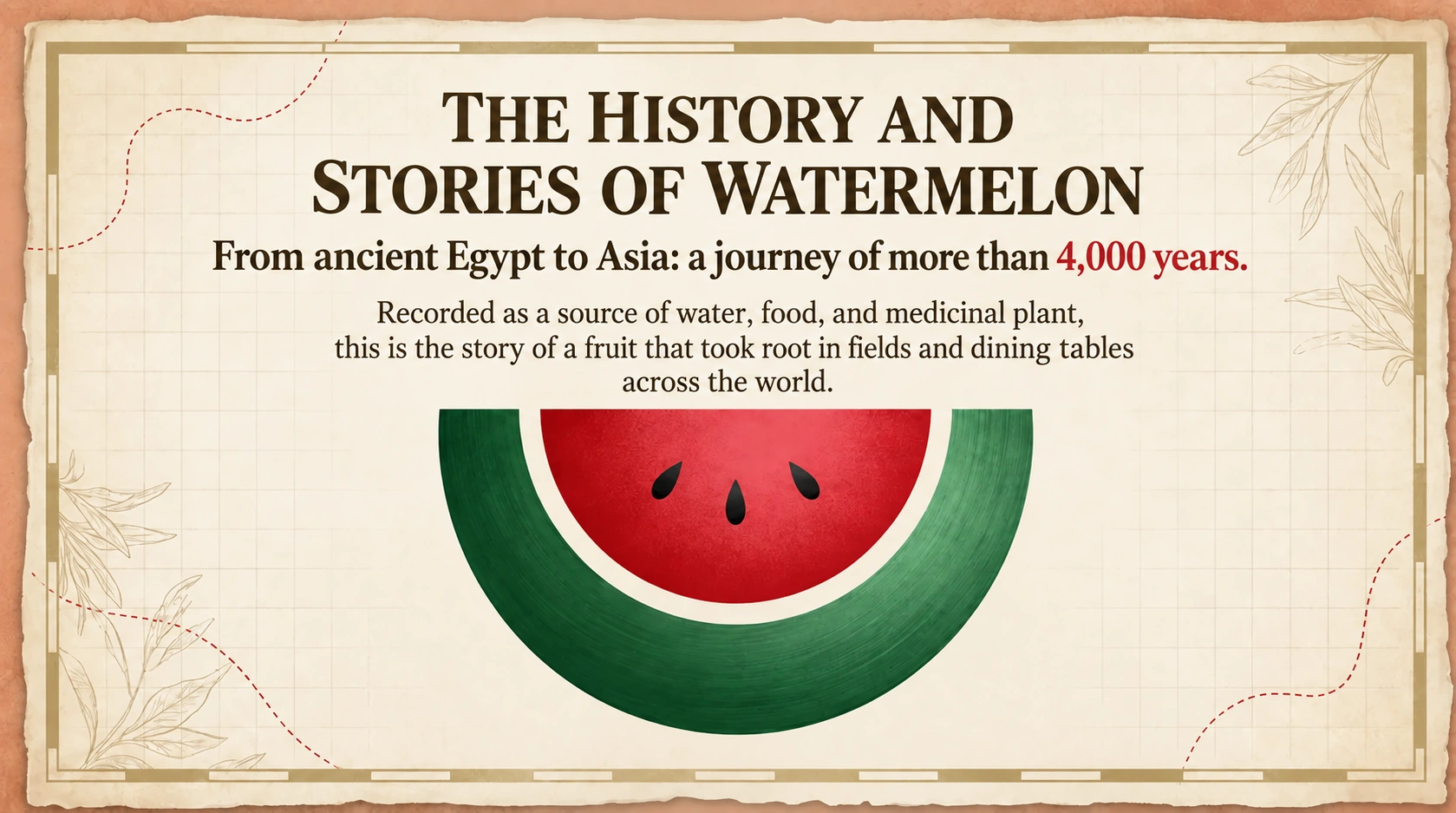
The watermelon on a summer table has a long history stretching from Africa across the world. Seeds found in ancient Egyptian tombs, wall paintings and biblical passages preserve traces of its early relationship with people.
This article follows its journey through the Mediterranean to China and Japan, and explores the name xīguā, or “western melon.” It also introduces Vietnam’s legend of Mai An Tiêm and Tết traditions, distinguishing the history recorded in sources from stories passed down through generations.
African origins and ancient Egypt: records more than 4,000 years old
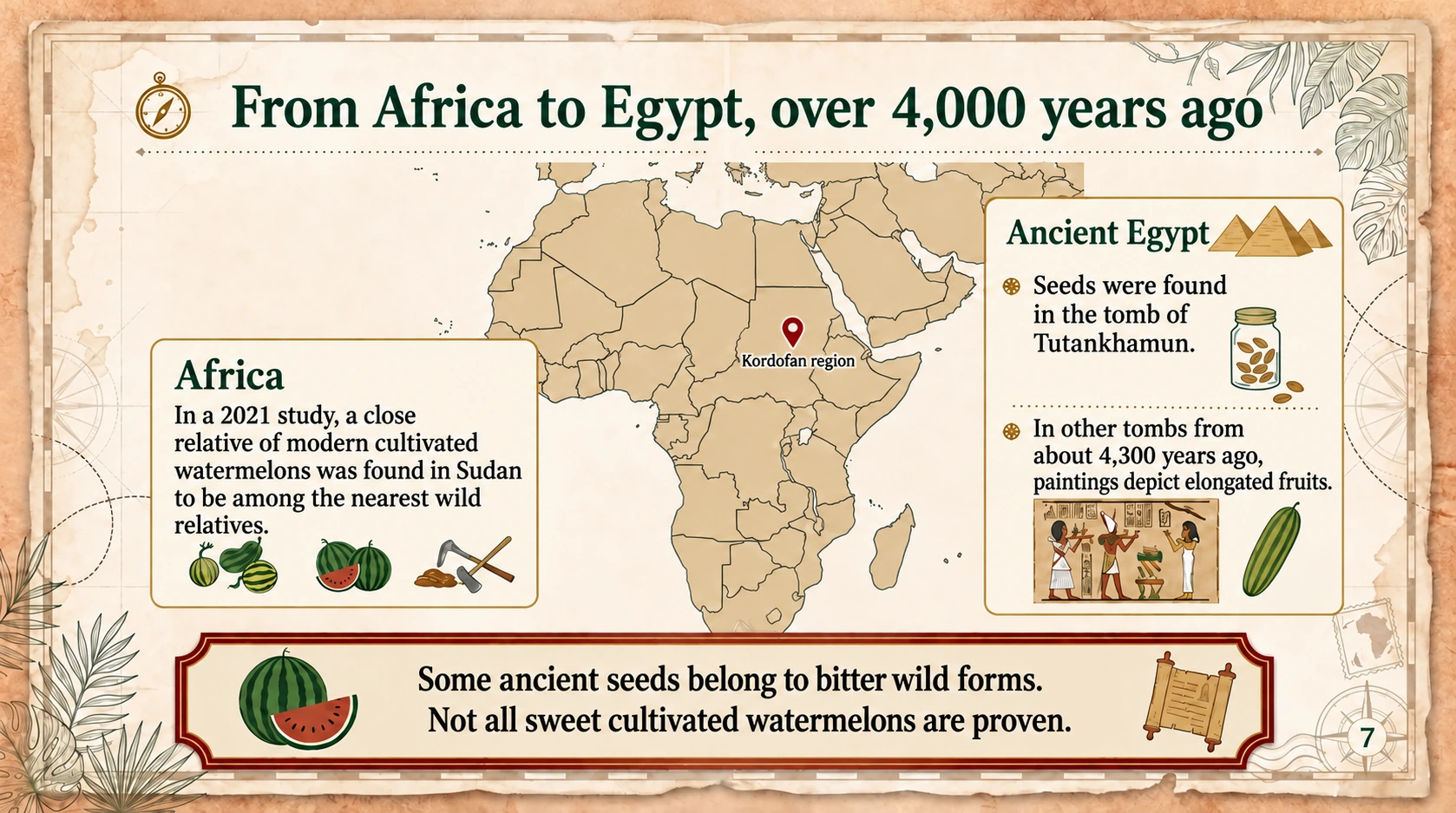
Watermelon’s origins lie in Africa. A 2021 genomic study identified Sudan’s Kordofan melon as the closest known relative of cultivated watermelon and a possible progenitor. This research helps reassess the once-popular Kalahari origin theory. The Watermelon Guide explains the botanical background.
Seeds of the genus Citrullus have been found in Tutankhamun’s tomb. Other Egyptian tombs, dating to around 4,300 years ago, contain paintings of elongated fruit resembling watermelon. Some seeds from older sites belong to bitter wild forms, however, so not every discovery is evidence of sweet dessert watermelon like the fruit we eat today.
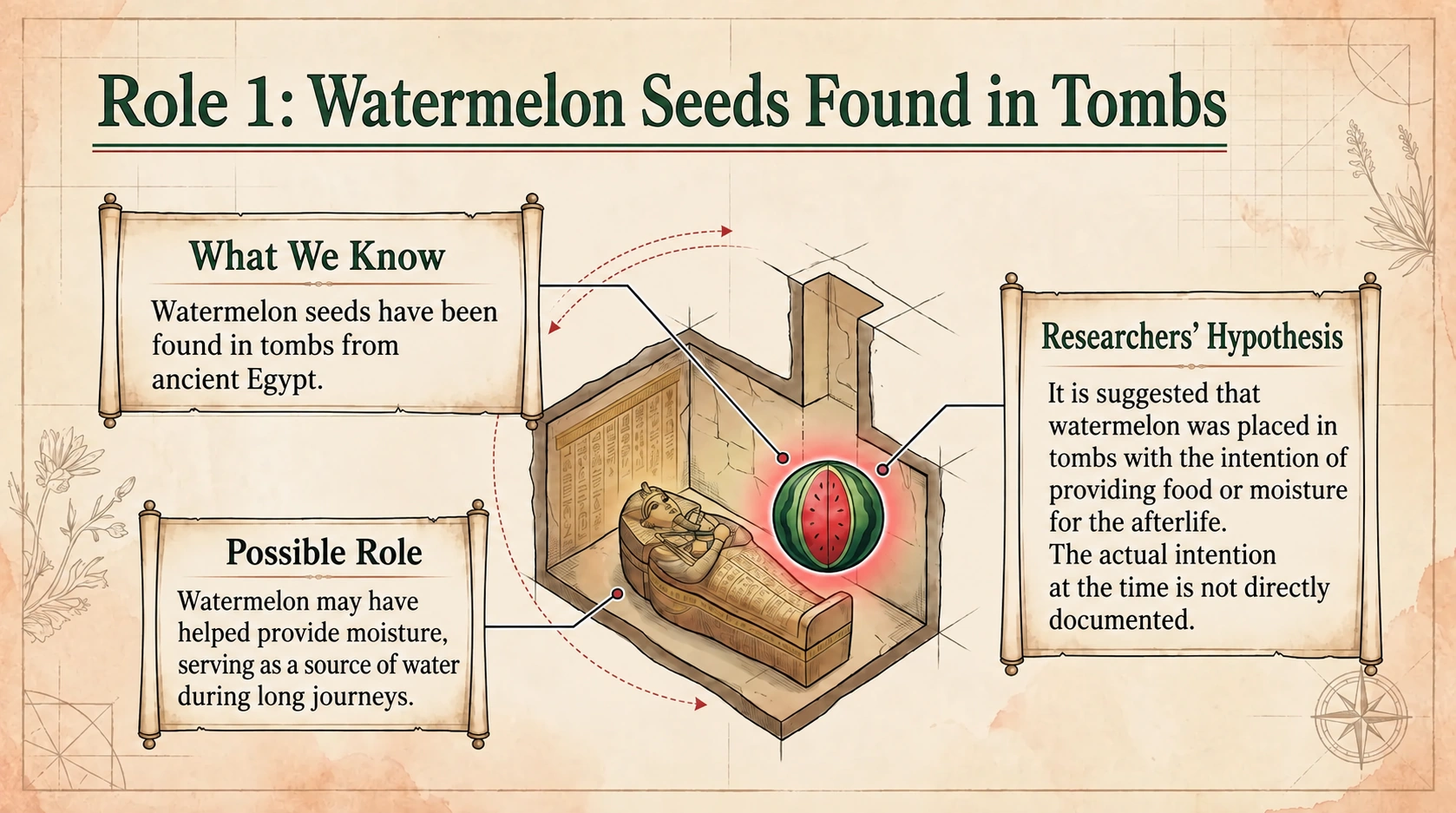
Researchers have suggested that watermelon’s ability to retain water may have made it useful on long journeys. Seeds placed in tombs might also have represented provisions for the afterlife. These are interpretations drawn from archaeological evidence, rather than direct records of the people’s intentions.
A remembered taste of Egypt in the Bible
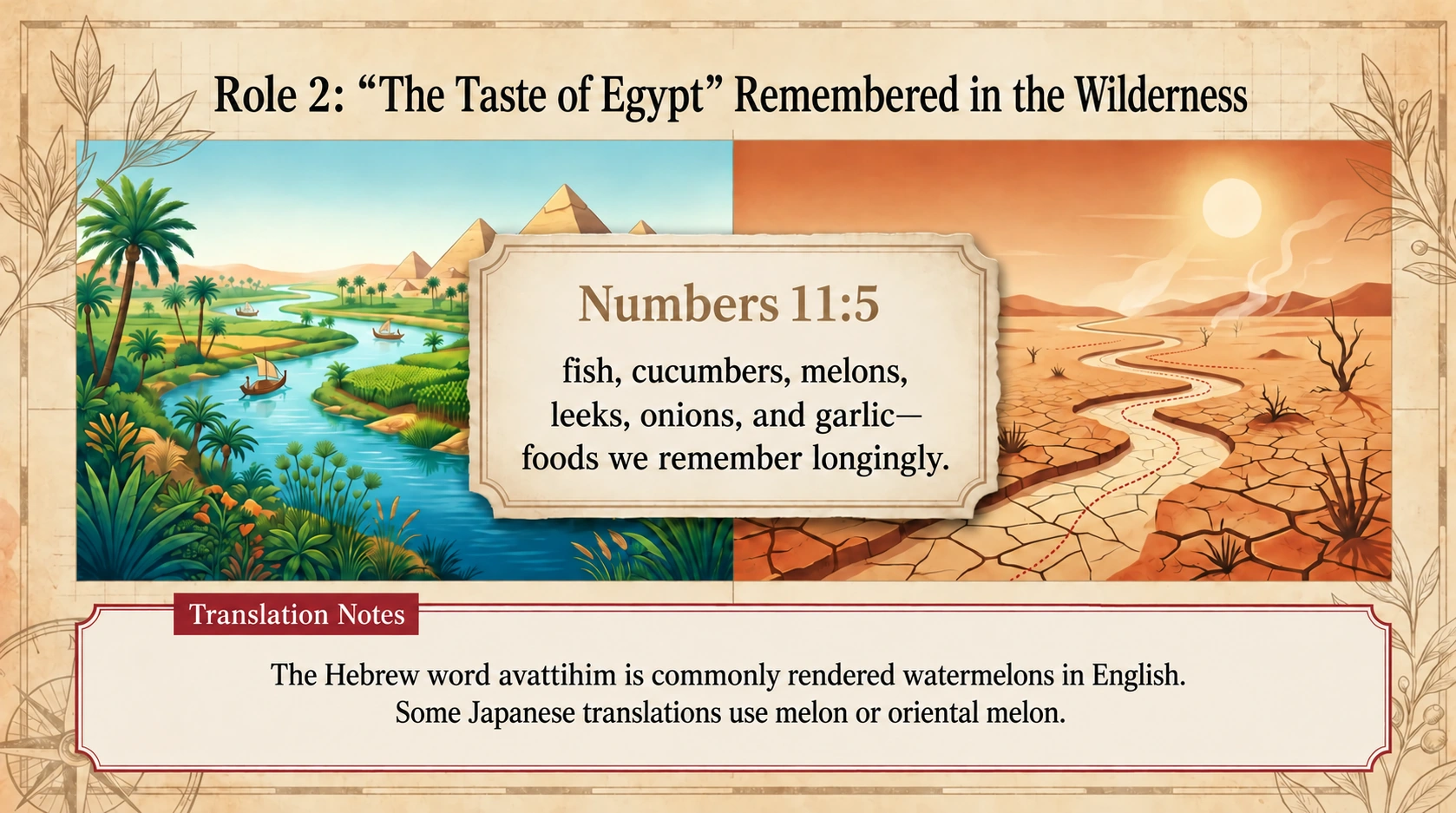
Watermelon’s history also appears in the Bible. Numbers 11:5 describes the Israelites, traveling through the wilderness after leaving Egypt, remembering fish, cucumbers, melons, leeks, onions and garlic.
The Hebrew word avattihim is commonly rendered “watermelons” in English translations, while some Japanese translations use words for melon or oriental melon. Translation choices differ, so it is important not to impose modern taxonomic precision on the wording. The passage nevertheless evokes water-rich cucurbits as remembered food from Egypt.
Through the Mediterranean to Europe
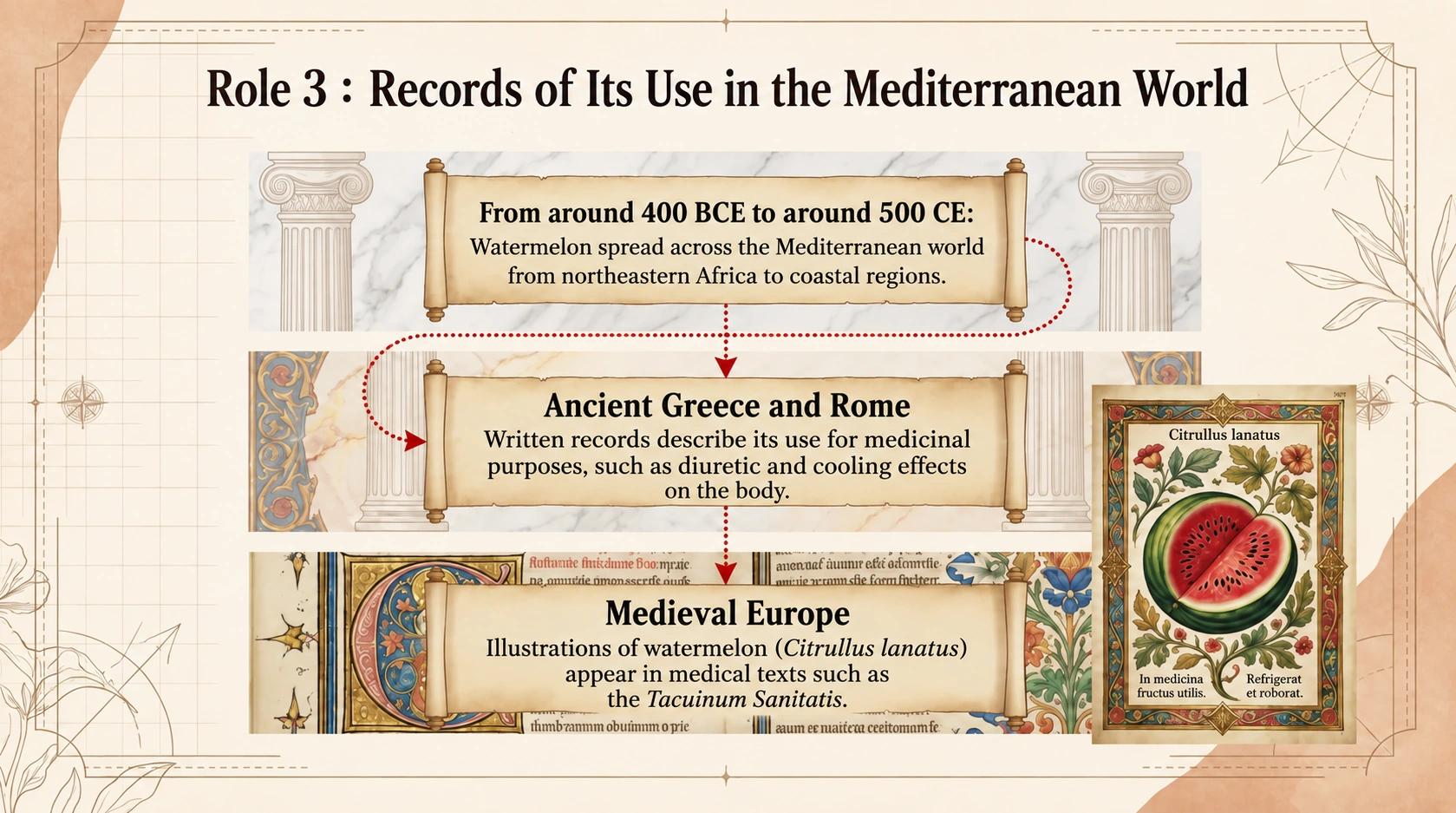
Watermelon spread from northeastern Africa into the Mediterranean world. The historical literature discussed in the Japanese article places this movement broadly between about 400 BCE and 500 CE.
Ancient Greek and Roman writings describe uses associated with urination and cooling the body. These reflect the medical beliefs of the period; they are not evidence of clinical benefits established by modern medicine.
Illustrated manuscripts of the medieval health handbook Tacuinum Sanitatis show red-fleshed watermelon. By this period, at least, red watermelon flesh was clearly represented in surviving imagery.
Why the Chinese name means “western melon”
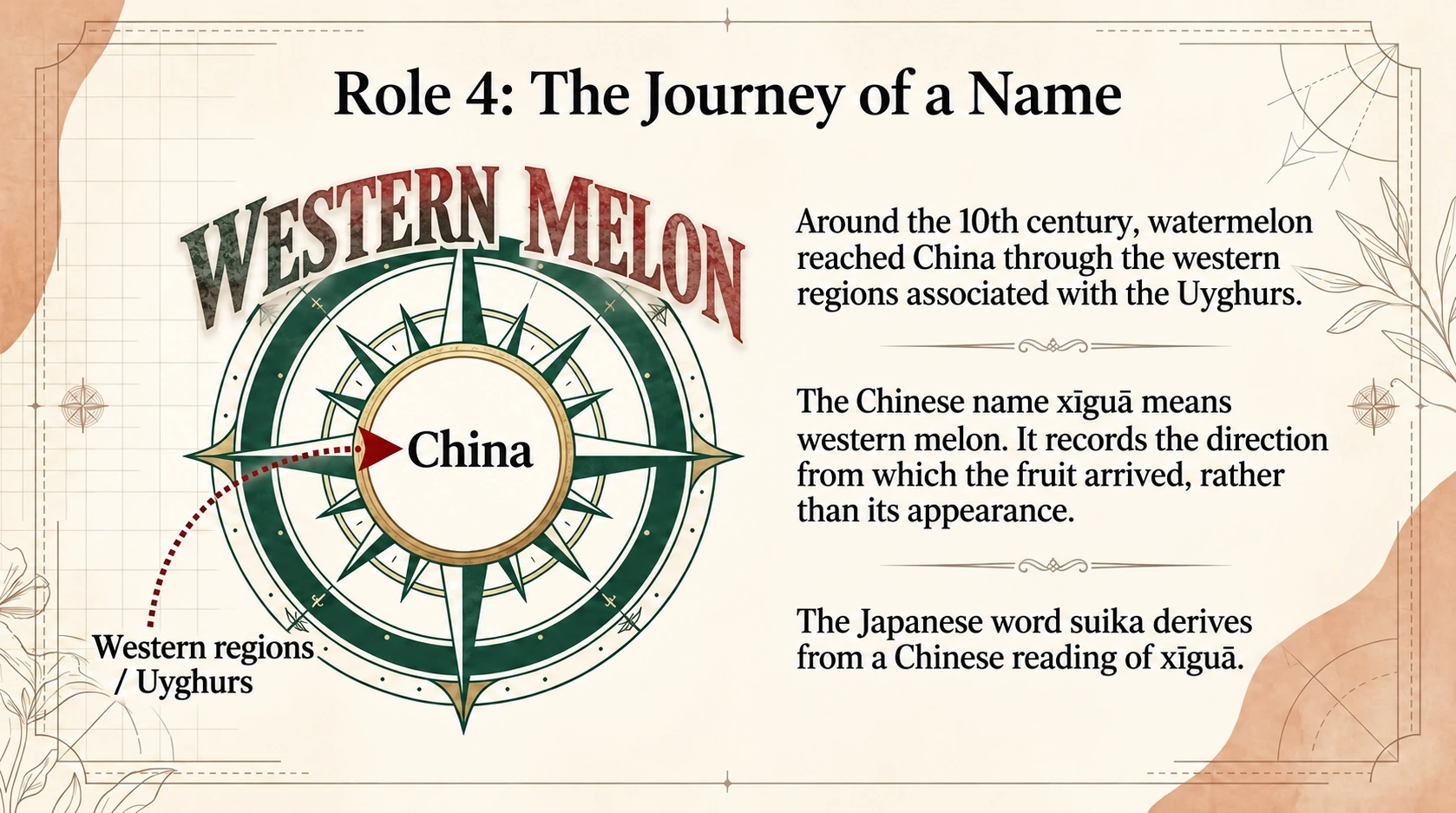
Watermelon also traveled east through Asia. It is generally said to have reached China around the tenth century through the western regions associated with the Uyghurs.
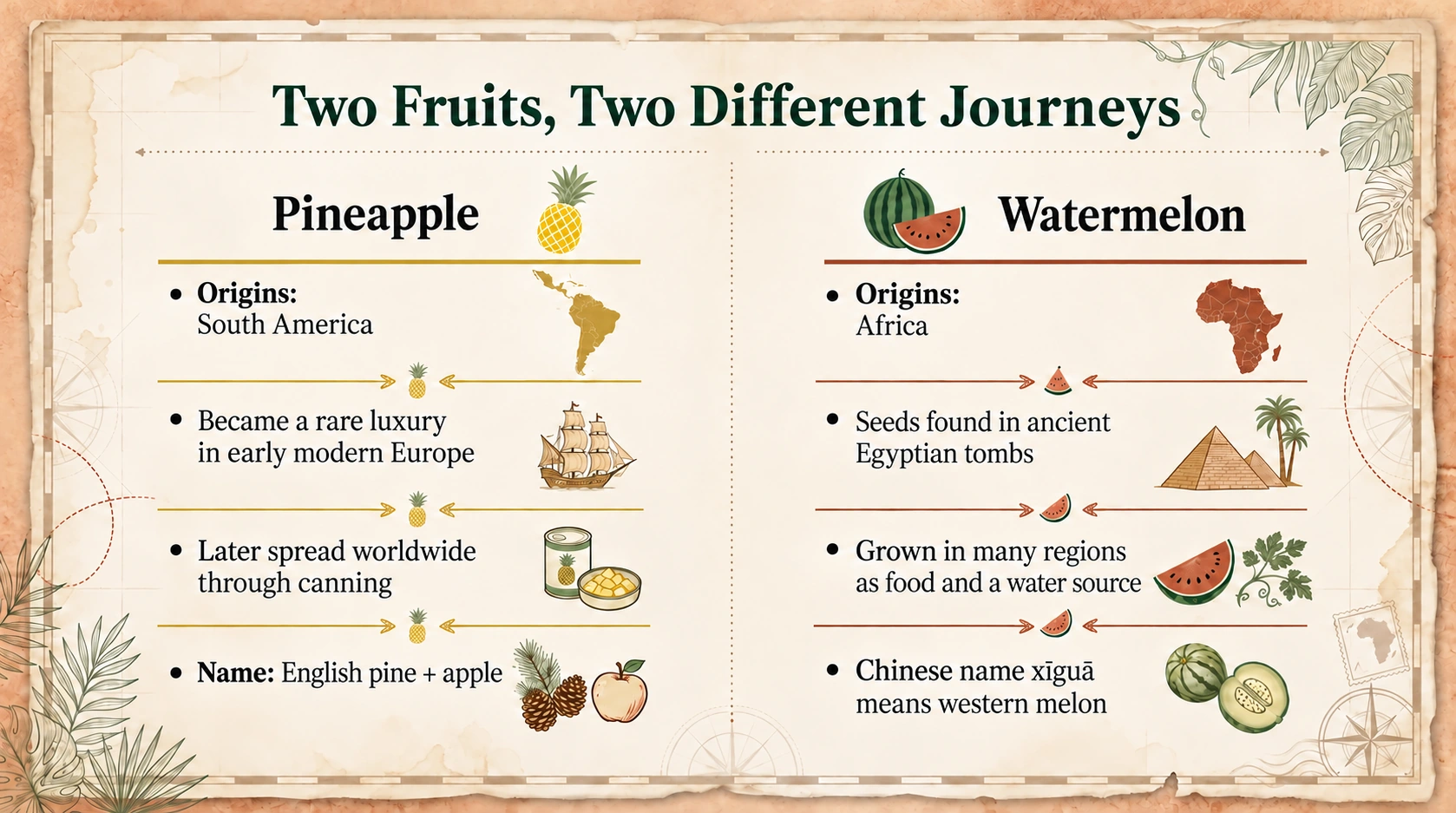
The Chinese name 西瓜, xīguā, means “western melon”: a melon arriving from the west, viewed from China. Whereas the English word “pineapple” combines comparisons with a pine cone and an apple, watermelon’s Chinese name records a direction of travel.
The Japanese word suika is generally explained as deriving from a Chinese reading of 西瓜. A familiar fruit name thus preserves a memory of its journey across Asia.
When did watermelon reach Japan? Several accounts survive
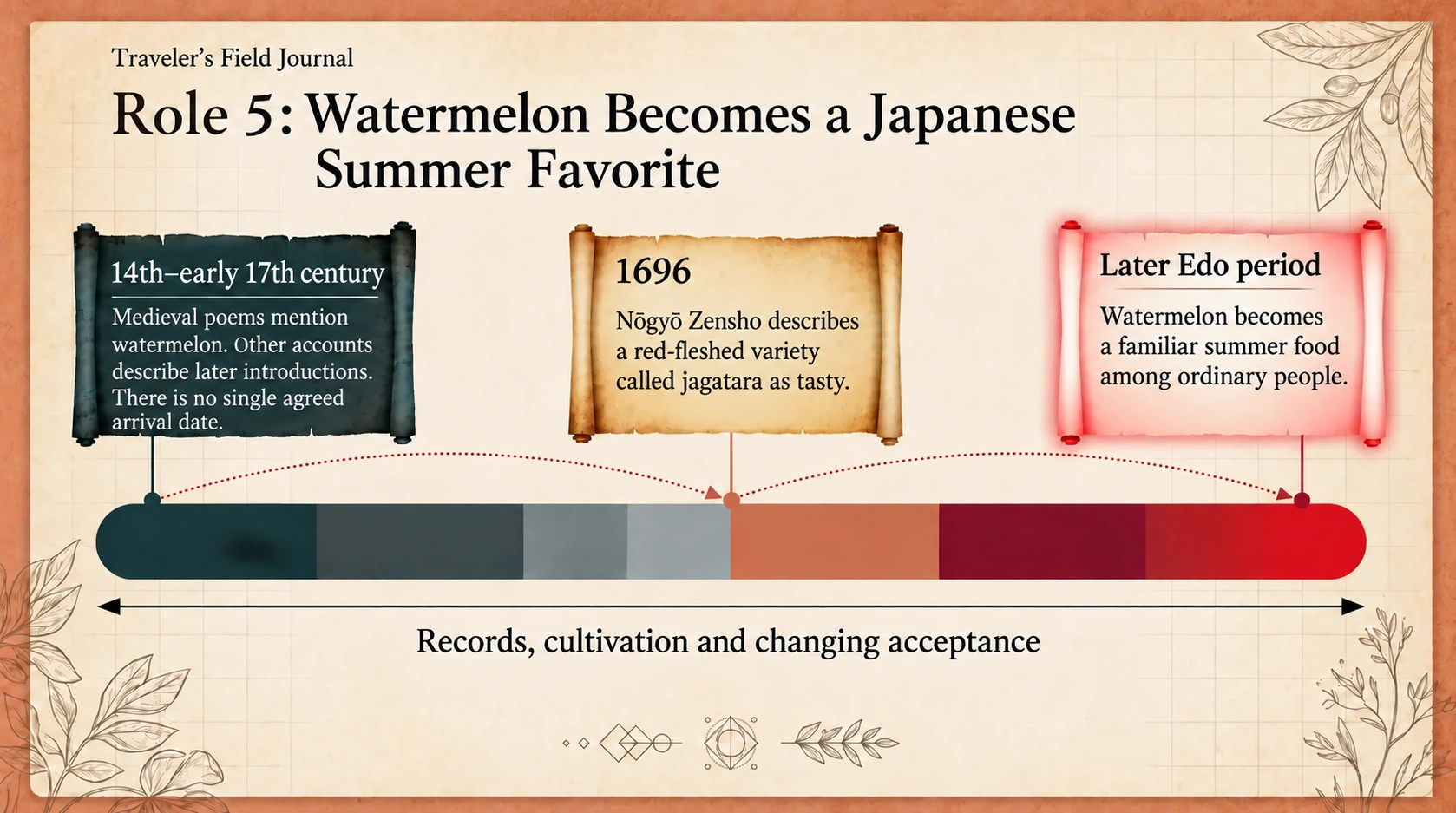
There is no single agreed date for watermelon’s arrival in Japan. Chinese-style poems in the medieval collection Kūkashū mention 西瓜, suggesting it may have been known by the fourteenth century. Other accounts refer to a Portuguese introduction in 1579 or an introduction by the Zen monk Ingen during the Keian era, 1648–1652. The agricultural handbook Nōgyō Zensho, published in 1696, already includes watermelon.
Later sources suggest that some people disliked red flesh because it resembled blood or meat. That does not establish a universal reaction among people at the time.
Indeed, Nōgyō Zensho describes a red-fleshed type called “jagatara” as tasty, suggesting differences across places and periods. By the later Edo period, watermelon had become a familiar summer food among ordinary people.
Vietnam’s watermelon legend: Mai An Tiêm
Vietnam has a traditional tale about how watermelon became known in the country: the legend of Mai An Tiêm. It is a cultural origin story, not a historical account proving the crop’s botanical origins.
The story is set in the time of the Hùng kings. Mai An Tiêm was the king’s adopted son and enjoyed royal favor, including, in some tellings, marriage to a princess. He then claimed that his achievements came from his own ability rather than the king’s generosity. His pride, together with accusations from people who envied him, led the king to exile him and his family to a distant island.
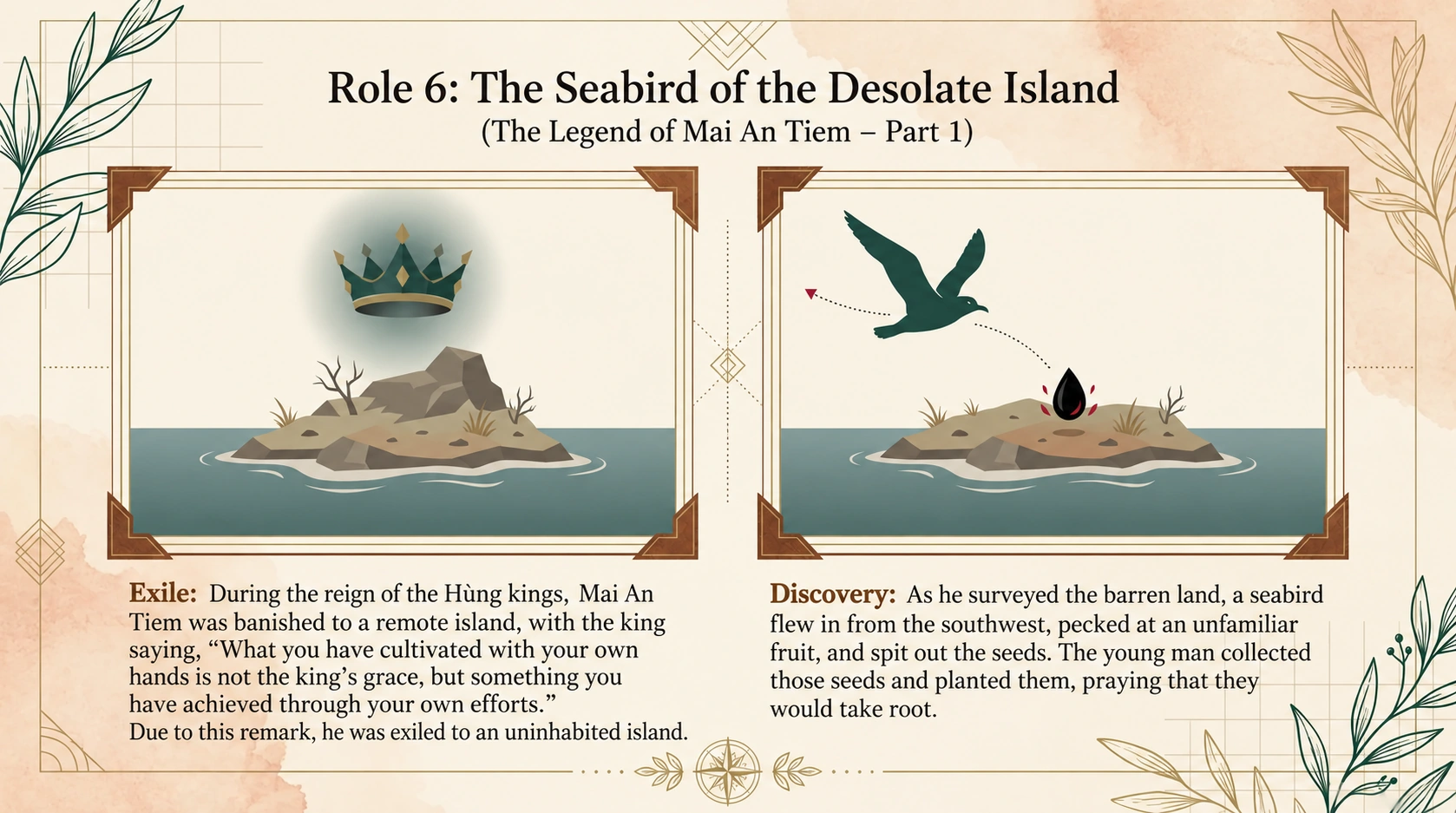
On the supposedly hopeless island, Mai An Tiêm encountered birds arriving from the west. They pecked at unfamiliar fruit and dropped seeds. He gathered the seeds, planted them and grew the fruit later known as watermelon. Through persistence, the family expanded the fields and turned the barren island into productive land.
In one version, he marked watermelons and floated them out to sea, beginning trade with merchants who found them. News eventually reached the king, who recognized the family’s achievements and recalled them to the mainland. Details vary across tellings, but the story remains a celebration of overcoming adversity through one’s own efforts.
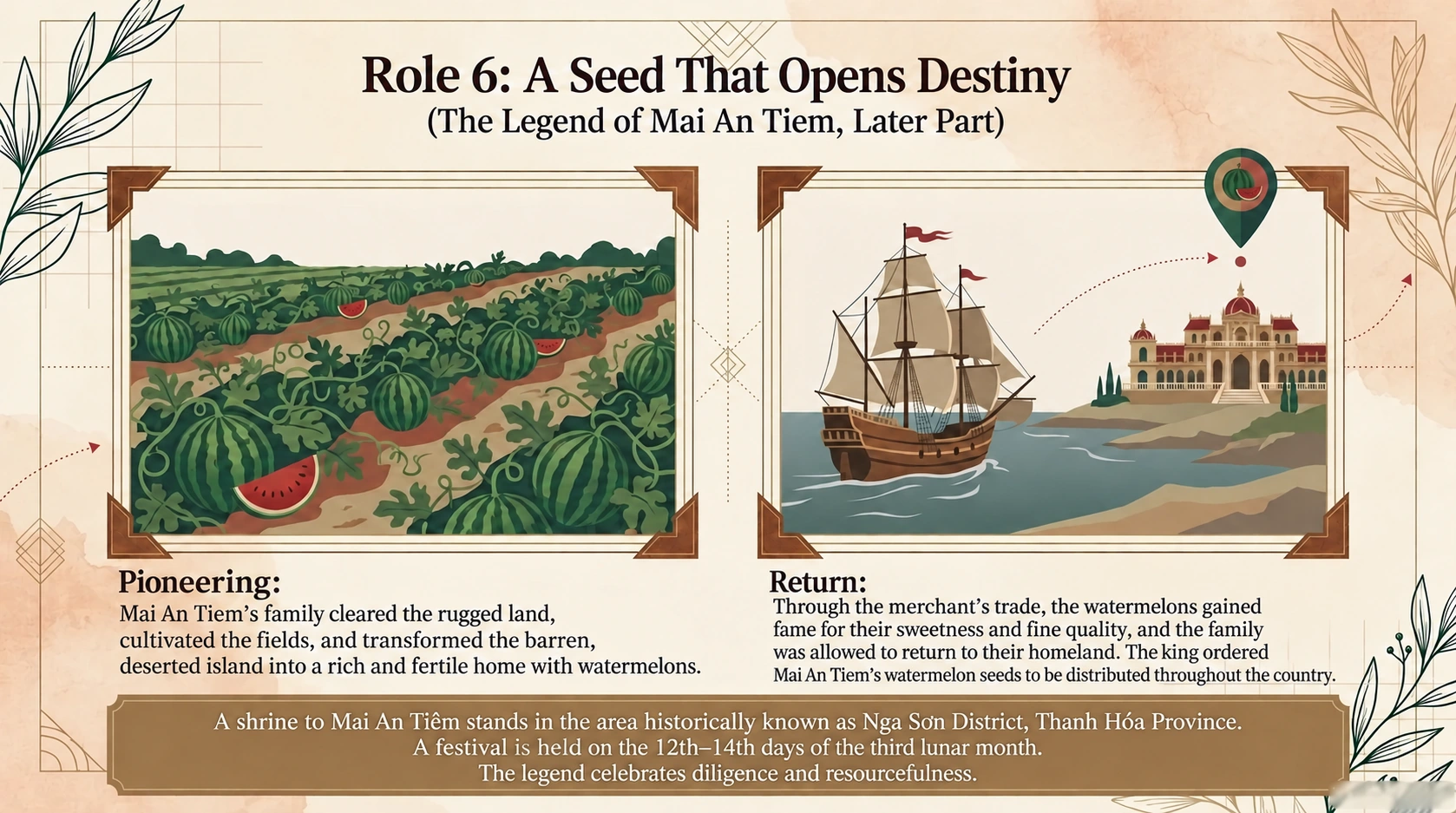
A shrine to Mai An Tiêm stands in the area historically described as Nga Sơn District, Thanh Hóa Province, where the legend is said to have taken place. The source cited in the Japanese article describes nine traditional buildings containing statues and old decorative objects. A festival is held on the twelfth to fourteenth days of the third lunar month, with offerings and performances connected to the discovery of watermelon. The legend continues to symbolize diligence, resourcefulness and self-reliance.
What watermelon’s journey tells us
The history of pineapple follows a fruit that crossed the Atlantic, became associated with elite display, and later reached households around the world through canning.
Watermelon’s surviving records tell a different story. Its seeds appear in Egyptian tombs; biblical passages remember it as food from home; Mediterranean writings describe food and medicinal uses. In China, a direction of arrival became its name. In Japan, it became a summer favorite. In Vietnam, it became linked with an exiled young man’s determination to build a new life.
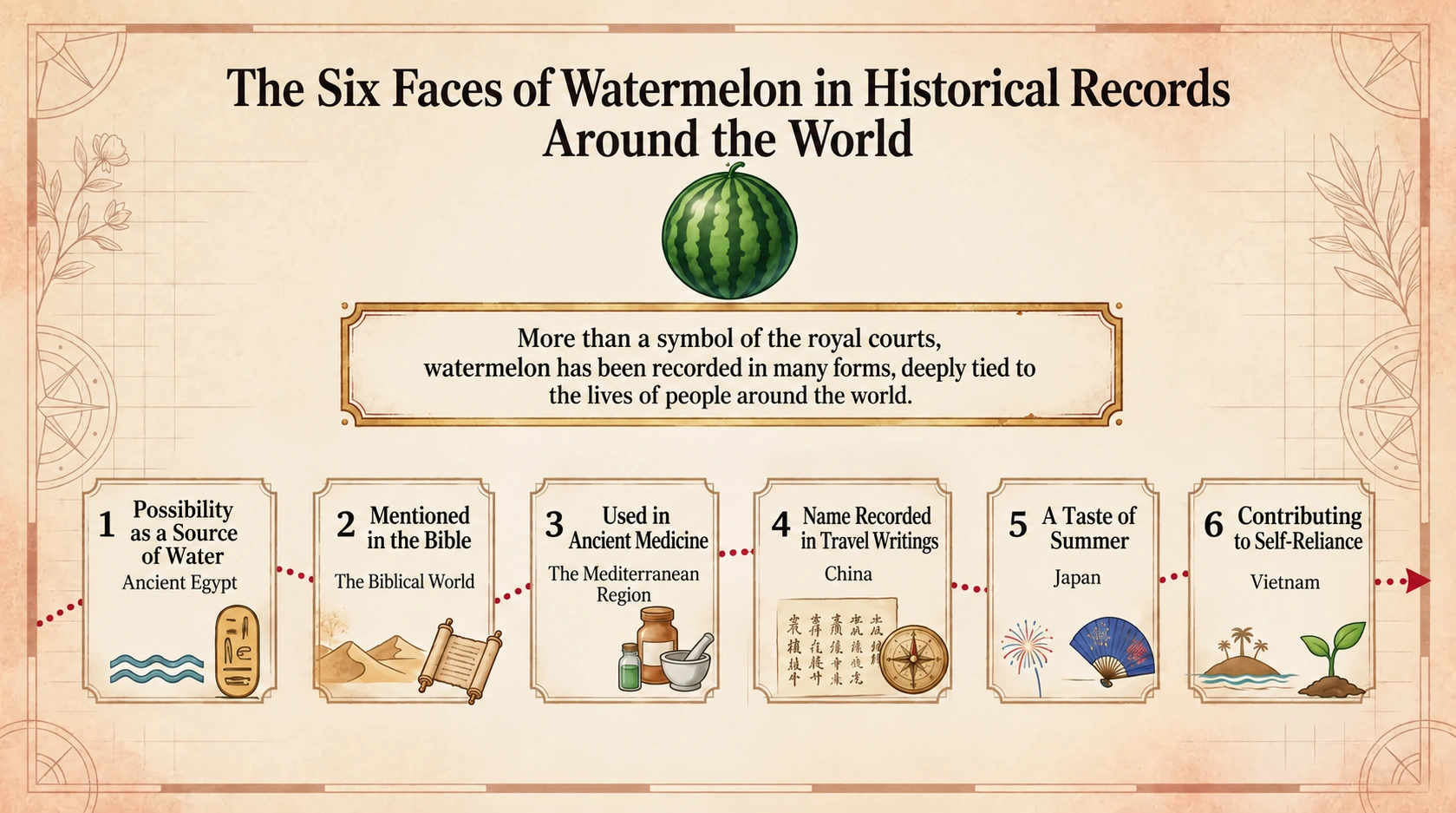
Watermelon is recorded chiefly through its connections with everyday life. The next time you cut one open, its bright flesh offers a small reminder of more than 4,000 years of cultivation and movement.
For its present-day biology, nutrition, varieties and trade, read the Watermelon Guide.

Frequently asked questions
Where did watermelon originate?
Africa. Genomic research identifies Sudan’s Kordofan melon as the closest known relative of cultivated watermelon and a possible progenitor.
Was watermelon eaten in ancient Egypt?
Seeds of Citrullus have been found in Egyptian tombs, and paintings show elongated fruit resembling watermelon. Not all recovered seeds necessarily came from sweet varieties like those eaten today.
When did watermelon arrive in Japan?
Fourteenth-century poems mention 西瓜, suggesting it was already known. Other accounts refer to introductions in the late sixteenth or early seventeenth centuries. A single arrival date has not been conclusively established.
What is Vietnam’s watermelon legend?
It tells of Mai An Tiêm, exiled to an island, who grew watermelon from seeds dropped by birds and overcame adversity. Versions differ, but the tale is associated with diligence and self-reliance.
Related reading
- Watermelon Guide: botany, nutrition, varieties and trade.
- How to Eat Watermelon in Vietnam: buying, selecting, cutting and storing.
- The Story of Pineapple.
- 15 Fruits to Try in Vietnam (in Japanese).
References
- Renner et al. (2021): A chromosome-level genome of a Kordofan melon illuminates the origin of domesticated watermelons, PNAS
- Paris (2015): Origin and emergence of the sweet dessert watermelon, Citrullus lanatus, Annals of Botany
- Watermelon evolutionary-history research (2022), Molecular Biology and Evolution
- National Geographic: The 5,000-Year Secret History of the Watermelon
- Bible Hub: Numbers 11:5, interlinear text
- National Diet Library: watermelon history (in Japanese)
- Vietnamese Wikisource: Sự tích trái dưa hấu (in Vietnamese)
- Báo Thanh Hóa: Mai An Tiêm shrine and watermelon legend (in Vietnamese)
About the Author

Chuta
Based in Hanoi, Vietnam, Chuta buys fruit at local markets and supermarkets and writes about its taste, seasons, selection and preparation. Drawing on life in Vietnam, he introduces tropical fruits that are less familiar to readers in Japan.
About Fruit Guide