The History and Stories of Apples
Published October 8, 2026
Why is the forbidden fruit so often shown as an apple?
Genesis does not identify the fruit eaten by Adam and Eve. Yet Western paintings and children’s books frequently give it the shape of an apple. The history of language may help explain this, including the familiar hypothesis about Latin words for “apple” and “evil.”
Originating in Central Asia, apples acquired different meanings as they traveled. From the forbidden fruit to Johnny Appleseed, Japan’s Fuji and Vietnam’s gift baskets, their journey connects mythology with everyday life.
Greek myths describe a golden “apple” contested by goddesses and fruits in the garden of the Hesperides. Human ideas about the Fall, conflict and immortality have all been expressed through this fruit.
Why does the apple keep appearing?
One clue lies in the history of words for apples and fruit. To begin, we return to the Central Asian mountains where a major ancestor of today’s apple grows.
Vietnam lies at the other end of this journey. There, the fruit familiar from Western stories is called táo tây or bôm, and appears on everyday tables and in gift baskets. The same fruit takes on different roles in different places.
Its origins and movement, names and myths, lead us toward its place in modern life.
From the Tian Shan forests: a major ancestor’s homeland
The apple’s homeland lies in the mountains of Central Asia.
A major ancestor of the cultivated apple, Malus domestica, is considered to be Malus sieversii, a wild species around the Tian Shan mountains. Its range centers on Kazakhstan and extends through Kyrgyzstan and Xinjiang, China. Kazakhstan’s largest city, Almaty, is commonly interpreted as a “place of many apples.” Its name preserves the region’s connection with the fruit.
Fruits descended from this wild ancestor traveled west with people and along trade routes. Along the way, they crossed with related species. The European wild apple, Malus sylvestris, is thought to have made a particularly important contribution to the cultivated apple. During domestication, people selected for larger fruit, firmer flesh, greater sweetness and less acidity. Over generations, mountain fruit was shaped into the apples we recognize today.
The history is remarkably old. Human use of apples reaches back into prehistory, long before Europeans encountered the pineapple in the Americas.
| Apple origins and movement | Details |
|---|---|
| Range of a major ancestor | Malus sieversii around the Tian Shan in Central Asia |
| Westward movement | Spread toward Europe with migration and trade |
| Crosses with related species | Malus sylvestris and other relatives contributed to cultivated apples |
| Today’s cultivars | Developed through repeated crossing and selection |
Source: Research review on apple origins. The table describes movement and interbreeding rather than suggesting one simple route.
Planting a seed does not reproduce the same apple
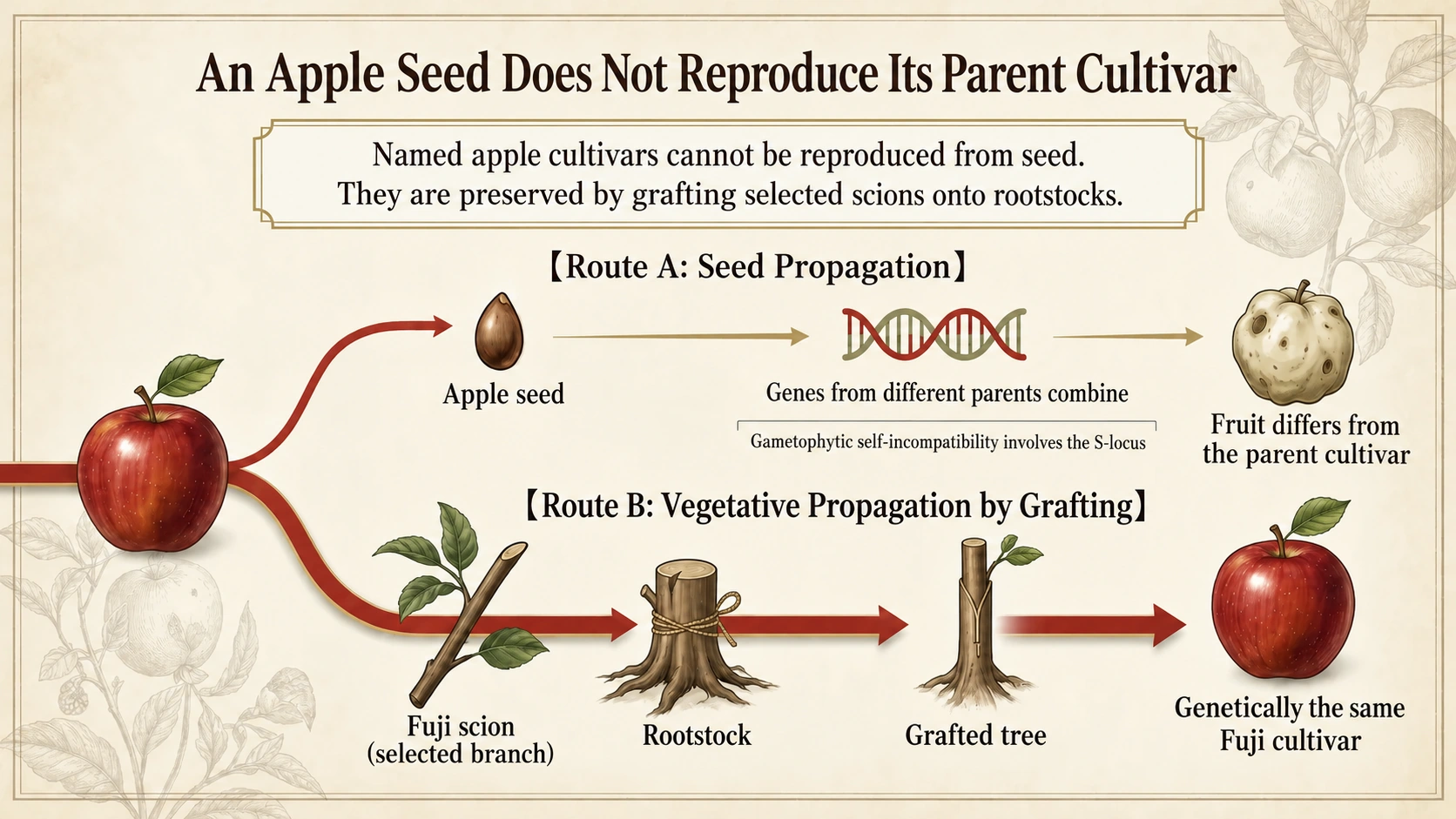
A characteristic of apples has shaped their cultivation: a seed does not reproduce its parent cultivar. Offspring differing from their parents is common in sexually reproducing crops. Apples, however, have strong self-incompatibility and substantial genetic diversity, making cultivars particularly difficult to reproduce from seed.
Their gametophytic self-incompatibility involves multiple alleles at the S-locus. If the pollen’s S-type matches either S-type in the pistil, pollen-tube growth is inhibited. Many cultivars therefore set fruit poorly after self-pollination. Orchards need compatible pollen-producing trees, not merely a different variety: flowering periods must overlap, S-genotypes must be compatible, and the pollen must be viable.
Seeds consequently combine genes from different parents. A seed taken from a Fuji apple produces a genetically distinct seedling, not another Fuji.
How, then, did Fuji reach orchards worldwide? Through grafting. Cultivars are propagated vegetatively by joining a piece of a selected branch to another tree’s root system. The propagated cultivar generally retains the parent tree’s genotype. Even with the same genotype, however, rootstock, climate, soil and cultivation affect tree vigor and fruit quality.
A grafted nursery tree combines a rootstock, providing the roots, with a scion, carrying the desired cultivar. Grafted nursery stock is normally used to reproduce Fuji.
Ancient Roman sources already describe named apple varieties and grafting. Identifying distinct cultivars implies that people could preserve and reproduce their fruit. Grafting has long been the method for passing a selected apple down through generations.
Apple etymology: when “apple” could mean “fruit”
Names are part of this story.
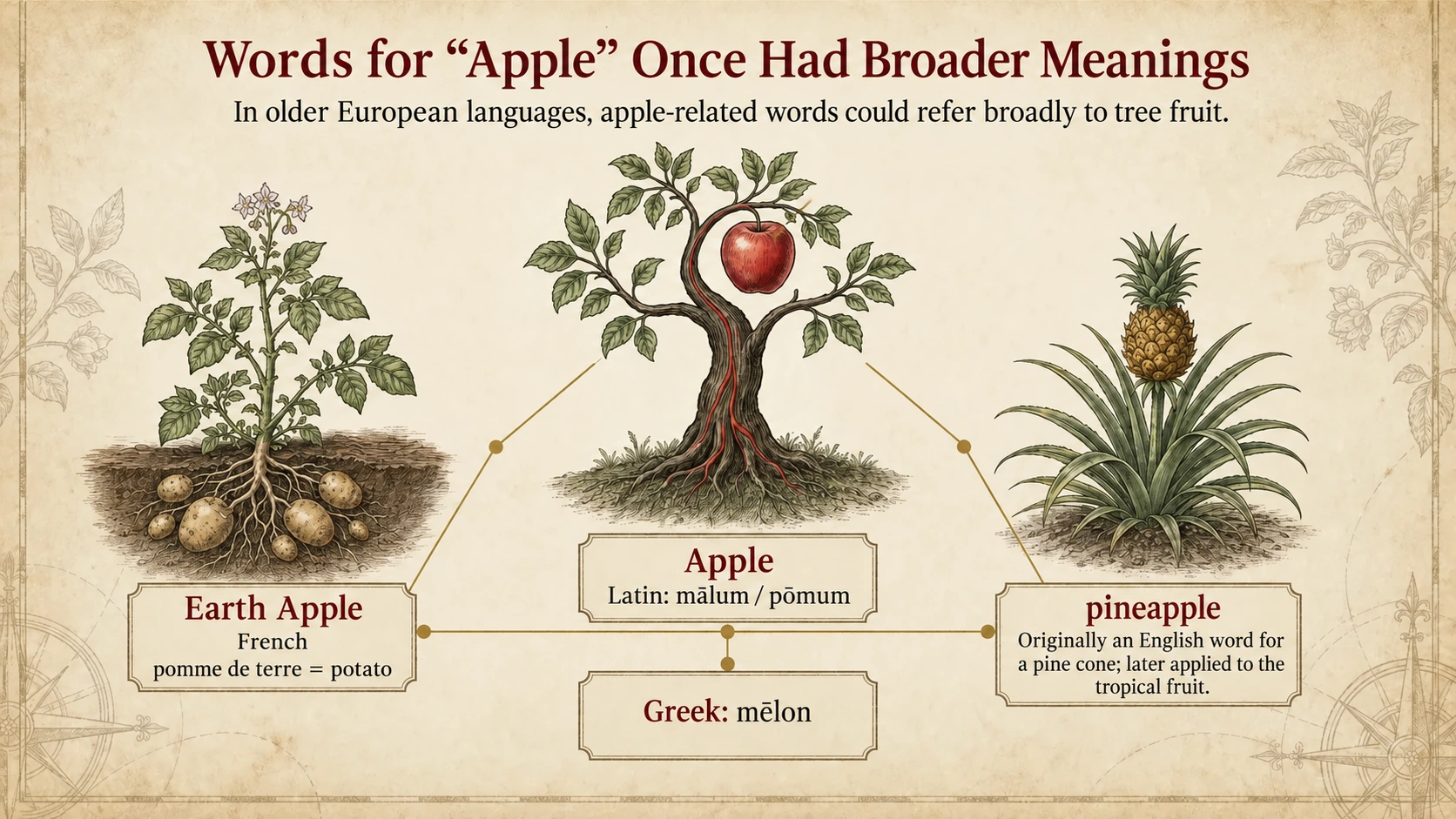
In Latin, mālum means apple and mălum means evil, distinguished by vowel length. Without the length marks, both are written malum. Meanwhile, pōmum referred broadly to tree fruit. Ancient Greek mēlon likewise had uses extending beyond apples to fruit more generally.
In these older European languages, the boundary between “apple” and “tree fruit” could be less precise than it feels today.
Words for apples consequently became attached to other foods. French pomme once had a broader meaning of fruit. The potato’s name, pomme de terre, literally “apple” or “fruit of the earth,” preserves this usage. English pineapple originally meant a pine cone; the word was later transferred to a tropical fruit with a similar appearance when Europeans encountered it in the Americas.
The pineapple thus traveled the world with a name containing the word apple. The apple was such a representative fruit that its name could be borrowed. That broad vocabulary also helps explain why so many stories later took the apple’s form.
Why is the forbidden fruit an apple? And what about golden apples?
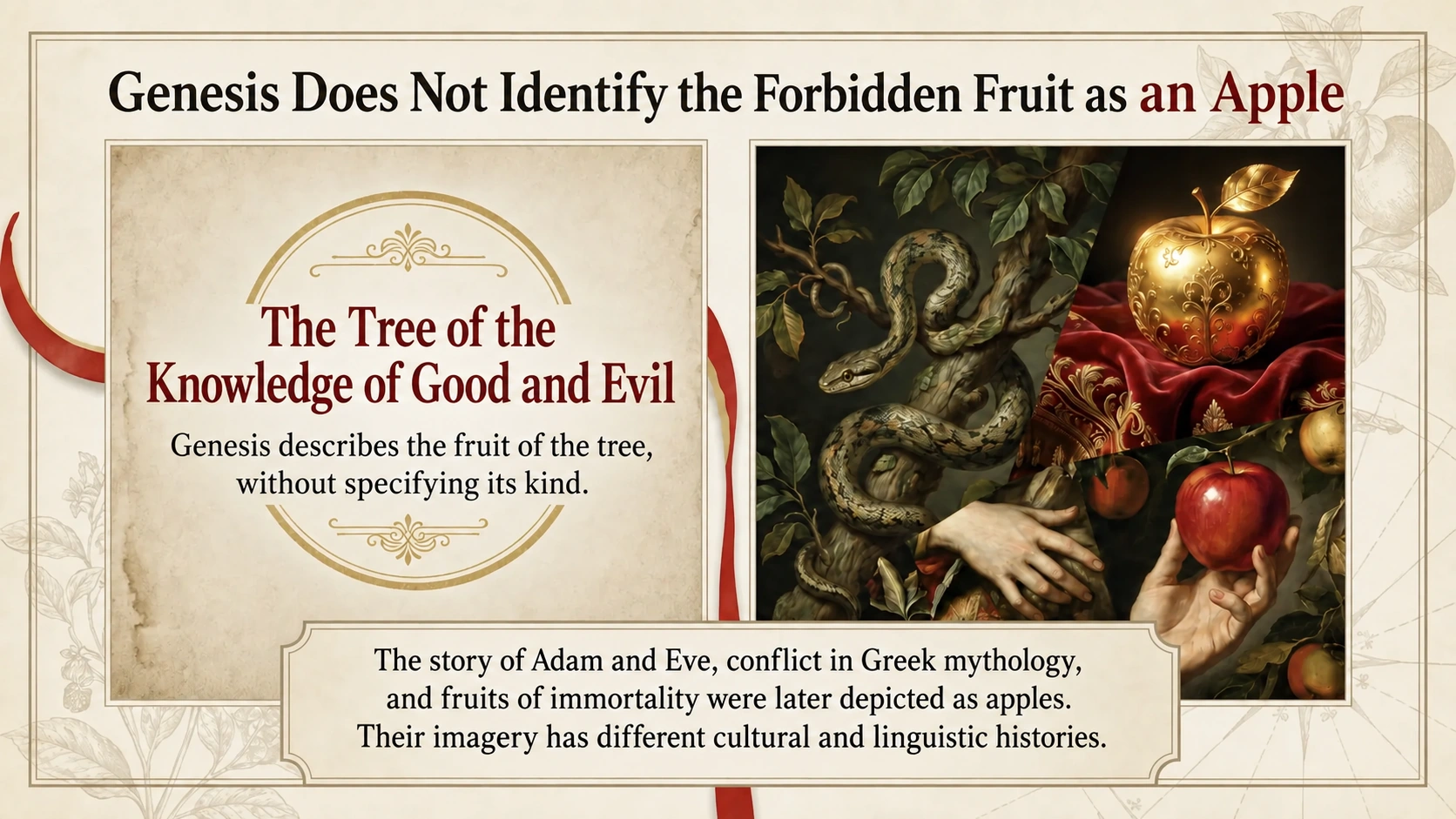
Many people assume that Adam and Eve ate an apple in Eden. Genesis, however, never identifies the fruit. It describes the fruit of the tree of the knowledge of good and evil.
The best-known explanation for its later depiction as an apple is a Latin wordplay hypothesis. Genesis 2:17 in the Vulgate includes “de ligno autem scientiae boni et mali”, referring to the tree of the knowledge of good and evil. The word for evil resembles mālum, apple, in writing. A confusion, or an intentional double meaning, is said to have encouraged apple imagery.
This is a hypothesis, not a settled explanation. Recent research points out that medieval Latin commentaries offer little evidence supporting the wordplay account. Another important hypothesis concerns Old French pom, whose meaning narrowed from fruit in general to apple. Changes in language may have influenced the developing imagery.
Artworks showing the forbidden fruit as an apple also predate Milton’s Paradise Lost of 1667. That poem alone cannot be treated as the origin of the image.
Other proposed identifications include figs, grapes, pomegranates, quinces, wheat and bananas. The apple’s prominence seems to involve language as much as the fruit’s taste or appearance.
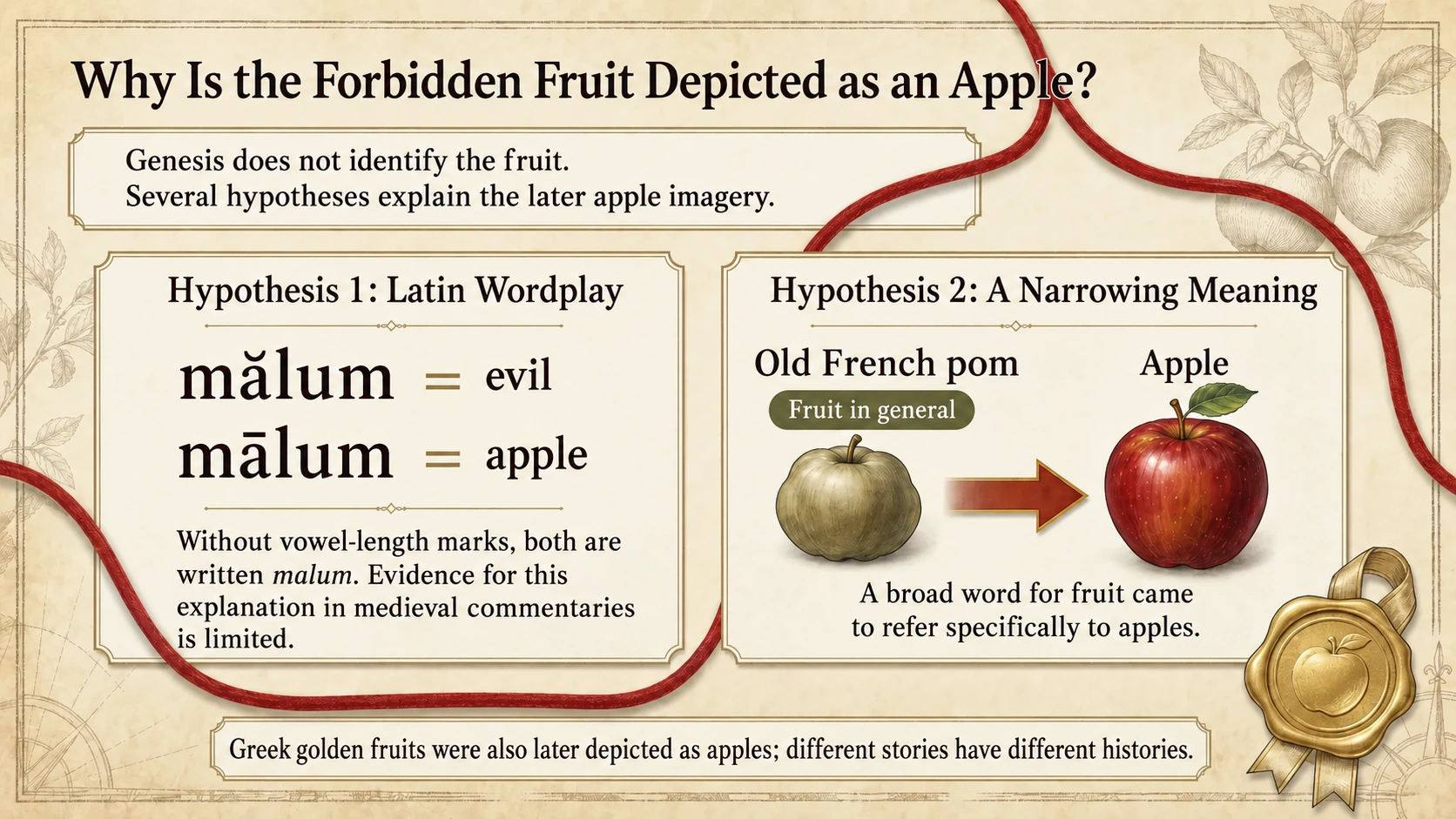
Apples also play major roles in Greek mythology. Ancient Greek mēlon could mean tree fruit more broadly, so the expressions translated as “golden apples” may originally have suggested “golden fruits.”
Eris, goddess of discord, was not invited to the wedding feast of Peleus and Thetis. In anger, she threw in a golden fruit inscribed “to the fairest.” Hera, Athena and Aphrodite competed for it. Their dispute was judged by Paris, prince of Troy, and his decision eventually helped bring about the Trojan War.
Golden apples also grew in the garden of the Hesperides, imagined at the far western edge of the world and guarded by the dragon Ladon. Gaia was said to have given the tree to Hera on her marriage to Zeus. Its fruits have been interpreted in connection with divine immortality and eternal youth.
We can now return to the opening question: why are apples chosen so often?
One possible reading is that older European words for fruit covered a wider range than modern words for apples. Fruits in earlier stories may have been understood as apples in later language and art. But the development of biblical and Greek mythological imagery cannot all be explained by a single cause.
Etymology and imagery remain open to debate. Still, the possibility that words helped place such a burden of meaning on an ordinary fruit offers an intriguing way to understand it.
Johnny Appleseed: nursery trees and hard cider
In nineteenth-century America, one man entered both history books and children’s stories: John Chapman, better known as Johnny Appleseed (1774–1845).
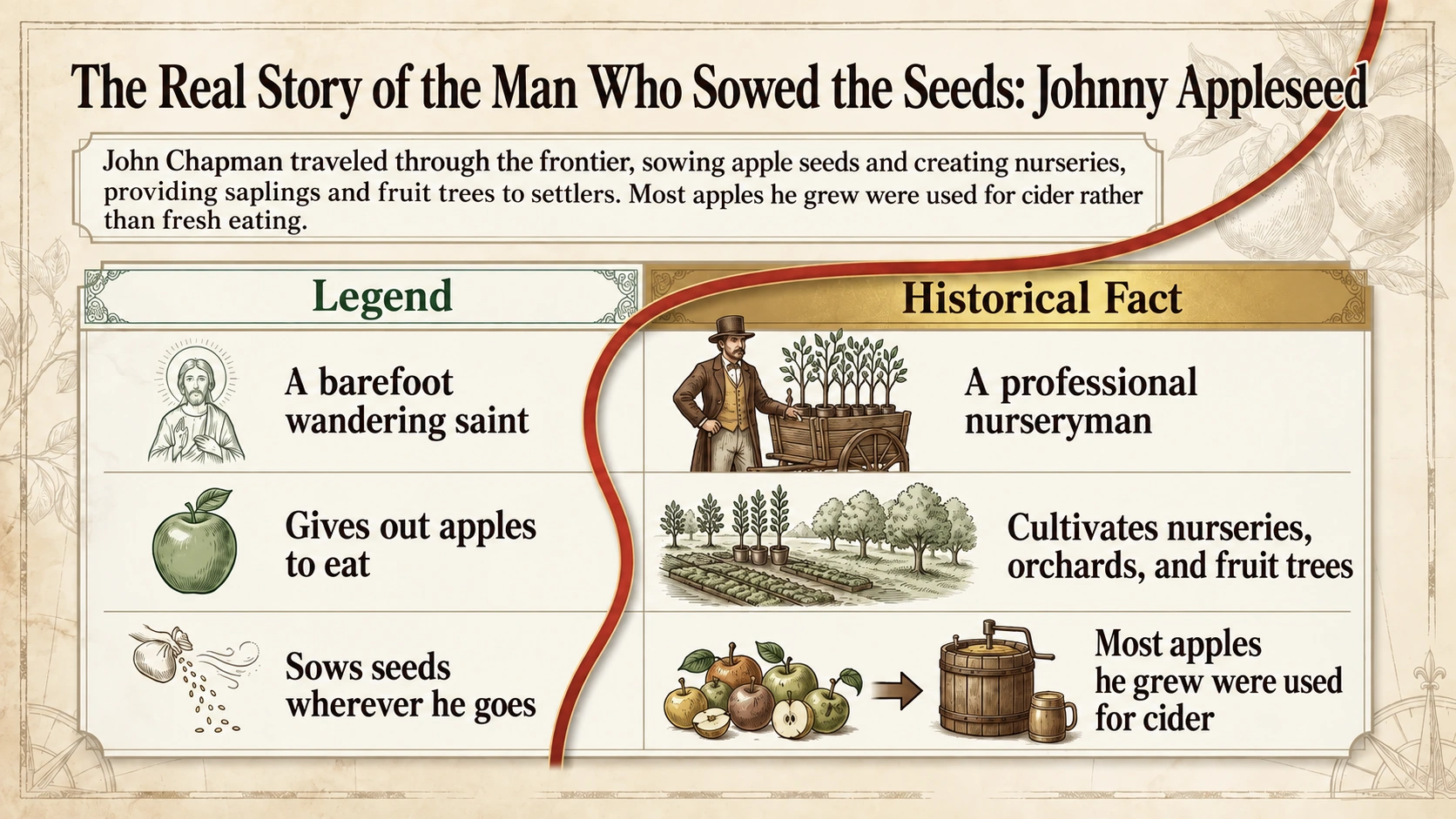
Legend portrays him as a saintly wanderer, walking barefoot through the wilderness and scattering apple seeds. His devotion to the Swedenborgian faith is also widely remembered.
The historical Chapman was more specifically a professional nurseryman. He moved ahead of settlement, cleared land, established nurseries and sold or gave trees to settlers. Planting seeds was part of a business as well as an act of generosity.
The fruit from those trees needs explanation too. As discussed above, seed-grown apples do not reproduce their parent cultivar. Many seedlings produce acidic or astringent fruit, and relatively few become good dessert apples.
They still had an important use: hard cider, fermented apple juice. Fruit unsuitable for eating fresh could be pressed and fermented. Cider kept longer than fresh fruit, could be exchanged for money and was a familiar everyday drink on the frontier.
Much of what Chapman spread was therefore destined to be drunk rather than eaten. In a cultivation history built around grafting selected varieties, his nurseries contained countless genetically different, seed-grown apples.
Apples in Japan: Aomori’s beginnings and the birth of Fuji
Apples also traveled east.
Japan’s older Chinese-derived wa-ringo apples date to the Kamakura period or later and were called ringo. The Japanese written name 林檎 is sometimes explained by breaking the second character into a tree element and a bird element: birds supposedly gathered in the forest for the sweet fruit. This is a folk etymology. The bird component 禽 is generally understood as phonetic.
One proposed explanation of the pronunciation ringo traces it to the Chinese-derived name 林檎, rendered rinchin in the Japanese account, through forms such as rinkin, rinki and riugō.
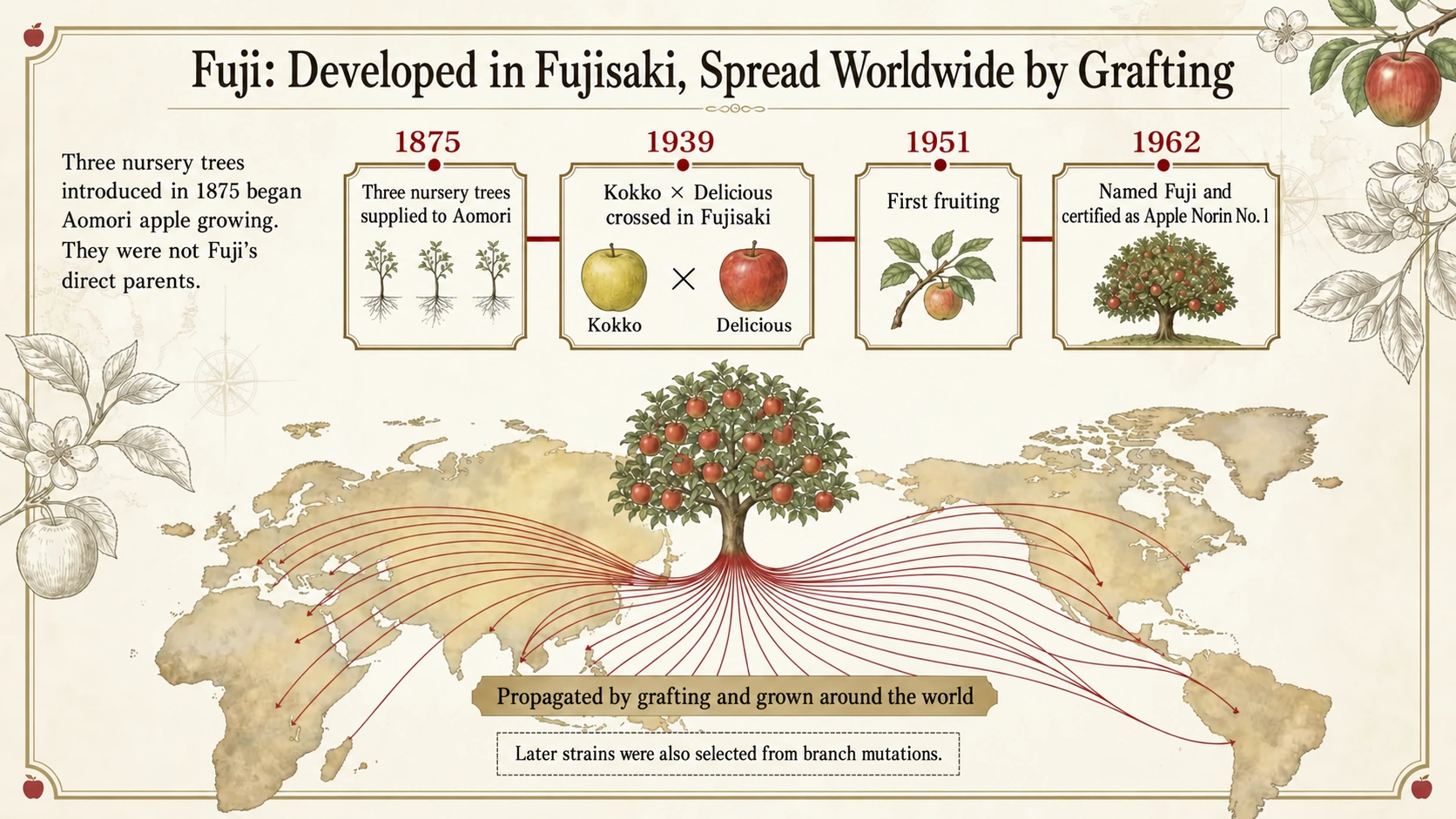
Western cultivated apples, leading to today’s common varieties, were introduced in 1871. In spring 1875, three nursery trees from the government’s agricultural promotion bureau were planted at Aomori’s prefectural office. This is regarded as the start of Aomori apple growing.
Sixty-four years later, an influential cross was made in the same prefecture. In 1939, the Tohoku Branch of the government horticultural experiment station in Fujisaki crossed Kokko as seed parent with Delicious as pollen parent. One selected seedling first bore fruit in 1951 and was announced as Apple Tohoku No. 7 in 1958. It was named Fuji in March 1962, then registered as Apple Norin No. 1 on April 21, 1962 under the agricultural certification system, distinct from modern registration under Japan’s Plant Variety Protection and Seed Act.
In 1982, Fuji overtook the Delicious group to become Japan’s leading apple by production. It is now estimated to be the world’s most widely grown cultivar.
Grafting makes this story possible. Fuji trees in orchards around the world were not independently recreated in separate breeding programs. Their branches can generally be traced through generations of propagation to the selected tree from the 1939 Fujisaki cross, with numerous later strains selected from branch mutations or sports.
A fruit whose ancestors traveled west from Central Asia spread worldwide again through a tree developed in a small town in Japan.
Vietnam: a fruit that borrowed its name
Vietnam is this story’s final destination.
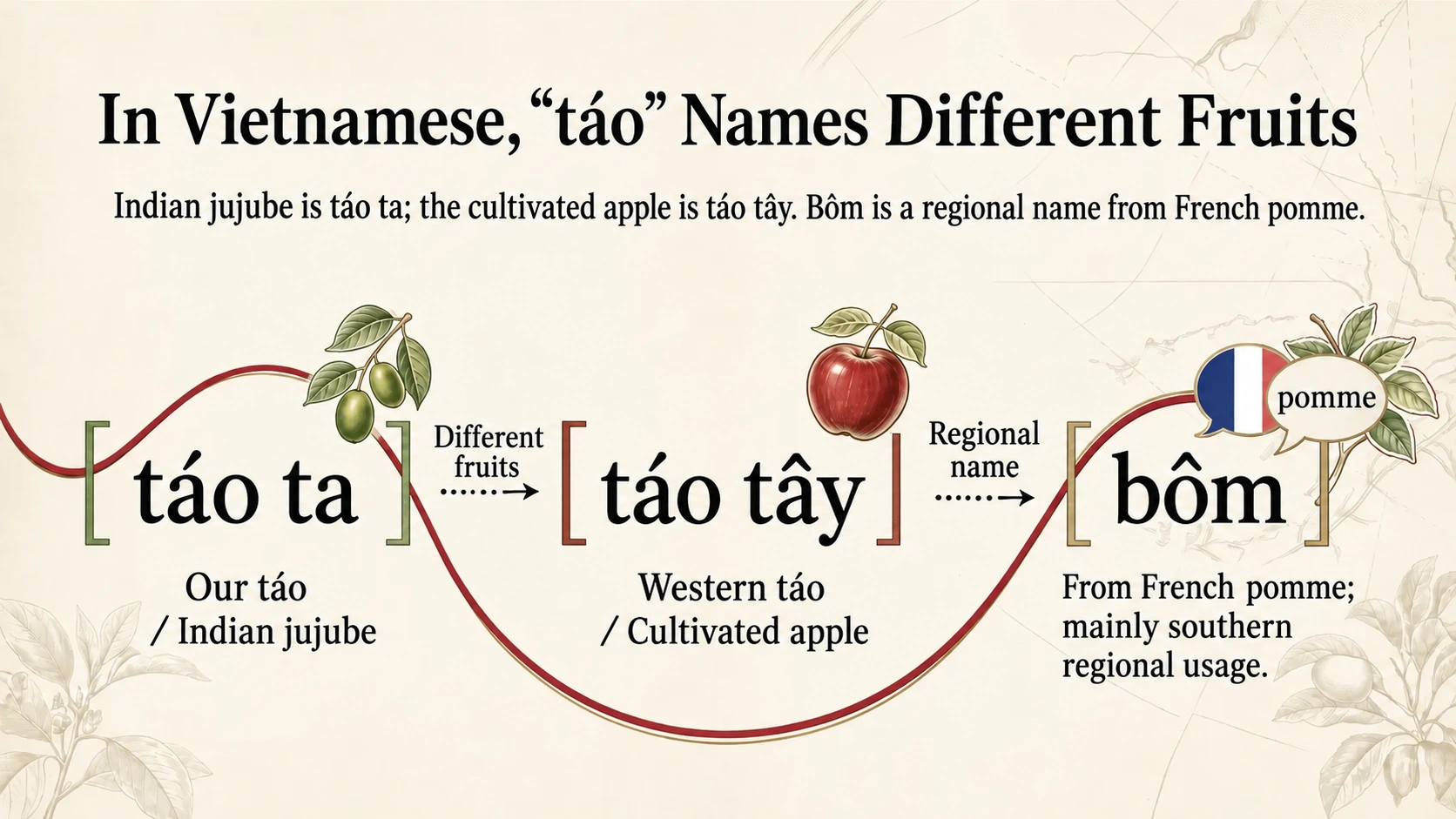
When apples arrived, a fruit called táo was already familiar. Táo ta, roughly “our táo” or “local táo,” is Ziziphus mauritiana, Indian jujube. It belongs to a different family from apples. It remains a specialty of the Ninh Thuan area, formerly Ninh Thuan Province and now part of Khanh Hoa, where it is piled high in markets.
The newcomer became táo tây, “Western táo.” The fruit whose name had been lent to so many things in Europe now borrowed an existing local name, with “Western” added to distinguish it.
Vietnamese has another apple name, bôm, considered a borrowing from French pomme. Dictionaries classify it as regional or dialect usage. Both Vietnamese names relate to existing vocabulary: one to a locally familiar fruit, the other to a European word.
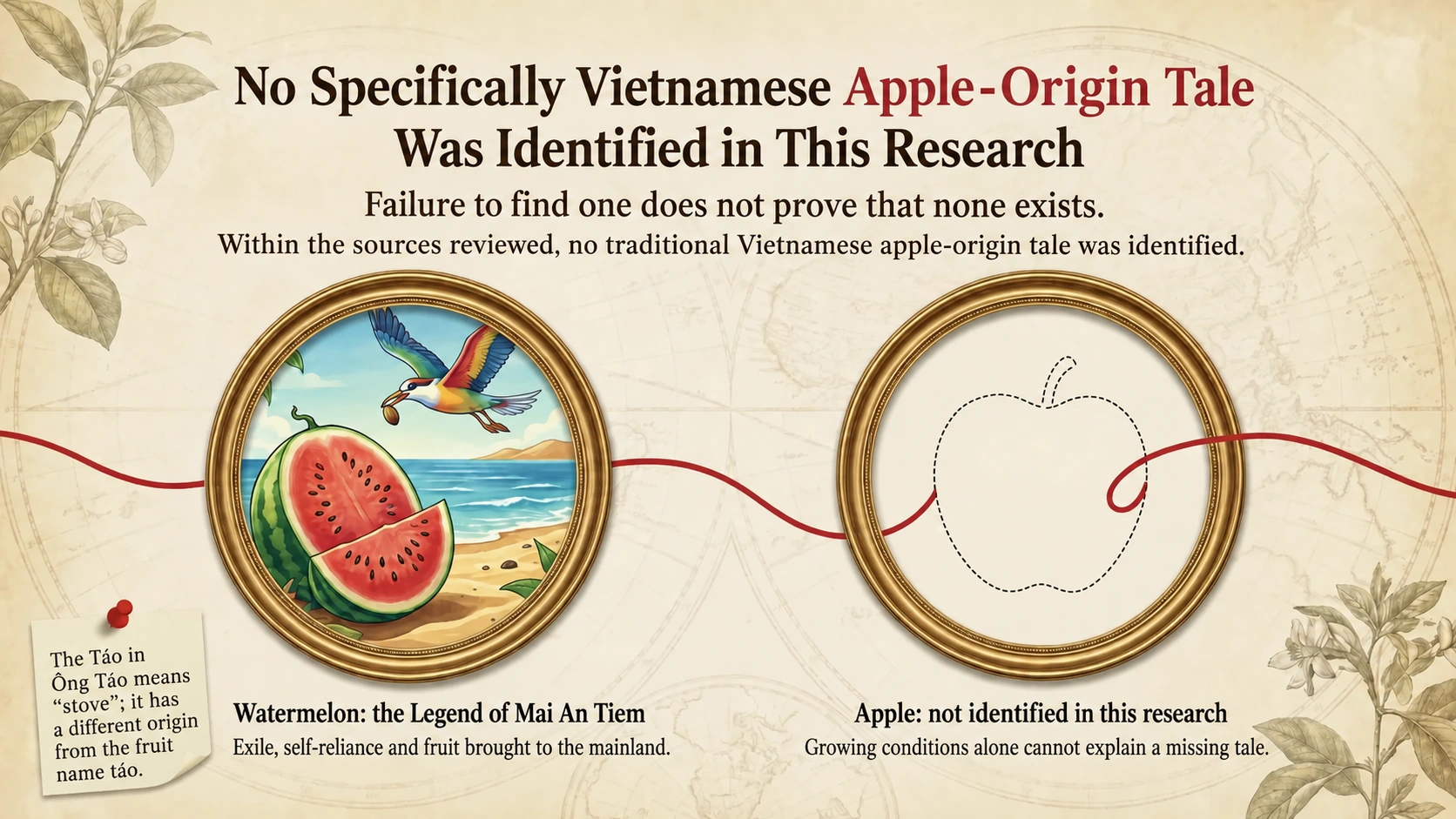
There is another thing the research did not find: a traditional Vietnamese apple-origin tale.
As told in The Story of Watermelon (Japanese), Vietnam has the legend of Mai An Tiem. Exiled to an island, a young man grows fruit from seeds brought by birds, proves his self-reliance and returns to the mainland. Other fruits also have origin stories.
Searching Vietnamese for sự tích quả táo, “the origin story of táo,” instead brought up tales of the Kitchen God, Ông Táo, or translations of foreign stories. Failure to find something does not prove it does not exist. The narrower conclusion is that this research did not identify a traditional Vietnamese tale explaining the apple’s origin.
One speculation is that local folktales often arise around crops people grow, tend and await. Stable production of temperate apples needing winter chill is difficult in tropical and subtropical lowlands. Introductions and trials have occurred in cooler northern areas such as Sapa, Lao Cai, and Sin Ho, Lai Chau, with good performance reported for Fuji and Granny Smith. The sources reviewed did not establish a large, widespread industry. Cultivation history alone, however, cannot explain why an origin story was not found.
The Kitchen God’s name should not be confused with the fruit. The Táo in Ông Táo derives from 灶, meaning stove or hearth. It has a separate etymology despite sounding the same. On the twenty-third day of the twelfth lunar month, the deity is said to ride a carp to heaven and report the year’s events to the Jade Emperor. This important Tet tradition has no etymological link to apples.
What role do apples play in Vietnam today? One prominent answer is gifts.
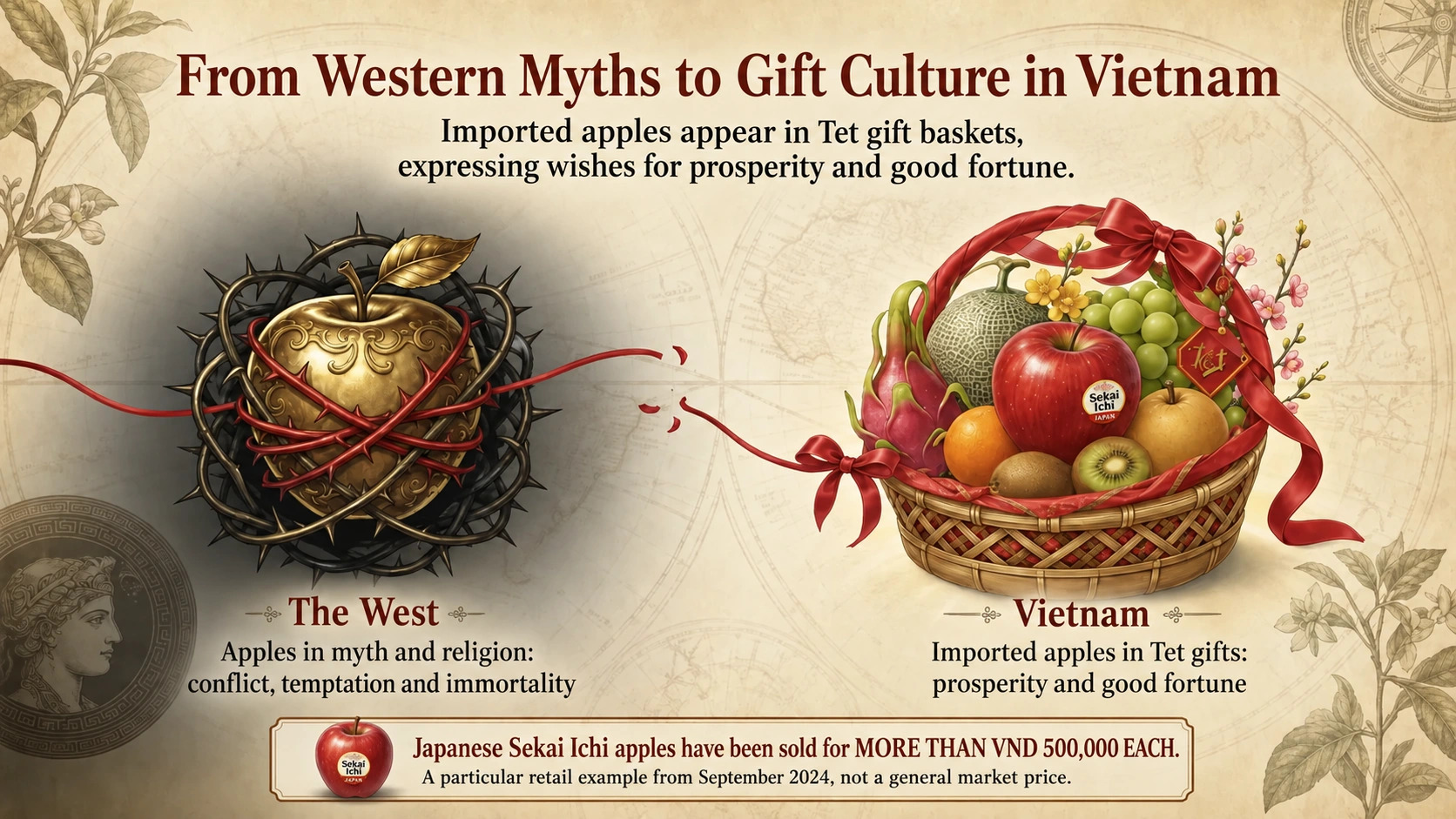
As Tet approaches, imported-fruit gift baskets fill shop displays. An ANTV report from February 2024 quoted a seller saying sales of imported-fruit Tet gifts had risen about 10% year on year, with Japanese apples, pears and mandarins treated as premium products.
Vietnamese reporting in September 2024 also described a Japanese Sekai Ichi apple selling for more than VND 500,000 each. This was a particular retail example at a particular time, not a general market price. Fruit baskets can express wishes for abundance and prosperity.
Apples therefore have roles both as everyday food and as imported gifts. Japanese apples exported to Vietnam must meet bilateral requirements, including orchard and facility registration, orchard management, bagging or cold treatment, and export inspection. Each fruit crossing the sea has a history of procedures and care behind it.
A fruit that gathers meaning in different places
Few fruits have carried as many human meanings as the apple.
The Fall in Eden, rivalry among goddesses, promises of immortality: all have been placed on its small form. Its name stood for fruit itself and was lent to potatoes and pineapples. On the American frontier it became cider; in a Japanese town it became the globally grown Fuji. Wherever it traveled, it acquired a role.
For this fruit, a traditional Vietnamese origin tale was not found within the research reviewed here.
In Vietnam, apples circulate as táo tây or bôm. Imported apples on supermarket shelves are familiar everyday food as well as fruits associated with myths.
They also carry a newer meaning as gifts. Near Tet, they pass from person to person in imported-fruit baskets. In northern Vietnam they may appear in mâm ngũ quả, the New Year five-fruit offering placed on an ancestral altar. Their presence does not have the same longstanding, fruit-specific explanation as bananas or pomelos, but they have become fruits people give and offer.
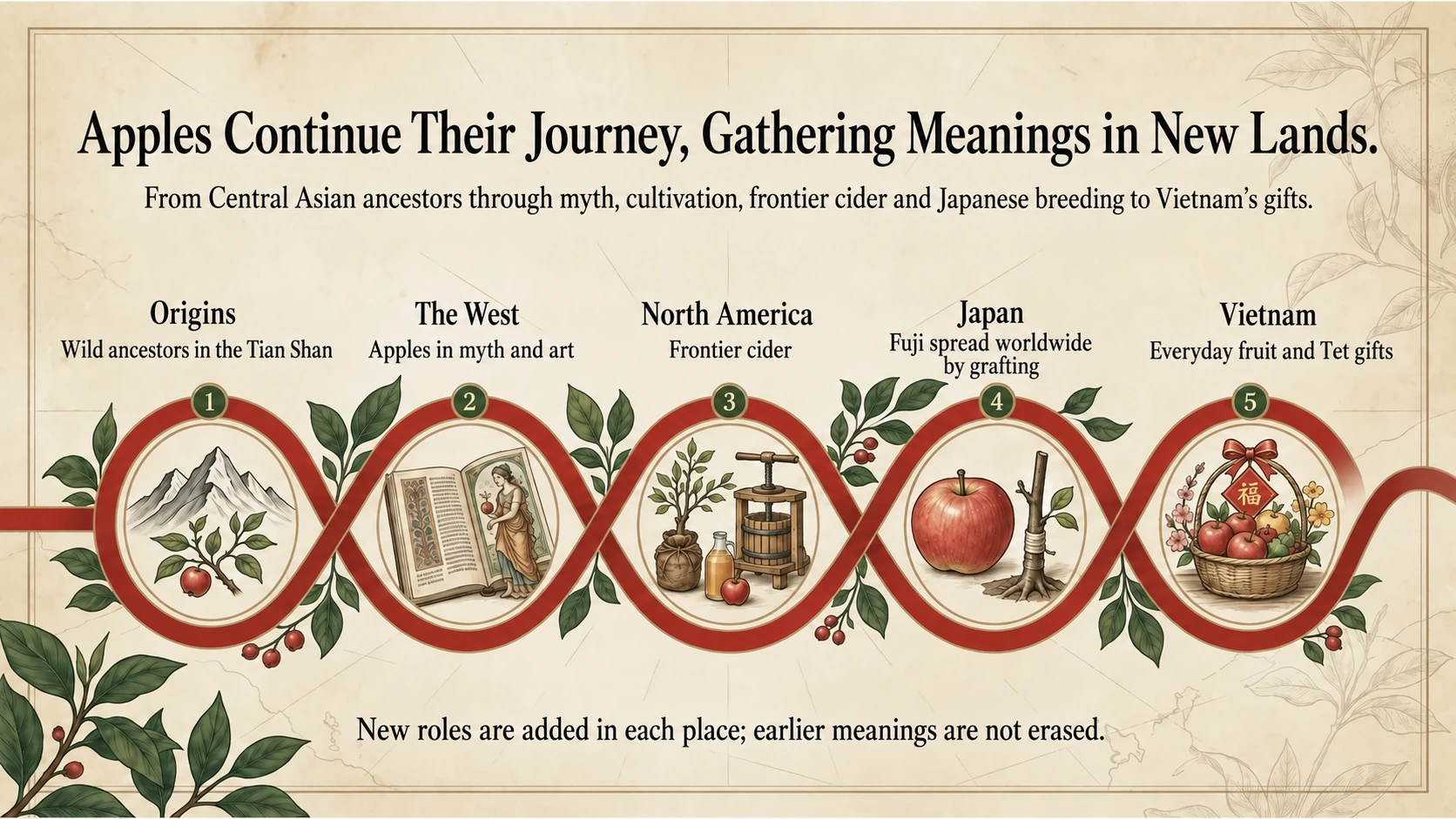
The meanings accumulate: mythological fruit, frontier cider, Japanese Fuji, and Vietnam’s tables and gift baskets. Through one fruit, we see both cultivation history and the lives of the people who welcomed it.
For biology, nutrition, varieties and market trends, continue to Apples in Vietnam. To learn how to buy and eat the fruit before it enters a Tet basket, see How to Buy and Eat Apples in Vietnam.
Related articles
- Apple biology, nutrition, varieties and markets: Apples in Vietnam.
- A fruit that borrowed the apple’s name: The Story of Pineapple.
- A fruit with a direction of travel embedded in its name: The Story of Watermelon (Japanese).
- Buying, choosing, cutting and storing apples: How to Buy and Eat Apples in Vietnam.
- Other fruits to explore: 15 Fruits to Try in Vietnam (Japanese).
References
- Apple: botany and history: ja.wikipedia.org.
- Research review: Malus sieversii and cultivated apple origins: pmc.ncbi.nlm.nih.gov.
- Apple University: apple self-incompatibility: www.ringodaigaku.com.
- Apple University: nursery trees, rootstocks and scions: www.ringodaigaku.com.
- University of Chicago Logeion: Latin mālum, mălum and pōmum, meanings and vowel lengths: logeion.uchicago.edu, logeion.uchicago.edu.
- Yuji Kawaguchi, Tokyo University of Foreign Studies: names of introduced crops in French: www.tufs.ac.jp.
- Forbidden fruit: proposed identifications: ja.wikipedia.org.
- Rutgers University: How the Forbidden Fruit Became an Apple; wordplay questioned and Old French pom discussed: www.rutgers.edu.
- National Diet Library reference database: sources on forbidden-fruit apple imagery: crd.ndl.go.jp.
- Apple of Discord and golden apples in Greek mythology: ja.wikipedia.org, ja.wikipedia.org.
- Johnny Appleseed: biographical background: en.wikipedia.org, ja.wikipedia.org.
- North Carolina Historic Sites: John Chapman, Pioneer Nurseryman: historicsites.nc.gov.
- Penn State Extension: Apple Production; gametophytic self-incompatibility and compatible pollen sources: extension.psu.edu.
- Oxford Learner’s Dictionaries: pineapple and its earlier pine-cone meaning: www.oxfordlearnersdictionaries.com.
- Japanese Etymology Dictionary: ringo and its written name: gogen-yurai.jp.
- Aomori apple history: www.aomori-ringo.or.jp.
- Fujisaki Town: the birthplace of Fuji: www.town.fujisaki.lg.jp.
- Japan MAFF: Aomori’s three nursery trees in 1875: www.maff.go.jp.
- NARO: Fuji, Kokko × Delicious, Tohoku No. 7 and certification in 1962: www.naro.go.jp.
- NARO Fruit Tree Research Institute News No. 4: first fruiting in 1951: www.naro.go.jp.
- Táo tây: Vietnamese apple names and French-derived bôm: vi.wikipedia.org, en.wiktionary.org.
- Ông Táo: Kitchen God tradition and name: en.wikipedia.org.
- ANTV, February 10, 2024: imported-fruit gifts for Tet: antv.gov.vn.
- 24H, September 4, 2024: a Sekai Ichi apple selling for over VND 500,000: www.24h.com.vn.
- Japan Plant Protection Station: commodity-specific export requirements for Vietnam: www.maff.go.jp.
- FAO: Deciduous fruit production in Vietnam; historical Sapa trials: www.fao.org.
- Báo Lai Châu: cultivated apples in Sin Ho: www.baolaichau.vn.
- Vietnamese government news: Traditional foods offering to ancestors on Tet festival: en.baochinhphu.vn.
- Vietnamese dictionary: bôm as regional usage: vtudien.com.
- Vietnamese government: 2025 provincial administrative reorganization: baochinhphu.vn.
About the Author

Chuta
Based in Hanoi, Vietnam, Chuta buys fruit at local markets and supermarkets and writes about its taste, seasons, selection and preparation. Drawing on life in Vietnam, he introduces tropical fruits that are less familiar to readers in Japan.
About Fruit Guide