Apples in Vietnam: Varieties, Nutrition and Growing Conditions
Published October 8, 2026
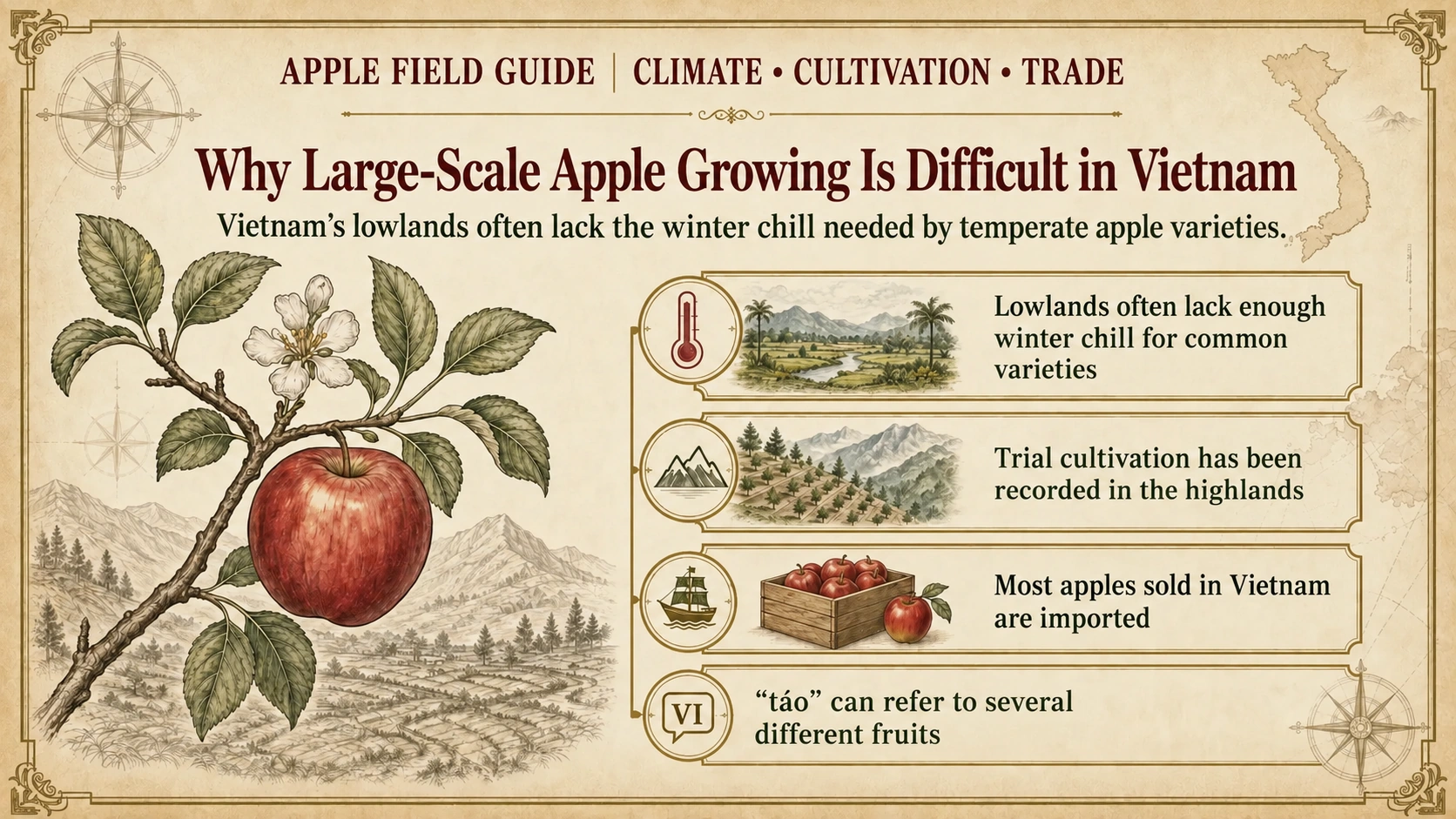
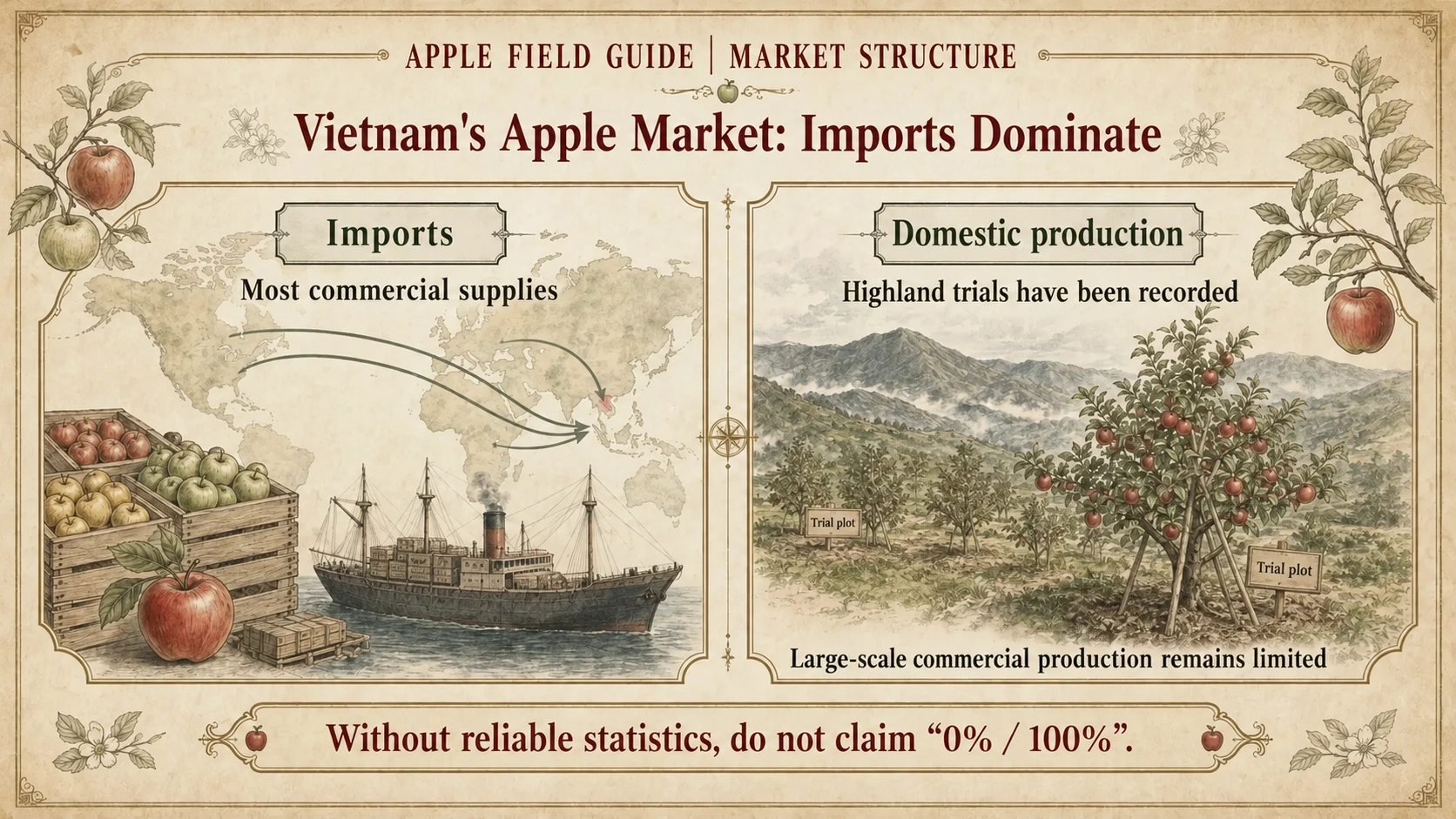
Vietnamese supermarkets stock many apple varieties throughout the year. Most are imported. Although apples are a familiar fruit, large-scale commercial production within Vietnam remains very limited.
One reason is the winter chill required for apple cultivation. Many varieties need a certain amount of cold weather before dormant buds can resume growth, and Vietnam’s lowlands rarely meet those requirements. There are, however, records of introductions and trial cultivation in the cooler northern highlands.
This guide explores apple varieties, nutrition and growing conditions alongside Vietnam’s import market. It also explains the name táo and how it can refer to fruits other than the apples you expect to find on a supermarket shelf.
Apple facts at a glance
| Item | Details |
|---|---|
| English and Japanese names | Apple; ringo in Japanese |
| Vietnamese names | táo tây; also bôm, mainly in southern Vietnam |
| Scientific name | Malus domestica, the cultivated apple |
| Classification | A deciduous tree in the rose family, genus Malus, approximately 2–15 m tall. Most flesh develops from tissues around the ovary; the fruit type is a pome |
| Origin | Central Asia. Wild Malus sieversii around the Tian Shan mountains is considered a major ancestor |
| Production in Vietnam | Commercial supplies are predominantly imported. Introductions and trials have been recorded in northern highland areas, including Sapa in Lao Cai Province |
| Availability in Vietnam | Year-round; varieties change with harvest seasons in supplying countries |
| Main nutrients | Dietary fiber, including pectin; potassium; vitamin C |
Sources are listed at the end of the article.
Apple characteristics, origins and cultivation in Vietnam
People sometimes debate whether watermelon should be called a vegetable or a fruit. An apple, by contrast, is the classic fruit growing on a tree. Yet its internal structure has a surprise of its own.
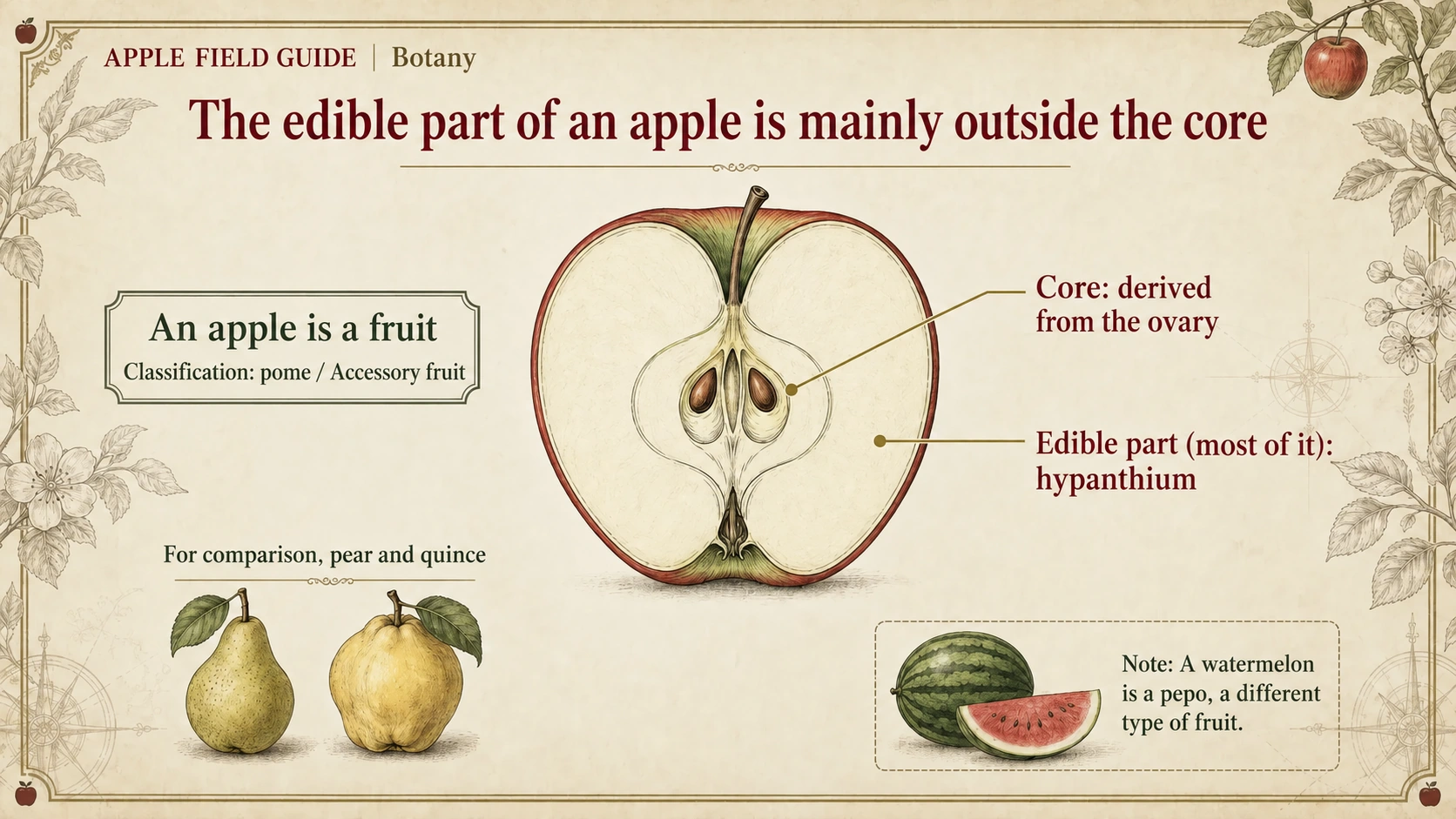
Most apple flesh develops from tissues around the ovary
The apple is a deciduous tree in the rose family, related to pears and loquats. It grows approximately 2–15 m tall, shedding its leaves and passing through winter dormancy.
The white flesh we eat develops mainly from the flower’s receptacular tissues, including the floral cup or hypanthium surrounding the ovary, rather than from the ovary itself. Fruits with this structure are called pomes. The firmer tissue around the core corresponds to the ovary. Much of each bite is therefore an enlarged part of the flower’s base.
Fruits incorporating tissues outside the ovary are also called accessory fruits. Under broad definitions, watermelon can be included in this category, although classification conventions differ. As explained in the Watermelon Guide, two fruits that look very different can share a connection in how their flowers develop into fruits.
Central Asian origins and Almaty, a “place of many apples”
The apple’s origins lie in Central Asia. A major ancestor of today’s cultivated apple is thought to be Malus sieversii, which grows wild around the Tian Shan. Its range centers on Kazakhstan and extends into Kyrgyzstan and Xinjiang, China. This was not the only ancestor: genetic contributions from related species, including the European crab apple, Malus sylvestris, have also been identified.
The name of Kazakhstan’s largest city, Almaty, is commonly interpreted as “a place of many apples.” It preserves the connection between the region and the fruit.
Apples were cultivated before the Common Era, and ancient Roman writings describe varieties and grafting. Japan’s older Chinese-derived wa-ringo apples date to the Kamakura period or later. Western cultivated apples, the ancestors of the varieties common today, were introduced in 1871. In spring 1875, three nursery trees supplied by the government’s agricultural promotion bureau were planted on the grounds of the Aomori prefectural office. This is regarded as the beginning of Aomori’s apple industry.
Táo tây or bôm? Vietnamese apple names
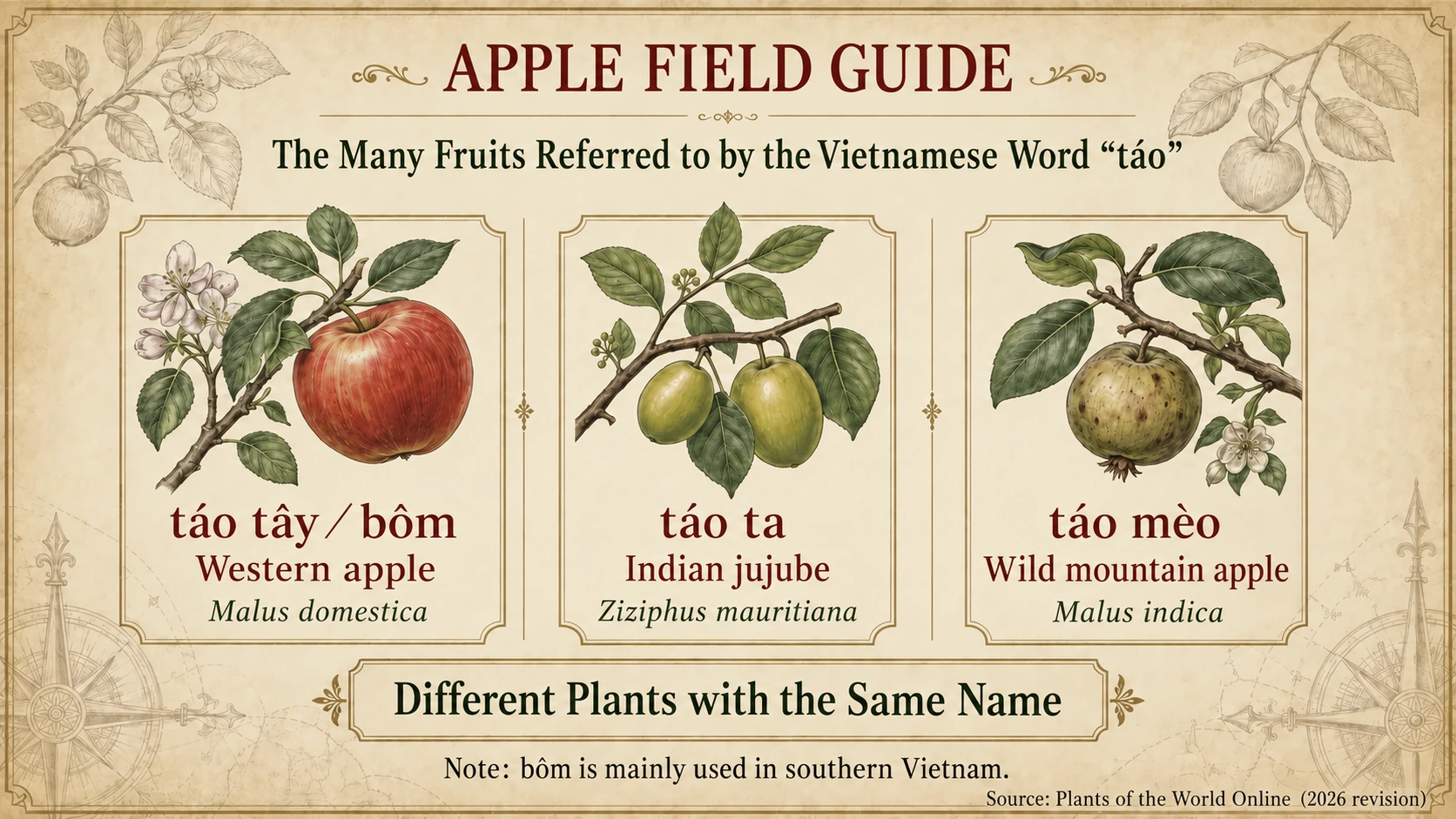
The Vietnamese name táo tây literally means “Western táo”: tây means Western. Another name, bôm, is considered a borrowing from French pomme, meaning apple. Dictionaries classify it as a regional or dialect word, used mainly in southern Vietnam.
The important point is that táo alone does not always mean an apple. Several other fruits share this name, as explained below. At a market, asking for táo can bring you a fruit quite different from the apple you had in mind.
Why insufficient winter chill limits commercial apple growing
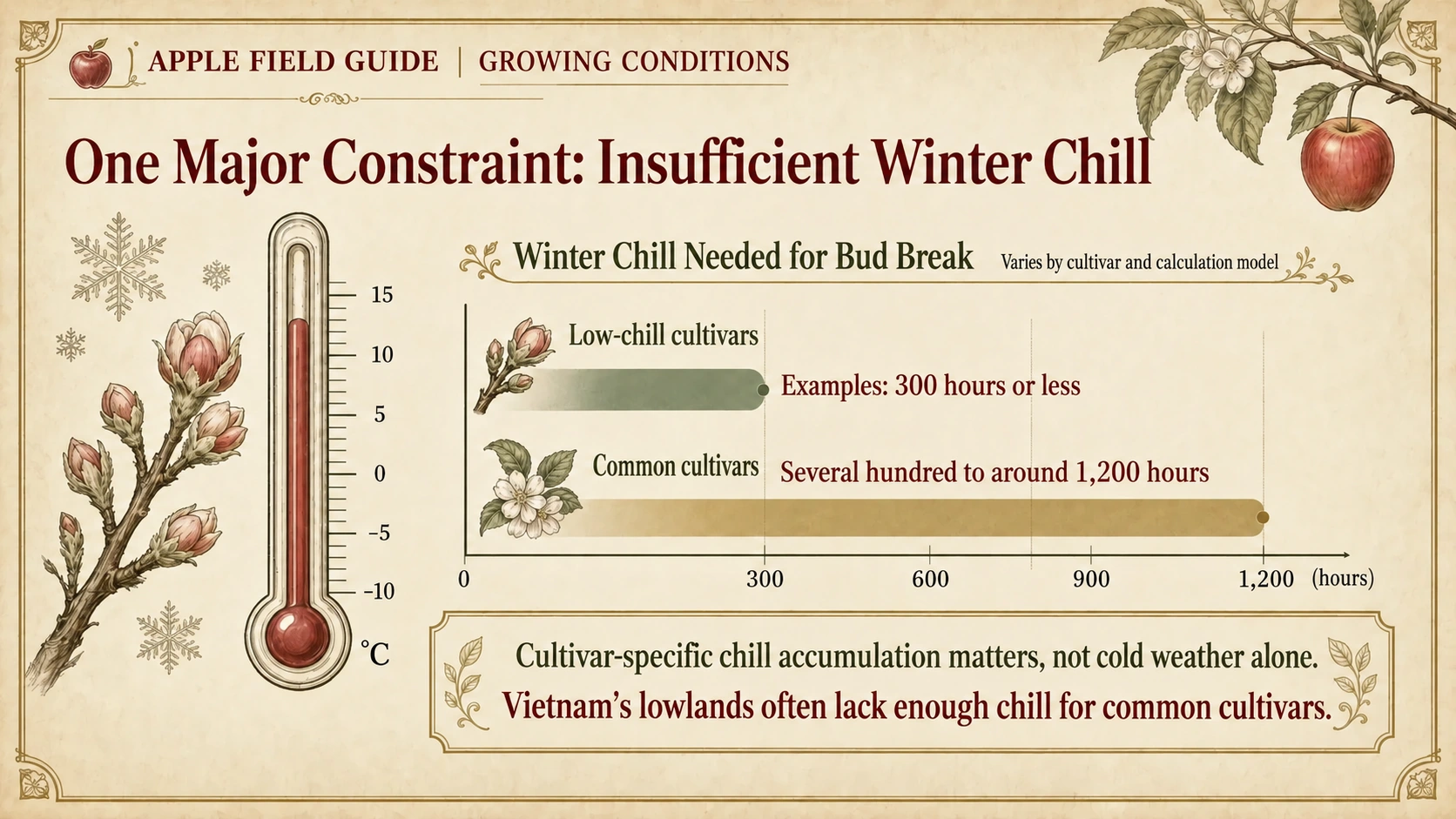
Temperature is a major constraint, specifically the lack of sufficient winter chill.
Apple buds require exposure to cold conditions during winter before they can break dormancy. This requirement can be expressed as chilling hours or chilling units, but the amount depends strongly on the cultivar and calculation method. University growing guides in the United States describe roughly 500–1,000 hours below about 7°C for many temperate varieties. Some low-chill cultivars developed for warmer regions require only around 250–300 hours.
Vietnam’s lowlands often cannot provide the winter chill needed by common temperate cultivars. However, rootstocks, growing methods and production infrastructure also matter. Temperature alone cannot determine whether production is possible, and Vietnam’s absence from a production ranking does not prove that its output is zero.
Saying that apples cannot grow anywhere in Vietnam would therefore be inaccurate. An FAO report records an introduction at Sapa State Farm, approximately 1,500 m above sea level, in 1995. Fuji and Granny Smith grafted onto M9 rootstock reportedly performed well. This is a historical cultivation record, not evidence of current acreage or production.
The lowlands face constraints, while the cooler highlands have records of introductions and trials. The sources reviewed here do not establish today’s total national production.
| Sapa cultivation record | What the FAO report states |
|---|---|
| Location | Sapa State Farm, northern Vietnam, approximately 1,500 m elevation |
| Introduction year | 1995 |
| Cultivars and rootstock | Fuji and Granny Smith on M9 |
| Reported result | Good performance with these combinations |
| What it does not establish | Current national acreage or output; the organizer of the trial |
Source: FAO, “Deciduous fruit production in Vietnam”. Historical records should be distinguished from present production conditions.
Apple nutrition
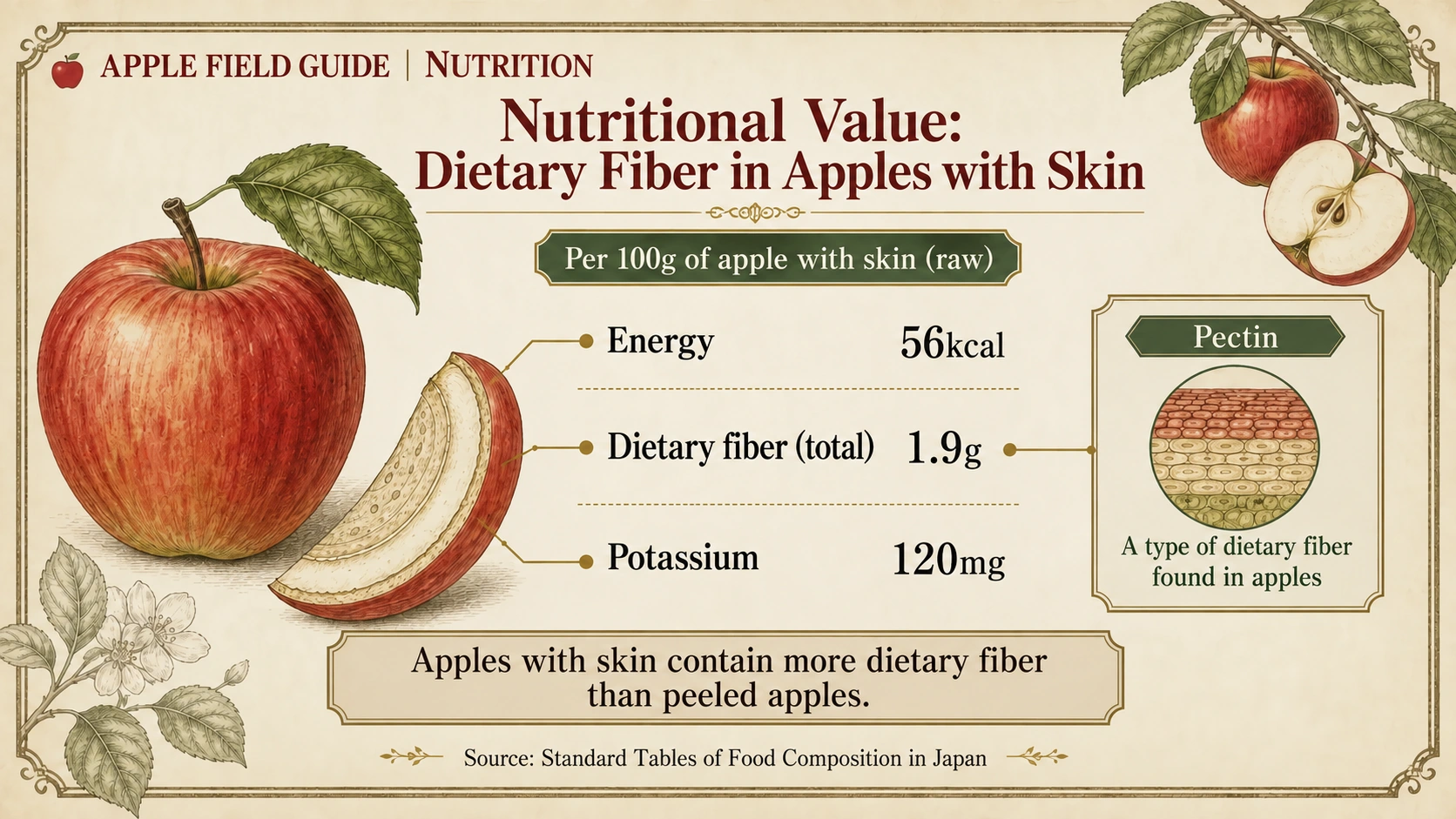
Raw apple with skin contains the following nutrients per 100 g of edible portion.
| Nutrient | Raw apple with skin, per 100 g |
|---|---|
| Energy | 56 kcal |
| Water | 83.1 g |
| Carbohydrate | 16.2 g |
| Total dietary fiber | 1.9 g |
| Potassium | 120 mg |
| Vitamin C | 6 mg |
| Beta-carotene | 22 μg |
Source: Japan’s MEXT Food Composition Database. These are values per 100 g, not per whole apple.
Dietary fiber is particularly worth noting. The watermelon described in the Watermelon Field Guide (Japanese) contains 0.3 g per 100 g, compared with 1.9 g in apple with skin, more than six times as much. Apple fiber includes the soluble fiber pectin. Keeping the skin increases fiber intake because fiber is also concentrated around it.
Potassium helps the body excrete excess sodium. Apples, however, are not especially rich in vitamin C.
These statements concern the general roles of nutrients. They do not establish that eating apples treats or improves a particular medical condition.
The proverb “An apple a day keeps the doctor away” has an early recorded form from Pembrokeshire, Wales, in 1866, suggesting that eating an apple before bed would keep the doctor from earning a living. The shorter modern wording appears in print by 1887 and became widespread in the late nineteenth century. It is a longstanding saying, rather than a medical guarantee.
World production and varieties in Japan and Vietnam
China dominates apple production
GLOBAL NOTE’s compilation of FAO statistics gives 51,285,100 tonnes for China and 4,922,840 tonnes for the United States in 2024. China’s output was approximately 10.4 times that of the United States.
More than 7,500 apple varieties are known worldwide, although totals differ depending on how varieties are counted.
| Country | Apple production in 2024 |
|---|---|
| China | 51,285,100 tonnes |
| United States | 4,922,840 tonnes |
Source: GLOBAL NOTE’s compilation of FAO statistics. Both figures use the same year and unit.
Japanese varieties and the worldwide spread of Fuji
Japan produced 603,800 tonnes of apples in 2023. Aomori accounted for 374,400 tonnes, approximately 62%. Familiar Japanese varieties include Fuji, Tsugaru, Orin and Jonagold.
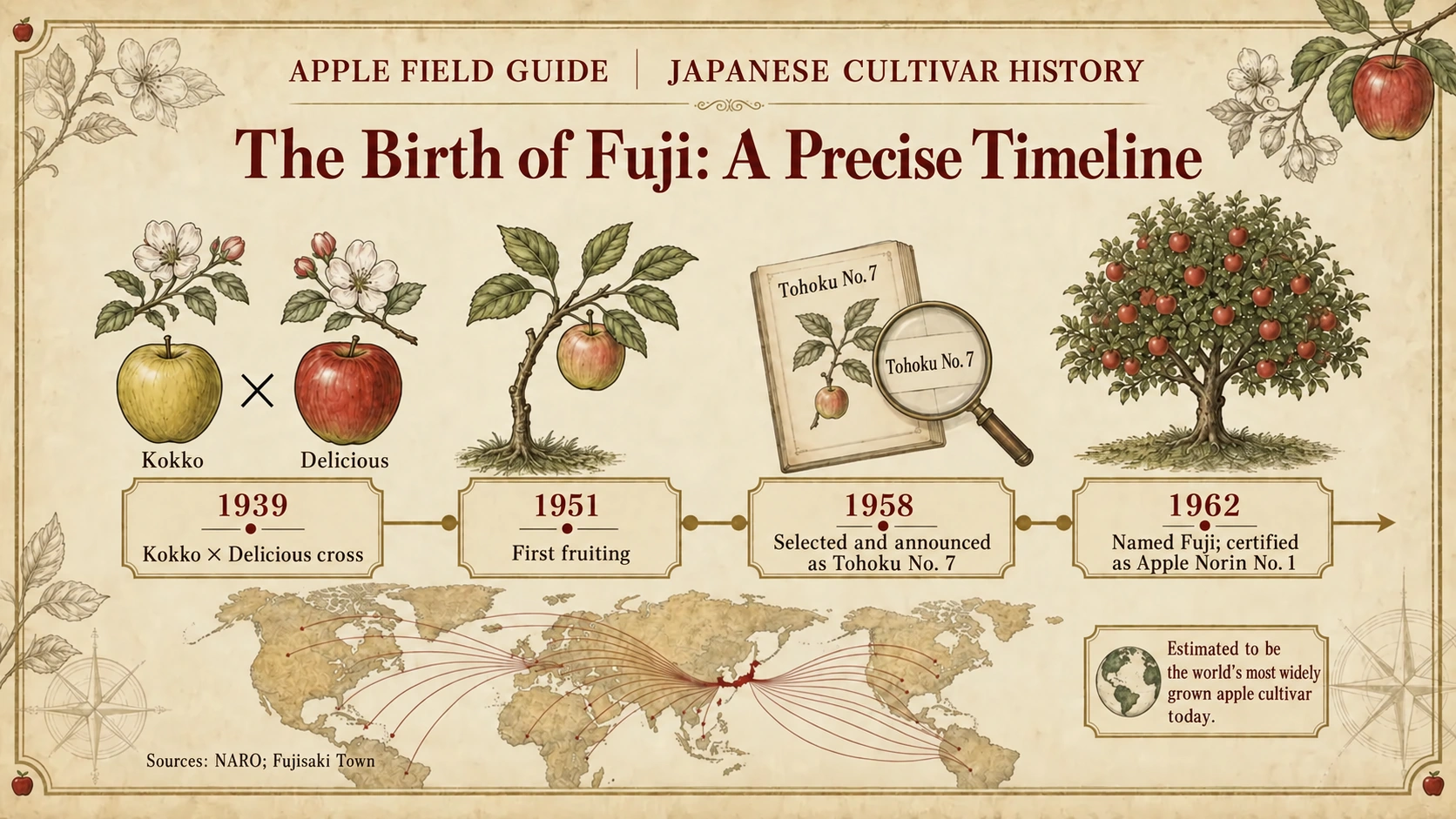
Fuji’s development is a particularly significant chapter in Japanese fruit history. In 1939, researchers at the Tohoku Branch of the government horticultural experiment station in Fujisaki, Aomori, crossed Kokko as the seed parent with Delicious as the pollen parent. The selected tree first bore fruit in 1951 and was announced as the promising line Tohoku No. 7 in 1958. It was named Fuji in March 1962 and registered as Apple Norin No. 1 under the agricultural certification system in April that year. This was a different system from modern cultivar registration under Japan’s Plant Variety Protection and Seed Act.
The name is said to honor both Mount Fuji and Fujisaki, the town where the cultivar was developed. In 1982, Fuji overtook the Delicious group to become Japan’s leading variety by production, then spread abroad. It is now estimated to be the world’s most widely grown apple cultivar: a variety developed in a small Aomori town became a global fruit.
Two other Vietnamese fruits called táo
The word táo at a Vietnamese market does not necessarily refer to a cultivated apple. Two important examples illustrate why.
Táo ta means roughly “our country’s táo.” Its scientific name is Ziziphus mauritiana, commonly called Indian jujube, and it is a different fruit from the apple. An important growing area is Ninh Thuan, formerly Ninh Thuan Province and now part of Khanh Hoa Province. Local names include táo xanh, meaning green táo, and táo Phan Rang. The shiny yellow-green fruits are crisp and relatively small, with about 10–25 fruits per kilogram.
In 2023, the area had more than 1,000 ha under cultivation, supplying approximately 40,000 tonnes annually. Around 830 ha used netting to protect against fruit flies and other pests. The former province set 2030 targets of 1,200 ha and 54,000 tonnes per year, including 200 ha and 12,000 tonnes intended for export. These are targets, not achieved output figures.
The second fruit is táo mèo, also called sơn tra. Its accepted scientific name is Malus indica, formerly Docynia indica. In the recent classification used by Kew’s Plants of the World Online, Docynia is included in Malus. Táo mèo is therefore a tree in the same genus and rose family as the cultivated apple, although it is a different species.
It occurs in Vietnam’s cooler northern mountains, including Sapa in Lao Cai; Mu Cang Chai and Tram Tau in the former Yen Bai Province, now part of Lao Cai; and Bac Yen in Son La. Yellow, round to oval fruits measure approximately 2–3 cm across. Their strong acidity and astringency make them less suitable for fresh eating. They are used in fruit wine, rượu táo mèo, vinegar and traditional medicinal preparations. Flowers appear around March, with harvests from September to November. Sơn tra Mù Cang Chải was registered as a trademark in 2016.
Although large-scale cultivated apple production is difficult in Vietnam, this distinct “mountain táo” in the same Malus genus grows in the northern highlands.
Vietnam’s apple imports and quarantine rules with Japan
Vietnam is a substantial apple import market
Báo Đầu Tư reported, citing customs statistics, that Vietnam imported approximately US$237 million worth of apples in 2023, down 11.5% from the previous year.
The country also has a strong connection with New Zealand apples. World Bank WITS/UN Comtrade data for 2024 show New Zealand’s fresh apple exports to Vietnam worth approximately US$76.29 million, totaling about 40,561 tonnes. By export value, Vietnam ranked second after China.
Dân Trí reported on August 15, 2026 that Vietnam’s fruit and vegetable imports from New Zealand reached US$78 million in the first half of 2026, up 20.3% year on year. This figure covers all fruit and vegetables, not apples alone.
The same report said Annam Gourmet’s imported apple sales revenue rose 26% in that period. It also quoted a consumer who bought New Zealand apples for VND 79,000 per kg after a discount of about 30%. That is an individual purchase example, not Annam Gourmet’s listed price or a market-wide average.
| New Zealand fresh apple exports in 2024 | Exports to Vietnam |
|---|---|
| Value | US$76,286,930 |
| Quantity | 40,560,600 kg, approximately 40,561 tonnes |
| Destination ranking | Second after China, by export value |
Source: WITS/UN Comtrade, HS 080810. Values are consistently expressed in US dollars, without mixing conversions from New Zealand dollars.
Japanese apples can enter Vietnam under agreed conditions
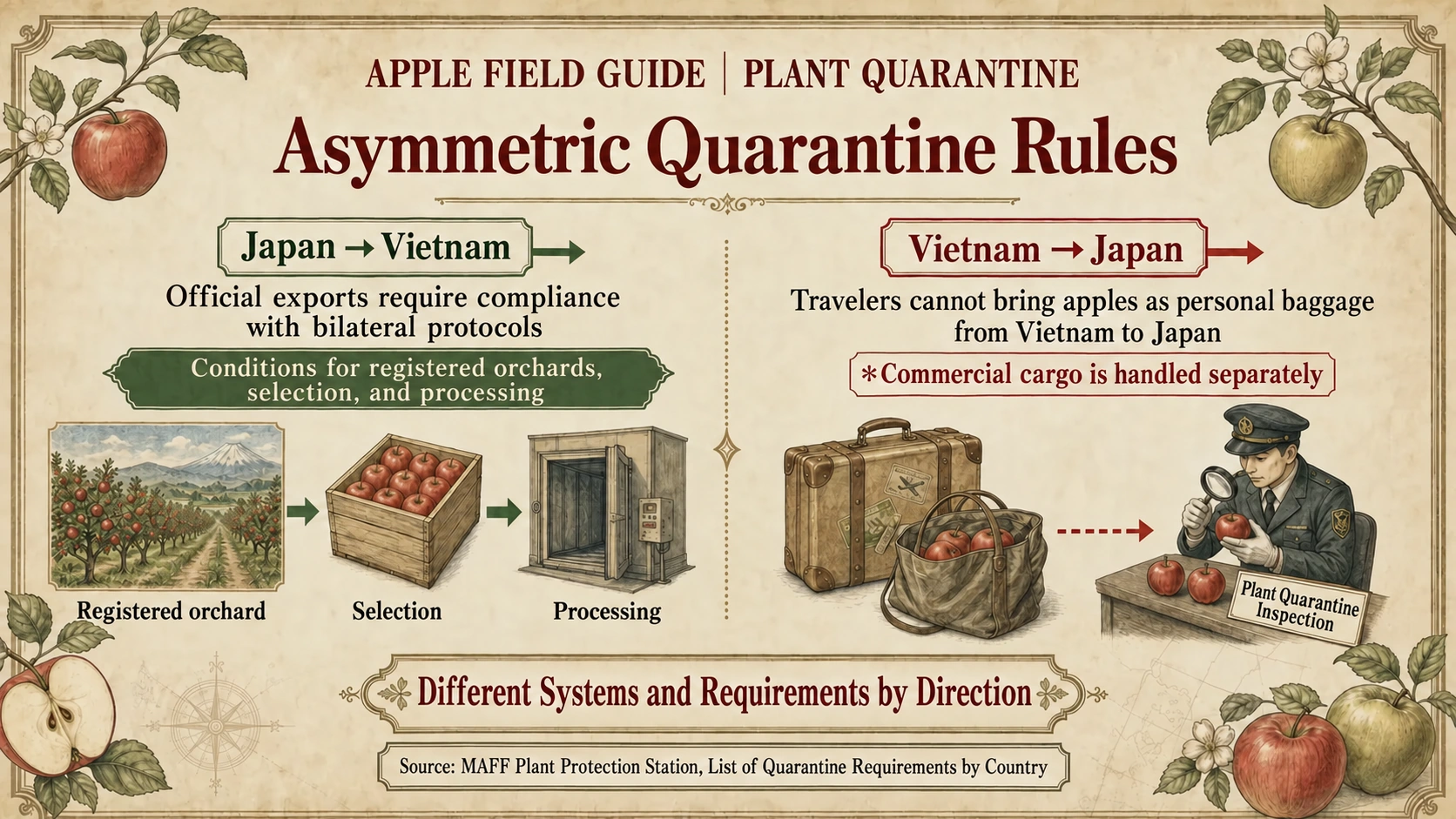
Many fruits covered in this series cannot be brought from Vietnam into Japan. Apples require a careful distinction between the direction of trade, commercial exports and travelers’ baggage.
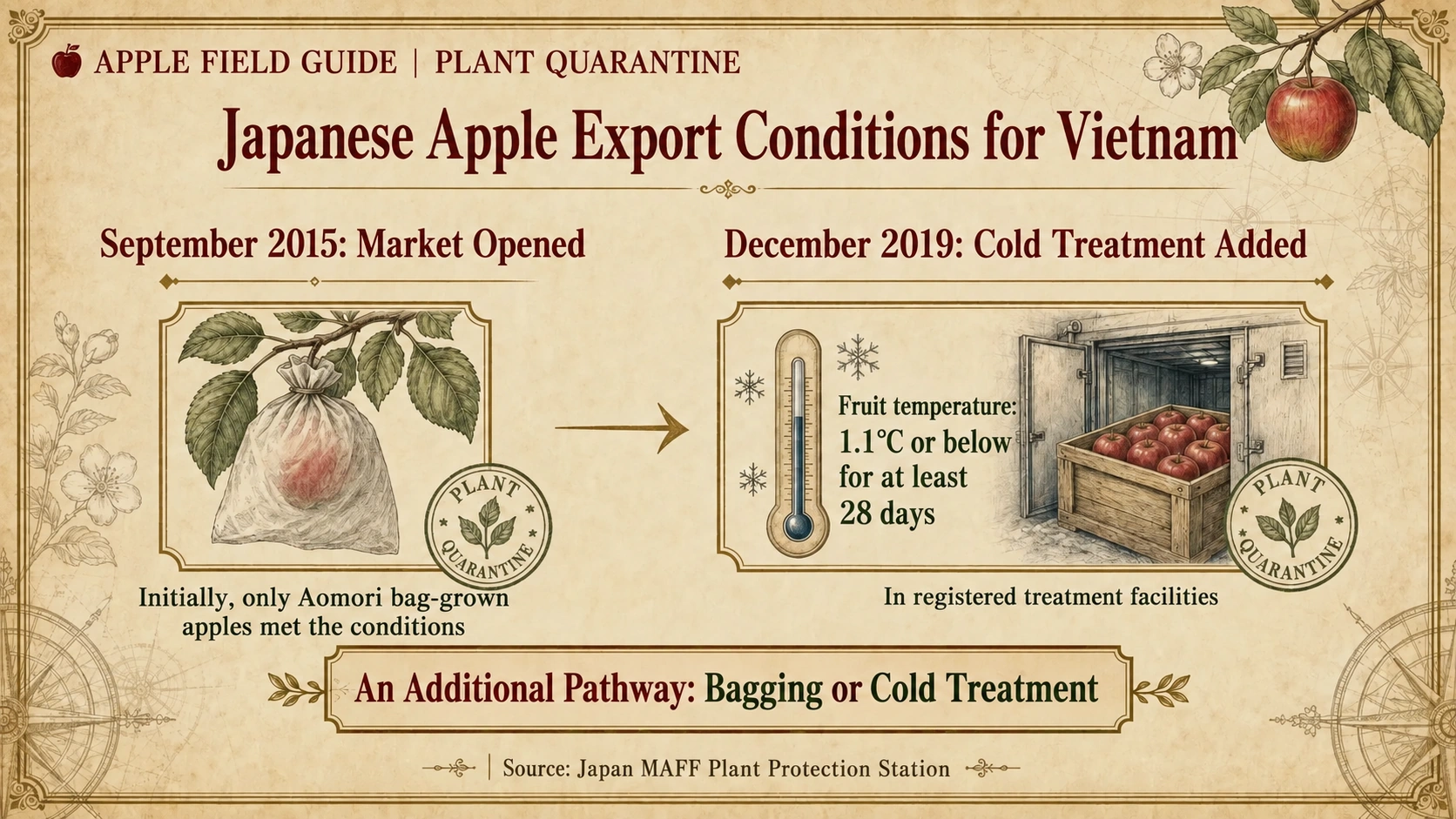
Vietnam opened its market to fresh Japanese apples on September 17, 2015. Initial conditions included pest management in registered orchards, orchard inspections by Japan’s Plant Protection Station, processing at registered sorting and packing facilities, export inspections and on-site inspection by a Vietnamese delegation in the first year. Initially, only bag-grown apples from Aomori met the requirements.
From December 15, 2019, an additional pathway became available. As an alternative to orchard bagging, fruit could be held at 1.1°C or below for at least 28 days in a cold-treatment facility registered by Japan’s Plant Protection Station. Bagging was not abolished: cold treatment allowed apples grown without bags to qualify for export. Aomori continues to accept annual registrations for orchards, sorting and packing facilities, storage facilities and cold-treatment facilities serving the Vietnamese market.
When the Plant Protection Station’s list was checked on October 8, 2026, the fresh fruits covered by bilateral export conditions from Japan to Vietnam were apples, Japanese pears and satsuma mandarins. Grapes, peaches and loquats could not be exported because Vietnam had not established quarantine conditions. Apples were among the fruits that first opened this route for Japanese produce.
On the same day in 2015, Japan also opened its market to fresh Vietnamese mangoes. On the day the apple conditions changed in 2019, Japan approved Vietnamese lychees of the Thieu variety. The opening discussed in the Lychee Field Guide emerged from the same negotiations. Quarantine agreements can develop in both directions.
Travelers cannot bring fresh apples from Vietnam into Japan
The Plant Protection Station’s traveler guidance for Vietnam was checked on October 8, 2026.
Fresh apples carried from Vietnam into Japan are prohibited under Japan’s plant quarantine rules. The rules depend on the combination of the country or region from which the item is brought and the type of plant product. The Vietnam page explicitly lists apples as not permitted.
This means apples in baggage departing Vietnam cannot be brought into Japan even if they were originally grown in New Zealand or the United States. They cannot serve as a fresh-fruit souvenir on this route.
Japan’s Ministry of Agriculture, Forestry and Fisheries lists five Vietnamese market-access requests on its relevant page: chili peppers, requested in February 2009; star apples, June 2016; passion fruit, July 2016; rice straw, December 2017; and pomelos, February 2021. Fresh apples do not appear on that published request list.
Five points for understanding apples in Vietnam
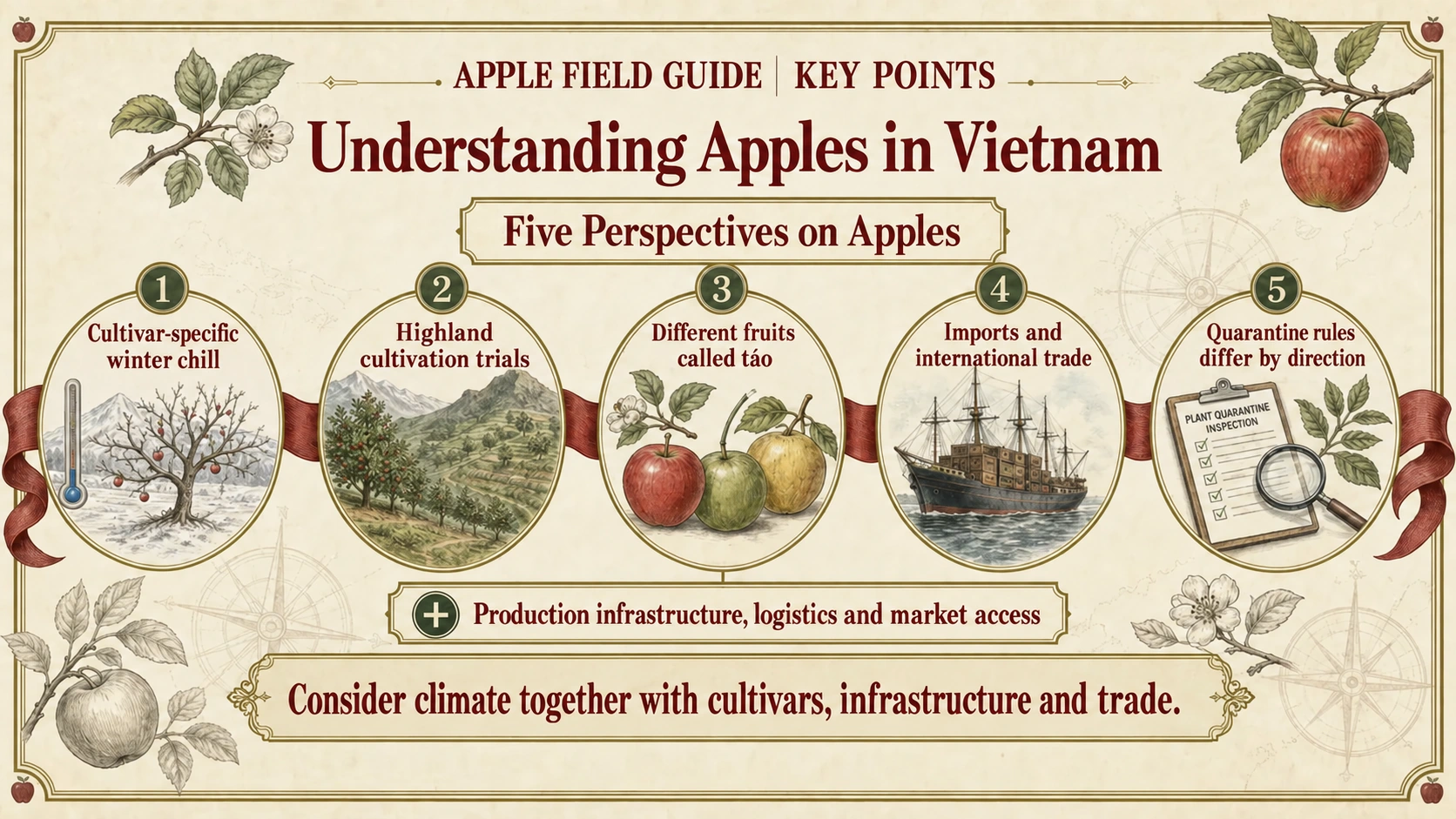
- Apples have major roots in Central Asia. Most edible flesh develops from tissues around the ovary, and the fruit is classified as a pome.
- Insufficient winter chill constrains common varieties in Vietnam’s lowlands, but historical introductions and trials are recorded in highland areas such as Sapa.
- Táo tây is the cultivated apple; táo ta is Indian jujube. Táo mèo is another species. Shared names do not mean identical plants.
- Retail apples are predominantly imported. Check their variety and origin, then compare taste and price.
- Japanese apples may be exported to Vietnam if conditions are met. Travelers cannot carry fresh apples from Vietnam into Japan, according to guidance checked on October 8, 2026.
Explore the history and cultural background in The Story of Apples, or learn how to buy, choose and cut them in How to Buy and Eat Apples in Vietnam.
For fruits grown and enjoyed locally, see 15 Fruits to Try in Vietnam (Japanese) and 15 Fruits Vietnamese People Commonly Eat (Japanese). The Watermelon Field Guide (Japanese) provides a comparison of fruit structures, while the Lychee Field Guide explains a related market-access agreement.
References
- Apple: classification, structure, origins and introduction to Japan: ja.wikipedia.org.
- Apple: more than 7,500 known cultivars: en.wikipedia.org.
- FAO: Deciduous fruit production in Vietnam; Sapa introduction in 1995, Fuji and Granny Smith on M9: www.fao.org.
- University of California ANR and University of Florida IFAS: apple winter chill and low-chill cultivars: ucanr.edu, ask.ifas.ufl.edu.
- Research review: apple origins and genetic contributions from related species: pmc.ncbi.nlm.nih.gov.
- Fukuoka University of Education: fruit classification and accessory-fruit definitions: staff.fukuoka-edu.ac.jp.
- Japan MAFF pest-management forum: Japanese and Aomori production figures: www.maff.go.jp.
- Fuji apple and Fujisaki Town: cultivar history and development: ja.wikipedia.org, www.town.fujisaki.lg.jp.
- Aomori apple history: the three nursery trees introduced in 1875: www.aomori-ringo.or.jp.
- MEXT Food Composition Database: raw apple with skin, 2023 supplement to the eighth edition: fooddb.mext.go.jp.
- GLOBAL NOTE: worldwide apple production, compiled from FAO statistics: www.globalnote.jp.
- An apple a day keeps the doctor away: the 1866 Welsh record and later wording: en.wikipedia.org.
- Vietnamese apple names: táo tây, bôm, and distinctions from other táo fruits: vi.wikipedia.org, en.wiktionary.org.
- Indian jujube: botany, Ninh Thuan production in 2023 and targets for 2030: gap.org.vn, baotintuc.vn, tuoitre.vn.
- Kew Plants of the World Online and Vietnamese reporting: Malus indica, formerly Docynia indica; distribution, uses, harvest and trademark: powo.science.kew.org, vi.wikipedia.org, www.vietnamplus.vn.
- Báo Đầu Tư: Vietnam apple import value in 2023: baodautu.vn.
- VnBusiness: New Zealand apples and Vietnam’s market position: vnbusiness.vn.
- World Bank WITS / UN Comtrade: New Zealand fresh apple exports by country, 2024, HS 080810: wits.worldbank.org.
- Dân Trí, August 15, 2026: first-half imports, retailer sales and individual price examples: dantri.com.vn.
- JETRO: Japanese apple market opening on September 17, 2015 and original requirements: www.jetro.go.jp.
- JETRO: additional cold-treatment route from December 15, 2019: www.jetro.go.jp.
- Japan MAFF: agreed apple export conditions for Vietnam; bagging or cold treatment: www.maff.go.jp.
- Japan Plant Protection Station: commodity-specific commercial export conditions for Vietnam: www.maff.go.jp.
- Aomori Prefecture: orchard and facility registration for apple exports to Vietnam: www.pref.aomori.lg.jp.
- Japan MAFF: published Vietnamese market-access requests; fresh apples not listed: www.maff.go.jp.
- Japan Plant Protection Station: traveler restrictions for fresh produce from Vietnam: www.maff.go.jp.
- Japan Plant Protection Station: country and region rules for travelers’ produce: www.maff.go.jp.
- Vietnamese government: 2025 provincial administrative reorganization: baochinhphu.vn.
About the Author

Chuta
Based in Hanoi, Vietnam, Chuta buys fruit at local markets and supermarkets and writes about its taste, seasons, selection and preparation. Drawing on life in Vietnam, he introduces tropical fruits that are less familiar to readers in Japan.
About Fruit Guide