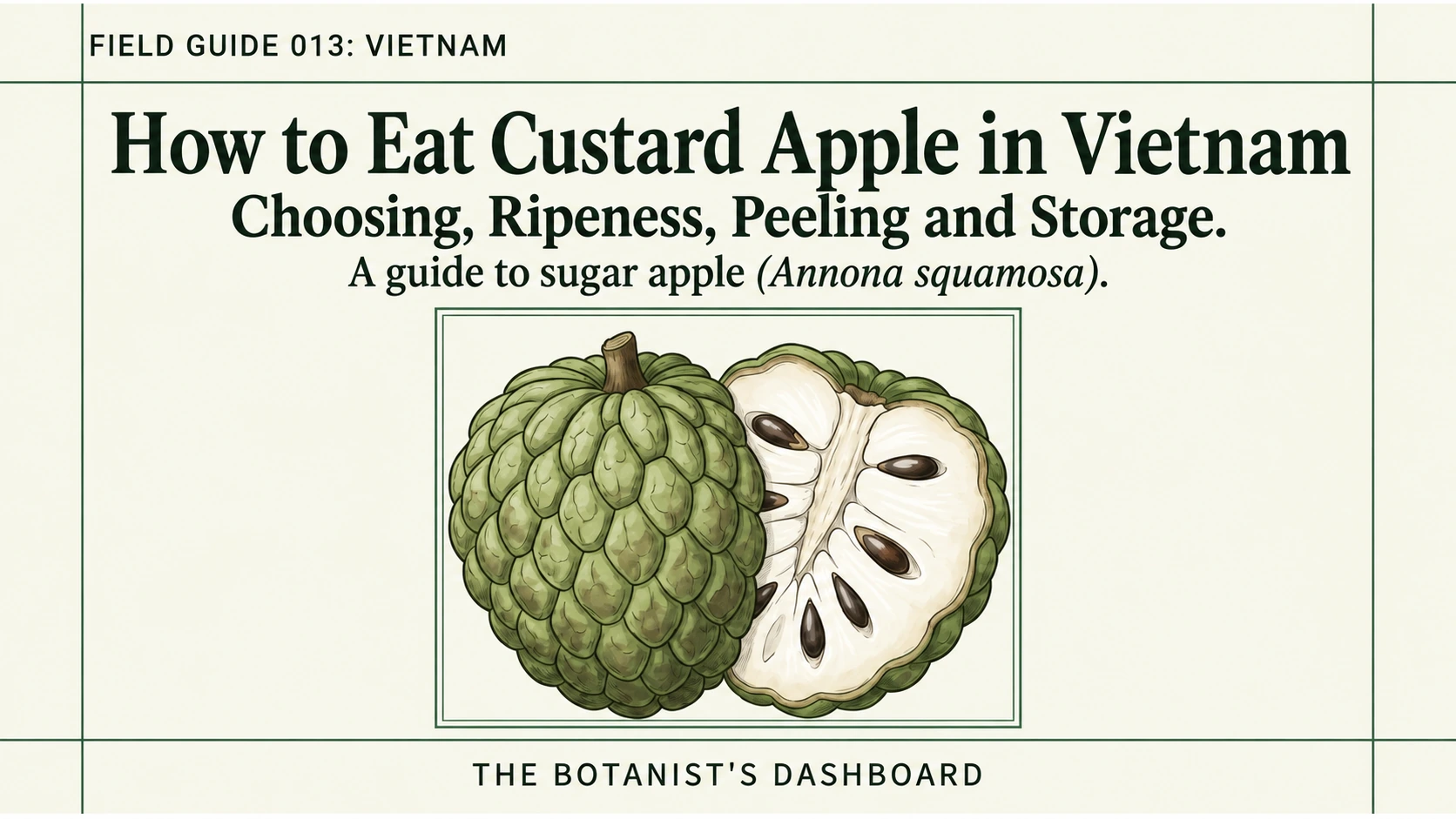
Open the segmented green skin of a sugar apple and you will find white flesh dotted with black seeds. At a Vietnamese market, knowing when to eat it can be harder than recognising it.
This guide covers Annona squamosa, generally called na or mãng cầu ta in Vietnam. It explains how to choose mature fruit, let it soften, open it by hand or with a knife and spoon, remove the seeds and store the flesh. A purchase and tasting record from Hanoi provides a personal example.
Buying and eating at a glance
| Item | What to know |
|---|---|
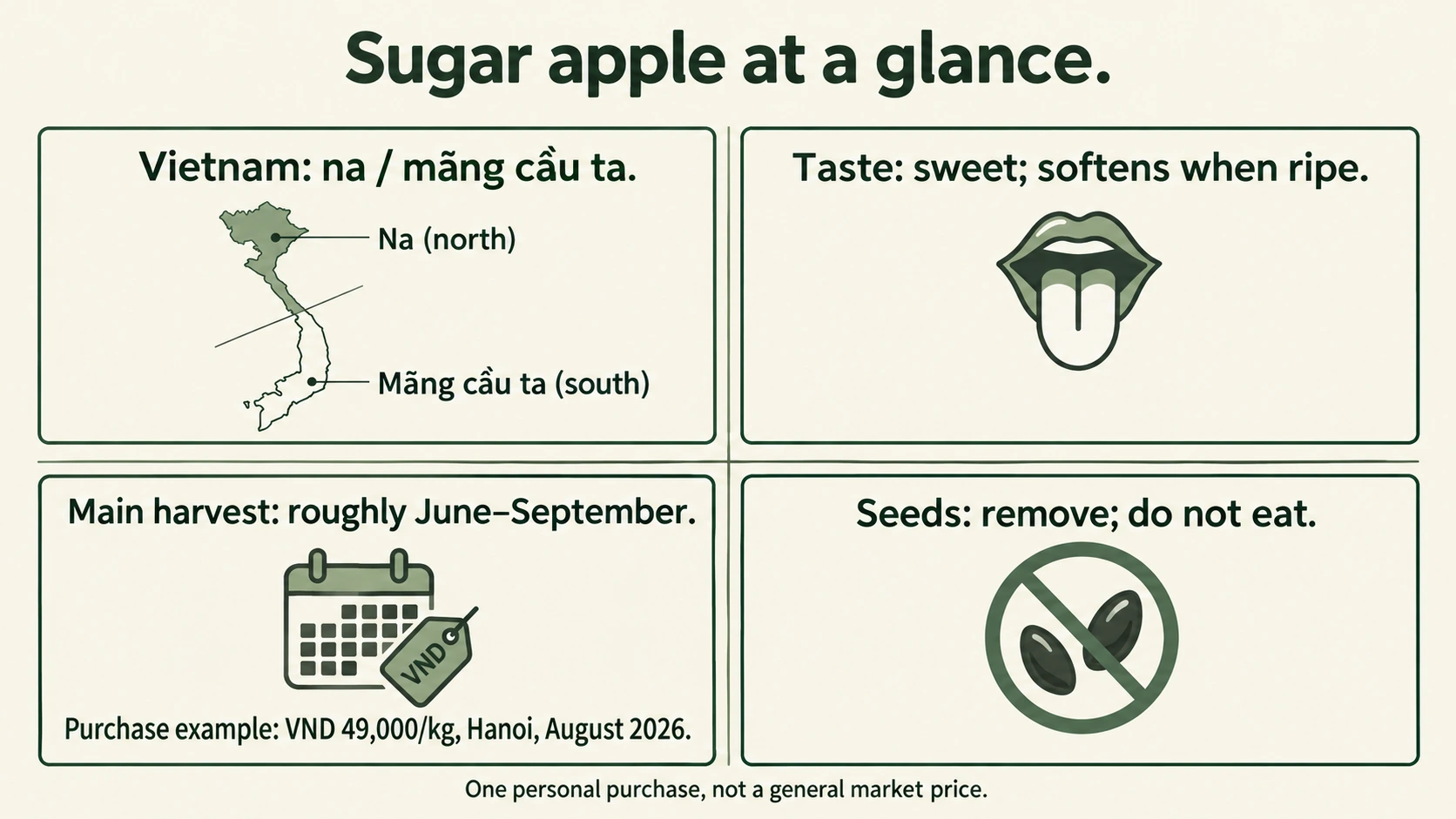
| Vietnamese names | Mainly na in the north; mãng cầu ta in the south |
| Flavour | Very sweet, with little acidity |
| Texture | Softens when ripe; may be grainy or elastic depending on the type |
| Main harvest | Roughly June–September, varying by region |
| Purchase example | VND 49,000/kg at a Hanoi supermarket in August 2026 |
| Ready-to-eat signs | Wider gaps between segments and a little give under gentle pressure |
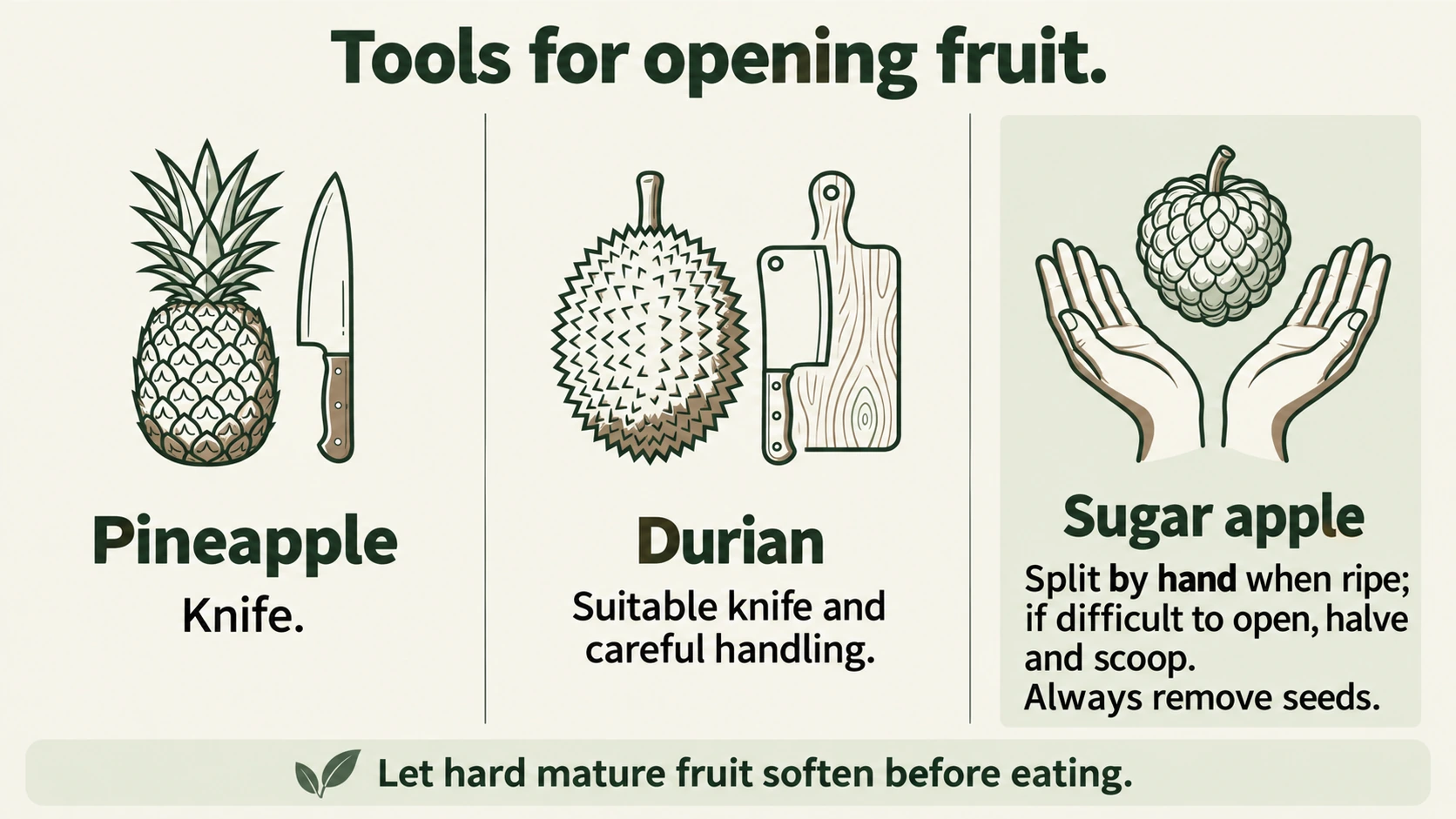
| How to eat | Split ripe fruit by hand, or halve and scoop |
| Seeds | Remove all black seeds; do not chew or grind them |
Ask for na or mãng cầu ta
The shorter southern name mãng cầu may refer to soursop, mãng cầu xiêm, in some contexts. To be clearer, say mãng cầu ta and point to the fruit. Drinks or desserts with mãng cầu in their name may contain soursop instead.
Taste and texture
Sugar-apple flesh is white to cream, very sweet and softer when ripe. Black or dark brown seeds sit within the flesh.
Fruit described as na dai tends to have firmer, more elastic flesh. Na bở becomes more crumbly when ripe. These are fruit-characteristic descriptions, not separate botanical species.
Price and where to buy
In August 2026, I bought sugar apples at a Hanoi supermarket for VND 4,900 per 100 g, equivalent to VND 49,000 per kg. This was one purchase, not a general market price. Prices change with growing area, selection, season, grade and seller.
Markets, supermarkets and fruit shops all sell the fruit. Markets allow you to compare individual fruit; supermarkets may make the weight and unit price easier to check.
How to choose a sugar apple
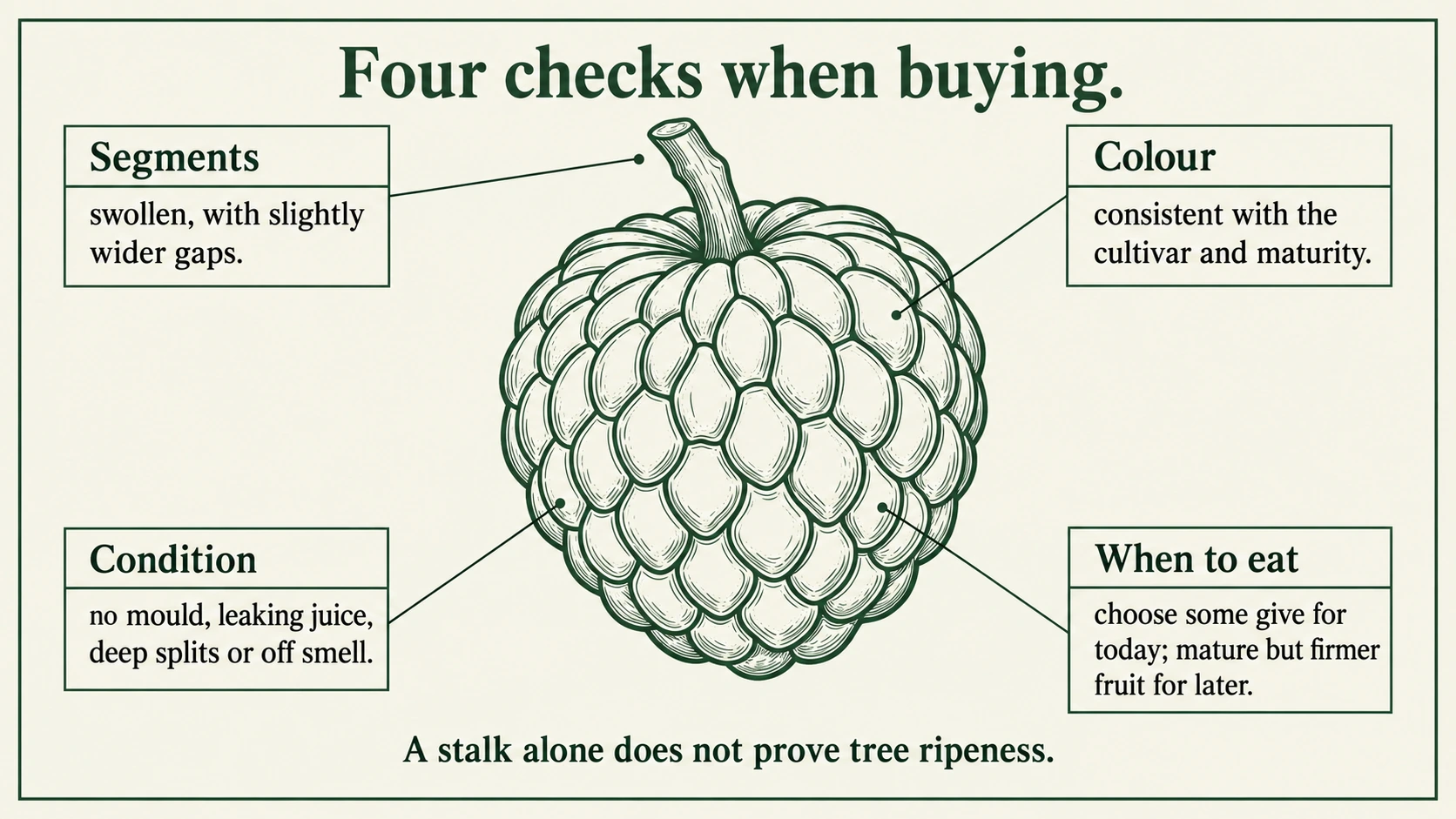
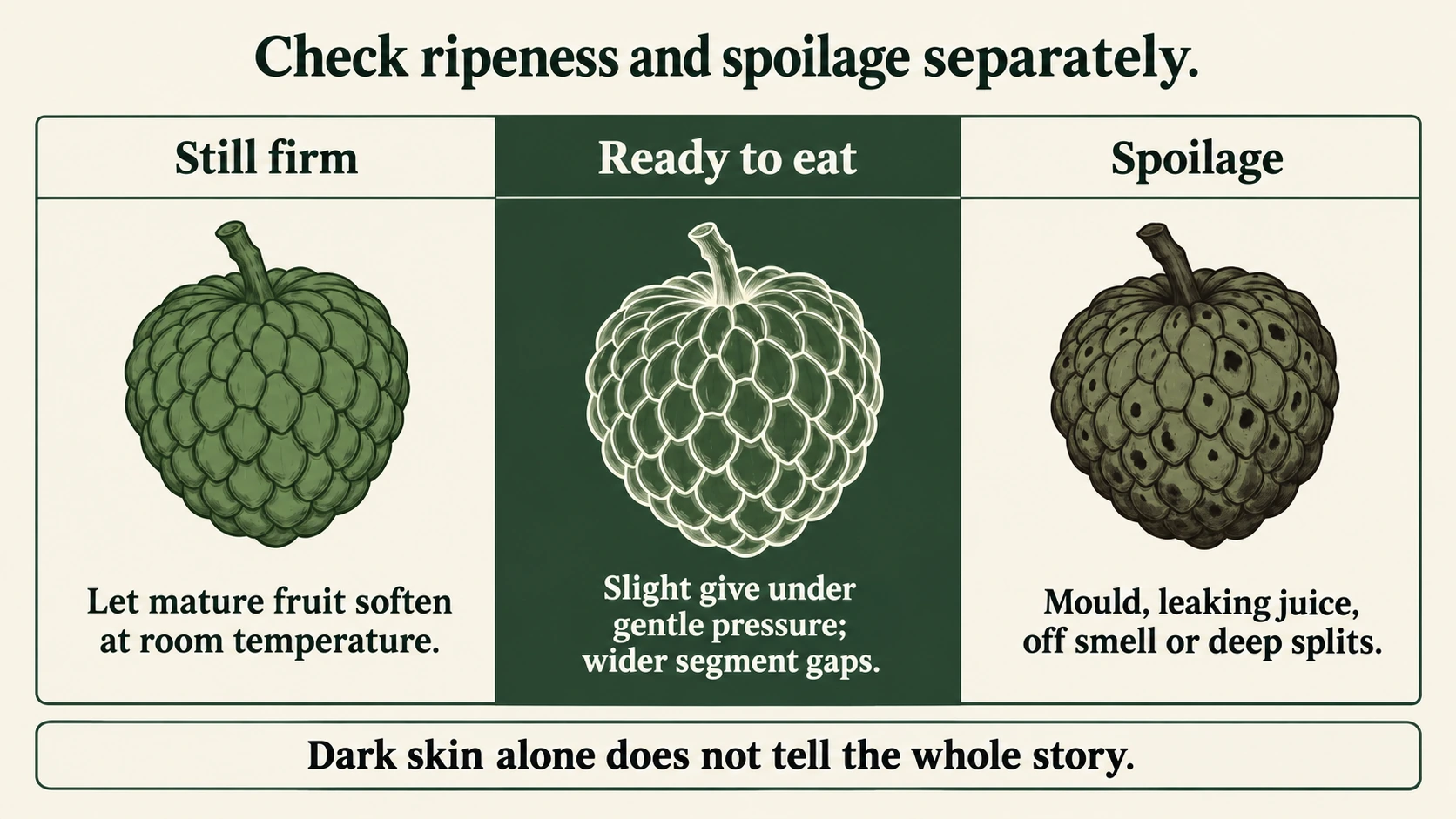
The University of Florida describes maturity in green-skinned fruit through swelling between the segments and a change towards yellow-green. At a shop, check four things:
- Segments: look for swollen segments with slightly wider gaps.
- Colour: consider the cultivar’s normal colour and its signs of maturity.
- Condition: avoid mould, leaking juice, deep splits and an off smell.
- When you will eat it: some give suits eating today; mature but firmer fruit may suit a later day.
A stalk alone does not prove that a fruit ripened on the tree. Combine the signs rather than relying on one detail.
When is it ready to eat?
Mature fruit can soften at room temperature. Fruit picked too immature may remain hard, turn brown and decay without becoming pleasant to eat.
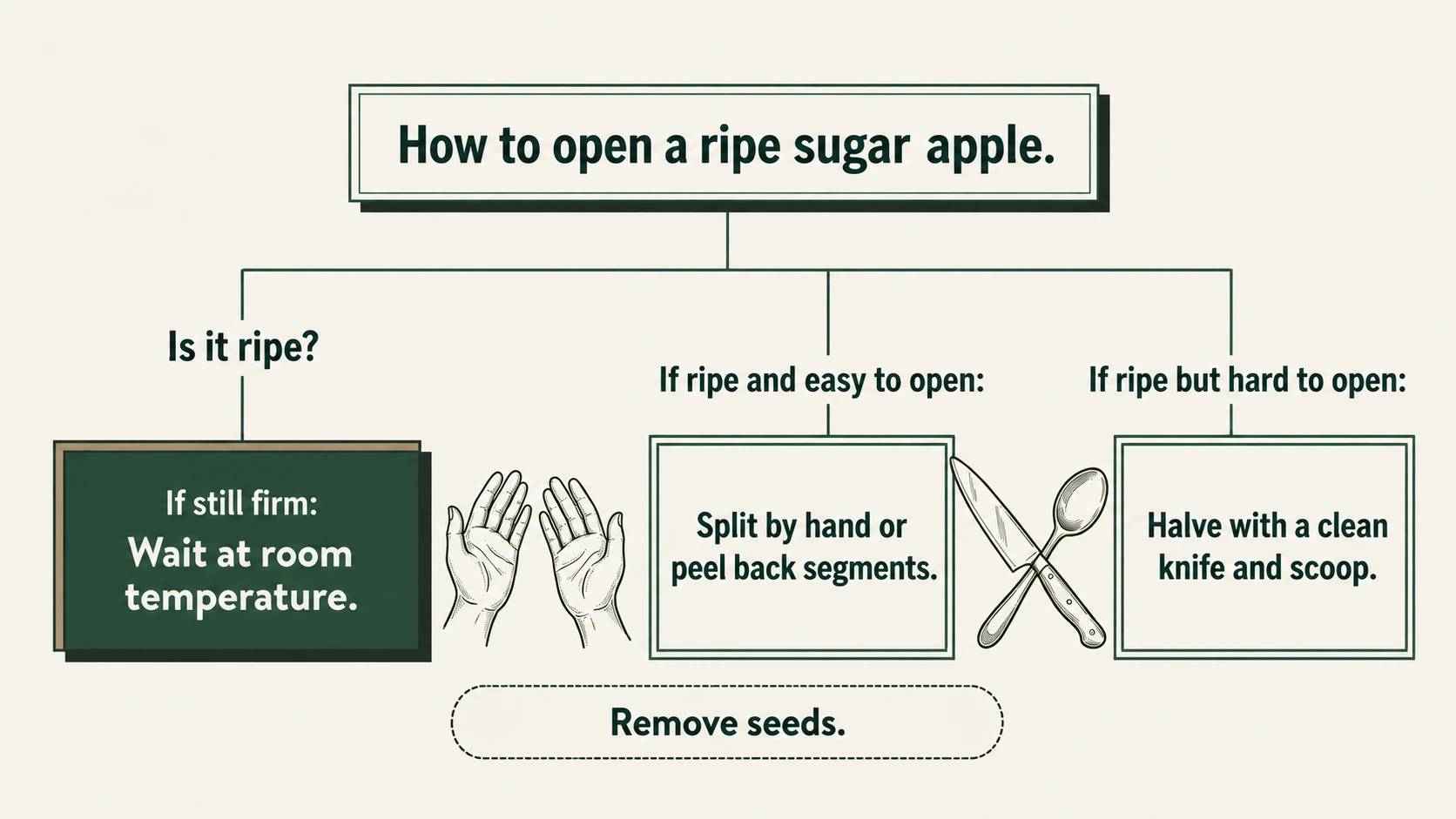
Let firm fruit develop a little give before opening it. Do not confuse fruit that needs more time with fruit developing mould, leaking juice or an off smell. Darkened skin alone is not a complete test of ripeness or spoilage.
Method A: split ripe fruit by hand
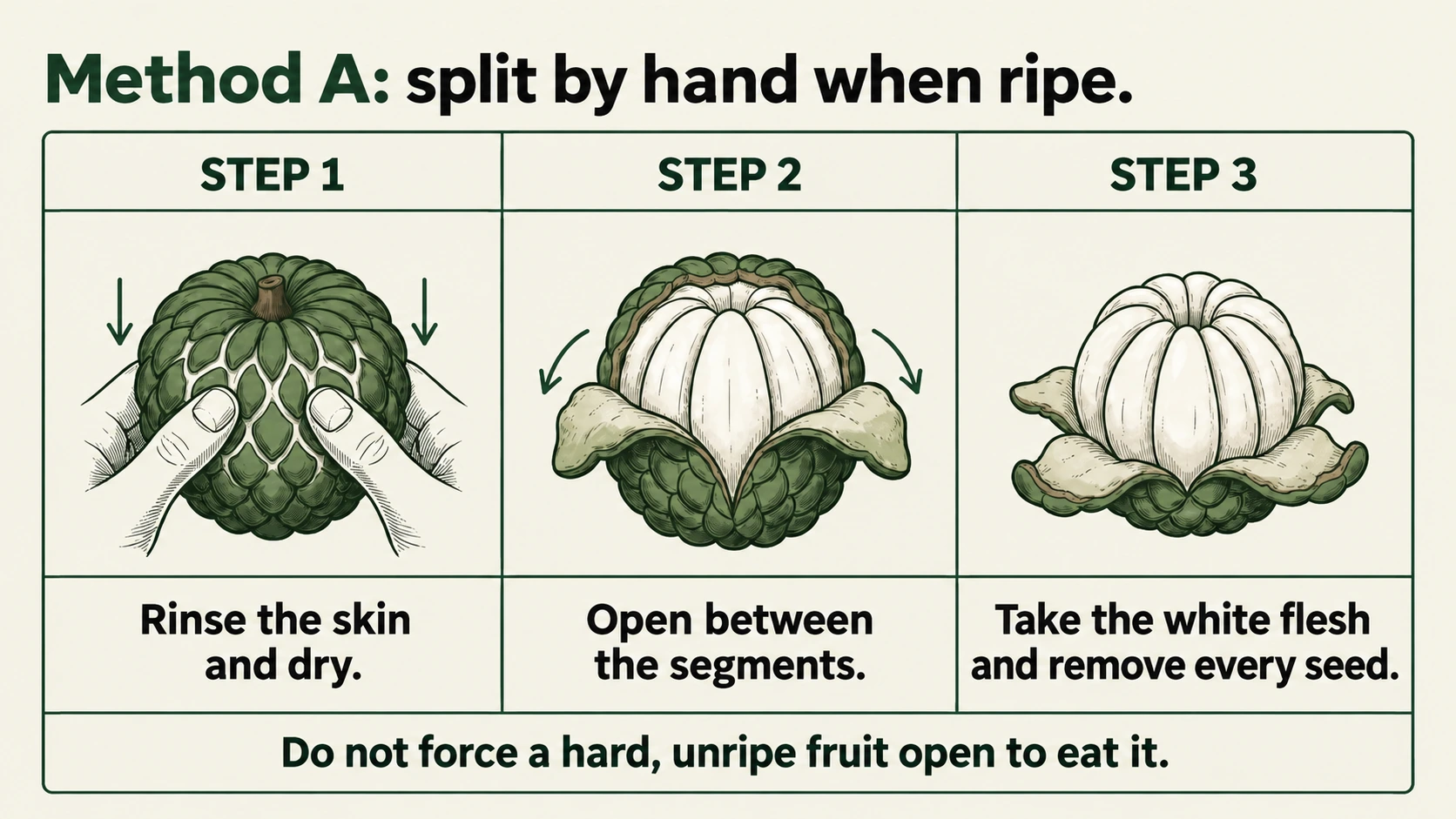
- Rinse the skin under running water and dry it.
- Place your fingers between the segments and split the fruit or peel the skin back.
- Take the white flesh with your fingers or a spoon.
- Remove the black seeds before swallowing the flesh.
Method B: use a knife and spoon
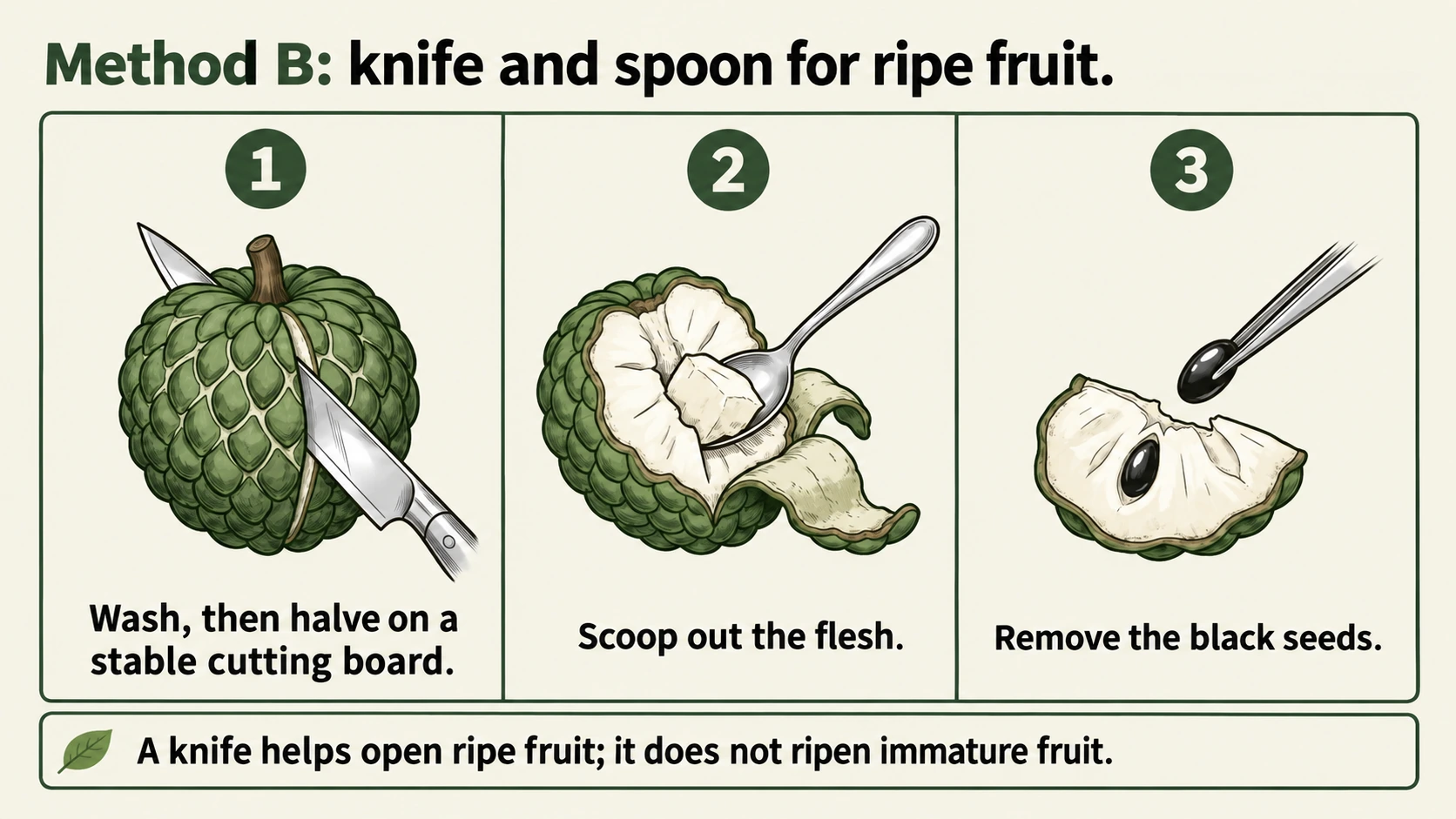
If a ripe fruit is difficult to open by hand, wash it, place it on a stable cutting board and cut it lengthwise in half with a clean knife. Scoop the flesh out with a spoon and remove the seeds.
A knife helps open a ripe fruit; cutting does not make immature fruit ripe. Avoid forcing a hard fruit open simply to eat it.
Remove the seeds, especially for children
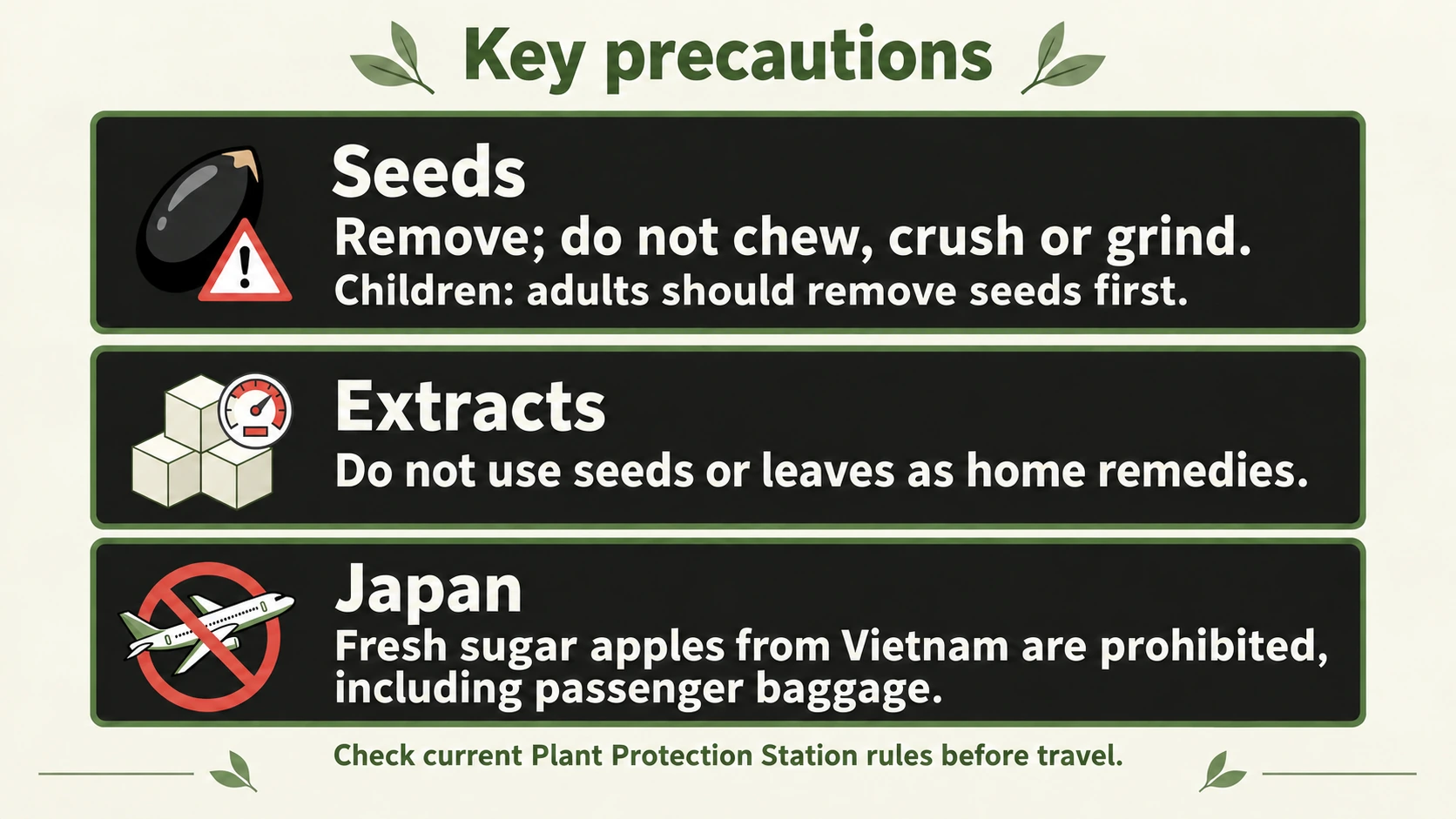
The black seeds are not edible. Do not chew, crush or grind them into a drink. An adult should remove the seeds before serving the flesh to young children to reduce the risk of choking.
Treat the edible flesh separately from seeds, leaves and concentrated extracts. Do not use the seeds or leaves as home remedies.
Fresh fruit, drinks and desserts
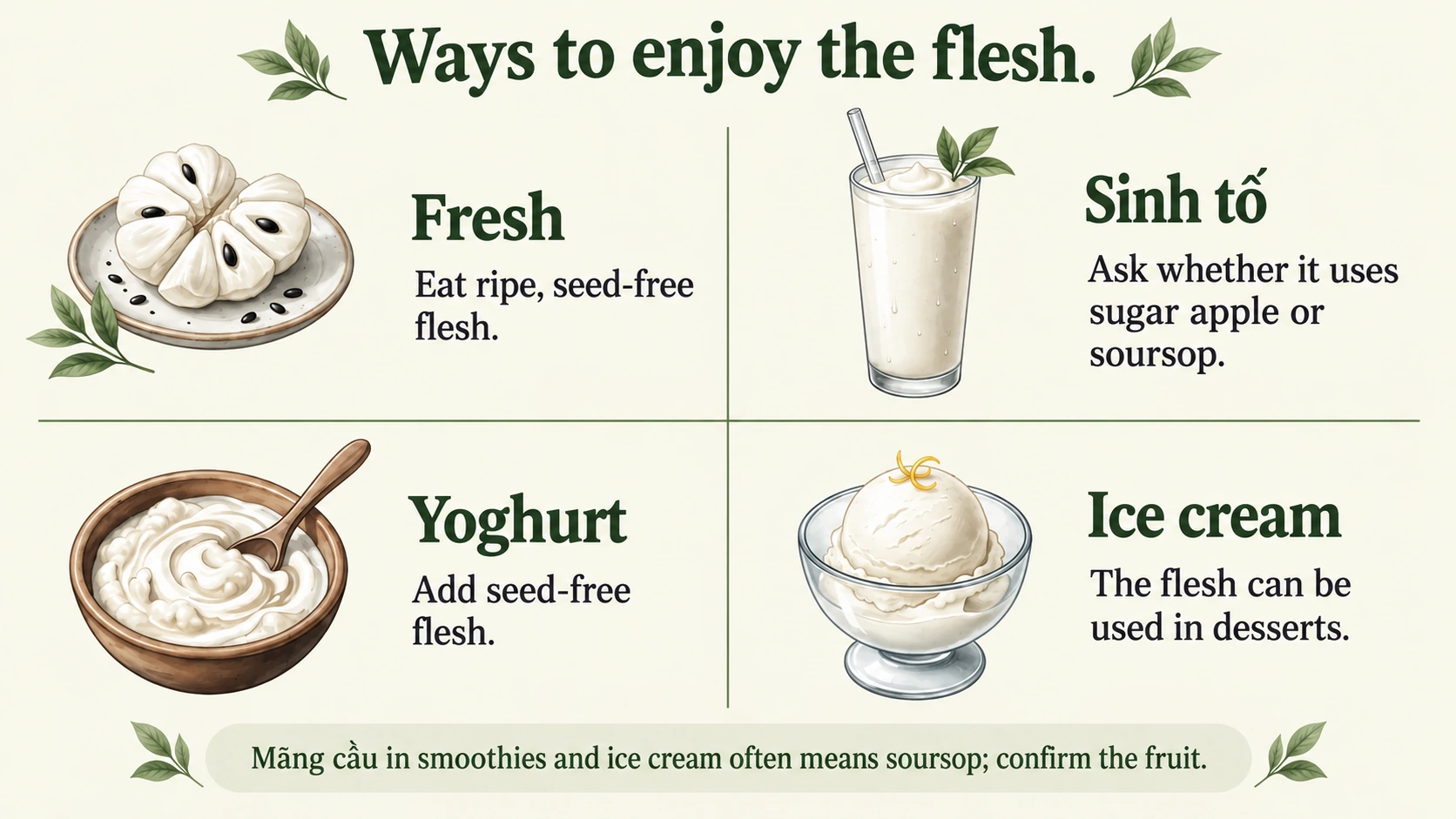
Sugar apple is usually eaten fresh. Its seed-free flesh can also be used in ice cream and milk shakes. Vietnamese rural-tourism information describes sugar-apple drinks, ice cream and other processed products in Tây Ninh.
However, sinh tố mãng cầu and kem mãng cầu often use the more tart soursop. Ask which fruit is used. Adding seed-free flesh to yoghurt or using it in a frozen dessert are other ways to enjoy leftovers.
How to store sugar apples
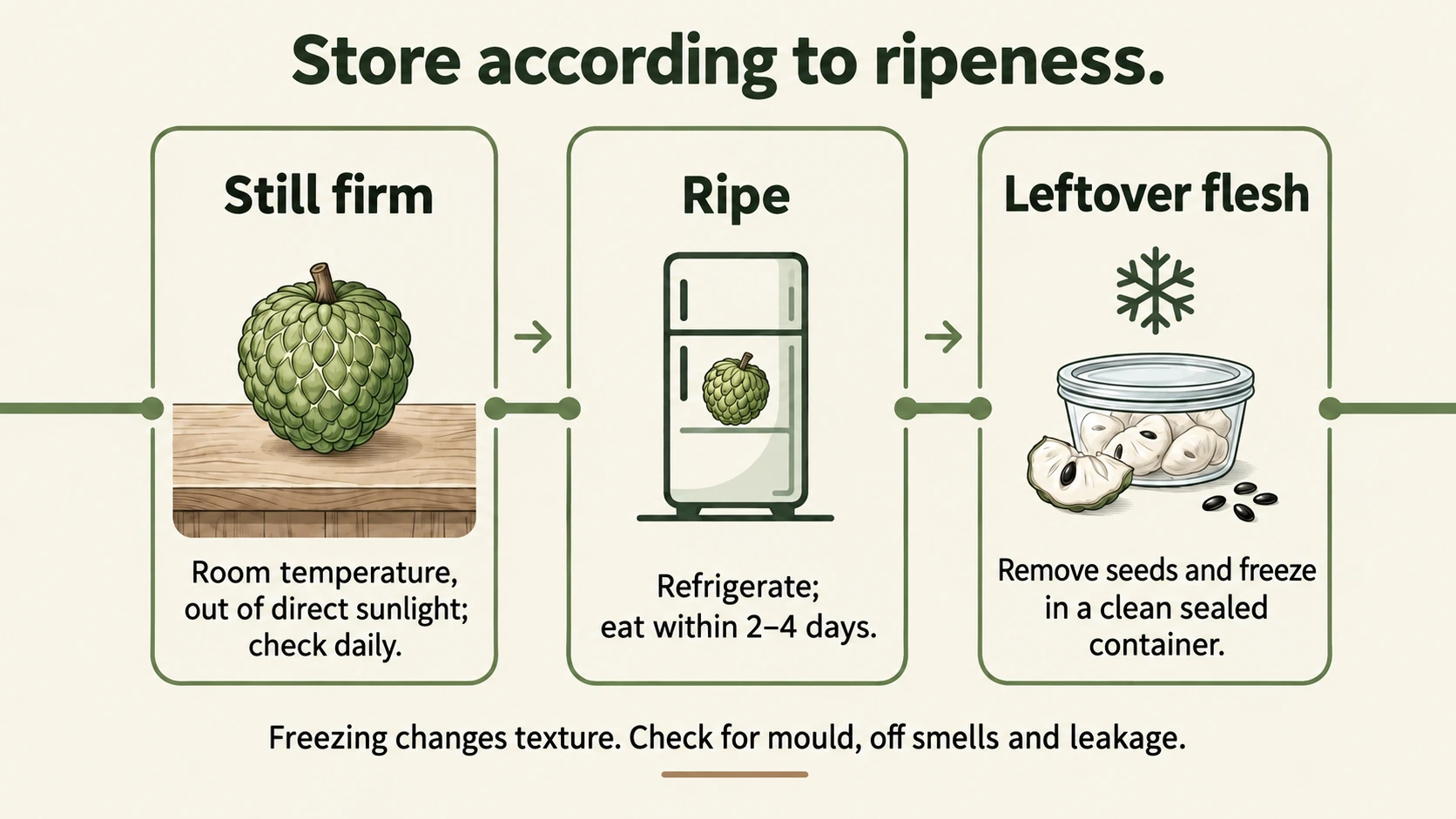
Still firm
Keep mature, firm fruit out of direct sunlight at room temperature. Check it daily, including when using a paper bag. A little give in the skin indicates that it may be ready to eat.
Ripe
Refrigerate ripe fruit and eat it promptly. The University of Florida gives 2–4 days as a short storage guide. Ripeness and temperature affect deterioration, so check for mould, off smells and leakage rather than using the calendar alone.
Leftover flesh
Remove every seed and freeze the flesh in a clean sealed container or freezer bag. The texture changes after thawing, making it more suitable for smoothies or desserts.
Can fresh sugar apples be brought into Japan?
Fresh sugar apples from Vietnam are prohibited from entering Japan. This includes passenger baggage. Obtaining a phytosanitary certificate does not turn them into an allowed souvenir.
Japan’s Plant Protection Station has published enforcement examples involving fresh Vietnamese sugar apples carried as baggage. Check the current conditions before travelling. This information was checked on October 9, 2026.
My Hanoi purchase and tasting notes
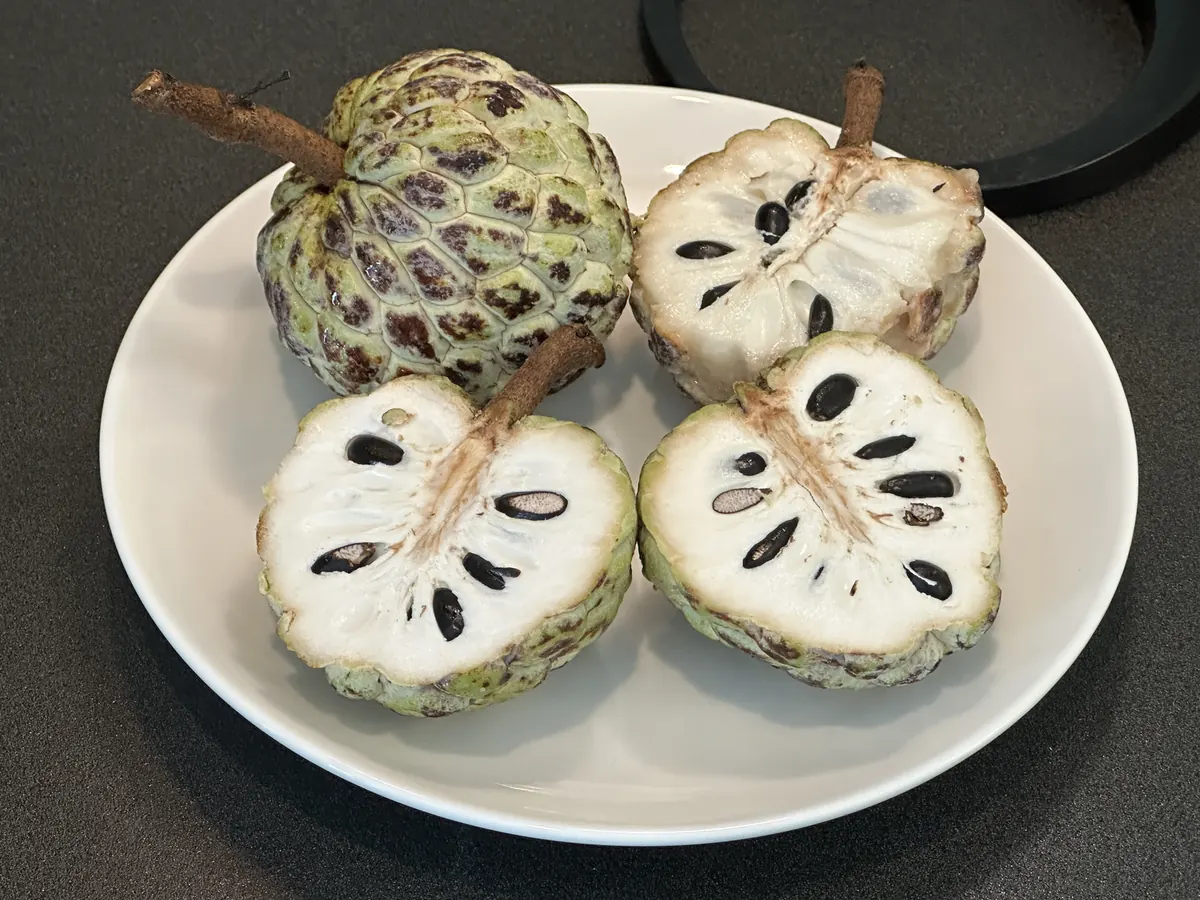
Purchase record
Date: August 8, 2026
Place: a supermarket in Hanoi
Price: VND 4,900 per 100 g, or VND 49,000 per kg
What I tasted: the fruit still had some firmness. Its texture was more crisp and grainy than smooth. Some skin came away by hand. I would like to compare it with fruit allowed to soften further.
This is one tasting experience, rather than a description of every ripe sugar apple. The photograph and purchase record also appeared in the companion Vietnamese-fruit article.
Frequently asked questions
Can I eat a hard sugar apple if I cut it with a knife?
Cutting is possible, but the fruit may not be ripe. If it is harvest-mature, let it soften first. Fruit that stays hard and browns may have been picked too immature.
Can I eat the skin?
The skin is normally removed. Eat the white flesh and discard the seeds.
Are the seeds edible?
No. Remove them; do not chew, crush or grind them.
Can I take it home to Japan?
Not as a fresh fruit from Vietnam. Enjoy it while you are there.
A final eating checklist
- Choose mature fruit with swollen segments.
- Let firm fruit soften before eating.
- Wash the skin before opening.
- Split ripe fruit by hand, or halve and scoop.
- Remove all seeds.
- Refrigerate once ripe and eat promptly.
- Check whether mãng cầu drinks use sugar apple or soursop.
- Do not carry fresh Vietnamese sugar apples into Japan.
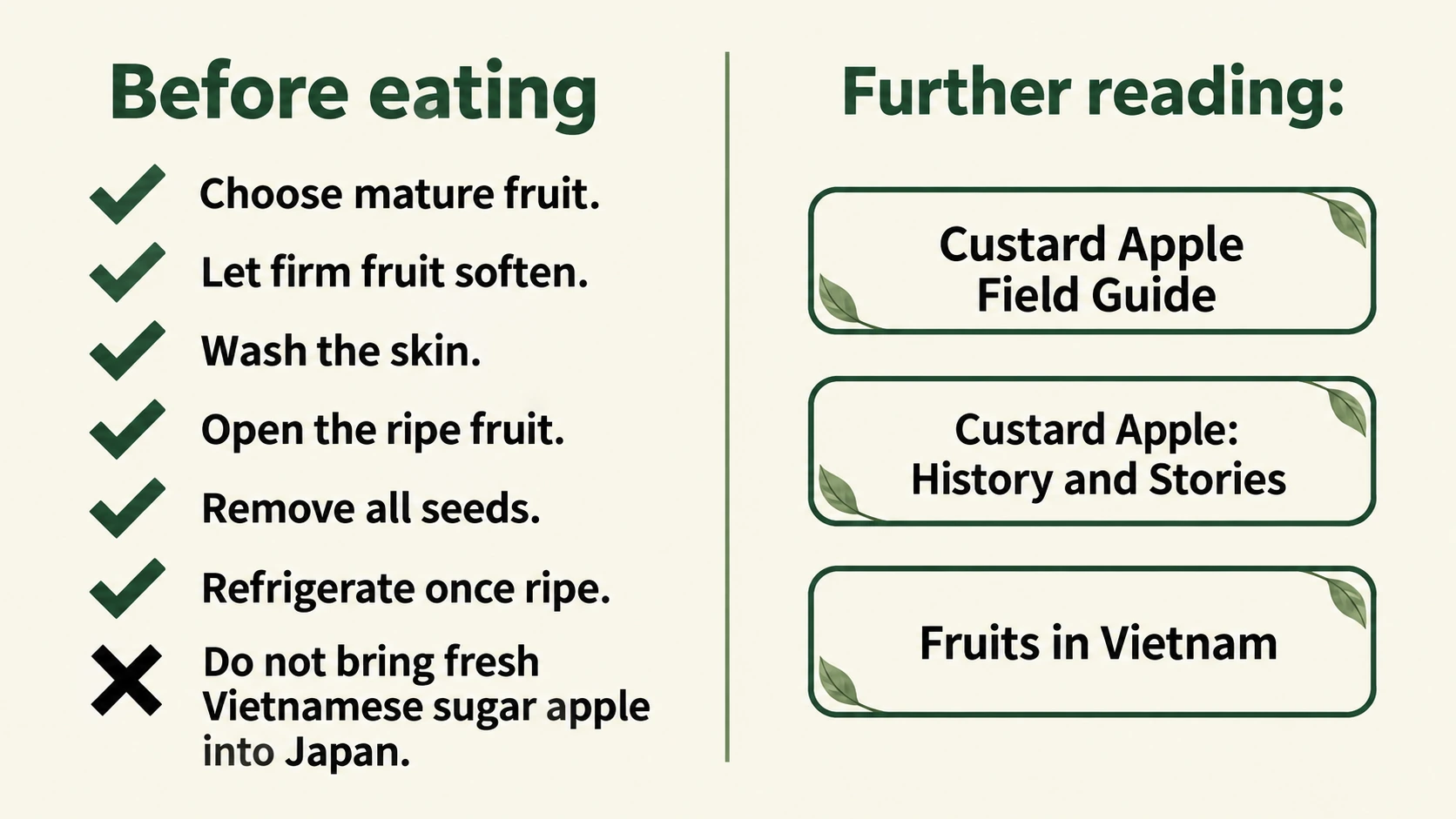
Related articles
- Custard Apple Field Guide: species, flavour, season and nutrition.
- Custard Apple: History and Stories: origins, names and Tết culture.
- Fruits in Vietnam: discover other fruits.
References
- University of Florida IFAS Extension, “Sugar Apple Growing in the Florida Home Landscape”
- Vietnam rural tourism information “Một số mô hình du lịch nông nghiệp nông thôn tiêu biểu ở Tây Ninh”
- Japan Plant Protection Station: enforcement cases under the Plant Protection Act
- Japan Plant Protection Station: frequently asked questions about bringing plants into Japan
- “Seed Waste from Custard Apple (Annona squamosa L.): A Comprehensive Insight on Bioactive Compounds, Health Promoting Activity and Safety Profile”
