この記事の結論
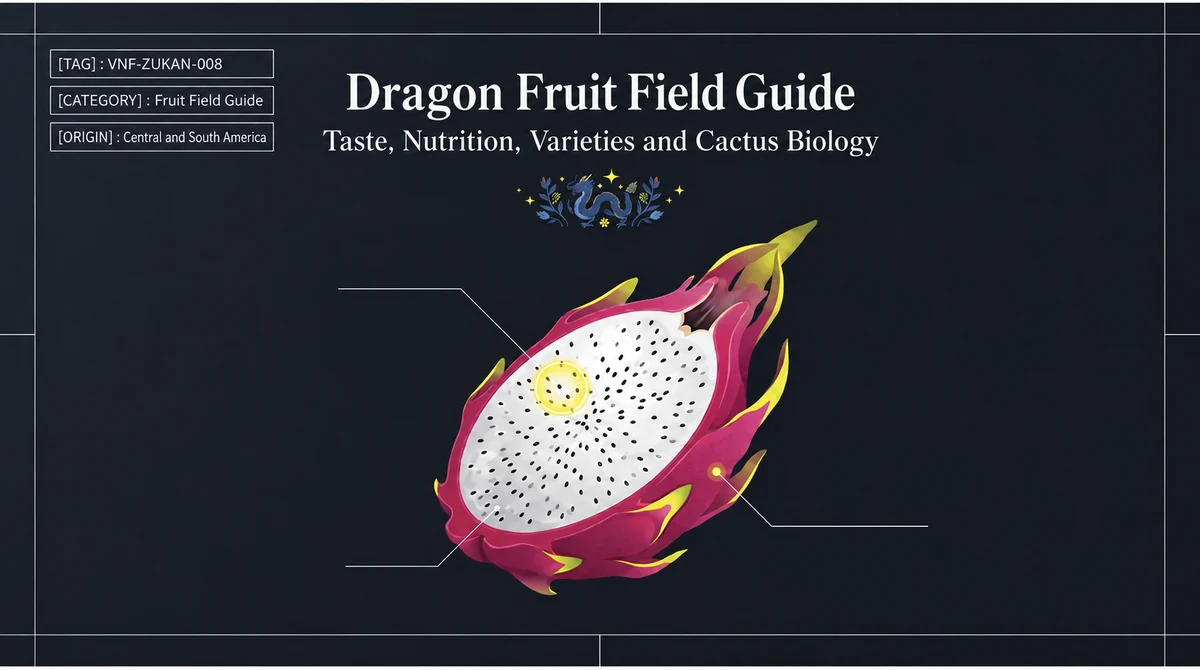
Bright pink skin and scale-like bracts make dragon fruit instantly recognizable. Yet the plant is just as intriguing: it is a climbing cactus that opens large white flowers at nigh…
| 記事タイプ | 主な比較ポイント | 向いている人 |
|---|---|---|
| 図鑑 | 分類・生態・品種・旬 | 特徴や違いを比較したい人 |
| 物語 | 原産地・歴史・文化・伝説 | 背景まで深く知りたい人 |
| 食べ方 | 選び方・切り方・保存方法 | 買って実際に楽しみたい人 |
Bright pink skin and scale-like bracts make dragon fruit instantly recognizable. Yet the plant is just as intriguing: it is a climbing cactus that opens large white flowers at night and produces fruit with white or red flesh.
This illustrated guide covers taste, nutrition and calories, white-fleshed, red-fleshed and yellow-skinned types, the origins of its names, night-blooming flowers and lighting used in cultivation. For choosing and cutting the fruit, see How to Eat Dragon Fruit in Vietnam: Prices, Choosing, Cutting and Storage. For its journey to Vietnam, see Dragon Fruit History and Stories.
Dragon Fruit at a Glance
| Item | Details |
|---|---|
| Common names | Dragon fruit; pitaya or pitahaya; 火龍果 (Chinese) |
| Vietnamese name | Thanh long, a Sino-Vietnamese name meaning “blue/green dragon” |
| Scientific names | Representative species include Selenicereus undatus (formerly placed in Hylocereus) |
| Classification | Perennial climbing succulents in the cactus family (Cactaceae), genus Selenicereus |
| Origins | Vary by species. The representative white-fleshed species S. undatus is native from Mexico to Honduras; yellow-skinned, white-fleshed S. megalanthus is native from Colombia to Peru |
| Stems | Fleshy stems produce aerial roots and climb trees, rocks and supports |
| Cultivation in Japan | Grown in Okinawa, Kagoshima and elsewhere, but domestically grown fruit accounts for a very small share of supply |
| Availability in Vietnam | A familiar fruit available year-round. Vietnam is one of the world’s major producers and exporters |
| Notable nutrients | Dietary fiber, vitamin C and potassium; red-fleshed types also contain the pigment betacyanin |
Sources are listed at the end of this article.
Dragon Fruit Is a Climbing Cactus
Scale-Like Skin and the Origins of Its Names
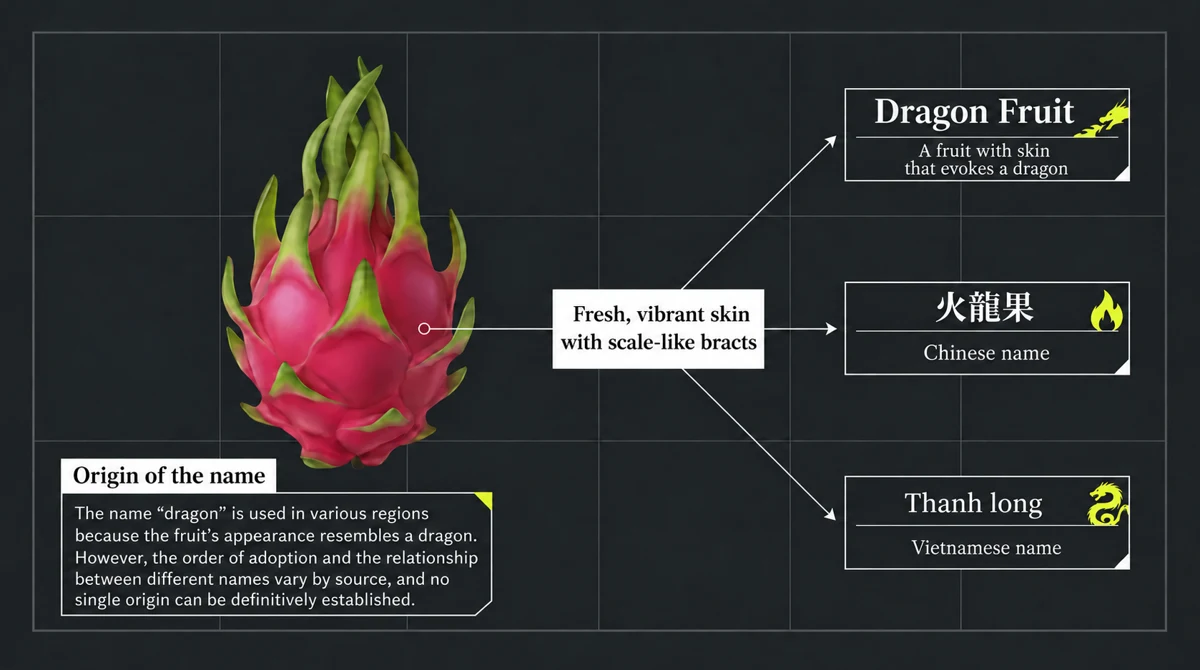
The names “pitaya” and “pitahaya” are generally traced to Indigenous languages of the Antilles and spread through Spanish. The English name “dragon fruit” and Chinese “火龍果” evoke a dragon through the vivid skin and scale-like bracts. Sources differ on which name came first, so it is difficult to establish a simple translation relationship.
In Vietnamese, the fruit is called “thanh long.” In these Sino-Vietnamese words, “thanh” refers to blue or green and “long” to a dragon. Other names in this series have equally vivid origins: longan means “dragon’s eye,” while rambutan derives from the Malay word for hair. Dragon fruit’s name strongly connects its scale-like appearance with the image of a dragon.
A Forest Cactus That Climbs with Aerial Roots
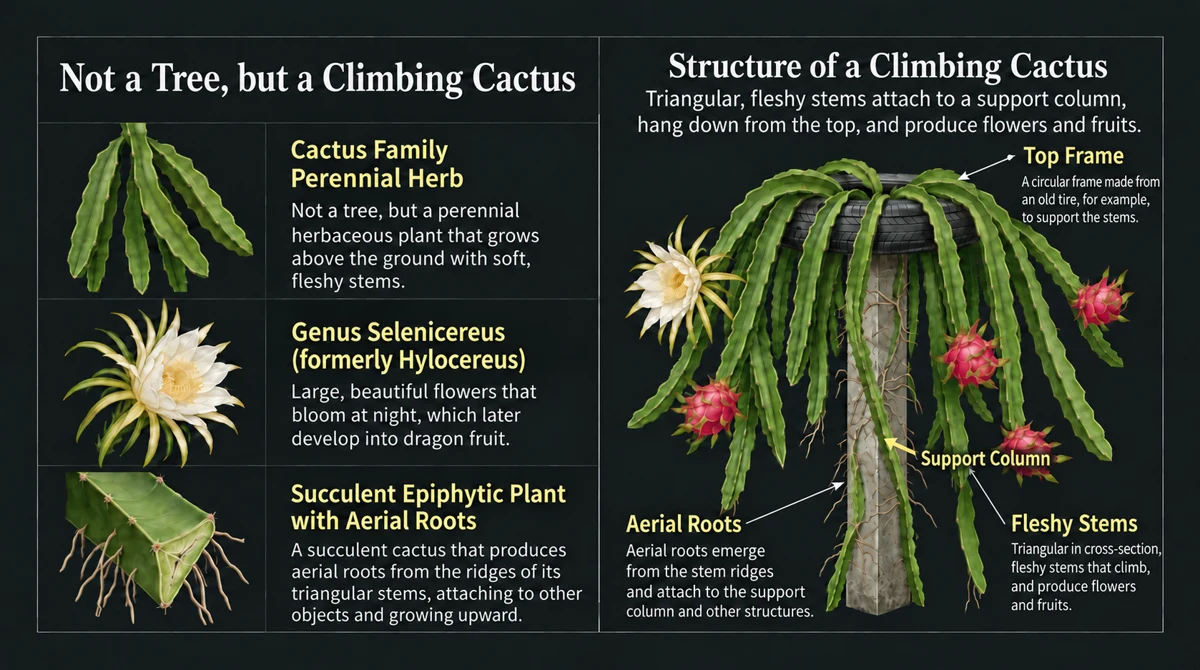
Dragon fruit belongs to a very different group from pineapple (a perennial herb), mango (a tree in the cashew family), and lychee, rambutan and longan (trees in the soapberry family). It is a climbing succulent in the cactus family, genus Selenicereus.
In its native habitat, it grows on trees and rocks, producing aerial roots from its stems to climb higher. Cultivated plants need supports. On Vietnamese farms, concrete posts topped by circular frames are common, with branches trained to hang down. Some frames reuse old tires, creating rows of plants that resemble umbrellas from a distance.
Night-Blooming Flowers and Pollination That Depends on the Cultivar
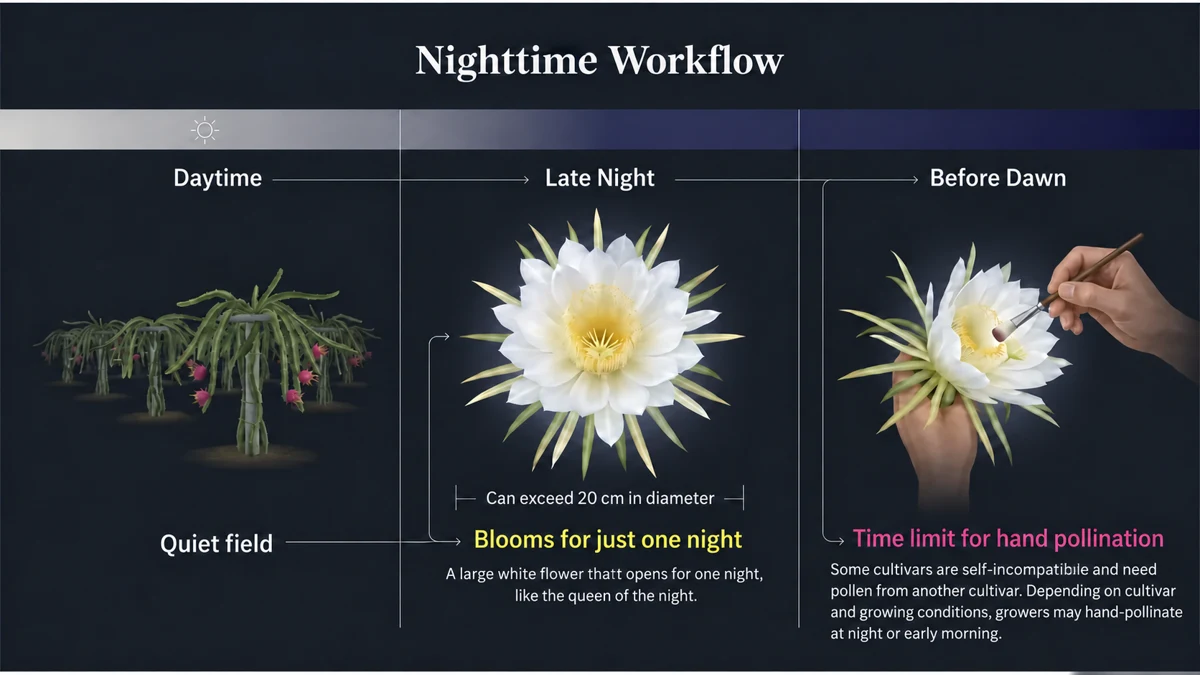
Representative species open large white flowers that can exceed 20 cm across. They bloom from evening into the night and close the next morning. The queen of the night familiar in Japan is also a cactus, but belongs to another genus. In dragon fruit’s native range, nocturnal moths and bats can carry pollen; bees may also visit flowers still open in the morning.
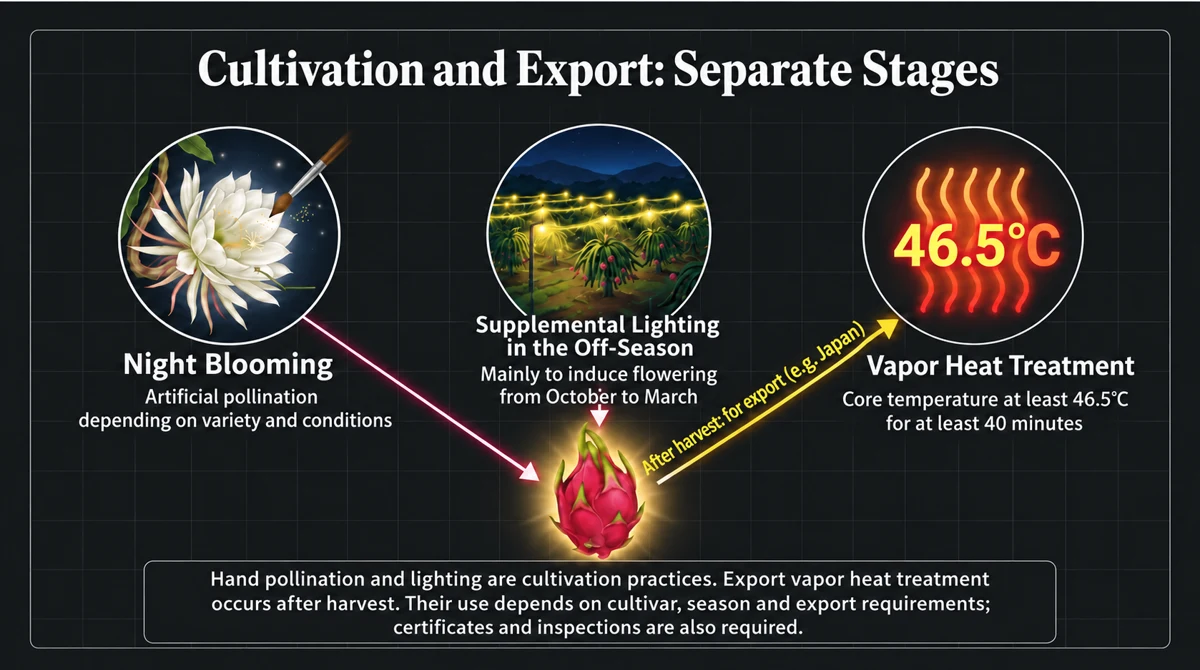
Natural pollinators may be scarce in cultivated areas. Some cultivars are self-incompatible, making fruit set difficult with pollen from the same plant or cultivar. Growers may use a brush to hand-pollinate flowers at night or early in the morning to improve fruit set and fruit size. Hand pollination is not essential for every cultivar or farm, but the short window for this work is a distinctive feature of cultivation.
Lighting Turns Nighttime Fields into a Sea of Light
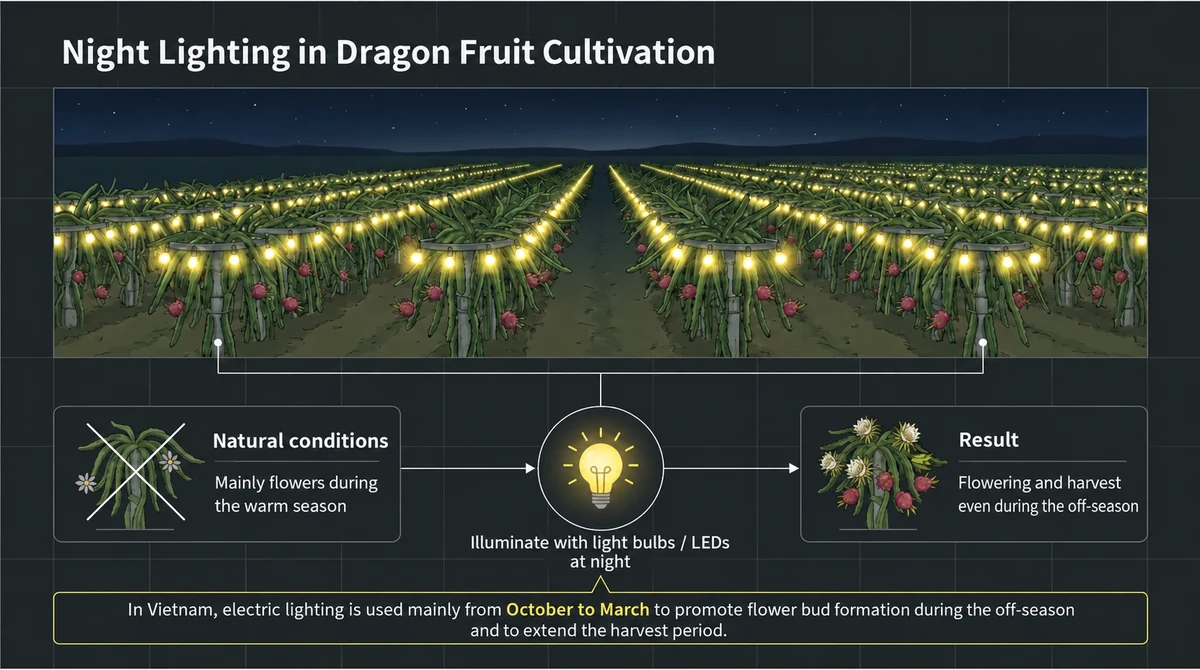
Natural flowering seasons vary by location and cultivar. In Vietnam’s main growing regions, nighttime lighting is widely used to encourage flower-bud formation and extend harvests during the off-season, mainly October to March. Energy-saving LEDs are being introduced alongside incandescent bulbs.
In growing areas such as former Binh Thuan Province, now part of Lam Dong Province, illuminated fields can resemble a sea of light. Whether hand pollination is used depends on the cultivar and farm, but the concentration of flower and lighting management at night is a distinctive aspect of dragon fruit production.
White Flowers, Colorful Flesh
The flowers of commonly marketed representative species are white, but flesh and skin colors differ among species and cultivars. Types include red to magenta flesh, white flesh, and yellow skin with white flesh. The main red-flesh pigment is betacyanin, a member of the betalain group. It is a nitrogen-containing pigment distinct from polyphenols. Antioxidant activity has been reported in laboratory tests, but this does not demonstrate disease prevention from eating the fruit.
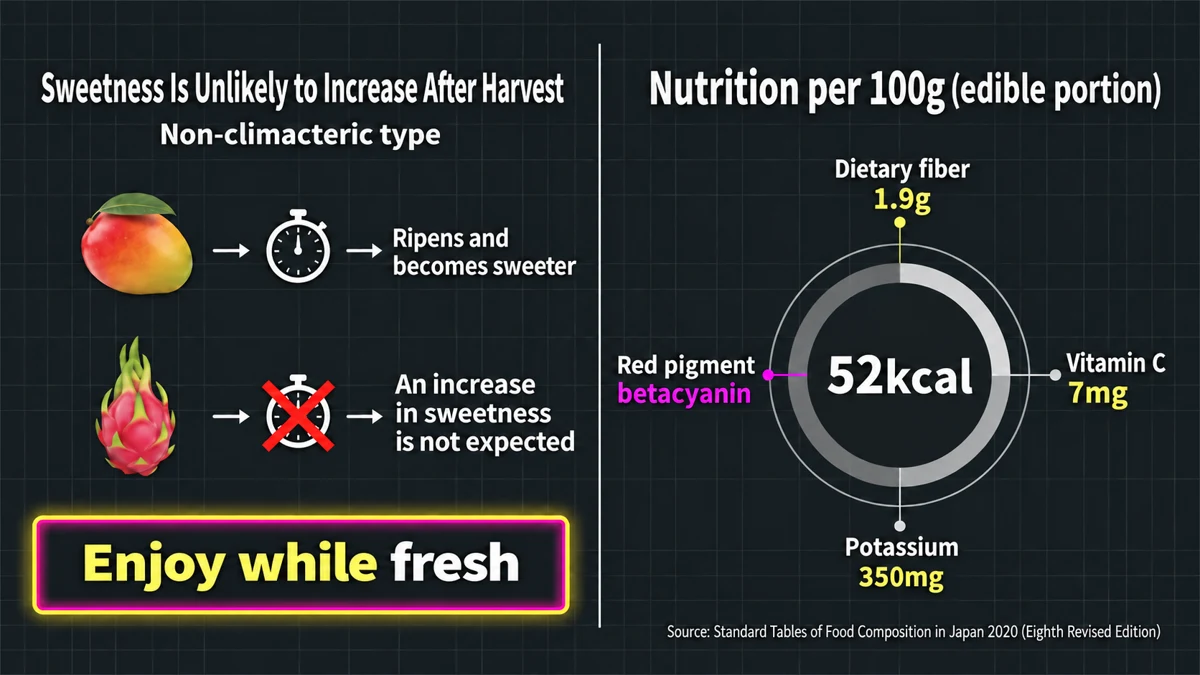
Dragon fruit is non-climacteric: it cannot be expected to become sweeter after harvest. Choose fruit harvested at suitable maturity. Leaving an early-picked fruit to sit will not produce the increase in sweetness associated with mango ripening. Enjoy it while it is in good condition.
What Does Dragon Fruit Taste Like? Sweetness and Texture
The flesh is juicy and soft, with tiny black seeds that add a gentle crunch. Acidity and aroma are relatively mild, and sweetness varies by cultivar and ripeness. Flesh color alone cannot tell you how sweet a fruit will be. My taste comparison and cutting instructions are in How to Eat Dragon Fruit in Vietnam.
Dragon Fruit Nutrition and Calories
The flesh contains the following nutrients and pigments:
- Dietary fiber: 1.9 g per 100 g
- Vitamin C: 7 mg per 100 g
- Potassium: 350 mg per 100 g
- Betacyanin (red-fleshed types): a betalain pigment that gives the flesh its red to purple color
Japan’s Ministry of Education, Culture, Sports, Science and Technology (MEXT) food composition database lists raw dragon fruit at 52 kcal per 100 g. Nutrient values vary with cultivar, growing region and ripeness.
Dragon Fruit Types: White Flesh, Red Flesh and Yellow Skin
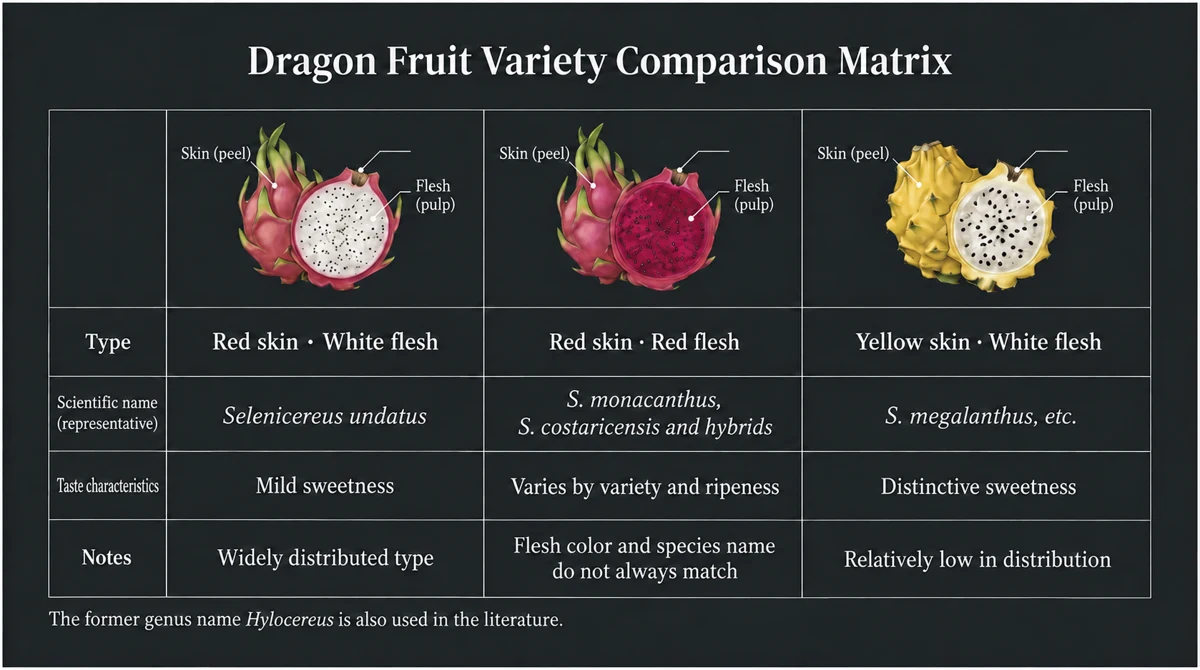
Dragon fruit can be grouped into three broad types by the combination of skin and flesh color.
| Type | Representative scientific names | Characteristics |
|---|---|---|
| Red skin, white flesh | Mainly Selenicereus undatus | The most widely available type; generally juicy with mild sweetness |
| Red skin, red flesh | S. monacanthus, S. costaricensis, hybrids and other lines | Red to purple flesh containing betacyanin. Sweetness and texture vary by cultivar and ripeness |
| Yellow skin, white flesh (yellow pitaya) | S. megalanthus and related material | Yellow skin with white flesh. A different species from the red-skinned types, and less widely available |
Commercial labels such as “white-fleshed” and “red-fleshed” do not always correspond one-to-one with botanical species. The former genus name Hylocereus remains common in horticultural and trade literature.
Main Cultivars Grown in Vietnam
White-fleshed dragon fruit is widely grown in Vietnam, and red-fleshed types are also produced. Look for “ruột trắng” for white flesh and “ruột đỏ” for red flesh.
- Thanh long ruột trắng (white-fleshed): traditional cultivars long grown in Vietnam, with pink to red skin and white flesh
- Thanh long ruột đỏ Long Định 1 (red-fleshed, Long Dinh 1): a representative red-fleshed cultivar developed in southern Vietnam. Sweetness depends on ripeness and growing conditions
Vietnam’s Dragon Fruit Growing Regions and Market Trends
In Hanoi, in northern Vietnam, where I live, dragon fruit is a familiar year-round sight under the name “Thanh long.” To complete the picture, here is a look at the market surrounding this everyday fruit.
Vietnam is one of the world’s major dragon fruit producers and exporters. A 2024 Ministry of Industry and Trade report puts the cultivated area at about 55,000 ha and production at over 1.2 million tonnes at the end of 2023. The main regions were then Binh Thuan, Long An and Tien Giang provinces. White-fleshed dragon fruit from Binh Thuan was registered under Japan’s geographical indication (GI) protection system on October 7, 2021.
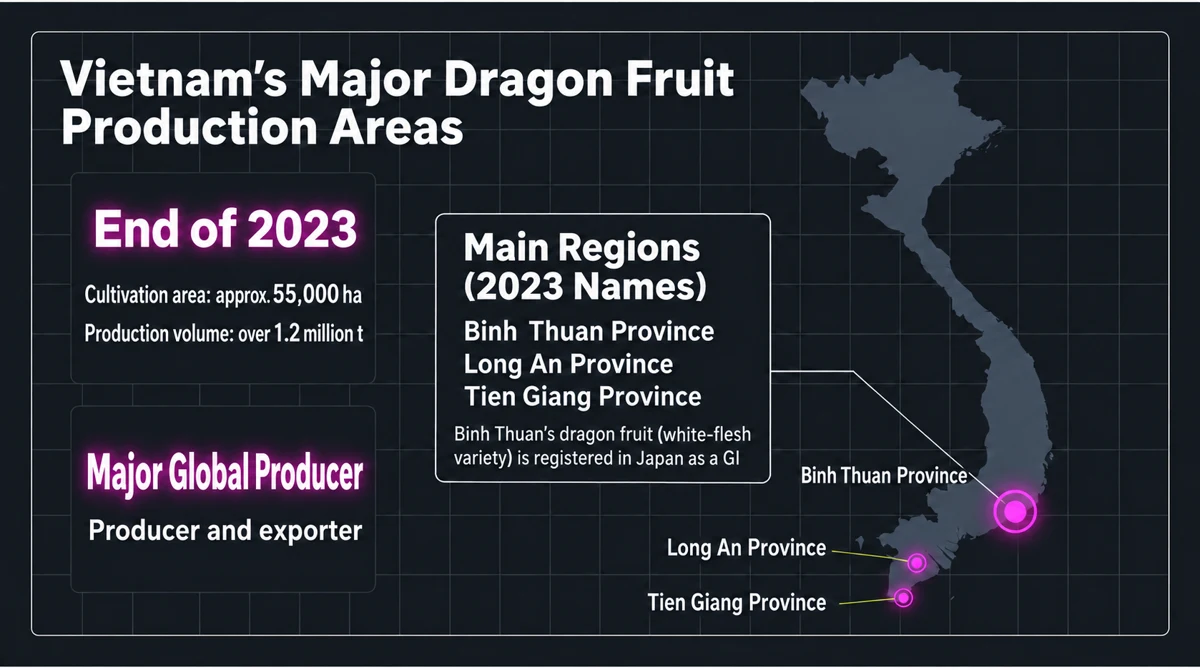
These regional names reflect the 2023 administrative divisions. Under the 2025 reorganization, former Binh Thuan was incorporated into Lam Dong, former Long An into Tay Ninh, and former Tien Giang into Dong Thap.
China has long been a major destination for Vietnamese dragon fruit. As production in China expands and market conditions change, Vietnam faces the challenge of diversifying export destinations and developing processed products. Rankings and market shares depend on the year and scope of the statistics, so this article does not assign a fixed global ranking.
Conditions for Importing Vietnamese Dragon Fruit into Japan
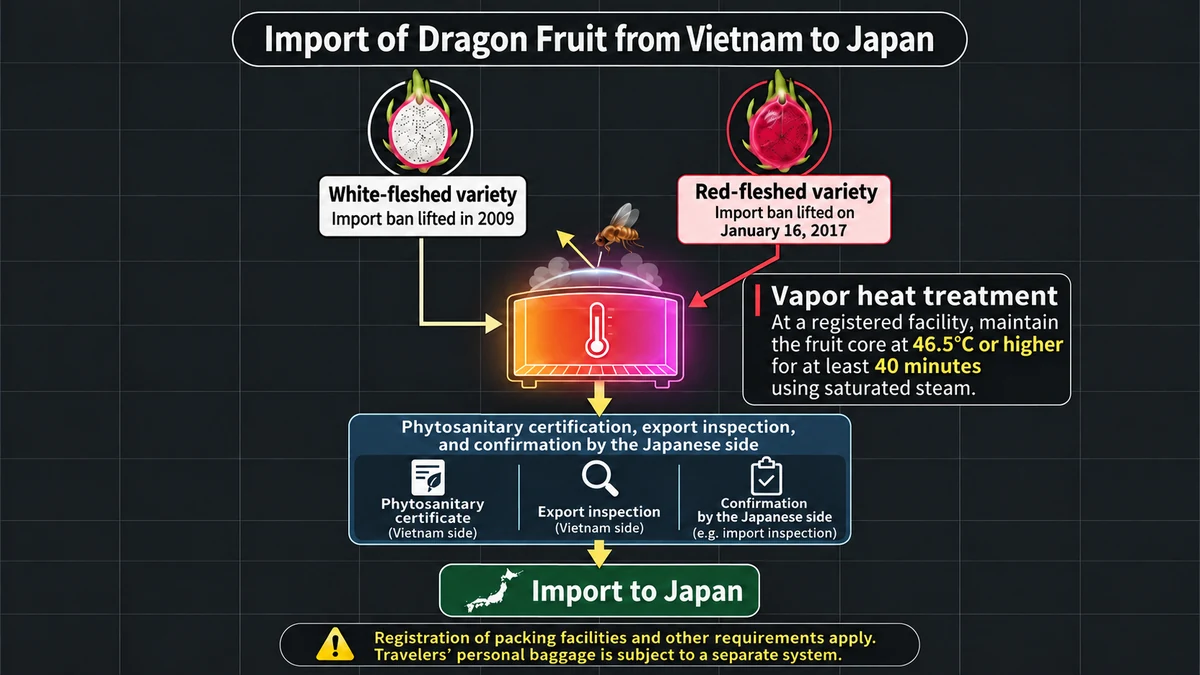
Japan opened imports at different times for different types. Fresh Vietnamese white-fleshed fruit was approved in 2009. Red-fleshed fruit was prohibited for longer because of fruit-fly risks, but fresh imports were approved on January 16, 2017, alongside Vietnam’s approval of fresh Japanese pear imports.
Imports must meet specified plant-quarantine conditions, including vapor heat treatment with saturated steam at a registered facility, maintaining the fruit’s core temperature at or above 46.5°C for at least 40 minutes. A phytosanitary certificate, export inspection and verification by Japanese plant-quarantine officers are also required.
Dragon Fruit Field Guide: Key Points
The main points covered in this guide:
- Dragon fruit is a perennial climbing succulent in the cactus family, genus Selenicereus. Its aerial roots attach to trees and supports as it grows
- Representative species open large flowers at night and close the next morning. Hand pollination may be used depending on cultivar and growing conditions, while lighting to induce off-season flowering is widespread in Vietnam
- Skin and flesh colors vary by species and cultivar. Since sweetness is not expected to increase after harvest, choose appropriately mature fruit and eat it while fresh
- Vietnam is a major producer and exporter. Its main 2023 growing regions were the former provinces of Binh Thuan, Long An and Tien Giang
- Japan approved fresh imports of Vietnamese white-fleshed fruit in 2009 and red-fleshed fruit in 2017
For other fruits to discover, see 15 Vietnamese Fruits.
Frequently Asked Questions About Dragon Fruit
What kind of plant is dragon fruit?
It is a perennial climbing succulent in the cactus family, genus Selenicereus. Even when plants look like small trees in a field, their stems are trained around supports.
What does dragon fruit taste like?
It is generally juicy with mild sweetness. Flavor and texture depend on cultivar, ripeness and growing conditions, rather than simply whether the flesh is white or red.
How many calories does dragon fruit contain?
MEXT’s Japanese food composition database lists raw dragon fruit at 52 kcal per 100 g.
How do white-fleshed and red-fleshed types differ?
The main differences are flesh color and pigment. Red-fleshed types contain betacyanin, a betalain pigment. Sweetness varies with cultivar and ripeness.
When is dragon fruit in season?
Vietnam’s Ministry of Industry and Trade 2024 report gives the normal harvest season as April–September and the off-season as October through February or March of the next year. Lighting and other cultivation practices help make the fruit available almost year-round. Harvest timing varies by region and cultivar.
References
- Royal Botanic Gardens, Kew, Plants of the World Online“Selenicereus undatus”
- Royal Botanic Gardens, Kew, Plants of the World Online“Selenicereus costaricensis”
- Royal Botanic Gardens, Kew, Plants of the World Online“Selenicereus monacanthus”
- Royal Botanic Gardens, Kew, Plants of the World Online“Selenicereus megalanthus”
- University of Florida IFAS Extension“Pitaya (Dragonfruit) Growing in the Florida Home Landscape”
- UC Davis Postharvest Research and Extension Center“Dragon Fruit”
- MEXT Food Composition Database: Raw Dragon Fruit (in Japanese)
- Li et al.“A review on the advances of dragon fruit”Tropical Plants 3, e041 (2024)
- Vietnam Ministry of Industry and Trade: Tình hình sản xuất trái thanh long (2024 report; end-2023 area and production; in Vietnamese)
- MAFF: GI Registration No. 110, Binh Thuan Dragon Fruit (in Japanese)
- MAFF: Approval of Fresh Vietnamese Dragon Fruit Imports (in Japanese)
- MAFF material hosted by JETRO: Progress of Import-Approval Verification Procedures (Vietnamese red-fleshed dragon fruit; in Japanese)
- JETRO: Approval of Fresh Japanese Pear Imports (Vietnam, Japan; in Japanese)
- Government of Vietnam: Resolution on the 2025 Administrative Reorganization
- Phan Thi Thu Hien: The Dragon Fruit Export Challenge and Experiences in Vietnam, FFTC Agricultural Policy Platform (2019)
