Pears are called quả lê in Vietnamese and are also grown in northern Vietnam’s Bắc Hà region. Harvest timing varies by cultivar: reports describe VH6 harvesting from late June to mid-July and local green pears from late August to early September.
This guide introduces Japanese, Chinese and European pears, their flavor and nutrition, and the origins and seasons of pears you may encounter in Vietnam. The harvest-season section identifies the years and sources behind those dates.
Contents
- What is a pear? Names, origins and botanical basics
- Pear trees, flowers and fruit
- Japanese, Chinese and European pears: how do they differ?
- Pear nutrition and calories: a comparison per 100 g
- Growing pears: winter chill and cultivar differences
- Pear seasons in Japan and Vietnam
- Pears in Vietnam: Bắc Hà’s VH6 and local green pears
- Five points to remember about pears
- More in the pear trilogy
- References and source dates
What is a pear? Names, origins and botanical basics
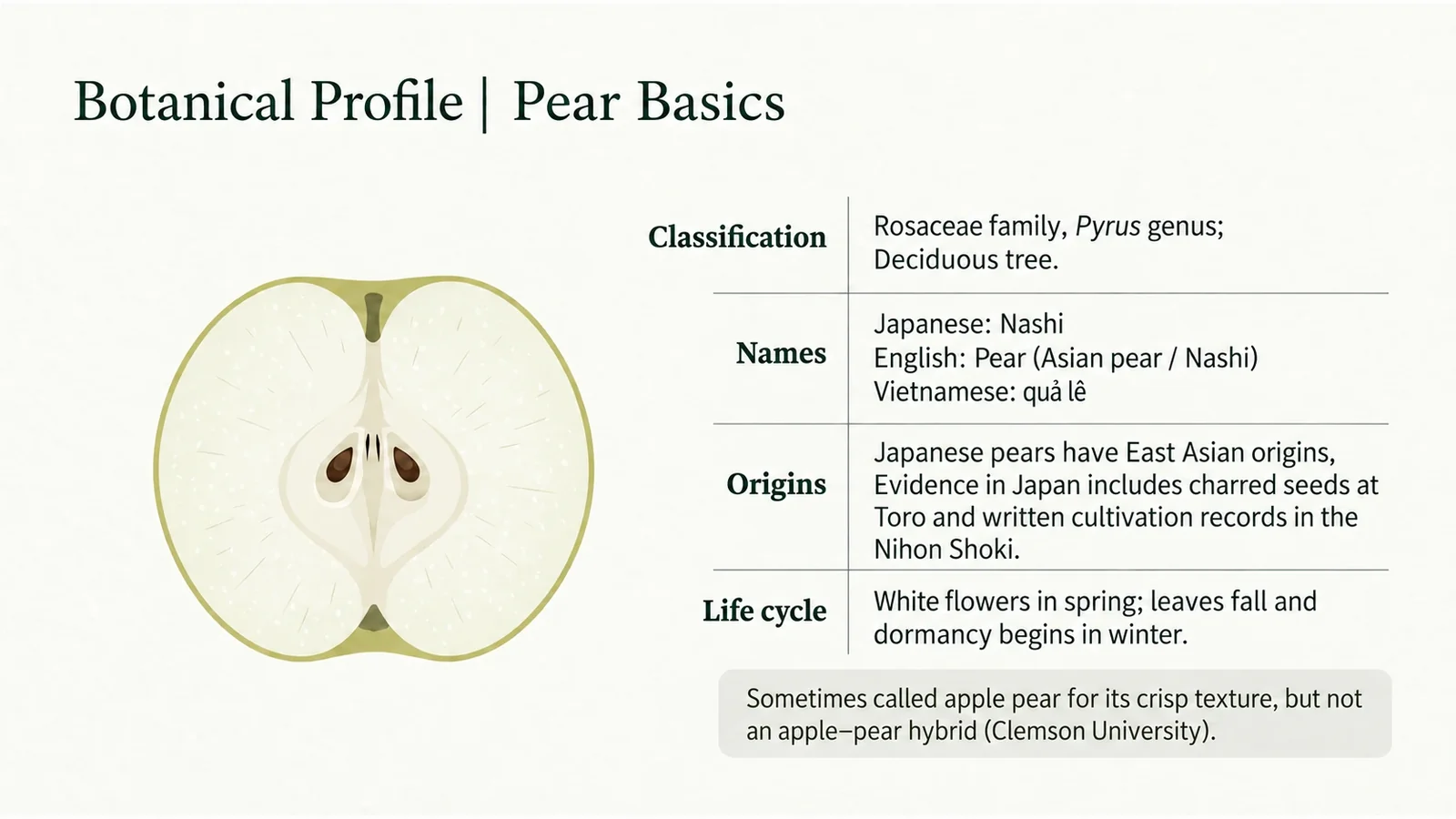
| Feature | Details |
|---|---|
| Japanese name | Nashi |
| English name | Pear; Japanese pears are also called Asian pears or nashi |
| Vietnamese name | quả lê |
| Classification | Family Rosaceae, genus Pyrus |
| Scientific names | Japanese pear: Pyrus pyrifolia; Chinese pear: Pyrus bretschneideri; European pear: Pyrus communis |
| Origins | Japanese pears have East Asian origins; they are not native exclusively to Japan |
| Growth habit | Deciduous trees with white spring flowers; leaves fall in winter |
| Pollination | Many cultivars set fruit poorly with their own pollen: self-incompatibility |
| Texture | Japanese pears are crisp and juicy; European pears develop smooth flesh as they ripen after harvest |
| Components and texture | Water, potassium and sorbitol; stone cells contribute to grittiness |
| Examples of Vietnamese growing areas | Bắc Hà, Lào Cai Province: VH6 and local green pears |
Scientific names follow Japan’s Ministry of Education, Culture, Sports, Science and Technology (MEXT) food composition database, cited below. Botanical details draw on Clemson University’s Asian Pear factsheet, and origins on Kawasaki City’s pear history. The Japanese source edition checked these on September 29, 2026. Taxonomic treatment varies between references.
Pear trees, flowers and fruit
White spring flowers and winter dormancy
Pear trees flower in spring and bear fruit in summer or autumn, then lose their leaves and become dormant in winter. “Asian pear” commonly covers Japanese and Chinese pears. The name “apple pear” refers to the round shape and crisp bite of some types, not a cross between apples and pears. Source: Clemson University HGIC.
Why compatible pollen matters
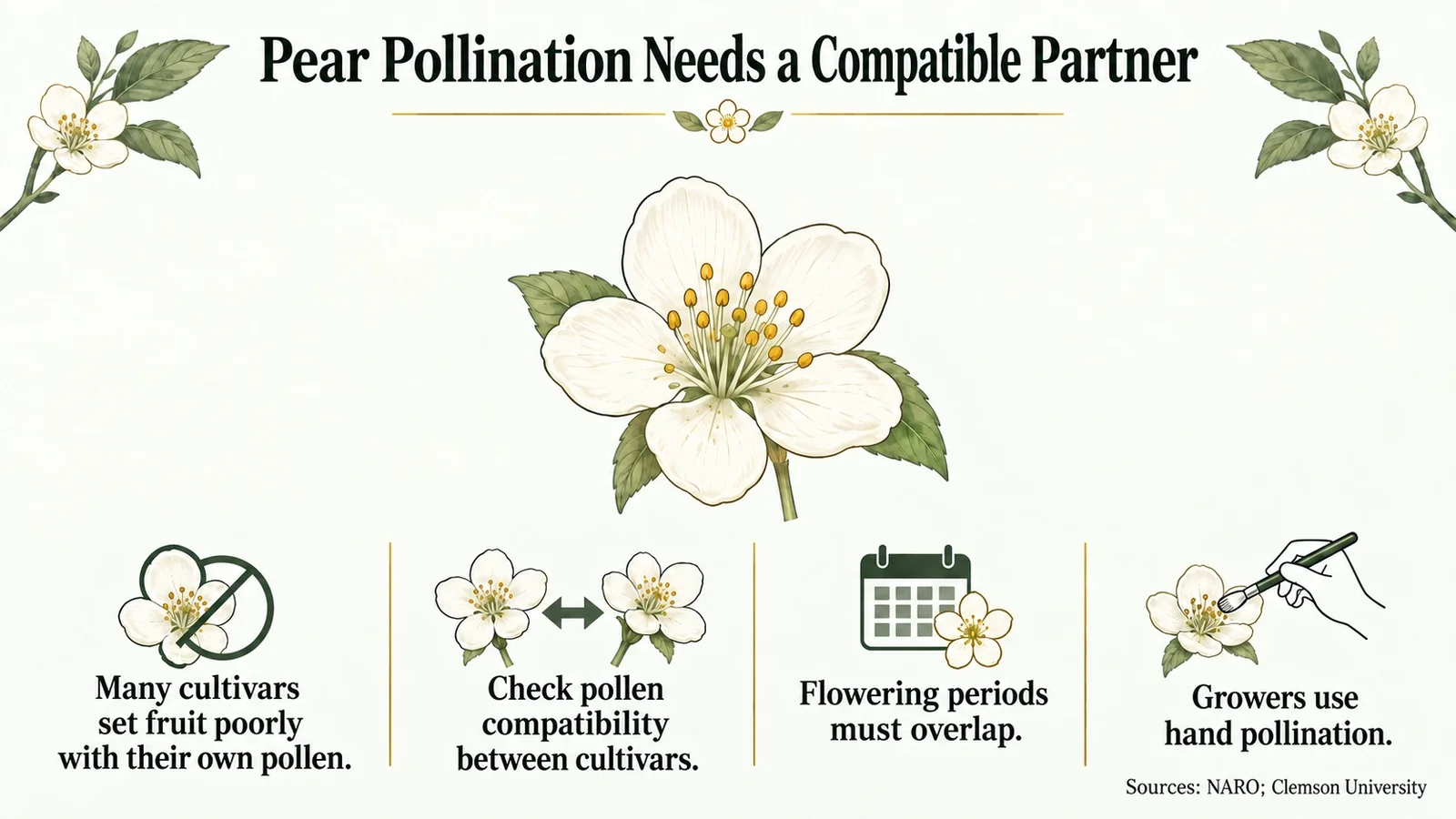
Many major Japanese pear cultivars are self-incompatible. Japan’s National Agriculture and Food Research Organization (NARO) explains that pollen and pistils distinguish self from non-self, preventing fertilization by the tree’s own pollen. Growers therefore often apply pollen from another cultivar by hand. This labor-intensive work must be done during the short flowering period. Source: NARO, December 16, 2015.
Not every other cultivar is a suitable partner. Pollen compatibility and overlapping flowering periods both matter. Source: Clemson University.
The same NARO report introduces ‘Narumi’, a cultivar able to set fruit with its own pollen, illustrating breeding efforts to reduce hand-pollination work.
East Asian origins and Japanese cultivation
Kawasaki City traces cultivated Japanese pears to wild Japanese pears originating in central and southern Japan, the southern Korean Peninsula and areas along China’s Yangtze River. Its account also mentions charred seeds at Japan’s Toro archaeological site and references in the Nihon Shoki, evidence of a long association with the fruit. Source: Kawasaki City.
Nijisseiki, or ‘Twentieth Century’, is a well-known green-skinned cultivar discovered in Matsudo, Chiba, and widely grown in Tottori. Read about its discoverer and name in Pear History and Stories.
Japanese, Chinese and European pears: how do they differ?
| Group | Examples | Eating characteristics |
|---|---|---|
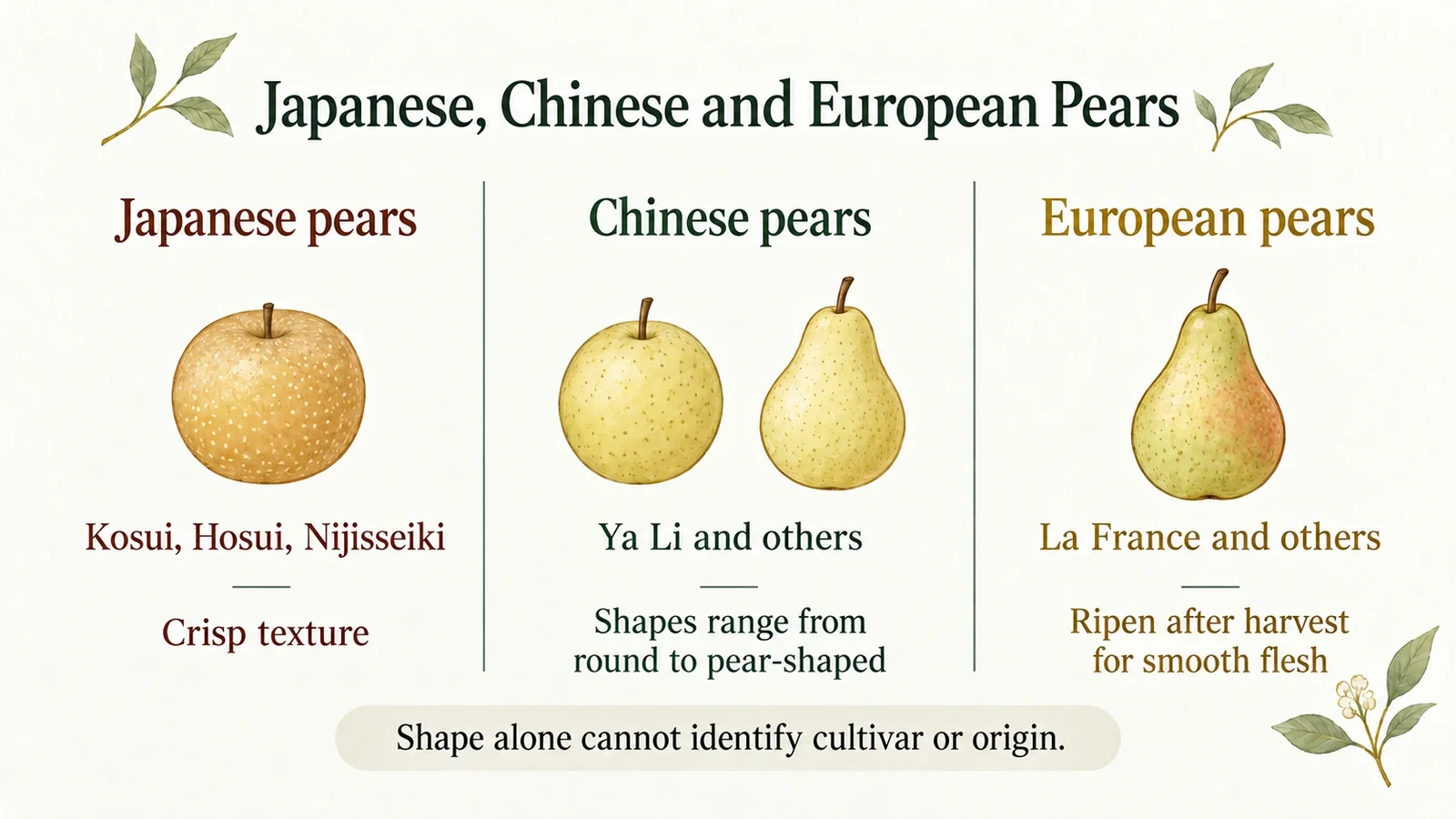
| Japanese pears | Kosui, Hosui, Niitaka, Nijisseiki | Ripened on the tree; enjoy their crisp texture soon after purchase |
| Chinese pears | Ya Li and others | Crisp flesh; shapes vary from round to pear-shaped |
| European pears | La France, Bartlett and others | Ripened after harvest and eaten when the flesh has softened |
These are general examples, not a list of cultivars necessarily available in Vietnamese shops. Taiwan’s Ministry of Agriculture also discusses East Asian cultivars such as Ya Li in its January 2003 account.
Japanese pears: russet and green skins
Japanese pears are commonly divided by skin color into russet-skinned types, such as Kosui and Hosui, and green-skinned types, such as Nijisseiki. Nijisseiki is known for abundant juice, sweetness and refreshing acidity. Source: Kudamono Navi, Nijisseiki.
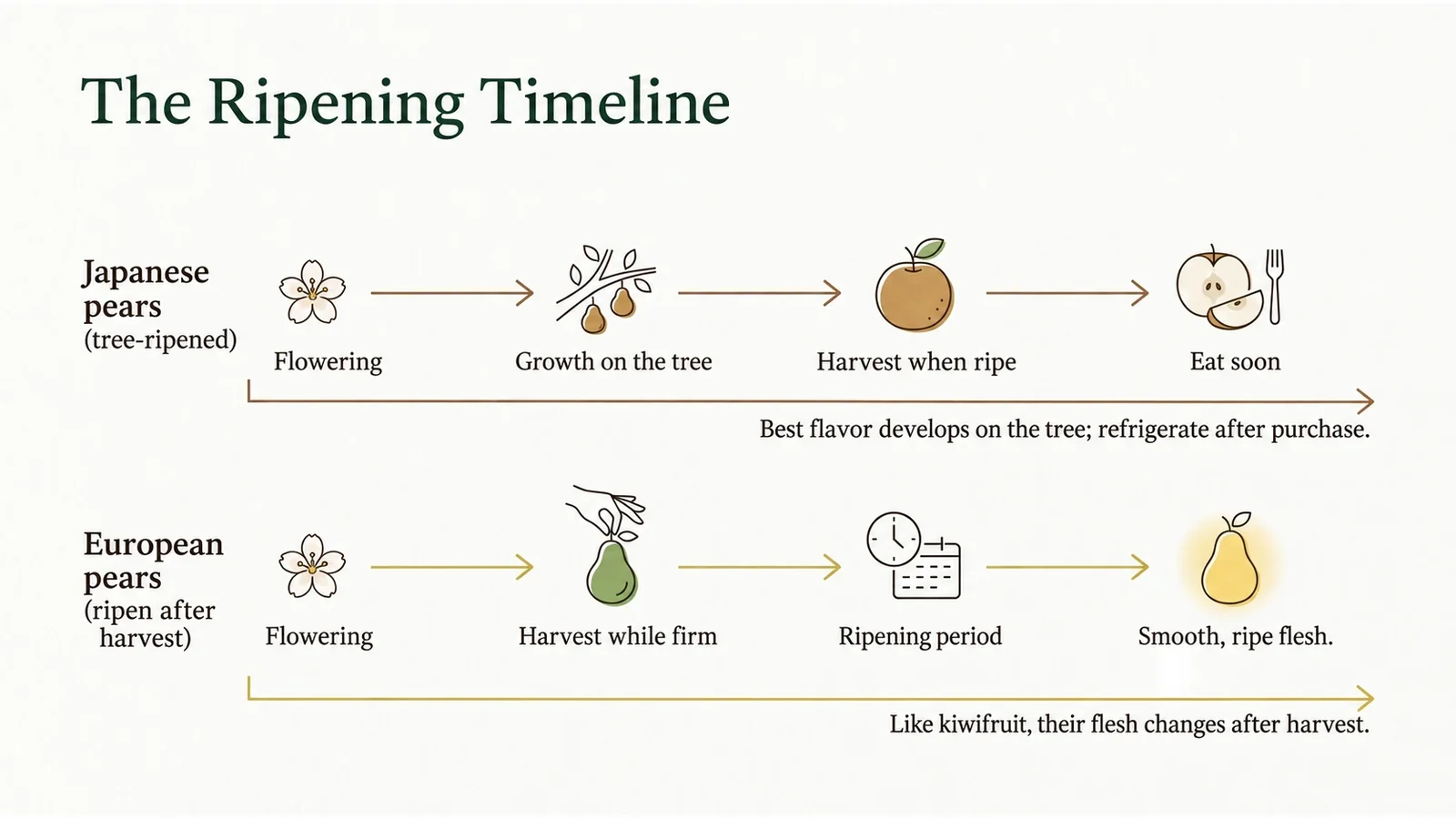
European pears: ripening after harvest
Clemson explains that Asian pears taste best when ripened on the tree, unlike European pears. Their flesh is crisp and juicy, with some tartness near the core, a different texture from a soft, sweet European pear. Source: Clemson University HGIC.
European pears are harvested while firm and develop smoother flesh afterward. Like kiwifruit, they belong to the group of fruits commonly ripened before eating.
Stone cells and the gritty bite
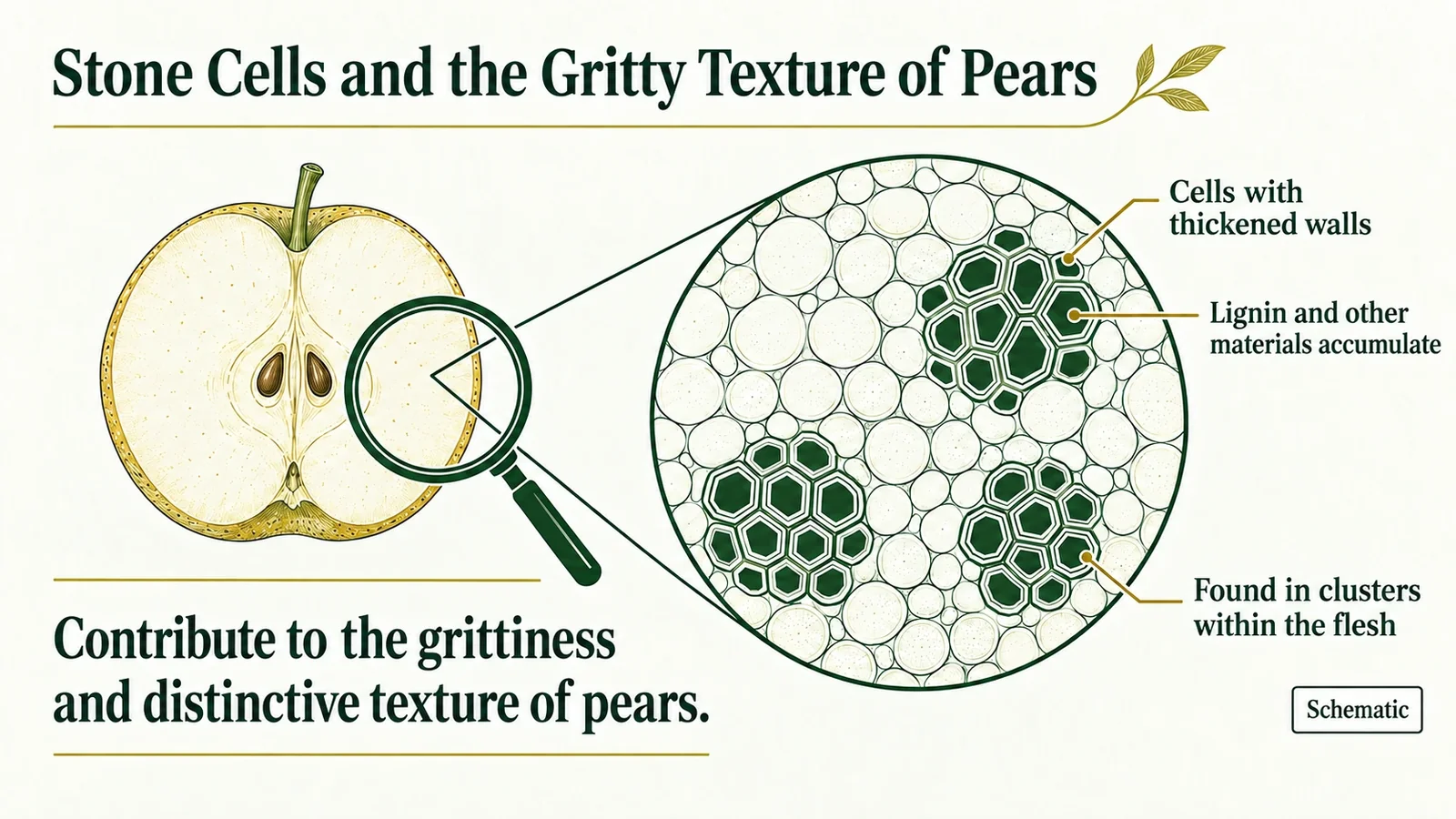
Stone cells, or sclereids, contribute to the grittiness and distinctive texture of pear flesh. These cells have thickened walls containing accumulated lignin and other materials, and occur in clusters. A 2007 study of ‘Niitaka’ examined stone-cell development up to around 60 days after full bloom. Source: Journal of the Japanese Society for Horticultural Science, 76(3).
Pear nutrition and calories: a comparison per 100 g
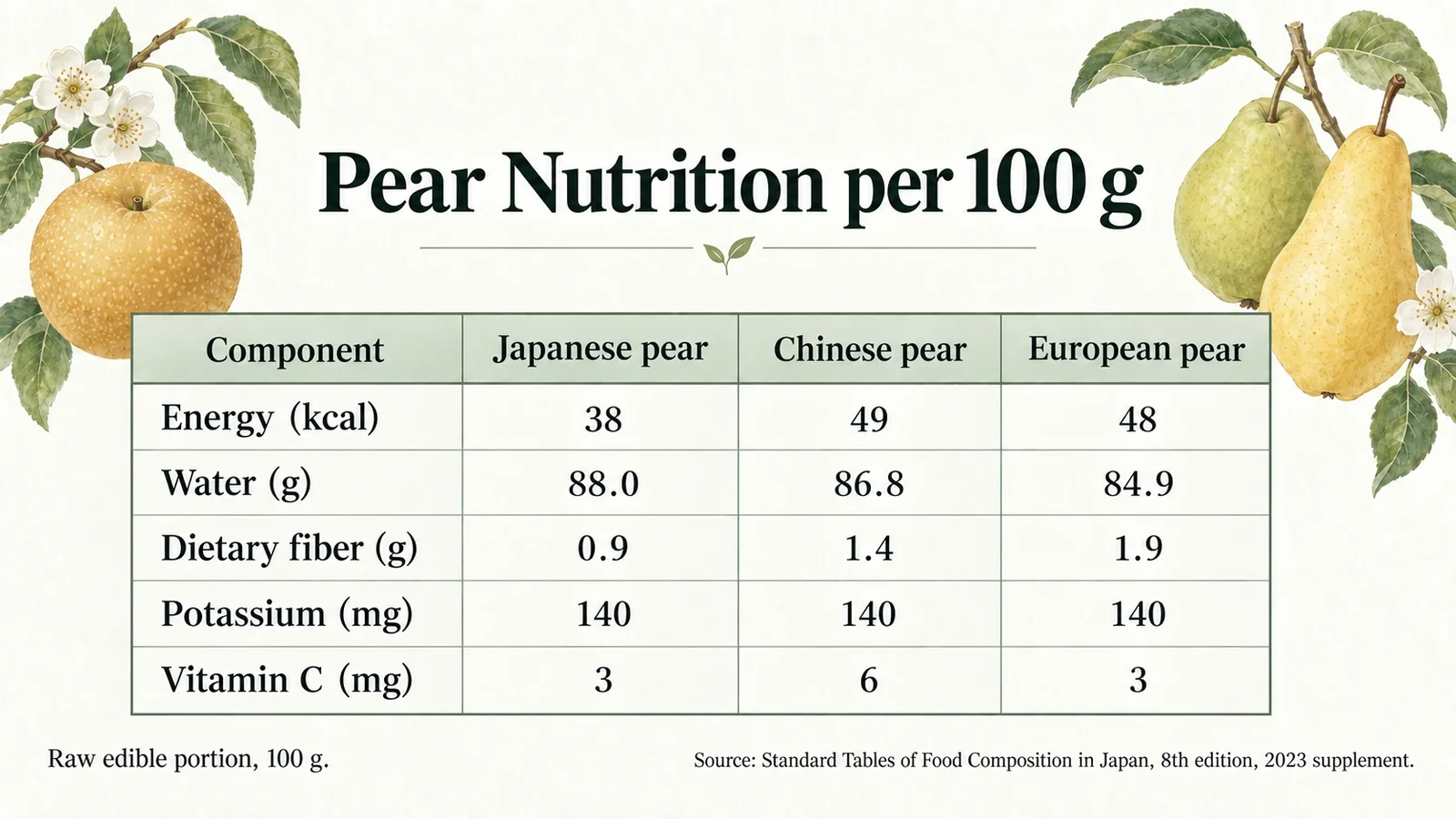
Japan’s MEXT food composition database lists the three groups separately. These figures are for 100 g of raw edible flesh, excluding the peel, core and other inedible portions.
| Component per 100 g edible portion | Japanese pear, raw | Chinese pear, raw | European pear, raw |
|---|---|---|---|
| Energy | 38 kcal | 49 kcal | 48 kcal |
| Water | 88.0 g | 86.8 g | 84.9 g |
| Carbohydrate | 11.3 g | 12.7 g | 14.4 g |
| Dietary fiber | 0.9 g | 1.4 g | 1.9 g |
| Potassium | 140 mg | 140 mg | 140 mg |
| Vitamin C | 3 mg | 6 mg | 3 mg |
Sources: MEXT entries for Japanese pear, Chinese pear and European pear, Standard Tables of Food Composition in Japan, eighth edition, 2023 supplement. Checked in the Japanese source edition on September 29, 2026.
Japanese pear contains 88.0 g of water per 100 g edible portion. In this table it has the lowest energy value, at 38 kcal, while European pear has the most dietary fiber, at 1.9 g. These figures help compare the groups.
Japanese pear also contains 1.5 g of the sugar alcohol sorbitol per 100 g edible portion. Source: MEXT carbohydrate data.
These are not values per whole fruit. The Japanese composition-table values do not necessarily match an individual pear sold in Vietnam.
Growing pears: winter chill and cultivar differences
Chilling requirements vary
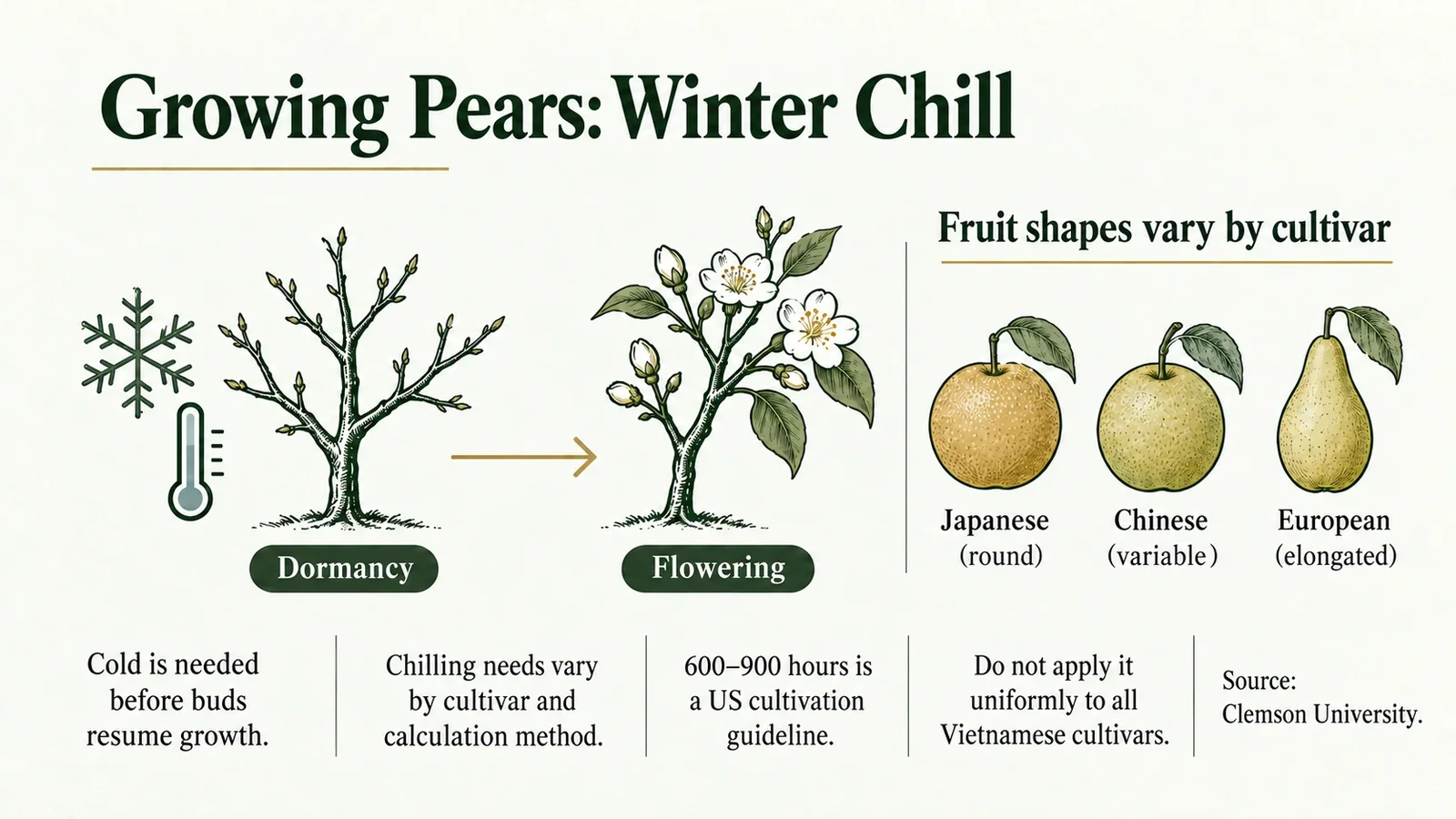
Deciduous fruit trees need a period of winter cold for normal bud development in spring. This is called their chilling requirement.
The amount depends on the cultivar and calculation method, so simple comparisons with other fruit trees can be misleading.
Clemson gives 600–900 chilling hours for Asian pears, noting that some cultivars need less. This is guidance for South Carolina, USA, and should not be applied directly to every cultivar in Vietnam. Source: Clemson University HGIC.
Vietnamese reports describe pear growing in the northern mountains. Winter cold matters, but a single source cannot define all suitable growing areas.
Fire blight in the US growing guide
The same South Carolina guide identifies fire blight, a bacterial disease, as a major production problem. Flowers and shoots can die with a scorched appearance. Resistant cultivars and orchard sanitation are among its management measures. This is the context of the US guidance, not a claim about disease prevalence in Vietnam. Source: Clemson University HGIC.
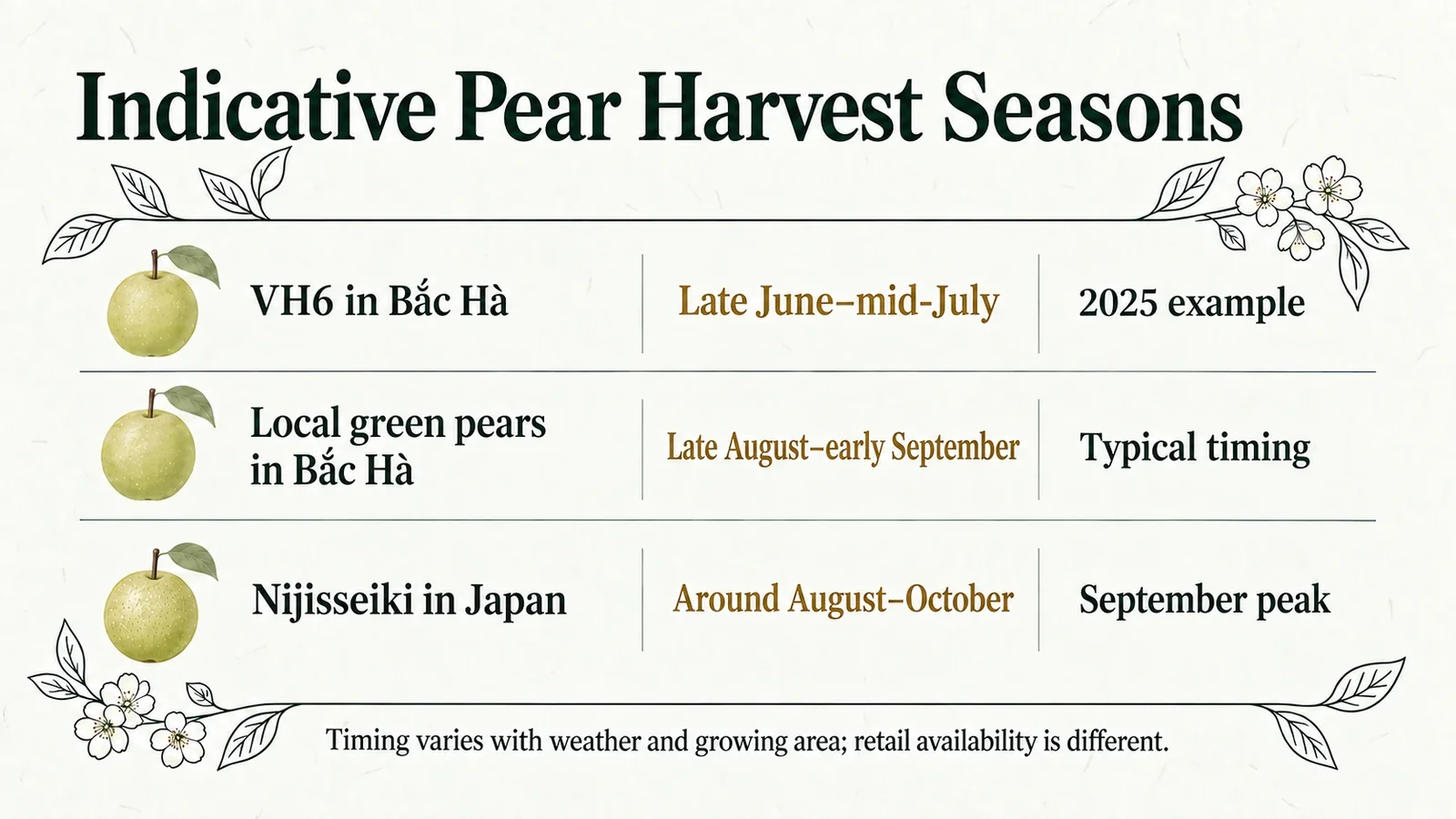
Pear seasons in Japan and Vietnam
Japanese pears are a summer-to-autumn fruit. Japan’s Ministry of Agriculture, Forestry and Fisheries (MAFF) reported a provisional 167,900 tonnes harvested in 2025. Leading prefectures by harvest volume were Chiba, Ibaraki, Tochigi, Fukushima and Tottori, in that order. Source: MAFF, published February 17, 2026.
In Vietnam, distinguish VH6 from local green pears when considering the season.
| Area and cultivar | Reported harvest period | Source |
|---|---|---|
| VH6 in the Bắc Hà area | Late June to mid-July, 2025 | Công Thương, 2025 |
| Local green pears in Bắc Hà | Usually late August to early September; earlier in dry conditions in 2024 | Báo Lào Cai, 2024 |
| Nijisseiki in Japan, for comparison | Around August–October, peaking in September | Kudamono Navi |
Weather shifts harvest dates from year to year. Imported pears, including Korean fruit, also appear in shops, so availability is not limited to these harvest windows. Check the origin on the label or packaging.
Pears in Vietnam: Bắc Hà’s VH6 and local green pears
The Vietnamese name: quả lê
Pears are called quả lê. Labels may add a country, as in lê Hàn Quốc, meaning Korean pears.
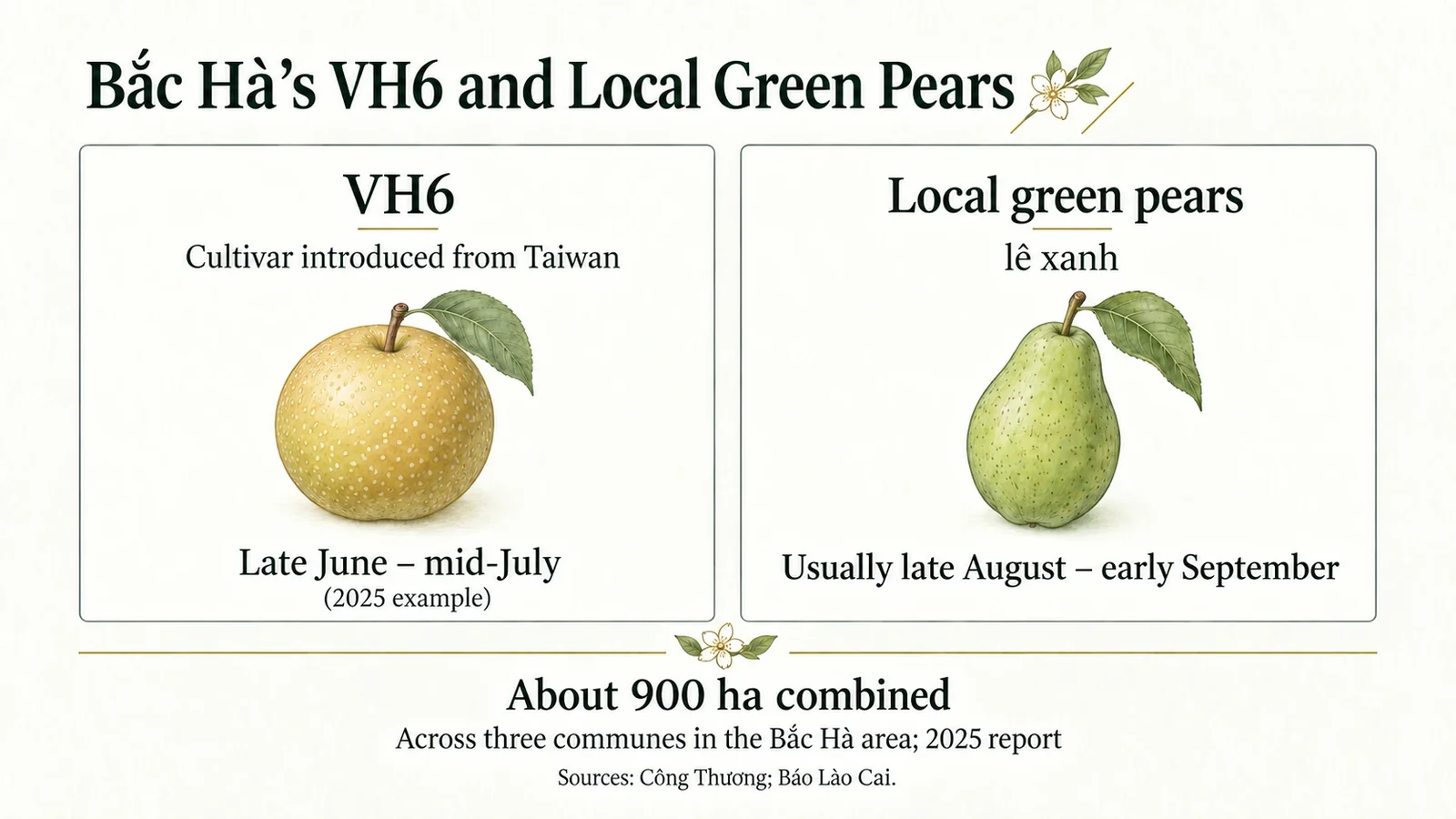
VH6: a cultivar introduced from Taiwan
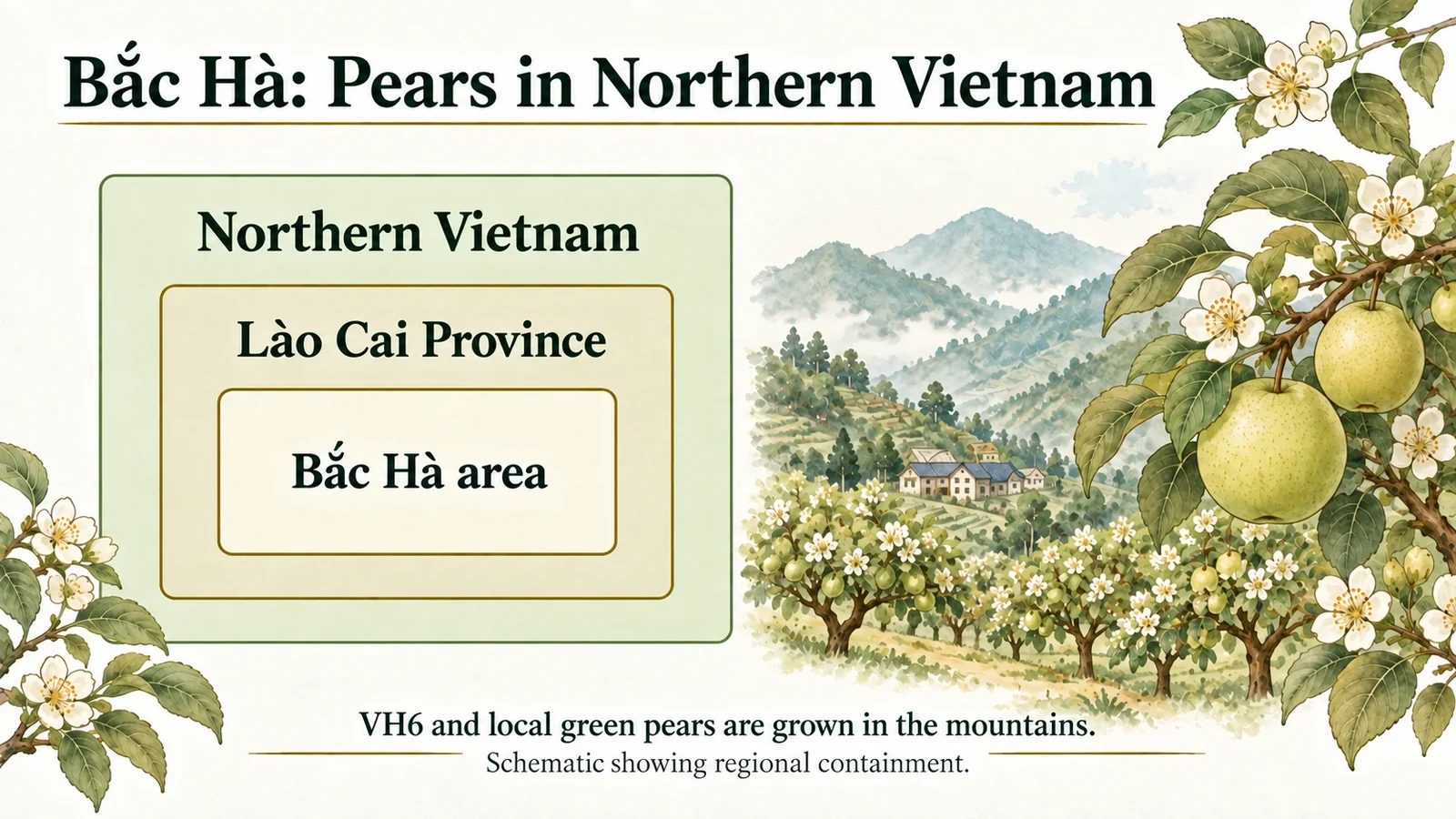
Bắc Hà, in Lào Cai Province near the Chinese border, is known for pears. One cultivar grown there is VH6, introduced from Taiwan.
Vietnam’s National Agricultural Extension Center reports that trials began at Bắc Hà’s research and production farm in 2002. The Ministry of Agriculture and Rural Development recognized it as a new cultivar in 2012. The account describes cultivation in Nậm Pung, including examples of 30–50 kg of fruit per tree at 5–7 years old. Source: National Agricultural Extension Center, June 8, 2021.
A July 2025 Công Thương report described about 900 hectares of VH6 and green pears combined across three communes in the Bắc Hà area, with more than 500 hectares bearing fruit. VH6 harvesting had begun in late June and was expected to end in mid-July. On July 4, reported producer prices were VND 30,000–40,000/kg for top-grade fruit and VND 5,000–10,000/kg for ordinary grades, about half the previous year’s level. These are historical producer prices, not current shop prices. Source: Công Thương, July 4, 2025.
These examples concern the Bắc Hà area. They do not establish VH6’s share of total Vietnamese pear production.
Local green pears: lê xanh
Bắc Hà also has long-established local green pears, lê xanh. Báo Lào Cai describes oval fruit weighing 300–500 g, with green skin developing a slight reddish blush when ripe, juicy white flesh, sweetness and a refreshing aroma. Harvest is usually in late August or early September, but prolonged dry weather brought it forward in 2024.
The August 2024 account reported that the area under these pears had fallen from nearly 100 hectares to just over 15 hectares, with local efforts to conserve them and develop tourism around them. Source: Báo Lào Cai, August 19, 2024.
Cultivar, growing origin and exporting country are different
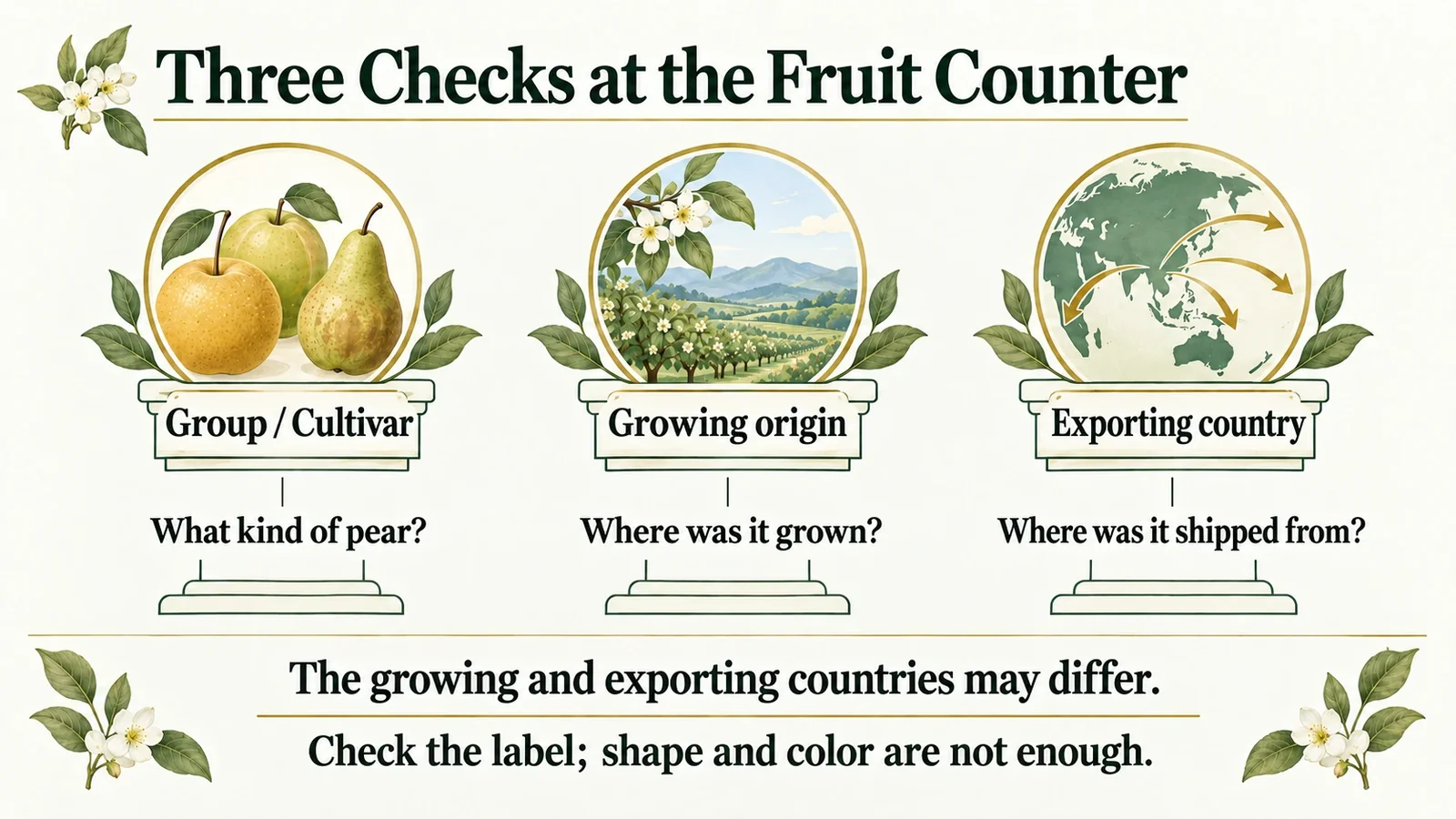
Ask three separate questions: What cultivar or group is it? Where was it grown? From which country was it exported to Vietnam? The producing and exporting countries need not be the same.
A round pear is not necessarily a Japanese pear; it may be a Chinese pear or a cultivar introduced from Taiwan. Shape and color cannot establish cultivar or origin. Read the packaging or price label, and ask the retailer if needed. For a real purchase example, see the photos, price and tasting notes for a Chinese green pear bought in Hanoi.
The growing areas in this article are examples. They do not describe all Vietnamese production or the overall mix of pears in shops.
Five points to remember about pears
- Pears are deciduous trees in the rose family, genus Pyrus. Japanese, Chinese and European pears are useful broad groups.
- Many major Japanese cultivars are self-incompatible, and growers use hand pollination with compatible pollen.
- Japanese pears ripen on the tree; European pears ripen after harvest. Stone cells contribute to pears’ gritty texture.
- Winter-chill needs vary by cultivar. Northern Vietnamese mountain areas provide examples of pear cultivation.
- Bắc Hà grows Taiwanese-origin VH6 and local green pears, with reported harvest windows in early-to-midsummer and late summer-to-early autumn respectively.
When you see quả lê in Vietnam, look at whether it is locally grown or imported and what the label says about its origin.
More in the pear trilogy
- How to Eat Pears in Vietnam: Buying, Ripening and Storage
- Pear History and Stories: Japan, Taiwan and Vietnam
References and source dates
The Japanese source edition first checked the listed references on September 29, 2026, with later checks recorded in its revision notes. This translation retains that evidence history; it does not claim a fresh review of every source. Statistics, prices and harvest dates refer to the years stated above.
- Clemson University HGIC: Asian Pear
- NARO: Self-compatible Japanese pear cultivar Narumi
- Lee et al.: Stone-cell development in Niitaka, 2007
- MEXT: Japanese pear, raw
- MEXT: Chinese pear, raw
- MEXT: European pear, raw
- MAFF: Japanese pear and grape harvest statistics, 2025 crop
- Matsudo City: The birthplace of Nijisseiki
- Kudamono Navi: Nijisseiki
- Vietnam National Agricultural Extension Center: VH6 cultivation
- Công Thương: VH6 harvest in Bắc Hà, July 2025
- Báo Lào Cai: Local green pears in Bắc Hà, August 2024
- Kawasaki City: The story of pears
- Taiwan Ministry of Agriculture: Pear industry issues and responses, 2003
- MEXT: Japanese pear carbohydrate composition
