Banana Guide: Varieties, Origins, Seasons and Nutrition
Published October 9, 2026
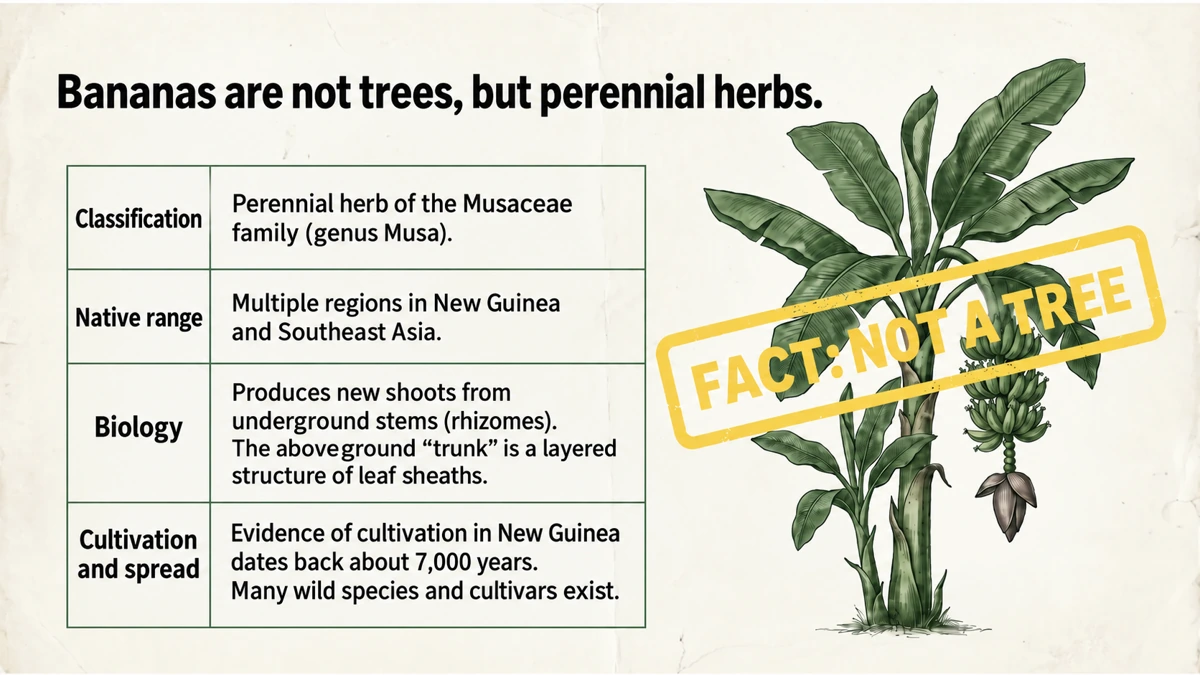
With its thick stem and large leaves, a banana plant looks like a tree. It is actually a perennial herb in the genus Musa, family Musaceae. The apparent trunk is a pseudostem made of overlapping leaf bases—a surprising structure hidden in a familiar fruit plant.
Bananas originated in New Guinea and Southeast Asia. Vietnam grows many varieties, woven into everyday meals and Lunar New Year offerings. This guide covers their biology, origins, varieties, seasons and nutrition, then explains Cavendish bananas, Panama disease and Vietnam’s export trade.
For history and culture, see Banana: History and Stories. For buying, cooking and storage tips, see How to Eat Bananas in Vietnam.
What Are Bananas? Names, Seasons and Origins at a Glance
| Item | Details |
|---|---|
| Common name | Banana; Japanese names include kanshō and mibashō |
| Vietnamese name | Chuối |
| Scientific name | Musa spp., chiefly Musa acuminata, Musa balbisiana and their hybrids |
| Classification | Perennial herbs in the genus Musa, family Musaceae; they are not trees |
| Origins | New Guinea and Southeast Asia; several wild species and subspecies contributed to domestication |
| Season in Vietnam | Grown and shipped year-round; demand rises particularly before Tết, the Lunar New Year |
| Main growing areas in Vietnam | Đồng Nai Province in the south and other regions; important export hubs for China and Japan |
| Notable nutrients | Potassium, dietary fiber, vitamin B6 and carbohydrates |
Sources are listed at the end of this article.
Bananas Are Herbs, Not Trees: Biology and Origins
Pineapples and watermelons may surprise readers because they do not grow on trees. Bananas are an even more striking example: plants standing roughly 2–10 meters tall look unmistakably tree-like.
The “Trunk” Is a Pseudostem Made of Leaf Sheaths
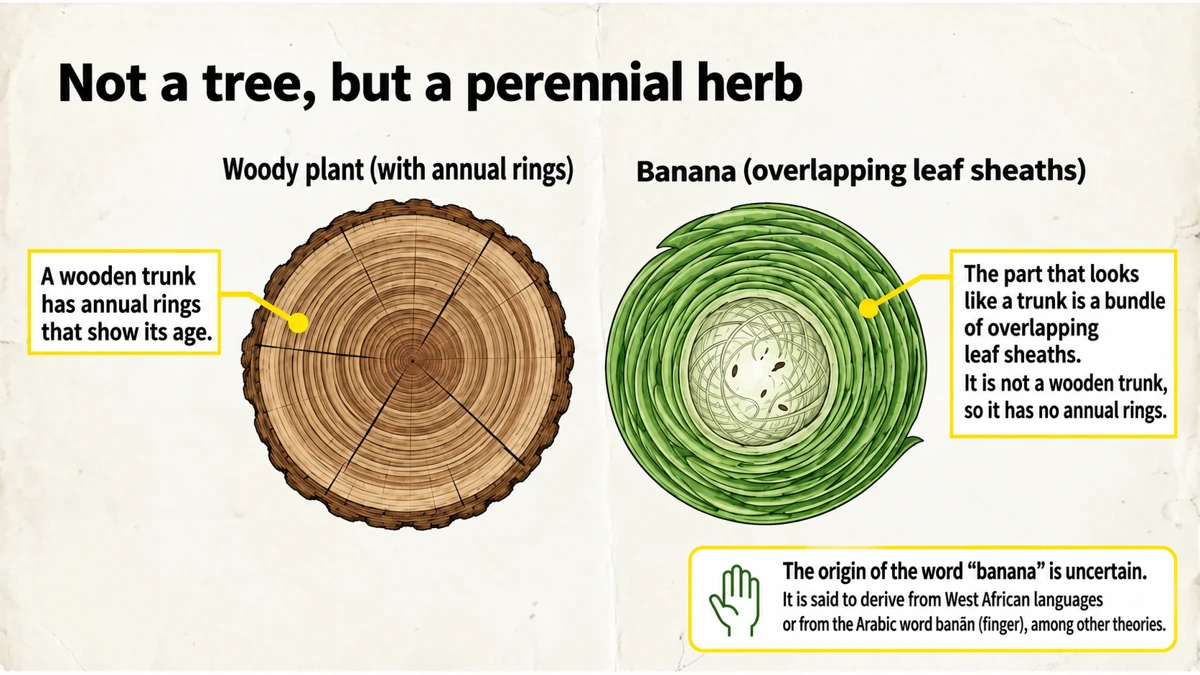
Bananas are perennial herbs in the family Musaceae and genus Musa. New shoots emerge from an underground stem. The thick above-ground structure that looks like a trunk is a pseudostem formed by overlapping leaf bases, rather than a true woody trunk.
Woody trunks thicken over the years and develop growth rings. A banana pseudostem does not grow this way. After flowering and fruiting, it dies, while new shoots from the underground stem develop into the next plants. Their exceptional height makes bananas some of the world’s largest herbaceous plants.
The Word “Banana” Has Several Proposed Origins
The English word “banana” is thought to have arrived through Spanish or Portuguese, but its earlier origin is uncertain. One explanation traces it to a West African language; another connects it with the Arabic banān, meaning fingers. The latter is not an established etymology.
In cultivation and trade, each tier in a banana bunch is called a “hand,” and each individual fruit is a “finger.” These terms remain in use today.
Domestication in New Guinea and Southeast Asia
Edible bananas are thought to have undergone a complex domestication process in several parts of New Guinea and Southeast Asia. Their major ancestors are the wild species Musa acuminata and Musa balbisiana, although genetic studies also point to other wild species and several M. acuminata subspecies. Archaeological evidence indicates cultivation of M. acuminata in New Guinea by about 7,000 years ago. Human migration and trade later spread different cultivated lineages through Southeast Asia, the Pacific and South Asia.
International Trade Depends on Similar Cavendish Cultivars
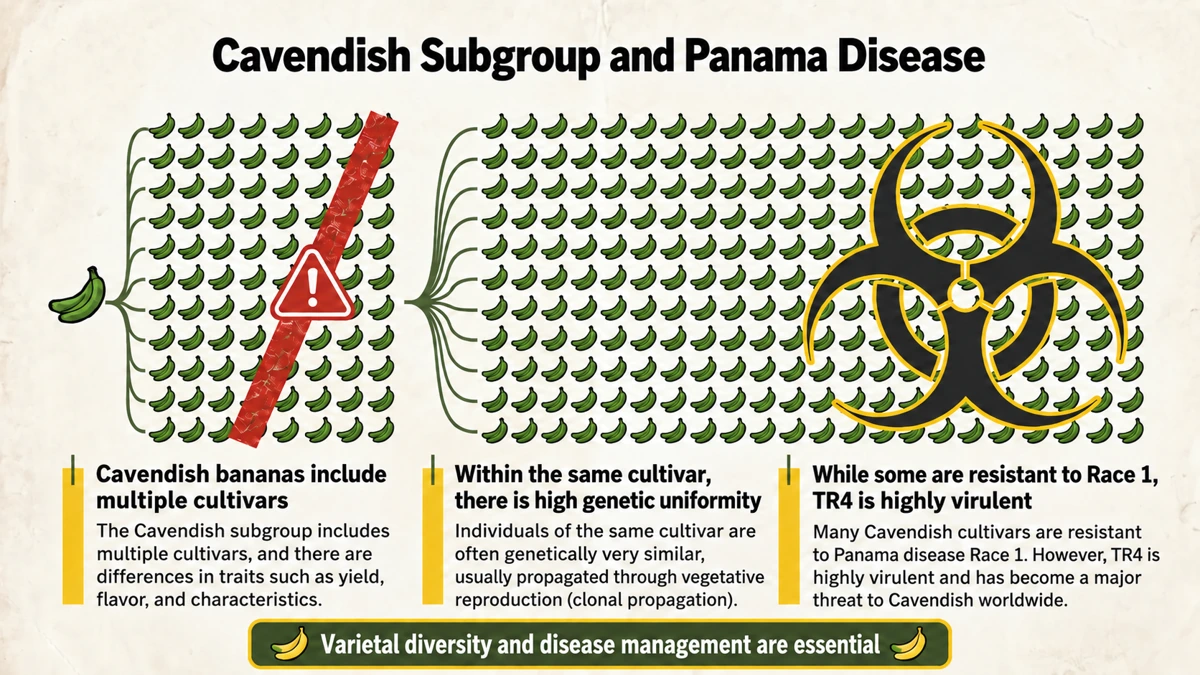
More than 1,000 banana cultivars are said to exist worldwide, but the Cavendish subgroup dominates international exports. Cavendish is not a single cultivar: it includes closely related cultivars such as Grand Nain and Williams. Edible bananas are difficult to propagate from seed, so growers use suckers or tissue culture. High genetic uniformity within a cultivar can leave crops vulnerable to disease.
Gros Michel, once the main export banana, suffered severe losses from Panama disease, or Fusarium wilt, during the first half of the twentieth century. From the 1950s onward, growers shifted toward Cavendish cultivars resistant to race 1 of the pathogen. Today, Tropical Race 4 (TR4), which also infects Cavendish, is spreading in different regions. Concentrating production in genetically similar cultivars makes shared pathogens especially damaging, so varietal diversity and disease prevention matter.
Banana Nutrition: Calories and Nutrients per 100 g
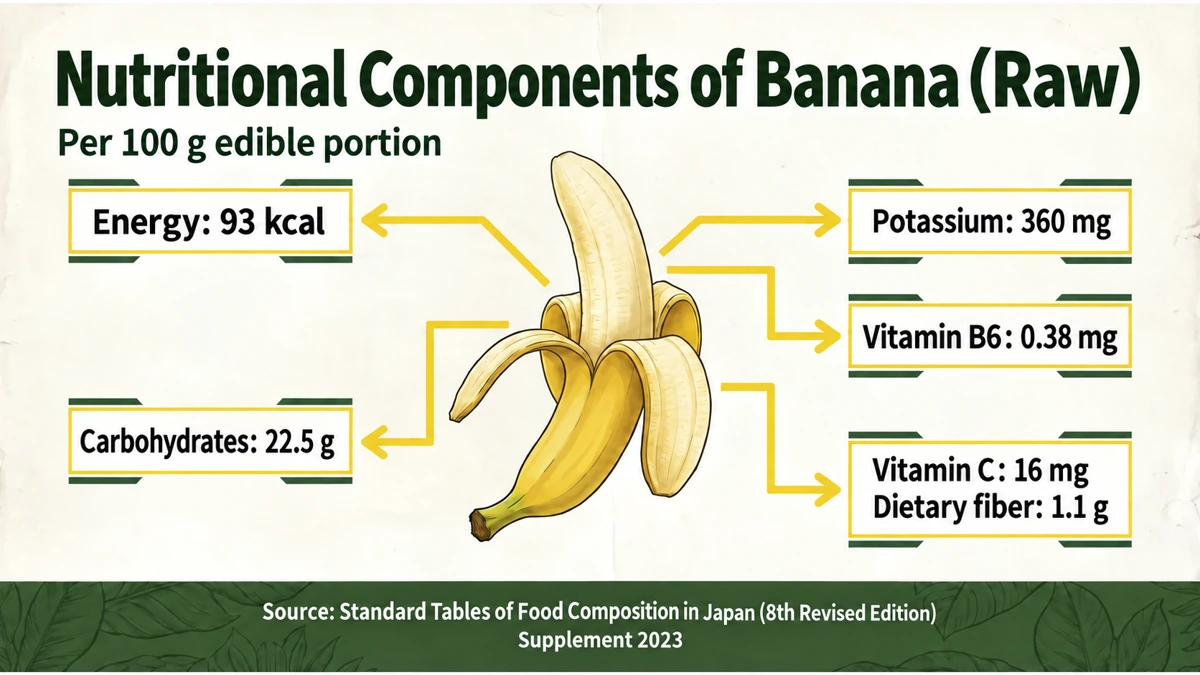
Raw bananas contain the following nutrients per 100 g of edible portion:
- Energy: 93 kcal
- Water: 75.4 g
- Carbohydrates: 22.5 g
- Dietary fiber: 1.1 g
- Potassium: 360 mg
- Vitamin C: 16 mg
- Vitamin B6: 0.38 mg
Their carbohydrates provide a convenient source of energy, making bananas a popular breakfast food or snack around exercise. Potassium helps the body excrete excess sodium, while vitamin B6 plays a role in protein metabolism.
These are general functions of nutrients, not proof that eating bananas treats particular symptoms. Portability and the ease of peeling them are also reasons bananas are enjoyed around the world.
Banana Varieties: Global Staples and Vietnamese Types
Production and Exports: India and Ecuador
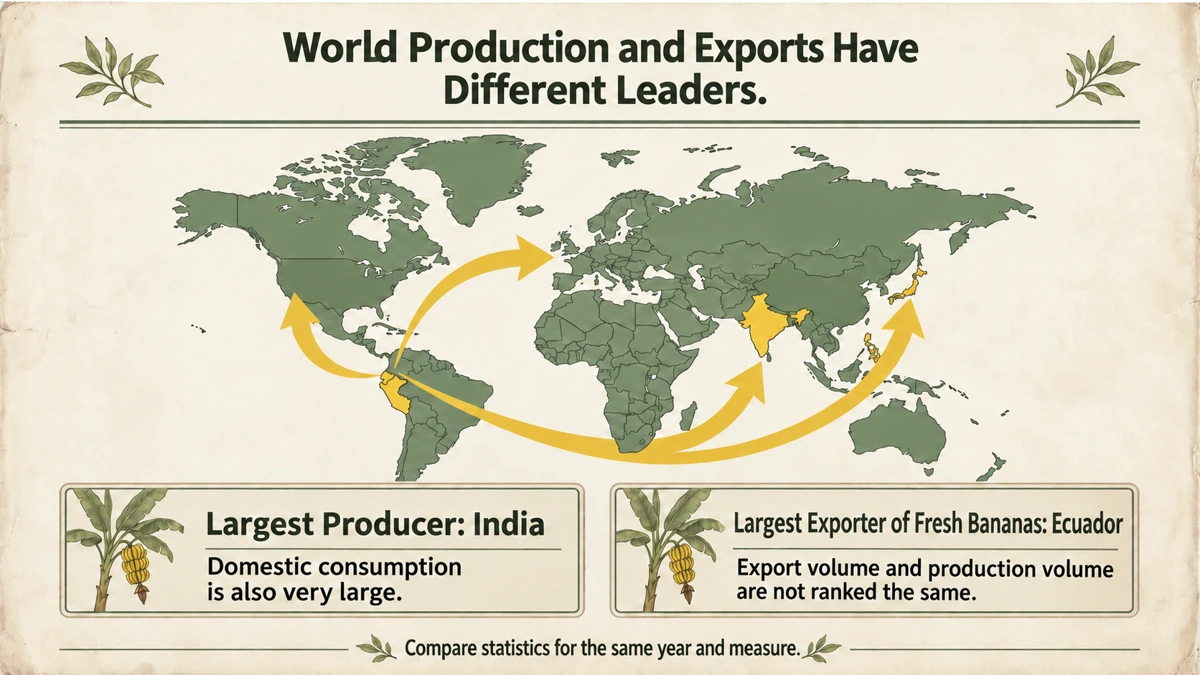
FAOSTAT production statistics rank India as the largest banana producer, followed by China and Indonesia. Production and export rankings differ, however. Much of India’s crop is consumed domestically, while FAO’s 2024 trade review identifies Ecuador as the largest exporter of fresh bananas.
Japan imports around one million tonnes of bananas a year, more by volume than any other imported fruit. The Philippines is the main supplier, with additional imports from Ecuador, Mexico, Vietnam and elsewhere. Country shares change by year; comparisons should use the same year and units in Japan’s Ministry of Finance trade statistics.
Vietnamese Names and Representative Varieties
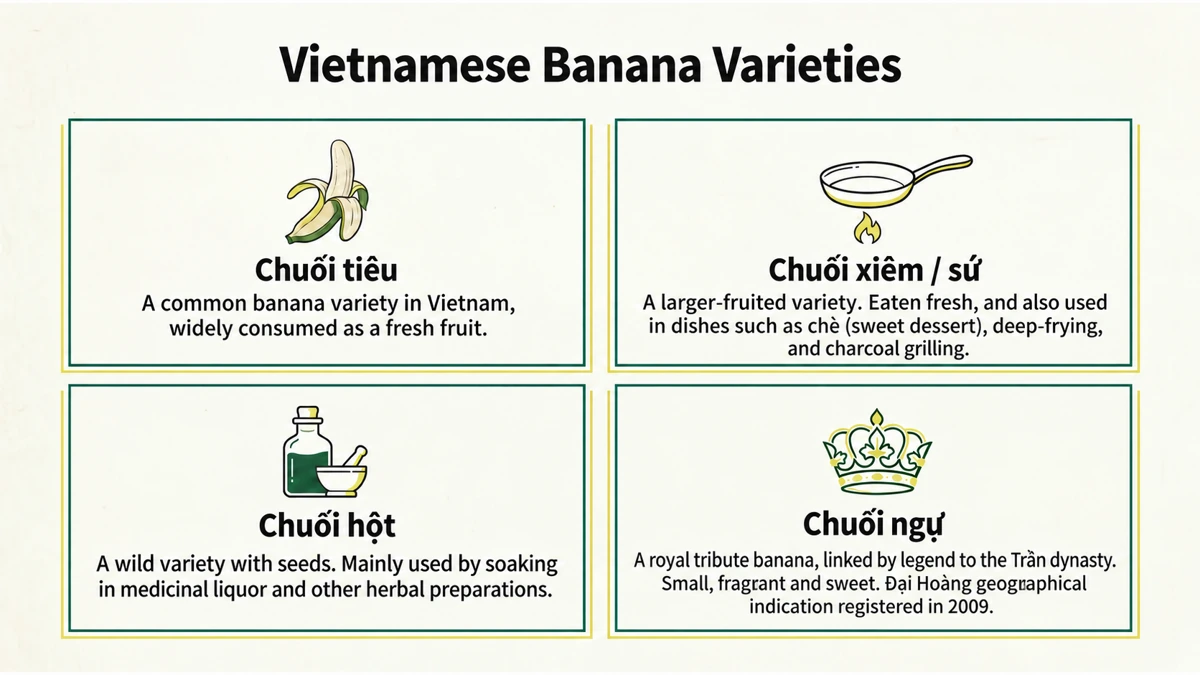
Banana is chuối in Vietnamese. Representative types include chuối tiêu, a traditional dessert banana; the thicker chuối xiêm/sứ, eaten fresh and used in chè, fried snacks and grilled dishes; and seeded wild chuối hột, used in preparations such as herbal liquor.
A distinctive traditional variety is chuối ngự, the “royal tribute banana,” from Đại Hoàng in northern Vietnam. At the time of its geographical indication registration, the area was in Lý Nhân District, Hà Nam Province. Legend says a Trần-dynasty king enjoyed a farmer’s bananas so much that he ordered them grown as tribute. The fruit is small, fragrant and sweet. Vietnam’s intellectual property authority registered the Đại Hoàng geographical indication on September 30, 2009.
Bananas as Tết Offerings
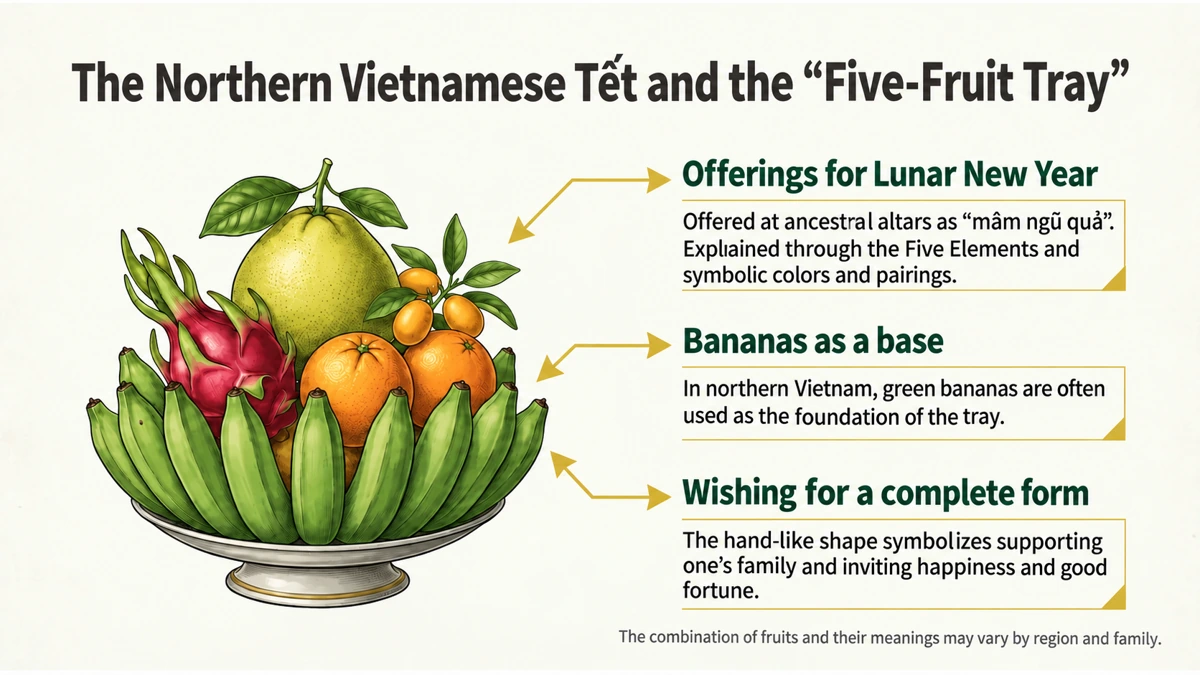
As Tết approaches, Vietnamese families prepare mâm ngũ quả, a five-fruit offering for the ancestral altar. In the north, it is sometimes explained through the five elements and color symbolism. A banana hand often forms the base. Its upward-curving, palm-like shape can symbolize welcoming good fortune or supporting the family. Traditions differ in the south, where combinations may include watermelon, papaya, pineapple and mango; see the Watermelon Guide (in Japanese) for more.
Vietnamese Banana Exports and the Japanese Market
Vietnam’s Growing Presence in Exports to China
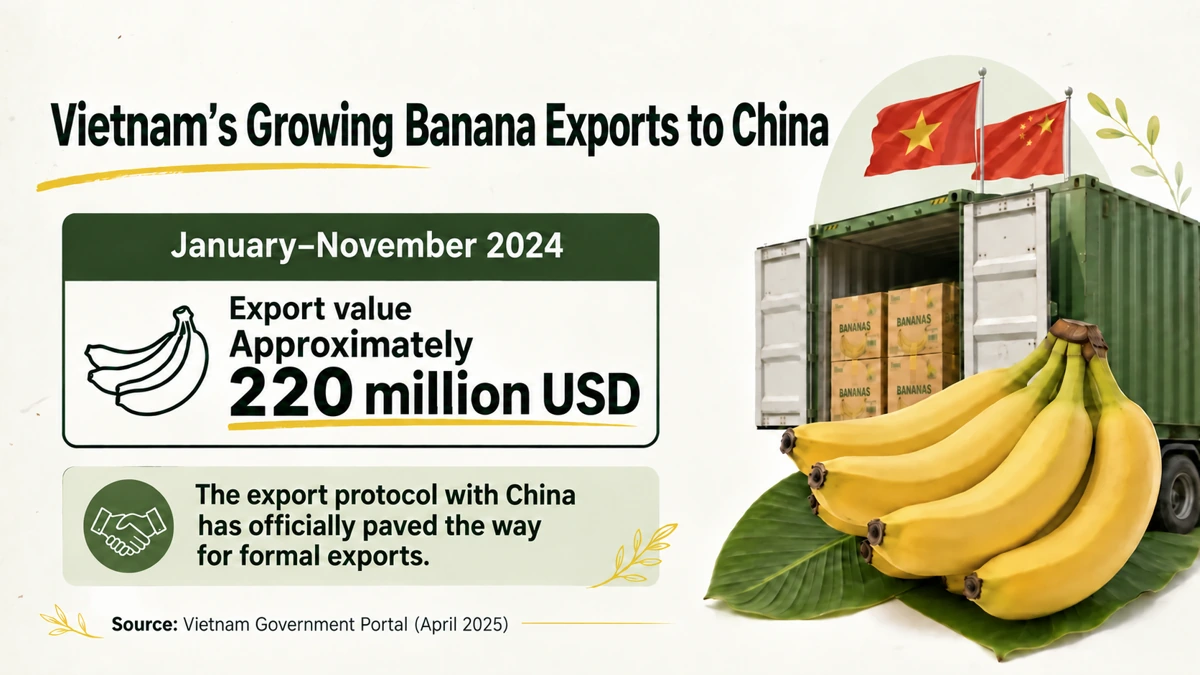
Vietnam’s fresh banana exports to China have been growing. According to an April 2025 Vietnamese government announcement, their value reached approximately US$220 million in January–November 2024. A phytosanitary export protocol with China has also supported the expansion of formal export routes.
Đồng Nai Province in southern Vietnam is a major growing area. Its official announcement reported banana exports exceeding 400,000 tonnes in 2022. Sources may use different reporting periods for planted area, production and exports; match the years before combining figures.
More Vietnamese Bananas in Japan: 2024 Import Figures
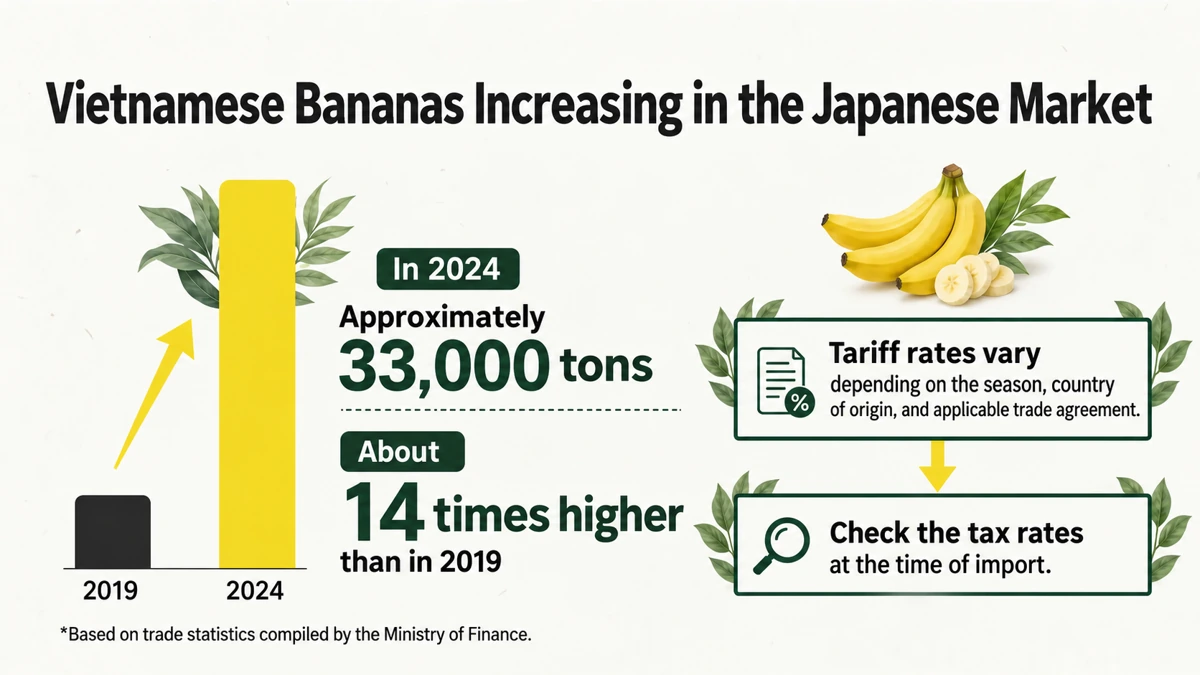
Japan’s imports of Vietnamese bananas have also increased. News reports compiling Ministry of Finance trade statistics put 2024 imports at approximately 33,000 tonnes, around 14 times the 2019 level. The relatively short shipping distance to Japan may contribute to competitiveness. Banana tariff rates vary with season, origin and the applicable economic partnership agreement, so consult the tariff schedule in force when importing.
Can Travelers Bring Vietnamese Bananas into Japan?
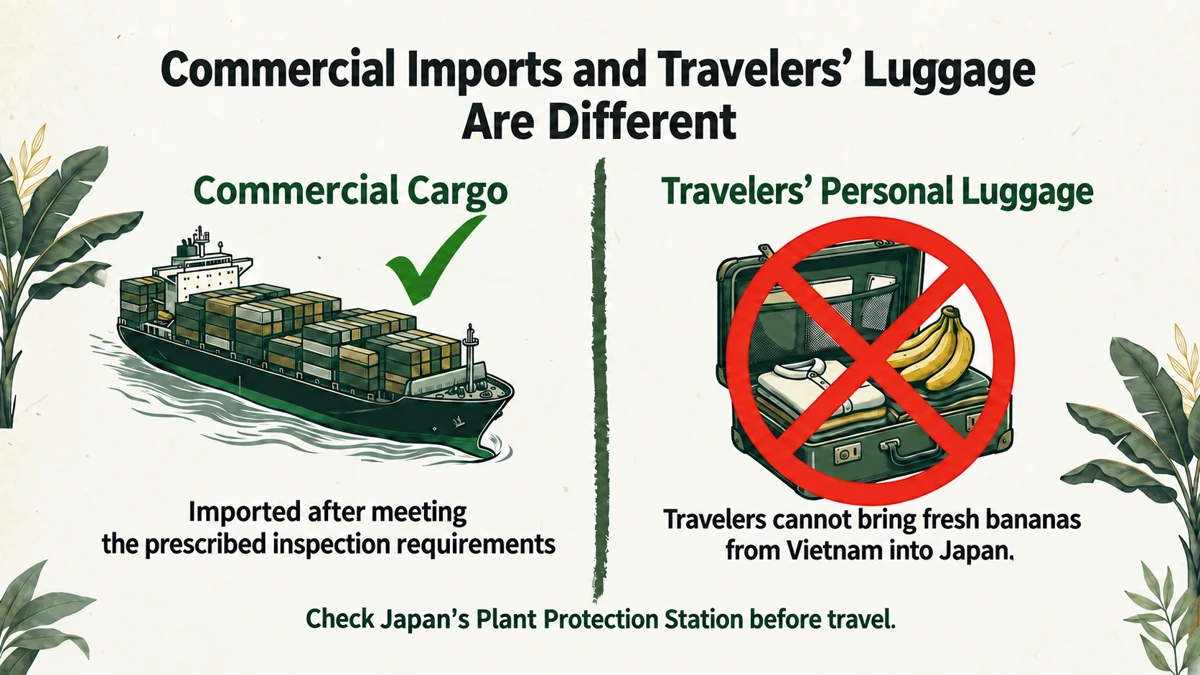
Commercial imports and travelers’ baggage are governed differently. Japan’s Plant Protection Station guidance lists fresh bananas from Vietnam among items travelers cannot bring into Japan. Requirements may change, so consult its latest information before traveling.
Frequently Asked Questions About Bananas
Are Banana Plants Trees or Herbs?
They are perennial herbs in the genus Musa, family Musaceae. The apparent trunk is a pseudostem formed from overlapping leaf bases.
Where Did Bananas Originate?
Edible bananas are thought to have been domesticated in several parts of New Guinea and Southeast Asia. Multiple wild species and subspecies contributed, so their history cannot be reduced to one origin or one route.
When Are Bananas in Season?
Staggered cultivation and shipping across tropical and subtropical regions make bananas available almost year-round in Vietnam. Demand for offerings rises before Tết.
Can I Bring Vietnamese Bananas Back to Japan?
They are imported commercially, but travelers cannot bring fresh Vietnamese bananas into Japan in their baggage. Check the latest Plant Protection Station guidance before traveling.
Summary: Biology, Varieties, Nutrition and Trade
The key points are:
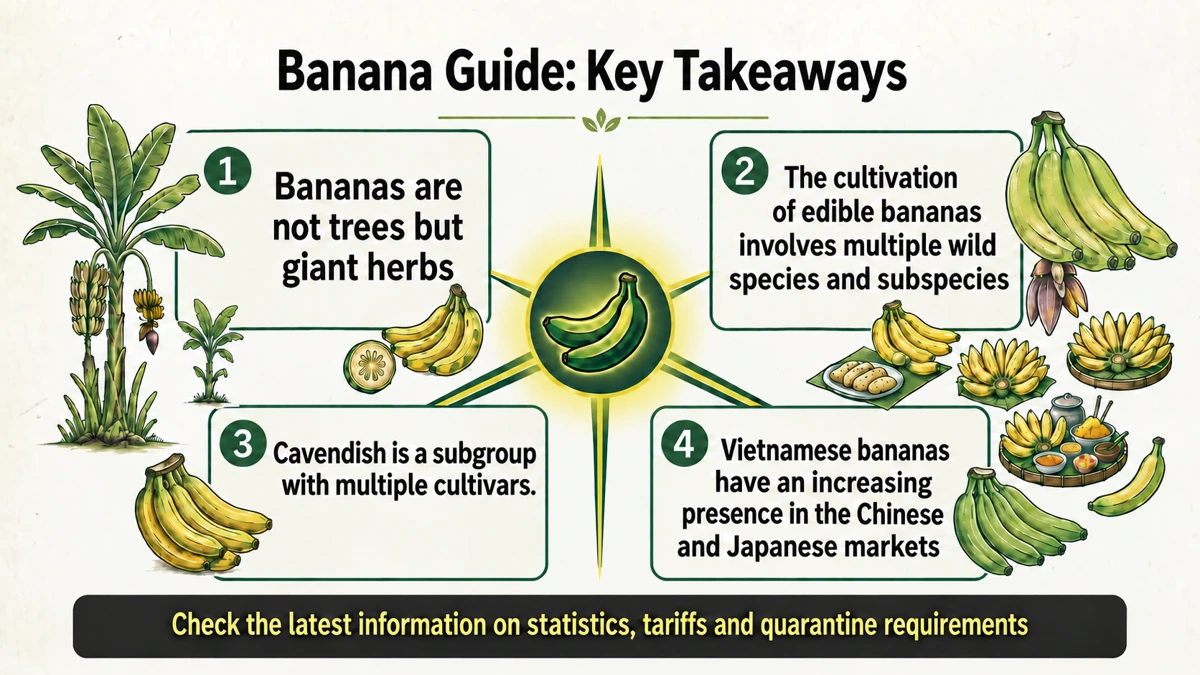
- Bananas are perennial herbs in the genus Musa, family Musaceae. Their apparent trunks are pseudostems made of overlapping leaves, without growth rings. They are among the largest herbaceous plants.
- The etymology of “banana” remains uncertain. Edible bananas followed a complex domestication history in New Guinea and Southeast Asia.
- International exports depend heavily on the Cavendish subgroup, which contains several similar cultivars. TR4 is an ongoing disease concern.
- Bananas contain carbohydrates, potassium and vitamin B6. India is the largest producer and Ecuador the largest fresh-banana exporter. Vietnam grows types such as chuối tiêu and chuối xiêm/sứ; in the north, bananas also appear in Tết offerings.
- Vietnam has expanded exports to China and Japan. Commercial imports to Japan are permitted under applicable conditions, but travelers cannot bring the fresh fruit in their baggage.
Related Articles
- Global history and a Vietnamese children’s story: Banana: History and Stories
- Choosing, cooking and storing bananas in Vietnam: How to Eat Bananas in Vietnam
- Fruit to enjoy in Vietnam: 15 Fruits in Vietnam (in Japanese)
References
- Royal Botanic Gardens, Kew: Musa L.
- Perrier et al., “Multidisciplinary perspectives on banana domestication,” PNAS
- Martin et al., “Interspecific introgression patterns reveal the origins of worldwide cultivated bananas in New Guinea,” The Plant Journal
- Oxford Companion to Food: Botanical Names for Banana
- National Geographic Japan: Panama disease reaches South America (in Japanese)
- Nature Digest: New Panama disease reaches Latin America (in Japanese)
- MEXT Food Composition Database: raw banana; Standard Tables of Food Composition in Japan, Eighth Revised Edition, Supplement 2023
- FAOSTAT: Crop Production, Yield, Harvested Area and Processed
- FAO: Banana Market Review, Preliminary Results 2024
- note: A summary of Vietnamese banana classifications (in Japanese)
- iVIVU: Chuối ngự Đại Hoàng – Đặc sản tiến vua của Hà Nam
- VOV World: Fruit offerings for Tết in Vietnam (in Japanese)
- Vietnamese Government: Viet Nam expands agricultural exports to China; Đồng Nai Province: Đồng Nai is a banana export hub
- ACCESS ONLiNE: Vietnamese bananas gain a presence in Japan (in Japanese)
- Plant Protection Station: Phytosanitary requirements for items from Vietnam (in Japanese)
Royal Botanic Gardens, Kew: Cavendish banana; IP VIETNAM: Protection of Đại Hoàng GI for Ngự banana
About the Author

Chuta
Based in Hanoi, Vietnam, Chuta buys fruit at local markets and supermarkets and writes about its taste, seasons, selection and preparation. Drawing on life in Vietnam, he introduces tropical fruits that are less familiar to readers in Japan.
About Fruit Guide