Persimmons in Vietnam are known as quả hồng. Some are crisp and ready to eat; others need their astringency removed or are made into dried fruit. Understanding the cultivar, origin and processing method helps explain what you find at the market.
This guide covers the plant, sweet and astringent types, nutrition, growing conditions and seasons, with examples from northern Vietnam and Dalat.
The persimmon trilogy: History and stories · How to eat and store persimmons
What is a persimmon?
| Feature | Details |
|---|---|
| Japanese name | Kaki |
| English names | Persimmon, Japanese persimmon, kaki |
| Vietnamese name | quả hồng |
| Family and genus | Ebenaceae; Diospyros |
| Scientific name | Diospyros kaki |
| Origin and native range | Often described as originating in China; Kew also includes Vietnam in its native range |
| Growth habit | Deciduous fruit tree |
| Flowers | Some cultivars bear female flowers only; others bear male and female flowers |
| Main eating types | Non-astringent and astringent |
| Components of interest | Vitamin C, carotenoids, fiber and tannins |
| Vietnamese examples | Bao Lam in Lang Son, Hac Tri in Phu Tho, and Dalat in Lam Dong |
Horticultural sources commonly describe China as the origin. Kew’s plant database gives a native range extending from Assam to China, Vietnam and Taiwan. Cultivation history and natural distribution are different questions. Botanical details below draw on California Rare Fruit Growers (CRFG).
The tree, flowers and fruit
A deciduous tree with a long cultivation history
Persimmon trees can reach about 7 m. The fruit colors in autumn and the leaves fall before winter. CRFG describes a long history of cultivation in China and more than 2,000 cultivars. Further cultivars developed after the fruit spread to Korea and Japan.
Fruit can develop without pollination
Flowering patterns differ by cultivar. Some trees have only female flowers, while others produce both male and female flowers.
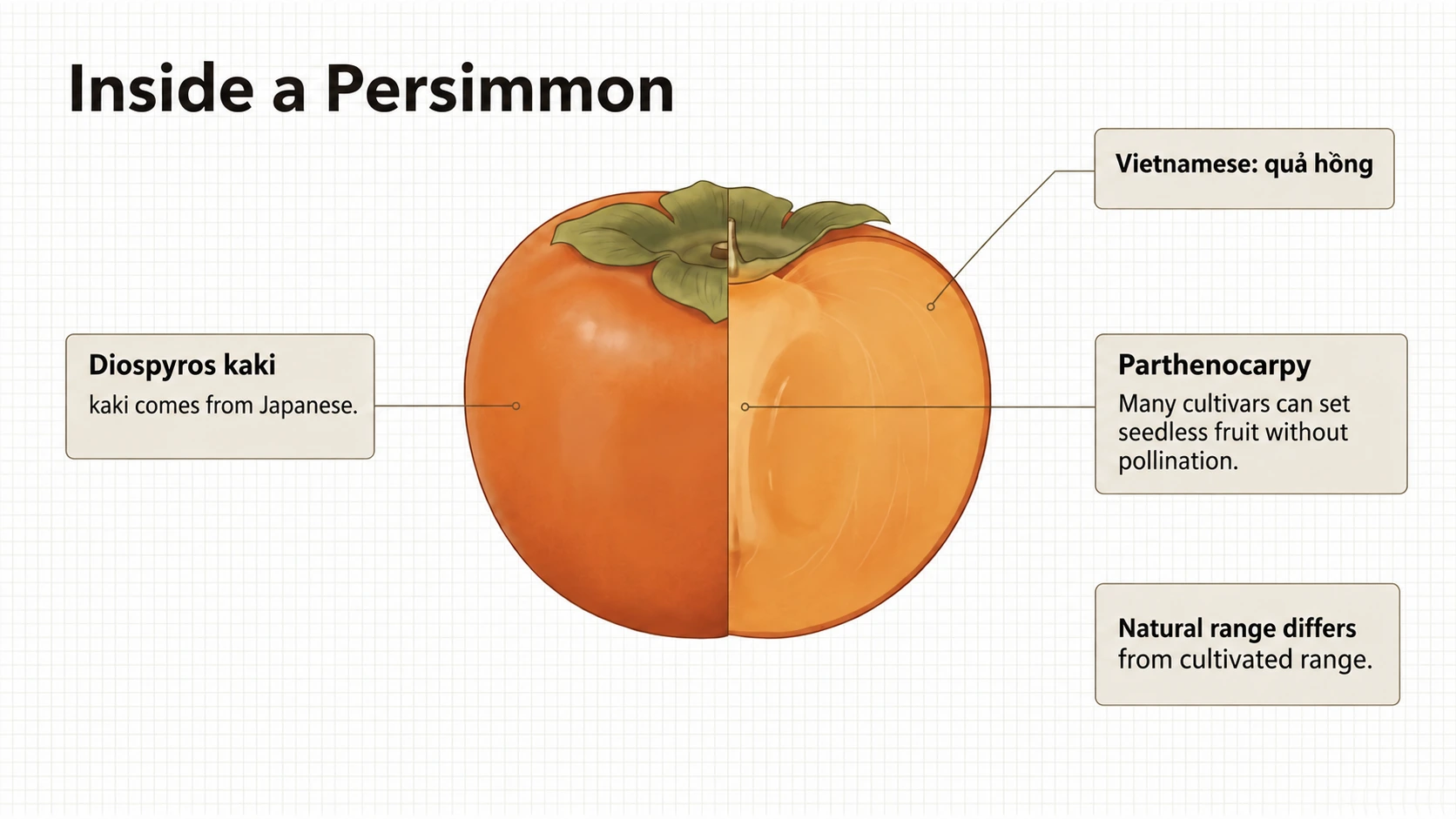
Many cultivars can set fruit without pollination, a process called parthenocarpy. Fruit formed this way is usually seedless. CRFG notes that the presence of seeds, rather than pollination by itself, affects certain fruit characteristics. A seedless fruit on one occasion does not guarantee that every fruit of that cultivar will be seedless. Source: CRFG
Why the scientific name includes kaki
The second part of Diospyros kaki comes from the Japanese word kaki. The same word is used as a common name in parts of Europe and elsewhere. Although persimmons have a long cultivation history in China, their scientific name preserves a Japanese connection.
Sweet versus astringent persimmons
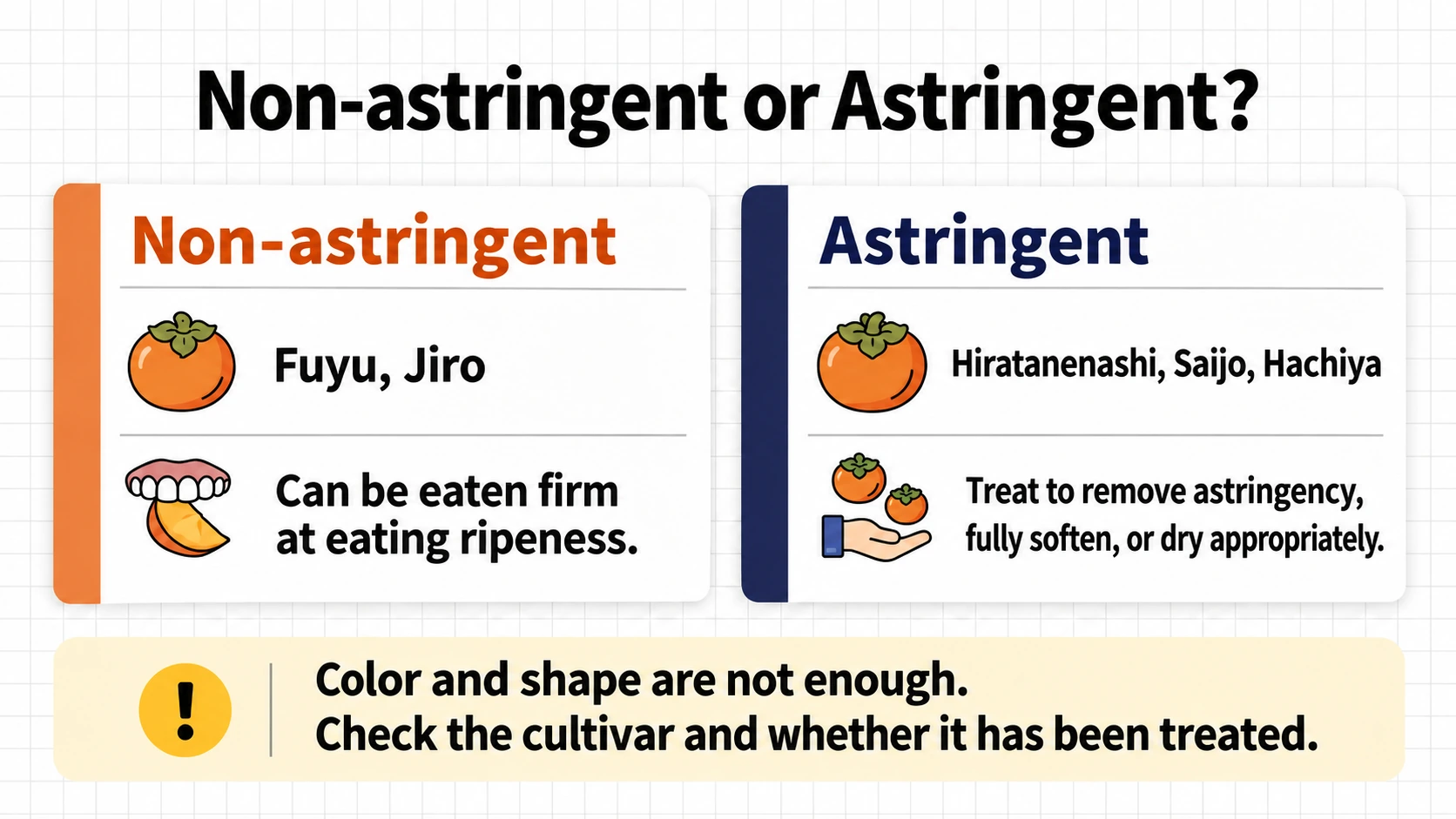
The first useful distinction is between non-astringent types, often called sweet persimmons, and astringent types. Color and shape alone are not reliable guides.
| Type | Examples | When to eat |
|---|---|---|
| Non-astringent | Fuyu, Jiro | Can be eaten firm once at eating ripeness |
| Astringent | Hiratanenashi, Saijo, Hachiya | After suitable treatment, full softening or drying |
The examples follow CRFG and Shimane Prefecture’s cultivation guidance. Check both the cultivar and the treatment status: an astringent cultivar can still be sold firm and ready to eat after treatment.
Non-astringent types
In familiar types such as Fuyu and Jiro, astringency disappears as the fruit matures, allowing it to be eaten while still firm. However, some persimmon types behave differently depending on seed formation, so this distinction should not be applied indiscriminately to every cultivar.
Astringent types
Astringent persimmons may remain strongly puckering even after their skin has colored. Shimane’s guidance explains that Saijo retains astringency until it becomes fully soft, unless treated beforehand.
Commercial methods include carbon dioxide, dry ice and alcohol. The same guidance describes warm-water treatment at 38–40°C for around 15 hours, while noting that quality can deteriorate more easily with this faster method. This is background on processing methods, rather than a universal home-treatment protocol. Source: Shimane Prefecture
How astringency removal works
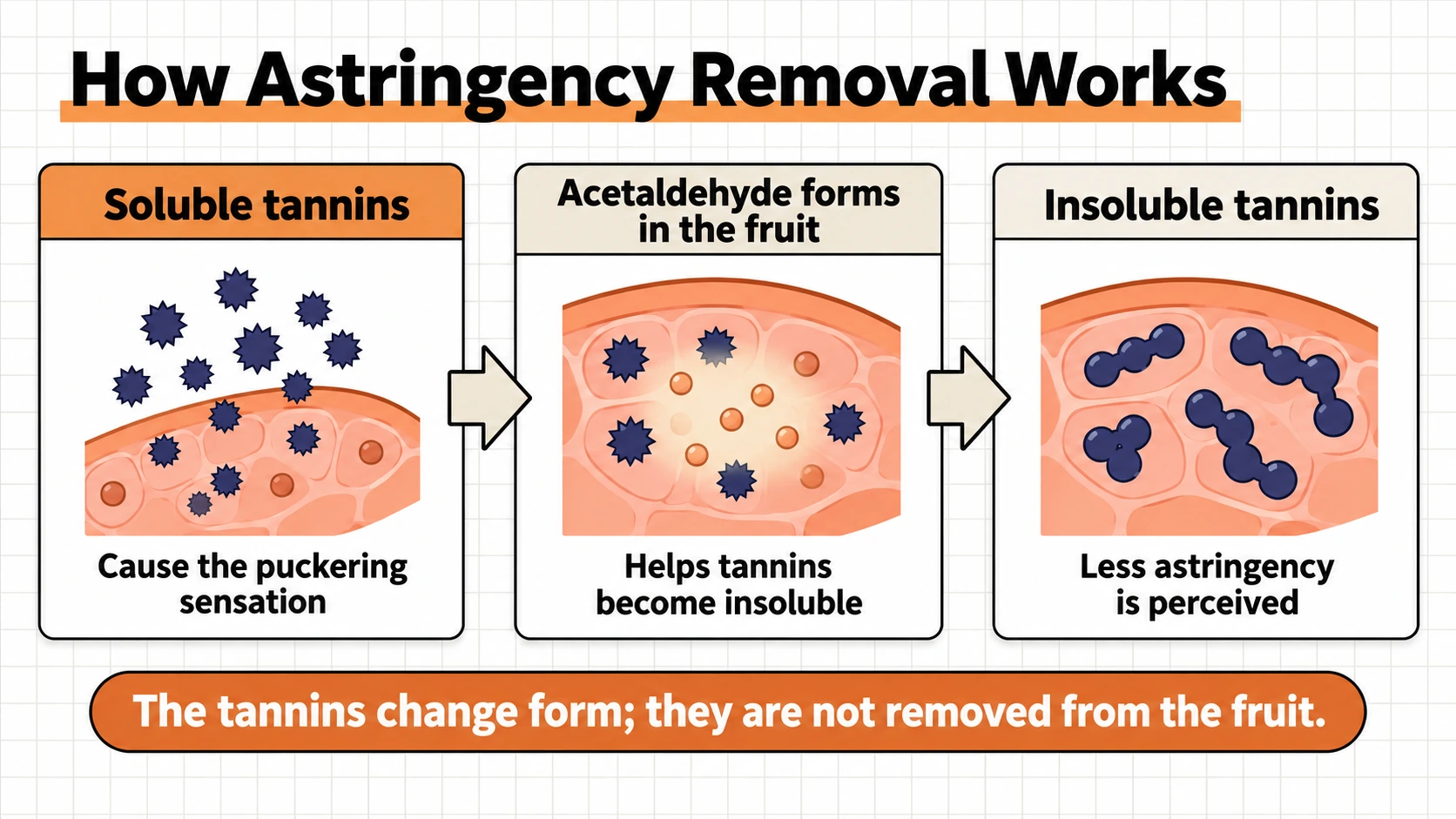
Soluble persimmon tannins create the dry, puckering sensation. Treatment changes them into a less soluble form, so they are less readily perceived as astringent.
The Japanese Society of Plant Physiologists explains the role of acetaldehyde. Alcohol is converted into acetaldehyde; carbon dioxide or dry ice creates low-oxygen conditions that encourage acetaldehyde to accumulate inside the fruit. The reduction of astringency during drying involves the same underlying process.
The tannins are changed inside the fruit, not extracted from it.
Persimmon nutrition and calories per 100 g
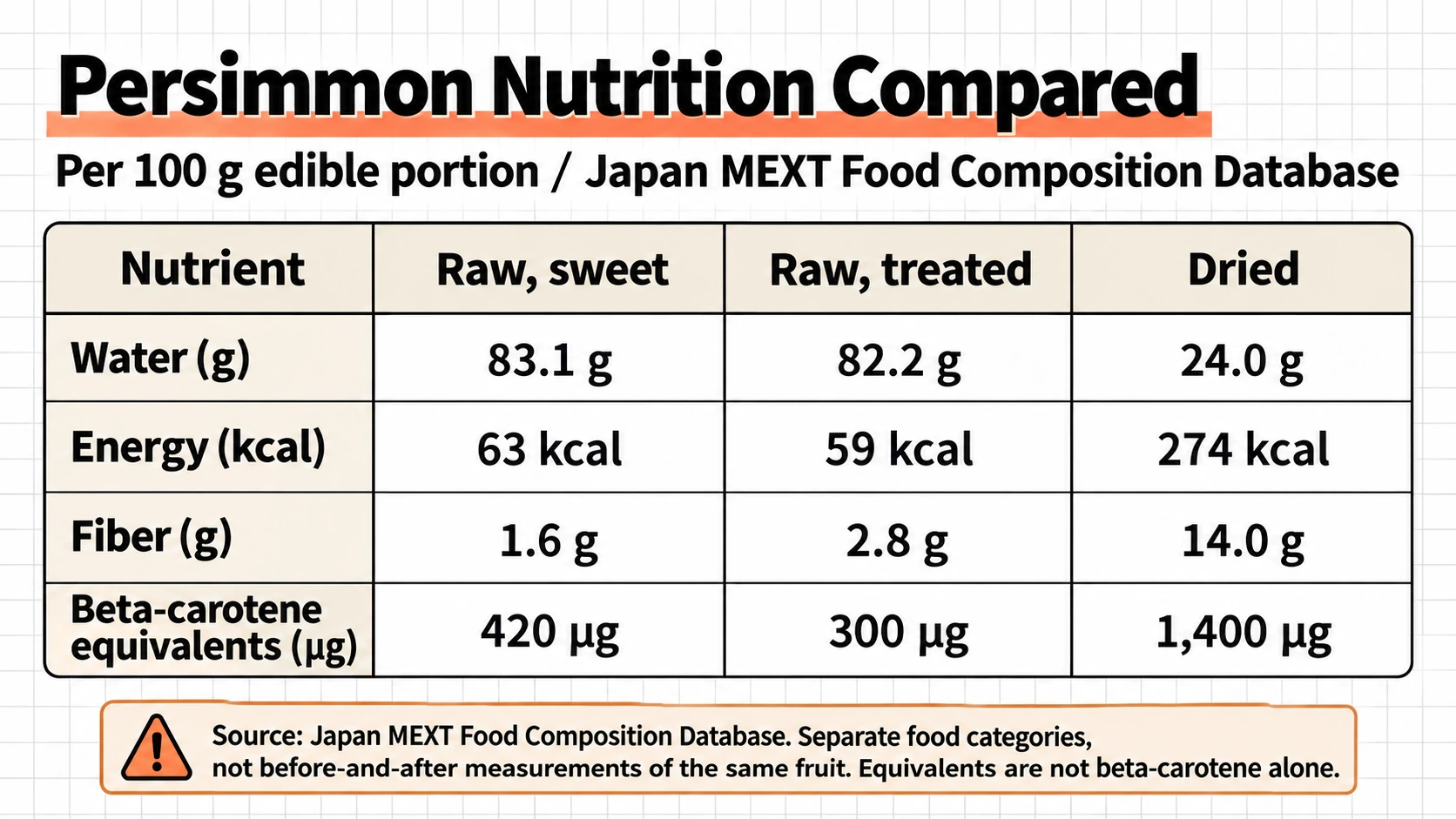
Japan’s Ministry of Education, Culture, Sports, Science and Technology (MEXT) lists raw sweet persimmons, raw treated persimmons and dried persimmons separately. Values below are for 100 g of edible portion, excluding discarded skin, seeds and other refuse as defined in the database.
| Component | Raw sweet persimmon | Raw treated persimmon | Dried persimmon |
|---|---|---|---|
| Energy | 63 kcal | 59 kcal | 274 kcal |
| Water | 83.1 g | 82.2 g | 24.0 g |
| Carbohydrate | 15.9 g | 16.9 g | 71.3 g |
| Dietary fiber | 1.6 g | 2.8 g | 14.0 g |
| Potassium | 170 mg | 200 mg | 670 mg |
| Beta-carotene equivalents | 420 µg | 300 µg | 1,400 µg |
| Vitamin C | 70 mg | 55 mg | 2 mg |
Sources: MEXT Food Composition Database, raw sweet, raw treated and dried; Standard Tables of Food Composition in Japan, eighth edition, 2023 supplement. Values checked for the Japanese v08 edition on 15 October 2026.
Raw sweet persimmon supplies 70 mg of vitamin C per 100 g in this table. Dried persimmon contains less water and more energy and fiber for the same weight.
These are separate food categories, not measurements of the same fruit before and after drying. Cultivars and processing conditions also differ, so water loss alone does not explain every difference. Consider serving size as well as the per-100-g figures.
Beta-carotene equivalents are not the same as beta-carotene alone. The latter values are 160 µg for raw sweet, 100 µg for raw treated and 370 µg for dried persimmon per 100 g. The Japanese reference values do not necessarily match every product sold in Vietnam.
Why persimmons grow in Vietnam
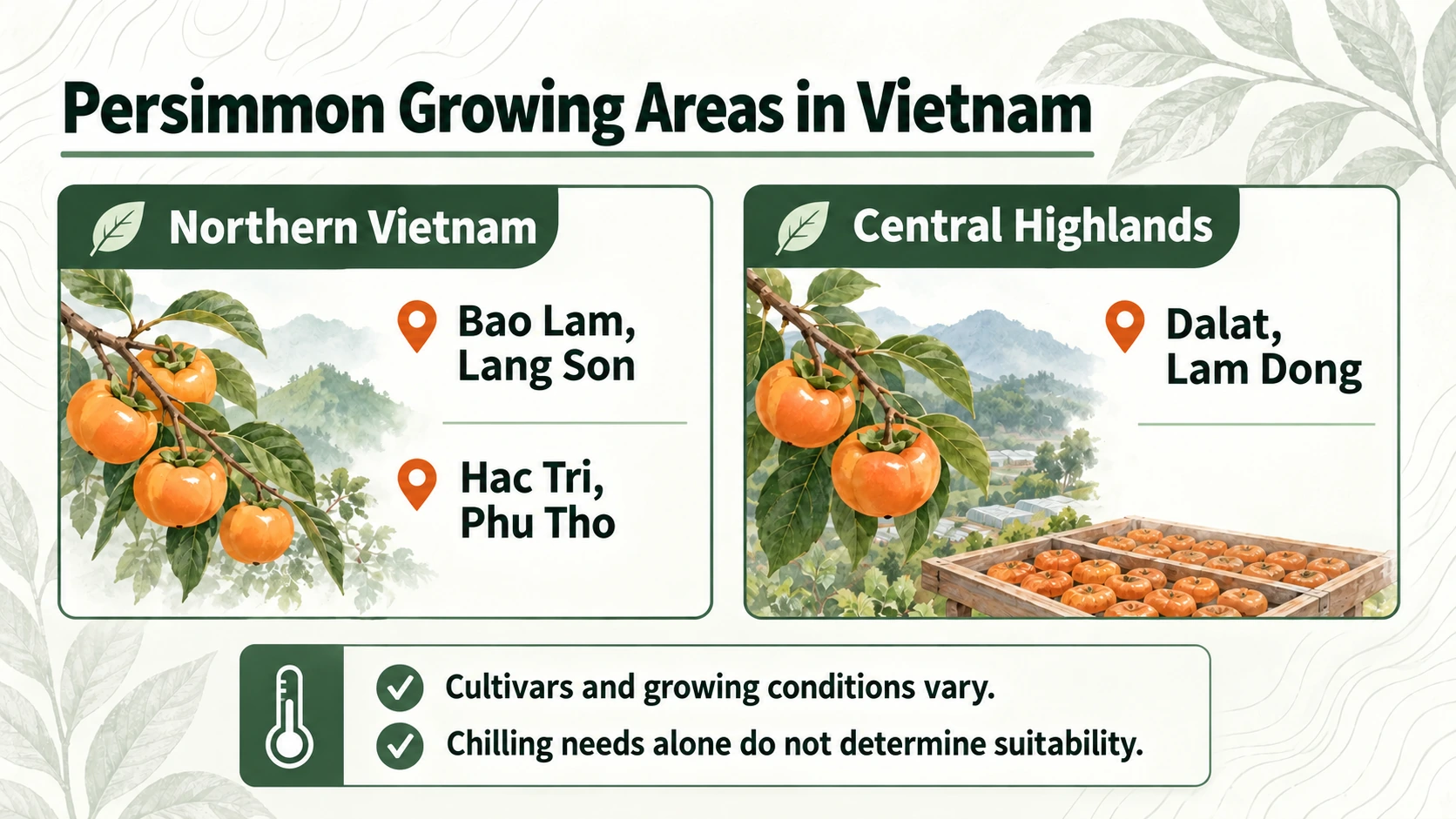
Persimmons are deciduous trees with relatively modest winter chilling requirements. CRFG gives a figure of fewer than 100 chilling hours, but this should not be treated as a universal requirement for every cultivar and location.
The same source notes that warm early-spring weather can trigger growth that is then vulnerable to frost. In Vietnam, cultivation occurs in northern regions and around Dalat. Suitability depends on summer heat, rainfall, cultivar and other conditions as well as winter chilling. Source: CRFG
Persimmon seasons in Japan and Vietnam
In Japan, persimmons are an autumn fruit. A provisional government release dated 15 April 2025 put the 2024 harvest at 167,300 tonnes, with Wakayama, Nara and Fukuoka the leading prefectures by harvest volume. Source: Japan MAFF
Autumn is also important in the Vietnamese growing areas described here.
| Area or product | Seasonal guide | Source |
|---|---|---|
| Bao Lam seedless persimmons, Lang Son | Around the Mid-Autumn Festival, the 15th day of the eighth lunar month | Vietnam Ministry of Industry and Trade, 2022 |
| Hac Tri persimmons, Phu Tho | Harvested and treated during the eighth and ninth lunar months | Vietnamnet, 2019 |
| Dalat hung-dried persimmons | Hung for drying from September until before Tet | Công Thương, 2024 |
Lunar months fall on different Gregorian dates each year. Imported fruit can also appear in shops outside these periods. Check the origin on the label or price ticket rather than inferring it from the season.
Northern seedless persimmons and Dalat dried fruit
The Vietnamese name: quả hồng
Quả hồng means persimmon. The word hồng also appears in hoa hồng (rose) and in expressions for pink, so the full fruit name is helpful at a market.
Northern traditions of water soaking
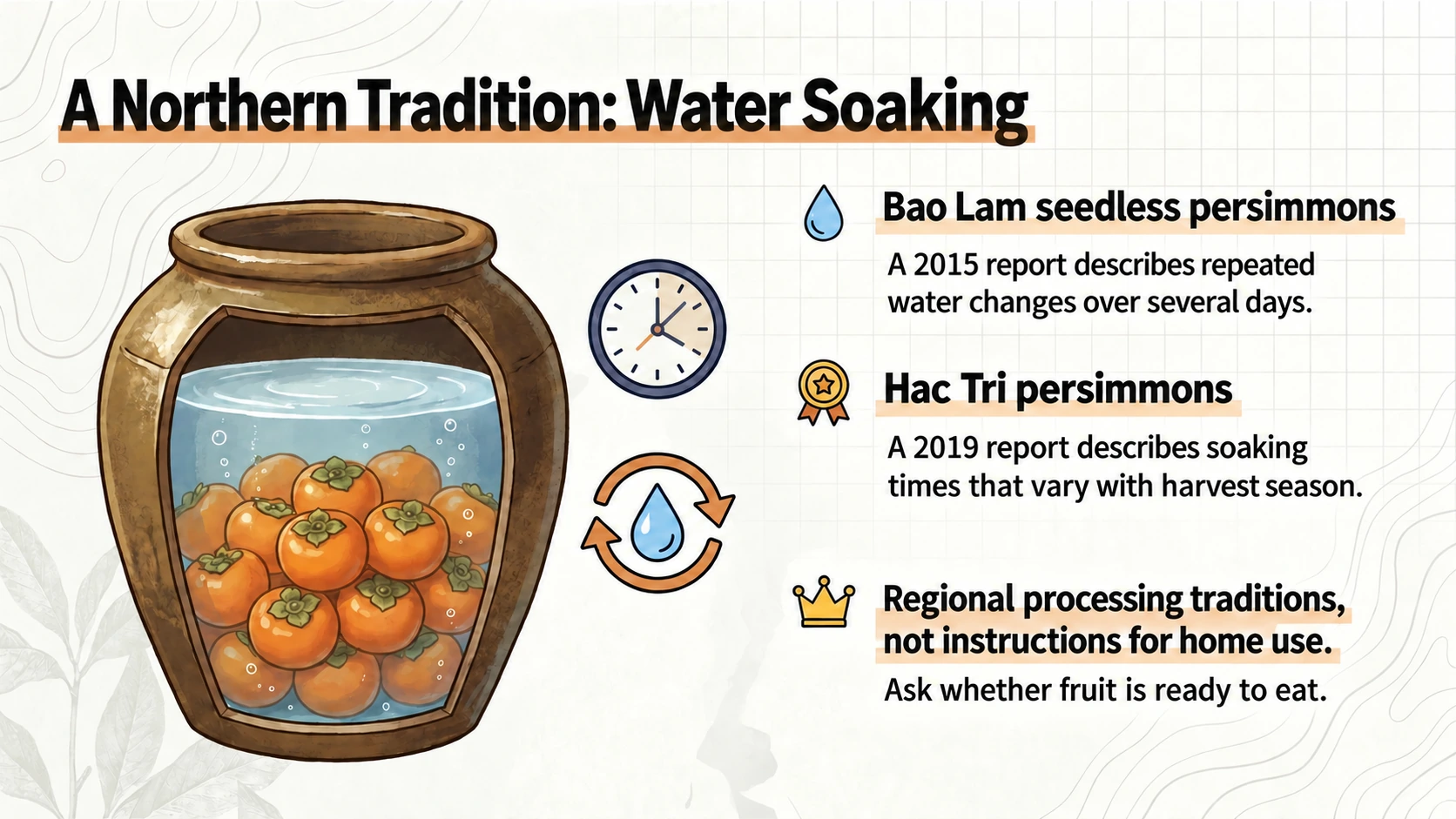
Some northern Vietnamese communities remove astringency by soaking persimmons in water for several days.
Bao Lam seedless persimmons (hồng không hạt Bảo Lâm) received geographical indication registration on 14 November 2012. Vietnam’s Intellectual Property Office lists Decision 2838/QĐ-SHTT and registration number 00032. The fruit is known for its crisp texture. Source: Intellectual Property Office of Vietnam
A VnExpress report from 19 September 2015 describes harvesting fruit as the skin turns yellow, submerging it in tubs or earthenware jars and changing the water daily for four days and four nights. It also describes bags submerged in fast-flowing streams. These are accounts of regional practice. Source: VnExpress
Hac Tri persimmons (hồng Hạc) in Phu Tho are also soaked. Local tradition describes them as a former royal tribute fruit. Vietnamnet reported in October 2019 that 249 trees aged over 25 years remained in the province. The report described different soaking schedules: two days and three nights for fruit harvested in the eighth lunar month, and three days and three nights in the ninth. These are dated reports, not current tree counts. Source: Vietnamnet
The soaking practices illustrate local food culture. They are not presented as home instructions: when buying fruit, ask whether treatment is complete and it is ready to eat.
Dalat’s Japanese-influenced drying methods
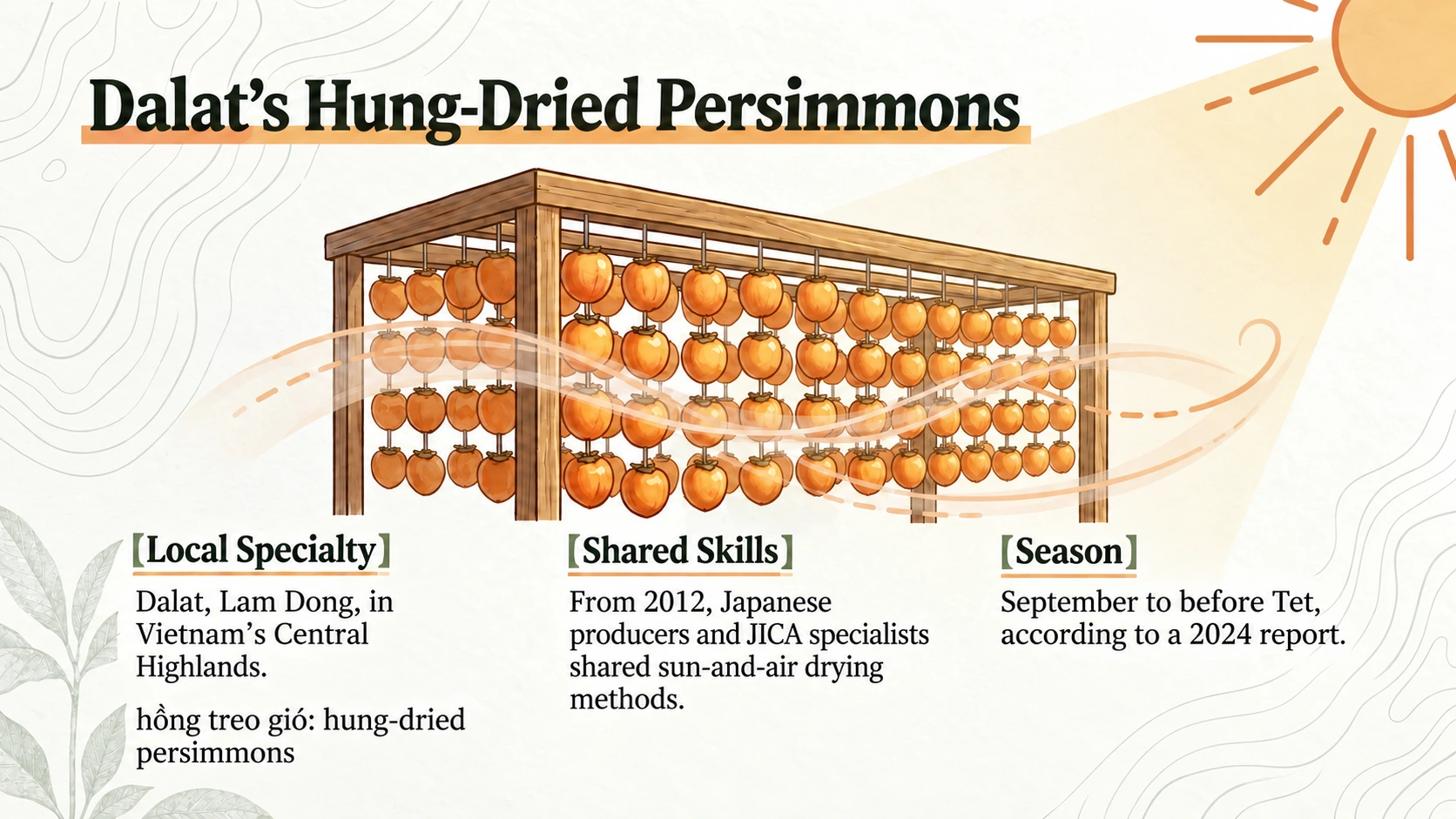
Dalat, in Lam Dong in the Central Highlands, is known for hồng treo gió, literally persimmons hung in the wind.
A 2024 Công Thương report states that, from 2012, Japanese dried-persimmon producers and JICA specialists taught more than 100 farming households to dry fruit with sunlight and air rather than charcoal or firewood. The report gives a hanging season from September to before Tet and a price of VND 250,000–400,000 per kilogram. That price belongs to the report published on 17 October 2024; it is not a current quotation. Source: Công Thương
Northern soaking and Dalat drying show different ways of working with the same fruit’s astringency.
Keep cultivar, origin and processing separate
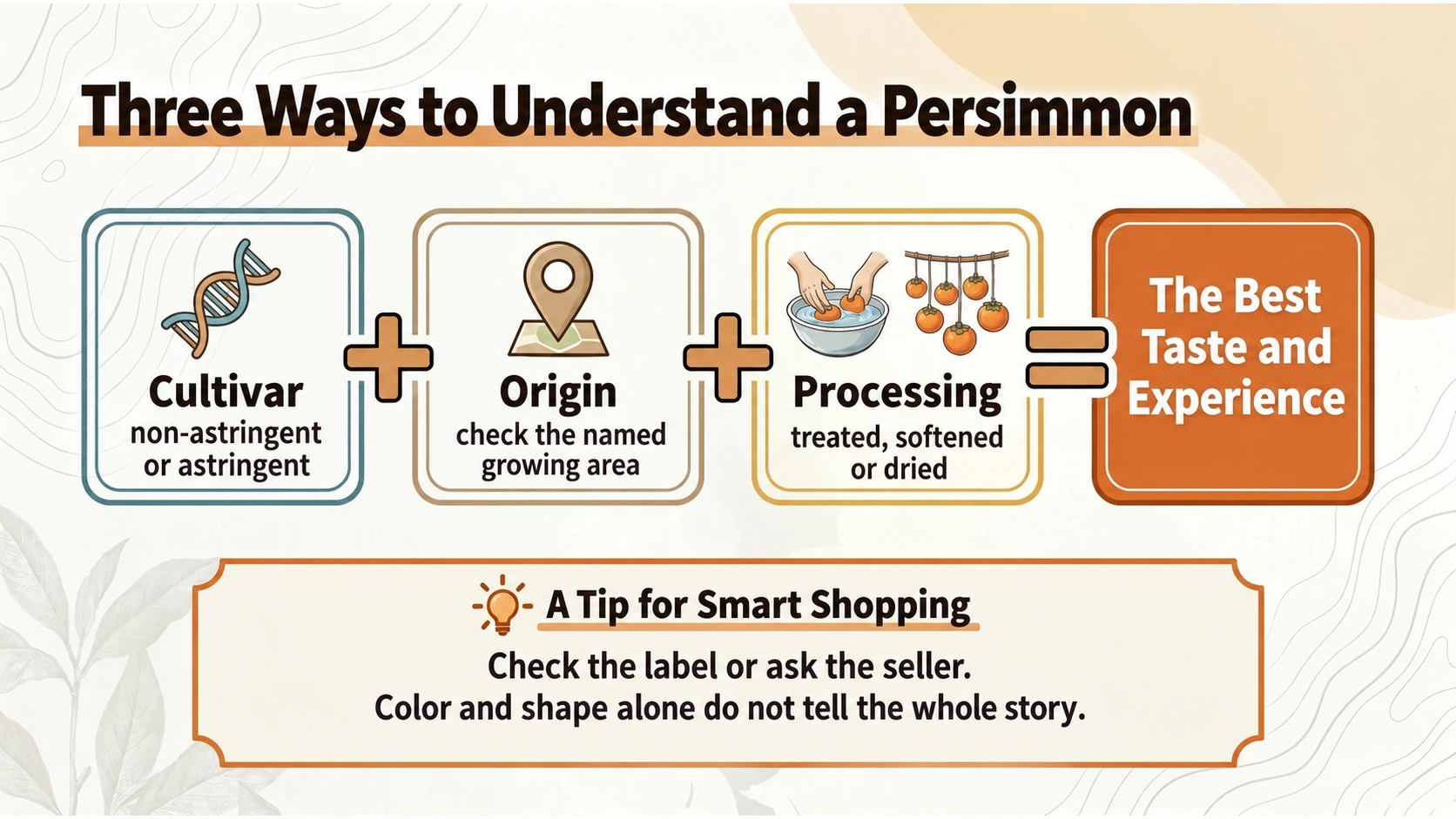
Ask three different questions: Is it a non-astringent or astringent cultivar? Where was it grown? How was it made ready to eat?
An astringent cultivar can taste sweet after suitable treatment or drying. Color and shape alone do not identify the cultivar or growing area. Check packaging and price labels, or ask the seller.
The locations here are examples, not a complete picture of Vietnam’s production or the origins of all fruit sold in its shops.
Five points to remember
- Persimmons have a long East Asian cultivation history; kaki in the scientific name comes from Japanese.
- Astringency depends on soluble tannins, and seed formation affects some cultivars.
- Removing astringency changes tannins into a less soluble form rather than taking them out of the fruit.
- Persimmons grow in northern Vietnam and around Dalat, with conditions varying by cultivar and location.
- Water soaking is part of northern processing traditions, while Dalat’s hung-dried fruit has benefited from Japanese technical exchange.
When you spot quả hồng at a market, check the cultivar, origin and whether it is ready to eat.
Continue the persimmon trilogy
- Persimmon History and Stories: Why It Is Called Kaki
- How to Eat Persimmons in Vietnam: Choosing and Storing
Sources
The links throughout this article lead to the sources used in Japanese v08. Historical reports retain their original dates; translating this edition does not turn them into current statistics or prices.
