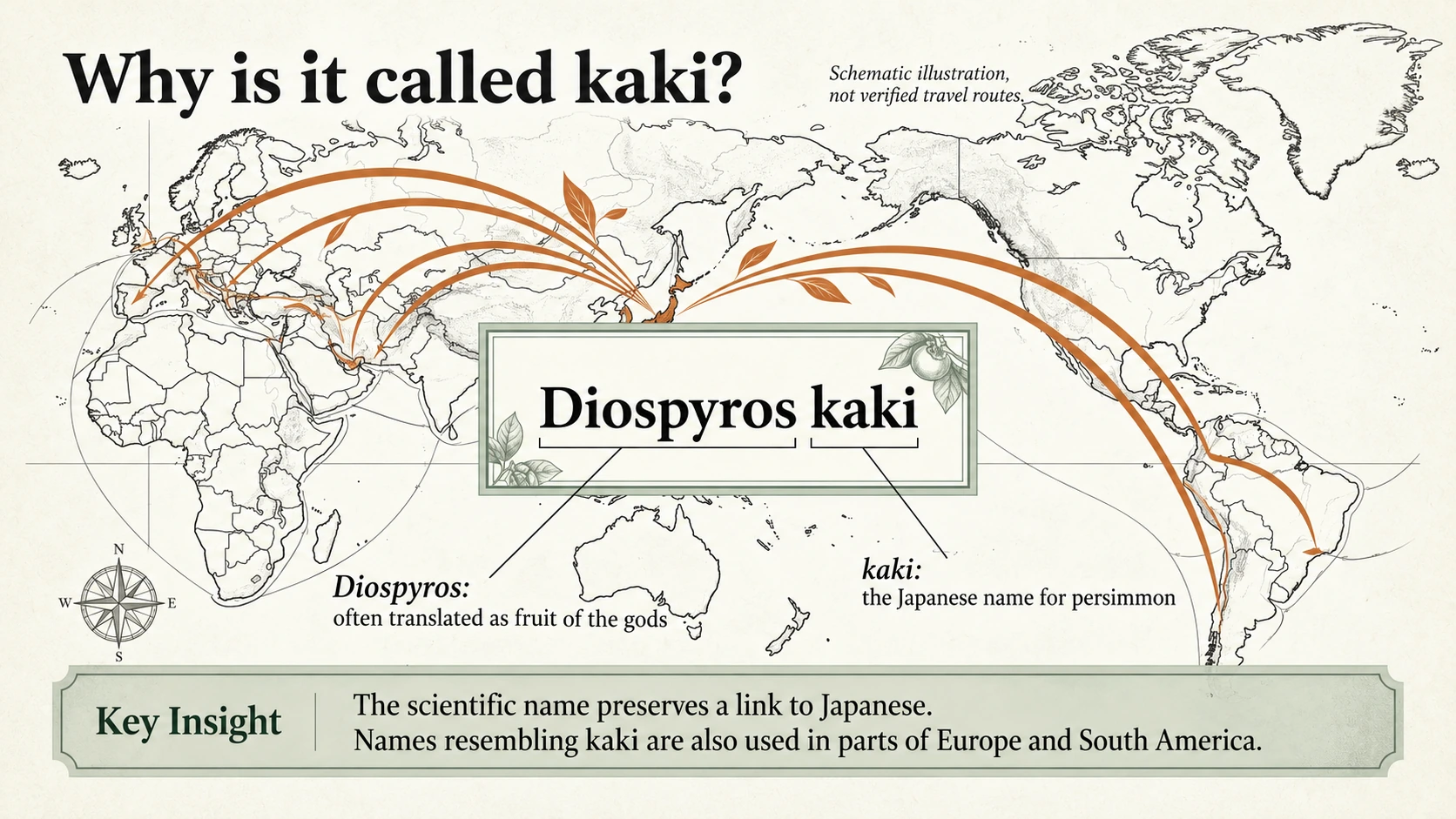
The scientific name of the Asian persimmon is Diospyros kaki. The second word, kaki, comes from the Japanese name for the fruit. In parts of Europe and South America, names close to the Japanese word have also become familiar.
This article follows the fruit from its long history of cultivation in China through Japanese traditions, the naming of varieties and its spread overseas. It also looks at a more recent connection: dried-persimmon production in Dalat, Vietnam. Historical records and local traditions are identified separately along the way.
The persimmon trilogy: Types, nutrition and growing areas · Choosing, eating and storing persimmons
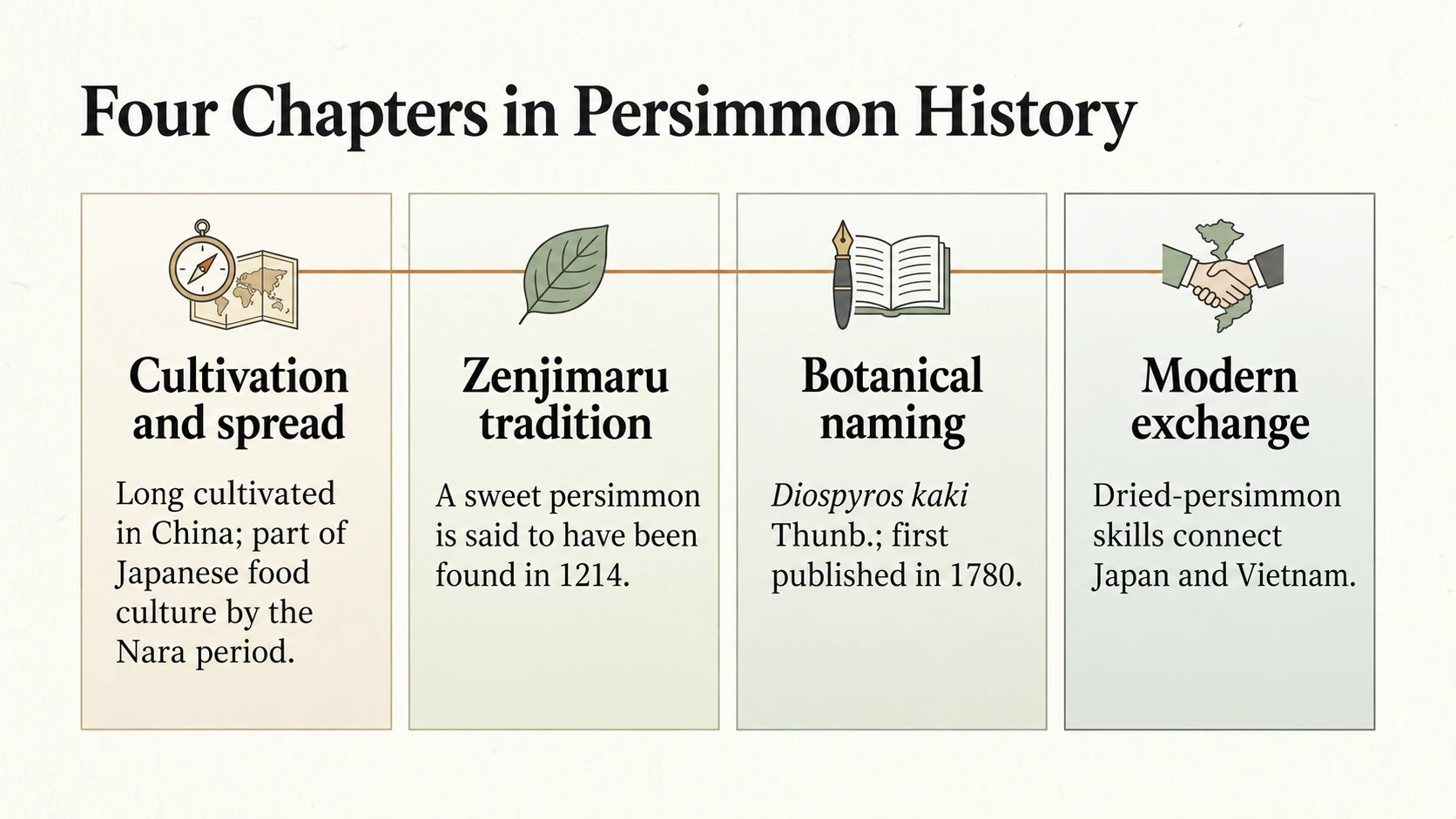
A Timeline of Persimmon History
| Period or year | Event |
|---|---|
| Long before modern times | Persimmons are cultivated in China, where many varieties develop. |
| Nara period, 710–784 | Persimmons become more widely eaten in Japan, according to the MAFF feature cited below. |
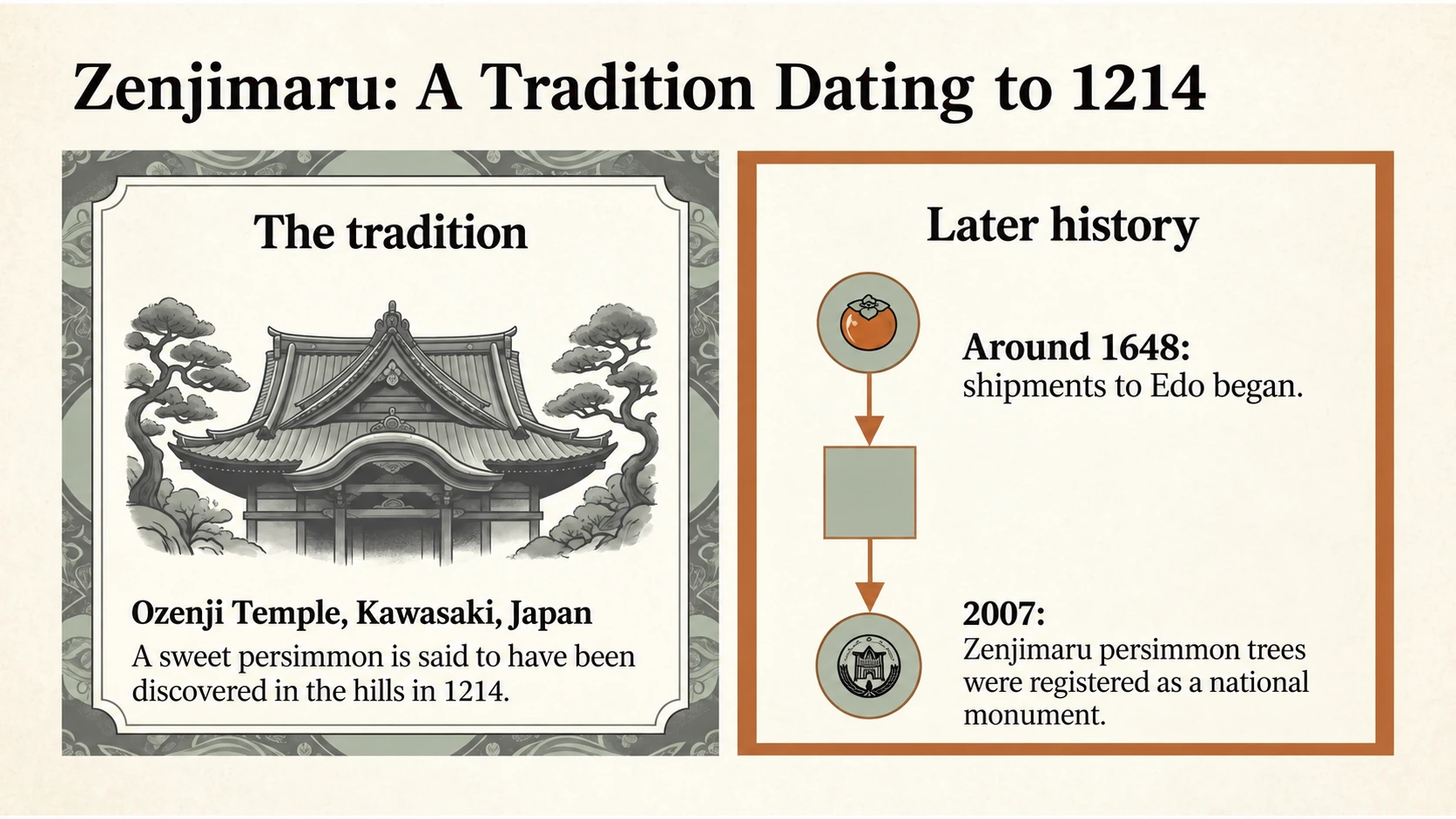
| 1214 | A sweet persimmon called Zenjimaru is said to have been discovered near Ozenji Temple in Kawasaki. |
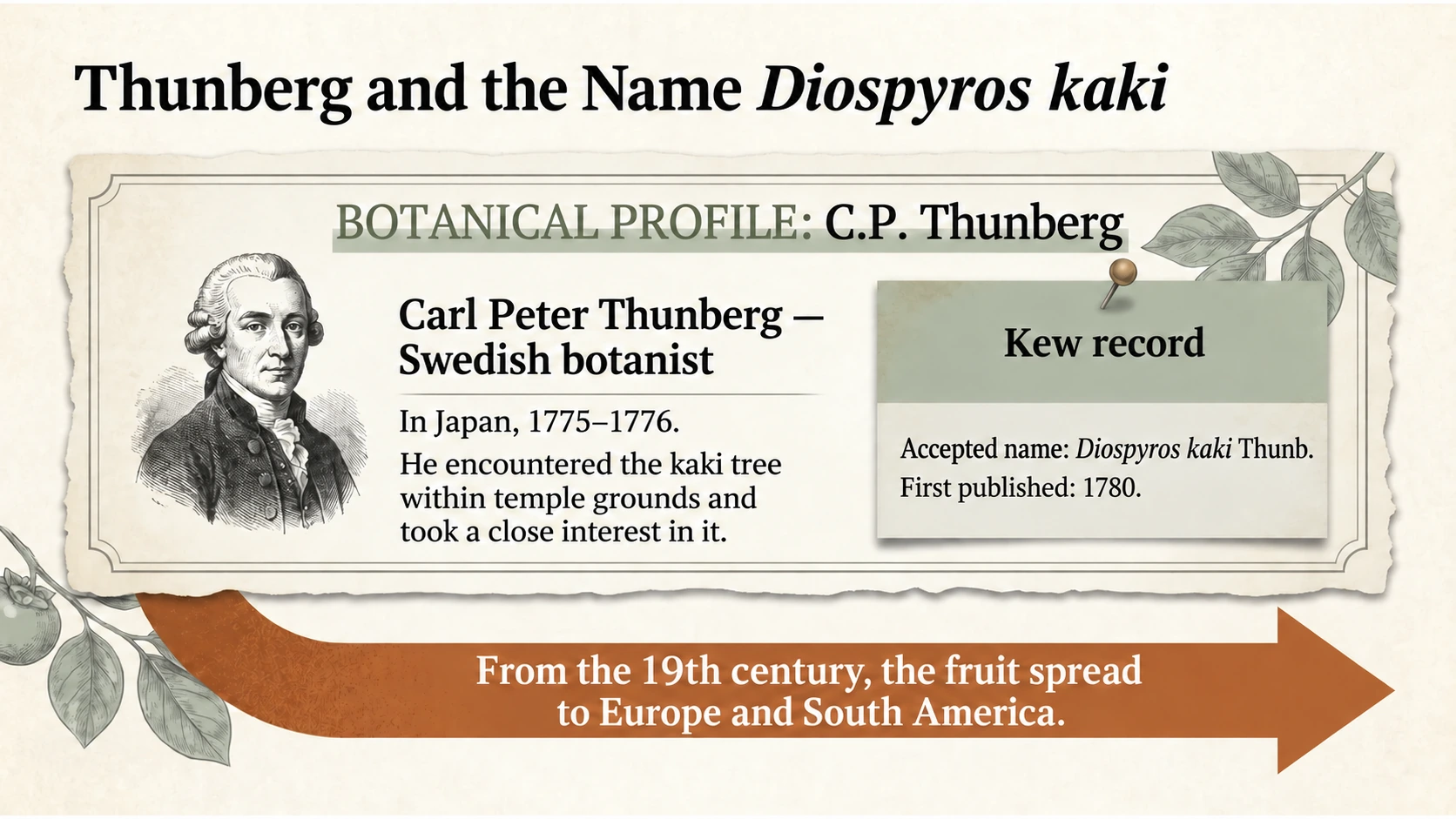
| 1775–1776 | Carl Peter Thunberg stays in Japan. He later publishes the name Diospyros kaki. |
| 1780 | First publication of the scientific name, as recorded by Kew. |
| From the 19th century | Persimmons spread to Europe and South America. |
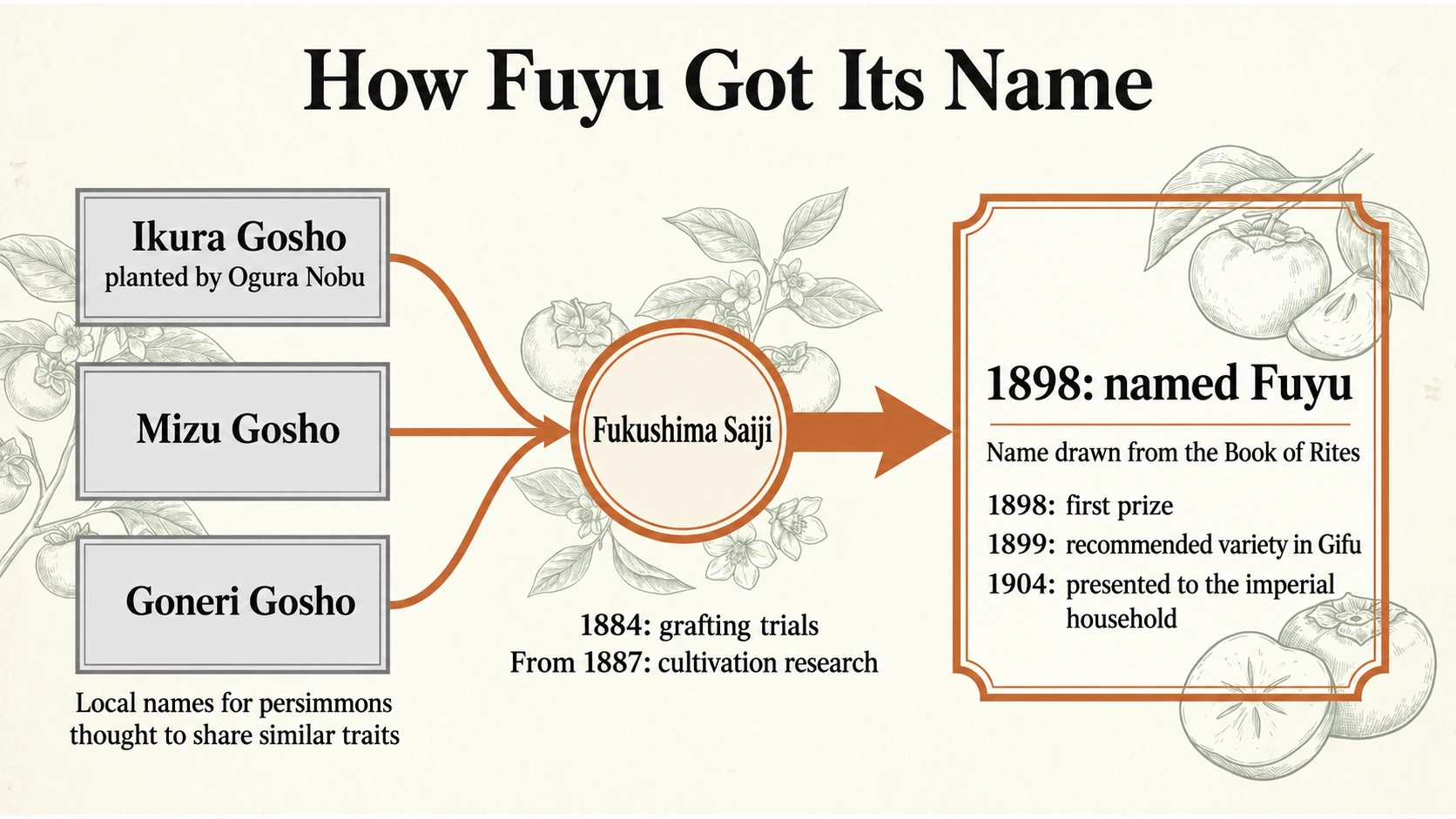
| 1898 | Fukushima Saiji names the variety Fuyu in Gifu, Japan. |
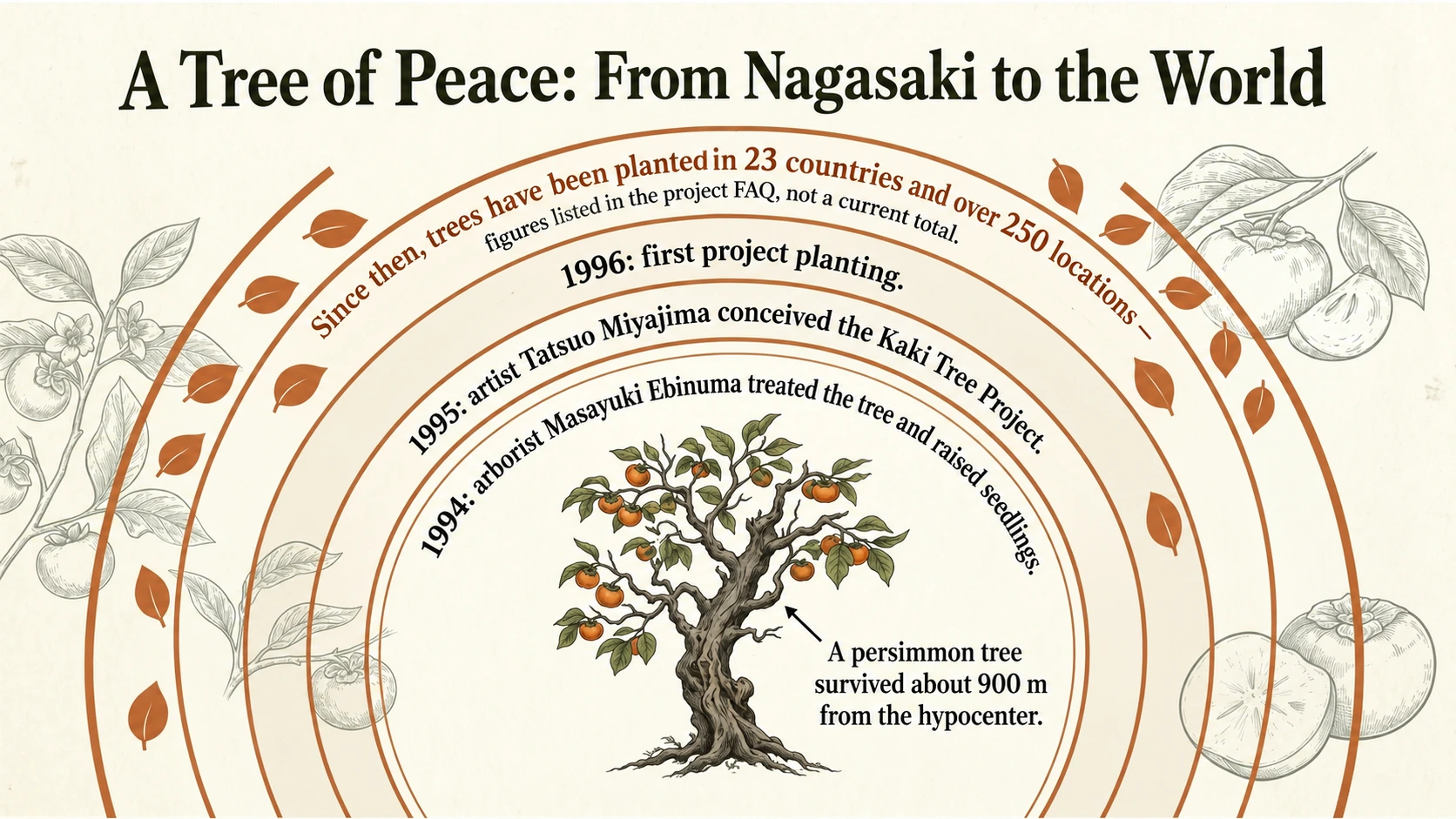
| 1994 | Seedlings are raised from a persimmon tree that survived the atomic bombing of Nagasaki. |
| 1996 | The first planting of the Kaki Tree Project takes place. |
| 2012 | Japanese-style dried-persimmon training begins in Dalat; Bao Lam seedless persimmons receive geographical indication protection. |
The sections below give the context and sources. The discovery dated to 1214 is a local tradition rather than a firmly established historical date.
Cultivation in China and the Spread Across East Asia
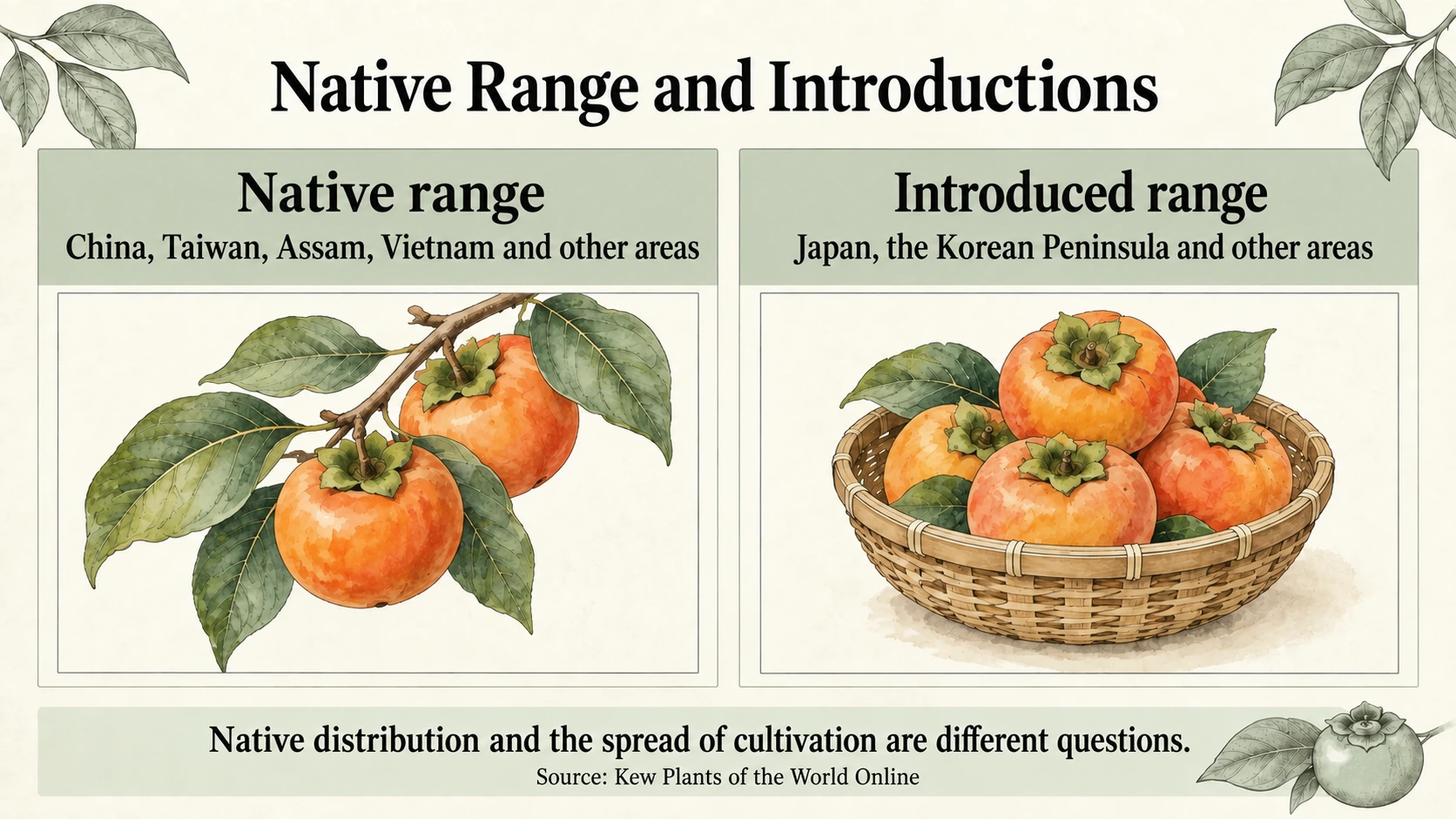
The cultivation story begins in China. California Rare Fruit Growers describes persimmons as originating there, with hundreds of years of cultivation and more than 2,000 varieties. The fruit later spread to the Korean Peninsula and Japan, where further varieties developed. Source: CRFG
Native distribution is a different question. Kew’s plant database includes Vietnam and other areas in the native range. A long history of cultivation in China does not mean every persimmon in Vietnam was introduced from China. Source: Kew
Persimmons in Japan: Food and the Nara Period
A feature published by Japan’s Ministry of Agriculture, Forestry and Fisheries (MAFF) on Google Arts & Culture reports persimmon finds at Yayoi-period archaeological sites. It describes the fruit as becoming more widely eaten during the Nara period, 710–784. Source: MAFF
Accounts of when and by which route persimmons reached Japan differ. Rather than assigning a single arrival date, this story follows the fruit’s place in Japanese food culture.
Persimmons eaten at that time are thought to have been mainly astringent types, prepared by drying or other treatments. Sweet varieties opened up another way to enjoy the fruit.
Native range and introductions: Kew lists Japan and the Korean Peninsula as introduced areas. The history of cultivation and the distribution of wild plants should not be treated as the same map.
The Zenjimaru Tradition: A Sweet Persimmon Found in 1214
Ozenji Temple in Kawasaki’s Asao Ward is associated with a tradition about the discovery of the sweet Zenjimaru persimmon. Kawasaki’s Board of Education recounts a discovery in the surrounding hills in 1214. The date belongs to the tradition, not to a conclusively established historical record.
The city also reports that shipments to Edo began around 1648. Growing the fruit and delivering it to an urban market helped sustain local agriculture. In 2007, Zenjimaru persimmon trees were registered as a national monument. Source: Kawasaki City
Preservation and planting activities continue to reflect the connection between these trees and local life.
Thunberg, the Name Kaki and the Wider World
The Swedish botanist Carl Peter Thunberg stayed in Japan in 1775–1776. MAFF’s feature attributes the scientific name Diospyros kaki to him. It explains Diospyros as “fruit of the gods” and connects this interpretation with persimmon trees he saw around temples and shrines.
Kew records Diospyros kaki Thunb. as the accepted name, first published in 1780. This is a botanical naming record; it is separate from the much older history of growing and eating the fruit. Source: Kew
MAFF’s feature also describes persimmons spreading to Europe and South America from the 19th century, carrying a name derived from Japanese. Alongside their long cultivation history in China, the scientific name preserves that Japanese connection. Source: MAFF
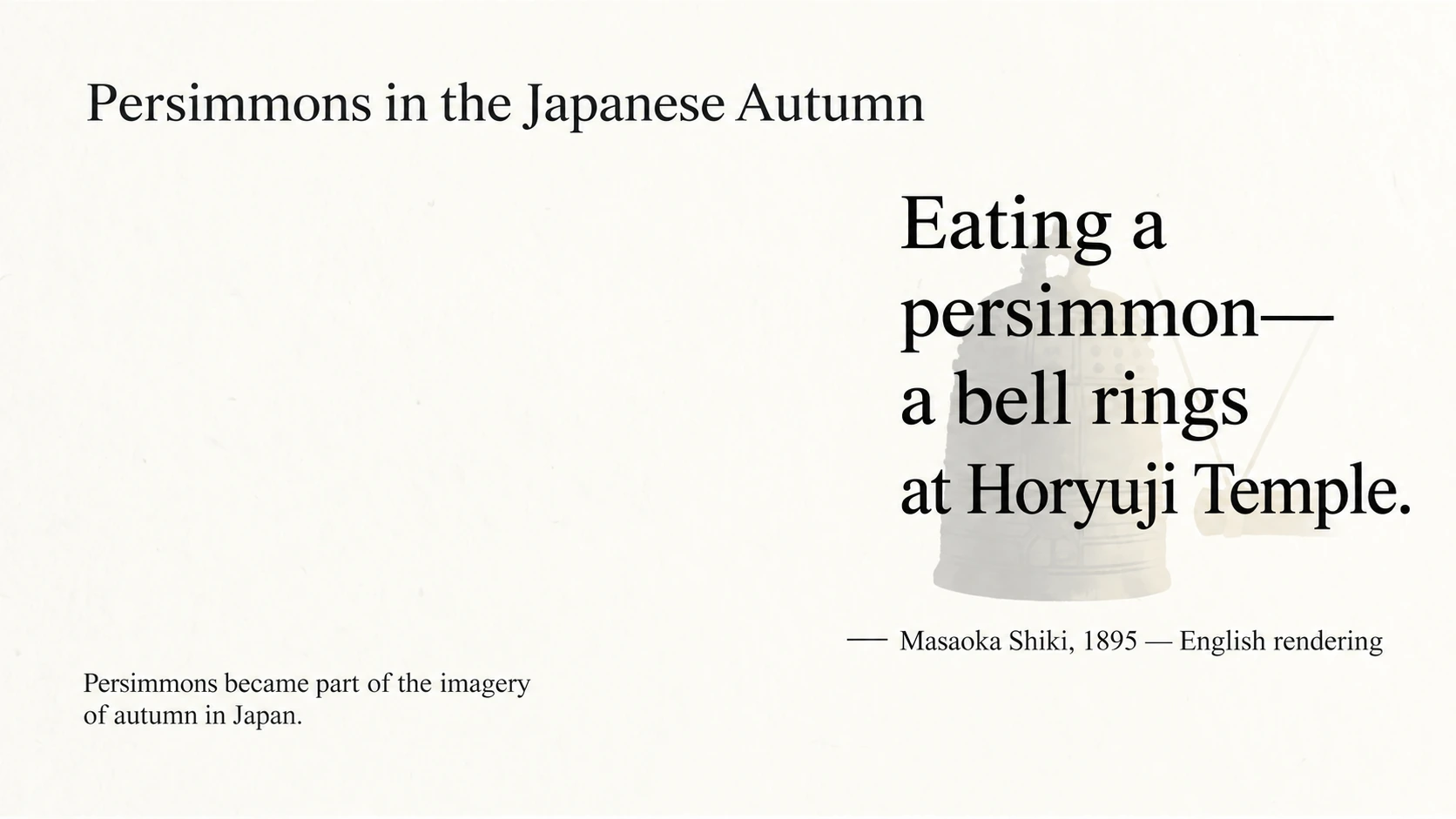
The same feature introduces a haiku written by Masaoka Shiki in 1895. An English rendering is:
Eating a persimmon—
a bell rings
at Horyuji Temple.
Persimmons became a familiar part of the imagery of autumn in Japan.
How Fuyu Got Its Name
Fuyu is now one of the best-known sweet persimmons. A document from Gifu Prefecture’s agricultural administration describes the people and decisions behind its name.
Around 1820, a woman named Ogura Nobu planted a Gosho persimmon near her home in Ikura Village, Mino Province—now Ikura in Mizuho City, Gifu. The tree became known as Ikura Gosho, a name associated with a local shrine or place name.
Fukushima Saiji, who came from the same village, tried grafting branches from the Ogura family’s tree in 1884. He began cultivation research in 1887, and the fruit won first prize at an exhibition in 1892.
Persimmons believed to have similar characteristics were being called Ikura Gosho, Mizu Gosho and Goneri Gosho in different places. In 1898, Saiji sought to establish a common name. He discussed two possibilities, Fukuju and Fuyu, with a school principal. The recommended name was Fuyu, taken from a phrase in the classical Book of Rites.
Saiji entered fruit under the name Fuyu in that year’s exhibition and won first prize. It became a recommended variety in Gifu in 1899 and was first presented to the imperial household in 1904. Source: Gifu Prefecture, “The Origins of Fuyu Persimmon”
The document notes an alternative account of whom Saiji consulted about the name. Its broader story brings together people who planted a promising tree, propagated it through grafting and helped establish a shared name.
From a Nagasaki Tree to the Kaki Tree Project
Persimmon history also includes a tree that carries a message of peace.
A persimmon tree in Wakakusa-machi, Nagasaki, survived about 900 metres from the hypocenter of the atomic bombing. It was described as roughly 150 years old. In 1994, arborist Masayuki Ebinuma treated the weakened tree and succeeded in raising seedlings from it.
Artist Tatsuo Miyajima learned of the work in 1995 and conceived the “Revive Time: Kaki Tree Project,” seeking people to care for the seedlings. The project’s first planting took place in 1996, and seedlings later travelled both within Japan and overseas. The project FAQ lists plantings in 23 countries and more than 250 locations. These are figures shown in that FAQ, not a verified current total. Sources: project website and FAQ
Seeds from a tree in Japan have reached children in other countries. The persimmon’s journey continues through these encounters as well as through cultivation and trade.
Vietnamese Traditions: Royal Offerings and Dalat’s Dried Persimmons
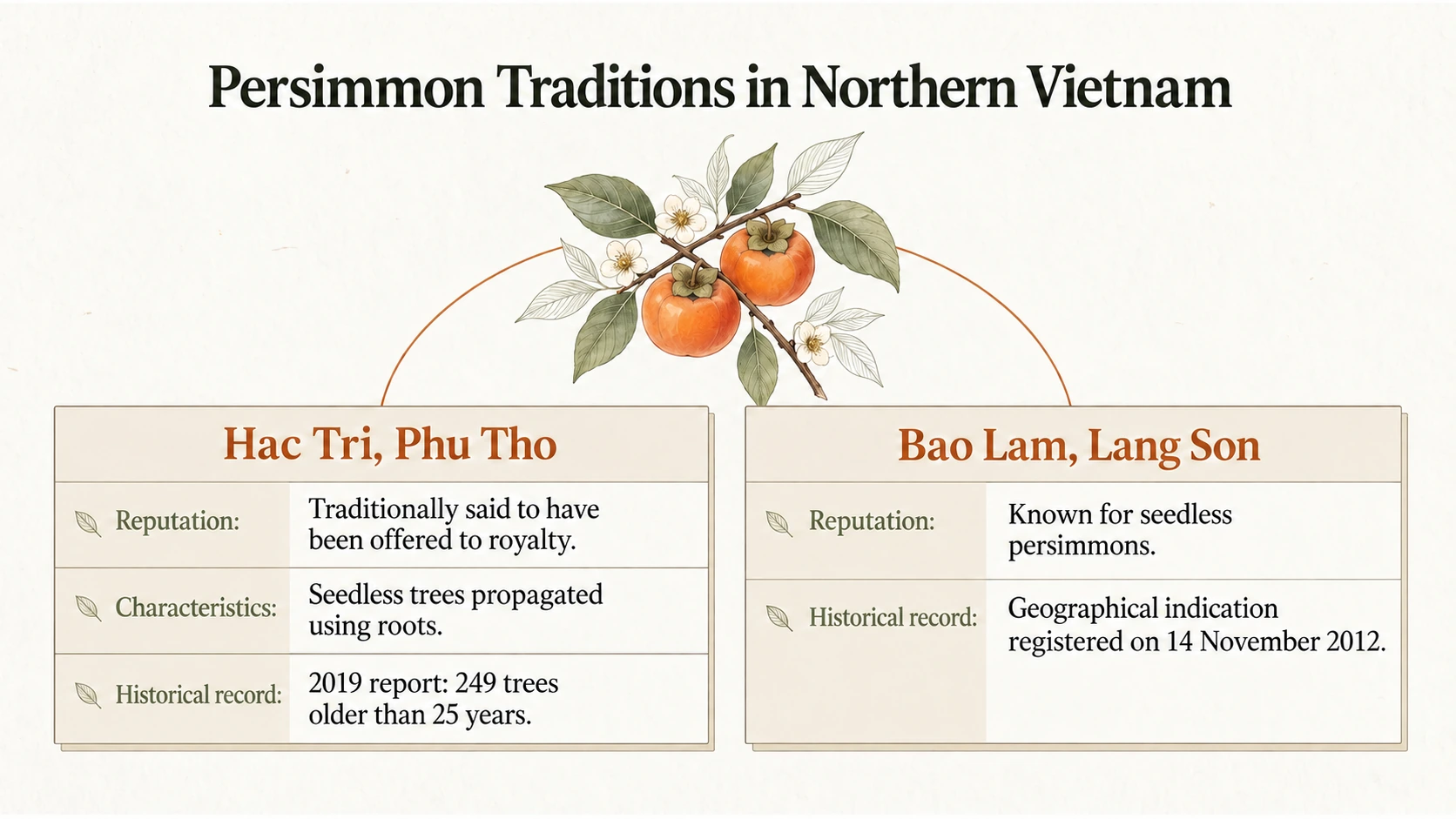
Northern Vietnam has persimmon stories of its own. In Hac Tri, Phu Tho, the fruit is traditionally said to have been offered to royalty. The old seedless variety has been propagated using its roots. A Vietnamnet report from 2019 stated that 249 trees older than 25 years remained in the province at that time. Source: Vietnamnet, 13 October 2019
Seedless persimmons from Bao Lam, Lang Son, received a Vietnamese geographical indication on 14 November 2012. Vietnam’s intellectual property authority identifies it as registration No. 00032. Source: Intellectual Property Office of Vietnam
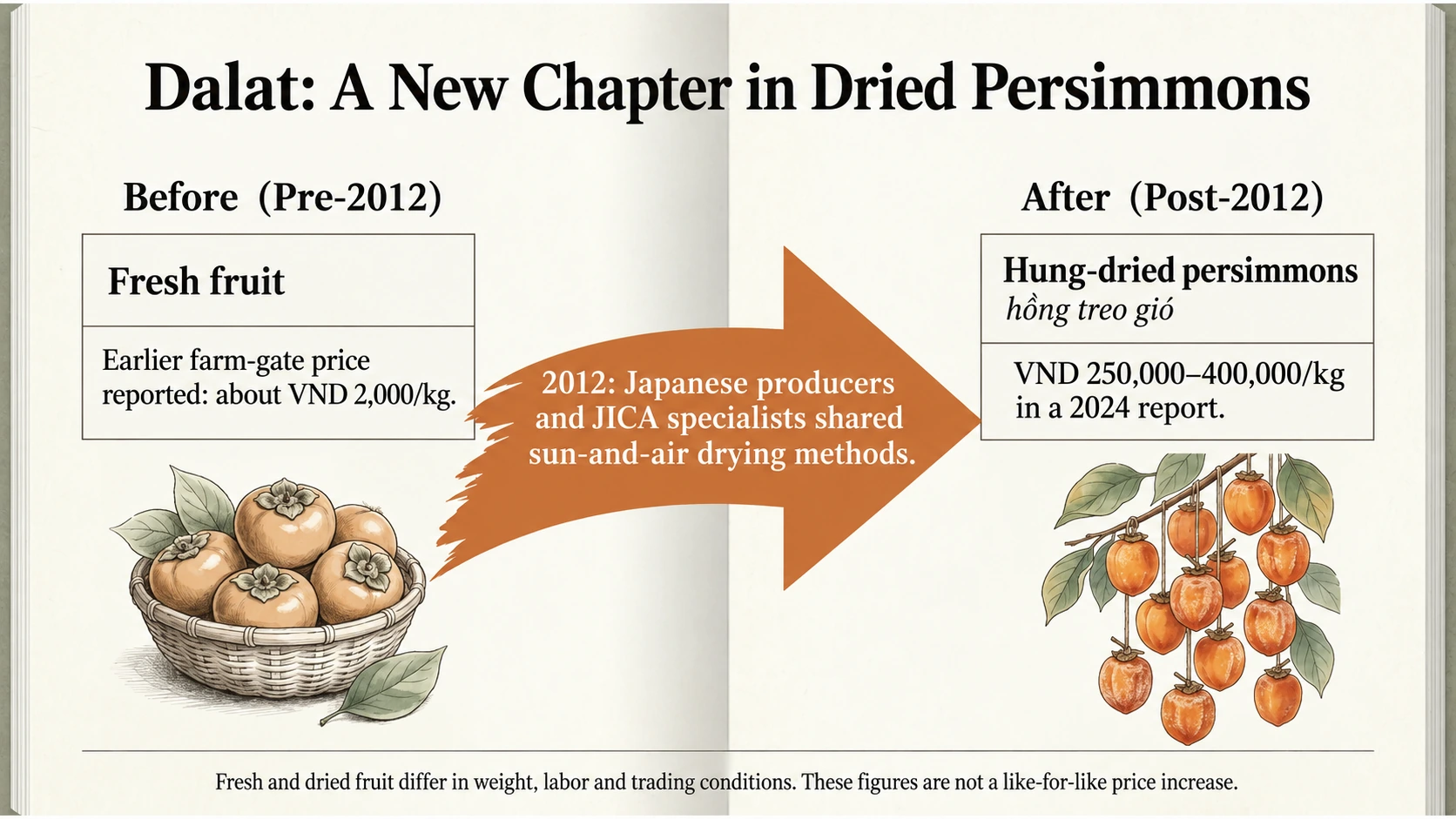
In Dalat, in Vietnam’s Central Highlands, a different story developed through connections with Japan. Nhân Dân reported that fresh persimmons had previously traded at farms for about VND 2,000 per kilogram. In 2012, Japanese dried-persimmon producers and JICA specialists taught more than 100 farming households how to dry the fruit using sunlight and air rather than charcoal. Source: Nhân Dân, 31 March 2024
The resulting hồng treo gió, literally persimmons hung in the wind, became a Dalat specialty. Nhân Dân described renewed interest in the crop. A 2024 Công Thương report quoted dried-persimmon prices of VND 250,000–400,000 per kilogram. Source: Công Thương, 17 October 2024
Fresh and dried fruit differ in weight, labour and trading conditions, so these figures cannot be used to calculate a simple price increase. They do, however, illustrate how processing created another market for Dalat’s persimmons.
A fruit long cultivated in East Asia, and drying skills developed in Japan, became part of a regional specialty in Vietnam. Hanging persimmons at a Vietnamese market are one visible part of that continuing exchange.
The People Behind the History
Persimmon history crosses borders. It includes long cultivation in China, sweet varieties and naming in Japan, the spread of the word kaki, and new stories in Vietnam.
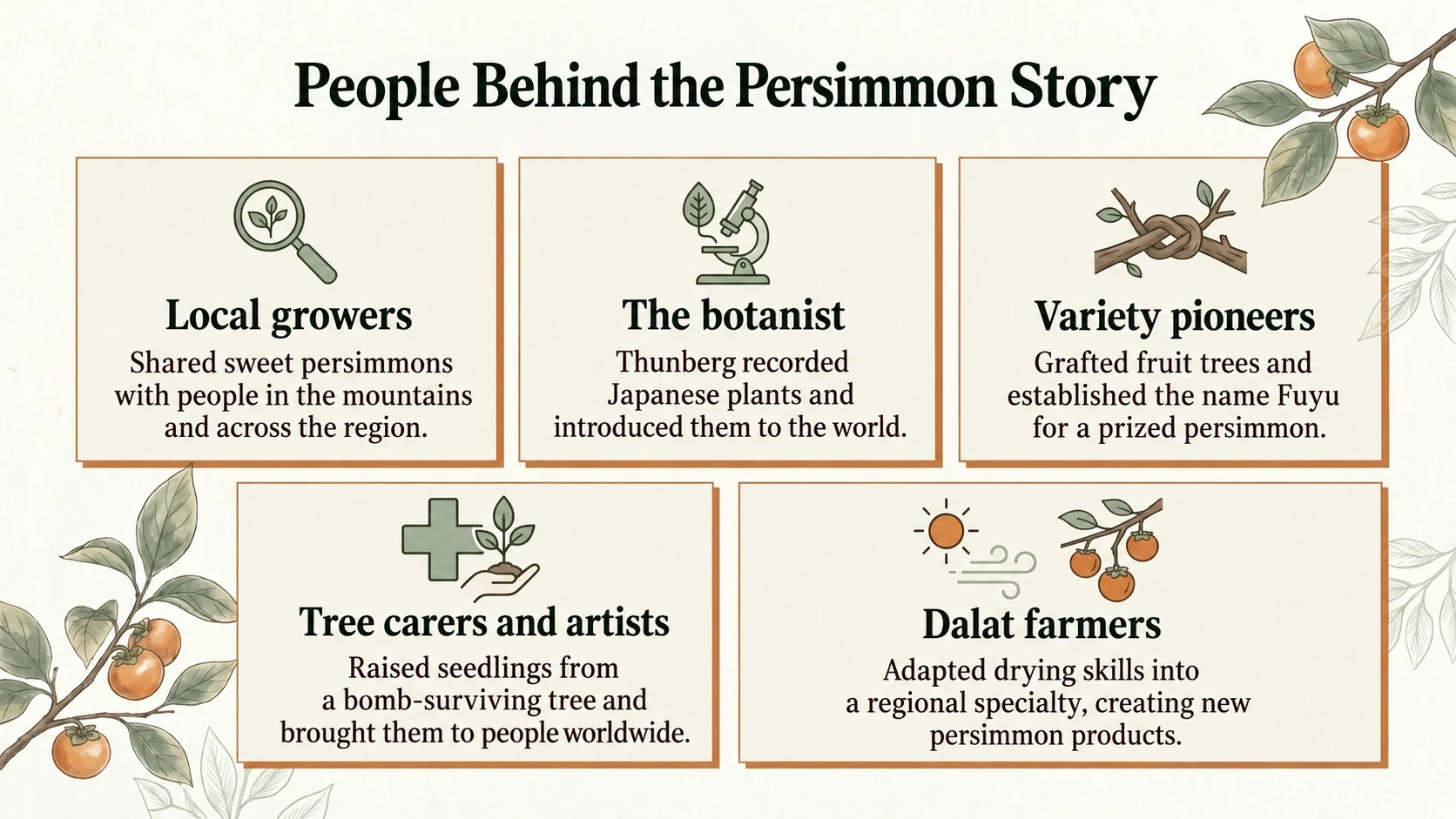
Different people sustained that history:
- Local growers who shared sweet persimmons with their communities.
- A botanist who introduced Japanese plants to a wider scientific audience.
- People who planted promising trees, grafted them and established variety names.
- An arborist and artists who helped seedlings from a bomb-surviving tree reach others.
- Producers who shared drying methods, and Vietnamese farmers who adapted them.
The next time you see quả hồng or dried persimmons at a Vietnamese market, you may notice more than a familiar autumn fruit: each also has a history of cultivation, names and shared skills.
More in the Persimmon Trilogy
Sources
- California Rare Fruit Growers, “Persimmon”: cultivation, varieties and spread to Japan and the Korean Peninsula.
- MAFF, “Persimmon: The Fruit of the Gods”: Japanese food history, naming, overseas spread and Shiki’s haiku.
- Kew, Plants of the World Online: accepted scientific name and native and introduced ranges.
- Kawasaki City Board of Education, Zenjimaru persimmons: local tradition, trade and registered trees.
- Gifu Prefecture, the origins of Fuyu: Ogura Nobu, Fukushima Saiji and the naming history.
- Kaki Tree Project and FAQ: tree care, seedlings and planting activities.
- Vietnamnet, Vietnam’s intellectual property authority, Nhân Dân and Công Thương: Vietnamese traditions and processing. Historical figures retain the dates of the reports.
