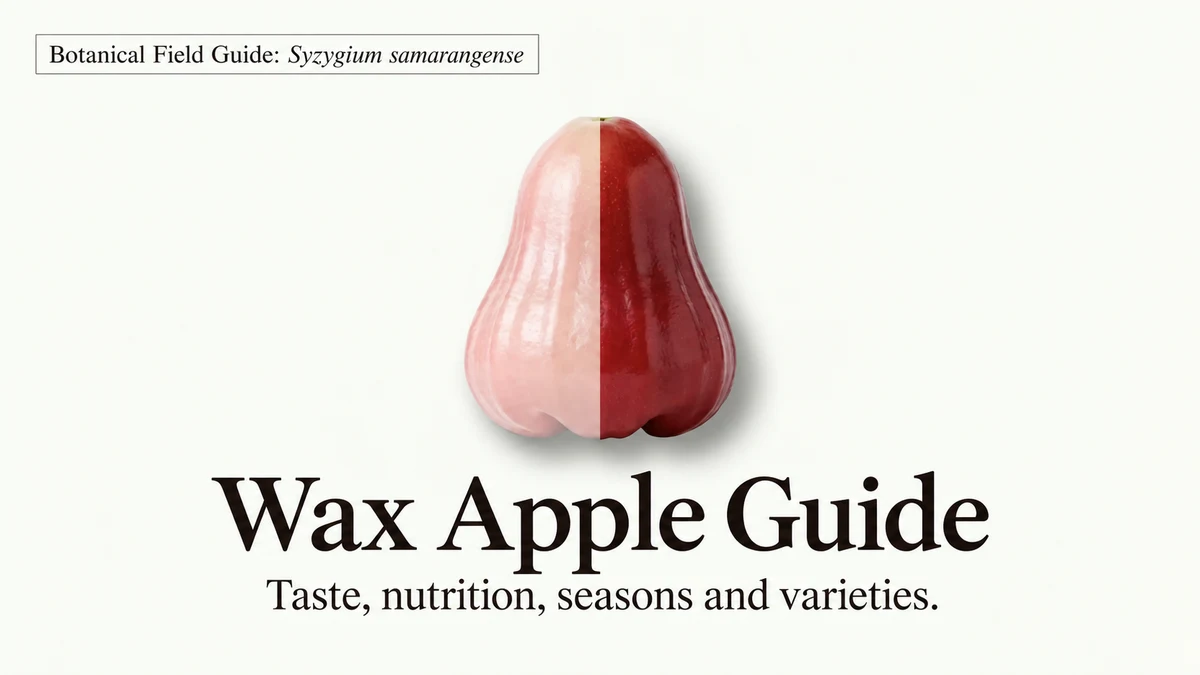
Roi in the north, mận in the south: different names for the same species.
Wax apple, known in Japanese as renbu, is a bell-shaped fruit in the myrtle family. Its glossy skin resembles polished wax, and its flesh is crisp, watery and mildly sweet. In Vietnam it is commonly called roi in the north and mận in the south.
Despite different names and skin colors, market wax apples in both regions belong to Syzygium samarangense. Vietnamese standards and university research use the same scientific name. This guide covers taste, season, nutrition, origins, names, varieties and availability in Japan.
Wax Apple at a Glance
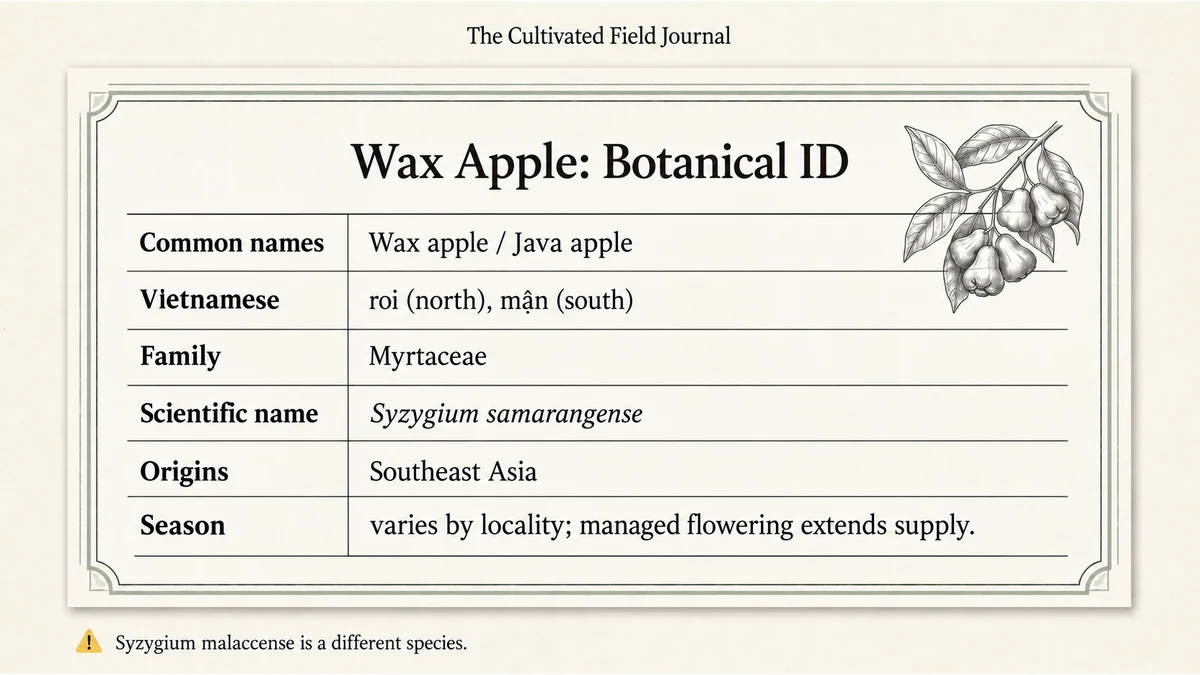
| Item | Details |
|---|---|
| Common names | Wax apple; Java apple; renbu in Japanese |
| Vietnamese names | Roi in northern Vietnam; mận in southern Vietnam |
| Scientific name | Syzygium samarangense, shared by northern roi and southern market mận |
| Classification | An evergreen tree in the genus Syzygium, family Myrtaceae |
| Origins | Southeast Asia, commonly described as the Malay Peninsula and Malay Archipelago |
| Season in Vietnam | Available for much of the year where flowering is managed; harvest timing varies by cultivar and locality. Spring to early summer is often described as a main harvest period. |
| Growing areas in Vietnam | Commercial growing areas include the Mekong Delta around Bến Tre and Tiền Giang, names used in the cited sources. Mận An Phước is a familiar southern cultivar; wax apple is also grown in northern gardens and local orchards. |
| Nutrition | About 89% water in Taiwan’s pink-variety reference data; also contains potassium, vitamin C and dietary fiber |
Sources are listed at the end of the article.
Names and Vietnam’s Regional Vocabulary
Wax apple has an unusual story: one country uses two familiar names for the same fruit. Its Japanese name also reflects a journey through Southeast Asian and Taiwanese languages.
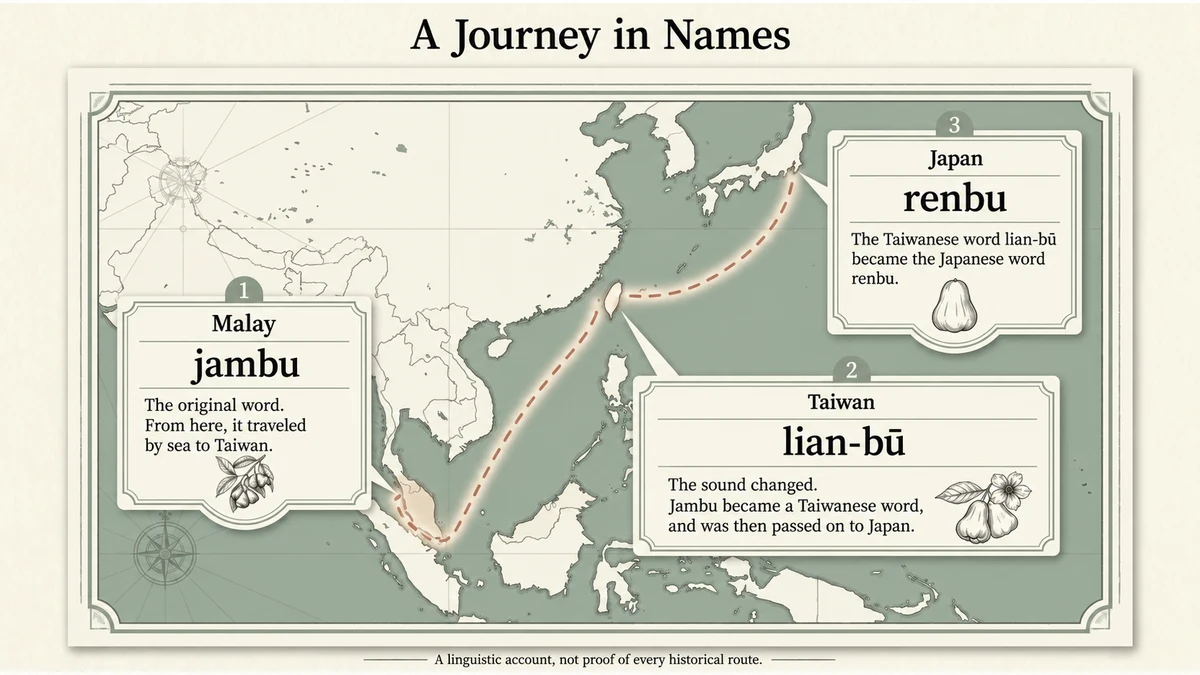
From Malay Jambu to Taiwan’s Lian-bū
The Japanese name renbu comes from the Taiwanese name written 蓮霧. This is generally explained as a borrowing from Malay jambu.
Accounts of its arrival in Taiwan during the seventeenth-century Dutch period describe jambu passing through Taiwanese forms such as jiam-bū and tsian-bū before lian-bū became established. These are linguistic explanations, rather than a fully documented itinerary for every stage. Mandarin reads the characters as liánwù.
The epithet samarangense refers to Semarang on Java. Names evoke connections between Southeast Asia, Taiwan and Japan, although a name alone does not prove a particular historical route.
Northern Roi and Southern Mận Are the Same Species
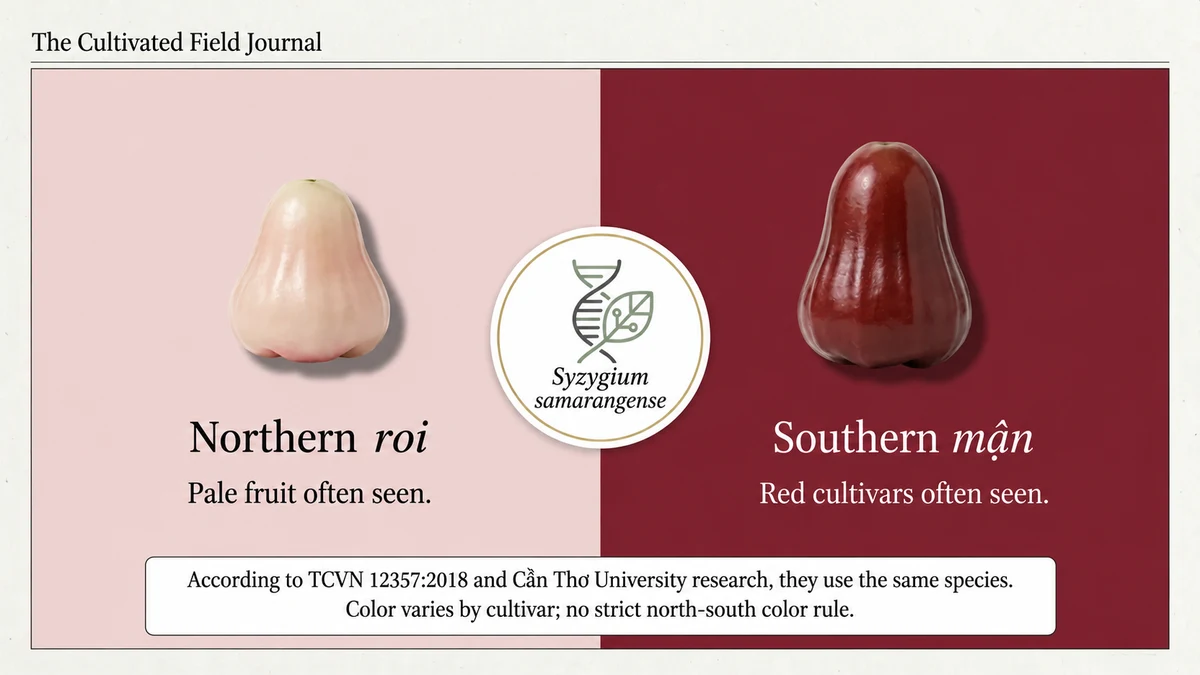
In the north, roi or roi hoa trắng is common; in the south, mận is familiar. Pale pink or white fruit may stand out in northern markets, while the southern cultivar Mận An Phước often has deep red skin. These impressions do not establish a botanical boundary.
Vietnamese standard TCVN 12357:2018, based on ASEAN Stan 29:2012, covers commercial fresh roi as Syzygium samarangense. Research by Lê Văn Hòa and colleagues at Cần Thơ University in 2012 uses the same name for Mận An Phước. The northern and southern market names therefore refer to the same species in this context.
Skin color and fruit size vary among cultivars, growing conditions and cultivation methods. It is too simple to divide all northern fruit into pale garden varieties and all southern fruit into dark commercial varieties.
Vietnam also has genuinely different related species. Roi hoa đỏ, or mận đỏ, is Syzygium malaccense, the Malay apple, which has red flowers. It should be distinguished from market wax apple, S. samarangense.
Mận Can Mean a Different Fruit in the North
The complication lies in vocabulary.
In northern Vietnam, mận usually means a plum, a fruit in the rose family. In the south, the same word commonly means wax apple. A conversation about mận may therefore evoke very different fruit depending on the region.
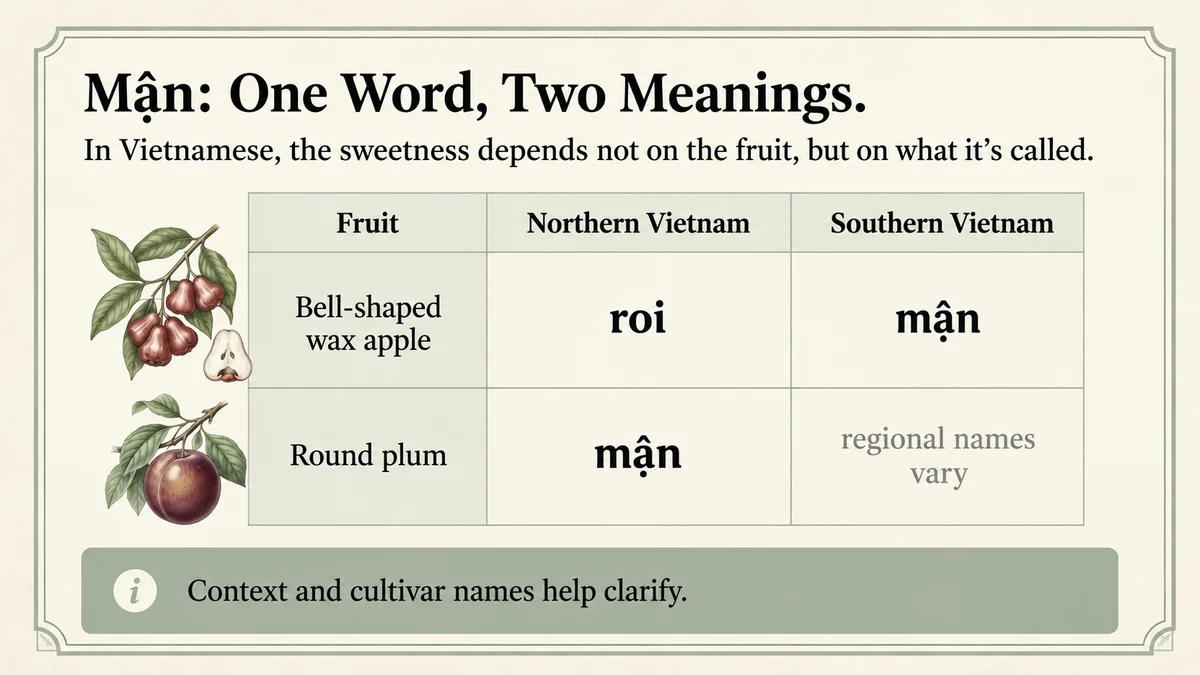
Context and cultivar names such as An Phước often make the intended fruit clear. Wax apple does not become a different species across Vietnam; rather, mận can designate two unrelated fruits in different regional usage.
Glossy Fruit and White Flowers with Radiating Stamens
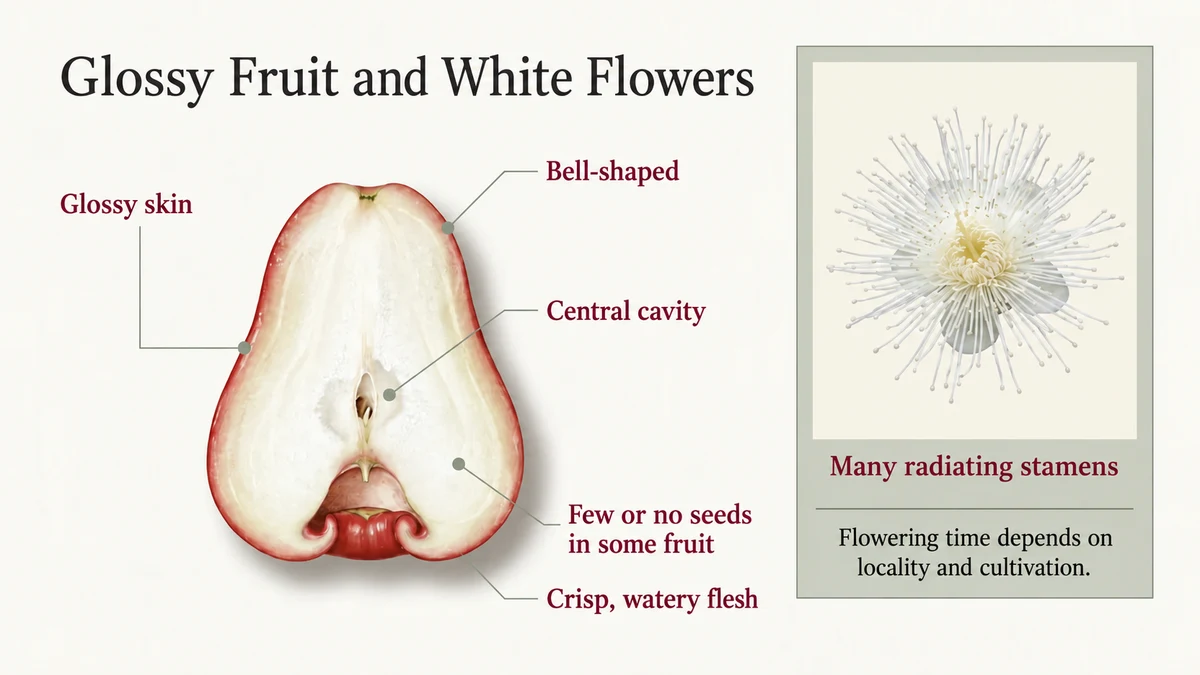
Japanese accounts describe white flowers appearing around April and May, with many stamens radiating outward. Managed flowering in southern Vietnam can follow a different schedule.
Fruit is typically bell-shaped, around 3–7 cm across, with skin colors ranging from pale green to pink, red or very dark shades. A central cavity is common, and some fruit has few or no seeds. The crisp, watery flesh has a light apple-and-pear character with mild acidity, varying by cultivar. It is usually eaten fresh; plum seasoning powder is one accompaniment used in Taiwan.
Wax Apple Nutrition and Calories
The values below are reference figures for 100 g of edible portion from Taiwan’s Food and Drug Administration food composition database, the average entry for pink wax apple.
- Energy: 39 kcal
- Water: 89.1 g
- Protein: 0.4 g
- Fat: 0.3 g
- Carbohydrate: 10.0 g
- Dietary fiber: 0.8 g
- Potassium: 91 mg
- Vitamin C: 8.8 mg
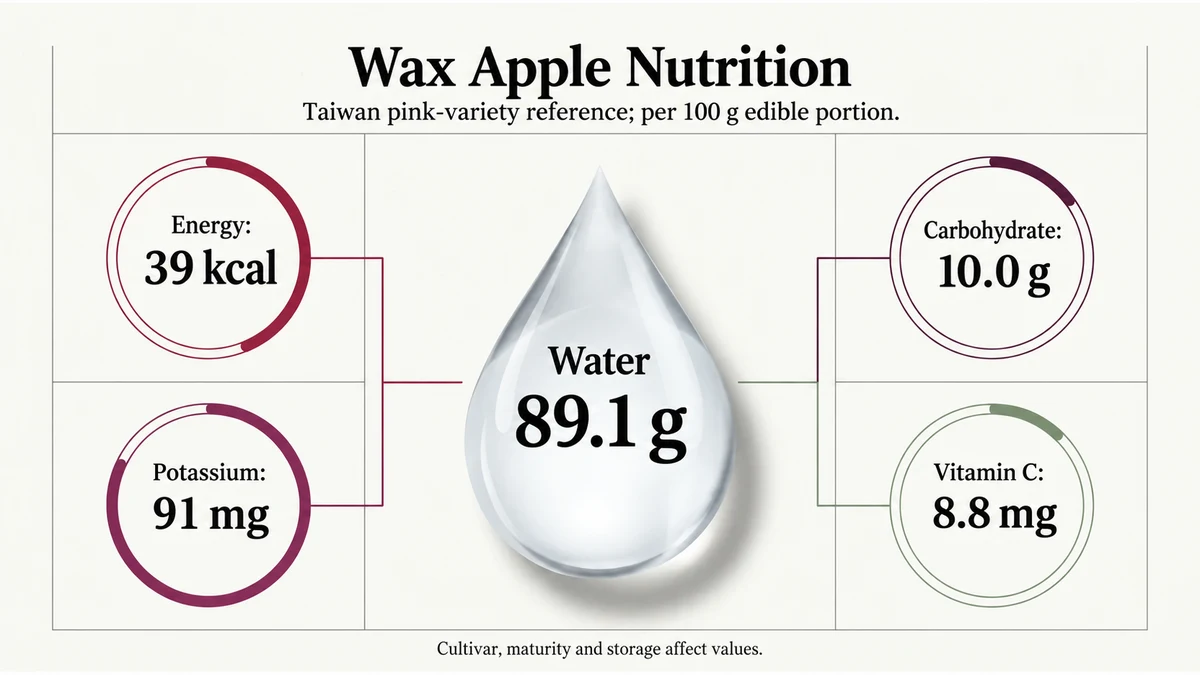
Its high water content is the most striking feature. At 39 kcal per 100 g in this reference entry, wax apple can be a light snack. Potassium and vitamin C have ordinary nutritional roles, but the presence of these nutrients does not make the fruit a treatment.
Eating wax apple has not been established here as a way to improve a particular illness or symptom. Enjoy it as part of a varied diet.
Two Cautions About Nutrition Data
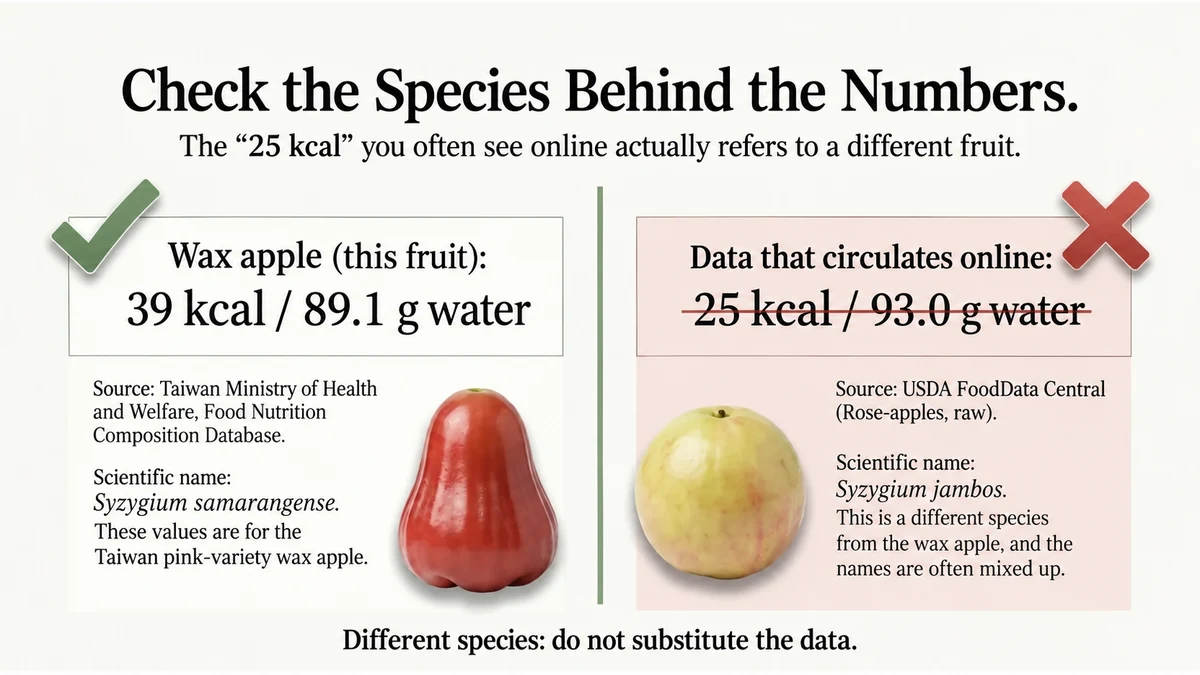
Two distinctions matter when reading these values.
First, the figures above are reference data for a Taiwanese pink variety. Cultivar, origin, maturity and storage affect composition. Studies of Mận An Phước include vitamin C changes during storage, but they do not provide an equivalent complete official food composition table. No wax apple entry was identified in the Japanese food composition database consulted for this manuscript.
Second, some online wax apple figures actually describe a different fruit. The combination 25 kcal, 93.0 g water, 22.3 mg vitamin C and 123 mg potassium comes from USDA “Rose-apples, raw,” FDC ID 168171, identified as Syzygium jambos. Wax apple is S. samarangense. Loose use of “rose apple” for both fruits can cause this mix-up; check the scientific name before comparing values.
Varieties in Taiwan, Thailand and Vietnam
Growing Areas Mentioned in the Literature
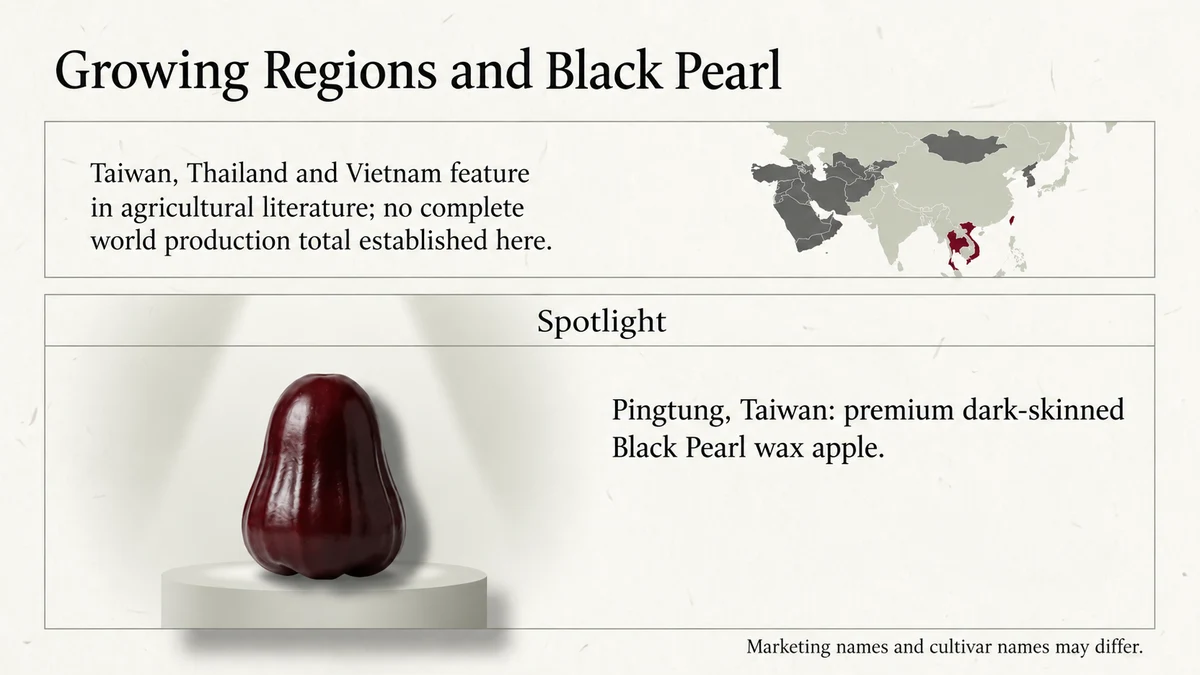
Wax apple does not have a separate commodity category in the FAO statistics consulted for the original article, so these sources do not establish a complete world production total. Agricultural literature discusses production in Taiwan, Thailand, Vietnam and other tropical Asian countries.
Historical figures include Taiwan’s 7,302 ha and 84,991 tonnes in 2005, compared with 5,416 ha and 78,109 tonnes in 2011. Other cited figures include Indonesia’s 13,454 ha and 239,108 tonnes in 2003 and Thailand’s 10,240 ha and 69,608 tonnes in 2004. These are old records, not present-day production estimates. Taiwanese exports to destinations including China, Hong Kong, Singapore and Canada have also been reported.
Taiwan’s Black Pearl and Growing Wax Apple in Japan
Pingtung is known for premium wax apple production, with relatively dry, sunny winter conditions. Very dark-skinned fruit sold as Black Pearl is particularly familiar. Names such as Black Diamond and other cultivar or market labels also appear; marketing names should not automatically be treated as interchangeable botanical cultivar names.
Wax apple is also grown in Japan. Japanese accounts describe its introduction from Taiwan to the Okinawa agricultural experiment station around 1940, followed by cultivation in Okinawa and the Amami Islands. Pink types and newer Taiwanese selections are mentioned. Okinawa’s harvest is commonly described as July–September. The cited 2024 figures, 1.49 tonnes and around JPY 1,200 per kg, are historical source values, not a current retail quote. Cold sensitivity, perishability and production challenges help explain its rarity.
Vietnam’s Mận An Phước
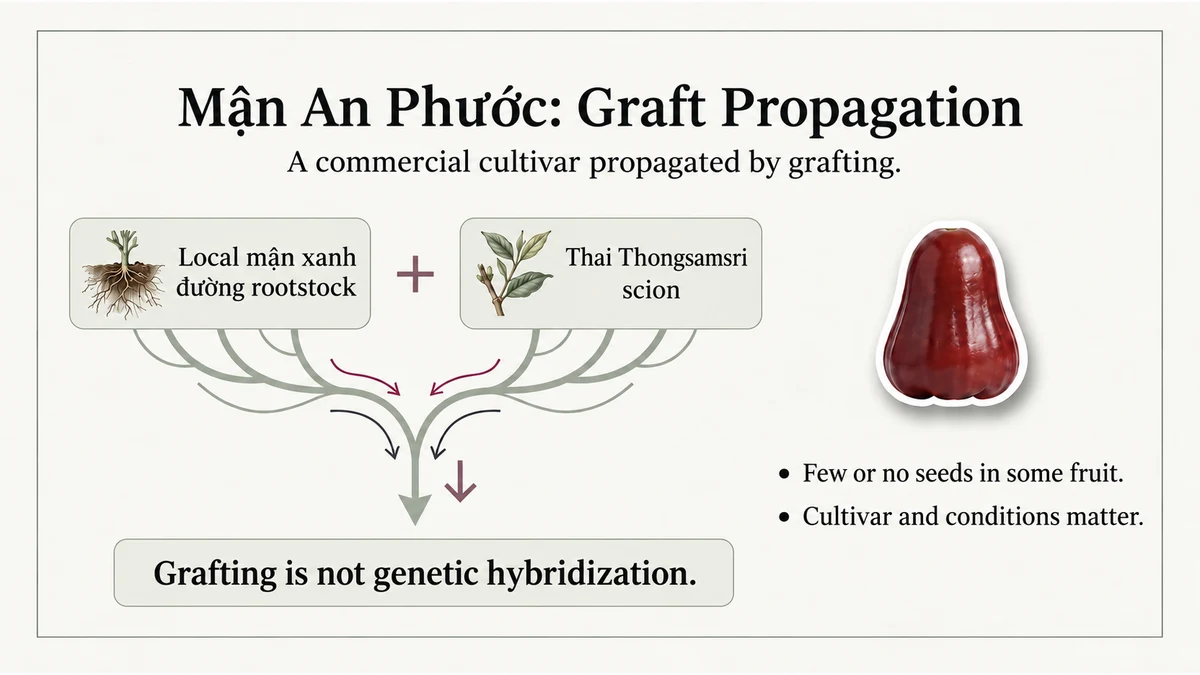
Mận An Phước is associated with An Phước in Bến Tre in the cited accounts. They describe the Thai selection Thongsamsri grafted onto local mận xanh đường rootstock. This is graft propagation, rather than proof of a newly bred genetic hybrid. The fruit is bell-shaped and red-purple, often with few or no seeds. Sources also mention Mỹ Lương in Cái Bè, Tiền Giang as a production area. These place names follow the cited records. Managed flowering allows multiple harvest periods; timing depends on locality and growing practice.
Wax Apple in Vietnam’s Markets
Cultivars and Growing Areas Shape Supply
Northern gardens and local markets feature in descriptions of roi, while southern Mận An Phước is associated with commercial orchards and wider sales. These are tendencies in the sources, rather than a rule for every grower.
Southern orchards may manage flowering to supply off-season fruit as well as the natural season. A 2019 agricultural newspaper report described prices of VND 12,000–20,000 per kg in the regular season and up to VND 70,000 off-season. These are historical figures from that report and should not be used as today’s price.
Cultivation and marketing differ within each region. Northern and southern Vietnam cannot be reduced to a fixed household-versus-commercial split.
Fresh Wax Apple from Vietnam Cannot Be Brought into Japan
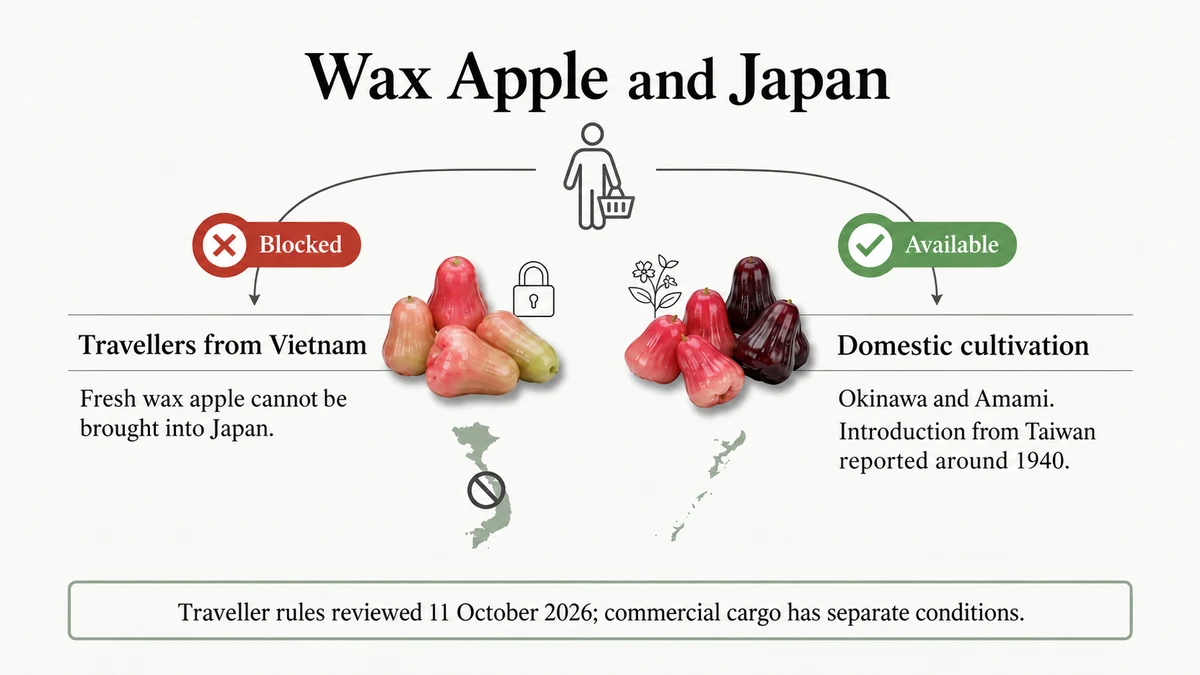
Japan’s Plant Protection Station traveller list states that fresh wax apple from Vietnam cannot be brought into Japan. The list applies to travellers’ baggage; commercial cargo has separate conditions. Check the official rules before travel.
Domestic wax apple may be available from growers in Okinawa or elsewhere in Japan. The traveller restriction does not establish a blanket rule about every commercial import route, and it does not prevent buying fruit grown within Japan.
Frequently Asked Questions
What Does Wax Apple Taste Like?
It is mildly sweet, sometimes lightly tart, with crisp, watery flesh. Texture is often compared with apple or pear, although taste varies by cultivar.
Is Wax Apple the Same as Rose Apple?
Common English names overlap, but wax apple is Syzygium samarangense. Rose apple in the narrower sense is Syzygium jambos, a different species. Check the scientific name when comparing nutrition data.
Are Roi and Mận Different Fruits?
Northern roi and southern market mận can both mean Syzygium samarangense. Northern mận, however, normally means plum, an unrelated fruit.
Can You Eat the Skin?
Yes, after washing it thoroughly. See How to Eat Wax Apple in Vietnam: Buying, Washing, Cutting and Storage for choosing, washing, cutting and storage.
Key Points About Wax Apple
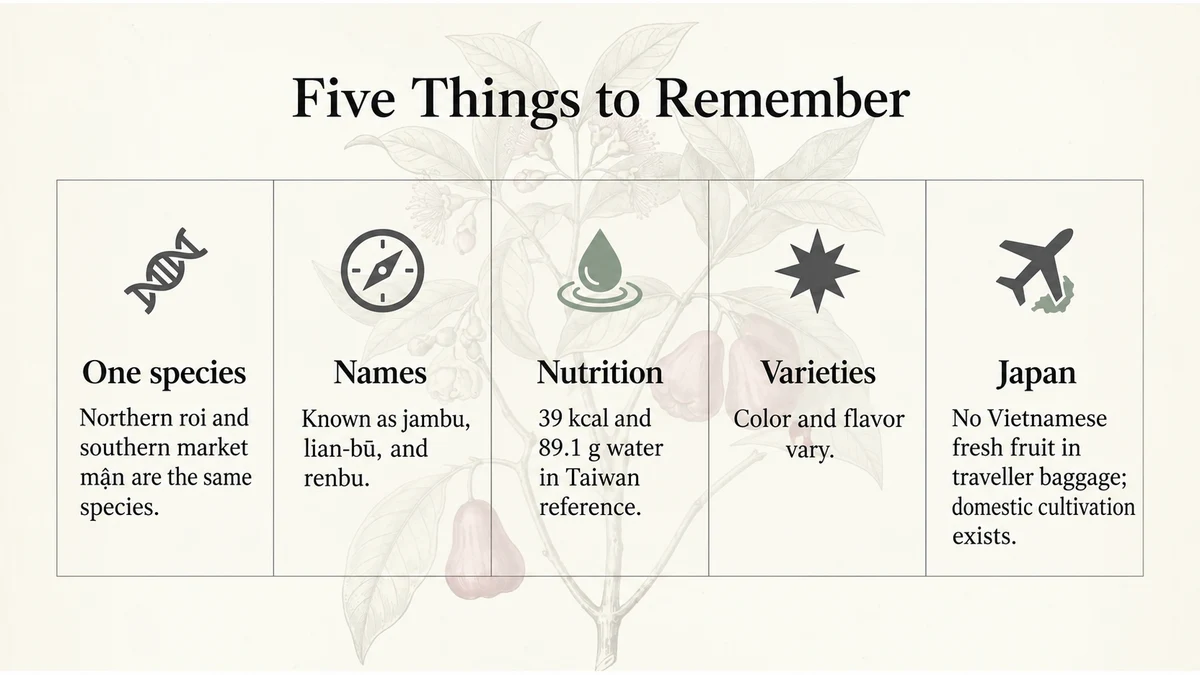
Keep these points in mind.
- Wax apple is an evergreen Syzygium tree in the myrtle family. Southeast Asian origins and the borrowing of jambu into Taiwanese help explain the Japanese name renbu.
- Northern roi and southern market mận, including Mận An Phước, are treated as Syzygium samarangense in Vietnamese standards and research. Names and cultivar appearance differ.
- Northern mận means plum, so the same word can designate an unrelated fruit in a different region.
- Taiwan’s pink-variety reference entry gives 39 kcal, 89.1 g water, 91 mg potassium and 8.8 mg vitamin C per 100 g. The frequently quoted 25 kcal entry describes Syzygium jambos, not wax apple.
- Taiwan, Thailand and Vietnam feature in agricultural accounts; Black Pearl is a familiar Taiwanese premium name. Japan also has domestic cultivation. Fresh Vietnamese wax apple cannot be brought into Japan in travellers’ baggage.
Read Wax Apple History and Stories: Names, Growers and Sea Journeys for its history and cultural background, and How to Eat Wax Apple in Vietnam: Buying, Washing, Cutting and Storage for practical preparation. For other fruit, explore 15 Vietnamese Fruits and Everyday Fruits in Vietnam.
References
- Cần Thơ University research record (2012)
- Vietnamese Wikipedia: Roi hoa trắng and Roi hoa đỏ; Roi hoa đỏ
- Fauna and Flora of Vietnam: Cây mận
- Japanese Wikipedia: Wax apple
- VIETJO: Roi and mận; regional Vietnamese vocabulary; Regional Vietnamese vocabulary
- Taiwan FDA food composition database: average pink wax apple, D18001; open data; Taiwan open food composition data
- Taiwan Miaoli District Agricultural Research and Extension Station: Wax apple
- USDA: Rose-apples, raw (FDC ID 168171; Syzygium jambos)
- ISHS: Wax Apple Production in Selected Tropical Asian Countries
- Mynavi Agriculture: Wax apple cultivation in Okinawa
- Cần Thơ agricultural product listing: Mận An Phước
- Vietnam agricultural newspaper: Mận An Phước on Tân Lộc
- Cần Thơ University journal issue (2012)
- Japan Plant Protection Station: Vietnam traveller restrictions
Japan Plant Protection Station: Vietnam traveller restrictions — Reviewed 11 October 2026. Fresh wax apple from Vietnam cannot be brought into Japan in travellers’ baggage.
